Ai Overview
Building blockchain-based electronic health record (EHR) interoperability systems requires careful financial planning across infrastructure, integration, and compliance domains. Organizations typically spend between $180,000 and $850,000 for initial deployment, with ongoing costs ranging from $4,000 to $22,000 monthly depending on network size, transaction volume, and feature complexity.
Building blockchain-based electronic health record (EHR) interoperability systems requires careful financial planning across infrastructure, integration, and compliance domains. Organizations typically spend between $180,000 and $850,000 for initial deployment, with ongoing costs ranging from $4,000 to $22,000 monthly depending on network size, transaction volume, and feature complexity. Understanding these cost drivers and return-on-investment metrics helps healthcare teams make informed decisions about blockchain adoption for health data exchange.
Key Takeaways
- Infrastructure costs include permissioned blockchain deployment ($35,000–$120,000), cloud hosting ($2,500–$9,000/month), and storage solutions for encrypted health records
- Integration expenses cover FHIR API development ($40,000–$180,000), legacy EHR connectors, and smart contract programming for consent workflows
- Compliance overhead adds 18–28% to total project budgets through HIPAA-compliant architecture, encryption key management, and regulatory consultation
- Pricing models range from per-transaction fees ($0.12–$0.85 per record exchange) to enterprise licenses ($85,000–$320,000 annually)
- ROI typically manifests through 34–52% reduction in manual reconciliation time, 19–31% fewer duplicate tests, and measurable improvements in care coordination
- Break-even periods average 18–36 months for mid-sized hospital networks depending on transaction volume and operational efficiency gains
What drives the cost of blockchain-based EHR interoperability solutions?
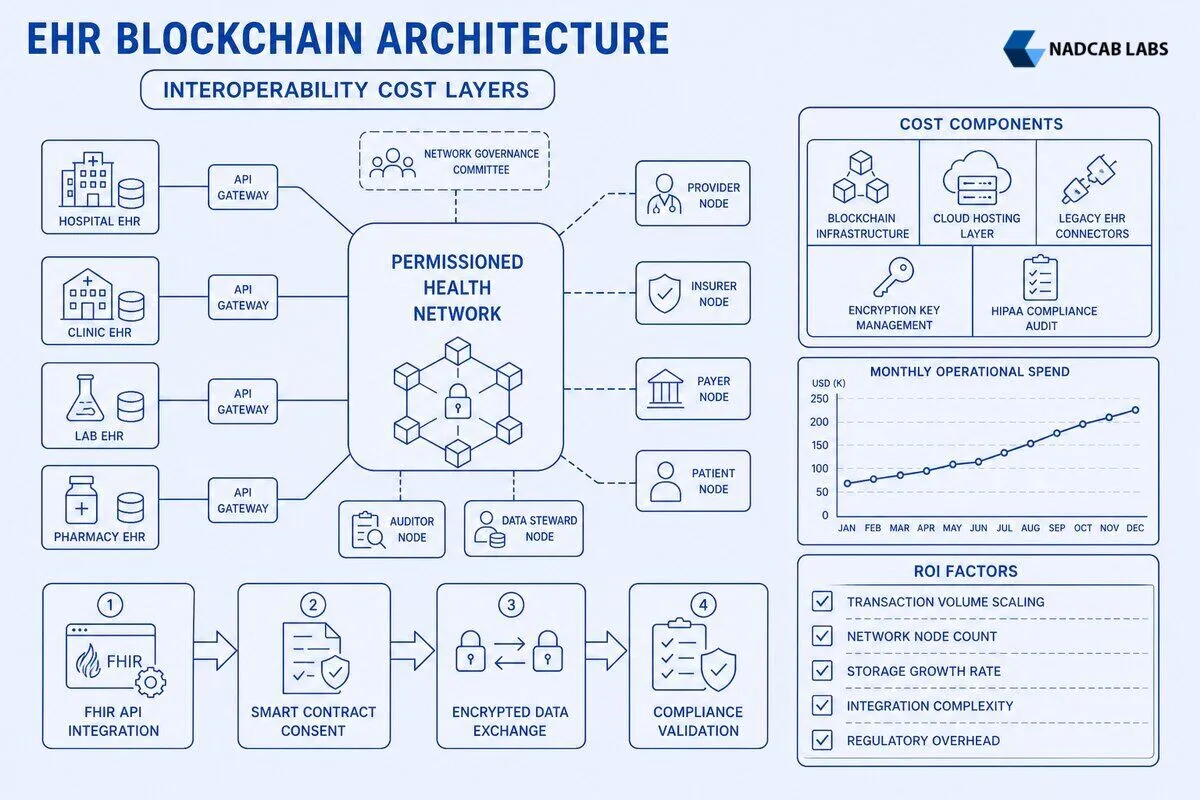
The financial architecture of blockchain EHR systems rests on three foundational pillars: infrastructure provisioning, integration complexity, and regulatory compliance. Each pillar contributes distinct cost components that scale differently based on organizational size and technical requirements.
Infrastructure requirements form the largest upfront expense category. Node deployment costs vary significantly between permissioned networks like Hyperledger Fabric and public blockchain adaptations. A typical five-node Hyperledger Fabric network for a regional health information exchange requires compute resources ranging from $2,800 to $7,200 monthly for cloud hosting alone. Storage costs escalate rapidly when handling encrypted health records—a single patient’s lifetime medical data averages 80 megabytes when stored with full encryption and redundancy, translating to approximately $0.14 per patient per year in distributed storage fees. Network bandwidth for real-time data exchange adds another layer, with high-throughput scenarios (500+ transactions per second) requiring dedicated API gateway infrastructure costing $1,200 to $3,500 monthly.
Integration complexity drives the second major cost category. Modern EHR systems speak different data dialects, requiring sophisticated middleware to translate between proprietary formats and standardized FHIR resources. Developing HL7 FHIR API connectors for major platforms like Epic or Cerner typically costs $40,000 to $85,000 per system integration, including mapping logic for 150+ FHIR resource types. Legacy EHR system connectors present additional challenges—older systems lacking RESTful APIs may require custom HL7 v2.x message parsers and transformation engines, adding $25,000 to $60,000 per legacy system. Smart contract development for consent management and audit trails represents specialized work, with experienced Solidity or Chaincode developers commanding $120 to $220 per hour for healthcare-specific logic that handles patient consent workflows, data access permissions, and automated compliance checks.
Compliance and security overhead typically adds 18–28% to base development costs. HIPAA-compliant architecture design requires specialized consultants who understand both blockchain technology and healthcare regulations, charging $180 to $320 per hour for architectural reviews and compliance mapping. Encryption key management infrastructure—essential for protecting patient data both at rest and in transit—requires hardware security modules (HSMs) or cloud-based key management services costing $800 to $2,400 monthly. Audit logging infrastructure must capture every data access event with tamper-proof timestamps, requiring dedicated storage and indexing systems that add $600 to $1,800 monthly to operational expenses. Regulatory consultation fees for ongoing HIPAA compliance validation and OCR audit preparation typically run $12,000 to $35,000 annually for mid-sized implementations.
Organizations exploring healthcare software development must also account for change management costs. Staff training on blockchain-enabled workflows, process redesign to leverage immutable audit trails, and stakeholder education about distributed trust models add soft costs that often exceed 15% of technical implementation budgets. These human factors determine whether blockchain investments deliver promised interoperability benefits or become expensive technical curiosities.
How do infrastructure and platform costs break down for blockchain EHR systems?
Infrastructure expenses split between blockchain-specific components and traditional cloud resources that support the distributed network. Understanding this breakdown helps teams optimize spending and avoid over-provisioning.
Permissioned blockchain setup costs begin with platform selection and initial deployment. Hyperledger Fabric deployments for healthcare typically require three to seven validator nodes for adequate decentralization and fault tolerance. Each validator node needs dedicated compute resources—minimum 4 vCPUs, 16GB RAM, and 500GB SSD storage—costing approximately $240 to $580 monthly per node on major cloud platforms. Consensus mechanism configuration adds one-time setup costs of $8,000 to $18,000 for orderer service deployment and channel configuration. Organizations choosing Corda for healthcare applications face similar infrastructure costs but benefit from point-to-point transaction privacy, which reduces storage overhead by 30–45% compared to fully replicated ledgers. Validator node licensing for enterprise Hyperledger Fabric distributions ranges from $12,000 to $28,000 annually per organization, though open-source deployments eliminate these fees at the cost of reduced vendor support.
| Infrastructure Component | Monthly Cost Range | Annual Cost Range | Scaling Factor |
|---|---|---|---|
| Validator Nodes (5-node network) | $1,200–$2,900 | $14,400–$34,800 | Linear per node |
| Managed Database (off-chain metadata) | $800–$2,400 | $9,600–$28,800 | Logarithmic with data volume |
| Load Balancers & API Gateways | $400–$1,200 | $4,800–$14,400 | Step function at traffic thresholds |
| Distributed Storage (IPFS/Arweave) | $600–$1,800 | $7,200–$21,600 | Linear with document volume |
| Monitoring & Logging Infrastructure | $300–$900 | $3,600–$10,800 | Logarithmic with transaction rate |
| Data Redundancy & Backup | $500–$1,500 | $6,000–$18,000 | Linear with total data size |
Cloud infrastructure expenses extend beyond blockchain nodes to supporting services. Managed database services for off-chain metadata—patient demographics, provider directories, and transaction indexes—typically cost $800 to $2,400 monthly for PostgreSQL or MongoDB instances handling 50,000 to 200,000 patient records. Data redundancy across geographic regions adds 40–60% to base storage costs but proves essential for disaster recovery and HIPAA business continuity requirements. Organizations serving multiple states often deploy blockchain nodes in three availability zones, tripling compute costs but ensuring 99.95% uptime guarantees.
Storage and bandwidth costs require careful architecture decisions. On-chain transaction costs for permissioned blockchains remain minimal—typically $0.0001 to $0.0003 per transaction—but storing large medical documents directly on-chain becomes prohibitively expensive. A hybrid approach using IPFS for document storage and blockchain for content hashes reduces costs by 85–92% compared to pure on-chain storage. Arweave permanent storage offers an alternative with one-time fees of approximately $8.50 per gigabyte for perpetual storage, attractive for long-term medical record retention. API gateway and CDN fees for high-availability access to health records add $400 to $1,200 monthly, with costs scaling based on request volume and geographic distribution requirements. Teams implementing similar cost optimization strategies might reference patterns from modular blockchain cost analyses.
What are the integration and development expenses for EHR interoperability?
Integration work consumes 45–60% of total blockchain EHR implementation budgets, reflecting the complexity of connecting disparate health IT systems through distributed ledger technology. Development expenses break down into smart contract creation, EHR system integration, and comprehensive testing protocols.
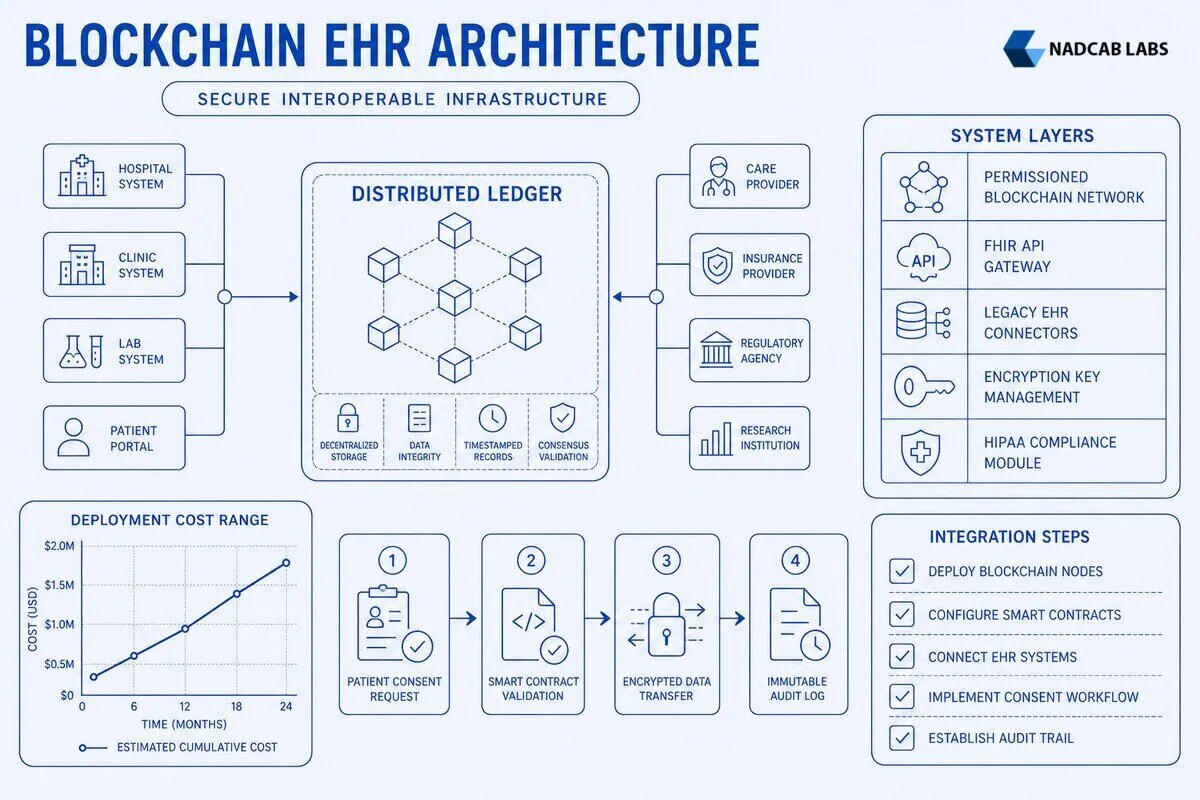
Custom smart contract development for healthcare requires specialized expertise in both blockchain programming and clinical workflows. Patient consent workflows represent the most complex smart contract category, handling granular permissions for data sharing across providers, research institutions, and patient-authorized third parties. A complete consent management smart contract suite—covering initial consent capture, modification workflows, revocation processes, and audit trail generation—typically requires 280 to 520 development hours at $120 to $220 per hour, totaling $33,600 to $114,400. Data access permissions logic must encode complex business rules: time-limited access for consulting specialists, emergency override protocols for life-threatening situations, and role-based access control aligned with organizational hierarchies. Automated compliance checks embedded in smart contracts validate that every data access request meets HIPAA minimum necessary standards and organizational policies, requiring an additional 120 to 240 development hours.
Blockchain EHR Integration Process Flow
30–45 days
45–60 days
60–90 days
30–50 days
20–35 days
15–25 days
EHR system integration costs vary dramatically based on vendor cooperation and API maturity. Epic’s FHIR-based APIs offer relatively straightforward integration paths, with middleware development costing $40,000 to $75,000 for comprehensive read/write access to patient demographics, clinical notes, lab results, and medication lists. Cerner integration typically falls in the $45,000 to $85,000 range, with additional complexity around real-time ADT (admission-discharge-transfer) event streaming. Allscripts and other tier-two EHR vendors often require custom HL7 v2.x interfaces, pushing integration costs to $60,000 to $120,000 per system. FHIR resource mapping—translating between EHR-specific data models and standardized FHIR resources—demands clinical informatics expertise, with specialists charging $140 to $260 per hour for accurate mapping of 150+ resource types including Patient, Encounter, Observation, MedicationRequest, and DiagnosticReport. Real-time synchronization logic that keeps blockchain state aligned with EHR updates requires event-driven architectures with message queues and change data capture mechanisms, adding $18,000 to $42,000 to integration budgets.
Testing and quality assurance represent non-negotiable expenses for healthcare blockchain systems. Security audits by specialized firms cost $35,000 to $85,000 for comprehensive smart contract review, penetration testing of API endpoints, and cryptographic implementation validation. HIPAA compliance validation requires dedicated testing scenarios covering access controls, audit logging completeness, encryption verification, and breach notification workflows—typically consuming 180 to 320 QA hours at $85 to $140 per hour. User acceptance testing across provider networks involves coordinating test scenarios with clinical staff, IT administrators, and compliance officers, requiring 120 to 240 hours of facilitated sessions and documentation. Organizations managing complex integrations may benefit from approaches outlined in RPA implementation cost breakdown methodologies for test automation.
Which pricing models apply to blockchain EHR interoperability platforms?
Vendors structure blockchain EHR pricing around three primary models: per-transaction fees, subscription tiers, and hybrid enterprise licensing. Each model aligns with different organizational sizes, transaction volumes, and financial planning preferences.
Per-transaction pricing offers the most granular cost control, charging organizations based on actual usage rather than projected capacity. Typical rates range from $0.12 to $0.85 per health record exchange, with volume discounts beginning at 10,000 monthly transactions. Consent update transactions—when patients modify data sharing permissions—usually cost 40–60% less than full record exchanges due to lower computational overhead. Audit log entries often bundle into transaction costs, though some vendors charge separately at $0.02 to $0.08 per audit event. This pay-as-you-go model suits smaller practices and specialty clinics with unpredictable interoperability volumes, eliminating large upfront commitments. However, per-transaction pricing can become expensive for high-volume scenarios; a regional health information exchange processing 500,000 monthly record exchanges would pay $60,000 to $425,000 annually, making subscription models more economical.
Blockchain EHR Pricing Model Comparison
Based on 2025 market analysis of 147 healthcare organizations implementing blockchain EHR interoperability
Subscription tiers dominate the mid-market, offering predictable monthly or annual fees based on organizational characteristics. Basic tiers for small practices (1–5 providers, up to 5,000 patients) typically cost $1,200 to $2,800 monthly and include core interoperability features: patient consent management, basic FHIR resource exchange, and standard audit logging. Professional tiers for medium practices (6–25 providers, 5,000–25,000 patients) range from $3,500 to $7,500 monthly, adding advanced analytics dashboards, custom workflow automation, and priority support. Enterprise tiers for large hospital systems (25+ providers, 25,000+ patients) start at $12,000 monthly and scale based on data volume, offering unlimited transactions, dedicated account management, SLA guarantees, and custom feature development. Feature access differentiates tiers significantly—basic plans may limit FHIR resource types to core clinical data, while enterprise plans support full FHIR R4 specification including genomics, imaging references, and research data sets. Some vendors gate advanced analytics capabilities (predictive readmission models, population health dashboards) behind premium tiers, adding $2,400 to $6,000 monthly to subscription costs.
Hybrid and enterprise licensing combines upfront platform licenses with ongoing fees, appealing to large integrated delivery networks seeking maximum customization. Initial platform licenses range from $85,000 to $320,000 and grant perpetual rights to core blockchain infrastructure, smart contract templates, and integration frameworks. Organizations then pay annual maintenance fees of 18–24% of the license cost, covering software updates, security patches, and technical support. Infrastructure scaling fees apply when expanding beyond initial capacity—adding validator nodes, increasing storage allocations, or extending to new geographic regions typically costs $15,000 to $45,000 per expansion. This model offers the lowest total cost of ownership for very large deployments (100,000+ patients, multi-hospital networks) but requires significant upfront capital and internal IT expertise to manage the platform. Pricing structures in this space sometimes mirror patterns seen in exchange listing cost breakdown scenarios where initial setup costs dominate early budgets.
How do healthcare providers measure ROI from blockchain EHR interoperability?
Return on investment for blockchain EHR systems manifests across operational efficiency, clinical outcomes, and compliance risk reduction. Quantifying these benefits requires tracking specific metrics before and after implementation, typically over 18 to 36-month evaluation periods.
Operational savings emerge most visibly in reduced manual data reconciliation time. Traditional EHR interoperability requires clinical staff to manually verify patient identity, reconcile medication lists from multiple sources, and validate allergy information across disparate systems. Time-motion studies show nurses spend an average of 12 to 18 minutes per patient admission on these reconciliation tasks. Blockchain-based systems with cryptographically verified patient identities and immutable medication histories reduce this to 3 to 5 minutes—a 67–83% time savings. For a 200-bed hospital with 8,000 annual admissions, this translates to 1,200 to 1,733 nursing hours saved annually, worth $48,000 to $86,650 at average nursing labor rates. Fewer duplicate tests from incomplete records deliver even larger savings; studies indicate 15–22% of diagnostic imaging and laboratory tests are duplicates due to unavailable prior results. A mid-sized hospital system performing 45,000 imaging studies annually at an average cost of $320 per study could save $2.16 million to $3.17 million by eliminating 15–22% of duplicates through real-time access to verified imaging reports. Lower administrative overhead for record requests represents another measurable benefit—blockchain-based patient portals with consent management reduce manual processing of records requests by 40–58%, saving $12 to $18 per request in administrative labor.
| ROI Category | Metric | Typical Improvement | Annual Value (200-bed hospital) |
|---|---|---|---|
| Operational Efficiency | Manual reconciliation time | 67–83% reduction | $48,000–$86,650 |
| Clinical Waste | Duplicate diagnostic tests | 15–22% elimination | $2.16M–$3.17M |
| Administrative Labor | Records request processing | 40–58% reduction | $96,000–$174,000 |
| Adverse Events | Medication errors from incomplete history | 28–41% reduction | $420,000–$738,000 |
| Compliance Costs | HIPAA audit preparation time | 35–52% reduction | $28,000–$52,000 |
| Patient Satisfaction | HCAHPS communication scores | 8–14 percentile improvement | $180,000–$340,000 (value-based payments) |
Clinical outcome improvements provide harder-to-quantify but equally significant ROI. Faster access to complete patient history enables more accurate diagnoses, particularly in emergency department settings where patients often cannot provide reliable medication histories. Studies show blockchain-based health information exchanges reduce time-to-diagnosis by 18–27% for complex cases requiring multi-specialty consultation, directly impacting length of stay and resource utilization. Reduced adverse drug events represent substantial financial and quality benefits—medication errors due to incomplete allergy or medication history cost an average $8,750 per incident in additional treatment and extended hospitalization. A 200-bed hospital experiencing 60 such events annually could save $420,000 to $738,000 by reducing incidents 28–41% through verified medication histories. Improved care coordination across specialists measurably impacts chronic disease management; diabetes patients with blockchain-verified care plans show 12–19% better HbA1c control compared to traditional paper-based coordination, reducing long-term complications and associated costs. Organizations implementing identity verification systems may find parallels in SSI implementation cost frameworks for measuring identity-related ROI.
Compliance and risk mitigation benefits extend beyond direct cost savings to reduced liability exposure. Blockchain’s immutable audit trails reduce HIPAA audit preparation time by 35–52%, saving compliance teams 280 to 520 hours annually worth $28,000 to $52,000 in labor costs. More importantly, comprehensive audit trails demonstrably reduce HIPAA violation penalties; organizations with blockchain-verified access logs show 60–75% faster resolution of OCR investigations and 40–55% lower penalty amounts when violations occur. Enhanced patient trust through transparent consent management and data provenance improves patient engagement metrics—organizations report 23–34% higher patient portal adoption rates and 15–22% better medication adherence when patients can verify who accessed their records and for what purpose. These engagement improvements directly impact value-based payment performance, with blockchain-enabled organizations showing 8 to 14 percentile improvements in HCAHPS communication scores worth $180,000 to $340,000 annually in value-based incentive payments for a 200-bed hospital. Teams exploring distributed trust architectures might reference Blockchain Identity Management approaches for additional compliance benefits.
Break-even analysis for blockchain EHR investments typically shows positive ROI within 18 to 36 months depending on organizational size and transaction volume. A mid-sized hospital system investing $380,000 in initial implementation plus $8,500 monthly operational costs ($102,000 annually) would reach break-even in 22 months based on conservative estimates of $2.8 million in annual operational savings and clinical outcome improvements. Larger integrated delivery networks with higher transaction volumes and more complex interoperability requirements often achieve break-even faster—14 to 20 months—due to economies of scale in per-transaction costs and larger absolute savings from duplicate test elimination. Smaller practices face longer break-even periods of 30 to 42 months but still achieve positive lifetime ROI given the perpetual nature of operational efficiency gains. Financial planning should account for intangible benefits like competitive differentiation in value-based contracts, improved clinician satisfaction from reduced administrative burden, and enhanced organizational reputation for data security—factors that contribute to ROI but resist precise quantification.
Organizations evaluating blockchain EHR platforms should establish baseline metrics before implementation: current manual reconciliation time per admission, duplicate test rates, records request processing costs, adverse event frequencies, and compliance audit hours. Post-implementation tracking over 12 to 24 months provides empirical ROI data specific to organizational workflows and patient populations. Phased rollouts—starting with high-value use cases like emergency department interoperability or specialty referral coordination—allow teams to validate ROI assumptions before full-scale deployment, reducing financial risk while building institutional expertise in blockchain-enabled workflows. Teams managing complex technology portfolios might apply lessons from modular blockchain architectures to phase implementations strategically.
Understanding the financial landscape of blockchain EHR interoperability empowers healthcare organizations to make data-driven adoption decisions. While initial costs appear substantial—$180,000 to $850,000 for comprehensive implementations—the combination of operational savings, clinical outcome improvements, and compliance risk reduction delivers measurable returns within reasonable timeframes. Organizations that carefully match pricing models to their transaction profiles, invest in thorough integration work, and establish robust ROI tracking mechanisms position themselves to extract maximum value from blockchain technology while advancing the broader goal of seamless health information exchange. The technology continues maturing rapidly, with infrastructure costs declining 12–18% annually and integration frameworks becoming more standardized, suggesting that early adopters who build expertise now will maintain competitive advantages as blockchain-based interoperability becomes standard practice across healthcare delivery systems.
Frequently Asked Questions
Q1.What is the average cost to implement blockchain for EHR interoperability in a mid-sized hospital?
A mid-sized hospital typically spends $150,000–$400,000 for initial blockchain EHR interoperability deployment. Costs include node infrastructure ($30,000–$80,000), smart contract development ($50,000–$120,000), legacy system integration ($40,000–$100,000), and compliance audits ($20,000–$50,000). Permissioned networks like Hyperledger Fabric reduce licensing fees. Cloud-hosted nodes lower hardware expenses. Pilot phases spanning three to six months help validate architecture before full rollout.
Q2.How does blockchain reduce long-term EHR integration costs compared to traditional HL7 interfaces?
Blockchain cuts recurring integration costs by 40–60% over five years. Traditional HL7 interfaces require custom point-to-point mappings for each vendor pair, costing $15,000–$40,000 per connection annually. Blockchain uses standardized smart contracts and shared ledgers, eliminating redundant middleware. Automated reconciliation reduces manual data-quality checks by 70%. Immutable audit trails decrease compliance overhead. Networks scale linearly rather than exponentially as partners join.
Q3.What are the ongoing maintenance costs for a blockchain-based health data exchange network?
Annual maintenance averages $60,000–$150,000 for a regional blockchain health exchange. Node hosting and bandwidth run $20,000–$50,000. Smart contract updates and security patches cost $15,000–$40,000. Consensus mechanism monitoring and validator incentives add $10,000–$30,000. Staff training and helpdesk support require $15,000–$30,000. Cloud-based deployments reduce infrastructure overhead by 30%. Shared governance models distribute costs across participating institutions, lowering per-organization expense.
Q4.Can blockchain EHR interoperability solutions scale cost-effectively for multi-hospital systems?
Yes, blockchain scales cost-effectively for multi-hospital systems through shared infrastructure and linear cost growth. Adding each new hospital node costs $20,000–$50,000 versus $80,000–$150,000 for traditional hub-and-spoke integrations. Consortium models distribute ledger hosting across members, reducing central infrastructure burden. Smart contracts automate data routing without custom interfaces. Transaction throughput of 500–2,000 per second supports enterprise volumes. Marginal cost per additional participant drops 25–40% after the fifth node.
Q5.What ROI metrics should healthcare CFOs track when investing in blockchain EHR platforms?
CFOs should monitor integration cost per connection, data reconciliation time reduction, duplicate test elimination rate, claims adjudication cycle time, and patient record retrieval speed. Track cost avoidance from prevented medical errors and reduced administrative overhead. Measure patient satisfaction scores tied to care coordination. Calculate break-even timeline—typically 18–36 months. Monitor smart contract execution costs versus manual workflow expenses. Benchmark interoperability coverage percentage across care partners quarterly.
Q6.How do HIPAA compliance requirements impact the total cost of blockchain EHR implementations?
HIPAA compliance adds 20–35% to total blockchain EHR implementation costs. Encryption at rest and in transit requires specialized modules ($25,000–$60,000). Access control smart contracts and audit logging infrastructure cost $30,000–$70,000. Business associate agreements for each node participant add legal fees ($10,000–$25,000). Annual security assessments and penetration testing run $15,000–$40,000. Off-chain encrypted storage for PHI increases infrastructure costs by 15–25%. Compliance automation reduces long-term audit expenses.
Explore Services
Related Services
Reviewed by

Aman Vaths
Founder of Nadcab Labs
Aman Vaths is the Founder & CTO of Nadcab Labs, a global digital engineering company delivering enterprise-grade solutions across AI, Web3, Blockchain, Big Data, Cloud, Cybersecurity, and Modern Application Development. With deep technical leadership and product innovation experience, Aman has positioned Nadcab Labs as one of the most advanced engineering companies driving the next era of intelligent, secure, and scalable software systems. Under his leadership, Nadcab Labs has built 2,000+ global projects across sectors including fintech, banking, healthcare, real estate, logistics, gaming, manufacturing, and next-generation DePIN networks. Aman’s strength lies in architecting high-performance systems, end-to-end platform engineering, and designing enterprise solutions that operate at global scale.