Ai Overview
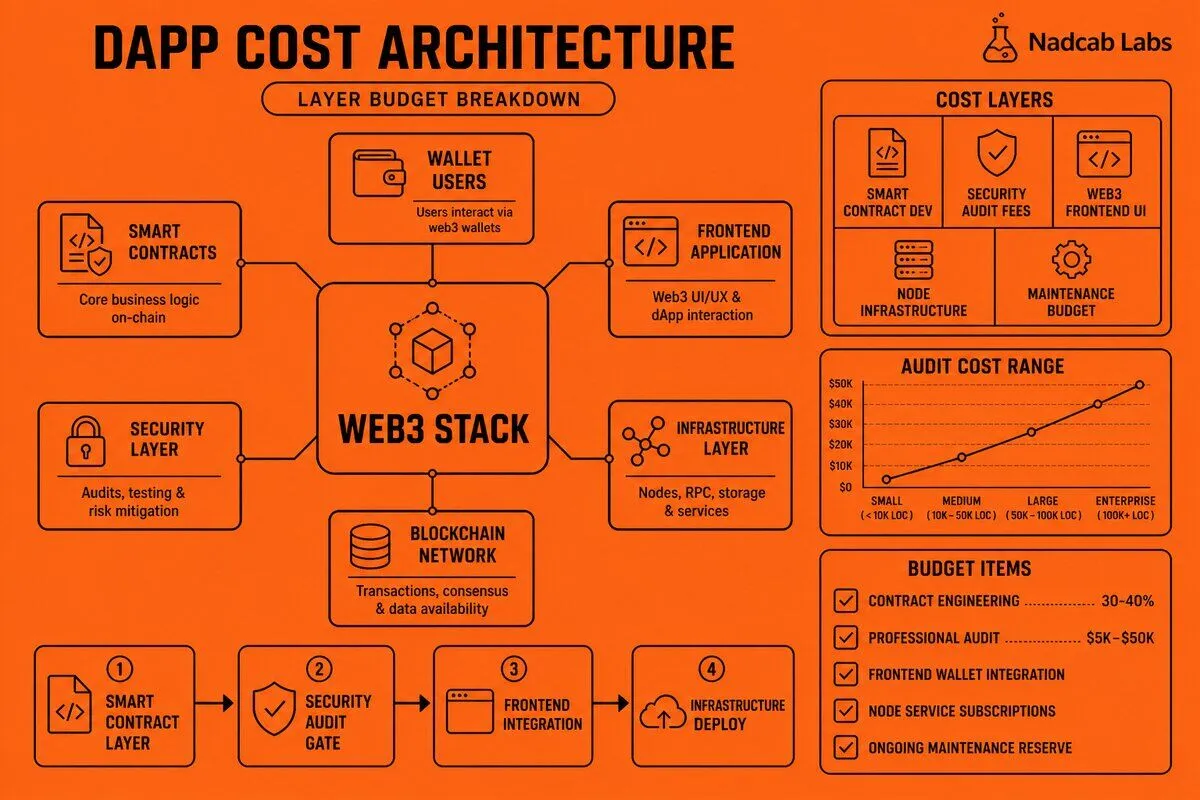
Building a decentralized application is a multi-layered investment that spans smart contract engineering, frontend development, security audits, infrastructure subscriptions, and ongoing maintenance. The smart contract audit cost alone can represent 20–30% of your total budget, but skipping or underfunding this step exposes your protocol to exploits that can drain millions in user funds within hours of launch.
Building a decentralized application is a multi-layered investment that spans smart contract engineering, frontend development, security audits, infrastructure subscriptions, and ongoing maintenance. Unlike traditional web apps, dApps require blockchain-specific expertise, third-party node services, and rigorous security vetting—each adding distinct line items to your budget. Understanding the dApp development cost breakdown by architecture layer helps you allocate resources wisely, avoid budget overruns, and plan realistic timelines from prototype to production launch.
Key Takeaways
- Smart contract development and professional audits typically account for 30–40% of total dApp project cost, with audit fees ranging from $5,000 to over $50,000 per contract.
- Frontend and wallet integration work requires specialized Web3 libraries and UI/UX design, adding $15,000–$40,000 depending on complexity and platform support.
- Node infrastructure subscriptions (Infura, Alchemy, QuickNode) and decentralized storage (IPFS, Arweave) introduce recurring monthly costs from $50 to $500+ for production-grade access.
- Ongoing maintenance—gas budgets for upgrades, monitoring services, bug bounties—can consume 10–20% of initial deployment cost annually, scaling with user growth.
- Total dApp development pricing varies by category: DeFi protocols $80,000–$250,000+, NFT marketplaces $50,000–$150,000, DAO tooling $40,000–$120,000, each with distinct ROI timelines.
- Architectural decisions—on-chain vs off-chain logic, choice of blockchain, gas optimization strategies—directly impact both upfront and runtime expenses.
What drives the cost of building a decentralized application?
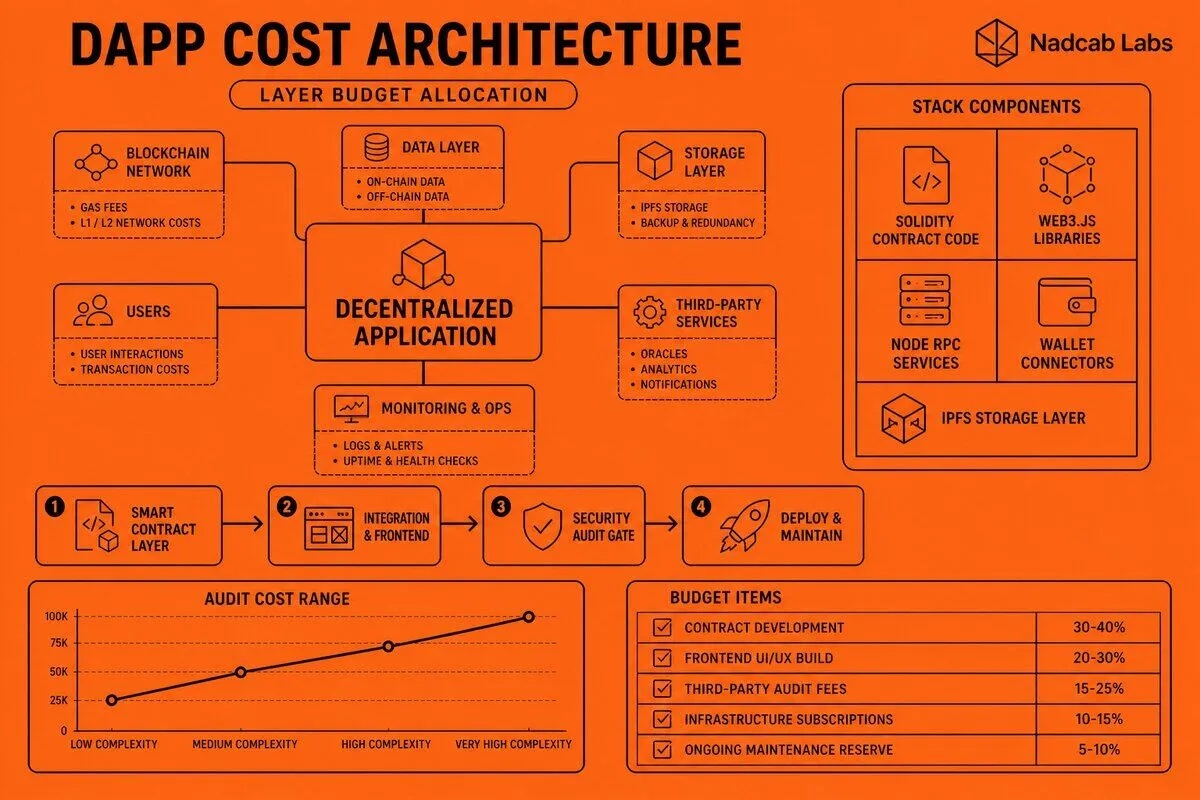
The cost to build a dApp is shaped by three foundational pillars: architecture complexity, team composition, and blockchain network economics. Each pillar introduces specific budget requirements that compound as your application scales in functionality and user base.
Architecture complexity determines how much logic runs on-chain versus off-chain. Simple dApps with a single smart contract for token transfers or basic NFT minting cost significantly less than multi-contract DeFi protocols handling liquidity pools, yield farming, and governance voting. On-chain storage is expensive—storing 1 KB of data on Ethereum mainnet can cost several dollars in gas fees—so projects that rely heavily on IPFS or Arweave for metadata and media files reduce deployment costs but add integration complexity. The number of smart contracts, their interdependencies, and the data storage strategy all scale linearly with development hours and testing cycles. For a detailed explanation of how these layers interact, see our guide on dApp Architecture.
Development team composition is the second major cost driver. A typical dApp project requires blockchain engineers proficient in Solidity or Rust, frontend developers skilled in React and Web3 libraries like ethers.js or wagmi, UI/UX designers who understand wallet connection flows, and DevOps specialists for node infrastructure and CI/CD pipelines. Security auditors—either in-house or third-party firms—add another layer of specialized expertise. Hourly rates for blockchain engineers range from $80 to $200 depending on experience and geography, while senior auditors from reputable firms command premium fees. A lean team of three to five specialists can execute a mid-complexity dApp in three to six months, but larger projects with custom tokenomics or cross-chain bridges may require eight to twelve developers working in parallel.
Network selection and gas optimization profoundly affect both deployment and runtime costs. Deploying a complex smart contract suite on Ethereum mainnet can cost $5,000–$15,000 in gas fees during high-congestion periods, whereas the same deployment on Polygon or Arbitrum might cost under $100. However, Ethereum offers superior liquidity and composability for DeFi applications, making the premium worthwhile for certain use cases. Layer 2 solutions reduce transaction costs by 90–99% but introduce bridge complexity and potential latency. Gas optimization techniques—minimizing storage writes, batching operations, using efficient data structures—can cut runtime costs by 30–50%, but require additional developer time upfront. For projects involving asset tokenization, our Tokenization Cost Factors guide explores how network choice impacts total cost of ownership.
| Cost Driver | Impact Level | Typical Budget Range |
|---|---|---|
| Smart contract development (3–5 contracts) | High | $25,000–$80,000 |
| Professional security audit (per contract) | High | $5,000–$50,000+ |
| Frontend development + wallet integration | Medium-High | $15,000–$40,000 |
| Node infrastructure (annual subscription) | Medium | $600–$6,000+ |
| Mainnet deployment gas fees (Ethereum) | Medium | $3,000–$15,000 |
| UI/UX design and prototyping | Low-Medium | $5,000–$15,000 |
These ranges assume a mid-complexity dApp with standard features. Projects requiring custom cryptographic primitives, zero-knowledge proofs, or novel consensus mechanisms will exceed these benchmarks. Conversely, template-based NFT minting dApps or simple DAO voting tools can fall below the lower bounds. For context on how similar complexity applies to other emerging tech stacks, compare our AR VR development cost breakdown, which shares overlapping team roles and infrastructure patterns.
How much do smart contract development and audits cost in a dApp project?
Smart contract coding and security auditing together form the most critical—and often most expensive—phase of dApp development. The smart contract audit cost alone can represent 20–30% of your total budget, but skipping or underfunding this step exposes your protocol to exploits that can drain millions in user funds within hours of launch.
Smart contract coding rates vary by contract complexity and developer seniority. A simple ERC-20 token contract with basic transfer and allowance functions might require 20–40 hours at $80–$120 per hour, totaling $1,600–$4,800. In contrast, a DeFi lending protocol with collateralization logic, liquidation mechanisms, interest rate models, and governance modules can demand 200–500 hours of senior Solidity engineering at $150–$200 per hour, pushing costs to $30,000–$100,000. Token standards (ERC-721, ERC-1155), staking contracts, and automated market maker (AMM) logic each add layers of state management, event emission, and edge-case handling that multiply development time. Gas optimization—using assembly for critical loops, packing storage variables, minimizing external calls—requires additional expertise and testing cycles but pays dividends in reduced runtime costs for users.
Professional audit pricing depends on contract size (lines of code), integration complexity, and auditor reputation. A boutique security firm might charge $5,000–$15,000 for a straightforward 300-line contract with no external dependencies. Top-tier firms like Trail of Bits, ConsenSys Diligence, or OpenZeppelin charge $20,000–$50,000+ for comprehensive audits of multi-contract systems, including manual code review, automated static analysis, formal verification, and economic attack modeling. Auditors bill per contract or per lines of code, with typical rates of $200–$400 per hour for senior security researchers. A 1,000-line DeFi protocol suite might consume 100–150 audit hours, translating to $20,000–$60,000. Projects handling large TVL (total value locked) or novel cryptographic schemes should budget toward the upper range and consider dual audits from independent firms.
Post-audit remediation and re-audit cycles add 15–25% to the initial audit cost. No first audit returns zero findings—most uncover medium and low-severity issues, and occasionally critical vulnerabilities. Developers must fix these issues, write new unit tests, and submit the updated code for verification. Some audit firms include one round of re-review in their base fee; others charge 30–50% of the original audit cost for each additional pass. Budget extra time for this iteration: a two-week audit might require another week of fixes and a follow-up review, delaying mainnet launch and extending developer salaries. For projects integrating self-sovereign identity or privacy features, cross-reference our SSI implementation cost guide, which details similar audit and compliance cycles.
Smart Contract Development & Audit Process Flow
Define tokenomics, logic, access control
Write contracts, unit tests, gas optimization
Hardhat/Foundry test suites, coverage >90%
Submit to security firm, 2–4 week review
Fix findings, re-test, re-audit verification
Publish audit report, deploy, monitor
This six-step flow illustrates why smart contract work consumes 30–40% of total dApp budgets. Each phase requires specialized skills, and rushing any step—especially audit and remediation—introduces existential risk. For projects building on modular blockchain architectures, see our modular blockchain cost analysis, which explores how separating execution and data availability layers affects contract deployment strategies and costs.
What are the frontend and backend infrastructure costs for dApps?
While smart contracts handle core business logic, the user-facing frontend and supporting backend infrastructure determine whether your dApp is usable, performant, and reliable at scale. dApp infrastructure pricing includes both one-time development costs and recurring subscriptions that grow with traffic.
Frontend framework and wallet integration typically requires a modern JavaScript stack—React or Next.js—paired with Web3 libraries such as ethers.js, wagmi, or web3.js. Developers must implement wallet connection flows (MetaMask, WalletConnect, Coinbase Wallet), transaction signing UIs, error handling for rejected transactions, and real-time state updates when blockchain events occur. A polished frontend for a mid-complexity dApp demands 150–300 developer hours at $60–$120 per hour, totaling $9,000–$36,000. UI/UX design adds another $5,000–$15,000 for wireframes, prototypes, responsive layouts, and accessibility compliance. Mobile-responsive design and progressive web app (PWA) features increase costs by 20–30%. Projects targeting both desktop and native mobile apps (iOS/Android via React Native or Flutter) can double frontend budgets. Cross-chain dApps that support multiple wallets and networks require additional abstraction layers and testing matrices, pushing costs higher.
Node infrastructure subscriptions are essential for production dApps. Running your own Ethereum or Polygon node requires dedicated servers, DevOps expertise, and 24/7 monitoring—typically $500–$2,000 per month in infrastructure and labor. Most teams instead use managed RPC providers like Infura, Alchemy, or QuickNode, which offer tiered pricing based on request volume and features. Infura’s free tier supports 100,000 requests per day, suitable for early prototypes; production dApps with thousands of daily users need paid plans starting at $50–$200 per month for 10–50 million requests. High-traffic DeFi protocols or NFT marketplaces processing millions of transactions monthly can incur $500–$2,000+ in RPC costs. Premium tiers unlock dedicated nodes, archive data access, enhanced rate limits, and priority support—critical for applications requiring historical state queries or sub-second response times. For real-world examples of infrastructure planning in asset tokenization, explore our Layer 2 Architecture case study.
IPFS and decentralized storage costs depend on data volume and retrieval frequency. Pinata offers 1 GB of free IPFS pinning; paid plans start at $20 per month for 100 GB and scale to $1,000+ for terabytes of data. Arweave charges one-time fees for permanent storage—currently around $7–$10 per GB—making it cost-effective for static NFT metadata and images that never change. Filecoin provides decentralized storage with pricing determined by market dynamics, typically $0.50–$2 per GB per year with retrieval fees. Projects storing large media libraries (video NFTs, high-resolution art) or user-generated content must budget $100–$1,000+ monthly for storage and bandwidth. Hybrid architectures—storing metadata on IPFS and large files on Arweave—optimize cost and performance but add integration complexity.
Monthly Infrastructure Cost Comparison
These monthly costs compound over the dApp’s lifetime. A three-year operational budget for infrastructure alone can reach $10,000–$50,000 depending on traffic growth and feature expansion. Teams building multi-chain dApps must multiply these costs by the number of supported networks, as each chain requires separate RPC endpoints and indexing services. For blockchain-based business models like MLM platforms, our Blockchain MLM Platform guide details how infrastructure scales with user acquisition and transaction volume.
How do ongoing maintenance and operational expenses affect total dApp cost?
Launching a dApp is just the beginning—dApp maintenance cost accrues monthly and annually as you upgrade contracts, monitor security, respond to incidents, and scale infrastructure. Underestimating these recurring expenses is a common pitfall that strains budgets and forces teams to cut corners on security or user experience.
Gas fee budgets for contract upgrades and admin functions must be reserved for the dApp’s lifecycle. Proxy-based upgradeable contracts allow you to patch bugs or add features without redeploying, but each upgrade transaction costs gas. On Ethereum mainnet, upgrading a complex contract suite can consume $500–$3,000 in gas during peak congestion. Projects that plan quarterly upgrades should allocate 10–20% of initial deployment cost annually for gas reserves. Even non-upgradeable contracts require admin functions—pausing in emergencies, updating oracle addresses, adjusting fee parameters—that incur gas costs. DeFi protocols with governance systems must also budget for on-chain voting, which can cost $50–$200 per proposal execution depending on the number of state changes.
Monitoring, indexing, and subgraph services ensure your dApp surfaces accurate, real-time data to users. The Graph protocol offers hosted subgraphs for free during beta but charges query fees on the decentralized network—typically $0.0001–$0.001 per query. A dApp serving 100,000 queries daily incurs $10–$100 per day, or $300–$3,000 monthly. Self-hosted indexers (using Graph Node or custom PostgreSQL pipelines) eliminate query fees but require dedicated servers and DevOps labor, costing $200–$800 per month. Real-time monitoring tools like Tenderly, Defender, or Forta detect anomalies, failed transactions, and potential exploits. Tenderly’s paid plans start at $100 per month for advanced alerting and simulation features; Forta network subscriptions range from $50–$500 monthly depending on bot complexity and alert volume. These tools are non-negotiable for DeFi protocols handling user funds—missing a critical bug or oracle manipulation can cost millions in losses.
Security monitoring and incident response includes bug bounty programs, penetration testing, and emergency upgrade reserves. Platforms like Immunefi or HackerOne host bug bounty programs with rewards ranging from $500 for low-severity issues to $100,000+ for critical vulnerabilities. A modest bug bounty budget of $10,000–$50,000 per year incentivizes white-hat researchers to report issues before malicious actors exploit them. Annual penetration tests by third-party security firms cost $5,000–$20,000 and uncover integration flaws or frontend attack vectors missed in initial audits. Emergency response—deploying a hotfix, coordinating with exchanges to halt trading, communicating with users—requires on-call developer time and potentially legal counsel, adding unpredictable costs. Projects should maintain a reserve fund equal to 10–15% of TVL for incident response and user compensation in worst-case scenarios.
| Maintenance Category | Frequency | Annual Cost Range |
|---|---|---|
| Smart contract upgrades and gas reserves | Quarterly | $2,000–$12,000 |
| Subgraph hosting or query fees | Monthly | $3,600–$36,000 |
| Monitoring and alerting services | Monthly | $1,200–$6,000 |
| Bug bounty program | Ongoing | $10,000–$50,000 |
| Annual penetration test | Yearly | $5,000–$20,000 |
| DevOps and infrastructure scaling | Monthly | $6,000–$24,000 |
Summing these categories, a mid-complexity dApp can expect $27,800–$148,000 in annual maintenance costs. High-traffic DeFi protocols or NFT marketplaces with millions in TVL will trend toward the upper range, while simpler governance dApps or niche tools fall below. These figures do not include salaries for core team members (community managers, business development, legal counsel), which add another $100,000–$500,000+ annually depending on team size and location. For comprehensive budget planning across Web3 projects, review our dApp Architecture guide, which maps maintenance requirements to architectural choices.
What is the cost breakdown by dApp category and expected ROI timeline?
Different dApp categories—DeFi protocols, NFT marketplaces, DAO tooling—carry distinct development costs and revenue models, shaping their blockchain development budget and return-on-investment timelines. Understanding these patterns helps you set realistic financial expectations and choose the right category for your strategic goals.
DeFi protocols are the most expensive dApp category, with total costs ranging from $80,000 to $250,000 or more. A basic lending protocol with collateralization, liquidation, and interest rate logic requires 3–5 smart contracts, extensive testing, dual security audits, and sophisticated frontend dashboards showing APY, collateral ratios, and liquidation risk. Gas optimization is critical—inefficient code can make the protocol unusable during high network congestion. DeFi projects also need oracles (Chainlink, Band Protocol) for price feeds, adding integration complexity and recurring subscription costs. Revenue comes from protocol fees (0.3% swap fees for AMMs, 5–15% of interest for lending platforms), so ROI depends on TVL growth. A protocol reaching $10 million TVL with 0.5% annual fees generates $50,000 in revenue; achieving 12–18 month payback requires aggressive liquidity mining incentives and community building. Successful DeFi dApps can scale to hundreds of millions in TVL, but competition is fierce and regulatory scrutiny is increasing.
NFT marketplaces cost $50,000–$150,000 to build, covering smart contracts for minting (ERC-721 or ERC-1155), auction/sale logic, royalty distribution, and a React-based storefront with wallet integration and IPFS metadata display. Marketplaces generate revenue from transaction fees (2–5% per sale) and optional listing fees. A marketplace processing $1 million in monthly sales at 2.5% fees earns $25,000 monthly, enabling 6–12 month ROI if user acquisition costs are controlled. The frontend is more complex than typical dApps—users expect advanced filtering, real-time bid updates, collection analytics, and social features. Backend indexing (via The Graph or custom PostgreSQL) is essential for fast search and discovery. Competition from OpenSea, Blur, and Magic Eden means new marketplaces must offer niche differentiation—curated collections, lower fees, or integration with gaming ecosystems—to capture market share.
DAO tooling and governance dApps range from $40,000 to $120,000, depending on feature richness. A basic DAO with token-weighted voting, proposal submission, and treasury management requires 2–3 smart contracts and a straightforward UI. More advanced tools add delegation, quadratic voting, multi-sig execution, and off-chain voting with on-chain settlement (Snapshot + Safe). Revenue models are less direct—some DAO platforms charge SaaS fees ($100–$500 per month per DAO), others take a percentage of managed treasury, and some rely on token appreciation or grants. ROI timelines are longer (18–24 months) because DAOs grow slowly and value realization is tied to governance participation and treasury growth rather than transaction volume. However, DAO tooling has lower maintenance costs than DeFi—no liquidation bots, fewer oracle dependencies—and can serve as a foundational layer for broader Web3 ecosystems.
dApp Category Cost & ROI Comparison
These estimates assume professional development teams, comprehensive audits, and production-grade infrastructure. Cutting corners—skipping audits, using template contracts, minimal UI polish—can halve upfront costs but dramatically increases risk of exploits, poor user retention, and reputational damage. For teams evaluating whether to build in-house or partner with specialists, Nadcab Labs’ dApp Development services offer end-to-end solutions with transparent pricing and proven delivery timelines. Our expertise spans all major categories, from DeFi and NFTs to DAO tooling and cross-chain bridges, ensuring your budget aligns with realistic scope and quality standards.
ROI timelines also depend on market conditions, token incentives, and user acquisition strategies. Bull markets accelerate DeFi TVL growth and NFT trading volume, compressing payback periods by 30–50%. Conversely, bear markets extend timelines and may require additional funding rounds to sustain operations until revenue scales. Projects should model best-case, base-case, and worst-case scenarios, reserving 20–30% contingency budget for market downturns or unexpected technical challenges. For insights into how Web3 development pricing trends are evolving, explore our broader analysis of dApp Architecture, which examines how modular design and layer-2 adoption are reshaping cost structures industry-wide.
Final Thoughts
A thorough dApp development cost breakdown reveals that building a production-ready decentralized application requires strategic budget allocation across smart contract engineering, security audits, frontend development, infrastructure subscriptions, and ongoing maintenance. Smart contracts and audits alone consume 30–40% of total cost, while frontend and node infrastructure add another 25–35%. Recurring expenses—gas reserves, monitoring, bug bounties—compound annually, often reaching 10–20% of initial deployment cost. By understanding these layers and planning for category-specific ROI timelines—12–18 months for DeFi, 6–12 months for NFT marketplaces, 18–24 months for DAO tooling—you can set realistic budgets, avoid common pitfalls, and allocate resources to maximize both security and user experience. Whether you are launching a yield aggregator, an NFT platform, or a governance tool, transparent cost planning ensures your dApp reaches mainnet on time, on budget, and ready to scale.
Frequently Asked Questions
Q1.How much does it cost to build a dApp?
Building a dApp typically costs $50,000 to $500,000 depending on complexity. A basic single-chain application with standard smart contracts runs $50,000–$150,000. Multi-chain DeFi platforms with custom tokenomics, oracle integration, and advanced governance can exceed $300,000. Architecture layers—frontend ($15,000–$40,000), smart contracts ($25,000–$100,000), backend infrastructure ($10,000–$30,000), and security audits ($20,000–$80,000)—drive total spend. Team composition and development timeline significantly impact final budget.
Q2.What is the average cost of a smart contract audit?
Professional smart contract audits range from $5,000 to $80,000 based on code complexity and scope. Simple token contracts cost $5,000–$15,000, while DeFi protocols with multiple interdependent contracts run $30,000–$80,000. Top-tier firms like CertiK, OpenZeppelin, and Trail of Bits charge premium rates but provide comprehensive reports. Budget includes initial audit, remediation review, and final certification. Complex protocols often require multiple audits from different firms for institutional-grade security validation.
Q3.How much do node infrastructure providers charge for dApp hosting?
Node infrastructure costs vary by provider and usage volume. Alchemy and Infura offer free tiers up to 300 million compute units monthly, then $49–$499/month for standard plans. Enterprise dApps processing 10+ billion requests monthly pay $1,000–$5,000. QuickNode charges $9–$299/month for dedicated nodes. Self-hosted archive nodes cost $500–$2,000 monthly in server expenses. High-frequency DeFi applications often spend $3,000–$10,000 monthly on multi-region redundant infrastructure for reliability.
Q4.What are the hidden costs in dApp development projects?
Hidden costs include gas optimization iterations ($8,000–$25,000), emergency response retainers ($5,000–$15,000 monthly), legal compliance reviews ($15,000–$50,000), multi-chain deployment fees ($3,000–$10,000 per chain), oracle subscription costs ($500–$5,000 monthly), and community management ($4,000–$12,000 monthly). Post-launch monitoring tools, bug bounty programs, and governance infrastructure add 20–35% to initial budgets. Treasury management, liquidity provisioning, and token listing fees often exceed $50,000 for DeFi projects.
Q5.How long does it take to break even on a DeFi dApp investment?
DeFi dApps typically break even in 12–36 months depending on revenue model and market conditions. Projects with transaction fees (0.05–0.3% per swap) generating $500,000+ monthly volume can recover $200,000 development costs within 18–24 months. Lending protocols require $10+ million TVL for profitability. Yield aggregators with performance fees break even faster at 12–18 months. Market volatility, competitive pressure, and user acquisition costs significantly impact timeline. Failed projects never recover investment.
Q6.Do dApp maintenance costs increase over time as user base grows?
Yes, maintenance costs scale with user growth but not linearly. Infrastructure expenses increase 40–60% annually as transaction volume rises. A dApp serving 1,000 daily users costs $3,000–$6,000 monthly; scaling to 50,000 users raises costs to $15,000–$30,000. Smart contract upgrades, security monitoring, customer support, and compliance requirements drive increases. However, per-user costs decline due to economies of scale. Automated monitoring and efficient architecture design help control growth-related expenses.
Explore Services
Related Services
Reviewed by

Aman Vaths
Founder of Nadcab Labs
Aman Vaths is the Founder & CTO of Nadcab Labs, a global digital engineering company delivering enterprise-grade solutions across AI, Web3, Blockchain, Big Data, Cloud, Cybersecurity, and Modern Application Development. With deep technical leadership and product innovation experience, Aman has positioned Nadcab Labs as one of the most advanced engineering companies driving the next era of intelligent, secure, and scalable software systems. Under his leadership, Nadcab Labs has built 2,000+ global projects across sectors including fintech, banking, healthcare, real estate, logistics, gaming, manufacturing, and next-generation DePIN networks. Aman’s strength lies in architecting high-performance systems, end-to-end platform engineering, and designing enterprise solutions that operate at global scale.