Ai Overview
Entertainment app security architecture is a layered framework that protects user data, premium content, and payment information through authentication, encryption, DRM integration, and compliance controls. It combines API gateway defenses, threat modeling, and zero-trust principles to defend against unauthorized access, piracy, and regulatory penalties. A well-designed security architecture balances user experience with robust protection across mobile clients, backend services, and content delivery networks.
Entertainment app security architecture is a layered framework that protects user data, premium content, and payment information through authentication, encryption, DRM integration, and compliance controls. It combines API gateway defenses, threat modeling, and zero-trust principles to defend against unauthorized access, piracy, and regulatory penalties. A well-designed security architecture balances user experience with robust protection across mobile clients, backend services, and content delivery networks.
Key Takeaways
- Security architecture for entertainment apps requires authentication layers, API gateway controls, and end-to-end encryption for user data and payment flows.
- DRM integration with Widevine, FairPlay, and PlayReady protects premium content through encrypted streaming protocols and license server architectures.
- Threat modeling using STRIDE and attack surface analysis identifies spoofing, tampering, and denial-of-service risks across mobile and backend systems.
- Access control mechanisms enforce subscription tiers, geo-fencing, and device limits through JWT tokens, fingerprinting, and zero-trust micro-segmentation.
- GDPR, COPPA, and PCI-DSS compliance frameworks shape data consent workflows, child protection safeguards, and secure payment tokenization.
- API gateway security with rate limiting, token validation, and anomaly detection prevents credential stuffing and brute-force attacks on media platforms.
What are the core security layers in entertainment app architecture?
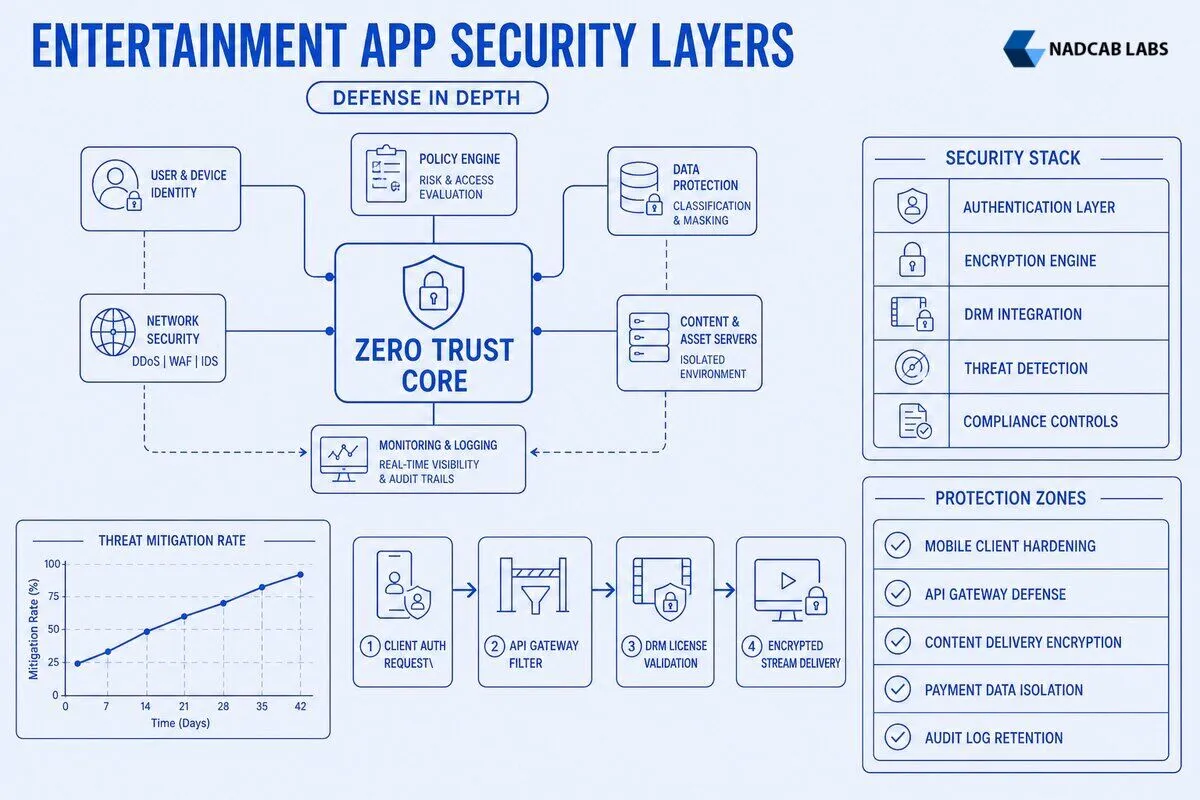
The foundation of entertainment app security architecture rests on three interconnected layers: authentication and authorization, API gateway protection, and data encryption. Each layer addresses distinct threat vectors while reinforcing the overall defense posture. Authentication verifies user identity through OAuth 2.0 or OpenID Connect flows, issuing short-lived access tokens and long-lived refresh tokens. Authorization enforces role-based access control (RBAC) to segment free users, premium subscribers, and administrative accounts. Multi-factor authentication (MFA) adds a second verification step—typically SMS codes or authenticator apps—to block credential theft.
The API gateway acts as a security checkpoint for all client requests. It validates bearer tokens, enforces rate limits to prevent brute-force attacks, and logs suspicious patterns for anomaly detection. Modern gateways integrate Web Application Firewall (WAF) rules to filter SQL injection, cross-site scripting (XSS), and command injection payloads. Rate limiting caps requests per IP address or user account—for example, 100 requests per minute for authenticated users and 20 for unauthenticated traffic. Token validation checks signature integrity, expiration timestamps, and issuer claims before forwarding requests to backend microservices. This centralized control point simplifies security policy enforcement across distributed services.
Data encryption protects sensitive information at rest and in transit. User profiles, viewing history, and payment details reside in encrypted databases using AES-256 encryption with hardware security modules (HSMs) managing keys. Transport Layer Security (TLS 1.3) encrypts all network traffic between clients and servers, preventing man-in-the-middle interception. Payment card data follows PCI-DSS tokenization standards, replacing card numbers with non-reversible tokens stored in secure vaults. This layered encryption ensures that even if an attacker breaches one component, stolen data remains unreadable without decryption keys.
Session management ties these layers together. After successful login, the server issues a JWT containing user ID, subscription tier, and expiration timestamp. The client includes this token in every API request header. Backend services validate the token’s signature using a shared secret or public key, then authorize the requested action based on the user’s role. Refresh tokens enable seamless re-authentication without repeated logins, while automatic token rotation limits the window for replay attacks. This architecture balances security with user convenience, a critical trade-off in consumer-facing entertainment app development.
Logging and monitoring complete the core security layers. Centralized log aggregation collects authentication events, API gateway traffic, and database access patterns. Security Information and Event Management (SIEM) systems correlate logs to detect anomalies—such as a user logging in from two continents within minutes or repeated failed login attempts. Real-time alerts trigger incident response workflows, enabling teams to block compromised accounts or patch vulnerabilities before widespread exploitation. Audit trails satisfy compliance requirements by recording who accessed what data and when, a mandatory control for GDPR and CCPA regulations.
How do you implement secure content delivery and DRM integration?
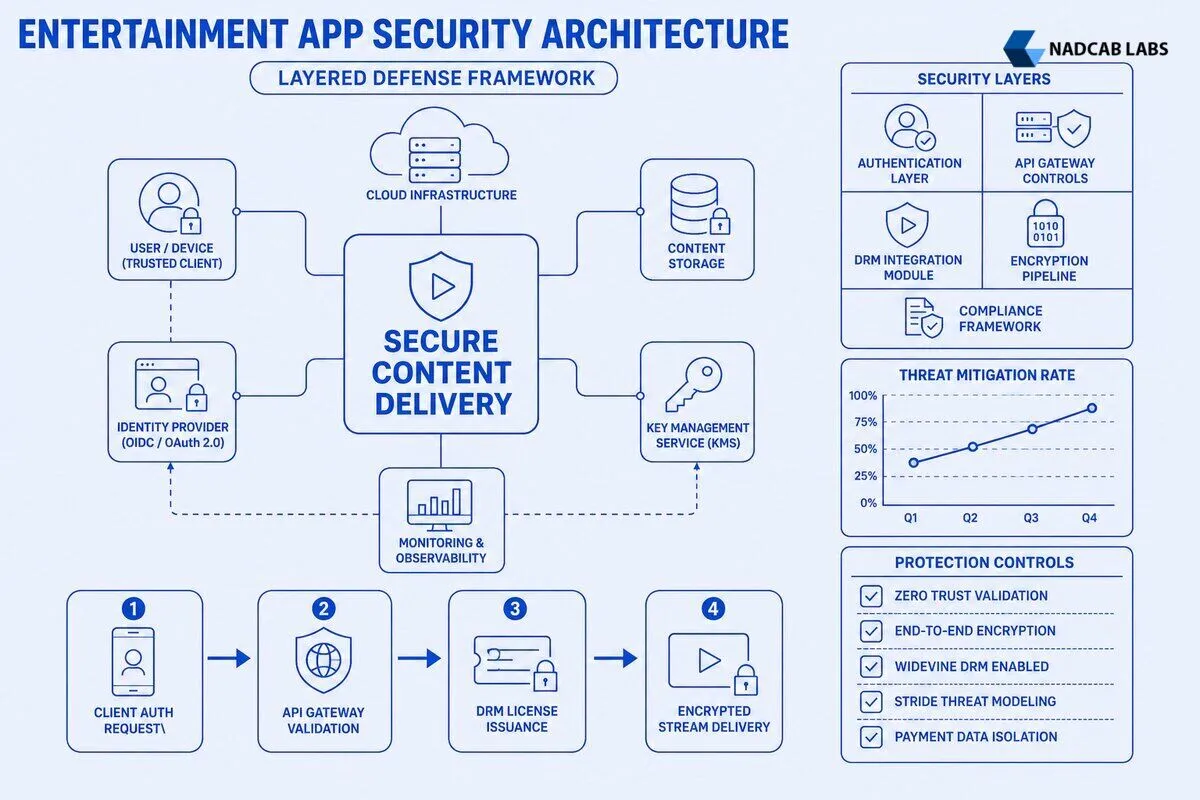
Secure content delivery architecture for entertainment apps combines encrypted streaming protocols, DRM key management, and CDN security configurations. The process begins when a user requests premium content: the client authenticates with the backend, receives a time-limited playback token, and initiates a streaming session. The backend generates a unique encryption key for that session and registers it with a license server. The client retrieves the encrypted media stream from a CDN, then requests the decryption key from the license server. Only after validating the playback token does the license server release the key, enabling decryption in the client’s secure hardware enclave.
Encrypted streaming protocols prevent unauthorized interception of media streams. HTTP Live Streaming with AES-128 encryption (HLS-AES) segments video into small chunks, encrypting each with a rotating key. The client fetches keys from a URL specified in the playlist manifest, which the server protects with token authentication. MPEG-DASH with Common Encryption (CENC) offers broader DRM compatibility, supporting Widevine (Android, Chrome), FairPlay (iOS, Safari), and PlayReady (Windows, Xbox) within a single adaptive bitrate stream. Each DRM system uses hardware-backed key storage—Trusted Execution Environments on mobile devices and Secure Media Path on desktops—to prevent key extraction by malicious software.
Process Flow: DRM-Protected Content Delivery
Client sends credentials to backend API
Backend returns JWT with content entitlements
Client contacts DRM license server with token
License server validates token, returns decryption key
Client decrypts stream in secure hardware enclave
DRM key management architecture separates content encryption keys (CEKs) from key encryption keys (KEKs). CEKs encrypt individual media files and rotate frequently—often per session or per asset. KEKs encrypt the CEKs and reside in HSMs with strict access controls. This hierarchy limits the blast radius of a key compromise: if an attacker extracts a single CEK, they can only decrypt one piece of content, not the entire library. License servers enforce usage policies embedded in the DRM license, such as maximum playback duration, offline download limits, and HDCP output protection requirements. These policies prevent screen recording and unauthorized redistribution.
CDN security configurations protect content from direct URL access and hotlinking. Signed URL tokens append a cryptographic signature and expiration timestamp to each media URL. The CDN validates the signature using a shared secret before serving the content. If the token expires or the signature fails verification, the CDN returns a 403 Forbidden error. Geo-blocking rules restrict content delivery to specific countries based on licensing agreements. IP allowlists limit access to known CDN edge nodes, preventing attackers from bypassing the application layer and requesting content directly. These controls complement DRM by securing the delivery pipeline itself, not just the media payload.
Watermarking adds a forensic layer to DRM protection. Invisible digital watermarks embed unique identifiers into each stream, linking playback sessions to specific user accounts. If pirated content appears online, watermark extraction reveals the source account, enabling account termination and legal action. Visible watermarks—such as session IDs overlaid on the video—deter screen recording by making pirated copies traceable. Combined with iOS App Development security best practices and Android Application Development hardening techniques, these measures create multiple barriers against content theft.
| DRM System | Supported Platforms | Security Level | License Server Latency |
|---|---|---|---|
| Widevine L1 | Android, Chrome OS, Chromecast | Hardware-backed TEE | 120–180 ms |
| FairPlay Streaming | iOS, macOS, tvOS, Safari | Secure Enclave | 100–150 ms |
| PlayReady | Windows, Xbox, Edge browser | Software or hardware TEE | 140–200 ms |
| AES-128 (HLS) | All platforms with HLS support | Software-only | 50–80 ms |
Which threat modeling techniques protect entertainment platforms from attacks?
Threat modeling for entertainment app security architecture begins with the STRIDE framework, which categorizes threats into six types: Spoofing, Tampering, Repudiation, Information Disclosure, Denial of Service, and Elevation of Privilege. Spoofing attacks impersonate legitimate users or services—for example, an attacker using stolen credentials to access premium content. Mitigations include MFA, device fingerprinting, and behavioral analytics that flag logins from unusual locations. Tampering targets data integrity, such as modifying API requests to upgrade a free account to premium status. Input validation, request signing, and server-side authorization checks prevent these manipulations.
Repudiation threats involve users denying actions they performed, such as claiming they never purchased a subscription. Comprehensive audit logs with cryptographic timestamps provide non-repudiable evidence of transactions. Information disclosure risks include database breaches exposing user profiles or payment details. Encryption at rest, access control lists, and least-privilege service accounts limit exposure. Denial-of-service attacks overwhelm servers with traffic, degrading performance for legitimate users. Rate limiting, auto-scaling infrastructure, and DDoS mitigation services absorb attack traffic. Elevation-of-privilege exploits grant attackers administrative access—prevented by principle of least privilege, regular patching, and security code reviews.
Attack surface analysis maps all entry points where adversaries can interact with the system. Mobile clients present risks through reverse engineering, code injection, and insecure local storage. Obfuscation tools scramble bytecode, making reverse engineering harder. Root and jailbreak detection blocks app execution on compromised devices. Certificate pinning prevents man-in-the-middle attacks by validating server certificates against a hardcoded public key. Backend APIs face threats from credential stuffing, SQL injection, and insecure deserialization. Web Application Firewalls filter malicious payloads, while parameterized queries prevent SQL injection. Third-party integrations—such as payment gateways, analytics SDKs, and social login providers—introduce supply chain risks. Vendor security assessments, API key rotation, and scoped permissions limit third-party access to sensitive data.
Penetration testing simulates real-world attacks to identify vulnerabilities before adversaries exploit them. External penetration tests probe public-facing APIs, web portals, and mobile apps from an attacker’s perspective. Internal tests assume a compromised employee account, evaluating lateral movement and privilege escalation paths. Automated vulnerability scanners run weekly, flagging outdated libraries, misconfigurations, and known CVEs. Manual testing by security engineers uncovers logic flaws that scanners miss—such as business logic bypasses or race conditions in payment processing. Bug bounty programs crowdsource security research, rewarding external researchers who responsibly disclose vulnerabilities. This continuous validation loop ensures that security controls evolve alongside new threats.
Threat intelligence feeds contextualize risks by tracking active exploits, malware campaigns, and attacker tactics. Integration with SIEM systems enables automated correlation: if a threat feed reports a new credential-stuffing botnet, the SIEM flags login attempts matching the botnet’s IP ranges. Incident response playbooks define procedures for common scenarios—account takeover, data breach, DDoS attack—specifying roles, communication channels, and escalation thresholds. Tabletop exercises simulate incidents, training teams to execute playbooks under pressure. Post-incident reviews identify gaps in detection, response, or recovery, feeding improvements back into the threat model. This iterative process aligns security architecture with the evolving threat landscape, a principle shared with trading bot security architecture in high-risk environments.
Attack Surface Coverage by Component
What access control mechanisms secure premium content and user data?
Access control for entertainment apps enforces subscription tiers, content entitlements, and device limits through a combination of JWT-based session management and policy engines. When a user subscribes to a premium tier, the backend updates their entitlements in a centralized authorization service. Each API request includes a JWT containing the user’s subscription level, allowed content categories, and device identifiers. Backend microservices decode the JWT and query the policy engine to determine whether the requested action—such as streaming a 4K movie or downloading content for offline viewing—is permitted. This decoupled architecture separates authentication (who you are) from authorization (what you can do), simplifying policy updates without redeploying services.
Multi-tier subscription models require granular entitlements. A basic tier might allow 720p streaming on one device, while a premium tier permits 4K HDR on four concurrent devices. The policy engine encodes these rules as attribute-based access control (ABAC) policies, evaluating conditions like subscription_tier == ‘premium’ AND concurrent_devices < 4 AND content_resolution <= '4K'. Dynamic entitlement checks prevent users from bypassing restrictions by modifying client-side code. Refresh tokens enable seamless entitlement updates: when a user upgrades their subscription, the next token refresh includes the new entitlements, granting immediate access to premium content without re-login.
Geo-fencing enforces regional licensing agreements by restricting content availability based on the user’s location. The client’s IP address maps to a geographic region using a geolocation database. If the content license prohibits streaming in that region, the API returns a 451 Unavailable For Legal Reasons response. VPN detection services identify IP addresses associated with proxy services, blocking attempts to circumvent geo-restrictions. Device fingerprinting generates a unique identifier from hardware attributes—screen resolution, installed fonts, browser plugins—to detect account sharing. If the same account logs in from devices with drastically different fingerprints within a short timeframe, the system flags the activity for review or enforces re-authentication.
Zero-trust architecture principles assume that no user or service is inherently trustworthy, even inside the network perimeter. Micro-segmentation divides backend services into isolated zones, each with its own firewall rules and access policies. A content recommendation service cannot directly access the payment database; it must route requests through a payment API that enforces strict authorization. Service-to-service authentication uses mutual TLS (mTLS), where both client and server present certificates to verify identity. This prevents lateral movement: even if an attacker compromises one microservice, they cannot pivot to others without valid certificates. Identity and Access Management (IAM) policies grant the minimum permissions required for each service to function, reducing the impact of credential leaks.
Session management balances security with user convenience. Short-lived access tokens (15-minute expiration) limit the window for token theft, while long-lived refresh tokens (30-day expiration) enable automatic renewal. Refresh token rotation issues a new refresh token with each renewal, invalidating the old one to prevent reuse. Anomalous behavior—such as a token used from a new device or location—triggers step-up authentication, requiring MFA before continuing the session. Concurrent session limits prevent account sharing by terminating older sessions when the limit is exceeded. These controls align with entertainment app development cost breakdown considerations, as robust access control reduces fraud losses and churn from account compromise.
How do compliance frameworks shape entertainment app security design?
GDPR compliance mandates user consent, data portability, and right-to-erasure workflows that fundamentally shape data architecture. Entertainment apps must obtain explicit, informed consent before collecting personal data—such as viewing history, device identifiers, or payment information. Consent banners present clear choices: users can accept all tracking, reject non-essential cookies, or customize preferences. The backend records consent decisions with timestamps and user IDs, storing them in an immutable audit log. Data processing activities must align with the stated purpose: if a user consents to personalized recommendations, the app cannot repurpose that data for third-party advertising without renewed consent.
Data portability requirements enable users to download their personal data in a machine-readable format, typically JSON or CSV. The backend aggregates data from multiple microservices—user profiles, watch history, payment records—into a single export file. Encryption protects the export during transit, and access controls ensure only the authenticated user can trigger the download. Right-to-erasure (right to be forgotten) workflows delete or anonymize user data upon request. Soft deletion flags records as inactive without immediate physical deletion, allowing a grace period for accidental requests. Hard deletion scrubs data from production databases, backups, and CDN caches, a complex operation requiring coordination across distributed systems.
COPPA safeguards protect children under 13 by requiring verifiable parental consent before collecting personal information. Age gates prompt users to enter their birthdate; if the user is under 13, the app redirects to a parental consent flow. Parents receive an email with a unique link to review and approve data collection. The app disables behavioral tracking, personalized ads, and social features for child accounts until consent is granted. Data minimization principles limit collection to what is strictly necessary for the service—avoiding location tracking, biometric data, or persistent identifiers. Parental dashboards allow guardians to review their child’s activity, manage privacy settings, and revoke consent at any time.
PCI-DSS standards govern secure payment processing, requiring encryption, tokenization, and network segmentation. Card data must never be stored in plaintext; tokenization replaces card numbers with random tokens that map to the actual data in a secure vault. Payment forms submit card details directly to a PCI-compliant payment gateway via client-side encryption, bypassing the app’s backend entirely. This reduces PCI scope, as the app never handles raw card data. Network segmentation isolates payment processing systems from other backend services using firewalls and VLANs. Regular vulnerability scans and penetration tests validate compliance, while quarterly audits verify adherence to PCI-DSS controls.
| Compliance Framework | Key Requirements | Impact on Architecture | Penalty for Non-Compliance |
|---|---|---|---|
| GDPR | Consent, portability, erasure, breach notification | Consent management, data export APIs, deletion workflows | Up to €20M or 4% global revenue |
| COPPA | Parental consent, data minimization, no behavioral ads | Age verification, parental dashboards, tracking restrictions | $43,280 per violation |
| PCI-DSS | Encryption, tokenization, network segmentation, audits | Payment gateway integration, token vaults, isolated payment zone | Fines up to $500K, card brand suspension |
| CCPA | Disclosure, opt-out, data sale transparency | Privacy policy updates, opt-out mechanisms, data inventory | $2,500–$7,500 per violation |
Blockchain-based audit trails provide immutable records of data access and modifications, enhancing compliance transparency. Each time a user’s data is read, updated, or deleted, a cryptographic hash of the operation is written to a distributed ledger. Regulators can verify that the app honored consent preferences and deletion requests by auditing the blockchain, which cannot be retroactively altered. Smart contracts automate compliance workflows: when a user revokes consent, a contract triggers deletion across all microservices and logs the action on-chain. This approach, similar to NFT marketplace smart contract architecture and RWA tokenization smart contract architecture, brings cryptographic proof to data governance. Integration with crypto payment gateway security architecture further strengthens auditability for payment transactions.
Compliance automation reduces manual overhead and human error. Policy-as-code frameworks encode regulations as executable rules, automatically flagging non-compliant configurations during deployment. For example, a rule might enforce that all database tables containing personal data must have encryption enabled and access logs configured. Continuous compliance monitoring scans infrastructure daily, generating alerts when drift occurs—such as an engineer accidentally disabling encryption on a test database. Remediation workflows auto-correct simple violations, while complex issues escalate to security teams. This proactive approach prevents compliance failures that could result in regulatory fines, reputational damage, and user churn.
Cross-border data transfer regulations require additional safeguards when user data leaves the EU or other jurisdictions with strict data protection laws. Standard Contractual Clauses (SCCs) establish legal agreements between data controllers and processors, ensuring adequate protection in the destination country. Data localization mandates may require hosting user data within specific geographic boundaries, necessitating region-specific infrastructure. Encryption in transit and at rest remains mandatory, with keys managed in the user’s home region. These requirements influence cloud provider selection, data center placement, and disaster recovery strategies, directly impacting the RPA architecture design patterns and operational complexity of global entertainment platforms.
Vendor risk management extends compliance obligations to third-party services. Entertainment apps integrate analytics providers, ad networks, customer support platforms, and content delivery networks—each handling user data. Due diligence assessments evaluate vendor security posture, data handling practices, and compliance certifications. Data Processing Agreements (DPAs) contractually bind vendors to GDPR and other regulatory requirements. Regular audits verify ongoing compliance, while exit clauses enable swift termination if a vendor suffers a breach or fails an audit. This supply chain security approach, shared with AR/VR App Development integrations, ensures that third parties do not become the weakest link in the security architecture.
Final Thoughts
Entertainment app security architecture demands a holistic approach that integrates authentication layers, DRM protection, threat modeling, access controls, and compliance frameworks. Each component reinforces the others: API gateway security prevents unauthorized access, DRM integration protects premium content, threat modeling identifies attack vectors, access controls enforce subscription tiers, and compliance workflows ensure regulatory adherence. The architecture must balance robust protection with seamless user experience, as friction in authentication or playback degrades satisfaction and drives churn. Continuous validation through penetration testing, vulnerability scanning, and compliance audits keeps defenses aligned with evolving threats and regulations. By embedding security into every layer—from mobile clients to backend microservices to content delivery networks—entertainment platforms protect user data, preserve content value, and maintain trust in an increasingly hostile threat landscape.
Frequently Asked Questions
Q1.What is entertainment app security architecture?
Entertainment app security architecture is a comprehensive framework protecting streaming platforms, gaming apps, and media services from unauthorized access, content piracy, and data breaches. It integrates DRM systems, encryption protocols, secure authentication mechanisms, API gateways, and compliance controls. The architecture encompasses content protection layers, user data security, payment processing safeguards, and network security measures. Nadcab Labs designs multi-layered security architectures that balance robust protection with optimal streaming performance and user experience.
Q2.How does DRM integration work in entertainment apps?
DRM integration in entertainment apps encrypts content at the source, manages license distribution through secure servers, and enforces playback restrictions on authorized devices. Systems like Widevine, FairPlay, and PlayReady encrypt media streams using AES-128 or AES-256, while license servers authenticate users and deliver decryption keys. The DRM client embedded in the app handles secure decryption and rendering. Nadcab Labs implements multi-DRM solutions supporting cross-platform compatibility while preventing screen recording and unauthorized redistribution of premium content.
Q3.Which encryption protocols are best for streaming media?
AES-128 and AES-256 encryption via HLS or DASH protocols provide optimal security for streaming media. TLS 1.3 secures transmission channels, while HTTPS prevents man-in-the-middle attacks during content delivery. For live streaming, encrypted HLS segments with rotating keys enhance protection. WebRTC uses DTLS-SRTP for real-time communication encryption. Nadcab Labs recommends AES-256-GCM for VOD content and AES-128-CBC for live streams, implementing key rotation every 2-10 seconds to prevent unauthorized decryption and content theft.
Q4.What are common security threats in entertainment platforms?
Entertainment platforms face credential stuffing attacks targeting user accounts, API abuse for content scraping, DDoS attacks disrupting streaming services, and man-in-the-middle attacks intercepting streams. Account sharing fraud, payment card fraud, bot-driven fake engagement, and content piracy through screen recording or stream ripping pose significant risks. SQL injection and XSS vulnerabilities threaten backend systems. Nadcab Labs implements rate limiting, bot detection, behavioral analytics, and multi-factor authentication to mitigate these threats while maintaining seamless user experience.
Q5.How do you implement GDPR compliance in entertainment apps?
GDPR compliance requires explicit user consent for data collection, transparent privacy policies, data minimization practices, and secure storage with encryption. Implement user rights mechanisms for data access, portability, rectification, and erasure requests. Maintain audit logs, conduct regular privacy impact assessments, and establish data breach notification procedures within 72 hours. Pseudonymize personal data, implement role-based access controls, and ensure third-party processors meet compliance standards. Nadcab Labs builds privacy-by-design architectures with automated consent management and data lifecycle controls.
Q6.What is the role of API gateway security in media platforms?
API gateway security controls access to backend services, enforces authentication via OAuth 2.0 or JWT tokens, and implements rate limiting to prevent abuse. It validates requests, filters malicious traffic, encrypts data in transit, and provides centralized logging for threat detection. The gateway manages API versioning, enforces CORS policies, and protects against injection attacks. It also handles load balancing and DDoS mitigation. Nadcab Labs configures API gateways with WAF integration, threat intelligence feeds, and real-time monitoring to secure content delivery and user data exchanges.
Explore Services
Related Services
Reviewed by

Aman Vaths
Founder of Nadcab Labs
Aman Vaths is the Founder & CTO of Nadcab Labs, a global digital engineering company delivering enterprise-grade solutions across AI, Web3, Blockchain, Big Data, Cloud, Cybersecurity, and Modern Application Development. With deep technical leadership and product innovation experience, Aman has positioned Nadcab Labs as one of the most advanced engineering companies driving the next era of intelligent, secure, and scalable software systems. Under his leadership, Nadcab Labs has built 2,000+ global projects across sectors including fintech, banking, healthcare, real estate, logistics, gaming, manufacturing, and next-generation DePIN networks. Aman’s strength lies in architecting high-performance systems, end-to-end platform engineering, and designing enterprise solutions that operate at global scale.