Ai Overview
Modern crypto trading bots operate in hostile environments where attackers constantly probe for weaknesses in API integrations, secret storage, and execution logic. A zero-trust security framework treats every request, connection, and component as potentially compromised, requiring continuous verification rather than assuming safety behind a perimeter firewall.
Modern crypto trading bots operate in hostile environments where attackers constantly probe for weaknesses in API integrations, secret storage, and execution logic. A zero-trust security framework treats every request, connection, and component as potentially compromised, requiring continuous verification rather than assuming safety behind a perimeter firewall. This architecture protects your trading infrastructure from insider threats, credential theft, and sophisticated attacks targeting high-value cryptocurrency operations.
Key Takeaways
- Zero-trust architecture eliminates implicit trust by verifying every access request regardless of network location or prior authentication
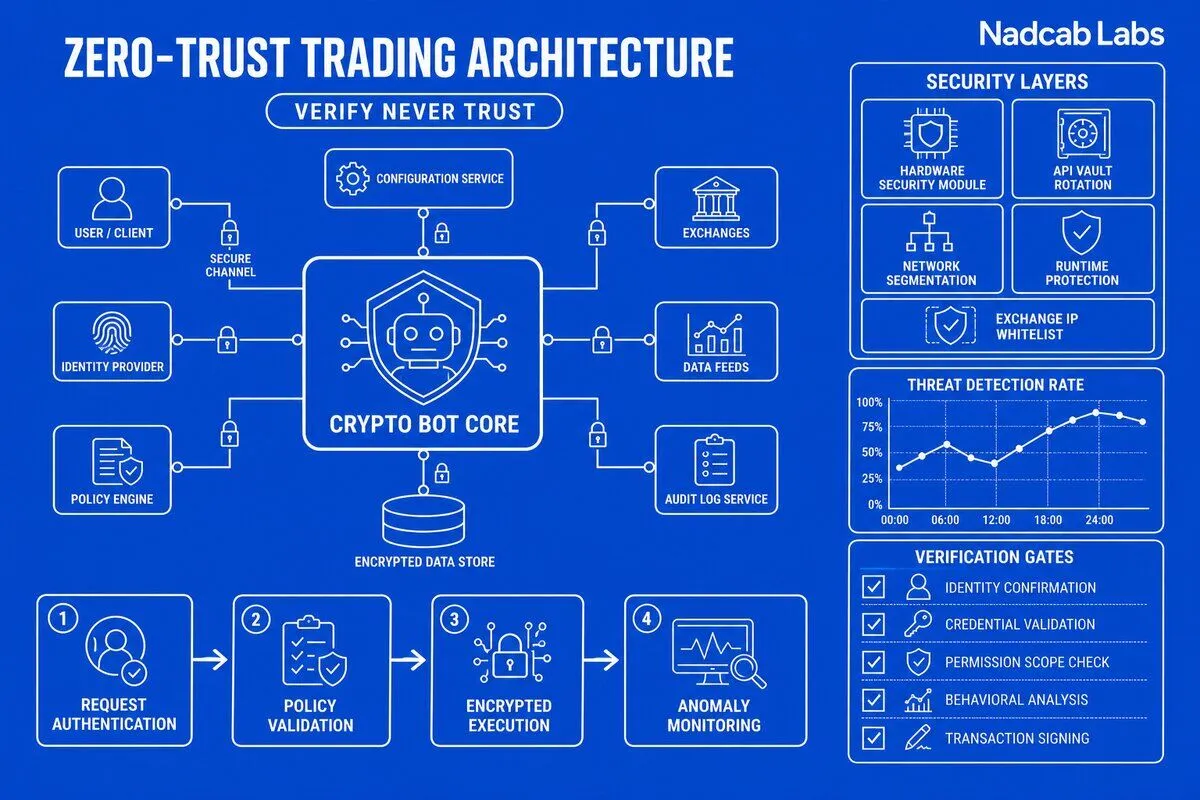
- Defense-in-depth layering combines network segmentation, encrypted communication, hardware security modules, and runtime protection mechanisms
- Secure API key management requires vault-based rotation, encrypted injection, and exchange-level restrictions like IP whitelisting and withdrawal limits
- Continuous monitoring with anomaly detection, immutable audit logs, and automated circuit breakers catches threats before they cause financial damage
- Microsegmentation isolates strategy engines, execution modules, and data stores to contain breaches and limit lateral movement
Why Does Traditional Perimeter Security Fail for Modern Trading Bots?
The shift from monolithic applications to distributed Trading Bot architectures has fundamentally changed the security landscape. Early trading systems ran as single processes on dedicated servers behind firewalls, creating a clear security perimeter. Today’s bots span multiple cloud regions, connect to dozens of exchange APIs, process market data through separate microservices, and store secrets in external vaults. Each component introduces new attack surfaces that perimeter defenses cannot address.
API-first design patterns create multiple trust boundaries that traditional security models struggle to protect. When your strategy engine calls an execution service, which then authenticates with exchange APIs, you have at least three points where credentials could leak or be intercepted. A crypto trading bot might authenticate once at startup, then assume all internal communications are safe. This implicit trust becomes a vulnerability when an attacker compromises one component and uses it to pivot through your infrastructure.
Cloud-native deployments demand identity-based security rather than network location checks. Your bot instances might run in different availability zones, scale dynamically based on market volatility, or migrate between regions for latency optimization. Network addresses change constantly, making IP-based firewall rules impractical. Modern attackers exploit this fluidity by compromising cloud credentials, launching instances within your network perimeter, and operating undetected because they appear to come from trusted locations.
The Low-Latency Trading Bot Architecture required for high-frequency strategies adds complexity. Microsecond-level performance requirements tempt developers to skip security checks or cache credentials longer than safe. This tension between speed and safety creates exploitable gaps where attackers can inject malicious orders or manipulate execution logic during the brief windows when security controls are relaxed for performance.
How Do You Implement Zero-Trust Principles in Trading Bot Architecture?
Zero-trust security starts with the principle “never trust, always verify” applied to every interaction within your trading infrastructure. Instead of authenticating once at login, each API call, database query, or inter-service communication must present fresh credentials and pass authorization checks. A strategy module requesting market data proves its identity through short-lived tokens that expire within minutes, forcing continuous re-authentication that limits the damage from stolen credentials.
Microsegmentation divides your bot infrastructure into isolated security zones with strictly controlled communication paths. Your strategy engine runs in one segment, the execution module in another, and the database in a third. Network policies allow only specific, necessary connections between segments. If an attacker compromises your backtesting service, microsegmentation prevents them from reaching the live trading execution module or accessing API keys stored in the secrets vault.
| Component | Trust Boundary | Authentication Method | Token Lifetime |
|---|---|---|---|
| Strategy Engine | Isolated compute segment | Service account with mTLS | 5 minutes |
| Execution Module | Privileged trading zone | Hardware token + biometric | 2 minutes |
| Market Data Service | Public data segment | API key rotation | 15 minutes |
| Database Layer | Encrypted data segment | Certificate-based auth | 10 minutes |
Least privilege access controls limit each bot component to the minimum permissions required for its specific function. Your market analysis module needs read access to price data but should never have permissions to execute trades or withdraw funds. The execution module can place orders but cannot modify strategy parameters or access user account balances. This granular permission model, similar to approaches used in social trading platforms, ensures that compromising one component does not grant attackers full system control.
What Are the Critical Components of Defense-in-Depth for Bot Security?
Defense-in-depth security layers multiple independent controls so that if one fails, others still protect your trading infrastructure. At the network layer, firewalls and intrusion detection systems filter malicious traffic before it reaches your applications. Application-layer security validates input data, sanitizes user requests, and enforces business logic rules. Data encryption protects information at rest and in transit. Identity controls verify users and services at every access point. This overlapping protection makes successful attacks exponentially harder.
Hardware security modules provide tamper-resistant storage for private keys and API secrets that software-only solutions cannot match. An HSM generates cryptographic keys inside its protected boundary and never exposes them to the host system. When your Trading Bot Development Company builds execution modules, the bot sends signing requests to the HSM, which returns signatures without revealing the private key. Even if attackers gain root access to your servers, they cannot extract keys from properly configured HSMs.
Trading Bot Security Process Flow
Bot presents short-lived JWT token with service identity claims to API gateway
Policy engine validates token signature, expiration, and permission scopes against request
Approved request fetches encrypted API key from vault using temporary access credentials
Bot signs request with HSM-protected key and sends to exchange over TLS 1.3 connection
Immutable log records request details, response status, and security events to SIEM system
Runtime application self-protection monitors your trading bot from inside the process, detecting and blocking attacks in real-time. RASP agents instrument your code to identify SQL injection attempts, command injection, unauthorized file access, and other exploitation techniques. When an attacker tries to manipulate order parameters through input validation bypasses, RASP detects the anomalous behavior and terminates the request before it reaches your execution logic. This protection works even against zero-day vulnerabilities that signature-based systems miss.
How Should You Architect Secure API Key and Secret Management Systems?
Vault-based secret management centralizes credential storage with automated rotation policies that limit exposure windows. HashiCorp Vault, AWS Secrets Manager, or similar systems generate fresh API keys on configurable schedules, update your bot configuration automatically, and revoke old credentials. A typical rotation policy generates new exchange API keys every 24 hours, giving attackers a maximum one-day window to exploit stolen credentials. This approach, detailed in our How to Build a Crypto Trading Bot with Python: Step-by-Step Guide, dramatically reduces the value of credential theft.
Encrypted environment variables and secrets injection eliminate hardcoded credentials from your codebase. Instead of storing API keys in configuration files or source code, your bot retrieves them at runtime from the secrets vault. The vault authenticates the requesting service through cloud IAM roles or Kubernetes service accounts, then injects decrypted secrets into memory. This pattern ensures credentials never touch disk in plaintext and cannot be extracted from version control history or container images.
API Key Security Controls Effectiveness
Exchange-level security controls provide additional protection layers independent of your bot infrastructure. IP whitelisting restricts API access to known server addresses, preventing attackers from using stolen keys from different locations. Rate limiting caps the number of requests per minute, making rapid fund extraction difficult. Withdrawal address whitelisting, available on most major exchanges and hybrid exchange platforms, ensures funds can only be sent to pre-approved addresses. Trading bots should enable all available exchange security features and treat them as the last line of defense when other controls fail.
What Security Monitoring and Incident Response Mechanisms Protect Trading Bots?
Real-time anomaly detection identifies suspicious patterns that indicate compromise or malfunction. Machine learning models trained on your normal trading behavior flag unusual order sizes, unexpected trading pairs, or API calls from new locations. A sudden spike in withdrawal requests, trades outside configured risk parameters, or authentication attempts from unfamiliar IP addresses trigger immediate alerts. These behavioral analytics catch threats that rule-based systems miss, similar to security approaches used in Crypto Derivatives Exchange Development and Cloud Security Services.
Comprehensive audit logging creates an immutable record of every action for forensic analysis and compliance verification. Each trade execution, API key usage, configuration change, and security event gets timestamped and cryptographically signed before storage in a write-once system. Attackers cannot cover their tracks by deleting logs. When investigating incidents, you can trace exactly what happened, which credentials were used, and what data was accessed. Many jurisdictions require this level of logging for financial systems, making it both a security and compliance necessity aligned with Microservices Compliance Framework standards.
Automated circuit breakers halt trading operations when threat indicators exceed thresholds. If your monitoring system detects potential credential compromise, unusual fund movements, or execution logic manipulation, it can automatically disable API keys, stop order placement, and alert administrators. These kill switches prevent attackers from draining accounts during the critical minutes before human responders can intervene. Configure circuit breakers with clear triggering conditions, escalation procedures, and recovery protocols to balance security protection with operational continuity.
Your incident response plan should define specific procedures for common attack scenarios: compromised API keys, unauthorized trades, data breaches, and denial-of-service attacks. Document step-by-step actions for containment, evidence preservation, system recovery, and stakeholder communication. Regular tabletop exercises test your team’s ability to execute the plan under pressure. The difference between a minor security incident and a catastrophic loss often comes down to how quickly and effectively your team responds in the first few minutes after detection.
Building secure trading bot infrastructure requires thinking like an attacker while implementing defense systematically. Zero-trust architecture eliminates dangerous assumptions about network safety. Defense-in-depth layering ensures multiple independent controls protect your systems. Proper secret management and continuous monitoring catch threats before they cause financial damage. These security investments protect not just your capital but also your reputation and regulatory standing in an industry where trust is everything.
Teams evaluating these options should align architecture, compliance, and rollout milestones with a clear delivery plan.
Frequently Asked Questions
Q1.What is zero-trust architecture and why is it essential for trading bot security?
Zero-trust architecture assumes no user or system is trusted by default, requiring continuous verification for every access request. For trading bot security, it’s essential because bots handle high-value transactions and API credentials. Zero-trust prevents lateral movement after breaches, enforces least-privilege access, and validates every API call, database query, and network connection, significantly reducing attack surfaces in automated trading environments.
Q2.How do I protect API keys and secrets in a distributed trading bot environment?
Use dedicated secrets management systems like HashiCorp Vault or AWS Secrets Manager with encryption at rest and in transit. Implement key rotation policies, separate keys per service, and never hardcode credentials. Apply environment-specific access controls, use temporary tokens where possible, and encrypt configuration files. For distributed systems, employ mutual TLS authentication and secure service meshes to protect inter-service communications containing sensitive data.
Q3.What are the most common security vulnerabilities in crypto trading bot systems?
Common vulnerabilities include exposed API keys in code repositories, insufficient rate limiting allowing manipulation, weak authentication mechanisms, unencrypted communication channels, and inadequate input validation leading to injection attacks. Other risks include insecure WebSocket connections, lack of transaction signing verification, inadequate logging for forensics, hardcoded credentials, and failure to implement proper session management and timeout controls across distributed components.
Q4.How can I implement defense-in-depth security without impacting bot performance?
Implement asynchronous security checks, use in-memory caching for authentication tokens, and deploy lightweight firewalls with optimized rulesets. Employ edge validation to reject malicious requests early, use connection pooling to reduce authentication overhead, and implement circuit breakers for failing security services. Parallelize security operations, leverage hardware acceleration for encryption, and use efficient logging mechanisms that don’t block trading execution paths.
Q5.What monitoring tools detect unauthorized access or suspicious trading bot behavior?
Use SIEM platforms like Splunk or ELK Stack for centralized log analysis, Prometheus with Grafana for real-time metrics, and specialized tools like Falco for runtime security monitoring. Implement anomaly detection systems that track trading patterns, API usage rates, and geographic access locations. Deploy intrusion detection systems, configure alerting for failed authentication attempts, unusual transaction volumes, and deviations from established trading behavior baselines.
Q6.Should I use hardware security modules (HSMs) for trading bot private key storage?
Yes, HSMs provide the highest security for private key storage in production trading environments handling significant capital. They offer tamper-resistant hardware, FIPS 140-2 Level 3+ certification, and prevent key extraction. For high-frequency trading, evaluate HSM latency impact and consider cloud HSM services like AWS CloudHSM for scalability. For smaller operations, secure enclaves or key management services may provide adequate protection at lower cost.
Explore Services
Related Services
Reviewed by

Aman Vaths
Founder of Nadcab Labs
Aman Vaths is the Founder & CTO of Nadcab Labs, a global digital engineering company delivering enterprise-grade solutions across AI, Web3, Blockchain, Big Data, Cloud, Cybersecurity, and Modern Application Development. With deep technical leadership and product innovation experience, Aman has positioned Nadcab Labs as one of the most advanced engineering companies driving the next era of intelligent, secure, and scalable software systems. Under his leadership, Nadcab Labs has built 2,000+ global projects across sectors including fintech, banking, healthcare, real estate, logistics, gaming, manufacturing, and next-generation DePIN networks. Aman’s strength lies in architecting high-performance systems, end-to-end platform engineering, and designing enterprise solutions that operate at global scale.