Ai Overview
Crypto payment gateway security architecture in 2026 demands a defence-in-depth strategy that protects transaction data, private keys, and user funds across multiple interdependent layers. Rate limiting policies prevent brute-force attacks and API abuse by capping requests per IP address or API key to 100 requests per minute for standard users and 1,000 for enterprise accounts.
Crypto payment gateway security architecture in 2026 demands a defence-in-depth strategy that protects transaction data, private keys, and user funds across multiple interdependent layers. Unlike traditional payment processors, blockchain gateways must secure on-chain transactions, off-chain databases, API endpoints, and cryptographic key material simultaneously. This article dissects the five critical security layers every enterprise-grade Payment Gateway must implement to withstand evolving attack vectors.
Key Takeaways
- Multi-layered security combines API authentication, transport encryption, wallet custody isolation, fraud detection, and threat mitigation into a unified architecture.
- Hot/cold wallet segregation with HSM integration and multi-signature schemes protects private keys from unauthorized access and insider threats.
- AES-256 encryption for data at rest, TLS 1.3 for data in transit, and ECC for blockchain signatures form the cryptographic foundation of secure payment flows.
- Real-time fraud detection using machine learning, address whitelisting, and behavioral biometrics prevents unauthorized transactions and AML violations.
- DDoS protection, smart contract audits, and SIEM-driven incident response mitigate common attack vectors targeting payment gateway infrastructure.
What Are the Core Security Layers in Crypto Payment Gateway Architecture in 2026?
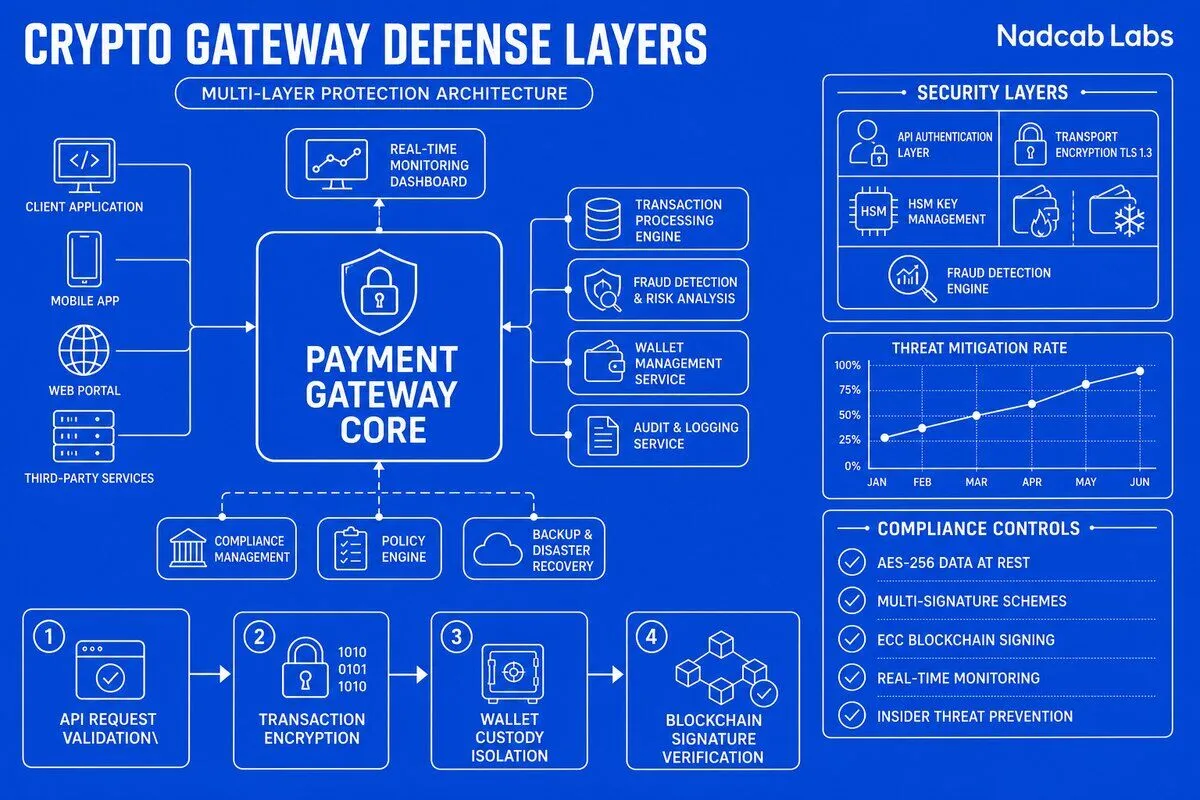
The first line of defence in crypto payment gateway security architecture is the API authentication layer. OAuth 2.0 flows with short-lived JWT tokens ensure that only authorized clients can initiate transactions. Rate limiting policies prevent brute-force attacks and API abuse by capping requests per IP address or API key to 100 requests per minute for standard users and 1,000 for enterprise accounts. Token expiration windows of 15 minutes force frequent re-authentication, reducing the window of opportunity if credentials are compromised. This approach creates a dynamic security perimeter that adapts to usage patterns while maintaining strict access controls across all gateway endpoints.
Transport layer security protects data as it moves between clients, gateway servers, and blockchain nodes. TLS 1.3 eliminates legacy cipher suites vulnerable to downgrade attacks, while certificate pinning ensures clients only trust gateway-issued certificates. End-to-end encryption means payment metadata remains encrypted from the merchant’s checkout page through settlement, preventing man-in-the-middle interception. Crypto Payment Gateways for Global businesses must enforce HTTPS-only connections and reject plaintext HTTP requests entirely. The protocol’s forward secrecy guarantees that even if long-term keys are compromised, past session data remains protected, a critical feature for financial infrastructure handling sensitive transaction histories.
Application layer defenses guard against injection attacks and cross-site scripting. Input validation whitelists acceptable characters for wallet addresses, transaction amounts, and API parameters. Prepared statements with parameterized queries prevent SQL injection into transaction databases. Content Security Policy headers block execution of unauthorized JavaScript, protecting users from XSS attacks that could steal session tokens or redirect payments. These controls are non-negotiable for any gateway handling real financial transactions. Regular security testing validates that these defenses remain effective against emerging attack techniques, with automated scanners running continuous vulnerability assessments across all application endpoints.
| Security Layer | Primary Mechanism | Attack Vector Mitigated |
|---|---|---|
| API Authentication | OAuth 2.0 + JWT (15-min expiry) | Credential theft, replay attacks |
| Transport Security | TLS 1.3 + Certificate Pinning | Man-in-the-middle, eavesdropping |
| Application Defense | Input validation + CSP headers | SQL injection, XSS, code injection |
How Do Wallet Custody Models Impact Security Architecture Design in 2026?
Wallet custody architecture determines how private keys are generated, stored, and used to sign blockchain transactions. Hot wallets connected to the internet enable instant transaction processing but expose keys to network-based attacks. Cold wallets stored offline in air-gapped environments provide maximum security but introduce operational friction. Enterprise gateways typically allocate 95% of funds to cold storage and maintain 5% in hot wallets for daily transaction volume, rebalancing nightly during low-traffic windows. This distribution strategy balances liquidity requirements with security imperatives, ensuring sufficient operational funds remain available while minimizing exposure to online threats.
Multi-signature schemes require M-of-N key approvals before executing high-value transactions. A 3-of-5 multi-sig setup means three private keys from a pool of five must sign a transaction, preventing any single compromised key from draining funds. Threshold cryptography using Shamir’s Secret Sharing distributes key fragments across geographically separated HSMs, so no single device holds a complete private key. This architecture survived the 2024 exchange hacks where single-point HSM failures led to $200 million in losses. Geographic distribution adds physical security layers, requiring attackers to compromise multiple facilities simultaneously to reconstruct signing capabilities.
Hierarchical Deterministic wallets generate unique addresses for every transaction from a single master seed, improving privacy and simplifying backup procedures. The BIP-32 standard allows gateways to derive billions of child keys without storing each individually. Hardware Security Modules isolate cryptographic operations in tamper-resistant chips that self-destruct if physical intrusion is detected. Multi-chain wallet implementations extend HD architecture across Bitcoin, Ethereum, and Solana chains using chain-specific derivation paths. The deterministic nature of key generation means disaster recovery requires only the master seed and derivation path documentation, dramatically simplifying business continuity planning.
(Hardware RNG)
(256-bit)
(BIP-32)
(Per-Tx)
(Isolated)
Which Encryption Protocols Protect Transaction Data in Modern Payment Gateways in 2026?
AES-256 encryption secures sensitive data at rest in gateway databases, including user KYC documents, transaction histories, and API keys. Key rotation policies mandate generating new encryption keys every 90 days, with old keys retained only long enough to decrypt legacy records during migration. Key management systems like AWS KMS or HashiCorp Vault store master keys in hardware-backed vaults, enforcing strict access controls that log every decryption request for audit trails. Automated rotation procedures ensure cryptographic hygiene without manual intervention, reducing the risk of human error in key lifecycle management. Encryption key hierarchies separate data encryption keys from key encryption keys, adding another layer of protection against unauthorized access.
Elliptic Curve Cryptography using the secp256k1 curve (Bitcoin/Ethereum) or Ed25519 (Solana) generates compact digital signatures that prove transaction authenticity without revealing private keys. A 256-bit ECC key provides security equivalent to a 3,072-bit RSA key while consuming 90% less bandwidth, critical for high-throughput payment gateways processing 10,000 transactions per second. Businesses Need a Crypto Payment Gateway that balances cryptographic strength with performance constraints. The computational efficiency of ECC enables mobile wallet applications to perform signature verification without draining battery life, expanding payment gateway accessibility to resource-constrained devices.
Zero-knowledge proofs allow gateways to verify transaction validity without exposing amounts or recipient addresses. zk-SNARKs enable privacy-preserving compliance checks where regulators can confirm AML screening occurred without viewing transaction details. Homomorphic encryption permits computations on encrypted payment data, letting fraud detection algorithms analyze transaction patterns while data remains encrypted end-to-end. These advanced protocols are becoming standard in privacy-focused payment architectures. Recursive proof composition allows gateways to aggregate thousands of transaction validations into a single compact proof, dramatically reducing on-chain verification costs while maintaining complete cryptographic assurance.
| Encryption Protocol | Use Case | Key Strength |
|---|---|---|
| AES-256 | Database encryption (at rest) | 256-bit symmetric |
| ECC secp256k1 | Transaction signing (Bitcoin/ETH) | 256-bit asymmetric |
| zk-SNARKs | Privacy-preserving verification | Computational soundness |
What Fraud Detection Systems Are Essential for Crypto Payment Security in 2026?
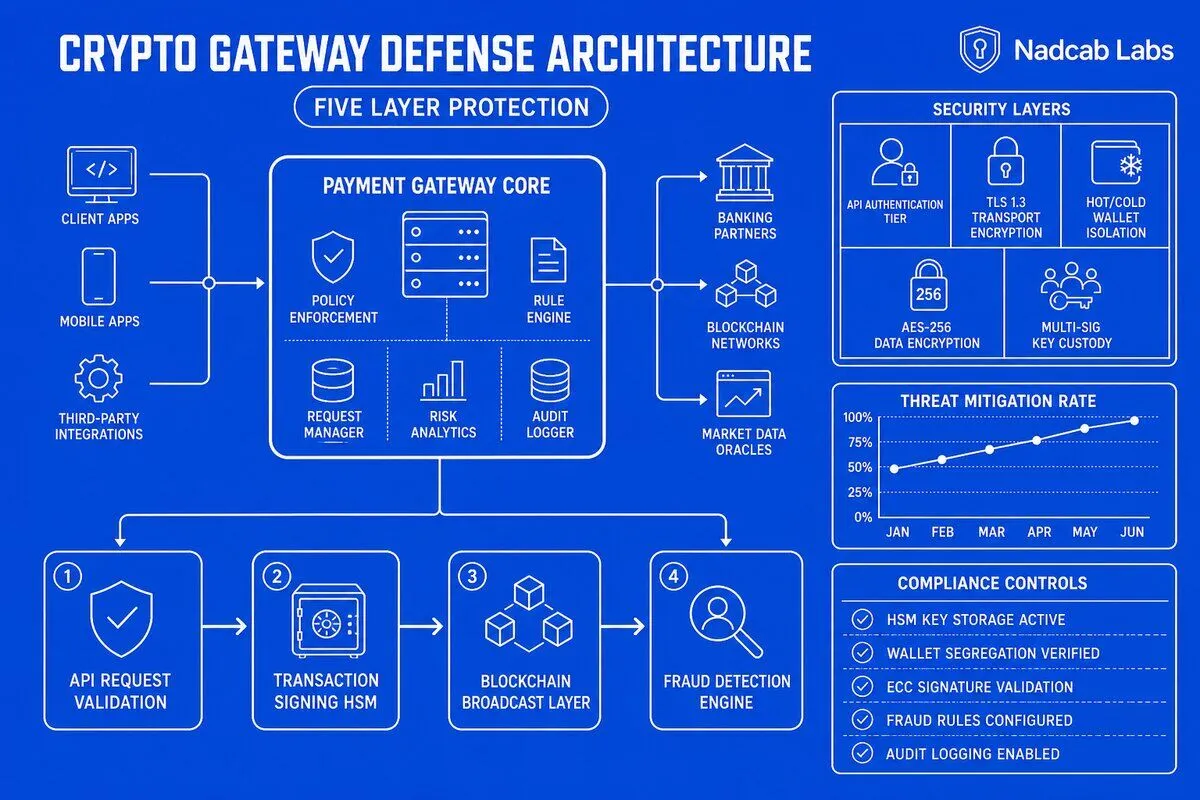
Real-time transaction monitoring engines analyze every payment against behavioral baselines and risk thresholds. Machine learning models trained on 50 million historical transactions flag anomalies like sudden high-value transfers, geographic inconsistencies (user in Japan sending to a Nigerian exchange), or velocity spikes (20 transactions in 5 minutes from an account averaging 2 per day). Gradient boosting algorithms achieve 97% precision in identifying fraudulent patterns while maintaining false positive rates below 0.5%. Continuous model retraining incorporates emerging fraud patterns, ensuring detection capabilities evolve alongside attacker tactics. Feature engineering extracts hundreds of behavioral signals from each transaction, including time-of-day patterns, device fingerprints, and network topology characteristics that distinguish legitimate users from compromised accounts.
Address whitelisting restricts withdrawals to pre-approved wallet addresses that users verify via email and 2FA during a 24-hour cooling-off period. Blacklist screening cross-references recipient addresses against OFAC sanctions lists, known ransomware wallets, and mixer services flagged by Chainalysis. AML transaction scoring assigns risk values from 0-100 based on factors like transaction size, counterparty history, and chain-hopping behavior, automatically blocking scores above 80 pending manual review. Graph analysis algorithms trace fund flows across multiple blockchain hops, identifying layering patterns characteristic of money laundering operations even when individual transactions appear legitimate.
Behavioral biometrics track typing patterns, mouse movements, and session duration to detect account takeovers. Device fingerprinting creates unique identifiers from browser configurations, screen resolution, and installed fonts, alerting security teams when familiar accounts access the gateway from unrecognized devices. Risk-based authentication escalates from password-only login (low-risk actions) to SMS codes (medium-risk) to hardware token verification (high-value withdrawals). Crypto payment gateway architectures must layer these controls without degrading user experience. Passive biometric monitoring operates transparently in the background, analyzing interaction patterns without requiring explicit user actions, maintaining security without introducing friction into legitimate payment flows.
How Can Gateway Architects Mitigate Common Attack Vectors in 2026?
Distributed Denial of Service attacks targeting payment APIs can cripple transaction processing during high-traffic periods. Multi-tier DDoS mitigation combines rate limiting at the application layer (rejecting requests exceeding thresholds), traffic filtering at the network edge (dropping malformed packets), and CDN-based absorption (distributing attack traffic across global points of presence). Cloudflare’s Magic Transit service mitigated a record 3.8 Tbps attack against a crypto exchange in 2025 by routing traffic through scrubbing centers that filtered malicious requests while preserving legitimate transactions. Anycast routing distributes incoming connections across multiple data centers, preventing any single point of failure from disrupting payment processing capabilities.
Smart contract vulnerabilities pose unique risks when gateways interact with DeFi protocols for liquidity or yield generation. Automated audit pipelines using tools like Slither and Mythril scan contract bytecode for reentrancy bugs, integer overflows, and unchecked external calls before deployment. Reentrancy guards using OpenZeppelin’s ReentrancyGuard modifier prevent recursive calls that drained $50 million from a payment gateway’s liquidity pool in 2024. Oracle manipulation defenses aggregate price data from multiple sources (Chainlink, Band Protocol, Pyth) and reject outliers beyond 5% deviation from the median. Time-weighted average price feeds smooth out short-term volatility spikes that attackers might exploit through flash loan manipulation.
Incident response automation shortens the window between breach detection and containment. SIEM systems like Splunk ingest logs from API gateways, HSMs, blockchain nodes, and fraud detection engines, correlating events to identify attack patterns. Automated playbooks trigger responses like IP blocking, account freezes, and cold wallet transfers when specific threat signatures are detected. Blockchain forensics tools trace stolen funds across mixers and exchanges, providing evidence for law enforcement. Trading bot security architecture principles apply equally to payment gateway defense-in-depth strategies. Tabletop exercises simulate breach scenarios, ensuring response teams can execute playbooks under pressure and identify gaps in coordination before real incidents occur.
Compliance frameworks provide structured approaches to security controls. While PCI DSS governs traditional card payments, crypto gateways map equivalent controls through SOC 2 Type II audits, ISO 27001 certification, and NIST Cybersecurity Framework alignment. Microservices Compliance Framework implementations isolate payment processing, wallet custody, and fraud detection into separate services with independent security boundaries, limiting blast radius if one component is compromised. Regular penetration testing by firms like Trail of Bits validates that architectural controls withstand real-world attack scenarios. Continuous compliance monitoring automates evidence collection for audit requirements, reducing the burden of annual certification renewals while maintaining real-time visibility into control effectiveness.
| Attack Vector | Mitigation Strategy | Implementation Tool |
|---|---|---|
| DDoS (L3/L4) | Traffic filtering + CDN absorption | Cloudflare Magic Transit |
| Smart Contract Bugs | Automated audits + reentrancy guards | Slither, OpenZeppelin |
| Insider Threats | Multi-sig + HSM key fragmentation | Ledger Enterprise, AWS KMS |
| Data Breaches | AES-256 encryption + access logging | HashiCorp Vault, Splunk |
Nadcab Labs implements these multi-layered security architectures in production Crypto Payment Gateway deployments, combining HSM-backed key management, real-time fraud detection, and compliance-ready audit trails. Our reference architecture supports Crypto Derivatives Exchange Development and other high-security applications requiring institutional-grade protection. Integration with Cloud Security Services enables hybrid deployments where sensitive operations run in air-gapped environments while public APIs scale elastically in cloud infrastructure.
Final Thoughts
Multi-layered crypto payment gateway security architecture in 2026 requires coordinated defenses across API authentication, wallet custody, encryption protocols, fraud detection, and threat mitigation. No single control provides complete protection; resilience emerges from overlapping safeguards that force attackers to breach multiple independent systems. As transaction volumes grow and attack sophistication increases, gateways must continuously evolve their security posture through automated monitoring, regular audits, and rapid incident response. The architectures detailed here represent current best practices, but security is a moving target demanding constant vigilance and adaptation. Organizations must invest not only in technical controls but also in security culture, ensuring every team member understands their role in protecting user funds and maintaining trust. Regular training programs, threat intelligence sharing, and participation in industry security forums help gateway operators stay ahead of emerging risks. By implementing defense-in-depth strategies and maintaining operational discipline, payment gateways can provide the security guarantees that institutional adoption demands while preserving the accessibility and efficiency that make cryptocurrency payments compelling for global commerce.
Frequently Asked Questions
Q1.What is the difference between hot wallet and cold wallet security in crypto payment gateways in 2026?
Hot wallets in 2026 remain connected to the internet for instant transaction processing, enabling real-time payments but exposing funds to online threats. Cold wallets store the majority of funds offline in hardware or paper formats, providing maximum security against hacking. Effective crypto payment gateway security architecture uses hot wallets for operational liquidity (typically 5-10% of funds) while keeping reserves in cold storage, implementing automated sweeping protocols to minimize online exposure.
Q2.How does multi-signature authentication enhance payment gateway security architecture in 2026?
Multi-signature authentication in 2026 requires multiple private keys (typically 2-of-3 or 3-of-5 configurations) to authorize transactions, eliminating single points of failure. This distributed control prevents unauthorized withdrawals even if one key is compromised. Payment gateways implement multi-sig for large transactions, administrative functions, and cold wallet access. The architecture distributes keys across different geographic locations and personnel, with hardware security modules (HSMs) protecting individual keys, significantly reducing internal fraud and external attack risks.
Q3.What encryption standards should crypto payment gateways implement in 2026?
Crypto payment gateways in 2026 should implement AES-256 encryption for data at rest and TLS 1.3 for data in transit. End-to-end encryption protects sensitive information including private keys, user credentials, and transaction details. Additional standards include SHA-256 or SHA-3 for hashing, elliptic curve cryptography (ECC) for key generation, and hardware security modules (HSMs) certified to FIPS 140-3 Level 3 or higher. Regular cryptographic audits and quantum-resistant algorithm preparation ensure long-term security resilience.
Q4.How do fraud detection systems identify suspicious transactions in real-time in 2026?
Fraud detection systems in 2026 use machine learning algorithms analyzing transaction patterns, velocity checks, geolocation data, device fingerprinting, and behavioral biometrics. They flag anomalies like unusual transaction amounts, rapid successive transactions, mismatched IP locations, or deviations from user spending patterns. Real-time risk scoring assigns threat levels to each transaction, triggering automated holds or additional verification for high-risk activities. Integration with blockchain analytics identifies connections to known fraudulent addresses or mixing services, providing comprehensive protection.
Q5.What are the PCI DSS equivalent compliance frameworks for crypto payment gateways in 2026?
In 2026, crypto payment gateways follow frameworks including ISO 27001 for information security management, SOC 2 Type II for service organization controls, and NIST Cybersecurity Framework for comprehensive security practices. Cryptocurrency-specific standards include CCSS (Cryptocurrency Security Standard) for digital asset protection and emerging regulatory requirements like MiCA in Europe. Many gateways also maintain PCI DSS compliance when handling fiat conversions. Regular third-party security audits, penetration testing, and vulnerability assessments demonstrate adherence to these frameworks.
Q6.How can payment gateway architects protect against smart contract vulnerabilities in 2026?
Payment gateway architects in 2026 protect against smart contract vulnerabilities through comprehensive code audits by specialized firms, formal verification methods proving contract correctness, and bug bounty programs incentivizing security researcher participation. Implementation includes timelock mechanisms for critical functions, upgradeable proxy patterns allowing security patches, circuit breakers pausing operations during attacks, and rate limiting to prevent exploitation. Continuous monitoring detects unusual contract interactions, while insurance protocols provide financial backstops. Testing on testnets and gradual mainnet deployment minimize risk exposure.
Explore Services
Related Services

Reviewed by

Aman Vaths
Founder of Nadcab Labs
Aman Vaths is the Founder & CTO of Nadcab Labs, a global digital engineering company delivering enterprise-grade solutions across AI, Web3, Blockchain, Big Data, Cloud, Cybersecurity, and Modern Application Development. With deep technical leadership and product innovation experience, Aman has positioned Nadcab Labs as one of the most advanced engineering companies driving the next era of intelligent, secure, and scalable software systems. Under his leadership, Nadcab Labs has built 2,000+ global projects across sectors including fintech, banking, healthcare, real estate, logistics, gaming, manufacturing, and next-generation DePIN networks. Aman’s strength lies in architecting high-performance systems, end-to-end platform engineering, and designing enterprise solutions that operate at global scale.