Ai Overview
To understand where AR/VR in gaming and entertainment is headed, you first need to look at where it stands financially. The hardware segment alone recorded over 55% of revenue in 2024, showing just how much consumers and companies are spending on headsets, controllers, and peripherals. The total revenue of content sold on the Quest platform reached just under $3 billion as of March 2025. In 2024 alone, the game generated $544 million in revenue.
Key Takeaways
- The global virtual reality in gaming market was valued at USD 32.5 billion in 2024 and is projected to reach USD 109.6 billion by 2030, growing at a CAGR of 21.6% from 2025 to 2030, with the hardware segment recording the largest revenue share of over 55% in 2024.
[1] - Pokémon GO has accumulated over $8 billion in lifetime player spending since its 2016 launch and generated $544 million in revenue in 2024, with 657 million downloads globally, and the United States contributing 38% of total revenue.
[2] - The global AR and VR headsets market was valued at USD 12.46 billion in 2024 and is projected to reach USD 261.92 billion by 2034, growing at a CAGR of 35.60%, driven by gaming, entertainment, and enterprise adoption.
[3] - Travis Scott’s 2020 Fortnite concert attracted nearly 28 million live viewers, and the Fortnite Remix: The Finale event on November 30, 2024, drew over 14 million concurrent players, marking the platform’s largest-ever live gathering.
[4] - Meta held approximately 75% of the standalone VR headset market share in 2024, while VR headset sales overall fell by 10% in 2024 to 6.9 million units, and active VR headsets in use dropped by 8% to 21.9 million units.
[5] - Apple Vision Pro shipped approximately 390,000 units in 2024 at a $3,499 price point, with 200,000 of those units sold in the first two weeks of its February 2024 launch, positioning it as a premium spatial computing device.
[6] - Half-Life: Alyx sold 680,000 copies in its first month in March 2020, generating approximately $40.7 million in revenue, and has since surpassed an estimated 3 million total copies, proving that AAA-quality VR games can drive hardware adoption.
[7] - Over 24 million AR and VR headsets were shipped globally in 2023, with standalone devices accounting for 56% of total shipments, and over 4,000 VR arcades were operational worldwide for location-based entertainment.
[8] - The location-based VR entertainment market is projected to reach USD 40.3 billion by 2032, up from USD 13.9 billion in 2024, with rapid expansion across tier 1 Asian cities where limited living space drives demand for public VR venues.
[9] - Fortnite has 650 million registered players, and Roblox has over 380 million monthly active users with 16 billion hours of engagement in the past 12 months, turning both platforms into metaverse hubs that host virtual concerts, brand events, and user-generated content.
[10]
There was a time when gaming meant staring at a flat screen and tapping buttons. That time is fading fast. Today, players are stepping inside the worlds they used to watch from the outside. They are swinging virtual swords in their living rooms, catching digital creatures on real streets, and attending concerts performed by global superstars inside video games. The line between what is “real” and what is “virtual” in entertainment has become wonderfully thin.
AR/VR in gaming and entertainment is not a future concept anymore. It is happening right now, in homes, arcades, stadiums, and on smartphones across the world. Augmented reality layers digital content onto the physical world, turning parks into battlegrounds and living rooms into puzzle arenas. Virtual reality, on the other hand, drops you into a completely different universe where the only limit is what developers can imagine. Together, these two technologies are rewriting what it means to play, watch, and experience entertainment.
This blog walks through the full picture of immersive entertainment technology. From market numbers and hardware battles to virtual concerts and metaverse worlds, everything covered here is grounded in what is actually happening across the industry.
The Market Behind the Magic: How Big Is VR/AR in Gaming?
To understand where AR/VR in gaming and entertainment is headed, you first need to look at where it stands financially. The numbers paint a clear picture of an industry that is growing rapidly, even if it faces occasional speed bumps.
The global virtual reality in gaming market was valued at USD 32.5 billion in 2024 and is projected to reach USD 109.6 billion by 2030, growing at a CAGR of 21.6% from 2025 to 2030, according to Grand View Research. The hardware segment alone recorded over 55% of revenue in 2024, showing just how much consumers and companies are spending on headsets, controllers, and peripherals. On a broader scale, the AR and VR headsets market was valued at USD 12.46 billion in 2024 and is projected to skyrocket to USD 261.92 billion by 2034, at a CAGR of 35.60%, according to Precedence Research.
What does this tell us? VR/AR game technologies are no longer a niche curiosity. They are a multi-billion-dollar industry drawing serious investment from the biggest names in tech. North America led the charge in 2024 with around 38.6% of the market revenue, backed by mature broadband infrastructure, high disposable incomes, and a deep gaming culture. But Asia Pacific is catching up quickly as the fastest growing region, fueled by location-based entertainment venues booming across dense urban corridors in China, Japan, and South Korea.
Meanwhile, the total global investment in AR and VR surpassed $5.2 billion in 2023, with venture capitalists backing over 800 startups focused on spatial computing and immersive content. North America attracted $3.1 billion of that startup investment, while Asia Pacific brought in $1.2 billion. These are not speculative bets. These are calculated moves by people who see virtual reality in gaming and AR entertainment as foundational to the next era of digital interaction.
Recommended Reading:
Digital Transformation in Entertainment Industry: Platforms, Tech & Monetization
The Hardware Race: Headsets Driving Immersive Entertainment Technology
No matter how impressive the software gets, the immersive entertainment technology experience starts with what you strap to your head. The hardware war in the AR/VR space has never been more intense, with multiple major players competing for dominance and each bringing a different philosophy to the table.
1. Meta Quest: The Affordable Gateway
Meta has owned the VR headset space for years. In 2024, the company held approximately 75% of the standalone VR headset market share, making it the undisputed leader by volume. The Quest 3, launched in late 2023, brought full color passthrough and mixed reality features at a $499 price point, while the Quest 3S arrived in October 2024 at $299.99, designed to reach an even wider audience. The Meta Quest 2, which debuted in 2020, had previously sold around 20 million units, establishing VR in mainstream households. The total revenue of content sold on the Quest platform reached just under $3 billion as of March 2025.
2. Apple Vision Pro: The Premium Spatial Computer
Apple entered the arena in February 2024 with the Vision Pro, a device it calls a “spatial computer” rather than a VR headset. Priced at $3,499, it shipped approximately 390,000 units in its first year. The device features a 4K micro OLED display per eye, 12 sensors, and a custom R1 chip that reduces latency to under 12 milliseconds. Apple sold around 200,000 units within the first two weeks of pre-orders. While the high price and limited app ecosystem have slowed broader adoption, the Vision Pro has influenced the entire industry’s approach to mixed reality interfaces and spatial computing design.
3. PlayStation VR2: Console VR Ambitions
Sony’s PlayStation VR2 launched in early 2023 and has shipped approximately 2 million units. While it offers impressive haptic feedback, eye tracking, and 4K HDR visuals, it remains tethered to the PlayStation 5 console. This creates a higher barrier to entry compared to standalone headsets, but the quality of exclusive gaming experiences keeps it competitive among dedicated console gamers.
4. Emerging Players
Companies like Pico (owned by ByteDance), HTC, and various Chinese manufacturers are steadily growing their presence, particularly in the Asia Pacific region. Pico has gained traction through location-based entertainment deployments and enterprise use cases. Meanwhile, AR smart glasses from companies like RayNeo and Xreal saw explosive growth in 2025, with the broader smart glasses category growing by 110% in the first half of that year.
How AR Changed Gaming Forever: The Pokémon GO Effect
No discussion of AR and VR in entertainment would be complete without talking about the game that made augmented reality a household term. Pokémon GO, developed by Niantic and launched in July 2016, didn’t just become a hit game. It became a global cultural phenomenon that showed the world what mobile AR gaming could actually look like.
Within a week of its release, the app had been downloaded over 10 million times. By the end of 2024, Pokémon GO had accumulated over $8 billion in lifetime player spending and 657 million downloads globally. In 2024 alone, the game generated $544 million in revenue. The United States accounts for 38% of total spending, followed by Japan at 31%. Even eight years after launch, the game maintains around 110 million monthly active players.
What made Pokémon GO special was not just AR technology. It was the way it turned the real world into a game board. Players walked through parks, explored neighborhoods, and gathered at landmarks to catch Pokémon, battle in gyms, and participate in community events. It proved that AR could drive real-world physical activity, social interaction, and massive commercial success at the same time.
The broader AR games market, however, has struggled to replicate this success. The total AR games market sits at approximately $12 billion in gross revenue, and new releases since 2022 have largely failed to attract meaningful player bases. Out of more than 100 new AR game launches since April 2022, only Monster Hunter Now (also by Niantic) managed to generate significant income, earning $164 million. This tells us something important: AR gaming has massive potential, but building a successful AR game requires the right blend of IP, gameplay design, and real-world integration.
VR Gaming’s Defining Moments: Titles That Changed Everything
While AR brought gaming out into the streets, VR has been building entirely new worlds behind the headset. Several landmark titles have shaped what virtual reality in gaming looks like today and have proven that VR gaming can deliver experiences that flat screens simply cannot match.
1. Beat Saber: The Rhythm Revolution
Beat Saber has been the closest thing VR gaming has to a “killer app” for years. Players slash through approaching blocks to the beat of music using virtual lightsabers, an experience that even hints at how rhythm games could one day integrate with a decentralized music platform to offer dynamic, creator-driven soundtracks. It is addictive, physically engaging, and easy to understand, which makes it accessible to both hardcore gamers and complete newcomers. The game has sold millions of copies across Steam, PlayStation VR, and Meta Quest platforms. On Quest alone, nearly 10 million users have unlocked the game’s initial achievements. Its success has fueled DLC music packs and sustained long-term engagement in a way few VR titles have managed.
2. Half-Life: Alyx: The AAA Benchmark
Released in March 2020, Half-Life: Alyx represented the first time a major publisher put its full weight behind a VR-exclusive title. Built from the ground up for VR by a team of around 80 people (the largest in Valve’s history), the game sold 680,000 copies in its first month, generating approximately $40.7 million in revenue. It has since surpassed an estimated 3 million total copies. Half-Life: Alyx proved that VR could support long-form narrative games (it offers about 15 hours of gameplay) with AAA production values. Its release added nearly one million monthly connected VR headsets on Steam in a single month.
3. Resident Evil, Skyrim VR, and Beyond
Other established franchises have also embraced VR. Resident Evil brought survival horror into an intimately terrifying VR format, while Skyrim VR let players wander through a beloved open world with their own hands. These ports demonstrated that existing game worlds could gain entirely new dimensions when experienced through a VR headset, expanding the catalog of reasons for gamers to invest in VR hardware.
Major VR/AR Headsets and Their Gaming Capabilities (2024)
| Headset | Price (USD) | Key Gaming Features |
|---|---|---|
| Meta Quest 3 | $499 | Full color passthrough, standalone + PC VR, 500+ game library, mixed reality support |
| Meta Quest 3S | $299 | Budget-friendly entry, XR2 Gen 2 chipset, mixed reality, Batman: Arkham Shadow bundle |
| Apple Vision Pro | $3,499 | 4K micro OLED per eye, spatial computing, eye and hand tracking, 600+ apps at launch |
| PlayStation VR2 | $549 | 4K HDR, haptic feedback, eye tracking, PS5 exclusive titles, OLED displays |
| Valve Index | $999 (full kit) | 120Hz display, finger tracking controllers, room scale VR, SteamVR library access |
| Pico 4 Ultra | $599 | Standalone + PC VR, full color passthrough, strong enterprise and LBE deployment focus |
Metaverse Gaming Experiences: Where Entertainment Meets Virtual Worlds
The word “metaverse” has been thrown around a lot in recent years, sometimes as hype and sometimes as a genuine vision. But when it comes to gaming, the concept is already very real. Metaverse gaming experiences are being built and used by hundreds of millions of people on platforms that have evolved far beyond their original purpose.
1. Fortnite: From Battle Royale to Cultural Platform
Epic Games’ Fortnite started as a battle royale shooter, but it has grown into something much larger. With 650 million registered players, Fortnite has become one of the biggest metaverse gaming platforms in the world. It regularly hosts virtual concerts, brand collaborations, and live events that draw audiences traditional entertainment can only dream of. Marshmello’s 2019 concert drew over 10.7 million attendees. Travis Scott’s 2020 Astronomical event attracted nearly 28 million live viewers, with replays pushing total viewership to 45 million. The Fortnite Remix: The Finale event on November 30, 2024, set a new record with over 14 million concurrent players. These are not just gaming milestones. They are entertainment milestones.
2. Roblox: User Generated Immersion
Roblox operates on a different model, allowing its community of users to build and publish their own games and experiences. With over 380 million monthly active users and 16 billion hours of engagement in the past 12 months, Roblox has become one of the most visited digital spaces on Earth. It hosts virtual concerts with artists, brand experiences, and educational content, all created through user-generated tools. The platform has over 20 million games created by its users, making it one of the largest user-generated content ecosystems ever built.
3. Decentraland and The Sandbox: Blockchain-Powered Worlds
On the blockchain side, platforms like Decentraland and The Sandbox allow users to buy, develop, and monetize virtual land using NFTs. These platforms combine elements of AR and VR in entertainment with decentralized ownership, giving players and creators actual financial stakes in the virtual worlds they inhabit. Decentraland notably saw a digital plot of land sell for $2.43 million, signaling real economic activity within metaverse environments.
Recommended Reading:
Virtual Concerts and Live Events: Entertainment Without Boundaries
One of the most visible ways AR/VR in gaming and entertainment has changed the entertainment landscape is through virtual concerts and live events. What started as an experiment during the pandemic has become a permanent part of how artists connect with fans and how fans experience music.
The concept gained mainstream attention with Marshmello’s February 2019 Fortnite concert, which drew over 10.7 million players. According to Rolling Stone UK, Marshmello’s social following saw dramatic spikes after the event, including 62,000 new followers on X (then Twitter), 260,000 on Instagram, and a 1,800% increase in YouTube subscribers. Travis Scott’s April 2020 Astronomical tour in Fortnite pushed the format further, attracting nearly 28 million live viewers during a global lockdown when physical events were impossible.
In 2024, the format continued to evolve with artists like Lady Gaga, Metallica, and Eminem performing in Fortnite. Roblox has hosted its own music events, bringing in artists and creating multi-day experiences that blend gaming, social interaction, and performance.
These events work because they do things that physical concerts cannot. They can host millions of attendees at once with no venue capacity limits. They can feature deceased artists performing through digital recreation. Stage design is limited only by imagination, not physics. And fans can attend from anywhere in the world with just an internet connection. For platforms like Fortnite and Roblox, virtual concerts have become a powerful tool for keeping users engaged and attracting new audiences who might not have come for the gaming alone.
Location-Based VR Entertainment: Arcades and Beyond
Not all immersive entertainment technology experiences happen at home. Location-based entertainment (LBE) has emerged as a significant growth area for VR, bringing premium hardware and multiplayer experiences to public venues where consumers can try high-end VR without buying expensive equipment.
Over 4,000 VR arcades were operational globally in 2023, offering everything from short thrill rides to full-scale multiplayer combat games. The LBE market is projected to reach USD 40.3 billion by 2032, up from USD 13.9 billion in 2024, according to Mordor Intelligence. This growth is particularly strong in dense Asian cities like Seoul, Shanghai, and Tokyo, where limited living space makes home VR setups less practical. In these urban corridors, VR arcades serve as social gathering spots and first exposure points for consumers who may later purchase their own headsets.
In the United States, companies like Sandbox VR operate locations across major cities, offering group VR experiences in purpose-built rooms with full body tracking. In 2024, Sandbox VR launched Deadwood PHOBIA, a psychological horror VR experience at its global locations. Meanwhile, Mirra revealed a 10,708 square foot immersive gaming space in Bellevue, Washington, featuring VR technology and 8K LED displays for up to 32 simultaneous players.
Location-based VR bridges a critical gap. It lets consumers experience what VR can do at its best, with hardware they could not afford at home, and in social settings that add to the fun. As these venues scale, they serve as both entertainment destinations and effective marketing channels for the broader VR industry.
The Technology Stack: What Powers Modern AR/VR Gaming
Behind every immersive gaming experience, there is a complex technology stack working together to create the illusion of presence. Understanding what goes into AR/VR in gaming helps explain both its current capabilities and its future potential.
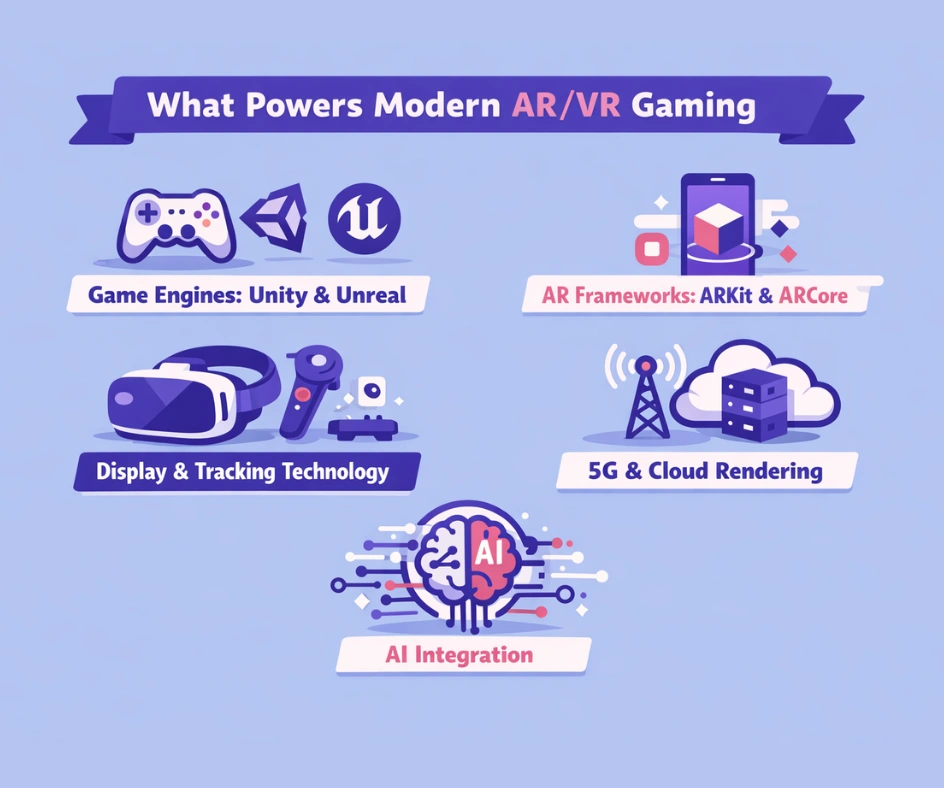
1. Game Engines: Unity and Unreal
Unity and Unreal Engine remain the two dominant platforms for VR and AR game development. Both now include built-in VR/AR development kits that have made it significantly easier and more affordable for both large studios and independent developers to create immersive experiences. Unreal Engine is particularly known for its photorealistic rendering, while Unity excels in cross-platform deployment and accessibility for smaller teams.
2. AR Frameworks: ARKit and ARCore
Apple’s ARKit and Google’s ARCore are the two primary SDKs for mobile AR development. They provide tools for motion tracking, environmental understanding, and light estimation, allowing developers to build interactive AR applications that blend digital content with the physical world on iOS and Android devices, respectively.
3. Display and Tracking Technology
Modern VR headsets use high-resolution OLED and micro OLED displays, foveated rendering (which focuses processing power on where the user is looking), and advanced motion tracking systems. Eye tracking, hand gesture recognition, and spatial audio all contribute to a sense of presence that was impossible just a few years ago. Apple Vision Pro’s R1 chip processes input from its 12 sensors with less than 12 milliseconds of latency, while Meta’s Quest 3 uses inside-out tracking to map the physical environment in real time.
4. 5G and Cloud Rendering
The rollout of 5G networks is opening the door to cloud-based VR gaming, where heavy processing happens on remote servers and streams to lightweight headsets. This could dramatically reduce the cost and weight of VR hardware while enabling higher fidelity experiences. Leading telecom carriers are already bundling 5G data with cloud rendering packages to make VR more accessible in mobile environments.
5. AI Integration
Artificial intelligence is becoming deeply embedded in VR/AR game technologies. AI drives more realistic NPC behaviors, generates dynamic content, personalizes difficulty levels, and powers spatial understanding in AR. Generative AI is being explored for creating virtual environments that evolve based on player choices, potentially making each playthrough unique.
AR/VR in Gaming and Entertainment: Key Market Segments (2024)
| Market Segment | 2024 Value | Growth Trajectory |
|---|---|---|
| VR in Gaming (Global) | USD 32.5 Billion | Projected to reach USD 109.6 billion by 2030 at 21.6% CAGR |
| AR & VR Headsets (Global) | USD 12.46 Billion | Projected to reach USD 261.92 billion by 2034 at 35.60% CAGR |
| Location-Based VR Entertainment | USD 13.9 Billion | Projected to reach USD 40.3 billion by 2032 |
| Consumer VR Market | ~USD 16 Billion | Projected to exceed USD 18 billion by the end of 2025 |
| AR/VR Software Market | USD 46.11 Billion (2025) | Projected to reach USD 220.99 Billion by 2034 at 19.02% CAGR |
| Overall Gaming Market | USD 220 Billion | Projected to reach USD 260 billion by 2026 |
Challenges Facing AR/VR in Gaming and Entertainment
Despite all the growth and excitement, AR/VR in gaming and entertainment faces real obstacles that are slowing down broader mainstream adoption. Acknowledging these challenges is important for understanding where the industry actually is versus where enthusiasts want it to be.
1. Hardware Cost and Comfort
Even with Meta’s efforts to bring prices down, VR headsets remain an additional expense on top of gaming consoles or PCs. The Apple Vision Pro at $3,499 is out of reach for all but early adopters and enterprise buyers. Weight and comfort remain issues across nearly every headset, with extended play sessions causing fatigue. Until headsets become lighter, cheaper, and more comfortable, mass adoption will face a ceiling.
2. Content Gaps
The VR gaming library has grown significantly, but it still lacks the volume and variety of traditional gaming platforms. Many VR experiences are short (under five hours), and the number of truly AAA VR exclusive titles remains small. Developers face a challenging return on investment equation: the installed base of VR headsets is still relatively small compared to console and PC gaming audiences, making it harder to justify large development budgets.
3. Motion Sickness and Accessibility
VR motion sickness remains a barrier for a meaningful percentage of potential users. While comfort options like teleportation, movement, and snap turning have helped, some users simply cannot tolerate extended VR sessions. Accessibility for users with physical disabilities also needs more attention from developers and hardware manufacturers.
4. Market Softness
Despite long-term projections being bullish, VR headset sales actually fell by 10% in 2024 to 6.9 million units, while the number of active headsets in use dropped by 8% to 21.9 million. Global VR headset shipments declined 17% year over year in Q3 2025. This short-term softness suggests that the market is still searching for its next major catalyst, whether that is a truly affordable headset, a must-have game, or a new form factor like AR glasses.
Recommended Reading:
The Future of AR/VR in Gaming: What Comes Next
Looking ahead, several trends are shaping the next phase of AR/VR in gaming and entertainment. These are not speculative predictions; they are directions already being built upon by the major players in the space.
1. The Shift Toward AR Glasses
The explosive growth of AR smart glasses (110% growth in H1 2025) signals a shift in how consumers want to interact with digital content. Rather than strapping on heavy headsets, many users prefer lightweight glasses that overlay information and entertainment onto the real world. Meta’s Ray-Ban smart glasses tripled in sales in the past year, and the broader XR device category (including AI glasses) is expected to grow 41.6% year over year to 14.5 million units shipped in 2025, even as traditional VR headset shipments decline.
2. Cross-Platform Interoperability
Standards like OpenXR are reducing the cost and complexity of developing for multiple VR platforms simultaneously. This means developers can launch games across Meta Quest, PlayStation VR, SteamVR, and other platforms with less duplicated effort. Greater interoperability encourages more studios to invest in VR development, which in turn grows the content library that attracts more users.
3. AI-Powered Immersion
As AI advances, expect VR worlds that respond intelligently to player behavior. Dynamic narratives that branch based on player choices, NPCs that hold natural conversations, and procedurally generated environments that feel handcrafted are all on the horizon. This level of personalization could make each VR gaming session feel genuinely unique.
4. Fitness and Wellness VR
Sports and fitness games are among the fastest-growing VR genres, projected to rise at a 21.23% CAGR through 2030. VR fitness games like Beat Saber, Supernatural, and FitXR have created an entirely new category of exercise that feels more like play than a workout. As health consciousness grows globally, this segment could become one of VR’s strongest mainstream use cases.
5. Enterprise Crossover
While this blog focuses on gaming and entertainment, it is worth noting that the enterprise VR market is increasingly influencing consumer products. Training simulations, architectural visualization, and remote collaboration tools are driving VR hardware improvements that benefit gamers. Companies like Boeing and Walmart already use VR for employee training, and this enterprise demand helps fund the R&D that makes consumer headsets better and cheaper.
AR/VR Gaming and Entertainment Implementations in the Real World
The following projects reflect how immersive gaming and entertainment platforms are already being built using blockchain, AR/VR, and metaverse technologies. Each implementation showcases the same principles discussed throughout this article, from play-to-earn ecosystems and virtual world creation to decentralized gaming infrastructure and token-based economies.
🎮
RoninChain: Layer 1 Blockchain for Web3 Gaming
Built a specialized Layer 1 blockchain designed specifically for Web3 gaming, offering low fees, high throughput, and support for millions of transactions. The platform enables game developers to create play-to-earn ecosystems, manage in-game NFT assets, and build immersive decentralized gaming communities with blockchain-backed ownership and governance.
🏆
Treasure: Decentralized Gaming Ecosystem with MAGIC Currency
Developed a decentralized gaming ecosystem that integrates multiple games through a unified economic layer built on the Arbitrum network. With over 15 interconnected games and $280 million in marketplace volume, the platform uses MAGIC currency and composable NFTs to enable cross-game asset interoperability, staking, and community-driven governance.
Build Your AR/VR Gaming or Metaverse Platform Today:
We bring 8+ years of blockchain and immersive technology expertise to gaming and metaverse development. Our specialized team handles everything from VR game development and AR integration to blockchain-powered in-game economies and metaverse world creation. Whether you need a play-to-earn gaming ecosystem or an immersive entertainment platform, we deliver solutions that perform.
Final Thoughts
AR/VR in gaming and entertainment has moved well beyond the experimental phase. It is a multi-billion-dollar industry with real products, real users, and real momentum. The VR gaming market alone is projected to exceed $109 billion by 2030, AR headset markets are on a path toward $261 billion by 2034, and platforms like Fortnite and Roblox are already hosting metaverse experiences that attract hundreds of millions of participants.
The path has not been entirely smooth. VR headset sales experienced a dip in 2024, the Apple Vision Pro’s high price has limited its reach, and the AR games market has struggled to produce a second Pokémon GO. But these are growing pains, not death signals. Every wave of consumer technology goes through cycles of excitement, reality checks, and renewed growth. What matters is that the fundamental demand for immersive entertainment is real and growing.
Consumers want to feel present in their entertainment. They want to swing a lightsaber and feel like they are in a galactic arena. They want to catch creatures on their neighborhood streets. They want to attend a concert inside a game alongside 14 million other fans. And increasingly, the technology exists to deliver these experiences at price points and quality levels that work for mass audiences.
For developers, businesses, and investors, the message is clear. The window to build in this space is wide open, but it will not stay that way forever. The companies that are investing now in VR/AR game technologies, immersive content creation, and metaverse infrastructure are the ones that will define what entertainment looks like for the next decade and beyond.
Frequently Asked Questions
Q1.What is the difference between AR and VR in gaming?
Augmented reality (AR) overlays digital content onto the real world using devices like smartphones or AR glasses. Players interact with virtual objects placed in their actual surroundings, as seen in games like Pokémon GO. Virtual reality (VR) completely replaces the real world with a digitally created environment viewed through a headset. Games like Half-Life: Alyx and Beat Saber are experienced entirely within a VR world where the player is fully immersed.
Q2.Which VR headset is best for gaming in 2025?
It depends on your budget and priorities. The Meta Quest 3S at $299 offers the best value for most consumers with standalone VR and mixed reality features. The Meta Quest 3 at $499 adds higher resolution and depth sensing. PlayStation VR2 is ideal for PS5 owners who want console-quality VR games. The Valve Index remains popular among PC VR enthusiasts for its high refresh rate and finger tracking controllers.
Q3.How big is the AR/VR gaming market?
The global VR in gaming market was valued at approximately USD 32.5 billion in 2024 and is projected to reach USD 109.6 billion by 2030. The broader AR and VR headsets market was valued at USD 12.46 billion in 2024 and is projected to reach USD 261.92 billion by 2034. These figures represent one of the fastest-growing sectors in the wider gaming and entertainment industry.
Q4.Can I experience metaverse gaming without a VR headset?
Yes. Metaverse gaming platforms like Fortnite, Roblox, and Decentraland are all accessible on standard PCs, gaming consoles, and mobile devices without any VR hardware. VR headsets enhance the immersive experience but are not required to participate in most metaverse gaming environments.
Q5.Are virtual concerts in games a real trend or just a fad?
Virtual concerts have proven to be a sustained and growing format. From Marshmello’s 2019 Fortnite concert (10.7 million attendees) to the Fortnite Remix: The Finale in November 2024 (14 million concurrent players), these events keep getting larger. Artists including Lady Gaga, Metallica, Eminem, and Ariana Grande have all performed in virtual game worlds, and platforms continue to invest heavily in this format.
Q6.What role does blockchain play in AR/VR gaming and entertainment?
Blockchain technology enables true digital ownership of in-game assets through NFTs, allows players to trade items across different games and platforms, and supports decentralized governance where communities help shape the direction of virtual worlds. Platforms like Decentraland and The Sandbox are built on blockchain, and gaming ecosystems like Treasure use token-based economies (MAGIC currency) to unify multiple games within a single decentralized ecosystem.
Explore Services
Related Services
Reviewed by

Aman Vaths
Founder of Nadcab Labs
Aman Vaths is the Founder & CTO of Nadcab Labs, a global digital engineering company delivering enterprise-grade solutions across AI, Web3, Blockchain, Big Data, Cloud, Cybersecurity, and Modern Application Development. With deep technical leadership and product innovation experience, Aman has positioned Nadcab Labs as one of the most advanced engineering companies driving the next era of intelligent, secure, and scalable software systems. Under his leadership, Nadcab Labs has built 2,000+ global projects across sectors including fintech, banking, healthcare, real estate, logistics, gaming, manufacturing, and next-generation DePIN networks. Aman’s strength lies in architecting high-performance systems, end-to-end platform engineering, and designing enterprise solutions that operate at global scale.