Ai Overview
Entertainment apps face a pivotal choice in 2026: which monetization framework will sustain long-term growth while meeting user expectations? Retention mechanics include annual billing discounts (typically 15–20% savings), family plans spreading costs across six users, and bundle offers combining streaming with music or gaming subscriptions. Average Revenue Per User (ARPU) for streaming apps ranges from $8.
Entertainment apps face a pivotal choice in 2026: which monetization framework will sustain long-term growth while meeting user expectations? From subscription tiers and ad-supported free access to emerging Web3 models like token-gated content and NFT memberships, each approach carries distinct revenue potential, implementation complexity, and user experience trade-offs.
Key Takeaways
- Subscription models (SVOD/AVOD/TVOD) deliver predictable recurring revenue with ARPU benchmarks between $8–$15 monthly across streaming platforms.
- Freemium strategies convert 2–5% of free users to paid tiers, requiring strong engagement hooks and premium feature differentiation.
- Ad-supported models generate $2–$6 CPM rates but demand careful balance between inventory fill rates and user experience degradation.
- Web3 monetization introduces token-gated access, NFT membership tiers, and play-to-earn mechanics, creating new revenue streams tied to blockchain ecosystems.
- Hybrid approaches combining multiple models maximize revenue capture across diverse audience segments while mitigating single-model risks.
- Implementation costs range from $15,000 for basic subscription billing to $80,000+ for full Web3 smart contract infrastructure and wallet integration.
What Are the Core Monetization Models for Entertainment Apps in 2026?
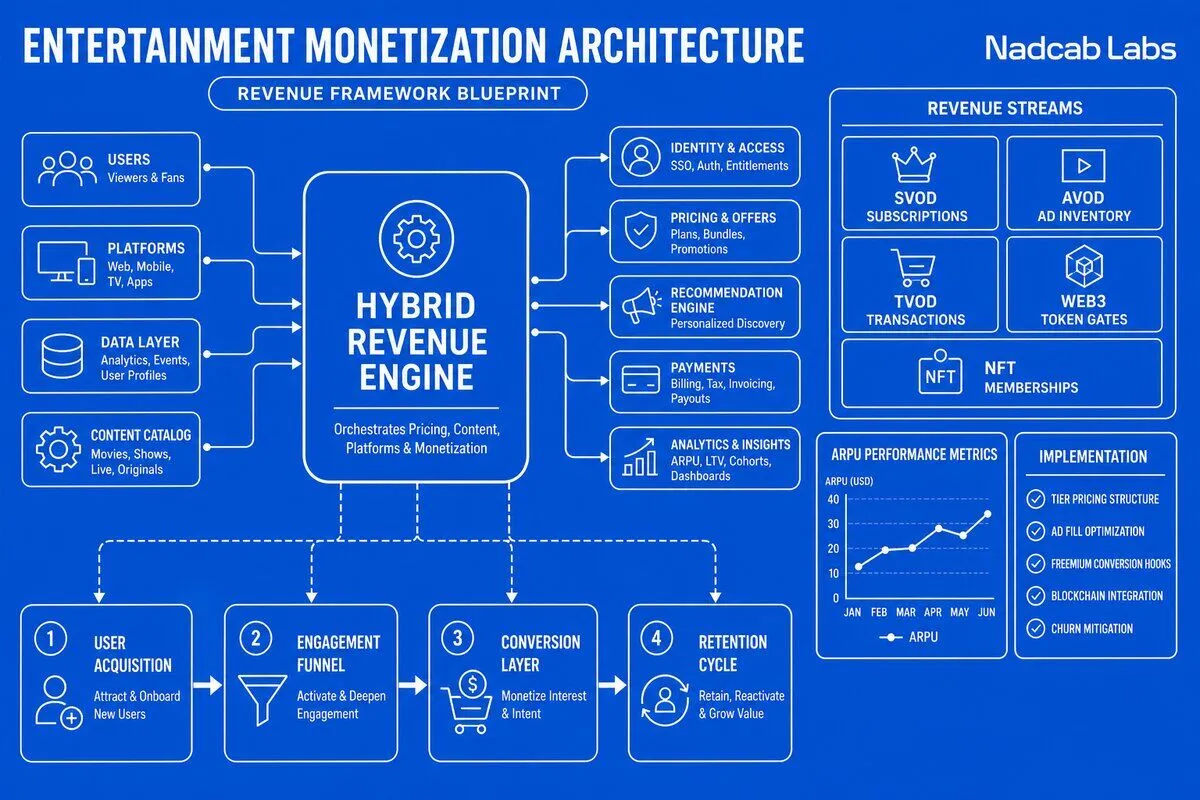
Subscription models remain dominant in streaming and gaming apps, with three primary variants shaping revenue architecture. Subscription Video on Demand (SVOD) offers unlimited content access for a recurring fee, exemplified by platforms charging $9.99–$19.99 monthly for ad-free libraries. Advertising-based Video on Demand (AVOD) provides free content supported by pre-roll, mid-roll, and display ads, while Transactional Video on Demand (TVOD) monetizes individual content purchases or rentals at $3.99–$19.99 per title.
Tiered pricing structures maximize revenue capture across user segments. Basic tiers at $7.99 monthly attract price-sensitive audiences, standard plans at $12.99 serve mainstream users with HD streaming and multiple devices, and premium tiers at $17.99+ offer 4K resolution, offline downloads, and exclusive content. Retention mechanics include annual billing discounts (typically 15–20% savings), family plans spreading costs across six users, and bundle offers combining streaming with music or gaming subscriptions.
Freemium strategies balance free content access with premium feature upsells. Core functionality remains accessible without payment—basic music streaming with ads, limited game levels, or standard video quality—while premium features require subscription upgrades. Effective freemium models identify high-value features users will pay to unlock: ad removal, unlimited skips in music apps, early access to new releases, or enhanced social features. Conversion optimization focuses on demonstrating premium value through limited-time trials, feature previews, and strategic friction points in the free experience.
Ad-supported frameworks generate revenue through multiple inventory types. Rewarded video ads offer in-app currency or premium content access in exchange for watching 15–30 second videos, achieving engagement rates above 70% in gaming apps. Native ads blend seamlessly with content feeds, delivering higher CTR (1.5–3%) than banner ads (0.3–0.8%). Programmatic advertising automates inventory sales through real-time bidding, optimizing fill rates and eCPM across demand sources. When planning entertainment app development, selecting the right monetization mix from the start ensures technical architecture supports future revenue scaling.
How Do Traditional Monetization Models Compare in Revenue Performance?
Subscription model economics demonstrate strong unit economics when churn stays below 5% monthly. Average Revenue Per User (ARPU) for streaming apps ranges from $8.42 for ad-supported tiers to $14.87 for premium subscriptions. Lifetime Value (LTV) calculations multiply ARPU by average subscription duration: a user maintaining a $12.99 subscription for 18 months generates $233.82 LTV. Churn rate benchmarks vary by vertical—music streaming averages 4.2% monthly churn, video streaming 5.8%, and fitness apps 7.1%—with annual retention rates between 40–65% across entertainment categories.
Customer Acquisition Cost (CAC) payback periods determine subscription model viability. Apps spending $35–$65 per acquired subscriber through paid channels require 3–5 months to recover costs at $12.99 monthly pricing. Organic acquisition through app store optimization and viral mechanics reduces blended CAC to $18–$28, accelerating payback to 2–3 months. Premium tiers at $19.99 monthly achieve faster payback but target smaller addressable markets, while basic tiers at $7.99 extend payback periods to 6–8 months despite broader appeal.
| Monetization Model | ARPU (Monthly) | Conversion Rate | Churn Rate | LTV (18 Months) |
|---|---|---|---|---|
| Premium Subscription | $14.87 | N/A | 4.8% | $267.66 |
| Freemium (Paid Users) | $9.23 | 3.2% | 6.4% | $166.14 |
| Ad-Supported (All Users) | $2.18 | N/A | 12.3% | $39.24 |
| Hybrid (Blended) | $6.91 | 4.7% | 5.9% | $124.38 |
Freemium conversion funnels depend on engagement triggers and premium value perception. Top-performing apps convert 2.8–5.1% of free users to paid subscriptions, with gaming apps reaching 4.2% through strategic in-app purchase prompts and content apps converting 2.9% via feature paywalls. Conversion rates spike during onboarding (first 72 hours), content cliffhangers (episode endings, level completions), and seasonal promotions (holiday trials, back-to-school offers). Revenue per user in freemium models averages $0.32 for free users (ad revenue only) and $11.47 for converted subscribers, yielding blended ARPU of $0.47 across the entire user base at 3.2% conversion.
Ad-supported model economics balance CPM rates, fill rates, and user tolerance. Cost Per Mille (CPM) for entertainment app inventory ranges from $2.14 for standard banner ads to $8.73 for rewarded video, with native ads commanding $4.26 CPM. Fill rate—the percentage of ad requests successfully filled—averages 78% for apps with multiple demand sources and programmatic fallbacks, compared to 52% for single-network implementations. A streaming app serving 2.4 million ad impressions monthly at $3.80 CPM and 76% fill rate generates $6,931 monthly revenue, translating to $2.31 ARPU across 3,000 active users. User experience trade-offs become critical above four ad interruptions per hour, with engagement dropping 18% and session duration declining 23% when ad load exceeds this threshold.
What Web3 Monetization Strategies Are Emerging for Entertainment Apps in 2026?
Token-gated content access models leverage utility tokens to unlock exclusive streaming and gaming experiences. Users purchase or earn platform tokens—priced between $0.50–$3.00 each—to access premium content, early releases, or limited-edition drops. A music streaming app might require 15 tokens ($22.50 at $1.50 per token) for exclusive concert livestreams, while a gaming platform could gate beta access behind 8 tokens ($12.00). Token economics create deflationary pressure through content consumption burns, with 30–60% of tokens used for access permanently removed from circulation, theoretically increasing remaining token value as demand grows.
Smart contracts automate access control and revenue distribution. When a user spends tokens to unlock content, the contract verifies wallet balance, transfers tokens to the platform treasury or burns them per the tokenomics model, and grants time-limited or permanent access credentials. Multi-signature wallets secure high-value token reserves, while oracle integrations enable real-world event triggers—automatically distributing bonus tokens when artists release new albums or games achieve player milestones. For insights on broader blockchain monetization, see Web3 Business Models.
NFT membership tiers offer permanent access rights, royalty shares, and community governance. Founding member NFTs priced at $299–$899 grant lifetime premium access, eliminating recurring subscription fees while generating upfront capital. Platinum tier NFTs at $1,499 include 0.5% revenue sharing from platform earnings, distributed quarterly via smart contracts to holder wallets. Gold tier NFTs at $599 provide governance voting rights on content acquisition, feature roadmaps, and treasury allocation decisions, with voting power weighted by NFT rarity and holding duration.
Secondary market royalties create ongoing revenue streams. When NFT memberships resell on OpenSea or Blur, smart contracts automatically route 5–10% royalties to the platform treasury. A founding member NFT initially sold for $499 generates $37.43 in royalties when resold at $749 (5% royalty), then $48.71 at $974 on the third sale. Over 18 months, a collection of 2,000 NFTs with 40% trading activity and 2.3 average sales per traded NFT generates $183,420 in secondary royalties at 5% rates. These mechanics are similar to structures in Crypto Wallet App Monetization models.
Play-to-earn and watch-to-earn mechanisms integrate blockchain rewards with user engagement. Gaming apps distribute 0.08–0.15 tokens per hour of active gameplay, with bonus multipliers for achievements, tournaments, and daily streaks. Streaming platforms reward 0.05 tokens per hour of content viewing, capped at 2 hours daily to prevent bot farming. Earned tokens unlock premium features, trade on decentralized exchanges, or stake for yield (8–12% APY), creating circular token economies where users reinvest earnings into platform experiences. Engagement-driven token distribution costs platforms $0.12–$0.19 per active user monthly at $1.20 token prices, offset by increased retention (42% higher for earning users) and reduced paid acquisition needs.
How Do Implementation Complexity and Infrastructure Costs Differ Across Models?
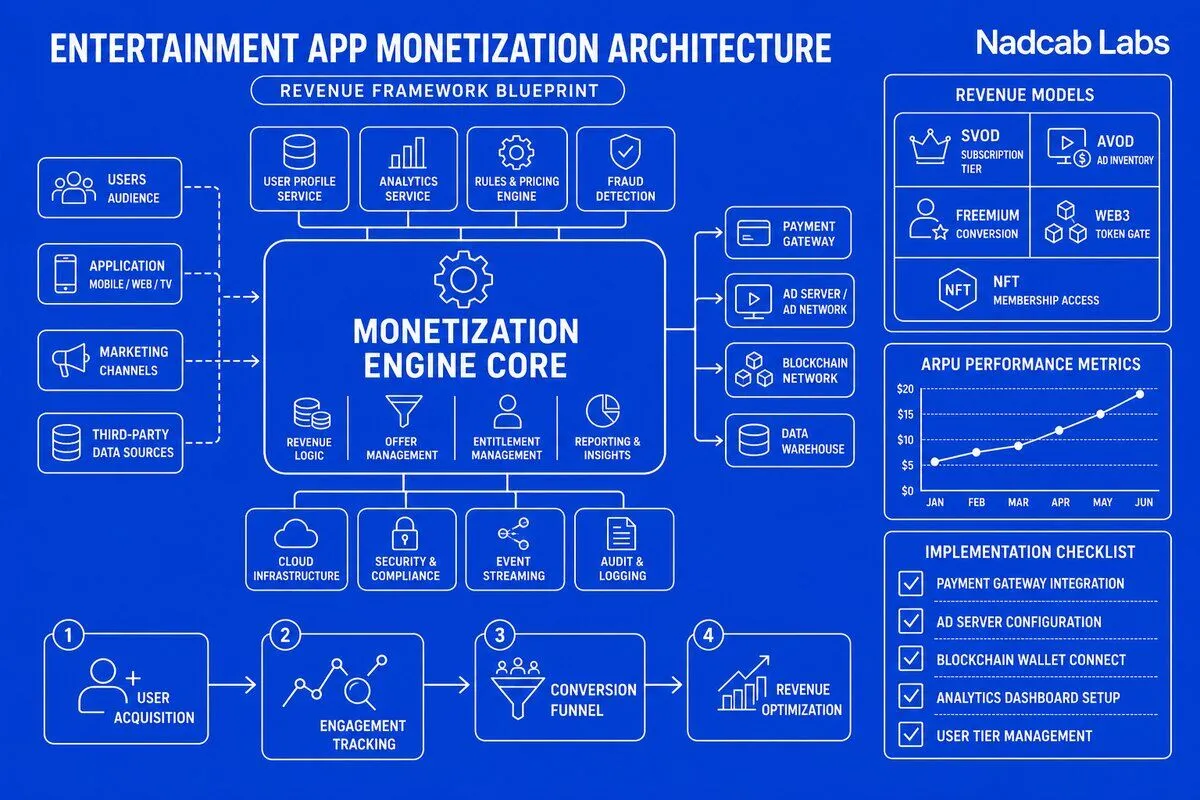
Subscription Implementation Process Flow
Connect Stripe, PayPal, or regional processors; implement PCI-compliant tokenization for card storage; configure webhook listeners for payment events ($4,200–$7,800 development cost).
Build tier selection UI, proration calculators, upgrade/downgrade flows, and cancellation workflows; implement grace periods and dunning for failed payments ($6,100–$9,400).
Integrate Widevine or FairPlay for content encryption; implement license servers and device limits; configure geo-restriction rules ($8,700–$14,200 for streaming platforms).
Deploy cohort analysis, churn prediction models, and automated win-back campaigns; integrate with Mixpanel or Amplitude ($3,800–$6,200).
Total Implementation Cost: $22,800–$37,600
Technical requirements for subscription billing demand robust payment infrastructure and recurring charge management. Payment gateway integration with Stripe or Braintree requires 80–120 developer hours, including webhook handling for subscription renewals, payment failures, and refund processing. Subscription management logic encompasses tier selection interfaces, proration calculations when users upgrade mid-cycle, and automated email sequences for payment reminders. Digital Rights Management (DRM) integration protects premium content through encryption and license verification, with Widevine DRM costing $0.02–$0.05 per stream and FairPlay requiring Apple developer enrollment at $99 annually plus per-device licensing.
Infrastructure overhead for ad-serving networks involves real-time bidding integration and analytics pipelines. Ad mediation platforms like Google AdMob or ironSource charge 3–5% revenue share while providing demand aggregation across 20+ ad networks. Real-time bidding (RTB) infrastructure requires sub-100ms response times to participate in programmatic auctions, demanding CDN distribution and edge caching at $240–$680 monthly for 5 million monthly active users. Analytics systems track impression delivery, viewability rates (percentage of ads actually seen by users), and click-through attribution, requiring data warehouse infrastructure at $180–$420 monthly for standard entertainment app scale. Similar infrastructure considerations apply to platforms discussed in Fintech App Development Companies.
Blockchain development costs for Web3 models include smart contract audits, wallet integration, and token infrastructure. Smart contract development for token-gated access or NFT memberships costs $12,000–$28,000, with mandatory security audits adding $8,000–$15,000 to prevent exploits. Wallet integration supporting MetaMask, WalletConnect, and Coinbase Wallet requires 120–180 developer hours at $85–$140 hourly rates. Token economics design—determining supply caps, burn rates, staking rewards, and distribution schedules—requires economic modeling expertise at $6,000–$12,000 for comprehensive tokenomics documentation. Ongoing blockchain infrastructure costs include gas fees for contract interactions ($0.08–$0.32 per transaction on Polygon, $2.40–$8.70 on Ethereum) and node provider fees at $99–$299 monthly for reliable RPC access.
Development timelines vary significantly by model complexity. Basic subscription billing launches in 6–8 weeks with off-the-shelf solutions like RevenueCat or Adapty, while custom implementations require 10–14 weeks. Ad-supported models deploy in 4–6 weeks using mediation SDKs but need ongoing optimization cycles every 2–3 months to maximize fill rates and eCPM. Web3 monetization demands 14–20 weeks for smart contract development, testing, audits, and mainnet deployment, with additional 6–8 weeks for wallet integration and token launch coordination. For broader context on technical implementation, explore Android Application Development approaches.
Which Monetization Model Should Entertainment Apps Choose in 2026?
Decision frameworks balance audience demographics, content type, and competitive positioning. Subscription models suit content-rich platforms with high production value—original series, exclusive music catalogs, premium game content—where users perceive clear value in unlimited access. Target audiences with household incomes above $65,000 convert at 4.2% to subscription tiers, compared to 2.1% for audiences below $45,000. Freemium works best for viral-growth products where network effects drive value—social gaming, user-generated content platforms, collaborative tools—converting engaged free users through strategic premium feature gates.
Ad-supported models fit content discovery platforms with broad audience reach and high session frequency. News aggregators, short-form video apps, and casual gaming platforms monetize effectively through ads when daily active users exceed 50,000 and average session counts surpass 3.2 daily. Web3 monetization targets crypto-native audiences (18–34 year olds with existing wallet adoption) and communities valuing ownership, governance, and speculative asset appreciation. NFT membership tiers resonate with superfans willing to invest $299–$899 for permanent access and status signaling within creator communities.
Revenue Potential by Model (Per 100K Monthly Active Users)
Hybrid model strategies maximize revenue capture across user segments while mitigating single-model risks. Leading streaming platforms combine ad-supported free tiers (attracting 70–80% of users), mid-tier subscriptions at $9.99 removing ads, and premium tiers at $16.99 adding offline downloads and 4K streaming. This three-tier approach generates blended ARPU of $4.83 across all users—$1.87 from ad-supported users, $9.99 from standard subscribers (12% of base), and $16.99 from premium subscribers (5% of base). Web3 integration layers onto existing models through optional NFT memberships and token rewards, capturing crypto-native users without alienating traditional audiences. For example, a gaming app might offer standard $7.99 subscriptions alongside $399 founding member NFTs, with token rewards available to all users regardless of payment model.
Long-term scalability considerations include regulatory compliance, user acquisition costs, and market saturation. Subscription models face increasing churn as market saturation grows—users now subscribe to 3.8 streaming services on average, down from 4.2 in 2024, indicating consolidation pressure. Ad-supported models must navigate privacy regulations (GDPR, CCPA) restricting behavioral targeting, reducing CPM rates by 15–30% for non-targeted inventory. Web3 monetization encounters regulatory uncertainty around token securities classification and NFT consumer protection laws, requiring legal reserves of $15,000–$35,000 for compliance counsel. User acquisition costs rise 8–12% annually across all models as paid channel competition intensifies, making organic growth and retention optimization critical for sustainable unit economics. Resources like Android App Development Companies can help optimize acquisition funnels.
Market positioning determines optimal model selection. First-movers in emerging entertainment categories (interactive storytelling, AI-generated content, metaverse experiences) often adopt freemium to maximize user base growth, then layer monetization as network effects solidify. Established players entering competitive markets leverage premium subscriptions to signal quality and justify higher content investment. Niche communities with passionate fanbases (anime, indie music, esports) monetize effectively through Web3 models, converting superfans into stakeholders through NFT memberships and governance tokens. Mass-market entertainment targeting 100+ million users typically relies on ad-supported models with optional subscription upgrades, balancing accessibility with revenue optimization. Platforms exploring immersive experiences should consider AR/VR App Development capabilities.
Frequently Asked Questions
Q1.What are the different types of monetization models for entertainment apps in 2026?
In 2026, entertainment apps use subscription (recurring access fees), freemium (basic free, premium paid), advertising (display/video ads), in-app purchases (content/features), pay-per-view (single content payments), token-gated access (blockchain-based ownership), and hybrid models combining multiple approaches. Each suits different content types and audience behaviors.
Q2.How does subscription monetization compare to freemium for streaming apps in 2026?
Subscription models in 2026 generate predictable recurring revenue ($8-15 monthly average) with higher lifetime value but require strong content libraries. Freemium attracts larger user bases with 2-5% conversion rates, lower entry barriers, and flexibility but faces higher churn. Subscriptions suit premium content; freemium works for user-growth strategies.
Q3.What is the average revenue per user for ad-supported entertainment apps in 2026?
Ad-supported entertainment apps in 2026 generate $2-8 average revenue per user (ARPU) monthly, varying by engagement levels and ad formats. Video ads yield $4-12 per thousand impressions, while display ads earn $0.50-2. Gaming and streaming apps with high session times achieve upper-range ARPU through programmatic advertising.
Q4.How do token-gated content models work in Web3 entertainment apps in 2026?
Token-gated models in 2026 require users to hold specific NFTs or cryptocurrency tokens to access exclusive content, features, or communities. Smart contracts verify ownership automatically. Users purchase or earn tokens, gaining membership benefits like premium streams, early releases, or interactive experiences, creating scarcity-driven engagement and secondary market opportunities.
Q5.Which monetization model has the lowest implementation cost for new entertainment apps in 2026?
Ad-supported monetization has the lowest implementation cost in 2026, requiring only SDK integration with networks like Google AdMob or Unity Ads ($500-2,000 setup). No payment processing infrastructure or content gating needed. Freemium follows closely, while subscription and blockchain models demand more complex payment systems, security, and compliance infrastructure.
Q6.Can entertainment apps combine multiple monetization models effectively in 2026?
Yes, hybrid monetization is highly effective in 2026. Apps commonly combine ad-supported free tiers with premium subscriptions (removing ads), in-app purchases for exclusive content, and token rewards for engagement. This maximizes revenue across user segments—casual users generate ad revenue while dedicated fans pay for subscriptions or NFT access, increasing overall profitability.
Explore Services
Related Services
Reviewed by

Aman Vaths
Founder of Nadcab Labs
Aman Vaths is the Founder & CTO of Nadcab Labs, a global digital engineering company delivering enterprise-grade solutions across AI, Web3, Blockchain, Big Data, Cloud, Cybersecurity, and Modern Application Development. With deep technical leadership and product innovation experience, Aman has positioned Nadcab Labs as one of the most advanced engineering companies driving the next era of intelligent, secure, and scalable software systems. Under his leadership, Nadcab Labs has built 2,000+ global projects across sectors including fintech, banking, healthcare, real estate, logistics, gaming, manufacturing, and next-generation DePIN networks. Aman’s strength lies in architecting high-performance systems, end-to-end platform engineering, and designing enterprise solutions that operate at global scale.