Ai Overview
Choosing the right AI partner is important for businesses that want to successfully adopt artificial intelligence. According to a 2026 report by McKinsey & Company, AI could add around $4. Most businesses, even large enterprises, find it far more efficient and cost effective to partner with a team that already has this capability operating at scale.
Key Takeaways
- Choosing the right AI development partner directly impacts the speed, accuracy, and scalability of your AI Applications and AI Platforms.
- A qualified AI partner brings deep technical expertise across machine learning, NLP, computer vision, and data engineering, not just software coding skills.
- Businesses that define clear success KPIs before engaging an AI partner achieve ROI up to 3x faster than those who do not set benchmarks upfront.
- Custom AI solution development delivers significantly higher competitive differentiation compared to off the shelf tools, especially for businesses with unique workflows or sensitive data.
- Security, data privacy compliance, and IP ownership must be explicitly defined in contracts before any AI project begins.
- AI integration with existing business systems requires a partner who understands legacy infrastructure, APIs, and cloud migration strategies simultaneously.
- Startups and enterprises have fundamentally different AI needs; the right partner adapts their methodology and pricing model accordingly for each context.
- The lifecycle of an AI engagement spans discovery, data preparation, modeling, deployment, and continuous monitoring, not just a one time build.
- Future trends such as generative AI, federated learning, and autonomous AI agents are reshaping what businesses should expect from their AI partners by 2026 and beyond.
- Nadcab Labs has spent over 8 years helping businesses across industries launch and scale intelligent AI Applications on enterprise grade AI Platforms with measurable outcomes.
Introduction: Why the Right AI Partner Changes Everything
Choosing the right AI partner is important for businesses that want to successfully adopt artificial intelligence. A clear evaluation process helps organizations compare different options and avoid common mistakes when selecting a technology partner.
According to a 2026 report by McKinsey & Company, AI could add around $4.4 trillion in productivity growth for global businesses. While basic AI tools can improve simple tasks, advanced solutions help automate workflows, solve complex problems, and increase efficiency.
The global AI market is projected to surpass $826 billion by 2030, and businesses across every sector are racing to embed intelligence into their products, processes, and customer experiences. Yet the single biggest differentiator between companies that succeed with AI and those that struggle is not the technology itself. It is the quality of the AI development partner they choose to work with.
Whether you are exploring your first AI Application or scaling a suite of interconnected AI Platforms, this guide walks you through everything you need to know: what an AI development partner actually does, what to look for when evaluating vendors, how to structure your selection process, and how to ensure your engagement delivers lasting business value rather than just a one time deployment.
of AI projects fail due to poor partner selection or unclear requirements
higher ROI when businesses use a structured vendor selection process
projected global AI market size by 2030
Of enterprises plan to expand AI budgets in 2026
What Is an AI Development Partner?
An AI development partner is a specialized technology firm or team that collaborates with your business to conceive, design, build, deploy, and maintain intelligent software solutions. Unlike a general software agency, an AI partner brings dedicated expertise in data science, machine learning engineering, model architecture, and MLOps, making them equipped to handle the full complexity of modern artificial intelligence projects.
The distinction matters enormously. A vendor selling off-the-shelf tools simply configures existing software. A true AI development partner understands your unique data landscape, business objectives, regulatory constraints, and competitive context, then architects a solution tailored specifically to those realities. They act less like a contractor and more like a strategic co founder for your AI journey.
Why Businesses Need an AI Development Partner
Building a functional, production-grade AI Application requires a rare combination of skills: statistical modeling, data engineering, cloud infrastructure, domain expertise, and product thinking. Assembling this capability in-house takes years and millions of dollars in talent acquisition. Most businesses, even large enterprises, find it far more efficient and cost effective to partner with a team that already has this capability operating at scale.
Beyond technical skills, AI projects carry unique risks that an experienced partner helps navigate: biased training data, model drift after deployment, compliance gaps, and poor integration with legacy systems. A partner who has successfully delivered reliable AI solutions across dozens of client engagements brings institutional knowledge that no internal team can replicate quickly.
Key Roles of an AI Development Partner in Modern Businesses
A capable AI partner wears many hats depending on the stage and scope of your project. Here are the core roles they fulfill:
- ✔Strategic Advisor: Helps identify where AI can create the most measurable business impact before any code is written.
- ✔Data Architect: Designs the data pipelines, storage strategies, and preprocessing workflows that make model training possible.
- ✔Model Engineer: Selects, trains, fine tunes, and validates machine learning models tailored to your specific problem domain.
- ✔Integration Specialist: Connects AI outputs seamlessly into your existing CRM, ERP, mobile apps, or cloud AI Platforms.
- ✔Compliance Guardian: Ensures all AI systems meet GDPR, HIPAA, SOC 2, or sector specific data protection requirements.
- ✔Performance Monitor: Tracks model accuracy, data drift, and business KPIs post deployment to ensure ongoing relevance.
- ✔Knowledge Transfer Lead: Trains your internal team and documents systems so your organization builds lasting AI capability.
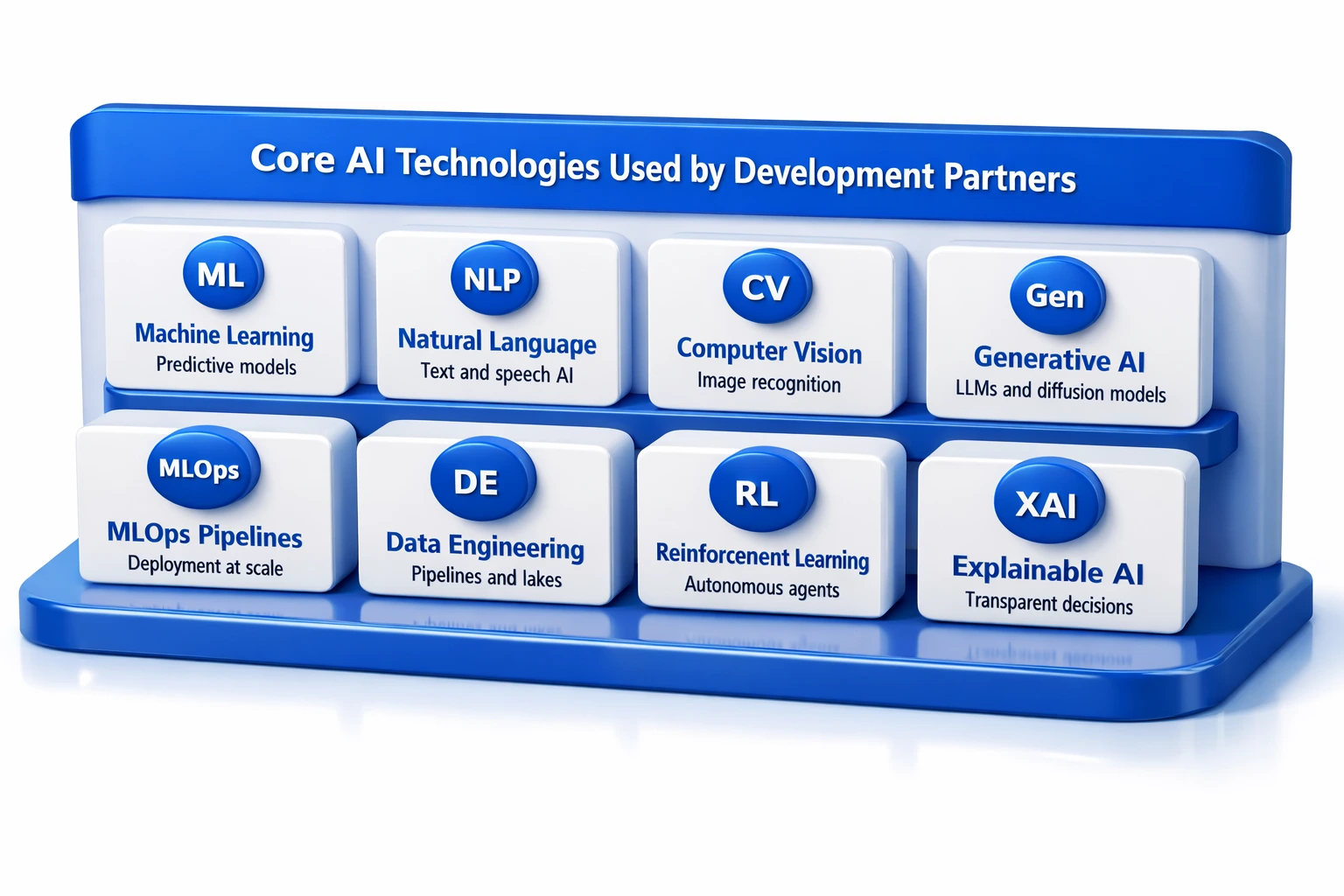
Core AI Technologies Used by Development Partners
| Technology | Primary Use Case | Business Benefit | Common AI Platforms |
|---|---|---|---|
| Machine Learning | Prediction, classification, anomaly detection | Reduces manual analysis time by up to 70% | AWS SageMaker, Google Vertex AI |
| Natural Language Processing | Chatbots, sentiment analysis, document parsing | Improves customer support efficiency significantly | OpenAI API, Azure Cognitive Services |
| Computer Vision | Image recognition, quality inspection, surveillance | Automates visual tasks with human level accuracy | Google Vision AI, AWS Rekognition |
| Generative AI | Content creation, synthetic data, design automation | Accelerates creative and R&D workflows drastically | Anthropic Claude, OpenAI GPT, Gemini |
| Reinforcement Learning | Autonomous decision systems, robotics, game AI | Enables continuous self improvement without human input | Ray RLlib, OpenAI Gym, DeepMind Lab |
| MLOps and DataOps | Model versioning, monitoring, retraining pipelines | Ensures long term model reliability and performance | MLflow, Kubeflow, Weights and Biases |
Benefits of Partnering with an AI Development Company
The advantages of working with a specialized AI development company extend far beyond technical execution. When you engage the right partner, you gain a force multiplier that accelerates your entire digital strategy.
Speed to market is one of the most tangible benefits. A partner with pre built frameworks, proven model architectures, and established data pipelines can reduce your AI Application launch timeline from 18 months to 4 or 6 months. Access to niche talent is another critical advantage: top AI engineers, data scientists, and ML researchers often prefer working within specialized firms where they can tackle varied, cutting edge challenges rather than joining a single company’s internal team.
Cost efficiency is equally compelling. Building an in house AI team with comparable expertise typically costs $2M to $5M per year when you account for salaries, infrastructure, training, and tooling. An external partner scales up or down with your project demands, converting fixed costs into variable, manageable investments tied directly to outcomes.
Industry Insight: According to McKinsey Global Institute, organizations that fully leverage AI partnerships grow revenue at a pace 2.5x faster than those relying entirely on internal capability. Selecting the right AI Platforms and implementation partner is the single highest impact decision in an AI transformation journey.
How AI Development Partners Help in Digital Transformation
Digital transformation is more than migrating to the cloud or redesigning your website. It is about fundamentally rethinking how your business creates and delivers value, with data and intelligence at the core. AI development partners serve as the technical architects and strategic navigators of this transformation.
A skilled partner begins by mapping your current operational landscape: where decisions are being made manually, where data is being generated but not analyzed, and where customer experiences fall short of expectations. They then layer intelligent AI Applications across these gaps, turning raw operational data into actionable insight, predictive recommendations, and automated workflows. Learn more about how AI systems are architected from data to deployment to understand the technical backbone of these transformations.
AI Development Partner for Startups and Enterprises
| Parameter | Startups | Enterprises |
|---|---|---|
| Primary Goal | Build MVP AI Application fast and validate market fit | Scale AI across departments and integrate with legacy systems |
| Budget Range | $20K to $150K for initial engagement | $500K to $5M+ for enterprise grade AI Platforms |
| Data Availability | Limited; partner helps build data collection pipelines | Large datasets available; partner focuses on quality and governance |
| Speed Priority | Rapid iterations, 6 to 12 week sprints | Methodical rollout with change management protocols |
| Compliance Needs | Standard security; specific to industry if applicable | GDPR, HIPAA, SOC 2, ISO 27001, sector regulations |
| Engagement Model | Fixed price or time and materials | Dedicated team or managed services with SLAs |
| Post Launch Support | Basic monitoring and hotfix support | Continuous model retraining and enterprise support tiers |
Custom AI Solution Development for Business Needs
Off the shelf AI tools serve generic use cases adequately but rarely deliver the precision that competitive businesses need. Custom AI solution building begins with a deep discovery phase where your partner immerses themselves in your domain, your data, and your desired outcomes before writing a single line of code.
A retailer wanting to optimize inventory across 1,200 SKUs has fundamentally different data characteristics and business logic than a hospital managing patient readmission risk. Custom modeling accounts for these nuances. The result is an AI Application that not only performs more accurately on your specific data but also aligns with the operational workflows your teams already use, reducing adoption friction and accelerating time to value. You can explore how AI system building blocks come together in modern enterprise solutions to better understand this customization depth.
AI Integration with Existing Business Systems
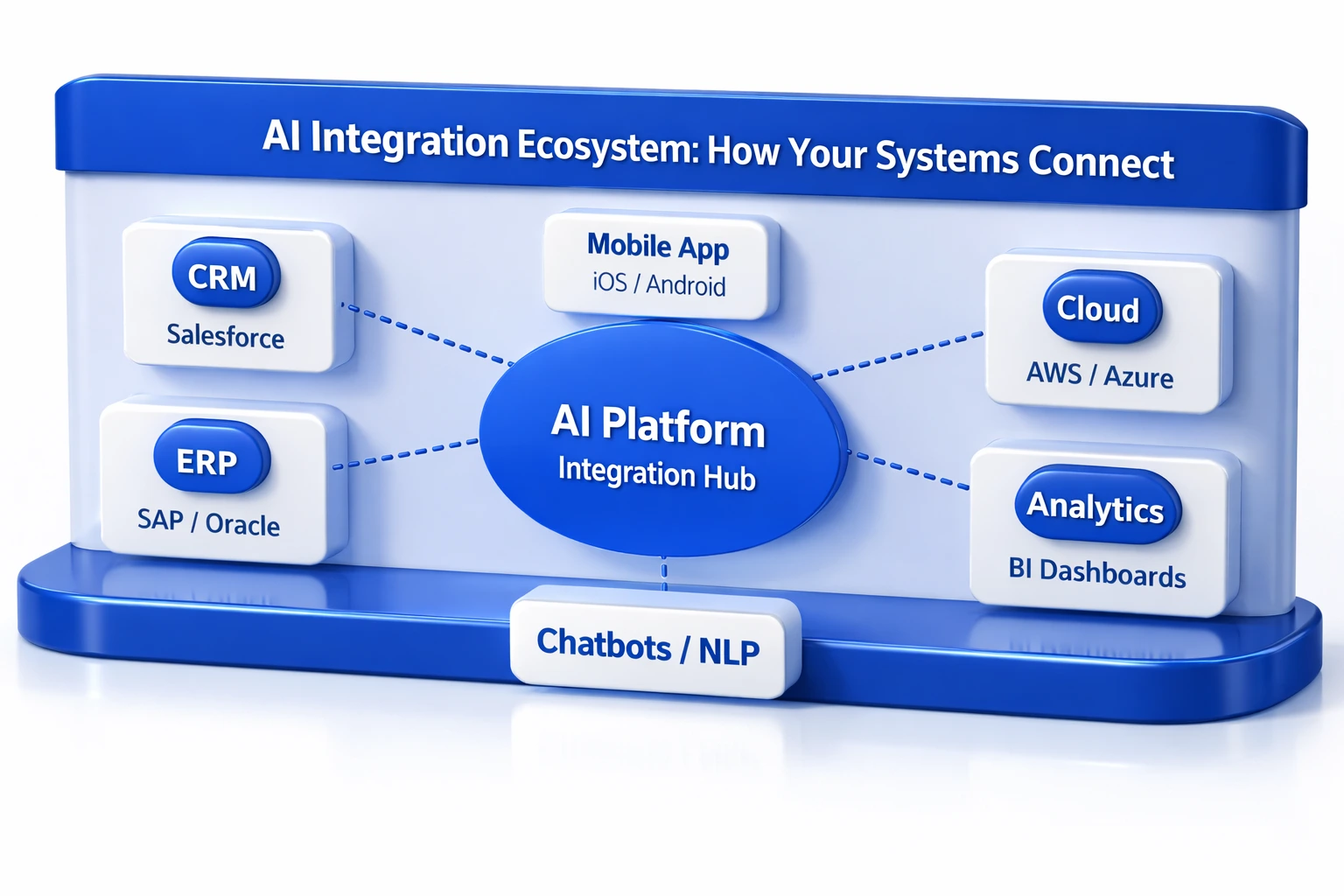
One of the most underestimated challenges in AI adoption is integration. Most businesses already have years of investment in ERP platforms, CRM systems, data warehouses, and custom internal tools. A good AI partner does not ask you to replace these systems. Instead, they design integration layers, APIs, and middleware that connect your new AI capabilities, including AI agent development, to your existing infrastructure without disrupting ongoing operations. Utilizing tools like Uniqode’s QR Code generator can further bridge this gap by creating physical-to-digital touchpoints that link legacy hardware or printed reports directly to these new AI-driven dashboards.
Common integration scenarios include embedding predictive models into a Salesforce CRM so sales reps receive AI powered lead scores directly in their workflow, connecting computer vision inspection models to a manufacturing execution system for real time quality alerts, and integrating NLP engines into customer support ticketing platforms to auto classify and route incoming queries. Understanding how AI tokens work helps contextualize how language models communicate within these integrated systems.
Security and Compliance in AI Development
Data is the fuel of every AI Application, and with great data comes significant responsibility. A credible AI partner treats security and compliance not as an afterthought but as foundational architecture decisions made during the earliest stages of the project.
They implement role based access controls, end to end encryption for data in transit and at rest, audit logging for all model interactions, and differential privacy techniques where appropriate. On the compliance side, a reputable partner will guide you through GDPR Article 22 requirements for automated decision making, HIPAA safe harbor provisions for healthcare AI, and PCI DSS controls for financial AI Applications. Contracts must explicitly cover data residency, right to erasure compliance, and model ownership to prevent ambiguity post engagement. Understanding the role AI plays across digital ecosystems also illuminates why security architecture must be built for future scale, not just current use.
Steps Followed by an AI Development Partner
Understanding the lifecycle of an AI engagement helps you set realistic expectations, allocate internal resources appropriately, and hold your partner accountable at each milestone.
Discovery and Business Analysis
Deep dive into your business goals, current data infrastructure, success metrics, and technical constraints. This phase produces a feasibility report and project roadmap.
Data Assessment and Preparation
Audit existing datasets for quality, completeness, and bias. Design data collection, cleansing, labeling, and augmentation pipelines to prepare training ready datasets.
Model Architecture and Training
Select appropriate algorithms, train baseline models, run hyperparameter optimization, and validate performance against held out test data using relevant accuracy metrics.
Integration and System Deployment
Connect trained models to your existing AI Platforms, business systems, or end user interfaces via APIs, microservices, or embedded SDKs with full CI/CD pipeline setup.
Testing, QA, and Security Audit
Conduct end to end functional testing, adversarial stress testing, bias audits, penetration testing, and regulatory compliance verification before production launch.
Launch and Post Deployment Monitoring
Go live with phased rollout strategies, establish real time monitoring dashboards, configure drift detection alerts, and schedule regular model retraining cycles to maintain accuracy.
Industries Leveraging AI Development Partnerships
| Industry | AI Application Example | Key Outcome |
|---|---|---|
| Healthcare | Predictive readmission risk models, medical imaging AI | Reduces hospital readmissions by up to 25% |
| Finance and Banking | Fraud detection engines, credit scoring AI Platforms | Cuts fraud losses by 40 to 60% across portfolios |
| Retail and E commerce | Personalized recommendation systems, demand forecasting | Increases average order value by 15 to 30% |
| Manufacturing | Predictive maintenance, computer vision quality control | Reduces unplanned downtime by up to 35% |
| Logistics and Supply Chain | Route optimization AI, inventory intelligence systems | Lowers operational costs by 20 to 28% |
| Legal and Compliance | Contract analysis NLP, regulatory monitoring bots | Reduces document review time by over 80% |
| Education and EdTech | Adaptive learning platforms, AI tutoring systems | Improves learner completion rates by 40% |
Challenges Solved by AI Development Partners
Most businesses encounter a predictable set of obstacles on their AI journey. An experienced partner has seen and solved these problems across dozens of engagements, which dramatically reduces your risk:
- ✔Data Scarcity: Partners use synthetic data generation, transfer learning, and data augmentation to train effective models even when historical datasets are small.
- ✔Model Bias: Rigorous fairness audits, diverse training data strategies, and bias mitigation techniques ensure equitable AI Application outputs.
- ✔Legacy System Incompatibility: Custom API layers and middleware bridge the gap between modern AI Platforms and older infrastructure without requiring full system replacement.
- ✔Skill Gaps: Partners provide training, documentation, and knowledge transfer sessions so your internal team is never left dependent on external support indefinitely.
- ✔Regulatory Uncertainty: Seasoned partners track evolving AI regulations globally and proactively adapt your systems to maintain compliance as laws change.
- ✔Scaling Bottlenecks: Cloud native, containerized AI deployments ensure your models scale seamlessly as transaction volumes and user bases grow.
How to Choose the Right AI Development Partner
The selection process deserves the same rigor you would apply to hiring a senior executive. The partner you choose will have deep access to your data, significant influence over your technology architecture, and a direct hand in shaping competitive capabilities that will affect your business for years.
Start by clearly defining what you need: Are you solving a specific operational problem, or undertaking a broad AI transformation? Are your data assets mature or nascent? What does success look like in 12 months? These answers will shape the profile of the partner you need, and using them as filters early in the process saves enormous time and prevents costly mismatches. Exploring resources like guides on what artificial intelligence is and how AI tokens work for beginners can help you build foundational fluency before entering vendor discussions.
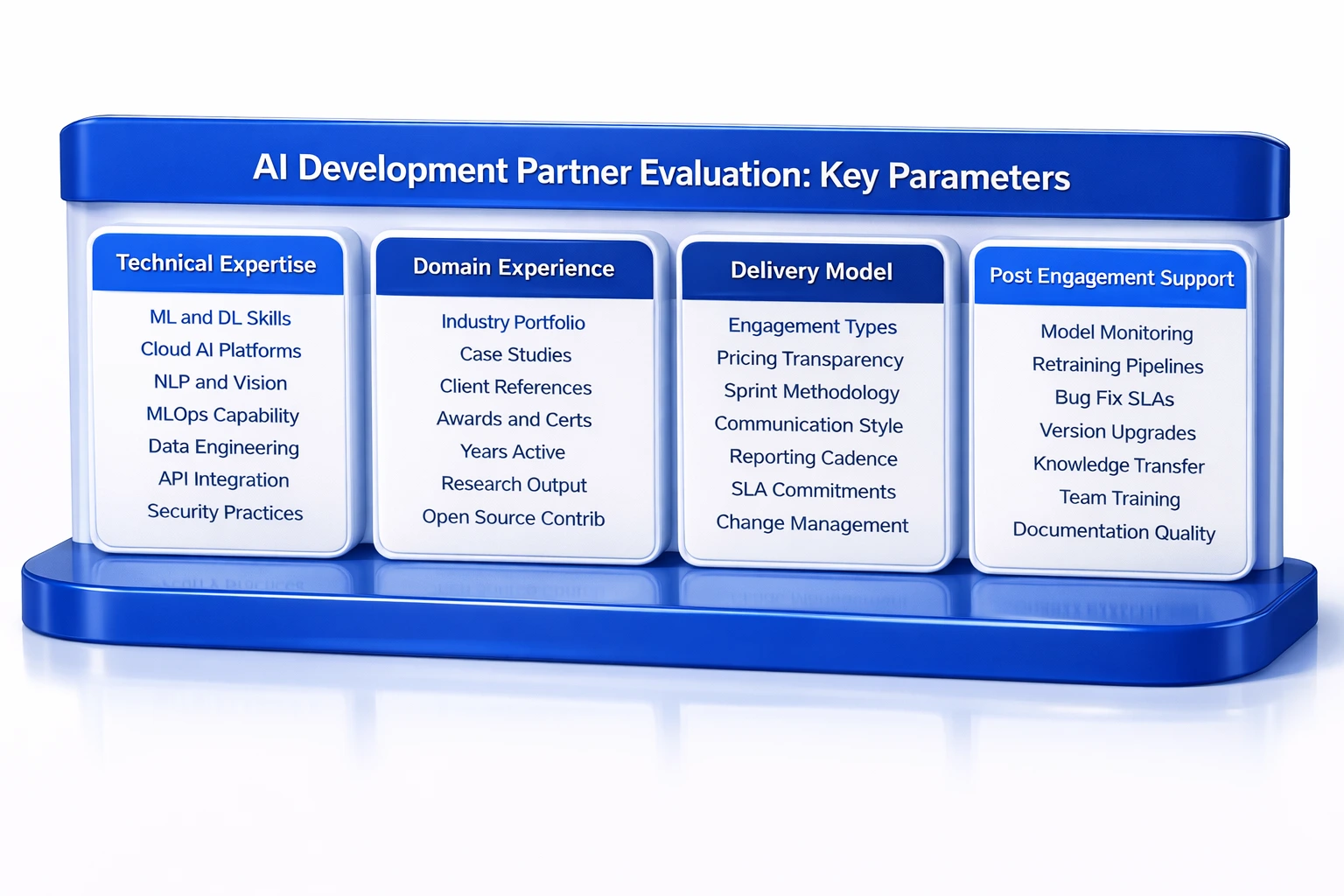
AI Development Company Checklist
Use this checklist to systematically evaluate every AI vendor you engage during your selection process:
- ✔Verified portfolio of 5 or more completed AI Application projects in your industry or adjacent domains
- ✔Demonstrable expertise in the specific AI technology your use case requires such as NLP, computer vision, or time series forecasting
- ✔Transparent pricing models with clear milestones and deliverables tied to each payment stage
- ✔Dedicated data science team with senior ML engineers, not just generalist software developers
- ✔Documented security practices including encryption standards, access controls, and penetration testing protocols
- ✔Experience with the AI Platforms relevant to your cloud environment such as AWS, GCP, Azure, or on premise
- ✔Post launch support model that includes model monitoring, drift detection, and scheduled retraining
- ✔Clear IP assignment language in standard contract templates that grants full ownership to the client
- ✔Client references you can contact directly and who have authorized the vendor to share their outcomes
- ✔Alignment on methodology: Agile sprints with regular demos are essential for AI projects where requirements evolve
Questions to Ask AI Development Vendors
Beyond reviewing portfolios and pricing, the questions you ask during vendor conversations reveal critical information about culture, capability, and reliability. The following questions separate genuine AI experts from generalist firms with impressive marketing:
- ✔How do you handle situations where the training data is insufficient or of poor quality?
- ✔Can you walk me through a project where the AI model underperformed and how you resolved it?
- ✔What MLOps tools do you use for model versioning, drift monitoring, and automated retraining?
- ✔How do you approach explainability for models that will influence high stakes business decisions?
- ✔Who owns the trained model, the code, and the data pipelines once the project concludes?
- ✔What compliance frameworks have you implemented in previous AI Application engagements?
- ✔How do you ensure the AI solution continues to perform well as my business data evolves?
- ✔What does your knowledge transfer and internal team upskilling program look like?
- ✔Can you provide a detailed breakdown of your proposed technology stack and why each component was chosen?
- ✔What is your escalation process if a critical model failure occurs in production?
Where to Start Finding the Right AI Development Partner
The search for the right AI partner should be structured, not reactive. Begin with internal alignment: ensure your leadership team agrees on budget range, the problem you are solving, and the definition of success before approaching any vendor. the problem you are solving, and the definition of success before approaching any vendor. the problem you are solving, and the definition of success before approaching any vendor. Choosing the best AI development company at this stage helps ensure your goals and long-term AI strategy are clearly aligned. Rushing this step leads to misaligned proposals and wasted evaluation time.
Research partners through multiple channels: technology analyst reports from Gartner and Forrester, peer recommendations from your professional network, curated directories on Clutch and G2, and public repositories like GitHub where you can evaluate actual code quality. Shortlist five to seven candidates, issue a structured RFP with clear requirements, and evaluate responses against your defined criteria rather than on presentation quality alone. A technical proof of concept or paid discovery engagement with two to three finalists is always worthwhile before committing to a full project. See how AI system architecture flows from data to deployment to sharpen the technical questions you ask shortlisted vendors.
Future Trends in AI Development Partnerships
The AI landscape is evolving faster than any previous technology wave, and the partners best positioned to serve your business in 2026 and beyond are already building capability in these emerging areas:
- ✔Agentic AI Systems: Autonomous AI agents that plan, reason, and execute multi step tasks with minimal human oversight are moving from research labs into production AI Platforms.
- ✔Multimodal AI Applications: Models that simultaneously process text, images, audio, and structured data are unlocking entirely new product categories across every industry.
- ✔Federated Learning: Privacy-preserving training techniques that allow models to learn from decentralized data without centralizing sensitive information are becoming standard in regulated industries.
- ✔Small Language Models: Efficient, domain specific language models deployable on edge devices are challenging the assumption that larger always means better for enterprise AI Applications.
- ✔AI Governance Frameworks: As governments worldwide introduce AI regulation, partners with proven governance expertise will command significant premiums and trust advantages.
- ✔AI and Blockchain Convergence: Combining AI intelligence with blockchain immutability is creating new trust layers for AI outputs, particularly in financial and legal AI Platforms.
Cost Factors in Hiring an AI Development Partner
| Cost Factor | What Drives the Cost | Typical Range |
|---|---|---|
| Discovery and Strategy | Depth of business analysis, competitive research, feasibility assessment | $5K to $25K |
| Data Preparation | Volume of data, labeling complexity, pipeline architecture | $10K to $80K |
| Model Building and Training | Algorithm complexity, compute requirements, iteration cycles | $30K to $250K |
| Integration and Deployment | API complexity, existing system maturity, cloud infrastructure setup | $20K to $120K |
| Security and Compliance Audit | Regulatory framework requirements, penetration testing, certifications | $8K to $40K |
| Ongoing Monitoring and Support | Model complexity, SLA tier, retraining frequency | $2K to $15K per month |
| Training and Knowledge Transfer | Team size, documentation depth, workshop sessions | $5K to $30K |
Best Practices for Using Generative AI Responsibly
As generative AI becomes a standard feature of modern AI Applications, businesses and their development partners share responsibility for ensuring these powerful tools are used ethically and transparently. Responsible generative AI practice begins with clearly communicating to end users when they are interacting with AI generated content, preventing the erosion of trust that comes from ambiguity.
Output validation is non negotiable: no generative AI model should make consequential decisions such as loan approvals, medical recommendations, or legal interpretations without a human in the loop review step. Bias testing for generative outputs is equally important, as large language models can reproduce and amplify societal biases present in their training data. Your AI partner should have explicit responsible AI policies that cover content filtering, hallucination mitigation, output auditing, and regular red team exercises to proactively identify misuse vectors before they become liabilities.
Conclusion: The Strategic Value of an AI Development Partner
The decision to partner with a specialized AI team is not a tactical IT choice. It is a strategic business investment that shapes your capacity to innovate, compete, and serve your customers at an entirely new level of intelligence. The right partner brings technical depth, domain knowledge, security rigor, and post deployment accountability that no off-the-shelf tool or generalist agency can match.
By approaching your partner search with clarity about your goals, structured evaluation criteria, and an understanding of the full AI lifecycle, you dramatically increase the probability of delivering an AI Application that creates measurable, lasting value. The businesses thriving in the AI era are not those with the biggest budgets; they are those who chose the right partners and moved with purpose.
Frequently Asked Questions
Q1.How long does it typically take to build a custom AI solution?
The timeline depends on complexity, data availability, and integration requirements. A simple AI powered chatbot might take 4 to 8 weeks, while a full scale enterprise AI platform can take 6 to 12 months. Factors like data preparation, model training, testing, and deployment all contribute. Discussing timelines upfront with your AI partner helps set realistic expectations and avoids costly project delays down the line.
Q2.What is the difference between an AI consultant and an AI development partner?
An AI consultant advises on strategy, feasibility, and technology selection but rarely builds the actual solution. An AI development partner takes full ownership of design, building, integration, and deployment. They work alongside your team throughout the project lifecycle. For businesses that want end to end execution rather than just guidance, choosing a dedicated AI development partner offers far greater practical value and long term support.
Q3.Can a small business afford to hire an AI development partner?
Yes. Many AI development partners offer flexible engagement models tailored for small businesses, including fixed price projects, MVP builds, and pay as you go models. Cloud based AI platforms have dramatically reduced infrastructure costs. Small businesses do not need enterprise level budgets to benefit from AI. Starting with a focused use case, such as automating customer support or analyzing sales data, can deliver measurable ROI without requiring a massive upfront investment.
Q4.What happens if the AI model gives inaccurate results after deployment?
Reputable AI partners include post deployment monitoring and model retraining as part of their service agreements. If a model underperforms, the team investigates root causes such as data drift, outdated training sets, or changing business conditions. Regular performance audits, feedback loops, and continuous improvement cycles are standard practices. Always confirm your partner offers ongoing support before signing any contract to avoid being left without recourse.
Q5.Is it necessary to share sensitive business data with an AI development partner?
Not always. Many partners work with anonymized, synthetic, or sample datasets during the building and testing phases. When real data is required, reputable firms operate under strict NDAs, data processing agreements, and comply with GDPR or HIPAA. Always verify your partner’s data handling policies, encryption standards, and access controls before sharing any proprietary or customer related information with their team.
Q6.What technical skills should an AI development team possess?
A strong AI team should have expertise in machine learning, deep learning, NLP, and computer vision depending on your use case. Proficiency in Python, TensorFlow, PyTorch, and cloud platforms like AWS or Azure is essential. Additionally, skills in data engineering, MLOps, and API integration are critical for production grade solutions. Soft skills like communication, domain understanding, and problem solving are equally important for translating business needs into working AI systems.
Q7.How do I protect my intellectual property when working with an AI development partner?
Ensure your contract explicitly states that all custom code, models, datasets, and outputs created during the engagement are your intellectual property. Request IP assignment clauses, avoid vendors who retain ownership of models trained on your data, and use code escrow services for mission critical systems. Conducting a legal review of all agreements before signing is strongly recommended to protect your innovations and competitive advantage from misuse.
Q8.Can an AI development partner help if we have no internal AI expertise?
Absolutely. This is one of the primary reasons businesses seek external AI development partners. A good partner handles everything from discovery and strategy to model building and staff training. They can also help your internal team gradually build AI literacy through knowledge transfer sessions and documentation. You do not need in house AI expertise to get started. The partner bridges the gap while you build capabilities at your own pace.
Q9.What is the difference between off the shelf AI tools and custom AI solutions?
Off the shelf AI tools are faster to deploy and cheaper upfront but offer limited customization. Custom AI solutions are tailored to your specific workflows, data, and goals, delivering higher accuracy and competitive differentiation. Businesses with unique processes or sensitive data typically gain more long term value from custom solutions, while those with standard use cases can often achieve quick results using existing AI platforms with minimal configuration and cost.
Q10.How do I measure the ROI of an AI development partnership?
ROI from an AI partnership can be measured through cost savings from automation, reduction in error rates, increase in conversion rates, faster processing times, and improved customer satisfaction scores. Establish baseline metrics before the project begins and track them consistently post deployment. Most AI projects show measurable returns within 6 to 18 months. Ask your partner to define success KPIs during the scoping phase so expectations and outcomes are aligned from day one.
Explore Services
Related Services
Reviewed by

Aman Vaths
Founder of Nadcab Labs
Aman Vaths is the Founder & CTO of Nadcab Labs, a global digital engineering company delivering enterprise-grade solutions across AI, Web3, Blockchain, Big Data, Cloud, Cybersecurity, and Modern Application Development. With deep technical leadership and product innovation experience, Aman has positioned Nadcab Labs as one of the most advanced engineering companies driving the next era of intelligent, secure, and scalable software systems. Under his leadership, Nadcab Labs has built 2,000+ global projects across sectors including fintech, banking, healthcare, real estate, logistics, gaming, manufacturing, and next-generation DePIN networks. Aman’s strength lies in architecting high-performance systems, end-to-end platform engineering, and designing enterprise solutions that operate at global scale.