Ai Overview
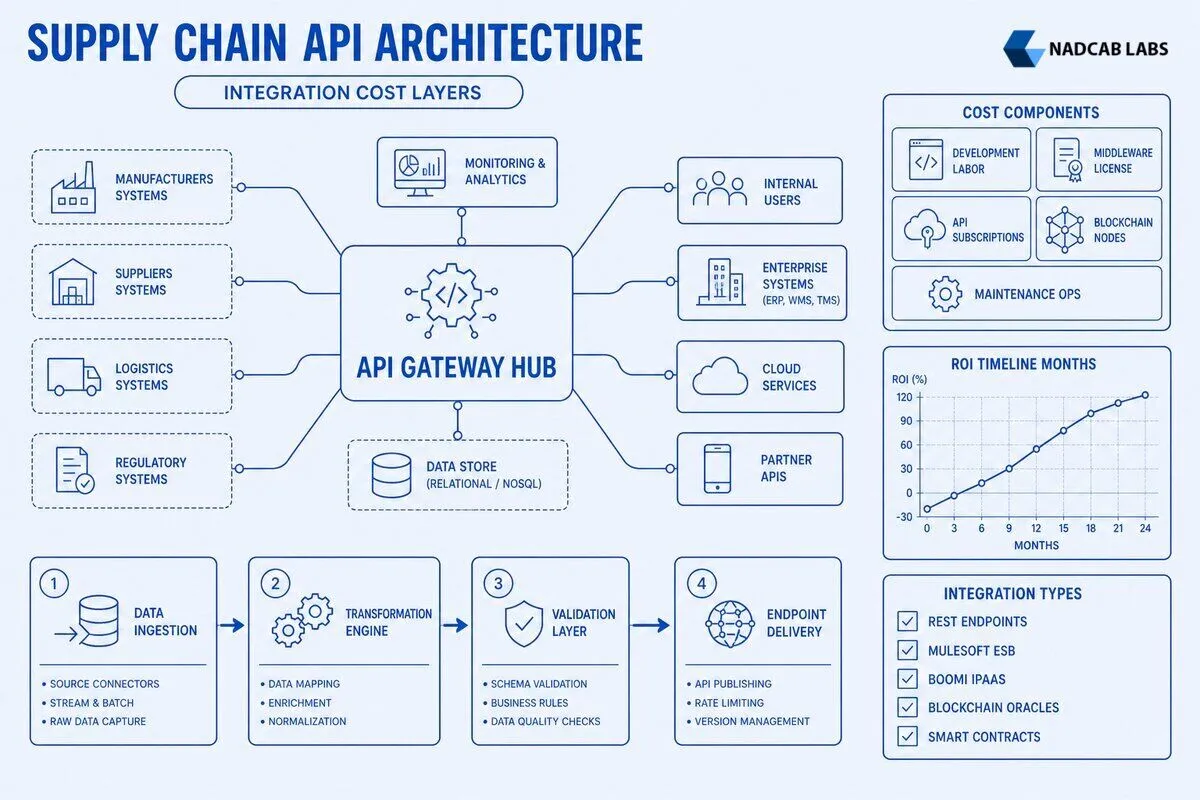
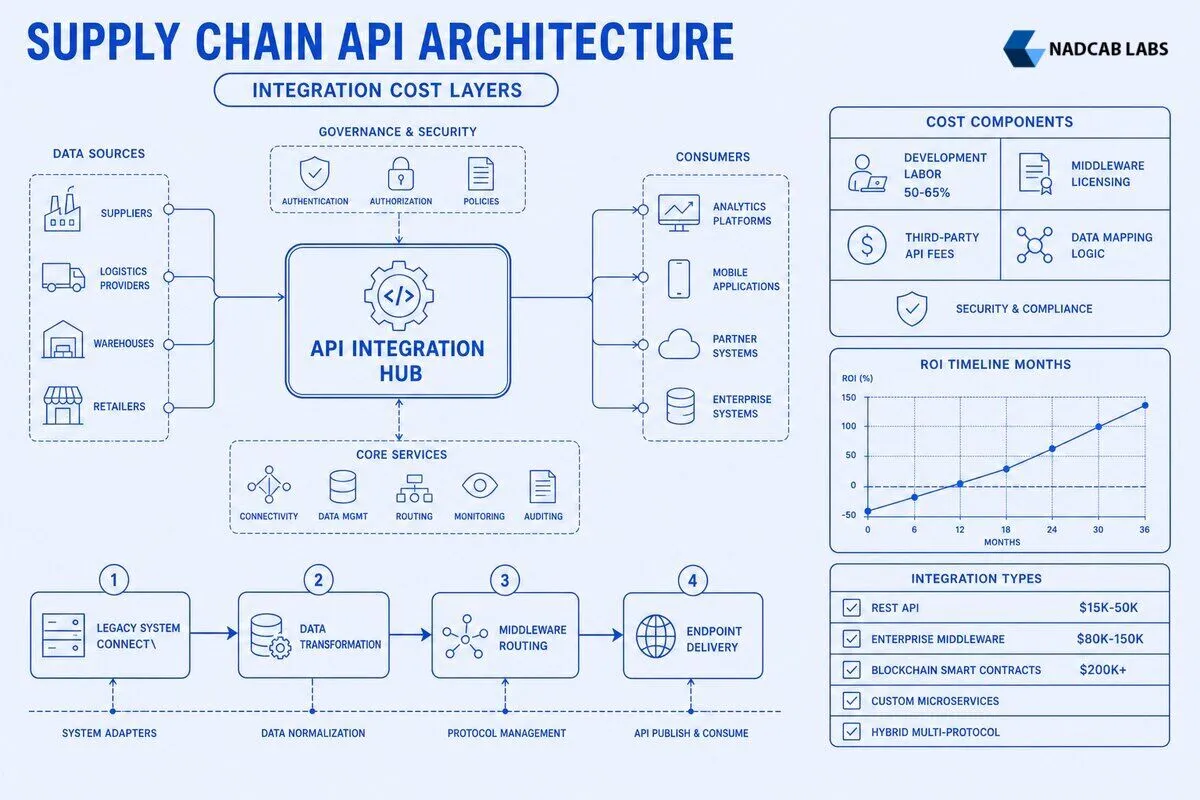
Supply chain API integration costs vary widely—from $15,000 for basic REST endpoints connecting two systems to over $200,000 for enterprise-grade blockchain integrations with smart contracts, oracles, and multi-party consensus layers. Development labor dominates supply chain API integration costs, typically consuming 50-65% of the total budget.
Supply chain API integration costs vary widely—from $15,000 for basic REST endpoints connecting two systems to over $200,000 for enterprise-grade blockchain integrations with smart contracts, oracles, and multi-party consensus layers. The total investment depends on development labor rates, middleware licensing (MuleSoft, Boomi, or custom solutions), third-party API subscriptions, data transformation complexity, and whether you choose traditional REST APIs or blockchain-based architectures. Understanding these cost drivers and calculating ROI through automation savings, error reduction, and inventory optimization helps procurement teams justify budgets and select the right integration approach.
Key Takeaways
- Development labor accounts for 50-65% of total API integration costs, with regional hourly rates ranging from $40 (offshore) to $200+ (senior US-based blockchain engineers).
- Blockchain API integrations cost 30-50% more upfront than traditional REST APIs but reduce long-term reconciliation and fraud costs by 40-60% through immutable audit trails.
- Hidden expenses—data transformation, security audits, compliance certifications, and downtime during migration—typically add 20-35% to initial budget estimates.
- ROI payback periods for supply chain API projects average 12-18 months when factoring automation savings, inventory carrying cost reductions, and delivery speed improvements.
- Partnering with specialized agencies like Nadcab Labs for blockchain-based supply chain integrations can reduce total ownership costs by 25-40% compared to building in-house teams.
- Middleware platforms (MuleSoft, Boomi) charge $15,000-$100,000 annually per connector tier, while custom-built API gateways require $30,000-$80,000 in initial infrastructure setup.
What drives the total cost of supply chain API integration projects?
Development labor dominates supply chain API integration costs, typically consuming 50-65% of the total budget. Frontend engineers build user interfaces for dashboards and monitoring tools, backend developers create API endpoints and business logic, and data mapping specialists handle schema transformations between disparate systems like ERP, WMS, TMS, and IoT sensor platforms. Regional rate variations significantly impact budgets: offshore teams in Eastern Europe or South Asia charge $40-$70 per hour, mid-tier markets like Latin America or Southeast Asia range from $60-$100 per hour, and senior US-based or Western European developers command $150-$250 per hour. For a mid-complexity integration connecting three systems with custom authentication and real-time data sync, expect 600-1,200 development hours—translating to $36,000-$180,000 in labor costs alone depending on team location and seniority.
Middleware platform licensing and API gateway infrastructure add substantial recurring costs. Enterprise integration platforms like MuleSoft charge $15,000-$100,000 annually based on connector count, transaction volume, and support tiers. Dell Boomi offers similar pricing structures with per-connection fees starting at $12,000 per year for basic plans and scaling to $80,000+ for enterprise deployments with unlimited integrations and advanced data transformation features. Boomi’s consumption-based model charges additional fees when monthly transaction volumes exceed contracted limits—a common pitfall for rapidly growing supply chains. Organizations building custom API gateways using open-source tools like Kong or Tyk face lower licensing costs but require $30,000-$80,000 in initial infrastructure setup (cloud hosting, load balancers, monitoring tools) plus ongoing DevOps salaries. Cloud-native API management services like AWS API Gateway or Azure API Management charge per million requests ($3.50-$4.50) and data transfer ($0.09-$0.12 per GB), making them cost-effective for moderate-volume integrations but expensive at scale.
Third-party API subscription fees compound monthly expenses as supply chains integrate more external services. ERP systems like SAP or Oracle charge $200-$1,500 per user per month for API access, with additional fees for premium connectors and high-frequency data sync. Warehouse management systems (WMS) like Manhattan Associates or Blue Yonder bill $5,000-$25,000 annually for API licenses depending on facility count and transaction volume. Transportation management systems (TMS) such as Descartes or project44 employ usage-based pricing—$0.05-$0.25 per shipment tracked via API—which can reach $50,000-$150,000 annually for high-volume shippers. IoT sensor platforms charge tiered rates: basic plans at $500-$2,000 monthly for up to 1,000 devices, scaling to $10,000-$30,000 monthly for enterprise fleets with real-time analytics and predictive maintenance features. Rate-limit tiers impose additional costs when integrations exceed contracted API call volumes; upgrading from 10,000 to 100,000 daily requests often doubles subscription fees, and exceeding limits without upgrading triggers overage charges of $0.001-$0.01 per excess call.
| Cost Category | Low Complexity | Mid Complexity | High Complexity |
|---|---|---|---|
| Development Labor (400-1,200 hrs) | $24,000-$48,000 | $60,000-$120,000 | $150,000-$300,000 |
| Middleware Licensing (annual) | $12,000-$20,000 | $25,000-$50,000 | $60,000-$100,000 |
| Third-Party API Subscriptions (annual) | $6,000-$15,000 | $20,000-$60,000 | $80,000-$200,000 |
| Infrastructure & Hosting (annual) | $3,000-$8,000 | $12,000-$30,000 | $40,000-$100,000 |
| Security & Compliance Audits | $5,000-$10,000 | $15,000-$35,000 | $50,000-$120,000 |
| Total First-Year Investment | $50,000-$101,000 | $132,000-$295,000 | $380,000-$820,000 |
Custom supply chain software development projects involving proprietary algorithms for demand forecasting, route optimization, or multi-party collaboration push costs into the high-complexity range. These integrations require specialized data science talent ($120-$200 per hour) and extended timelines (12-24 months), with ongoing maintenance consuming 15-25% of initial development costs annually for version updates, security patches, and API deprecation handling as third-party systems evolve.
How do blockchain-based API integrations compare in cost to traditional REST APIs?
Smart contract development and audit expenses add 30-50% to upfront costs compared to conventional API endpoint coding. Writing Solidity or Rust smart contracts for supply chain use cases—automated payment releases upon delivery confirmation, multi-signature approvals for high-value shipments, or tokenized inventory tracking—requires specialized blockchain engineers billing $150-$250 per hour. A moderately complex smart contract suite handling supplier onboarding, purchase order management, and shipment verification typically demands 300-500 development hours ($45,000-$125,000). Third-party security audits are non-negotiable for production smart contracts handling financial transactions or sensitive supply chain data; firms like CertiK, Trail of Bits, or OpenZeppelin charge $15,000-$50,000 per audit depending on contract complexity and line count. In contrast, traditional REST API development for equivalent business logic costs $30,000-$80,000 in labor without mandatory external audits, though penetration testing ($8,000-$20,000) remains advisable for enterprise deployments.
Oracle service fees for off-chain data feeds introduce ongoing costs absent in traditional APIs. Blockchain smart contracts cannot natively access external data (shipment GPS coordinates, temperature sensor readings, customs clearance status), requiring oracle networks like Chainlink or Band Protocol to bridge on-chain and off-chain systems. Chainlink charges per data request—$0.10-$1.00 depending on data source complexity and update frequency—plus network gas fees. A high-frequency supply chain integration polling IoT sensors every 5 minutes across 100 shipments incurs 288,000 oracle requests monthly ($28,800-$288,000 annually at scale), though batching and caching strategies reduce costs by 60-80%. Permissioned blockchain networks like Hyperledger Fabric or R3 Corda eliminate public oracle fees by allowing trusted nodes to inject off-chain data directly, but require enterprise node hosting ($5,000-$20,000 monthly per organization) and consortium governance overhead.
Gas optimization costs on public blockchains versus permissioned chains significantly impact total ownership. Ethereum mainnet transactions cost $5-$50 in gas fees during peak congestion, making high-frequency supply chain updates prohibitively expensive; a logistics company executing 10,000 daily shipment status updates would spend $50,000-$500,000 monthly in gas alone. Layer-2 solutions like Polygon or Arbitrum reduce per-transaction costs to $0.01-$0.10, cutting monthly expenses to $100-$1,000 for the same volume. Permissioned blockchains eliminate variable gas fees entirely—Hyperledger Fabric transactions cost only infrastructure hosting and compute resources—but sacrifice the decentralization and public verifiability benefits of public chains. Organizations prioritizing transparency for consumer-facing traceability (organic food provenance, conflict-free mineral sourcing) often justify public chain costs, while internal supplier networks favor permissioned architectures to control expenses.
Immutability benefits and long-term maintenance savings from reduced data reconciliation overhead offset higher upfront blockchain costs. Traditional supply chain integrations require continuous reconciliation processes to resolve data discrepancies between partners—manual audits, dispute resolution meetings, and corrective data entries consume 15-30% of supply chain IT budgets annually. Blockchain’s shared, tamper-proof ledger eliminates reconciliation for recorded transactions; a Deloitte study found enterprises reduced reconciliation labor costs by 40-60% after deploying blockchain-based supply chain APIs. Smart contracts automate compliance checks and payment releases without manual intervention, saving 200-500 administrative hours monthly for mid-sized operations ($20,000-$50,000 annual labor savings at $100 per hour). Fraud prevention benefits compound over time—immutable audit trails deter invoice manipulation, counterfeit product insertion, and unauthorized shipment diversions, reducing fraud losses by an estimated 25-40% according to industry case studies. These operational savings typically achieve ROI within 18-24 months despite higher initial investment, compared to 12-18 months for traditional APIs with lower upfront costs but persistent reconciliation overhead.
Blockchain vs. Traditional API Cost Comparison (5-Year Total Cost of Ownership)
*Includes development, infrastructure, maintenance, reconciliation labor, and fraud losses. Permissioned blockchain shows lowest TCO due to eliminated reconciliation costs and controlled infrastructure expenses.
Exploring smart contract architecture for supply chain systems reveals design patterns that minimize gas costs and oracle dependencies, directly impacting long-term operational expenses. Hybrid architectures—using blockchain for high-value transactions requiring immutability (purchase orders, payments, customs documents) and traditional REST APIs for high-frequency, low-value updates (real-time GPS tracking)—optimize cost-performance tradeoffs for most enterprises.
Which hidden expenses catch supply chain teams off guard during API rollouts?
Data transformation complexity for legacy system formats represents one of the most underestimated cost drivers. Converting EDI (Electronic Data Interchange) formats like ANSI X12 or EDIFACT to modern JSON or XML structures requires specialized mapping tools and expertise; enterprise data transformation platforms like Informatica or Talend charge $20,000-$80,000 annually for licenses supporting complex transformations. Custom mapping logic for proprietary ERP schemas (SAP IDoc, Oracle E-Business Suite) demands 100-300 additional development hours ($10,000-$45,000) beyond standard API coding. Legacy mainframe systems running COBOL or AS/400 often lack native API capabilities, forcing teams to build custom middleware adapters or screen-scraping solutions that add $30,000-$100,000 to integration budgets. Character encoding mismatches, date format variations across international systems, and unit-of-measure conversions (metric vs. imperial, currency exchange rates) introduce subtle bugs requiring extensive testing and validation—quality assurance efforts consuming 15-25% of total development time.
Security audits, penetration testing, and compliance certification costs escalate rapidly for supply chains handling sensitive data. SOC 2 Type II certification—increasingly required by enterprise customers—costs $15,000-$75,000 for initial audit and $10,000-$40,000 annually for recertification. GDPR compliance for European supply chain partners requires data protection impact assessments ($8,000-$25,000), privacy-by-design architectural reviews, and ongoing data processing agreement management. Penetration testing by certified ethical hackers ranges from $8,000 for basic API endpoint testing to $50,000+ for comprehensive assessments including infrastructure, authentication mechanisms, and data encryption protocols. Industry-specific certifications compound expenses: pharmaceutical supply chains require 21 CFR Part 11 validation ($25,000-$100,000), food distributors need FSMA compliance documentation ($10,000-$40,000), and defense contractors must achieve CMMC Level 3 certification ($50,000-$200,000). Organizations frequently budget only for initial security audits, overlooking annual recertification costs and emergency response fees when vulnerabilities are discovered post-deployment.
Downtime costs during migration, training programs, and vendor lock-in exit fees create budget overruns in 60-70% of supply chain API projects. Migrating from legacy systems to new API-based architectures requires parallel operation periods (running old and new systems simultaneously) lasting 3-12 months, doubling infrastructure costs during transition. Planned downtime windows for data migration—even during off-peak hours—disrupt operations; a 24-hour outage for a mid-sized distributor processing $50 million annually costs approximately $137,000 in lost revenue and productivity. Unplanned outages from integration bugs or data corruption incidents average 8-20 hours for complex deployments, with incident response and recovery consuming $15,000-$60,000 in emergency engineering time. Training programs for warehouse staff, logistics coordinators, and customer service teams to use new API-connected dashboards and mobile applications cost $500-$2,000 per employee; a 200-person operation spends $100,000-$400,000 on training alone. Vendor lock-in exit fees emerge when switching middleware platforms or third-party APIs—early termination penalties range from 25-50% of remaining contract value, and data export fees charged by some SaaS providers reach $0.10-$0.50 per record for large datasets.
Common Hidden Cost Scenarios
Understanding how Crypto Wallet Integration in Gaming Platforms handles user authentication and transaction security provides useful parallels for supply chain API authentication architectures—both require robust identity management and fraud prevention mechanisms that add 10-20% to base development costs. Similarly, examining Real Estate Tokenization Platform Pricing models reveals how asset-backed blockchain applications structure usage-based fees and compliance costs, applicable to tokenized inventory or warehouse receipt systems in supply chains.
How can you calculate ROI and payback period for supply chain API investments?
Quantifying automation savings from reduced manual data entry and error correction labor hours forms the foundation of supply chain API ROI calculations. Manual order processing—rekeying purchase orders from email or PDF into ERP systems—consumes 15-30 minutes per order at $25-$40 per hour loaded labor cost. A distributor processing 5,000 orders monthly spends $31,250-$100,000 annually on manual entry labor that API automation eliminates entirely. Error correction compounds costs: industry studies show manual data entry error rates of 1-4%, requiring 10-45 minutes per error to identify and resolve. At 2% error rate, the same 5,000-order operation corrects 100 errors monthly, consuming an additional $4,167-$7,500 in labor annually. Invoice reconciliation between purchase orders, shipping documents, and supplier invoices—a process taking 20-60 minutes per discrepancy—costs mid-sized operations $50,000-$150,000 yearly. API integrations with automated three-way matching reduce reconciliation labor by 70-90%, saving $35,000-$135,000 annually.
Inventory optimization value from real-time visibility translates directly to carrying cost reduction and stockout prevention. Excess inventory ties up capital and incurs warehousing costs (8-12% of inventory value annually for storage, insurance, obsolescence); real-time API-connected inventory tracking reduces safety stock requirements by 20-35% through improved demand visibility. A company holding $10 million in inventory saves $160,000-$420,000 annually by cutting excess stock from 25% to 10% of total value. Stockout prevention benefits are harder to quantify but substantial—lost sales from out-of-stock items average 4-8% of revenue for retailers and distributors. A $50 million operation losing 6% revenue to stockouts ($3 million annually) recovers $1.5-$2.1 million by reducing stockouts to 2-3% through API-enabled demand forecasting and automated replenishment triggers. Improved inventory turns (moving from 6x to 9x annually) free working capital for growth initiatives; increasing turns by 50% on $10 million inventory releases $1.67 million in cash flow.
Delivery speed improvements and customer satisfaction metrics tied to revenue growth complete the ROI picture. API-connected transportation management systems reduce average delivery times by 15-25% through optimized routing and real-time carrier selection. Faster delivery correlates with higher customer retention—studies show 1-day delivery improvement increases repeat purchase rates by 8-12%. For a $50 million B2B distributor with 40% repeat customer revenue, a 10% retention boost generates $2 million in additional annual sales. Net Promoter Score (NPS) improvements from shipment visibility and proactive exception alerts average 15-25 points; companies with NPS above 50 grow revenue 2.5x faster than competitors according to Bain & Company research. Quantifying these “soft” benefits requires baseline measurement and A/B testing, but conservative estimates attribute 5-10% of revenue growth to supply chain digitization initiatives in year two post-implementation.
Sample ROI Calculation: Mid-Sized Distributor ($50M Annual Revenue)
| Benefit Category | Annual Savings |
|---|---|
| Manual order entry elimination (5,000 orders/month) | $65,000 |
| Error correction reduction (70% fewer errors) | $5,250 |
| Invoice reconciliation automation (80% reduction) | $80,000 |
| Inventory carrying cost reduction (15% less safety stock) | $120,000 |
| Stockout prevention (4% to 2% out-of-stock rate) | $1,000,000 |
| Delivery speed & retention improvement (conservative) | $500,000 |
| Total Annual Benefit | $1,770,250 |
| Total Investment (mid-complexity integration) | $180,000 |
| Annual Maintenance (20% of initial) | $36,000 |
| Net First-Year ROI | $1,554,250 (863%) |
| Payback Period | 1.2 months |
*Actual results vary by industry, order complexity, and implementation quality. Conservative estimates use lower-bound savings figures.
Leveraging Machine Learning algorithms within API-connected supply chain systems amplifies ROI through predictive demand forecasting and dynamic pricing optimization, adding 10-20% to baseline automation savings. Multi-chain blockchain architectures enable cost-effective cross-border supply chain integrations by selecting optimal networks for different transaction types—high-value settlements on Ethereum, high-frequency tracking on Polygon—reducing overall gas costs by 60-75%.
Should you build in-house, buy SaaS tools, or partner with a blockchain development agency?
In-house team salary burden versus one-time agency fees presents the fundamental build-versus-buy tradeoff. Building custom supply chain APIs internally requires hiring full-stack developers ($90,000-$180,000 annual salary), DevOps engineers ($100,000-$160,000), data architects ($110,000-$170,000), and QA specialists ($70,000-$120,000). A minimal four-person team costs $370,000-$630,000 annually in salaries alone before benefits (add 25-35%), equipment, software licenses, and management overhead—total loaded cost reaches $500,000-$900,000 per year. This team can realistically deliver 2-3 major integration projects annually, putting per-project cost at $167,000-$450,000 for organizations with continuous integration needs. Ongoing support staff requirements persist indefinitely; even after initial development, maintaining API integrations demands 0.5-1.5 FTE ($45,000-$135,000 annually) for bug fixes, security patches, and third-party API version updates. In contrast, specialized agencies like Nadcab Labs charge $80,000-$250,000 for comparable projects as one-time fees, with optional annual support contracts at 15-20% of development cost ($12,000-$50,000)—total three-year cost of $116,000-$350,000 versus $1.5-$2.7 million for in-house teams.
Low-code platform trade-offs balance faster deployment against limited customization and recurring subscription costs. Platforms like Zapier, Workato, or Integromat enable non-technical users to build basic API integrations through visual workflow builders, reducing time-to-deployment from 3-6 months (custom development) to 2-6 weeks. Pricing starts at $300-$1,500 monthly for small business plans (up to 10,000 tasks/month) and scales to $5,000-$20,000 monthly for enterprise tiers with unlimited workflows and premium connectors. While attractive for simple point-to-point integrations (Shopify to QuickBooks, Salesforce to Slack), low-code platforms struggle with complex supply chain requirements: custom business logic, real-time data transformations, high-frequency IoT sensor ingestion, and blockchain smart contract interactions. Vendor-imposed rate limits (100-500 API calls per minute) throttle performance for high-volume operations. Lock-in risks emerge as workflows become platform-dependent; migrating 50+ Zapier workflows to custom code requires 200-400 development hours ($20,000-$60,000) if the platform becomes cost-prohibitive at scale. Total five-year cost for low-code platforms reaches $180,000-$1.2 million in subscriptions alone, often exceeding custom development costs for organizations with complex, evolving integration needs.
Blockchain expertise advantage when partnering with specialists like Nadcab Labs for smart contract API layers delivers capabilities unattainable through generalist agencies or in-house teams lacking Web3 experience. Blockchain-based supply chain integrations require niche skills: Solidity or Rust smart contract development, oracle network configuration, cryptographic key management, consensus mechanism selection, and gas optimization strategies. Hiring blockchain developers internally costs $140,000-$220,000 annually—a 40-60% premium over traditional API developers—and talent scarcity extends recruitment timelines to 6-12 months. Specialized agencies maintain teams with production blockchain experience across multiple supply chain use cases (pharmaceutical traceability, automotive parts provenance, food safety compliance), reducing project risk and accelerating delivery. Nadcab Labs’ expertise in permissioned blockchain architectures (Hyperledger Fabric, R3 Corda) and public chain integrations (Ethereum, Polygon) enables hybrid solutions optimizing cost and performance—public chains for consumer-facing transparency, permissioned networks for internal supplier collaboration. Agencies also navigate regulatory complexity (GDPR data handling on immutable ledgers, securities law for tokenized inventory) and provide ongoing protocol upgrade support as blockchain ecosystems evolve.
Build vs. Buy vs. Partner Decision Framework
Build In-House
Best For: Enterprises with 5+ ongoing integration projects annually, proprietary algorithms, extreme customization needs.
3-Year TCO: $1.5M-$2.7M
Pros: Full control, IP ownership, instant iteration. Cons: High fixed costs, recruitment challenges, knowledge loss if staff leave.
Buy Low-Code SaaS
Best For: SMBs with simple point-to-point integrations, non-technical teams, rapid proof-of-concept needs.
3-Year TCO: $180K-$720K
Pros: Fast deployment, no dev team needed. Cons: Limited customization, rate limits, vendor lock-in, recurring fees scale poorly.
Partner with Agency
Best For: 1-4 projects over 3 years, blockchain/Web3 requirements, need for specialized expertise without hiring.
3-Year TCO: $250K-$800K
Pros: Expert delivery, predictable costs, access to niche skills (blockchain, ML). Cons: Less control, dependency on external team, knowledge transfer needed.
Hybrid approaches often optimize cost-effectiveness: partnering with Nadcab Labs for initial blockchain architecture and smart contract development ($100,000-$200,000), then transitioning to a smaller in-house team (2-3 developers, $180,000-$360,000 annually) for ongoing feature additions and maintenance. This model captures agency expertise for high-risk foundational work while building internal capability for long-term evolution. Organizations should evaluate total cost of ownership over 3-5 years rather than fixating on initial project fees; a $150,000 agency project with $30,000 annual support ($240,000 over 5 years) often outperforms a $400,000 in-house build with $200,000 annual maintenance ($1.4 million over 5 years) for most mid-market supply chain operations.
Examining SSI implementation cost breakdowns for self-sovereign identity systems reveals parallels to supply chain API authentication architectures—both require cryptographic key management, decentralized identity verification, and regulatory compliance frameworks that add 15-25% to base development costs. Understanding Mining Rigs in blockchain ecosystems clarifies the infrastructure costs underlying public blockchain integrations, though supply chain applications typically use proof-of-stake or permissioned consensus to avoid energy-intensive mining.
Final Thoughts
Supply chain API integration costs span a wide spectrum—from $50,000 for straightforward REST connections to over $800,000 for enterprise blockchain implementations with smart contracts, multi-party consensus, and comprehensive security audits. The key to maximizing ROI lies in accurately forecasting all cost components: development labor at region-appropriate rates, middleware licensing aligned with transaction volumes, third-party API subscriptions matching actual usage patterns, and often-overlooked expenses like data transformation, compliance certification, and migration downtime. Blockchain-based integrations command 30-50% higher upfront investment but deliver 40-60% reductions in long-term reconciliation and fraud costs through immutable audit trails and automated smart contract execution. Organizations that quantify automation savings, inventory optimization value, and delivery speed improvements typically achieve 12-18 month payback periods, with conservative ROI exceeding 400% over three years. The build-versus-buy decision hinges on project volume and complexity: in-house teams make sense for enterprises with continuous integration needs and proprietary requirements, low-code platforms suit simple point-to-point connections for SMBs, and partnering with specialized agencies like Nadcab Labs optimizes cost-performance for blockchain-enabled supply chains requiring expert smart contract development and Web3 infrastructure. By applying the cost breakdowns, ROI frameworks, and decision matrices outlined in this guide, supply chain leaders can confidently budget for API modernization initiatives that deliver measurable business value while avoiding common pitfalls that derail projects and inflate expenses.
Frequently Asked Questions
Q1.How much does an API integration cost for supply chain systems?
Supply chain API integration costs range from $15,000 for basic EDI-to-API bridges to $150,000+ for enterprise multi-system orchestration. Mid-tier projects ($40,000–$80,000) typically connect ERP, WMS, and TMS platforms with real-time inventory sync. Costs depend on system complexity, data volume, security requirements, and whether you use pre-built connectors or custom development. Blockchain-enabled APIs add 20–35% for immutable audit trails and smart contract logic.
Q2.What is API in supply chain and why does it matter for logistics?
An API (Application Programming Interface) in supply chain is a software layer enabling real-time data exchange between logistics systems—ERP, WMS, TMS, carrier portals, and IoT sensors. It matters because it eliminates manual data entry, reduces order-to-delivery cycle time by 30–50%, and enables event-driven workflows like automatic reorder triggers or shipment exception alerts. APIs replace batch file transfers with instant, bi-directional communication across the entire logistics network.
Q3.How much should you charge for custom supply chain API development?
Custom supply chain API development pricing typically follows: $80–$150/hour for senior developers, $50–$90/hour for mid-level engineers. Fixed-price projects range from $25,000 (single-endpoint integration) to $200,000+ (multi-tenant platform with blockchain anchoring). Include 15–20% for security audits, 10% for documentation, and ongoing support at 18–25% of build cost annually. Charge premium rates (30–40% markup) for compliance-heavy verticals like pharmaceuticals or cold-chain logistics.
Q4.Is API better than SFTP for modern supply chain data exchange?
Yes—APIs outperform SFTP for modern supply chains. APIs deliver real-time data (sub-second latency) versus SFTP’s batch intervals (hourly/daily), enable bi-directional workflows, and support event-driven automation. SFTP requires manual file parsing and lacks native error handling. APIs reduce integration maintenance by 40–60% through standardized protocols (REST, GraphQL) and version control. However, SFTP remains viable for legacy systems or high-volume bulk transfers where real-time sync isn’t critical.
Q5.What are ongoing API maintenance costs as a percentage of initial investment?
Ongoing API maintenance averages 18–25% of initial development cost annually. This covers security patches, dependency updates, endpoint versioning, monitoring/logging infrastructure, and SLA compliance. Blockchain-integrated APIs run 22–28% due to node maintenance and smart contract audits. Costs increase 5–10% if you support multiple API versions simultaneously or handle high transaction volumes (>1M calls/month). Budget an additional 10–15% every 2–3 years for major refactoring as business logic evolves.
Q6.How do blockchain APIs reduce supply chain fraud and error-related costs?
Blockchain APIs cut fraud and error costs by 35–60% through immutable transaction logs, cryptographic provenance verification, and automated reconciliation via smart contracts. Every shipment, quality check, or custody transfer writes a tamper-proof record, eliminating invoice disputes and counterfeit insertion. Automated three-way matching (PO-receipt-invoice) reduces manual audit labor by 70%. Pharmaceutical and luxury goods sectors see ROI within 8–14 months from reduced chargebacks, compliance fines, and inventory shrinkage.
Explore Services
Related Services
Reviewed by

Aman Vaths
Founder of Nadcab Labs
Aman Vaths is the Founder & CTO of Nadcab Labs, a global digital engineering company delivering enterprise-grade solutions across AI, Web3, Blockchain, Big Data, Cloud, Cybersecurity, and Modern Application Development. With deep technical leadership and product innovation experience, Aman has positioned Nadcab Labs as one of the most advanced engineering companies driving the next era of intelligent, secure, and scalable software systems. Under his leadership, Nadcab Labs has built 2,000+ global projects across sectors including fintech, banking, healthcare, real estate, logistics, gaming, manufacturing, and next-generation DePIN networks. Aman’s strength lies in architecting high-performance systems, end-to-end platform engineering, and designing enterprise solutions that operate at global scale.