Ai Overview
Zero knowledge proof architecture is a system design pattern in which cryptographic proofs replace the disclosure of sensitive data as the mechanism for achieving trust between parties. The need for this architecture in zero knowledge proof real estate tokenization is driven by the specific sensitivity of the data that property investment platforms handle.
Key Takeaways
- 01
Zero knowledge proof real estate tokenization allows smart contracts to verify investor eligibility, payment validity, and property ownership without recording any sensitive private data on the public blockchain at all. - 02
ZK circuits encode the compliance logic of real estate token platforms, defining the rules that investor data must satisfy and generating cryptographic proofs that those rules are met without revealing input values. - 03
KYC and AML verification in ZK real estate tokenization uses trusted issuer attestations combined with ZK proofs, so the on-chain contract sees only a proof of compliance, never the investor’s raw identity documents. - 04
ZK SNARK proofs are compact and fast to verify on-chain, while ZK STARK proofs require no trusted setup and are quantum-resistant, each offering different security trade-offs for real estate tokenization platforms. - 05
ZK rollups enable high-throughput real estate token transactions at low gas costs by batching hundreds of transactions off-chain and submitting a single validity proof to the base layer smart contract. - 06
Property valuation privacy is achieved by committing to valuation figures using Pedersen Commitments and proving range conditions with Bulletproofs, so smart contracts enforce pricing rules without knowing exact property values. - 07
Singapore MAS, Dubai DFSA, and India SEBI compliance requirements can all be satisfied through ZK proof systems that give regulators cryptographic proof of compliance without requiring disclosure of investor-level data. - 08
Production ZK real estate platforms use Circom or Noir for circuit writing, snarkjs or Halo2 for proof generation, and on-chain Solidity verifier contracts generated automatically from circuit compilation outputs. - 09
The global tokenized real estate market has surpassed ten billion dollars and is projected to reach four trillion by 2035, making privacy architecture decisions made today foundational to long-term platform competitive positioning. - 10
Building ZK proof architecture for real estate tokenization requires layered implementation across circuit design, off-chain proving infrastructure, on-chain verifier contracts, and investor-facing proof generation user interfaces.
What is Zero Knowledge Proof Architecture and Why Real Estate Tokenization Needs It
Zero knowledge proof architecture is a system design pattern in which cryptographic proofs replace the disclosure of sensitive data as the mechanism for achieving trust between parties. In a conventional blockchain real estate transaction, verifying that an investor meets accreditation criteria requires the investor to share their financial documents with the platform, the platform to inspect them, and in many architectures, some form of that data to be referenced or logged on-chain for auditability. Every step in this chain is a potential privacy violation and a regulatory liability. Zero knowledge proof architecture eliminates each of these exposure points by replacing data sharing with proof sharing.
The need for this architecture in zero knowledge proof real estate tokenization is driven by the specific sensitivity of the data that property investment platforms handle. Unlike generic token trading platforms, real estate tokenization platforms deal with property legal titles, valuation reports from certified appraisers, investor accreditation certificates, beneficial ownership declarations, and cross-border tax identification information. Each of these data categories is governed by national laws that impose strict restrictions on how it may be stored, processed, and shared. In Singapore, the Personal Data Protection Act creates binding obligations. In Dubai’s DIFC, data protection rules mirror GDPR requirements. In India, the Digital Personal Data Protection Act 2023 introduces compliance obligations with significant penalty exposure for violations.
Zero knowledge proof architecture does not merely reduce the amount of sensitive data flowing through the system. It restructures the system so that sensitive data flows only to the party that generated it, the investor, and the cryptographic proof of its validity flows everywhere else. Smart contracts verify the proof, regulators verify the proof, secondary market participants verify the proof. Nobody except the investor ever needs to see the underlying data. This is a fundamentally different and stronger privacy guarantee than data minimization or encryption, and it is why leading property tokenization platforms across Singapore, UAE, and India are actively building ZK proof layers into their core architecture in 2026.
Core Components of Zero Knowledge Proof Architecture in Real Estate Tokenization
A production ZK proof architecture for real estate tokenization is not a single technology but a layered system of interconnected components that each play a specific role in the overall privacy guarantee. Understanding each layer is essential before attempting to build or evaluate such a system, because weaknesses in any single component can undermine the privacy guarantees of the entire architecture even if every other component is implemented correctly. This is a lesson our team has learned from hands-on work building ZK systems for property investment platforms operating across multiple regulatory jurisdictions simultaneously.
The ZK circuit layer is where the compliance and business logic of the platform is encoded into a mathematical form that can be verified without data disclosure. A circuit defines the relationship between private inputs, such as an investor’s net worth figure or a property’s appraised value, and public outputs, such as a binary eligibility confirmation. The circuit is compiled into a constraint system, typically an arithmetic circuit or rank-one constraint system, that can be evaluated by a proving system to generate a zero knowledge proof. This is the most complex and most critical layer, because errors in circuit logic can produce either false proofs or failing verifications that break the user experience in production.
The proving infrastructure layer handles proof generation, which is the computationally intensive process of running the circuit evaluation on the investor’s private inputs to produce a proof. This layer typically runs off-chain, either in the investor’s browser using WebAssembly-compiled proving libraries, or on a secure off-chain compute service that the investor’s device connects to. The verifier contract layer is the on-chain component that receives proofs and checks their validity using elliptic curve pairing operations, accepting or rejecting them before allowing the associated smart contract action, such as a token purchase or identity whitelisting, to proceed. These three layers, circuit, prover, and verifier contract, form the irreducible core of every ZK real estate tokenization architecture.[1]
How Zero Knowledge Proof Circuits Are Designed for Real Estate Token Verification
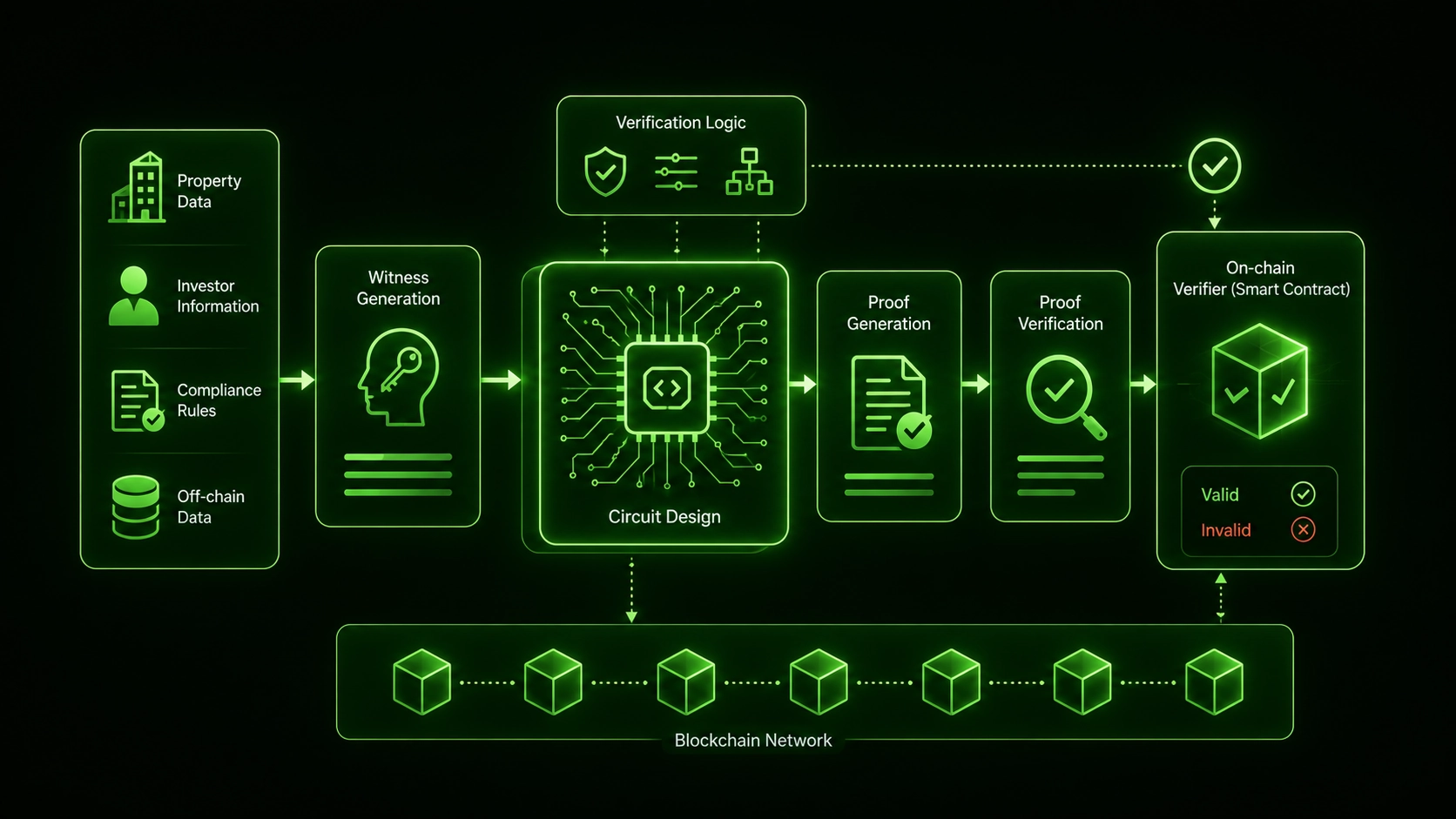
Designing a zero knowledge circuit for a real estate tokenization platform begins with a precise formal specification of the statement to be proven. Before writing a single line of circuit code, the platform architect must express the compliance condition in pure mathematical terms: what are the private inputs, what are the public inputs, and what relationship between them must hold for a valid proof?
For an accredited investor check, the private input might be the investor’s reported net worth, the public input might be the regulatory threshold value, and the circuit condition might be that the private input is greater than or equal to the public threshold and that the committed hash of the private input matches a commitment previously registered by a trusted attestation provider.
The circuit is then implemented using a domain-specific language designed for this purpose. Circom is the most widely adopted circuit language for ZK SNARK systems, offering a clear syntax for defining signals and constraints that compile into the rank-one constraint system format required by Groth16 and PLONK proving systems.
Noir, developed by Aztec Network, takes a higher-level approach that more closely resembles Rust programming, making it more accessible to engineers who are not specialist cryptographers. Cairo, developed by StarkWare, targets ZK STARK proving systems and is the circuit language underlying StarkNet, which processes complex computations including those relevant to institutional real estate finance applications in live production.
For a complete real estate tokenization platform, multiple circuits are typically required rather than a single monolithic circuit. An identity verification circuit handles the proof that an investor has passed KYC and holds a valid attestation. An accreditation circuit handles the proof that the investor meets financial eligibility thresholds. A property ownership circuit handles the proof that a token holder has a valid claim to a specific fractional property interest without revealing which specific tokens they hold.
A transaction validity circuit handles the proof that a proposed token transfer satisfies all platform rules including transfer restrictions and holding period requirements. Designing and auditing each of these circuits correctly, without introducing soundness errors that could be exploited to forge proofs, is the most technically demanding aspect of building a production ZK real estate tokenization platform.
How the Prover and Verifier Architecture Works in Real Estate Tokenization
The prover-verifier split is the fundamental operational model of every zero knowledge proof system, and understanding how it is implemented in a real estate tokenization context is essential for architects designing end-to-end systems. The prover is the party who holds the private information and wants to prove something about it without revealing it. In real estate tokenization, the prover is almost always the investor or a service acting on their behalf with their consent. The verifier is the party who needs to be convinced that the statement is true without seeing the private data. In real estate tokenization, the verifier is the smart contract on-chain, though off-chain verifiers may also be used in hybrid architectures.
The prover’s workflow begins when the investor provides their private inputs to a local proving client. This client might be a JavaScript library running in the investor’s browser, a mobile application component, or a desktop proving agent. The client loads the compiled circuit, receives the private and public inputs, and runs the proving algorithm, which in Groth16 involves a series of elliptic curve multiplications over the circuit’s constraint system. The output is a compact proof object, typically 128 to 256 bytes for Groth16 SNARKs, along with the public outputs of the circuit computation. This proof is then submitted to the smart contract along with the intended transaction, for example a token purchase request.
The verifier smart contract receives the proof and public outputs and calls its verification function, which is a Solidity implementation of the elliptic curve pairing check at the heart of the ZK proof system. If the pairing check passes, the proof is valid and the smart contract proceeds with the requested action. If it fails, the transaction reverts. This entire verification process is deterministic, transparent, and auditable by any blockchain participant, while revealing nothing about the private inputs the investor used to generate the proof.
For real estate platforms operating in Singapore and UAE where transaction auditability is a regulatory requirement, this architecture satisfies the audit requirement, that every transaction was validly authorised, without compromising the investor privacy requirement that personal data not be recorded on-chain.
How Zero Knowledge Proof Architecture Protects Property Ownership Data On Chain

Property ownership data on a tokenized real estate platform encompasses several categories of information that must be verifiable for the platform to function correctly but must be private for investors to trust the platform with their participation. These categories include the identity of the token holder, the specific quantity and class of tokens held, the purchase price at which tokens were acquired, any conditional rights attached to specific token holdings such as preferential liquidation rights, and the history of all transfers associated with a given property. In a standard public blockchain deployment, all of this information is visible to anyone with access to a blockchain explorer, which in practice means everyone.
Zero knowledge proof architecture addresses each of these privacy requirements through different cryptographic techniques applied at the relevant layer. Token holder identity is protected through a nullifier mechanism: instead of recording the investor’s address as the token holder, the smart contract records a commitment to the investor’s identity that only the investor can open.
Transfer eligibility is proven using ZK proofs that demonstrate the sender holds a valid token and that the recipient meets all platform transfer requirements, without revealing the sender’s position size, purchase history, or identity to the recipient or any on-chain observer. This pattern is similar to how Zcash shielded transactions work but adapted to the specific data model of fractional real estate token ownership with its additional compliance constraints.
For institutional investors in Singapore’s private wealth management sector or UAE’s family office community, this level of ownership privacy is a meaningful commercial benefit independent of regulatory compliance. Sophisticated investors do not want their portfolio positions in specific real estate assets to be visible to competitors, counterparties, or the general public. The standard blockchain transparency model is incompatible with institutional norms in private wealth management. Zero knowledge proof architecture for real estate token ownership is the technical mechanism that makes blockchain-based property investment compatible with institutional privacy expectations, which is a necessary condition for meaningful institutional adoption rather than just retail participation in the tokenized property market.
How Smart Contracts Are Structured to Support Zero Knowledge Proof in Real Estate Tokenization
Smart contract architecture for ZK-enabled real estate tokenization requires a fundamentally different design pattern than conventional token contracts. A standard ERC-20 or ERC-1400 security token contract records balances in a public mapping, enforces transfer restrictions by checking registered whitelist addresses, and emits events that include sender, recipient, and amount data. Every aspect of this design is incompatible with a meaningful zero knowledge privacy guarantee. Adapting it for ZK proof integration requires rethinking how balances are represented, how ownership is proven, and how compliance is enforced at the contract level.
The ZK-compatible smart contract architecture replaces public balance mappings with a Merkle tree of committed balances. Each investor’s holding is represented not as a plaintext balance but as a leaf in this Merkle tree, where the leaf value is a cryptographic commitment to the investor’s address and balance. The contract stores only the Merkle root, a single 32-byte hash that summarizes the entire ownership state of the token.
To prove ownership and execute a transfer, an investor generates a ZK proof that demonstrates knowledge of a valid leaf in the current Merkle tree, the transfer satisfies all compliance conditions, and the resulting new Merkle root after the transfer is correctly computed. The contract verifies this proof and updates the Merkle root without learning who transferred what to whom.
The verifier contract, which is automatically generated during the ZK circuit compilation process, is deployed alongside the main token contract and called by it during proof verification. The verifier contract is purely mathematical: it takes a proof and public inputs, runs the pairing check, and returns a Boolean result.
It has no knowledge of what the proof represents in business terms. The main token contract handles the business logic of accepting or rejecting the transaction based on the verifier’s output. This separation of concerns between cryptographic verification and business logic is a clean and auditable architecture that allows each layer to be independently tested, formally verified, and upgraded without affecting the other layers of the ZK real estate tokenization system.
How KYC and Investor Identity Verification Works Inside Zero Knowledge Proof Architecture
KYC and investor identity verification represent the most practically important application of zero knowledge proofs in real estate tokenization platforms, because they are the compliance requirement that every platform must satisfy and the privacy concern that most investors care about most directly. The standard approach to KYC on blockchain platforms involves collecting identity documents, running them through a third-party verification service, and recording an approval flag against the investor’s wallet address. This approach works but creates a centralized database of investor identity data that is a liability under every data protection regime in which the platform operates.
The ZK-native approach to KYC uses a trusted identity issuer model combined with ZK proofs derived from signed attestations. The investor completes their identity verification with an authorised KYC provider, which issues a signed credential confirming that the investor has passed verification and attesting to specific attributes such as their country of residence, accreditation status, and AML clearance level.
This credential is stored off-chain by the investor, not by the platform. When the investor wants to interact with a smart contract that requires KYC compliance, they use their ZK proving client to generate a proof that they hold a valid, unexpired credential from an approved issuer that satisfies the contract’s specific compliance requirements. The proof is submitted to the contract’s verifier, which confirms the proof and clears the investor for participation without the contract ever receiving or storing any of the investor’s personal information.
This architecture is being actively standardized through protocols like the Ethereum Attestation Service and frameworks like Polygon ID, which implement the W3C Verifiable Credentials standard for decentralized identity combined with ZK proof verification on-chain. For real estate tokenization platforms targeting investors in Singapore and India simultaneously, where the regulatory requirements around what must be verified differ between jurisdictions, this architecture is particularly powerful because different circuits can be deployed for different investor jurisdictions while the underlying credential infrastructure is shared, avoiding the need to maintain separate compliance databases for each market.
How Zero Knowledge Proof Architecture Handles Private Property Valuation and Transaction Data
Property valuation data is commercially sensitive in a way that investor identity data is not. While investor identity information is private for personal and regulatory reasons, property valuation information is private for competitive and commercial reasons. A developer tokenizing a luxury residential project in Dubai does not want the exact appraised value of each unit publicly visible on a blockchain before the token sale, because this creates arbitrage opportunities for sophisticated investors and pricing pressure that disadvantages the issuer. Similarly, a property management company conducting secondary market transactions does not want its pricing data publicly legible to competitors who might use it to undercut future offerings.
Zero knowledge proof architecture addresses property valuation privacy through commitment-based approaches combined with range proofs. The property’s appraised value is committed using a Pedersen Commitment, producing a public commitment value that hides the actual figure. Smart contracts can enforce pricing rules, for example that token sale prices are within a certain percentage of appraised value, by verifying ZK range proofs that demonstrate the committed figure satisfies the range condition without the contract learning the actual appraised value.
This allows automated compliance with pricing governance rules without creating public disclosure of commercially sensitive valuation data, which is a meaningful competitive advantage for property developers tokenizing high-value assets in Singapore and UAE markets where pricing strategy is a significant competitive variable. Transaction data privacy, specifically hiding the price and size of individual token trades in the secondary market, uses a similar approach to the ownership privacy mechanism described earlier.
A ZK-shielded secondary market for real estate tokens would allow a holder to generate a proof demonstrating they have tokens to sell at a stated price, allow a buyer to generate a proof that they meet transfer eligibility requirements and have sufficient funds, and execute the swap through a smart contract that verifies both proofs and updates the committed ownership state without publicly recording the transaction price or the identities of the parties. This level of secondary market privacy is what major institutional participants expect as a baseline when considering participation in tokenized real estate markets anywhere in the world.
ZK Rollup vs ZK SNARK vs ZK STARK Architecture for Real Estate Tokenization Platforms
Selecting the right proving system is one of the most consequential architectural decisions for a real estate tokenization platform because it affects proof size, verification cost, proving time, trusted setup requirements, and quantum resistance. These trade-offs have direct operational implications: proof size affects gas costs on-chain, proving time affects user experience during KYC and token purchase flows, and trusted setup requirements affect the governance complexity of the platform’s security model. There is no universally best choice; the right system depends on the platform’s specific performance requirements, regulatory context, and budget for infrastructure.
ZK SNARKs using the Groth16 proving system produce the smallest proofs, approximately 128 bytes, and the fastest on-chain verification times, typically under 300,000 gas on Ethereum, making them the most cost-effective option for platforms expecting high transaction volumes. Their main limitation is the requirement for a trusted setup ceremony specific to each circuit, which introduces governance complexity and a small theoretical trust assumption that the ceremony was conducted correctly.
ZK STARKs eliminate the trusted setup entirely, producing proofs from publicly verifiable randomness, and are based on hash function security rather than elliptic curve discrete logarithm assumptions, making them potentially quantum-resistant. However, STARK proofs are significantly larger, typically 40 to 200 kilobytes, making on-chain verification substantially more expensive in gas terms. ZK rollups are not a proving system but rather a scaling architecture that uses either SNARK or STARK proofs to validate batches of transactions off-chain and submit compressed state updates on-chain.
| Feature | ZK SNARK (Groth16) | ZK STARK | ZK Rollup |
|---|---|---|---|
| Proof Size | ~128 bytes | 40 to 200 KB | Batch Compressed |
| Trusted Setup | Required | Not Required | Depends on Scheme |
| Quantum Resistance | No | Yes (Hash-based) | If STARK-based |
| On-Chain Gas Cost | Low (~300K gas) | High | Very Low (Amortized) |
| Best Real Estate Use Case | Per-transaction KYC proof verification | Long-term post-quantum property records | High-volume secondary market trading |
| Key Libraries | snarkjs, Circom, Halo2 | Cairo, StarkWare, Polygon Miden | zkSync, StarkNet, Scroll, Linea |
How to Build a Zero Knowledge Proof Architecture Layer for Your Real Estate Tokenization Platform
Building a production ZK proof architecture layer for a real estate tokenization platform is a multi-phase engineering effort that requires specialist knowledge across cryptographic engineering, smart contract architecture, and frontend proving infrastructure. The sequence matters significantly: attempting to build the smart contract layer before the circuits are correctly specified and tested leads to expensive rework, and shipping a proving system to end users before the user experience around proof generation is smooth leads to adoption failure even if the cryptography is correct. Our team structures this work across five sequential phases based on experience with live platform builds for clients across India, Singapore, and UAE.
The ZK proof architecture layer is not a feature that gets added to a real estate tokenization platform after the fact. It must be designed in from the beginning because it affects the fundamental data model of how ownership is represented, how compliance is enforced, and how the user experience of every core investor workflow is structured. Platforms that build with ZK architecture from the foundation are positioning themselves as the trusted institutional infrastructure for the next decade of global property tokenization.
As the tokenized real estate market accelerates toward its projected multi-trillion dollar scale, the platforms that win institutional investor trust in Singapore, UAE, and India will be those that can prove, mathematically and not merely contractually, that investor privacy is protected by design rather than by policy.
Frequently Asked Questions
Q1.1. What is zero knowledge proof in real estate tokenization?
Zero knowledge proof in real estate tokenization is a cryptographic method that lets investors prove ownership, eligibility, or payment validity to a smart contract without revealing the underlying private data such as identity documents, financial figures, or property valuation details at any point in the process.
Q2.2. How does zero knowledge proof protect property data on blockchain?
Zero knowledge proof protects property data by allowing the system to verify that a statement is true, for example that an investor meets accreditation requirements, without recording any of the sensitive supporting data on the public blockchain. Only the proof and the outcome are stored on-chain, not the private inputs.
Q3.3. What is the difference between ZK SNARK and ZK STARK in real estate tokenization?
ZK SNARKs require a trusted setup ceremony and produce smaller proofs that verify faster, making them suited for high-volume real estate token transactions. ZK STARKs require no trusted setup and are quantum-resistant but produce larger proofs. Both protect property and investor data without revealing it to the public chain.
Q4.4. Can zero knowledge proofs handle KYC and AML in tokenized real estate?
Yes, zero knowledge proof systems can handle KYC and AML verification by allowing a trusted identity provider to issue a cryptographic attestation. The investor submits a ZK proof derived from this attestation to the platform’s smart contract, which confirms compliance without ever receiving or storing the investor’s raw identity documents.
Q5.5. What is a ZK rollup and how does it help real estate tokenization platforms?
A ZK rollup batches multiple real estate token transactions off-chain and generates a single zero knowledge proof that all transactions are valid. This proof is submitted on-chain, reducing gas costs and increasing throughput dramatically while maintaining the same privacy and security guarantees as individual on-chain transactions.
Q6.6. Is zero knowledge proof real estate tokenization compliant with regulations in India and UAE?
Zero knowledge proof architectures can be designed to meet the compliance requirements of MAS in Singapore, DFSA in Dubai, and SEBI and RBI guidelines in India. The architecture allows platforms to prove regulatory compliance to auditors through cryptographic proofs without exposing investor data to regulatory bodies unnecessarily.
Q7.7. How does zero knowledge proof protect property valuation data?
Property valuation data can be committed using cryptographic commitments, often Pedersen Commitments, and then proofs can be generated showing that a valuation falls within a valid range or meets specific criteria. These proofs can be verified by smart contracts without the actual valuation figure ever being recorded on the public ledger.
Q8.8. What programming languages and libraries are used to build ZK proof circuits for real estate?
The most commonly used frameworks include Circom for circuit writing with snarkjs for proof generation, Noir by Aztec for developer-friendly ZKP programming, Halo2 from the Zcash Foundation, and StarkWare’s Cairo language for STARK-based circuits. These tools allow engineers to encode real estate compliance logic into verifiable computation circuits.
Q9.9. How fast is zero knowledge proof verification in a real estate tokenization smart contract?
ZK SNARK proof verification on Ethereum or EVM-compatible chains typically takes between 1 and 5 milliseconds for well-optimized circuits, adding minimal overhead to a token transaction. ZK STARK verification is slightly slower but still practical for production use. Proof generation on the prover side takes longer, typically seconds to minutes depending on circuit complexity.
Q10.10. Which real estate tokenization markets are adopting zero knowledge proof architecture fastest?
Singapore leads in regulatory-forward ZKP adoption due to MAS sandbox programs that actively encourage privacy-preserving blockchain experiments. Dubai’s DIFC and ADGM financial zones are integrating ZKP-based identity verification for real estate token platforms. India’s institutional blockchain projects are increasingly including ZKP layers for investor data protection in compliance-heavy financial products.
Explore Services
Related Services
Reviewed by

Aman Vaths
Founder of Nadcab Labs
Aman Vaths is the Founder & CTO of Nadcab Labs, a global digital engineering company delivering enterprise-grade solutions across AI, Web3, Blockchain, Big Data, Cloud, Cybersecurity, and Modern Application Development. With deep technical leadership and product innovation experience, Aman has positioned Nadcab Labs as one of the most advanced engineering companies driving the next era of intelligent, secure, and scalable software systems. Under his leadership, Nadcab Labs has built 2,000+ global projects across sectors including fintech, banking, healthcare, real estate, logistics, gaming, manufacturing, and next-generation DePIN networks. Aman’s strength lies in architecting high-performance systems, end-to-end platform engineering, and designing enterprise solutions that operate at global scale.