Ai Overview
A real estate token smart contract on Ethereum is a program deployed permanently on the blockchain that encodes the rules governing a fractional property investment token. In practical terms, a real estate token smart contract replaces several functions that in traditional property investment require lawyers, escrow agents, transfer agents, and fund administrators. Each of these automations reduces operational cost, reduces human error risk, and reduces the time investors wait to receive what they are owed.
Key Takeaways
- 01
A real estate token smart contract on Ethereum automates property token issuance, transfer restrictions, KYC enforcement, and investor income distribution without any manual intermediary involvement at any step. - 02
ERC-3643 also known as T-REX is the most comprehensive token standard for real estate tokenization because it combines standard ERC-20 token logic with on-chain identity verification and programmable transfer compliance. - 03
Testing on Ethereum testnets including Sepolia before mainnet deployment is mandatory. Unit tests using Hardhat and Chai must achieve over 95 percent code coverage across all contract functions and edge cases. - 04
An independent smart contract security audit from a reputable firm is non-negotiable before mainnet deployment. A single reentrancy or access control bug in a real estate token contract can result in permanent loss of investor funds. - 05
KYC whitelisting should be implemented as a separate registry contract that the token contract references, allowing identity providers to update investor status without requiring changes to the core token contract logic. - 06
Ethereum mainnet deployment requires a funded deployment wallet, a Hardhat deployment script with the correct constructor arguments, and contract verification on Etherscan immediately after deployment for investor transparency. - 07
Real estate token smart contracts in Singapore, UAE, and India must encode jurisdiction-specific transfer restrictions including accredited investor thresholds, holding period lockups, and maximum investor count caps. - 08
Frontend connection using ethers.js or viem library against the deployed contract ABI allows investors to purchase tokens, view their holdings, and claim rental income distributions through a standard web browser interface. - 09
The global tokenized real estate market is projected to reach over one trillion dollars by end of 2026, making production-quality smart contract architecture a competitive necessity rather than an optional enhancement. - 10
Proxy upgrade patterns using OpenZeppelin TransparentUpgradeableProxy allow deployed real estate token contracts to be upgraded with bug fixes and new compliance rules without losing historical token balances or ownership records.
What is a Real Estate Token Smart Contract on Ethereum
A real estate token smart contract on Ethereum is a program deployed permanently on the blockchain that encodes the rules governing a fractional property investment token. Once deployed, the contract executes automatically whenever an investor interacts with it, enforcing the rules of the token offering without requiring any human intervention or trust in a central party. The contract holds the authoritative record of who owns how many tokens, prevents transfers that violate compliance rules, calculates and distributes rental income proportionally, and maintains a fully auditable history of every action that has ever occurred against the asset.
In practical terms, a real estate token smart contract replaces several functions that in traditional property investment require lawyers, escrow agents, transfer agents, and fund administrators. The token issuance function replaces the share registry. The transfer restriction function replaces the transfer agent’s compliance checks. The dividend distribution function replaces the fund administrator’s manual income calculations and wire transfers. Each of these automations reduces operational cost, reduces human error risk, and reduces the time investors wait to receive what they are owed.
For platforms serving investors across Singapore, UAE, and India simultaneously, a single well-designed real estate token smart contract can apply different compliance rules to different investor classes based on their KYC metadata, without requiring separate contract instances for each jurisdiction. This multi-jurisdiction capability is one of the most powerful architectural advantages of Ethereum smart contract-based property tokenization over traditional securities administration systems that require separate legal and operational infrastructure in each country of operation.
Why Ethereum is the Best Blockchain for Real Estate Token Smart Contracts
Ethereum holds approximately 65 percent of all on-chain real-world asset value as of 2026, according to rwa.xyz data, and this dominance is not accidental. For real estate token smart contracts specifically, Ethereum provides a combination of advantages that no other blockchain currently matches for institutional-grade property investment platforms. The most important of these are the depth and maturity of the Solidity developer ecosystem, the security track record of EVM-based contract execution, the availability of battle-tested smart contract standards like OpenZeppelin, and the deep DeFi liquidity that makes secondary market trading of property tokens practically feasible.[1]
The regulatory recognition that Ethereum has received in Singapore under MAS guidelines, in Dubai through the DIFC and ADGM frameworks, and in India through emerging SEBI blockchain securities guidance is also meaningful. Regulators in these jurisdictions are more likely to engage constructively with a platform built on Ethereum than with one built on a newer or less documented chain, simply because Ethereum’s security history, audit tooling, and developer documentation are better understood by compliance and legal teams reviewing technical implementations.
For platforms concerned about gas fees, Ethereum Layer 2 networks including Polygon, Arbitrum, and Base provide EVM compatibility with the same Solidity codebase and dramatically lower transaction costs, making them practical for retail investor platforms where token purchase and income claim transactions must be affordable at any investment size. The key decision, whether to deploy on Ethereum mainnet or a layer 2, depends on the investor profile and the regulatory requirements of the target markets in Singapore, UAE, or India, but the smart contract code and deployment process are nearly identical across all EVM-compatible networks.
What You Need Before Deploying a Real Estate Token Smart Contract on Ethereum
Before writing a single line of Solidity code, you need several foundational elements in place. Attempting to begin contract writing without these prerequisites leads to expensive rework when the requirements change mid-project, which is a common and avoidable failure pattern in property tokenization projects across all markets. The preparation phase typically takes two to four weeks and directly determines the quality and compliance of the contract that results from the coding phase.
First, you need a clear legal opinion on the token classification in your target jurisdiction. In Singapore, this means confirming whether your property token is a Capital Markets Products security under the Securities and Futures Act. In UAE, this means confirmation from DFSA or ADGM on whether the token falls under the Digital Investment Management framework. In India, this means legal advice on whether SEBI’s existing securities framework applies to your tokenized asset structure. The token standard and contract architecture differ depending on whether the token is classified as a security, a utility, or a digital representation of a fund unit.
Second, you need a fully documented token design specification covering the total supply, the offering price, the minimum investment, any holding period lockup rules, the income distribution mechanism, the KYC provider integration approach, and the governance model for admin key management. Third, you need your technical toolchain configured: Node.js, Hardhat, the OpenZeppelin Contracts library, a funded Ethereum wallet, and accounts with Alchemy or Infura as your RPC provider. Having all of this ready before coding begins reduces the total project timeline by four to six weeks based on our experience across dozens of real estate token launches.
How to Choose the Right Token Standard for a Real Estate Smart Contract
Selecting the correct token standard is the most consequential technical decision in designing a real estate token smart contract. Different standards encode different assumptions about compliance, transferability, and investor management, and choosing the wrong one creates either compliance gaps that regulators will flag or technical limitations that require costly redesigns later. The following table summarizes the main standards relevant to real estate token smart contracts in 2026 and when to use each one.
ERC-3643, also known as the T-REX protocol and formally standardized in 2023, is the most complete standard for regulated security token issuance on Ethereum. It extends ERC-20 with an on-chain Identity Registry that stores verified investor identities and a Compliance module that enforces configurable transfer rules at the protocol level. The T-REX standard was specifically designed for security tokens issued under EU MiFID II regulations but has been widely adopted for property tokens in Singapore and UAE because its compliance architecture maps naturally onto the investor eligibility requirements these jurisdictions impose. For most real estate token projects in 2026, ERC-3643 is the recommended starting point.
| Token Standard | KYC On-Chain | Transfer Restrictions | Best Use Case |
|---|---|---|---|
| ERC-3643 (T-REX) | Native | Built-in Modules | Regulated real estate security tokens in Singapore, UAE, India |
| ERC-1400 | Manual | Via Partitions | Multi-class token structures with separate investor tiers |
| ERC-20 + Custom | Not Native | Custom Coded | Simple tokenized property funds without securities classification |
| ERC-1155 | Not Native | Not Built-in | Multi-property portfolios where each property is a separate token type |
How to Write a Real Estate Token Smart Contract in Solidity
Writing a production-quality real estate token smart contract in Solidity requires starting from a secure, audited base implementation rather than writing from scratch. OpenZeppelin’s contract library provides battle-tested implementations of ERC-20, access control, pausability, and upgrade proxy patterns that form the foundation of every serious token contract. Attempting to rewrite these foundational components from scratch increases audit cost and vulnerability risk without providing any functional benefit, which is a mistake we see first-time property tokenization teams make repeatedly.
A minimal viable real estate token smart contract for a single property must include the following components: the token issuance function restricted to an admin role, a whitelist mapping that stores approved investor addresses, a modified transfer function that checks the whitelist before allowing any movement, a dividend deposit function that receives ETH or USDC from the property manager, a dividend claim function that calculates each holder’s share and transfers it to their wallet, a pause function for emergency halting of all transfers, and an events section that emits a log entry for every material action including issuance, transfer, dividend deposit, and claim.
Beyond the minimum, production contracts for platforms targeting institutional investors in Singapore and Dubai also include: a holding period lock that prevents transfers before a configurable unlock timestamp, a maximum investor count cap required under certain securities exemptions, a forced transfer function available only to a compliance admin for regulatory seizure scenarios, a recovery function for when an investor loses wallet access and provides proof of identity, and an upgradeable proxy pattern that allows the contract logic to be updated without migrating token balances. Implementing all of these correctly and securely in Solidity requires an experienced smart contract engineer with at minimum two years of EVM development experience and a thorough understanding of the ERC-3643 specification.
How to Test Your Real Estate Token Smart Contract Before Deployment
Testing a real estate token smart contract is not optional and it is not something you do once at the end of writing. Testing is an ongoing parallel activity that runs alongside coding, with each new function accompanied by corresponding unit tests written in the same code review cycle. The industry standard testing framework for Ethereum smart contracts is Hardhat combined with the Chai assertion library and Mocha test runner. Every function in the contract requires both a happy path test and at least two negative tests covering expected failure modes.
For a real estate token smart contract, the critical test cases include: verifying that a non-whitelisted address cannot receive tokens, verifying that a transfer reverts during the lockup period even for whitelisted addresses, verifying that the dividend calculation produces exactly the correct amount for each holder in a pool with multiple investors, verifying that the total token supply never exceeds the configured cap regardless of how the mint function is called, verifying that the pause function prevents all transfers and that only the admin role can unpause, and verifying that admin functions revert when called by any non-admin address. Coverage measurement using solidity-coverage should target above 95 percent line coverage before moving to testnet deployment.
Beyond unit tests, integration tests that simulate a complete investor lifecycle from whitelisting through token purchase, holding period, dividend receipt, and secondary market transfer provide the most realistic validation of the contract’s behavior. For Indian blockchain engineering teams preparing a property token launch, allocating two weeks specifically to testing before testnet deployment typically catches three to five critical logic errors that would have been extremely costly to discover post-deployment on mainnet where contract code is immutable without a proxy upgrade.
How to Deploy a Real Estate Token Smart Contract on Ethereum Testnet
Deploying to Ethereum testnet is the first time your real estate token smart contract runs in a real blockchain environment rather than a simulated local network. The current recommended Ethereum testnet is Sepolia, which replaced Goerli as the primary developer testnet in 2023 and provides a stable environment closely matching mainnet behavior. Sepolia ETH is freely available from multiple faucets including the Alchemy Sepolia Faucet and the Ethereum Foundation’s official faucet, making it cost-free to deploy and interact with your contract during testing.
To deploy using Hardhat, you create a deployment script in the scripts directory that uses the ethers.js ContractFactory to deploy your contract with the correct constructor arguments. The Hardhat configuration file specifies the Sepolia network using your Alchemy or Infura RPC URL and your deployer wallet’s private key loaded from environment variables for security. Running npx hardhat run scripts/deploy.js –network sepolia triggers the deployment, and the script outputs the deployed contract address to the console. This address should be saved immediately and used for all subsequent testing interactions.
After testnet deployment, verify the contract on Sepolia Etherscan using npx hardhat verify with your contract address and constructor arguments. Contract verification publishes your Solidity source code alongside the deployed bytecode, allowing anyone to confirm the code matches what was deployed. On testnet this is primarily for your team’s own review process, but it also ensures your verification workflow is practiced and working correctly before you need to execute it on mainnet where investors will be checking the Etherscan listing as part of their due diligence before committing funds to the property token offering.
How to Audit a Real Estate Token Smart Contract for Security
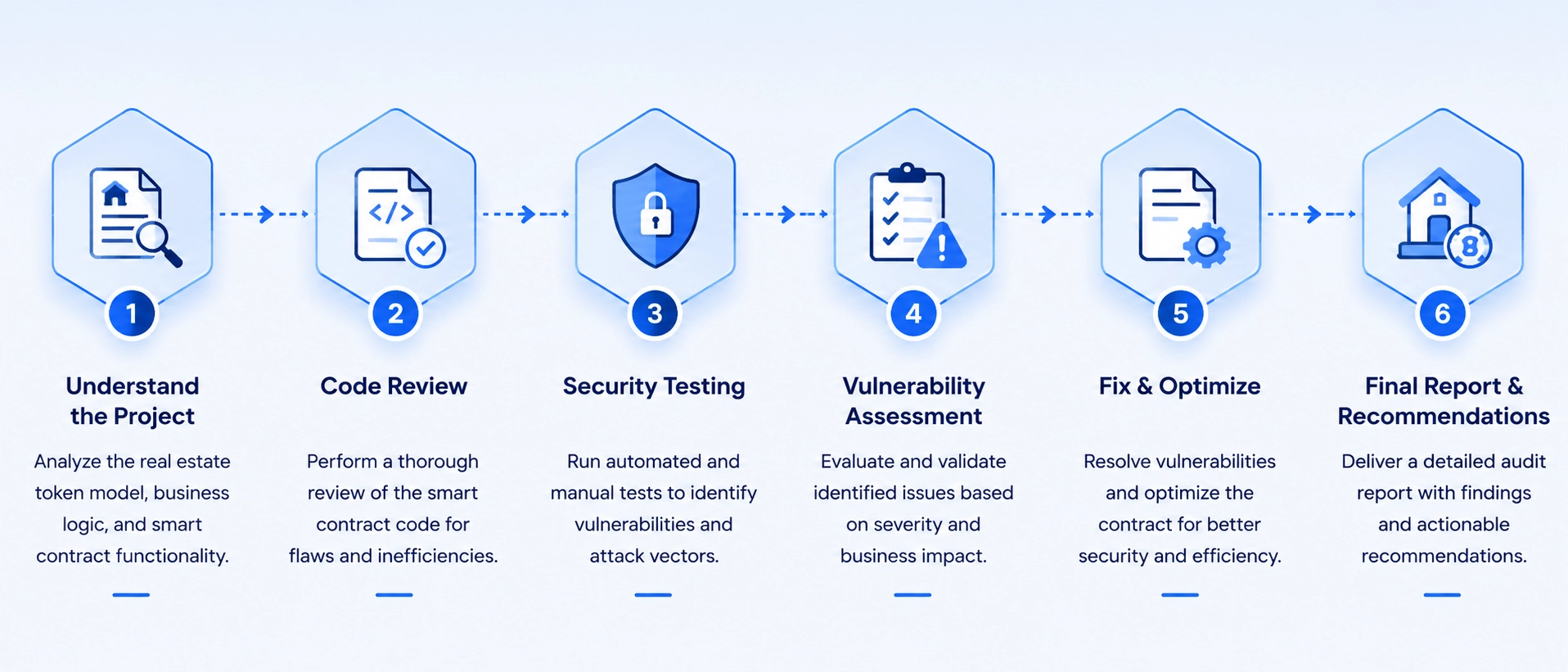
A smart contract audit is the process of having independent security researchers examine your Solidity code for vulnerabilities, logic errors, and deviations from best practices before you deploy to mainnet with real investor funds. For a real estate token smart contract, an audit is not optional regardless of how experienced your engineering team is. The code is immutable once deployed without a proxy, and any vulnerability discovered after mainnet deployment represents a potential loss of all investor capital with no recourse. Auditors find issues that authors always miss because they approach the code from an adversarial perspective rather than a constructive one.
The audit process begins by selecting an audit firm with verified experience in ERC-3643 or ERC-1400 security token contracts specifically, not just general DeFi protocol audits. Firms with relevant track records include OpenZeppelin, Certik, Quantstamp, Trail of Bits, and Halborn. The firm receives your complete contract code, your design documentation, and your test suite. Their team reviews the code manually for the OWASP Top 10 smart contract vulnerabilities, runs automated analysis tools including Slither and Mythril, and produces a detailed report classifying findings as Critical, High, Medium, Low, and Informational severity.
All Critical and High severity findings must be fixed and re-reviewed before mainnet deployment without exception. Medium severity findings should be fixed or formally documented with a risk acceptance rationale from your legal and compliance team. The final audit report, including the full list of findings and your team’s responses, should be published publicly on your platform’s website. In Singapore’s MAS regulatory environment and in UAE’s DFSA framework, publishing your audit report is increasingly becoming a market expectation for any real estate token platform seeking institutional investor trust in 2026.
How to Deploy a Real Estate Token Smart Contract on Ethereum Mainnet
Deploying to Ethereum mainnet is a one-way, permanent action. Once a non-upgradeable contract is deployed, its code cannot be changed. Mistakes cannot be undone with a redeployment without migrating all investor token balances, which is operationally complex and legally ambiguous. This is why the preparation steps of thorough testing, testnet validation, and audit completion are so critical before this step. Your team should treat the mainnet deployment as a formal release event with a written deployment checklist reviewed by at least two engineers and your legal counsel before execution begins.
The mainnet deployment process uses the same Hardhat script as testnet deployment, with the network parameter changed from sepolia to mainnet in the command and the configuration. The deployment wallet must hold sufficient ETH to cover gas costs, which for a full-featured real estate token contract typically ranges from 0.05 to 0.25 ETH depending on current network gas prices and contract bytecode size. Gas estimation before deploying using Hardhat’s gas reporter plugin allows you to predict the cost precisely and fund the wallet accordingly without leaving unnecessary capital at risk in the deployment wallet.
After deployment, immediately verify the contract source code on Etherscan mainnet using hardhat verify. This makes your contract’s source code publicly readable alongside the bytecode, allowing investors to confirm that the code they read is what is actually running. For real estate token platforms serving institutional investors in Singapore’s private wealth sector or Dubai’s DIFC financial community, contract verification on Etherscan is a baseline expectation that any sophisticated investor or their technical advisor will check before recommending the investment to clients. Following verification, transfer admin key management to a multi-signature wallet using Gnosis Safe, removing single-point-of-failure risk from the admin functions immediately after mainnet deployment.
How to Add KYC and Compliance Rules Into a Real Estate Token Smart Contract
KYC integration in a real estate token smart contract is implemented through a whitelist architecture where only wallet addresses that have been verified by an approved identity provider are permitted to hold or transfer tokens. The cleanest implementation separates KYC state management into a dedicated IdentityRegistry contract that the token contract references during transfer validation. This separation means that when an investor’s KYC status changes, for example if they are suspended pending a re-verification request, the IdentityRegistry can be updated without touching the core token contract, preserving token balances and avoiding any disruption to compliant investors during the update.
In the transfer function of the token contract, before executing any balance movement, the code calls the IdentityRegistry to check that both the sender and the recipient are verified. This check happens on-chain in a single function call and adds approximately 5,000 to 10,000 gas to each transfer operation, which at Ethereum’s typical gas prices represents a few cents of additional cost per transaction. For institutional investors making significant property token purchases, this cost is negligible. For retail investors on Polygon or Arbitrum where base gas fees are substantially lower, it is effectively invisible.
Additional compliance rules in the token contract can encode jurisdiction-specific restrictions including: a maximum token holder count required under Regulation D exemptions in US markets that may co-apply to Indian platforms, a minimum holding period implemented as a timestamp check that reverts any transfer attempted before the lockup expiry, a maximum percentage of total supply that any single address can hold to prevent concentration, and a country restriction list that prevents tokens from being sent to wallets associated with sanctioned jurisdictions.
The ERC-3643 standard’s Compliance module architecture allows all of these rules to be configured through separate module contracts without modifying the core token contract, which is a significant maintainability advantage for long-running property token platforms operating across multiple regulatory environments simultaneously.
How to Connect a Real Estate Token Smart Contract to a Frontend Dashboard
Once your real estate token smart contract is deployed and verified on Ethereum mainnet, the next step is connecting it to an investor-facing frontend that allows users to interact with the contract without needing to write code themselves. The standard technical approach uses the ethers.js or viem JavaScript library to create a connection between the browser-side application and the deployed contract using the contract’s ABI, which is the interface definition file generated during contract compilation that describes all the functions the contract exposes.
The investor dashboard typically displays the investor’s current token balance retrieved from the contract’s balanceOf function, the total tokens outstanding compared to the maximum supply from the totalSupply and cap functions, any unclaimed dividend amounts calculated from the contract’s pending dividend function, the investor’s KYC status from the IdentityRegistry lookup, and the remaining time until the holding period lockup expires from the lockup timestamp comparison. Each of these data points is fetched using read-only calls that do not require gas or wallet signatures, making the dashboard experience fast and free for the investor to view their portfolio status at any time.
For write operations like claiming dividends or initiating a secondary market transfer, the frontend prompts the investor’s MetaMask or WalletConnect-compatible wallet to sign and broadcast the transaction. The frontend should display estimated gas costs before asking the investor to confirm, provide clear transaction status feedback during blockchain confirmation, and display Etherscan links for completed transactions so investors can independently verify their actions. For platforms targeting investors in India who may be using mobile devices with variable connectivity, implementing optimistic UI updates that show the expected outcome while the transaction confirms improves the experience significantly without compromising the contract’s security guarantees.
Common Mistakes to Avoid When Deploying a Real Estate Token Smart Contract on Ethereum
After reviewing dozens of real estate token smart contract projects across Singapore, UAE, and India over the past eight years, our team has seen the same categories of mistakes appear repeatedly across different teams and market contexts. These mistakes range from minor inefficiencies that increase costs slightly to critical errors that result in permanent loss of investor funds or irreversible regulatory non-compliance. Understanding these failure patterns before you begin your contract writing process is one of the most efficient investments a property tokenization team can make in terms of reducing total project risk and time to successful deployment.
The most critical mistake is deploying without a professional audit. This sounds obvious but remains the single most common source of catastrophic failures in property token projects. Teams rationalize skipping audits with arguments about cost, timeline pressure, or confidence in their own code quality. Every one of these rationalizations has been proven wrong by real incidents where unaudited contracts resulted in investor losses. A second critical mistake is using a single private key as the admin for all contract functions without a multi-signature wallet. If this key is lost or compromised, administrative control over the entire property token supply and compliance configuration is gone permanently.
| Mistake | Consequence | Severity | Prevention |
|---|---|---|---|
| Skipping the audit | Exploitable bugs cause permanent investor fund loss | Critical | Always audit before mainnet regardless of cost or timeline |
| Single admin key | Key loss or compromise removes all admin control permanently | Critical | Transfer admin role to Gnosis Safe multisig immediately after deploy |
| No upgrade path | Compliance rule changes require full redeployment and migration | High | Use OpenZeppelin TransparentUpgradeableProxy from day one |
| Missing pause function | Cannot halt transfers during security incident or regulatory inquiry | High | Include OpenZeppelin Pausable in every property token contract |
| KYC in token contract | Updating investor status requires risky token contract migration | Medium | Separate KYC logic into standalone IdentityRegistry contract |
| No Etherscan verification | Investors cannot verify contract code, reducing trust significantly | Medium | Run hardhat verify immediately after every deployment to mainnet |
Deploying a real estate token smart contract on Ethereum is one of the highest-stakes technical operations a property tokenization platform team performs. The code you deploy governs real investor capital, real compliance obligations, and real income distribution for months or years after deployment. Getting it right the first time, through rigorous specification, careful Solidity engineering, comprehensive testing, professional auditing, and a controlled mainnet deployment process, is the only standard that property investors in Singapore, UAE, and India have a right to expect from platforms asking for their trust and their capital in 2026’s increasingly competitive tokenized real estate market.
Frequently Asked Questions
Q1.1. What is a real estate token smart contract on Ethereum?
A real estate token smart contract on Ethereum is a self-executing piece of code deployed on the Ethereum blockchain that governs the issuance, transfer, and ownership tracking of digital tokens representing fractional ownership in a physical property. It automates investor management, compliance enforcement, and income distribution without intermediaries.
Q2.2. Which token standard should I use for a real estate token smart contract?
The most widely adopted standards for real estate token smart contracts are ERC-1400 for security token logic with transfer restrictions and ERC-3643, also known as the T-REX protocol, which adds on-chain KYC identity verification. ERC-20 is used only for utility or governance tokens, not regulated property securities.
Q3.3. How much does it cost to deploy a real estate token smart contract on Ethereum?
The gas cost to deploy a fully featured real estate token smart contract on Ethereum mainnet typically ranges from approximately 0.05 ETH to 0.3 ETH depending on contract complexity and network congestion at deployment time. Testnet deployments using Sepolia or Goerli are free. Audit costs from reputable firms range from USD 5,000 to USD 50,000 or more.
Q4.4. Do I need a smart contract audit before going live with a real estate token on Ethereum?
Yes, a smart contract audit is mandatory before deploying a real estate token smart contract to Ethereum mainnet. Property tokenization contracts handle high-value investor funds and compliance obligations. A single bug can result in loss of investor capital or regulatory breach. Reputable audit firms include OpenZeppelin, Certik, Quantstamp, and Trail of Bits.
Q5.5. Can a real estate token smart contract automatically distribute rental income to investors?
Yes, a well-designed real estate token smart contract can automatically distribute rental income proportionally to all token holders. This is implemented using a dividend distribution function that calculates each holder’s share based on their token balance as a percentage of the total supply, then transfers their portion in ETH or a stablecoin like USDC.
Q6.6. How do you add KYC requirements to a real estate token smart contract on Ethereum?
KYC is added to a real estate token smart contract through a whitelist mapping that records which wallet addresses have been verified by an identity provider. The transfer function is modified to check this mapping before allowing any token movement, ensuring only KYC-approved investors can send or receive property tokens at any point.
Q7.7. What tools do I need to write and deploy a real estate token smart contract?
You need the Solidity programming language for writing the contract, Hardhat or Foundry for local testing and deployment scripting, OpenZeppelin Contracts library for secure base implementations, MetaMask for wallet management, Alchemy or Infura as an Ethereum RPC node provider, and Etherscan for contract verification after deployment.
Q8.8. Can I deploy a real estate token smart contract on Polygon or a layer 2 instead of Ethereum mainnet?
Yes, you can deploy a real estate token smart contract on Polygon, Arbitrum, or Base instead of Ethereum mainnet. These layer 2 and sidechain networks use the same Solidity code and EVM compatibility, offering significantly lower transaction fees that benefit retail investors in India and UAE making smaller fractional purchases.
Q9.9. What are the most common security vulnerabilities in real estate token smart contracts?
The most common security vulnerabilities include reentrancy attacks in payment functions, integer overflow in token calculations, missing access control on admin functions, improper transfer restriction logic that allows compliance bypass, and centralized admin key risks that give a single address control over all investor funds and contract parameters.
Q10.10. How long does it take to deploy a real estate token smart contract on Ethereum from start to finish?
A complete real estate token smart contract project, from initial Solidity writing through testing, audit, and mainnet deployment, typically takes 8 to 16 weeks for an experienced team. Simple single-property token contracts can be completed in 4 to 6 weeks. Multi-property platforms with full KYC integration and compliance modules require 4 to 6 months minimum.
Explore Services
Related Services
Reviewed by

Aman Vaths
Founder of Nadcab Labs
Aman Vaths is the Founder & CTO of Nadcab Labs, a global digital engineering company delivering enterprise-grade solutions across AI, Web3, Blockchain, Big Data, Cloud, Cybersecurity, and Modern Application Development. With deep technical leadership and product innovation experience, Aman has positioned Nadcab Labs as one of the most advanced engineering companies driving the next era of intelligent, secure, and scalable software systems. Under his leadership, Nadcab Labs has built 2,000+ global projects across sectors including fintech, banking, healthcare, real estate, logistics, gaming, manufacturing, and next-generation DePIN networks. Aman’s strength lies in architecting high-performance systems, end-to-end platform engineering, and designing enterprise solutions that operate at global scale.