Ai Overview
The idea of tokenized stocks is gaining attention as blockchain technology continues to expand beyond cryptocurrencies. Supporters believe tokenized equities could make investing more accessible, faster, and available around the clock. Instead of relying entirely on traditional market infrastructure, investors may be able to buy and transfer stock-related assets through blockchain-based systems.
The idea of tokenized stocks is gaining attention as blockchain technology continues to expand beyond cryptocurrencies. Supporters believe tokenized equities could make investing more accessible, faster, and available around the clock. Instead of relying entirely on traditional market infrastructure, investors may be able to buy and transfer stock-related assets through blockchain-based systems.
Interest in this market accelerated in June 2026 after 24X National Exchange filed SR-24X-2026-20, a proposal that would allow eligible participants to trade certain securities in tokenized form through a pilot backed by the Depository Trust Company (DTC). The proposal highlights how stock tokenization and broader asset tokenization initiatives are increasingly being explored by established financial institutions rather than just crypto-native platforms.
Key Takeaways
- Tokenized stocks are digital representations of traditional shares recorded on a blockchain.
- Some tokenized stocks provide shareholder rights, while others only offer exposure to a stock’s price movement.
- Tokenization changes how a share is represented, not the underlying security itself.
- Custodians, exchanges, and settlement providers continue to play key roles in most tokenized stock models.
- Tokenized equities can support fractional ownership, global access, and faster settlement processes.
- Most tokenized stock platforms operate within regulated and permissioned financial frameworks.
- Major financial institutions are actively exploring tokenized securities and blockchain-based market infrastructure.
- The future of tokenized stocks is likely to combine traditional finance with blockchain technology rather than replace existing markets.
What Exactly Are Tokenized Stocks?
Tokenized stocks are digital versions of traditional shares that are represented on a blockchain. They are designed to reflect the value of a real stock while using blockchain technology to make trading and ownership transfers more efficient.
For example, a platform may hold shares of companies like Apple or Tesla and issue blockchain-based tokens that represent those shares. Investors can then buy, sell, or transfer these tokens through approved platforms, including some cryptocurrency trading platforms that support tokenized assets.
Unlike cryptocurrencies, which operate as independent digital assets, tokenized stocks are linked to real-world financial assets.
Do You Really Own the Stock?
This is one of the most important questions investors should ask.
Not all tokenized stocks work the same way. Some are backed by real shares held by a regulated custodian, while others simply track a stock’s price without providing actual ownership rights.
Before investing, check:
- Is the token backed by real shares?
- Do you receive dividends?
- Are voting rights included?
- Who holds the underlying stock?
The answers can vary depending on the platform and regulatory structure.
How Tokenized Stocks Work
The process is relatively simple:
- A real share is purchased and held by a custodian.
- A blockchain token is created to represent that share.
- Investors buy and trade the token through approved platforms.
- Transactions are recorded on the blockchain while ownership and compliance records remain protected.
Simple Workflow:
Traditional Stock → Custodian → Blockchain Token → Investor
This approach can improve accessibility and settlement speed, but it does not remove all intermediaries.
Why Wall Street Still Matters
Many people believe stock tokenization will replace brokers and stock exchanges. However, most tokenized stock projects still depend on traditional financial infrastructure.
In the recent 24X proposal, tokenized securities would continue to trade within the existing market framework while relying on DTC for settlement and recordkeeping. This means blockchain may change how securities are represented, but it does not necessarily change who controls custody, compliance, or settlement.
Financial institutions continue to play important roles in:
- Regulatory compliance
- Asset custody
- Settlement processing
- Shareholder rights protection
- Wallet and participant eligibility controls
As a result, tokenized stocks are not replacing Wall Street. Instead, they represent a new way for traditional finance and blockchain technology to work together.
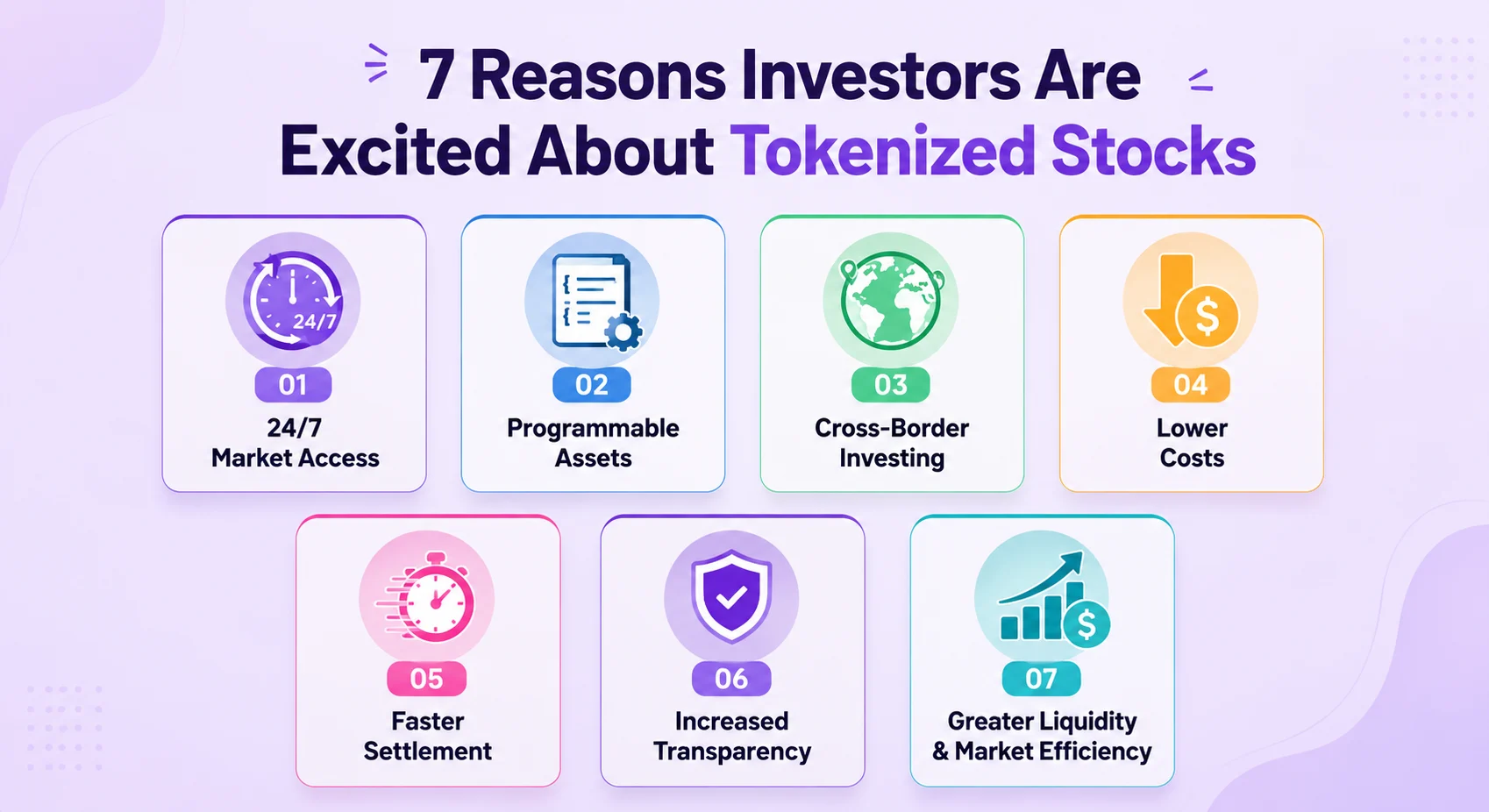
7 Reasons Investors Are Excited About Tokenized Stocks
The growing interest in tokenized stocks is driven by their potential to make investing more flexible, accessible, and efficient. While the technology is still evolving, several advantages continue to attract both retail and institutional investors.
24/7 Market Access
Traditional stock markets operate during specific trading hours. In contrast, blockchain-based systems can support trading beyond regular market schedules, creating the possibility of near 24/7 market access.
Fractional Ownership
Many high-value stocks can be expensive for individual investors. Stock tokenization allows assets to be divided into smaller units, making it easier for investors to gain exposure with smaller amounts of capital.
Global Accessibility
Tokenized equities can potentially reach investors across different regions without relying entirely on local brokerage infrastructure, expanding participation in global markets.
Faster Settlement
One of the biggest advantages of tokenized stocks is the potential for faster settlement. Traditional stock trades often settle on a T+1 or T+2 basis, while blockchain-based systems can significantly reduce settlement times through automated recordkeeping and digital asset transfers.
Lower Costs
By automating parts of the trading and settlement process, tokenized securities may help reduce operational expenses and administrative costs over time.
Programmable Assets
Unlike traditional shares, blockchain-based assets can incorporate smart contract functionality. This enables automated actions such as dividend distribution, compliance checks, or ownership transfers.
Cross-Border Investing
Tokenized stocks may simplify international investing by allowing assets to move across digital networks without many of the traditional barriers associated with cross-border transactions.
Tokenized Stocks vs Traditional Stocks: Which Is Better?
The answer depends on an investor’s goals. Traditional stocks benefit from established regulations, deep liquidity, and decades of market trust. Tokenized stocks, on the other hand, focus on improving accessibility and efficiency through blockchain technology.
| Feature | Traditional Stocks | Tokenized Stocks |
|---|---|---|
| Trading Hours | Limited | Potentially 24/7 |
| Settlement | T+1 / T+2 | Near Instant |
| Accessibility | Regional | Global |
| Fractional Ownership | Limited | Easier |
| Blockchain Integration | No | Yes |
Rather than replacing traditional markets, tokenized stocks currently aim to enhance how securities are traded and managed.
Also Read: Web3 Tokenization Is Transforming Real-World Asset Ownership
Can Blockchain Replace Stock Exchanges Like Nasdaq and NYSE?
Despite rapid innovation, blockchain is unlikely to completely replace major exchanges in the near future. Stock exchanges do much more than match buyers and sellers. They provide regulatory oversight, market surveillance, liquidity management, investor protection, and compliance infrastructure.
Blockchain can improve settlement and ownership tracking, but legal ownership rights, reporting requirements, and regulatory responsibilities still require institutional frameworks. For now, the industry appears to be moving toward integration rather than replacement.
How Major Financial Institutions Are Preparing for Tokenized Markets
The growing interest in tokenized securities is no longer limited to crypto companies. Major institutions such as Nasdaq, DTCC, ICE, and BlackRock are actively exploring blockchain-based financial infrastructure.
The momentum became even more visible after the SEC issued a notice regarding the 24X tokenized stock proposal in June 2026. The initiative follows earlier tokenization efforts and a December 11, 2025 SEC no-action framework that allowed DTC to test blockchain-based recording of certain security entitlements.
The focus of these institutions is not on replacing traditional markets overnight. Instead, they are exploring how blockchain technology can improve settlement efficiency, expand digital asset capabilities, and support tokenized securities while preserving shareholder rights, regulatory oversight, and market integrity.
Need Help Building a Tokenized Asset Platform?
Nadcab Labs develops secure blockchain solutions for tokenized stocks, digital securities, RWA tokenization, trading platforms, smart contracts, and compliant digital asset ecosystems tailored to your business goals.
Frequently Asked Questions
Q1.What are tokenized stocks?
Tokenized stocks are blockchain-based digital tokens that represent ownership or economic exposure to traditional shares. They allow investors to access stock-related assets using blockchain technology while remaining connected to real-world securities.
Q2.Do tokenized stocks give investors real ownership of shares?
Not always. Some tokenized stocks are backed by real shares held by a custodian and may provide shareholder benefits. Others simply track the price of a stock without granting legal ownership, voting rights, or dividends. Investors should always review the platform’s structure before investing.
Q3.How are tokenized stocks different from cryptocurrencies?
Cryptocurrencies operate as independent digital assets, while tokenized stocks are linked to traditional financial assets such as publicly traded shares. Their value is generally derived from the underlying stock rather than market demand alone.
Q4.Can tokenized stocks be traded on a cryptocurrency trading platform?
Yes, some cryptocurrency trading platforms are exploring or offering access to tokenized securities. However, availability depends on local regulations, platform licensing, and the structure of the tokenized asset.
Q5.Are tokenized stocks decentralized?
In most current models, no. While blockchain is used to record and transfer tokens, traditional institutions often remain responsible for custody, compliance, settlement, and shareholder rights. As a result, many tokenized stock systems still operate within regulated financial frameworks.
Q6.Why does Wall Street still play a role in tokenized stocks?
Tokenized stocks may use blockchain technology, but they still require oversight for legal ownership records, settlement, asset custody, and investor protection. This is why exchanges, custodians, and financial institutions continue to be involved in many tokenization projects.
Q7.What are the main benefits of tokenized stocks?
Potential benefits include faster settlement, fractional ownership, global accessibility, improved transferability, and the ability to integrate blockchain-based features into traditional investing.
Q8.Could tokenized stocks replace traditional stock markets?
Not in the near future. Current developments suggest that tokenized stocks are more likely to complement existing financial infrastructure rather than replace major exchanges and settlement systems. The focus today is on improving efficiency while maintaining regulatory safeguards and investor protections.
Explore Services
Related Services
Reviewed by

Aman Vaths
Founder of Nadcab Labs
Aman Vaths is the Founder & CTO of Nadcab Labs, a global digital engineering company delivering enterprise-grade solutions across AI, Web3, Blockchain, Big Data, Cloud, Cybersecurity, and Modern Application Development. With deep technical leadership and product innovation experience, Aman has positioned Nadcab Labs as one of the most advanced engineering companies driving the next era of intelligent, secure, and scalable software systems. Under his leadership, Nadcab Labs has built 2,000+ global projects across sectors including fintech, banking, healthcare, real estate, logistics, gaming, manufacturing, and next-generation DePIN networks. Aman’s strength lies in architecting high-performance systems, end-to-end platform engineering, and designing enterprise solutions that operate at global scale.