Ai Overview
The fundamental appeal of blockchain for real estate has always been clear: immutable ownership records, programmable compliance, automated income distribution, and global market access for fractional property interests. A single dividend distribution to ten thousand token holders on Ethereum mainnet at typical gas prices can cost tens of thousands of dollars in fees, obliterating the economic case for fractional ownership at accessible investment sizes.
Key Takeaways
- 01
Layer 2 architecture processes real estate token transactions off Ethereum mainnet in batches, reducing gas fees by up to 99 percent while inheriting Ethereum’s security for final settlement of all property token records. - 02
The two primary Layer 2 Architecture rollup types are ZK rollups using cryptographic validity proofs for instant finality and optimistic rollups using fraud proofs with a seven-day challenge window before final mainnet settlement. - 03
Polygon, Arbitrum, zkSync Era, Base, and Optimism are the most widely adopted Layer 2 Architecture networks for real estate tokenization platforms in 2026, each offering different trade-offs in cost, speed, and institutional support. - 04
KYC and compliance rules including investor whitelisting, holding period lockups, and transfer restrictions all function identically on Layer 2 Architecture as on Ethereum mainnet using the same ERC-3643 security token standard. - 05
Layer 2 architecture enables fractional real estate ownership at scale by making dividend distribution to thousands of small investors economically viable, with per-distribution costs measured in fractions of a cent rather than dollars. - 06
Robinhood built its own Ethereum Layer 2 Architecture specifically citing the goal of bringing stocks, private equity, and real estate on-chain at scale, validating Layer 2 as the institutional standard infrastructure for asset tokenization. - 07
Regulatory frameworks in Singapore MAS, UAE DFSA, and India SEBI do not require specific blockchain layers but demand compliance enforcement, investor protection, and auditability which Layer 2 Architecture platforms can fully satisfy. - 08
Choosing between Layer 2 Architecture networks depends on transaction volume projections, investor geography, regulatory jurisdiction, existing ecosystem integrations, and whether ZK rollup or optimistic rollup finality better matches the platform’s use case. - 09
App-specific Layer 2 Architecture chains using the OP Stack or ZK Stack allow real estate tokenization platforms to deploy their own rollup with full control over fee structure, compliance rules, and data availability configuration. - 10
The future of Layer 2 architecture in real estate tokenization points toward app-specific rollups, cross-chain interoperability, and AI-driven portfolio management executed natively on Layer 2 Architecture smart contract infrastructure.
Introduction to Layer 2 Architecture for Real Estate Tokenization
The fundamental appeal of blockchain for real estate has always been clear: immutable ownership records, programmable compliance, automated income distribution, and global market access for fractional property interests. The problem has been equally clear: Ethereum mainnet’s gas fees and throughput constraints make it impractical to run a high-volume property token platform on Layer 1 alone. A single dividend distribution to ten thousand token holders on Ethereum mainnet at typical gas prices can cost tens of thousands of dollars in fees, obliterating the economic case for fractional ownership at accessible investment sizes.
Layer 2 architecture resolves this fundamental tension by separating where transactions execute from where they are ultimately secured. Transactions execute on a high-speed, low-cost Layer 2 network. The security and finality of those transactions is provided by Ethereum mainnet through cryptographic proofs submitted in batches. The investor experience is fast and affordable. The security guarantee is as strong as Ethereum itself. This combination has made Layer 2 the dominant architectural pattern for serious real estate tokenization platforms launching in Singapore, UAE, and India in 2026.
Robinhood’s January 2026 disclosure that it built its own Ethereum Layer 2 Architecture specifically to bring stocks, private equity, and real estate on-chain at scale was a landmark institutional validation of this architectural approach. When one of the world’s largest consumer finance platforms chooses to invest in proprietary Layer 2 infrastructure rather than building on mainnet, it signals that Layer 2 architecture is not an experimental optimization but the required foundation for any serious asset tokenization platform targeting mass-market adoption and institutional-grade throughput simultaneously.
What Is Layer 2 Architecture and How It Works on Blockchain
Layer 2 architecture is a category of blockchain scaling solutions that operate as a secondary execution environment built on top of a base layer blockchain, typically Ethereum. The core design principle is simple: execute transactions in a separate environment that is faster and cheaper, then periodically commit a compressed summary of those transactions back to the base layer for final security and settlement. The base layer does not need to process every individual transaction; it only needs to verify that the batch of transactions submitted was valid according to the rules of the smart contracts involved.
The two dominant Layer 2 Architecture rollup designs differ in how they prove the validity of batched transactions to Ethereum mainnet. Optimistic rollups, which include Arbitrum and Optimism, submit batches to mainnet and assume they are valid by default. A seven-day challenge window allows any observer to submit a fraud proof if a transaction in the batch was invalid. If no successful challenge is raised, the batch is finalized.
This design is simple and computationally inexpensive for the operator but introduces a withdrawal delay when moving funds from Layer 2 back to mainnet, because the challenge window must expire before withdrawal is final. ZK rollups, which include zkSync Era, Polygon zkEVM, and StarkNet, submit cryptographic validity proofs with every batch. These proofs mathematically guarantee that every transaction in the batch was valid without requiring any trust assumption or waiting period. Verification is instant, making ZK rollups superior for use cases requiring fast finality.
For real estate token platforms, both rollup types offer enormous advantages over mainnet-only architectures. The choice between them depends on specific operational requirements around finality speed, proof generation cost, and the maturity of the developer tooling available for the target network. State channels, another Layer 2 approach, allow two parties to transact directly off-chain with only opening and closing transactions on mainnet, but they are less suitable for multi-party real estate token markets where the investor set is large and dynamic rather than fixed between two known counterparties.
Why Layer 2 Architecture Matters for Real Estate Tokenization Platforms
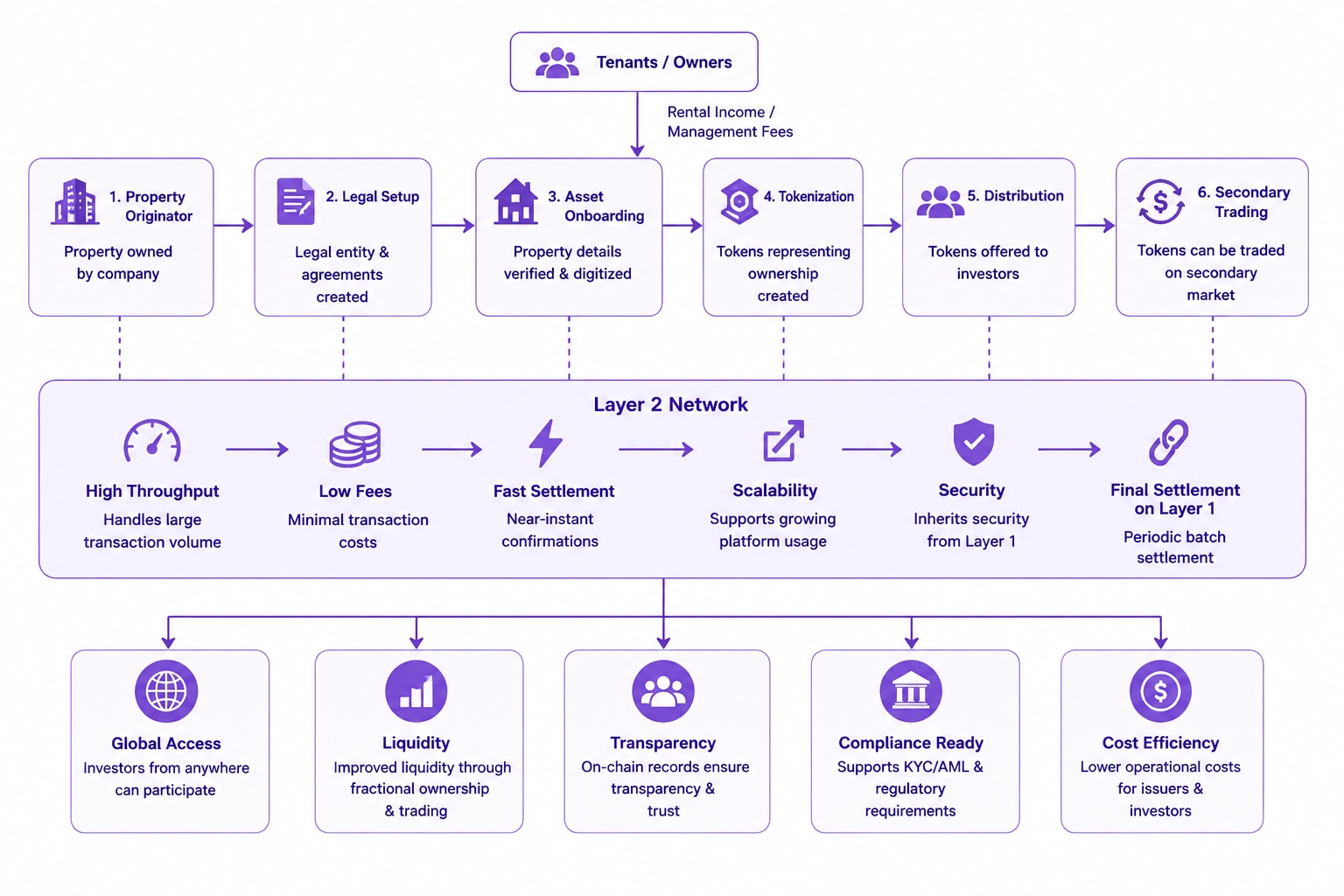
The business case for Layer 2 architecture in real estate tokenization becomes clear when you examine the operational economics of running a fractional property investment platform at meaningful scale. Consider a platform managing ten tokenized properties across Singapore and Dubai, each with five hundred fractional investors. This platform needs to distribute rental income monthly to five thousand wallet addresses, process secondary market trades throughout the month, execute KYC re-verification checks quarterly, and handle token redemption requests as they arise.
On Ethereum mainnet at typical gas prices, the monthly dividend distribution alone could cost between USD 25,000 and USD 100,000 in gas fees depending on network congestion. This cost would need to be passed to investors or absorbed by the platform, destroying the economic viability of small investment sizes that are the entire point of fractional ownership.
On a Layer 2 Architecture network, the same five thousand dividend transfers cost less than USD 5 to USD 50 total, reducing per-investor distribution cost to a fraction of a cent. This cost reduction is not marginal; it is the difference between a viable and an unviable business model for platforms targeting retail and emerging-market investors in India and the Gulf region who are making investment amounts below USD 1,000. Layer 2 architecture is what makes the democratization promise of real estate tokenization financially real rather than technically possible but economically impractical at the investment sizes most investors bring to these platforms.
Beyond direct cost savings, Layer 2 architecture enables product features that are impossible at mainnet gas prices. Real-time income streaming, where rental income is distributed continuously rather than monthly, requires hundreds of thousands of micro-transactions per year and is only economically feasible on Layer 2. Secondary market trading with tight bid-ask spreads requires that market makers can place and cancel orders frequently without each action costing dollars in gas.
High-frequency portfolio rebalancing for institutional clients requires computational agility that mainnet gas costs structurally prevent. Layer 2 architecture enables all of these product capabilities, transforming what a real estate tokenization platform can offer to investors in Singapore’s private wealth community, Dubai’s retail investment market, and India’s rapidly growing digital investment ecosystem.[1]
How Layer 2 Solutions Reduce Transaction Costs in Real Estate Tokenization
Transaction cost reduction in Layer 2 architecture operates through a simple but powerful economic principle: batching and amortization. When Ethereum mainnet processes a transaction, every node in the network must process that transaction, store its result, and update its local state. The gas fee reflects the computational and storage burden imposed on the entire decentralized network.
Layer 2 networks handle this differently: they process transactions locally in a high-performance execution environment, then submit a single compressed proof or state delta to mainnet representing the cumulative result of potentially tens of thousands of individual transactions. The mainnet gas cost is paid once for the batch submission rather than once per transaction, and this cost is divided across every transaction in the batch.
The cost reduction ratio depends on batch size and network conditions. A batch containing one thousand token transfers submits one mainnet transaction at approximately 200,000 to 500,000 gas. At USD 5 per mainnet transaction, the per-transfer cost within that batch is USD 0.005, compared to USD 2 to USD 10 per individual transfer on mainnet. As batch sizes grow, the per-transaction cost falls further.
Mature Layer 2 networks with high utilization, like Polygon and Arbitrum during normal operation, achieve per-transaction costs measured in fractions of a cent for simple token transfers. For the KYC whitelist checks and compliance validations that every regulated real estate token transfer requires, each check costs approximately USD 0.001 to USD 0.01 on Layer 2 versus USD 0.50 to USD 3.00 on Ethereum mainnet.
For real estate tokenization platforms in India where investors may be contributing as little as INR 5,000 to INR 50,000 (approximately USD 60 to USD 600) per property, this cost reduction is not a nice-to-have improvement but a structural prerequisite for the business model. If each token purchase costs USD 5 in gas fees, an investor contributing USD 100 is immediately down 5 percent before any market exposure. On Layer 2 Architecture, that same purchase costs USD 0.01 in gas, representing a negligible 0.01 percent friction that is entirely acceptable and comparable to the spread charged by traditional investment platforms.
Speed Advantages of Layer 2 Architecture for Property Token Transactions
Transaction speed is the second major operational advantage that Layer 2 architecture delivers for real estate token platforms. Ethereum mainnet produces a new block approximately every 12 seconds, and a transaction is typically considered safely confirmed after six to twelve blocks, meaning investors wait between one and two minutes to see a property token purchase or transfer confirmed. During periods of high network activity, transactions with insufficient gas fees may be delayed in the mempool for hours. This experience is tolerable for occasional mainnet transactions but completely unacceptable for secondary market trading where price execution requires near-instantaneous confirmation or for high-frequency dividend claiming workflows.
Layer 2 networks offer dramatically faster confirmation times. Arbitrum and Optimism produce blocks every two seconds, with transactions considered final at the Layer 2 level within seconds of submission. Polygon PoS processes blocks every two seconds. zkSync Era and Polygon zkEVM provide sub-second transaction inclusion with cryptographic finality provided by the ZK proof submitted to mainnet on a regular cadence. From the investor’s perspective, a token purchase on any of these networks feels as fast as a traditional stock trade: submit the transaction, see the confirmation within seconds, see the balance update almost immediately.
For secondary market trading infrastructure on a real estate token platform, Layer 2 speed enables order book matching engines and automated market maker contracts that respond in real time. A seller in Dubai can list property tokens and see buyers in Singapore and India executing against that order within seconds, with the resulting ownership change confirmed on Layer 2 before either party has had time to reconsider. This real-time settlement is the technical foundation of the liquidity improvements that property tokenization promises over traditional real estate investment, where settlement cycles typically take days or weeks even for the most sophisticated institutional platforms operating under the best conditions available in conventional markets.
Top Layer 2 Networks Used in Real Estate Tokenization Platforms in 2026
The Layer 2 Architecture landscape has matured considerably by 2026, with several networks establishing clear differentiation in terms of security model, transaction costs, developer tooling, institutional support, and regulatory engagement. For real estate tokenization platforms making a network selection decision, the choice carries significant long-term implications because migrating a production token contract with live investors and established ownership records from one network to another is operationally complex and potentially legally sensitive.
Polygon remains the most widely adopted Layer 2 network for real estate tokenization globally, with significant traction in Indian blockchain platforms due to its low fees, EVM compatibility, and strong institutional relationships including partnerships with JPMorgan, Mastercard, and the Reserve Bank of India’s CBDC pilot. Arbitrum has emerged as the preferred network for platforms prioritizing deep DeFi liquidity integration alongside their tokenization product, enabling property token holders to use their tokens as collateral in lending protocols.
zkSync Era and Polygon zkEVM represent the ZK rollup tier, attracting platforms where cryptographic security guarantees and fast withdrawal times are prioritized over the slightly lower cost achievable on optimistic rollups. Base, backed by Coinbase and built on the OP Stack, has attracted multiple real-world asset tokenization projects due to Coinbase’s institutional relationships and its custody infrastructure that many regulated platforms already use.
| Network | Rollup Type | Avg Tx Cost | TPS | Best For |
|---|---|---|---|---|
| Polygon PoS | Sidechain / PoS | <$0.01 | 7,000+ | High-volume retail platforms, India market |
| Arbitrum One | Optimistic Rollup | $0.05 to $0.20 | 40,000+ | DeFi-integrated property platforms |
| zkSync Era | ZK Rollup | $0.01 to $0.05 | 2,000+ | Fast finality, privacy-sensitive platforms |
| Base (Coinbase) | Optimistic Rollup | $0.01 to $0.10 | 2,000+ | Coinbase-integrated institutional platforms |
| Polygon zkEVM | ZK Rollup | $0.01 to $0.05 | 2,000+ | Enterprise platforms, regulatory compliance focus |
How Layer 2 Architecture Supports Fractional Ownership at Scale
Fractional property ownership is the core value proposition of real estate tokenization, and it creates specific technical requirements that only Layer 2 architecture can satisfy economically at meaningful scale. When a single property is divided into ten thousand fractional tokens and sold to a corresponding number of investors, the operational demands on the token smart contract multiply dramatically. Every dividend distribution cycle touches ten thousand wallet addresses. Every secondary market trade requires at least two balance updates and one compliance check. Every quarterly KYC re-verification requires ten thousand individual whitelist updates. The cumulative transaction volume is orders of magnitude higher than a platform serving a small number of accredited investors making large minimum investments.
Layer 2 architecture handles this volume through a combination of lower per-transaction cost and higher throughput capacity. Platforms can implement streaming rental income distribution, where smart contracts continuously accumulate rental income and allow investors to claim their proportional share at any time rather than waiting for monthly batch distributions. This push-to-claim model, which is only economically feasible on Layer 2 Architecture where each claim costs fractions of a cent, improves investor experience dramatically and reduces the operational complexity of managing fixed distribution schedules across thousands of investors in different time zones across Singapore, Dubai, and Indian cities.
Secondary market liquidity for fractional property tokens also scales more effectively on Layer 2. Automated market maker contracts that maintain liquidity pools for property token pairs require frequent small rebalancing transactions that would be prohibitively expensive on mainnet. On Layer 2, market makers can provide tight spreads and deep liquidity without the gas cost overhead that would otherwise make providing liquidity in property token markets economically unattractive for professional market makers and sophisticated individual liquidity providers operating in India’s growing DeFi participant community.
Security Considerations in Layer 2 Real Estate Tokenization Architecture
Security in Layer 2 real estate tokenization architecture operates across two distinct layers that require separate evaluation and trust models. The first is the security of the token smart contracts themselves, which is identical whether those contracts are deployed on Ethereum mainnet or a Layer 2 network. The same vulnerability classes, reentrancy attacks, access control errors, and arithmetic overflows, apply equally on any EVM-compatible network. Contract auditing requirements are unchanged by the Layer 2 deployment choice: all production token contracts must be independently audited by reputable firms before mainnet or Layer 2 deployment with real investor capital.
The second security dimension is the Layer 2 network’s own security model and how it ultimately settles to Ethereum. For optimistic rollups, the security guarantee is that at least one honest node will detect and submit a fraud proof if an invalid transaction batch is submitted. This one-of-n honesty assumption is practically very strong on well-established networks like Arbitrum and Optimism with thousands of validators and strong financial incentives for fraud detection. For ZK rollups, security is provided cryptographically: a validity proof mathematically guarantees that the batch contains only valid transactions. No trust in any party is required beyond the correctness of the ZK proof system’s mathematics, which is verifiable by anyone.
One specific security consideration for real estate token platforms is bridge risk. When investors move property tokens or stablecoin collateral between Layer 2 and Ethereum mainnet, or between different Layer 2 networks, they interact with bridge contracts that hold assets in escrow during the cross-chain transfer. Bridge contracts have historically been a major target for exploits in the broader DeFi ecosystem. Real estate tokenization platforms should implement clear guidance for investors on which bridging paths are officially supported, should preferably use each network’s official native bridge rather than third-party bridges for large value transfers, and should implement monitoring for unusual bridging activity associated with their token contracts that might indicate an attempted exploit.
Layer 2 Architecture and Regulatory Compliance for Tokenized Properties
Regulatory compliance in real estate tokenization does not change based on which layer the token contract is deployed on. The compliance obligations imposed by Singapore’s Monetary Authority, Dubai’s DFSA, and India’s emerging SEBI digital securities framework are technology-neutral: they require identity verification of investors, enforcement of transfer restrictions, investor protection mechanisms, and transaction auditability. All of these requirements can be implemented identically on Layer 2 as on Ethereum mainnet, because Layer 2 networks execute the same Solidity smart contract code and maintain the same on-chain transaction history that regulators and auditors can review.
The ERC-3643 token standard, which is the dominant framework for regulated security tokens, works identically on any EVM-compatible Layer 2. The Identity Registry that stores verified investor KYC credentials, the Compliance module that enforces jurisdiction-specific transfer rules, and the token contract itself all function the same way on Polygon, Arbitrum, or zkSync as they do on Ethereum mainnet.
Compliance officers at regulated platforms can query the Layer 2 blockchain explorer to retrieve the same audit trail of investor onboarding events, transfer history, and whitelist updates that they would access on an Etherscan mainnet query, with the additional advantage that Layer 2 transactions are typically confirmed and visible within seconds rather than the one to two minute confirmation times on mainnet.
One compliance-specific advantage of some Layer 2 architectures is the ability to implement app-specific rollups with custom access control at the network level. A real estate tokenization platform deploying its own rollup using the OP Stack or Polygon CDK can configure the rollup’s sequencer to reject transactions that fail compliance checks before they even reach the smart contract level, providing an additional layer of regulatory enforcement that mainnet deployments cannot offer without significant architectural complexity. This network-level compliance configuration is particularly relevant for platforms serving Singapore and UAE investors where regulators are increasingly sophisticated in their understanding of blockchain architecture and may in future mandate specific technical implementation approaches for compliance enforcement in tokenized asset platforms.
Real World Examples of Layer 2 Based Real Estate Tokenization Platforms
The adoption of Layer 2 architecture by real estate tokenization platforms in 2026 has moved beyond early experiments into production deployments handling real investor capital across multiple geographies. Examining these real-world implementations provides practical insight into which Layer 2 choices are proving effective for different platform types and investor profiles. Each case demonstrates a different dimension of how Layer 2 architecture enables property tokenization at scales that would be operationally infeasible on Ethereum mainnet alone.
Robinhood’s proprietary Ethereum Layer 2 built on Arbitrum’s technology stack is the highest-profile example of institutional Layer 2 adoption for asset tokenization. Robinhood explicitly cited its desire for Ethereum’s security combined with throughput and cost characteristics that mainnet cannot provide as the reason for building its own Layer 2. While Robinhood’s primary near-term use case is equities tokenization, its platform roadmap explicitly includes private equity and real estate as subsequent asset classes, establishing a Layer 2 infrastructure that will soon directly compete with traditional real estate tokenization platforms across all markets where Robinhood operates.
| Platform | Layer 2 Network | Market Focus | Key Benefit Achieved |
|---|---|---|---|
| Robinhood Layer 2 | Proprietary (Arbitrum stack) | US, Global (incl. real estate) | Mainnet security at Layer 2 cost and speed |
| RealT (US Properties) | Gnosis Chain (xDai) | Global retail investors | Daily rental income distribution at sub-cent cost |
| Propy | Polygon PoS | US and global property | Affordable on-chain deed recording and settlement |
| Ctrl Alt (Dubai DLD) | XRP Ledger (L1 alt) | Dubai, UAE investors | Fast settlement synced with land registry |
| Binaryx | Polygon PoS | Global, Bali and Europe focus | Daily automated rental income to global investors |
How to Choose the Right Layer 2 Architecture Solution for Your Tokenization Project
Selecting the right Layer 2 network for a real estate tokenization platform is a decision with significant long-term implications that cannot be easily reversed once investor token balances, KYC registries, and compliance contracts are live in production. The decision framework should evaluate five key dimensions: transaction cost and throughput requirements, finality speed requirements, regulatory jurisdiction alignment, ecosystem and liquidity considerations, and the team’s technical capability to operate on the chosen network.
Transaction volume and investor count projections drive the cost analysis. A platform targeting five hundred high-net-worth investors in Singapore and UAE, each making investments above USD 50,000, can comfortably operate on Arbitrum where per-transaction costs of USD 0.10 to USD 0.20 are negligible relative to investment sizes.
A platform targeting fifty thousand retail investors in India with investment sizes starting from INR 5,000 requires Polygon’s sub-cent transaction costs to avoid the situation where gas fees represent a meaningful percentage of small investment amounts. The projected transaction volume per month, including all token transfers, dividend distributions, and compliance checks, should be calculated and multiplied by the per-transaction cost on each candidate network to produce a monthly gas cost estimate before making a final decision.
For platforms requiring fast withdrawal finality, for example those offering secondary market liquidity with near-instant settlement guarantees to professional traders, a ZK rollup network like zkSync Era or Polygon zkEVM is preferable over optimistic rollups where the seven-day challenge window creates uncertainty about when a withdrawal from Layer 2 to mainnet becomes truly final. For platforms where withdrawal finality speed is less critical because most investors are holding property tokens for months or years rather than trading frequently, the lower operational complexity of optimistic rollup infrastructure may be preferable for a team that does not have deep ZK cryptography expertise on staff.
Future of Layer 2 Architecture in Real Estate Tokenization and Beyond
The Layer 2 Architecture landscape is evolving rapidly and several trends will significantly shape how real estate tokenization platforms build and scale their infrastructure over the next three to five years. Understanding these trends now allows platform architects in Singapore, UAE, and India to make forward-compatible design choices that do not require expensive redesigns as the ecosystem matures around them.
App-specific rollups are the most significant emerging trend for serious real estate tokenization platforms. Rather than deploying on a shared public Layer 2 network, platforms can now deploy their own dedicated rollup using the OP Stack from Optimism, the ZK Stack from zkSync, or the Polygon CDK. This gives platforms full control over their transaction fee structure, ability to exclude non-compliant transactions at the sequencer level, custom data availability configurations, and governance over upgrade decisions. Robinhood’s choice to build its own Ethereum Layer 2 rather than deploying on an existing network is an early example of this trend, and several dedicated real estate tokenization rollups are expected to launch across Asia-Pacific markets in 2026 and 2027.
Cross-chain interoperability is the second major frontier, enabling property tokens issued on one Layer 2 to be recognized and traded on other networks without complex bridging operations that carry security and liquidity fragmentation risks. The ERC-3643 standard’s approach to portable digital identity, where an investor’s verified credentials can be recognized across multiple networks, is a crucial enabler for this cross-chain future.
When a Singapore investor holding property tokens on a Polygon-based platform can seamlessly trade those tokens on an Arbitrum-based secondary market with their KYC credentials automatically verified across chains, the global liquidity of real estate tokens will approach that of conventional securities markets. This interoperability layer, which is actively under construction by projects like LayerZero, Chainlink CCIP, and the ERC-3643 standards committee, will likely be the defining infrastructure advancement for the real estate tokenization sector in 2027 and 2028.
Frequently Asked Questions
Q1.1. What is Layer 2 architecture in blockchain and why does it matter for real estate?
Layer 2 architecture is a secondary network built on top of a base blockchain like Ethereum that processes transactions off-chain and settles them on the main chain in batches. For real estate tokenization, it dramatically reduces gas fees and increases transaction throughput, making fractional property ownership accessible and affordable for investors of all sizes.
Q2.2. How does Layer 2 reduce transaction costs for property token platforms?
Layer 2 Architecture networks batch thousands of transactions together and submit a single compressed proof or state update to the Ethereum mainnet. This amortizes the gas cost across all transactions in the batch, reducing per-transaction fees from several dollars on Ethereum mainnet to fractions of a cent on leading Layer 2 networks like Polygon, Arbitrum, and zkSync.
Q3.3. Which Layer 2 networks are best for real estate tokenization in 2026?
The most widely adopted Layer 2 Architecture networks for real estate tokenization in 2026 include Polygon for its established ecosystem and EVM compatibility, Arbitrum for its security and DeFi liquidity, zkSync Era and Polygon zkEVM for zero knowledge proof-based security, and Base for its Coinbase institutional backing and growing real-world asset infrastructure.
Q4.4. Is Layer 2 real estate tokenization as secure as Ethereum mainnet?
Layer 2 Architecture networks inherit Ethereum mainnet security for final settlement, meaning funds and token ownership records are ultimately secured by Ethereum’s proof of stake consensus. The security model differs slightly between optimistic rollups, which have a challenge period for fraud proofs, and ZK rollups, which use cryptographic validity proofs for instant mathematical verification.
Q5.5. Can Layer 2 architecture handle compliance and KYC rules for property tokens?
Yes, KYC and compliance rules can be encoded directly into smart contracts deployed on Layer 2 networks using the same Solidity code and ERC-3643 T-REX token standard as Ethereum mainnet. Transfer restrictions, investor whitelisting, jurisdictional rules for Singapore, UAE, and India, and holding period lockups all function identically on Layer 2 with lower execution costs per compliance check.
Q6.6. What is the difference between ZK rollups and optimistic rollups for real estate tokenization?
ZK rollups use cryptographic validity proofs to instantly verify batches of transactions, providing faster finality and no withdrawal delay but higher proof generation cost. Optimistic rollups assume transactions are valid by default and allow a seven-day challenge window for fraud proofs, offering lower computational overhead but slower final settlement. Both significantly reduce costs compared to Ethereum mainnet.
Q7.7. How fast are token transactions on Layer 2 compared to Ethereum mainnet?
Ethereum mainnet processes approximately 15 to 30 transactions per second with typical confirmation times of 12 to 30 seconds. Layer 2 Architecture networks like Arbitrum and Polygon process hundreds to thousands of transactions per second with sub-second confirmation times, making real-time fractional property token trading and dividend distribution practically feasible for high-volume platforms.
Q8.8. Do real estate tokenization platforms on Layer 2 work with Ethereum wallets?
Yes, all major Layer 2 networks are EVM-compatible, meaning they work with standard Ethereum wallets including MetaMask and WalletConnect. Investors in Singapore, UAE, and India who already hold Ethereum wallets can interact with Layer 2 real estate token platforms without any new wallet setup, simply by switching their wallet’s network to the relevant Layer 2 chain.
Q9.9. How do investors move their property tokens from Layer 2 back to Ethereum mainnet?
Investors bridge tokens from Layer 2 Architecture to Ethereum mainnet using the network’s official bridge or third-party bridge protocols. For optimistic rollups, this process takes approximately seven days due to the fraud proof challenge window. For ZK rollup networks, withdrawals are processed much faster, typically within minutes to hours, once the validity proof is submitted and verified on-chain.
Q10.10. Is Layer 2 architecture supported by regulators in India, Singapore, and UAE?
Regulatory frameworks in Singapore under MAS, UAE under DFSA and ADGM, and India under emerging SEBI blockchain guidelines do not specifically mandate any particular blockchain layer. What regulators require is demonstrable compliance enforcement, investor protection mechanisms, and transaction auditability. All of these requirements can be satisfied on Layer 2 architectures with properly designed smart contract systems and audit trail infrastructure.
Explore Services
Related Services
Reviewed by

Naman Singh
Co-Founder & CEO, Nadcab Labs
Naman Singh is the Co-Founder and CEO of Nadcab Labs, where he drives the company’s vision, global growth, and strategic expansion in blockchain, fintech, and digital transformation. A serial entrepreneur, Naman brings deep hands-on experience in building, scaling, and commercializing technology-driven businesses. At Nadcab Labs, Naman works closely with enterprises, governments, and startups to design and implement secure, scalable, and business-ready Web3 and blockchain solutions. He specializes in transforming complex ideas into high-impact digital products aligned with real business objectives. Naman has led the development of end-to-end blockchain ecosystems, including token creation, smart contracts, DeFi and NFT platforms, payment infrastructures, and decentralized applications. His expertise extends to tokenomics design, regulatory alignment, compliance strategy, and go-to-market planning—helping projects become investor-ready and built for long-term sustainability. With a strong focus on real-world adoption, Naman believes in building blockchain solutions that deliver measurable value, solve practical problems, and unlock new growth opportunities for organizations worldwide.