Ai Overview
Think of smart contract architecture as the set of rules and systems that make an NFT marketplace run on its own. Over $100 million worth of NFTs were stolen between July 2021 and July 2022 alone, with scammers averaging around $300,000 per attack. And the broader crypto ecosystem saw losses climb from $1. The infamous 2016 DAO hack used this exact method to steal what was then worth $60 million in Ether.
Key Takeaways
- NFT marketplace development costs range from $30,000 to $150,000 or more, depending on features, with basic platforms starting at $30,000 and advanced platforms with custom smart contracts and multi-chain support reaching $150,000 or more.[1]
- Gaming NFTs represent a market valued at approximately $471.90 billion in 2024, with forecasts projecting growth to $942.58 billion by 2029, with trading volume concentrated heavily in PFP assets at 37 percent and gaming at 25 percent.[2]
- Virtual real estate NFTs are predicted to grow at a compound annual growth rate of 27.4 percent, with platforms like Decentraland and The Sandbox enabling users to buy, develop, and monetize digital property.[3]
- Event ticketing NFTs now represent 5.3 percent of ticket sales across major US venues in 2025, showing practical utility beyond speculative collectibles and providing fraud prevention.[4]
- Rarible introduced community governance through RARI tokens, allowing users to vote on platform decisions, including feature updates and fee changes, representing a shift toward decentralized marketplace management.[5]
When someone buys an NFT on a marketplace, most people think the platform is just acting like a shop. But what is actually doing all the work behind the scenes is a smart contract. It handles the money, confirms ownership, records the deal on the blockchain, and even pays the original creator a cut, all without anyone pressing a button.
This is what makes smart contract architecture the most important part of building any NFT marketplace. It is not just a piece of code sitting in the background. It is the engine that runs everything. And if that engine is built poorly, the whole platform can break, get hacked, or fail its users.
This blog explains how smart contract architecture works inside NFT marketplaces, what the main building blocks are, which token standards are used, how royalties get paid, and what it takes to keep everything safe.
NFT Marketplace Development Guide
What Is Smart Contract Architecture in an NFT Marketplace?
Think of smart contract architecture as the set of rules and systems that make an NFT marketplace run on its own. These rules are written as code and stored on a blockchain. Once they go live, no one can change them without following the process built into the contract itself.
In a traditional online store, a company’s server holds all the data and controls every action. In an NFT marketplace, control shifts to the smart contract. The contract decides who owns what, when money moves, and how much a creator gets paid every time their work is sold again.
The architecture is not just one contract. A well-built NFT marketplace typically uses multiple contracts working together. One handles minting, another manages listings and auctions, another controls royalty payouts, and yet another governs who has access to what. All of these contracts talk to each other to make the platform work as one unit.
The Main Layers of Smart Contract Architecture
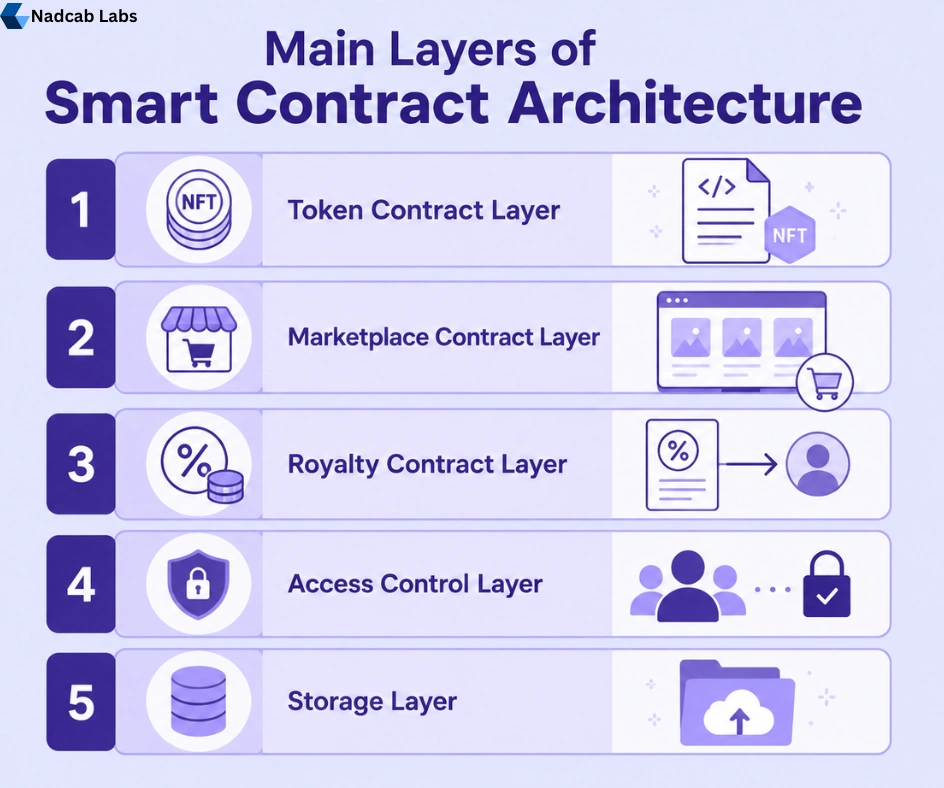
A typical NFT marketplace smart contract system has several layers:
1. Token Contract Layer
This is where NFTs are created. The token contract follows a standard like ERC-721 or ERC-1155 and defines the rules for how each NFT is minted, transferred, and tracked.
2. Marketplace Contract Layer
This layer handles the buying and selling. It manages listings, accepts bids, processes payments, and moves the NFT from seller to buyer once conditions are met.
3. Royalty Contract Layer
Using the EIP-2981 standard, this layer tells the marketplace how much royalty is owed to the creator on every resale, and where that payment should go.
4. Access Control Layer
This part of the architecture decides who can call which functions. It ensures only verified accounts can mint, only admins can pause the contract, and only buyers can trigger a purchase.
5. Storage Layer
NFT metadata like images, descriptions, and properties is usually stored off-chain using systems like IPFS or Arweave. The smart contract stores only a link to that data, keeping gas costs low.
NFT Token Standards: ERC-721 vs ERC-1155
The two most widely used token standards for NFTs are ERC-721 and ERC-1155. Both are built on Ethereum, but they work differently and are suited to different types of projects.
ERC-721: One Token, One Contract
ERC-721 was formally published in January 2018 and is the original standard built specifically for non-fungible tokens. Under this standard, every single NFT is unique and gets its own token ID. A new smart contract is deployed for each NFT type, which means every item stands completely alone.
This works well for digital art, rare collectibles, and one-of-a-kind items where the uniqueness of each piece is the whole point. CryptoKitties, one of the earliest and most well-known NFT projects, used a version of this standard. ERC-721 tokens cannot be exchanged with one another because no two are the same.
The downside is cost. Each NFT transfer requires its own transaction on the blockchain, which means sending 10 NFTs at once would cost 10 separate gas fees. When the Ethereum network gets busy, those fees can become very high, which can push away smaller creators and buyers.
ERC-1155: Many Tokens, One Contract
ERC-1155 was built to fix the limitations of ERC-721. It is called a multi-token standard because a single smart contract can hold many different types of tokens, both fungible and non-fungible, at the same time.
This is particularly useful for gaming platforms where players might hold dozens of different in-game items, currencies, and collectibles all at once. Instead of deploying a separate contract for each item type, one ERC-1155 contract handles everything. This reduces gas costs significantly and makes the whole system much easier to manage.
ERC-1155 also supports batch transfers, meaning you can send multiple different tokens in a single transaction. Compared to ERC-721, where each transfer is separate, this is a big efficiency gain. Adidas used ERC-1155 for their “Into the Metaverse” NFT campaign across multiple phases, taking advantage of its ability to handle varied asset types under one contract.
The trade-off is complexity. ERC-1155 takes more time to understand and implement correctly, and if not handled carefully, its flexibility can create room for misuse.
ERC-721 vs ERC-1155: Quick Comparison
| Feature | ERC-721 | ERC-1155 |
|---|---|---|
| Token Type | Non-fungible only | Fungible, non-fungible, and semi-fungible |
| Contracts Needed | One contract per token type | One contract for all token types |
| Batch Transfers | Not supported; each is a separate transaction | Supported multiple tokens in one transaction |
| Gas Efficiency | Higher gas cost per transfer | Lower gas cost due to batch support |
| Best Use Case | Digital art, rare 1-of-1 collectibles | Gaming items, multi-asset platforms, metaverse |
| Implementation Complexity | Simpler, more widely documented | More complex, steeper learning curve |
How Royalties Work Inside NFT Smart Contracts
One of the biggest reasons creators love NFTs is the promise of earning money every time their work is resold. In the traditional art world, a painter gets paid once when they sell a piece. After that, if the buyer sells it to someone else for ten times the price, the original artist gets nothing. NFT smart contracts changed that.
The standard that makes this possible is EIP-2981, also called the NFT Royalty Standard. It defines a single function inside the smart contract called royaltyInfo(), which takes two inputs: the token ID and the sale price. It then returns two things: the address where the royalty should go, and the exact amount that should be paid.
How EIP-2981 Actually Works
When someone buys an NFT on a marketplace that supports EIP-2981, the marketplace calls the royaltyInfo() function at the time of purchase. The function calculates the royalty based on the sale price, usually as a percentage stored inside the contract, and returns the exact amount to be paid and where to send it.
The EIP-2981 standard is compatible with both ERC-721 and ERC-1155, which means any NFT following either of those standards can also carry royalty information. Royalty receivers can be a single wallet address, a multi-signature wallet shared among a team, or even a smart contract that splits payments among multiple collaborators automatically.
It is important to understand that EIP-2981 does not force payment. It only provides the data. Enforcement is up to each marketplace. Some marketplaces honor it, others do not. This is still an ongoing challenge in the NFT space, and it is part of why newer frameworks like ERC-721C are being explored to add more on-chain enforcement.
Creative Royalty Structures Already in Use
Because the EIP-2981 standard keeps things simple and open, developers have built more advanced royalty models on top of it:
1. Decaying Royalties: The royalty percentage goes down with each transfer over time. Early resales pay more, later ones pay less.
2. Stepped Royalties: No royalty is charged if the sale price falls below a minimum threshold, protecting both buyer and creator.
3. Multisig Royalties: The royalty receiver is a multi-signature wallet, often used by DAOs or collaborative creator groups.
4. Split Contracts: A separate smart contract divides the royalty among several parties automatically, such as an artist, a co-creator, and a charity.
Metadata Storage: IPFS vs Arweave vs Cloud
Security in NFT Smart Contract Architecture
Security is the part that can make or break an NFT platform. Over $100 million worth of NFTs were stolen between July 2021 and July 2022 alone, with scammers averaging around $300,000 per attack. And the broader crypto ecosystem saw losses climb from $1.8 billion in 2023 back up to $2.2 billion in 2024, with NFT and DeFi protocol attacks driving much of that rise.
Once a smart contract is deployed on the blockchain, it generally cannot be changed. This means any bug in the code becomes a permanent flaw unless the contract was built with an upgradeable proxy pattern from the start. This is exactly why security must be built in before deployment, not added afterward.
Common Vulnerabilities Developers Must Watch For
1. Reentrancy Attacks: This happens when a smart contract sends funds to another address before it has finished updating its own records. An attacker can exploit that window to call the contract again and again, draining funds each time. The infamous 2016 DAO hack used this exact method to steal what was then worth $60 million in Ether. Developers prevent this using the checks-effects-interactions pattern, updating state before making any external calls, and using OpenZeppelin’s ReentrancyGuard library.
2. Access Control Flaws: Access control vulnerabilities were the leading threat in 2024, accounting for $953.2 million in documented damages. These occur when important functions like minting or pausing a contract are not properly protected, allowing unauthorized wallets to call them.
3. Integer Overflow and Underflow: When math inside a contract produces a number too large or too small for its variable type, the result can wrap around to an unexpected value. Developers now use Solidity 0.8 or above, which has overflow checks built in by default, or the SafeMath library for older versions.
4. Front-Running: In a public blockchain, anyone can see pending transactions before they are confirmed. Attackers can copy a transaction and submit it with a higher gas fee to get theirs processed first, especially in auctions or limited minting events.
Security Best Practices for NFT Smart Contract Development
1. Third-Party Security Audits: Before any contract goes live, it should be reviewed by an independent blockchain security firm. This is not optional for platforms handling real money.
2. Use Established Libraries: OpenZeppelin provides battle-tested, community-reviewed contract templates for ERC-721, ERC-1155, EIP-2981, access control, and more. Building on top of these instead of writing from scratch reduces the chance of introducing errors.
3. Upgradeable Proxy Patterns: Since standard contracts cannot be changed once deployed, teams often use proxy patterns that allow logic upgrades while keeping the contract address the same. This must be done carefully, as proxies introduce their own risks if not implemented correctly.
4. Bug Bounty Programs: Offering rewards for responsibly reported vulnerabilities encourages white-hat researchers to find problems before attackers do.
5. Multi-Signature Wallets for Admin Keys: Admin functions like setting royalties, pausing the contract, or upgrading logic should require multiple wallet signatures, not just one. This prevents a single compromised key from causing catastrophic damage.
Blockchain Network Choices and Their Impact on Architecture
The blockchain, a marketplace, shapes the entire smart contract architecture. Ethereum powers approximately 62 percent of NFT transactions and is the home of ERC-721 and ERC-1155. But it is not the only option, and in many cases, it is not the best one for every use case.
Blockchain Options and Their Trade-offs
1. Ethereum: The most widely adopted blockchain for NFTs. Has the largest developer community, the most tooling support, and the highest level of decentralization. But gas fees can be very high during periods of heavy use.
2. Solana: Much faster and cheaper than Ethereum. Uses a different programming model based on Rust rather than Solidity. Popular with gaming NFTs and high-volume platforms where speed matters more than raw decentralization.
3. Binance Smart Chain (BSC): Compatible with Ethereum’s smart contract language, making it easier for Ethereum developers to port their projects. Lower fees than Ethereum mainnet, though more centralized.
4. Polygon: A Layer 2 network built on top of Ethereum that inherits its security while processing transactions much faster and at a fraction of the cost. Many large NFT projects have moved to Polygon to reduce user costs without abandoning Ethereum entirely.
5. Cardano: Used by platforms like NEWM for music NFTs. Known for low fees and a research-driven approach to security. Supports automated royalty payments through smart contracts.
6. Immutable X: A Layer 2 built specifically for NFTs and gaming on Ethereum. Processes thousands of transactions per second with zero gas fees for users. Widely used for gaming NFT platforms.
NFT Marketplace Development Costs
| Development Component | Cost Range | Key Considerations |
|---|---|---|
| Basic Platform Features | $30,000 – $50,000 | User authentication, NFT minting, buying/selling functionality, basic wallet integration |
| Advanced Platform Features | $100,000 – $150,000+ | Custom smart contracts, multi-chain support, advanced analytics, decentralized storage, royalty management |
| UI/UX Design | $5,000 – $20,000 | Simple interface vs. custom-branded design with detailed elements |
| Blockchain Integration | $10,000 – $20,000 | Ethereum most common; alternatives like Solana or BSC may vary in cost |
| Smart Contract Development | Included in platform costs | Token standards (ERC-721, ERC-1155), security audits, testing |
| Security Implementation | $5,000 – $15,000 | Encryption, multi-factor authentication, and regular security audits |
| Ongoing Maintenance | $1,000 – $5,000/month | Server hosting, updates, customer support, security monitoring |
Auction and Listing Mechanisms Inside the Marketplace Contract
The marketplace contract is what most users interact with when they buy or sell an NFT. It is more complex than it looks. A well-built marketplace contract supports multiple sale types, handles escrow, and manages time locks for auctions.
Types of Sale Mechanisms
1. Fixed Price Listings: The seller sets a price. The buyer pays that exact amount. The contract checks that the right amount was sent, transfers the NFT, sends the funds to the seller minus any platform fee and royalty, and records the transaction on-chain.
2. English Auctions: The price starts low and rises as bidders compete. The contract holds the highest bid in escrow. When the auction time runs out, the highest bidder gets the NFT and the seller gets the funds. Previous bidders get their money back automatically.
3. Dutch Auctions: The price starts high and drops over time until someone buys it. This model is popular for NFT drops because it lets the market find its own price level quickly.
4. Offer-Based Sales: Buyers make offers below the listed price. Sellers can accept or ignore them. The smart contract holds the buyer’s funds in escrow while the offer is active and releases them when it expires or is rejected.
How the Contract Handles a Purchase Step-by-Step
When a buyer clicks “buy” on a marketplace, the smart contract performs a specific sequence of actions without any human involvement:
Step 1: The contract confirms the buyer has sent the correct amount of cryptocurrency.
Step 2: It checks that the NFT is still listed and available.
Step 3: It calls the royaltyInfo() function on the NFT contract to find out how much is owed to the creator.
Step 4: It deducts the royalty amount and the platform fee from the purchase price.
Step 5: It sends the royalty to the creator’s address, the platform fee to the marketplace wallet, and the remaining amount to the seller.
Step 6: It transfers the NFT to the buyer’s wallet.
Step 7: It records the entire transaction permanently on the blockchain.
All of this happens in a single block, meaning it either all succeeds or all fails. There is no partial execution.
Real Use Cases Where Smart Contract Architecture Already Works
It is easy to talk about architecture in theory. Looking at how it actually performs in real platforms makes it much clearer.
Gaming NFT Platforms
Gaming NFTs represent a market valued at approximately $471.90 billion in 2024, projected to reach $942.58 billion by 2029. For gaming, transaction speed and cost matter most because players make dozens of small in-game purchases and trades that need to feel instant. Immutable X, Solana, and WAX are commonly used here, and ERC-1155 is the preferred token standard because it supports batch minting of multiple item types in a single contract call.
Music NFT Platforms
Platforms like NEWM have used Cardano’s blockchain for low transaction fees and automated royalty payments through smart contracts. Musicians can set a royalty percentage at the time of minting, and every time the music NFT is resold, the payment is sent to their wallet automatically without any action required from them.
Event Ticketing NFTs
Event ticketing NFTs now represent 5.3 percent of ticket sales across major US venues in 2025. These platforms use time-locked NFTs that expire after the event date, built directly into the smart contract logic. This prevents scalping in some cases and adds fraud protection because ticket ownership is verified on-chain.
Virtual Real Estate
Virtual real estate NFTs are predicted to grow at a compound annual growth rate of 27.4 percent. Platforms like Decentraland and The Sandbox allow users to buy, develop, and monetize parcels of digital land. The ownership of each parcel is recorded in a smart contract, and the rules around what can be built, rented, or sold are also embedded in code.
Smart Contract Architecture in Action
The following projects show how smart contract architecture is already being applied across NFT marketplaces, gaming, and blockchain platforms. Each example reflects the same contract design principles covered in this blog, from token standards and royalty logic to access control and multi-chain deployment.
🔗
DentNet: Blockchain-Based Digital Asset Marketplace
Built a blockchain platform that tokenizes telecom services into tradeable digital assets using smart contracts. Users can buy, sell, and swap telecom data and voice minutes across borders, directly reflecting how NFT marketplace contracts handle digital ownership and peer-to-peer transfers in a decentralized environment.
🤖
Athene Network: Decentralized Token Governance Platform
Created a decentralized platform where token holders govern decisions through Proof of Stake consensus, mirroring the access control and governance contract layers used in NFT marketplaces like Rarible. Shows how smart contract architecture can power community-driven platforms where users vote on rules, fees, and feature updates.
Build Your NFT Marketplace with the Right Smart Contract Foundation:
Our blockchain development team handles everything from NFT token contract design to royalty systems, multi-chain integration, and security audits. Whether you are building a digital art platform, a gaming NFT marketplace, or a real-world asset tokenization platform, we write contracts that work correctly from day one.
Wallet Integration Flow in NFT Marketplaces
Final Thoughts
Smart contract architecture is what separates a real NFT marketplace from a basic webpage. Everything that makes an NFT platform trustworthy, whether it is confirmed ownership, automatic royalties, fair auctions, or transparent transaction records, comes from how the contracts are designed and connected.
Choosing the right token standard matters. Using ERC-721 for one-of-a-kind art makes sense. Using ERC-1155 for gaming platforms where players hold many asset types makes better sense. Adding EIP-2981 royalty support gives creators a sustainable way to earn from their work beyond the first sale.
Security cannot be treated as an afterthought. The numbers are clear: hundreds of millions of dollars have been lost to smart contract exploits, and that figure keeps rising. Third-party audits, proven libraries, proper access control, and multi-signature admin wallets are not optional extras. They are the foundation of a platform people will trust.
The NFT market reached $48.7 billion in 2025 and is on a path toward $247 billion by 2029. That growth is built on smart contracts working exactly as designed, every single time. Building the architecture correctly from the start is the most important decision any NFT marketplace project will make.
Frequently Asked Questions
Q1.What is smart contract architecture in an NFT marketplace?
It is the collection of smart contracts that run the core functions of an NFT marketplace, including minting, buying, selling, royalty distribution, and access control. Each contract handles a specific job, and together they make the platform work without any central authority controlling transactions.
Q2.What is the difference between ERC-721 and ERC-1155 for NFT development?
ERC-721 is best for platforms where every NFT is completely unique, like digital art or rare collectibles. ERC-1155 is better for platforms that deal with many types of assets at once, like gaming marketplaces, because it can manage multiple token types in a single contract and supports batch transfers that save on gas fees.
Q3.How do royalties work in NFT smart contracts?
NFT royalties are managed using the EIP-2981 standard. When an NFT is resold on a supporting marketplace, the marketplace calls the royaltyInfo() function in the NFT contract. That function returns the creator’s wallet address and the exact royalty amount. The marketplace then sends that payment to the creator automatically as part of the purchase transaction.
Q4.What are the biggest security risks in NFT smart contracts?
The most common risks are reentrancy attacks, access control flaws, integer overflow errors, and front-running. Reentrancy attacks accounted for some of the largest NFT and DeFi losses in history, including the 2016 DAO hack. Access control vulnerabilities alone caused $953.2 million in documented damages in 2024.
Q5.Which blockchain is best for building an NFT marketplace?
It depends on the platform’s goals. Ethereum is the most established with the largest ecosystem. Polygon and Immutable X offer lower fees while staying connected to Ethereum. Solana is fast and low-cost, making it popular for gaming NFTs. Cardano is used by music NFT platforms for its low fees and automated royalty capabilities. There is no single best answer, as it depends on the target user base, transaction volume, and cost requirements.
Q6.How much does it cost to build an NFT marketplace with smart contracts?
A basic NFT marketplace with standard minting, buying, and selling functionality typically costs between $30,000 and $50,000. Advanced platforms with custom smart contracts, multi-chain support, royalty management, and detailed analytics can reach $150,000 or more. Security audits, UI/UX design, and ongoing maintenance add to the total budget.
Explore Services
Related Services
Reviewed by

Aman Vaths
Founder of Nadcab Labs
Aman Vaths is the Founder & CTO of Nadcab Labs, a global digital engineering company delivering enterprise-grade solutions across AI, Web3, Blockchain, Big Data, Cloud, Cybersecurity, and Modern Application Development. With deep technical leadership and product innovation experience, Aman has positioned Nadcab Labs as one of the most advanced engineering companies driving the next era of intelligent, secure, and scalable software systems. Under his leadership, Nadcab Labs has built 2,000+ global projects across sectors including fintech, banking, healthcare, real estate, logistics, gaming, manufacturing, and next-generation DePIN networks. Aman’s strength lies in architecting high-performance systems, end-to-end platform engineering, and designing enterprise solutions that operate at global scale.