Ai Overview
Tokenization cost factors represent one of the most misunderstood aspects of blockchain implementation planning. After eight years of structuring tokenization projects across asset classes ranging from real estate to securities to commodities, we have observed that initial budget estimates routinely underestimate final costs by 40% to 70% this comprehensive guide examines every cost dimension affecting tokenization initiatives, providing enterprise decision-makers with the detailed knowledge required for accurate f…
Tokenization cost factors represent one of the most misunderstood aspects of blockchain implementation planning. After eight years of structuring tokenization projects across asset classes ranging from real estate to securities to commodities, we have observed that initial budget estimates routinely underestimate final costs by 40% to 70% this comprehensive guide examines every cost dimension affecting tokenization initiatives, providing enterprise decision-makers with the detailed knowledge required for accurate financial planning and realistic project scoping.
Understanding tokenization cost factors requires moving beyond superficial platform fee comparisons toward comprehensive analysis of legal infrastructure, regulatory compliance, technical architecture, security frameworks, governance systems, operational overhead, and long-term maintenance obligations. Organizations approaching tokenization with inadequate cost understanding face project delays, scope reductions, or outright failures when actual expenses exceed available budgets.
The tokenization landscape has matured substantially since early experimental implementations. Regulatory frameworks have crystallized in major jurisdictions including the United States, United Kingdom, United Arab Emirates, and Canada. This regulatory clarity brings both opportunities and obligations. While legal pathways now exist for compliant tokenization across diverse asset classes, compliance costs have increased as regulators impose stricter requirements around investor protection, anti-money laundering controls, data privacy, and ongoing reporting.
This guide examines tokenization cost factors through eighteen detailed sections, each addressing specific cost dimensions that impact project budgets. We draw on actual project experience across multiple jurisdictions, asset types, and implementation scales to provide realistic cost ranges, identify hidden expense categories, and explain the decision variables that drive cost variations. Our objective is equipping readers with decision-grade knowledge enabling accurate budget development, appropriate contingency planning, and informed vendor selection.
Key Takeaways
- Total tokenization costs factors for enterprise implementations typically range from $350,000 to $2,500,000 for initial deployment, with ongoing annual operational costs representing 15 to 30 percent of initial implementation expenses. Projects targeting institutional investors in regulated markets consistently fall toward the higher end of this range.
- Legal and regulatory compliance costs constitute 35 to 50 percent of total tokenization expenses for projects requiring securities registration, multi-jurisdictional compliance, or complex ownership structures. Organizations underestimating legal costs encounter the most severe budget overruns.
- Blockchain network selection creates 10x cost variations in ongoing transaction expenses. Ethereum mainnet implementations incur $50 to $200 per transaction during network congestion, while Layer-2 solutions and permissioned networks reduce per-transaction costs to $0.10 to $5.00.
- Smart contract development and audit costs range from $80,000 to $450,000 depending on logic complexity, security requirements, and audit depth. Projects requiring multiple token types, complex governance mechanisms, or advanced compliance automation fall toward the upper range.
- Integration with existing enterprise systems contributes 20 to 35 percent of technical implementation costs. Organizations with legacy infrastructure, multiple data sources, or complex authentication requirements experience higher integration expenses than greenfield implementations.
- Security architecture including key management, access controls, and threat monitoring adds $120,000 to $350,000 to initial costs, with ongoing security operations requiring dedicated resources or managed service contracts costing $60,000 to $180,000 annually.
- Investor onboarding systems incorporating KYC/AML verification, accreditation checks, and compliance screening cost $45,000 to $150,000 to implement, with per-investor verification costs ranging from $15 to $85 depending on verification depth and jurisdictional requirements.
- Secondary market infrastructure for token trading adds $200,000 to $800,000 when including exchange integration, market-making arrangements, and liquidity provision mechanisms. Projects prioritizing investor liquidity require substantially higher budgets than those treating tokens as illiquid instruments.
- Governance system implementation costs scale with decision complexity and stakeholder diversity, ranging from $35,000 for basic voting mechanisms to $180,000 for sophisticated multi-tier governance with proposal systems, delegation mechanisms, and automated execution frameworks.
- Long-term cost considerations including protocol upgrades, regulatory adaptation, and feature evolution require annual budgets of 18 to 35 percent of initial implementation costs. Organizations treating tokenization as one-time expense rather than ongoing operational commitment consistently encounter sustainability challenges.
Understanding Why Tokenization Cost Factors Varies Across Different Asset Classes and Use Cases
Tokenization cost factors differ dramatically across asset classes due to fundamental variations in regulatory treatment, ownership complexity, valuation methodologies, investor expectations, and operational requirements. A tokenized real estate project faces entirely different cost structures than tokenized securities, commodities, carbon credits, or intellectual property. Understanding these asset-specific cost drivers represents the essential first step in accurate budget development.
Real estate tokenization projects typically incur higher legal costs due to property title complexities, jurisdictional land registry requirements, zoning compliance, and the necessity of creating legal entities to hold physical assets. A single-property tokenization might require establishing special purpose vehicles, drafting operating agreements, coordinating with title companies, securing property insurance, and implementing property management systems. These requirements create legal and operational costs that securities tokenization projects avoid.
Securities tokenization benefits from more standardized regulatory frameworks but encounters different cost pressures. Compliance with securities laws across target jurisdictions requires legal opinions, registration filings, disclosure document preparation, and ongoing reporting systems. Securities tokens representing equity must integrate with cap table management systems, support dividend distributions, and accommodate governance rights. Debt securities require interest calculation mechanisms, covenant monitoring systems, and default management procedures. Each feature adds development and operational costs.
Commodity tokenization introduces physical custody, quality verification, and logistics tracking requirements absent from digital-native assets. Tokenizing gold reserves requires vault audits, assay certifications, insurance arrangements, and custody agreements. Agricultural commodity tokenization adds harvest verification, quality grading, storage management, and spoilage risk monitoring. These physical world interactions create ongoing operational costs that purely digital assets avoid.
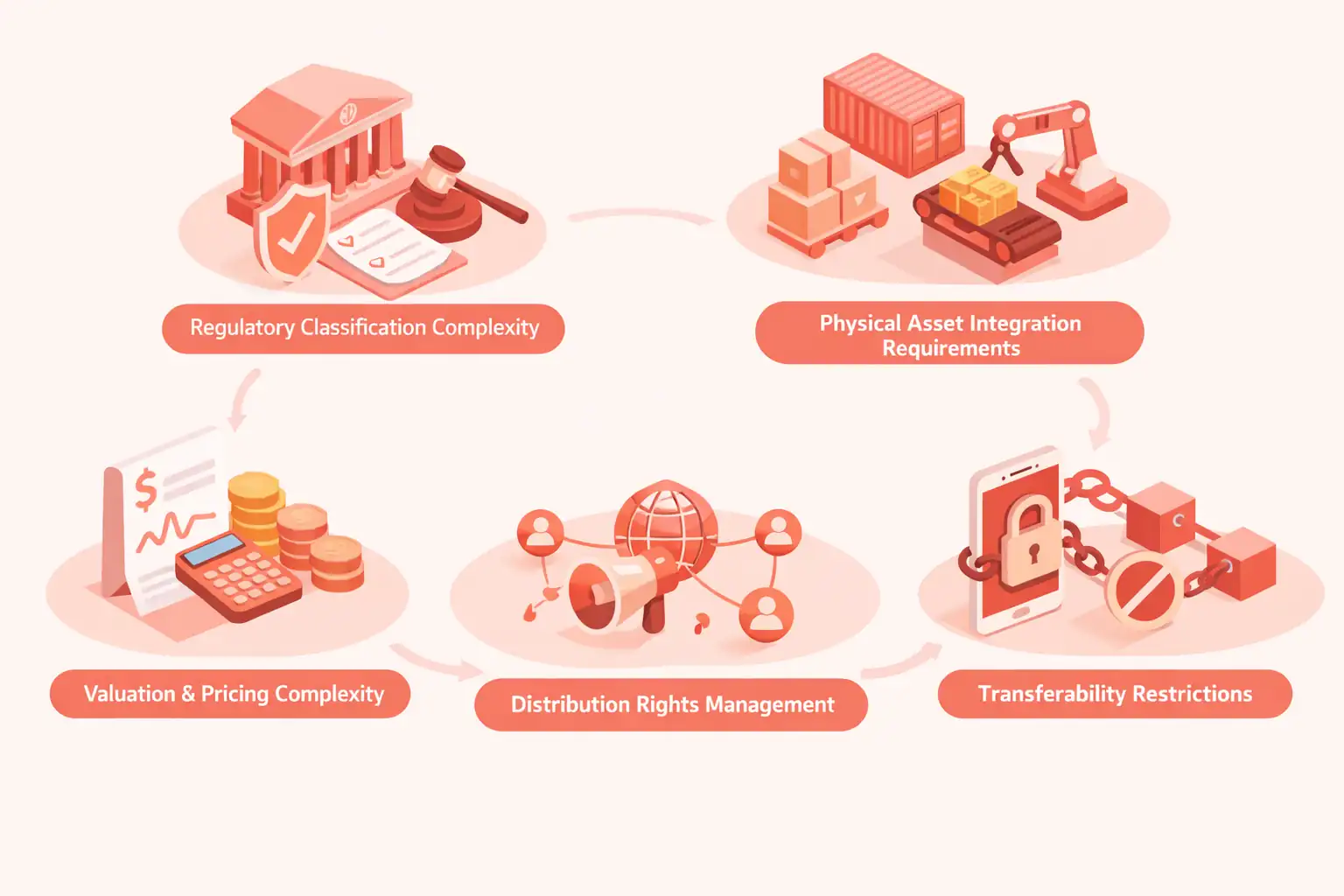
Asset Class Cost Impact Analysis
The following factors drive tokenization cost factors variations across asset classes:
- Regulatory Classification Complexity: Assets falling into ambiguous regulatory categories require multiple legal opinions, increased regulatory engagement, and conservative compliance approaches, adding $80,000 to $250,000 in legal costs.
- Physical Asset Integration Requirements: Tokenizing physical assets requires custody arrangements, verification systems, insurance, and logistics tracking, adding $120,000 to $400,000 in operational infrastructure costs.
- Valuation and Pricing Complexity: Assets lacking liquid markets or standardized pricing require custom valuation methodologies, third-party appraisals, and pricing oracles, adding $45,000 to $180,000 in ongoing operational costs.
- Distribution Rights Management: Assets generating ongoing distributions require calculation engines, payment processing systems, tax reporting, and reconciliation procedures, adding $60,000 to $200,000 in technical implementation costs.
- Transferability Restrictions: Assets subject to transfer restrictions require compliance checking systems, approval workflows, and registry coordination, adding $35,000 to $120,000 in smart contract and integration costs.
Use case objectives significantly influence tokenization cost factors beyond asset class considerations. Organizations tokenizing assets for capital formation face different requirements than those pursuing operational efficiency, fractional ownership, or market accessibility. Capital formation use cases require comprehensive investor relations systems, distribution management, regulatory compliance infrastructure, and secondary market support. These investor-facing requirements create costs that internal operational use cases avoid.
Fractional ownership use cases prioritize governance systems enabling collective decision-making among numerous owners. Implementing voting mechanisms, proposal systems, quorum requirements, and execution frameworks adds development costs. The more sophisticated the governance requirements, the higher the implementation and ongoing operational costs. Projects requiring multi-tier governance with different voting rights for different token classes incur substantially higher costs than simple majority-rule systems.
Liquidity-focused use cases necessitate integration with trading platforms, market-making arrangements, liquidity pool mechanisms, and price discovery systems. Secondary market infrastructure represents one of the most expensive optional components of tokenization projects. Organizations prioritizing token liquidity must budget $200,000 to $800,000 for exchange integrations, listing fees, market-making agreements, and ongoing liquidity management operations.
Geographic scope dramatically impacts tokenization cost factors through jurisdictional compliance requirements. Single-jurisdiction projects face simpler legal and regulatory landscapes than multi-jurisdictional offerings. A tokenization project targeting only United States accredited investors under Regulation D operates within a well-understood compliance framework. Expanding that same project to include United Kingdom, UAE, and Canadian investors introduces multiple regulatory regimes, each with distinct requirements for disclosure, investor verification, ongoing reporting, and transfer restrictions.
Cross-border tokenization projects require legal counsel in each target jurisdiction, opinions on securities treatment, compliance procedures for each regulatory regime, and systems supporting jurisdiction-specific restrictions and reporting. Legal costs for multi-jurisdictional projects typically range from $280,000 to $850,000, compared to $120,000 to $350,000 for single-jurisdiction implementations. The complexity increase is not linear as each additional jurisdiction introduces interaction effects with existing compliance requirements.
Target investor profile influences tokenization cost factors through investor verification requirements, distribution infrastructure, and ongoing communication systems. Projects targeting institutional investors require sophisticated investor onboarding systems supporting entity verification, beneficial ownership identification, and accredited investor status confirmation. Retail-focused projects add consumer protection requirements, simplified user interfaces, educational content, and more extensive customer support systems.
| Asset Class | Primary Cost Drivers | Typical Cost Range | Key Complexity Factors |
|---|---|---|---|
| Real Estate | Property title work, SPV formation, land registry coordination, property management integration | $450,000 – $1,200,000 | Property location, ownership structure, number of properties, financing arrangements |
| Securities (Equity) | Securities registration, disclosure documents, cap table integration, dividend distribution systems | $380,000 – $950,000 | Offering structure, number of jurisdictions, governance complexity, shareholder rights |
| Securities (Debt) | Indenture drafting, trustee arrangements, interest calculation, covenant monitoring systems | $320,000 – $780,000 | Debt structure complexity, number of tranches, covenant sophistication, collateral management |
| Commodities | Physical custody arrangements, quality verification, insurance, logistics tracking, storage management | $420,000 – $1,100,000 | Commodity type, storage requirements, quality standards, geographic distribution |
| Carbon Credits | Registry integration, verification standards, retirement mechanisms, regulatory compliance | $350,000 – $820,000 | Verification methodology, registry requirements, trading market integration, retirement tracking |
| Intellectual Property | IP valuation, licensing agreements, royalty distribution, usage tracking, rights management | $380,000 – $980,000 | IP type, territorial rights, sublicensing provisions, royalty calculation complexity |
Investment size and token distribution volume create economies of scale affecting per-token costs but increasing absolute budget requirements. A tokenization project raising $5 million might have similar base legal and technical costs as one raising $50 million, but the larger project requires more extensive investor onboarding infrastructure, enhanced security measures, more sophisticated distribution management, and greater ongoing operational capacity. Understanding the relationship between project scale and tokenization cost factors enables appropriate budget scaling.
Projects targeting sophisticated institutional investors can implement more efficient onboarding processes leveraging existing know-your-customer relationships, institutional identity verification services, and streamlined accreditation checks. Retail-focused projects require more extensive verification procedures, consumer protection measures, and educational content. The per-investor cost for institutional onboarding typically ranges from $15 to $35, while retail investor onboarding costs $45 to $85 per investor depending on verification depth and jurisdictional requirements.
Asset lifecycle stage influences tokenization cost factors through different operational and legal requirements. Tokenizing existing mature assets with established cash flows, clear ownership, and operating history presents simpler implementation paths than tokenizing assets under formation or pre-revenue stage ventures. Existing assets benefit from historical financial data, proven management teams, and track records that simplify investor due diligence and regulatory compliance. New assets require more extensive documentation of projections, risk factors, and management capabilities.
Impact of Asset Type Complexity on the Overall Tokenization Cost Factors Structure
Asset type complexity directly influences tokenization cost factors through variations in legal structuring requirements, valuation methodologies, ownership documentation, rights management, and operational administration. Simple assets with clear ownership, standardized valuation, and minimal ongoing management requirements cost substantially less to tokenize than complex assets with layered ownership structures, subjective valuation, extensive regulatory requirements, or intricate operational needs.
Real estate represents a moderately complex asset class for tokenization purposes. Single-family residential properties offer relatively straightforward ownership structures, established valuation methodologies through comparable sales analysis, and simple operational requirements. Commercial real estate introduces additional complexity through tenant relationships, lease management, capital expenditure requirements, and more sophisticated financial analysis. Mixed-use properties add further complexity by combining multiple property types with different operational characteristics, tenant profiles, and valuation approaches.
Ready to Plan Your Tokenization Project Budget?
Get expert guidance on tokenization cost factors tailored to your specific asset class, jurisdiction, and business objectives. Our team helps you build realistic budgets.
Real estate tokenization cost factors escalate when properties include financing arrangements, multiple ownership layers, complex lease structures, or cross-jurisdictional holdings. A debt-encumbered property requires coordination with lenders, subordination agreements, and mechanisms ensuring lien priority. Properties owned through multiple entity layers require analyzing each entity’s legal structure, tax treatment, and operational role. International real estate holdings introduce foreign ownership restrictions, currency considerations, and multi-jurisdictional tax planning requirements.
Securities tokenization complexity depends on instrument type, rights attached, and regulatory classification. Simple common equity with standard voting and economic rights costs less to tokenize than complex preferred equity with multiple preference tiers, conversion features, and protective provisions. Convertible debt instruments require mechanisms tracking conversion ratios, adjustment events, and redemption rights. Structured products with embedded derivatives or contingent features require sophisticated smart contract logic and extensive legal documentation.
Complexity Cost Multipliers
Asset complexity creates cost multipliers affecting base tokenization expenses:
- Single vs Multiple Assets: Tokenizing a portfolio of assets rather than a single asset increases legal costs by 1.4x to 2.2x and technical costs by 1.3x to 1.8x due to additional data management, reporting requirements, and operational complexity.
- Simple vs Complex Rights Structures: Assets with multiple classes of ownership rights, tiered distributions, or conditional entitlements increase smart contract development costs by 1.5x to 3.0x and legal costs by 1.3x to 2.0x.
- Domestic vs Cross-Border: Adding cross-border dimensions to tokenization projects increases legal costs by 1.8x to 3.5x and compliance costs by 2.0x to 4.0x depending on the number of jurisdictions and regulatory harmonization.
- Static vs Dynamic Characteristics: Assets with characteristics that change over time (such as development projects or lifecycle-dependent rights) increase technical implementation costs by 1.6x to 2.8x due to state management complexity.
- Standardized vs Custom Terms: Highly customized tokenization structures with unique terms and conditions increase legal drafting costs by 1.4x to 2.5x compared to projects using standardized documentation templates.
Fund structures represent particularly complex tokenization scenarios. Traditional investment funds involve general partners, limited partners, capital calls, distributions, carried interest, management fees, and sophisticated waterfall calculations. Tokenizing fund interests requires replicating these structures in smart contract logic while maintaining compatibility with existing fund documentation and regulatory requirements. Fund tokenization projects typically cost $650,000 to $1,800,000 due to this structural complexity.
Derivatives and structured products push tokenization cost factors higher through mathematical complexity, risk management requirements, and regulatory oversight. Interest rate swaps, options, futures, and other derivatives require sophisticated pricing models, mark-to-market calculations, collateral management, and margining mechanisms. Implementing these features in blockchain environments while maintaining regulatory compliance and operational efficiency creates substantial development and testing costs.
Revenue-generating assets introduce distribution management complexity affecting tokenization cost factors. Assets producing rental income, interest payments, dividends, royalties, or other ongoing cash flows require calculation engines determining distribution amounts, payment processing systems delivering funds to token holders, tax reporting for distribution recipients, and reconciliation procedures ensuring accuracy. The more complex the distribution rules and the more frequent the distributions, the higher the implementation and operational costs.
Assets with embedded governance rights require voting systems, proposal mechanisms, delegation features, and execution frameworks. Simple majority-vote systems for routine operational decisions cost $35,000 to $80,000 to implement. Sophisticated multi-tier governance with different voting rights for different token classes, delegation mechanisms, quadratic voting, or time-locked voting periods costs $120,000 to $280,000. Projects requiring integration with offline governance processes (such as coordinating with traditional shareholder meetings) add further complexity and cost.
Collateralized assets introduce custody, valuation, and liquidation mechanisms affecting tokenization cost factors. Debt instruments secured by collateral require monitoring collateral values, triggering alerts when loan-to-value ratios breach thresholds, and implementing liquidation procedures upon defaults. Physical collateral requires custody arrangements, insurance, and verification systems. Financial collateral requires integration with market data feeds, automated valuation updates, and margin call mechanisms.
Assets subject to regulatory restrictions on transferability require compliance checking systems embedded in token transfer logic. Securities subject to holding periods under Regulation D Rule 506, accredited investor requirements, or jurisdiction-based restrictions need smart contract controls enforcing these limitations. Implementing transfer restrictions adds $45,000 to $150,000 in smart contract development costs depending on restriction complexity and the number of distinct restriction types.
Intellectual property tokenization presents unique complexity through territorial rights, licensing terms, sublicensing provisions, and royalty calculations. IP tokens representing fractional ownership of patents, trademarks, copyrights, or trade secrets require legal structures defining usage rights, enforcement mechanisms, and benefit-sharing arrangements. Music royalty tokenization requires tracking usage across multiple platforms, calculating royalties according to complex agreements, and distributing payments to potentially thousands of token holders. These operational requirements create implementation costs of $380,000 to $980,000.
| Complexity Factor | Impact on Legal Costs | Impact on Technical Costs | Impact on Operational Costs |
|---|---|---|---|
| Multiple Asset Classes | +40% to +85% due to additional legal analysis, regulatory opinions, and documentation requirements | +30% to +60% for portfolio management systems and multi-asset data structures | +45% to +90% for diverse operational procedures and asset-specific management |
| Complex Distribution Rules | +25% to +50% for documenting distribution waterfalls and priority structures | +50% to +120% for calculation engines and distribution automation systems | +35% to +70% for distribution processing and reconciliation procedures |
| Sophisticated Governance | +30% to +65% for governance documentation and rights structuring | +70% to +180% for voting systems, proposal mechanisms, and execution frameworks | +25% to +55% for governance administration and communication systems |
| Cross-Jurisdictional Elements | +80% to +250% for multi-jurisdictional legal opinions and compliance frameworks | +35% to +80% for jurisdiction-specific restrictions and reporting systems | +60% to +140% for multi-jurisdictional compliance monitoring and reporting |
| Embedded Derivatives | +45% to +95% for derivative documentation and regulatory analysis | +90% to +200% for pricing models, risk calculations, and hedging systems | +50% to +110% for mark-to-market processing and risk reporting |
| Collateral Management | +35% to +70% for collateral documentation and priority agreements | +55% to +130% for valuation systems, monitoring, and liquidation mechanisms | +65% to +150% for collateral custody, insurance, and administration |
Regulatory classification ambiguity creates cost uncertainty affecting budget planning. Assets falling into unclear regulatory categories require legal analysis determining applicable frameworks, opinions from counsel in relevant jurisdictions, and potentially regulatory engagement seeking guidance. Ambiguous classification scenarios add $80,000 to $250,000 in legal costs as counsel researches precedents, analyzes statutes, and develops compliance approaches for novel asset types.
Pre-revenue or early-stage assets introduce additional complexity through projection uncertainty, business model validation requirements, and enhanced disclosure obligations. Tokenizing established businesses with historical financials, proven management, and operating track records costs less than tokenizing startups or development projects lacking performance history. Early-stage projects require more extensive risk factor disclosure, sensitivity analysis, and scenario modeling, increasing legal and financial advisory costs by 25 to 50 percent.
Assets with environmental, social, or governance characteristics require verification systems, impact measurement, and reporting frameworks. ESG-linked tokens with performance-based features require monitoring systems tracking sustainability metrics, calculation engines adjusting terms based on performance, and reporting systems communicating impact to stakeholders. Implementing ESG features adds $65,000 to $180,000 in development costs plus ongoing monitoring and verification expenses of $35,000 to $95,000 annually.
Role of Legal Classification and Regulatory Alignment in Tokenization Cost Factors Planning
Legal classification represents one of the most significant tokenization cost factors, determining applicable regulatory frameworks, compliance requirements, disclosure obligations, and operational restrictions. Tokens classified as securities face comprehensive regulatory oversight in most jurisdictions, requiring registration or exemption qualification, ongoing reporting, transfer restrictions, and anti-fraud protections. Utility tokens or non-security tokens navigate different regulatory landscapes with potentially lower compliance costs but face classification uncertainty risks.
Securities classification in the United States follows the Howey Test and subsequent Securities and Exchange Commission guidance. Tokens representing investment contracts evidenced by investment of money in common enterprises with profits expected from efforts of others fall within securities regulation. This classification triggers requirements under the Securities Act of 1933 for registration or exemption qualification and the Securities Exchange Act of 1934 for ongoing reporting if registration thresholds are met.
Achieving securities registration through Form S-1 or other registration statements represents the most expensive compliance path, with legal and accounting costs ranging from $850,000 to $3,500,000 depending on asset complexity, disclosure requirements, and SEC review process length. Registration creates ongoing reporting obligations under Section 13 or 15(d) of the Exchange Act, requiring quarterly reports, annual audited financials, and current event disclosures. Annual compliance costs for registered securities tokenization projects range from $280,000 to $950,000.
Exemptions from securities registration under Regulation D, Regulation A+, Regulation Crowdfunding, or Regulation S offer lower-cost paths with corresponding limitations on investor types, raise amounts, or geographic distribution. Regulation D Rule 506(b) allows unlimited capital raises from accredited investors plus up to 35 sophisticated non-accredited investors without general solicitation, with legal costs ranging from $120,000 to $280,000 for initial implementation and $45,000 to $120,000 in annual compliance costs.
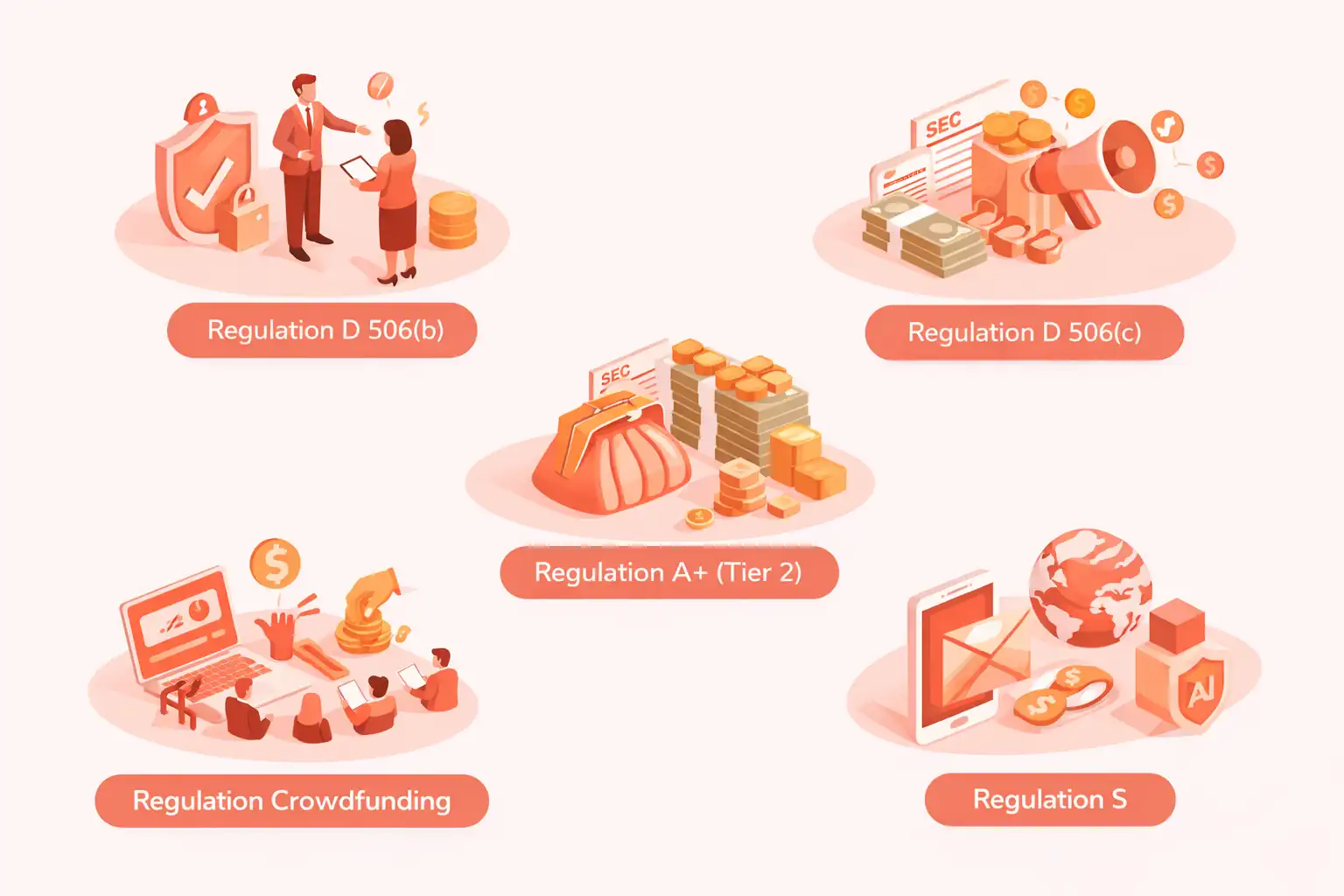
U.S. Securities Exemption Cost Comparison
Different exemption paths create distinct cost profiles:
- Regulation D 506(b): Initial legal costs $120,000 to $280,000, annual compliance $45,000 to $120,000. Limited to accredited investors plus 35 sophisticated investors, no general solicitation, Form D filing required, state blue sky notice filings may apply.
- Regulation D 506(c): Initial legal costs $150,000 to $320,000, annual compliance $55,000 to $145,000. Allows general solicitation to accredited investors only, requires reasonable steps verifying accreditation, Form D filing, potential state coordination costs.
- Regulation A+ (Tier 2): Initial legal and accounting costs $380,000 to $850,000, annual compliance $180,000 to $420,000. Allows raises up to $75 million, requires offering circular, annual and semi-annual reports, audited financials, testing the waters permitted.
- Regulation Crowdfunding: Initial legal costs $80,000 to $180,000, annual compliance $35,000 to $85,000. Limited to $5 million raise, individual investment limits apply, requires intermediary platform, annual reporting obligations, financial statement requirements vary by raise amount.
- Regulation S: Initial legal costs $95,000 to $220,000, minimal ongoing compliance for pure offshore offerings. Permits offerings to non-U.S. persons outside the U.S., category-dependent restrictions apply, integration risks with domestic offerings require careful structuring.
European Union regulations under the Markets in Financial Instruments Directive (MiFID II) and Prospectus Regulation create distinct compliance frameworks affecting tokenization cost factors for projects targeting EU investors. MiFID II classification determines whether tokens qualify as financial instruments requiring authorization for trading platforms and investment firms. Prospectus requirements apply to public offerings exceeding exemption thresholds, with preparation and approval costs ranging from 280,000 to 950,000 euros depending on complexity and scrutiny level.
United Kingdom regulatory treatment follows Financial Conduct Authority guidance distinguishing security tokens, utility tokens, and exchange tokens. Security tokens fall within Financial Services and Markets Act perimeter requiring authorization, prospectus approval for public offerings, and ongoing compliance with conduct of business rules. FCA authorization costs for token issuance platforms range from 180,000 to 550,000 pounds including legal fees, application preparation, and regulatory engagement.
UAE regulatory frameworks vary between onshore and free zone jurisdictions. Dubai Financial Services Authority (DFSA) in Dubai International Financial Centre established comprehensive crypto-asset regulatory frameworks requiring authorization for security token offerings. DFSA authorization costs range from $220,000 to $680,000 including legal fees, compliance system implementation, and application processes. Abu Dhabi Global Market operates similar frameworks with comparable cost structures. Mainland UAE regulations continue evolving with Virtual Assets Regulatory Authority oversight.
Canadian securities regulation follows a provincial-territorial system with securities commissions in each jurisdiction. Ontario Securities Commission and other provincial regulators apply National Instrument 45-106 (Prospectus Exemptions) and National Instrument 45-102 (Resale Restrictions) to token offerings. Accredited investor exemptions parallel U.S. structures with variations in definitions and documentation requirements. Multi-provincial offerings require coordination across multiple regulators, increasing legal costs by 30 to 60 percent compared to single-province offerings.
Determining regulatory classification often requires legal opinions analyzing token characteristics, rights conveyed, economic substance, and regulatory precedents. Obtaining classification opinions from respected securities counsel in target jurisdictions costs $35,000 to $95,000 per jurisdiction depending on analysis complexity and novelty. Novel token structures lacking clear precedents require more extensive analysis, research, and documentation, pushing opinion costs toward the higher end of ranges.
Risk Warning: Classification Uncertainty
Classification ambiguity creates significant financial and operational risks. Tokens structured to avoid securities classification but later determined to be securities face potential regulatory enforcement, investor rescission rights, and operational disruptions. The cost of rectifying classification errors substantially exceeds the cost of conservative initial classification. Organizations should prioritize regulatory certainty over marginal cost savings from attempting aggressive classification positions. Budget 20 to 30 percent contingency for classification uncertainty scenarios.
Anti-money laundering and know-your-customer requirements apply across most tokenization projects regardless of securities classification. Implementing AML/KYC compliance systems costs $85,000 to $250,000 for initial setup including identity verification integration, screening databases, monitoring systems, and policy documentation. Ongoing AML/KYC operational costs range from $45,000 to $180,000 annually depending on investor volume and verification depth requirements.
Transfer restrictions embedded in securities tokens to enforce regulatory compliance require smart contract controls and transfer approval systems. Implementing compliant transfer systems costs $65,000 to $180,000 including smart contract development, transfer agent integration, whitelist management, and approval workflows. Projects requiring sophisticated transfer restrictions with holding periods, accreditation checks, jurisdiction validations, and volume limitations fall toward the higher end of implementation cost ranges.
Tax classification influences tokenization cost factors through reporting requirements, withholding obligations, and information delivery systems. Tokens classified as securities trigger Form 1099 reporting requirements for U.S. recipients of distributions, requiring issuer infrastructure supporting tax reporting, recipient data collection, and filing procedures. Implementing tax compliance systems costs $45,000 to $120,000 with annual operational costs of $25,000 to $75,000 depending on distribution frequency and recipient count.
Cross-border tax considerations add complexity through withholding obligations, tax treaty analysis, and multi-jurisdictional reporting. Projects distributing income to international token holders must analyze applicable withholding rates, implement withholding procedures, file required withholding reports, and potentially provide tax documentation to recipients. International tax compliance adds $55,000 to $180,000 in annual operational costs beyond domestic tax reporting requirements.
Data privacy regulations including GDPR in Europe, PIPEDA in Canada, and state-level privacy laws in the United States affect tokenization cost factors through data handling requirements, consent mechanisms, and retention policies. Blockchain immutability creates tensions with data privacy rights including rights to erasure. Implementing privacy-compliant tokenization systems requires careful data architecture, off-chain personal data storage, and consent management frameworks costing $45,000 to $150,000.
Ongoing regulatory monitoring and adaptation represent often-overlooked tokenization cost factors. Regulatory frameworks for digital assets continue evolving rapidly across jurisdictions. Maintaining compliance requires monitoring regulatory developments, analyzing impact on existing structures, implementing necessary adjustments, and potentially engaging with regulators. Annual regulatory monitoring and adaptation costs range from $35,000 to $120,000 depending on project complexity and jurisdictional scope.
Influence of Jurisdictional Compliance Requirements on Tokenization Cost Factors Expectations
Jurisdictional compliance requirements represent major tokenization cost factors, with expenses scaling rapidly as projects expand across multiple regulatory territories. Single-jurisdiction implementations benefit from focused compliance efforts within one legal framework, while multi-jurisdictional projects face compounding complexity as each additional territory introduces distinct requirements for investor verification, disclosure, ongoing reporting, and operational restrictions.
United States compliance costs vary significantly based on exemption selection, state coordination requirements, and ongoing reporting obligations. Federal securities exemptions provide baseline compliance frameworks, but state securities laws (blue sky laws) layer additional requirements. Some exemptions provide federal preemption of state registration requirements, while others require coordination with state securities regulators. State-level compliance adds $8,000 to $25,000 per state for notice filings, merit review (in states requiring it), and ongoing coordination.
Projects relying on Regulation D Rule 506(b) or 506(c) benefit from federal preemption under the National Securities Markets Improvement Act, limiting state requirements to notice filings and fees. These notice filings typically cost $1,500 to $5,000 per state including filing fees and legal coordination. Projects targeting investors across all fifty states face aggregate state compliance costs of $75,000 to $250,000 for initial implementation, though most projects target investors in ten to twenty states, reducing costs proportionally.
Regulation A+ offerings undergo SEC qualification process similar to registration but benefit from federal preemption of state registration requirements for Tier 2 offerings. SEC qualification costs range from $380,000 to $850,000 including legal fees, accounting fees for audited financials, and SEC review process management. Tier 2 offerings exceeding $20 million require ongoing annual and semi-annual reporting, creating annual compliance costs of $180,000 to $420,000.
Multi-Jurisdictional Compliance Cost Model
Jurisdictional compliance costs follow a base-plus-increment structure:
- Base Jurisdiction Costs: First jurisdiction (typically home jurisdiction) requires $120,000 to $380,000 for legal structure, disclosure documents, regulatory filings, and compliance system implementation.
- Second Jurisdiction Addition: Adding a second major jurisdiction increases legal costs by $85,000 to $240,000 (roughly 70% of base costs) due to additional legal opinions, regulatory analysis, and compliance procedures.
- Third Jurisdiction Addition: Third jurisdiction adds $65,000 to $190,000 (roughly 55% of base costs) as teams gain efficiency and leverage existing frameworks.
- Fourth and Beyond: Additional jurisdictions add $50,000 to $150,000 each (roughly 40% of base costs) with diminishing incremental complexity as compliance infrastructure scales.
- Harmonized vs Divergent Regulations: Jurisdictions with similar regulatory frameworks (such as multiple Canadian provinces) add lower incremental costs than jurisdictions with fundamentally different approaches (such as adding UAE after establishing U.S. compliance).
European Union compliance under MiFID II, Prospectus Regulation, and Markets in Crypto-Assets Regulation (MiCA) creates comprehensive frameworks affecting tokenization cost factors. MiCA establishes EU-wide regulatory treatment for crypto-assets including asset-referenced tokens, e-money tokens, and utility tokens, with phased implementation requiring authorization for issuers and service providers. MiCA compliance costs for token issuers range from 280,000 to 950,000 euros including legal analysis, authorization applications, and system implementations.
United Kingdom post-Brexit regulatory framework diverges from EU requirements, creating separate compliance obligations for projects targeting both markets. FCA requirements for security token offerings include authorization for issuance platforms, prospectus approval for public offerings exceeding exemption thresholds, and ongoing conduct of business compliance. Dual EU-UK compliance costs exceed single-jurisdiction implementation by 60 to 90 percent due to divergent regulatory requirements and separate authorization processes.
UAE regulatory frameworks in Dubai International Financial Centre (DIFC) and Abu Dhabi Global Market (ADGM) established progressive crypto-asset regulations providing clear pathways for compliant tokenization. DFSA regulations require authorization for security token offerings, with comprehensive application processes examining business models, systems and controls, governance structures, and financial resources. DFSA authorization costs range from $220,000 to $680,000 with annual compliance costs of $95,000 to $280,000.
Canadian securities regulation operates through provincial securities commissions with coordination through Canadian Securities Administrators. Projects targeting multiple provinces require either registration or reliance on prospectus exemptions in each province. Accredited investor exemptions similar to U.S. Regulation D provide common exemption pathways across provinces, though definitions and documentation requirements vary. Multi-provincial offerings require legal coordination across relevant jurisdictions, increasing costs by 30 to 60 percent compared to single-province implementations.
Singapore Monetary Authority regulatory frameworks for digital tokens distinguish between payment tokens, utility tokens, and security tokens under Securities and Futures Act. Security tokens require prospectus registration or exemption qualification, with exemptions available for offers to institutional investors, accredited investors, or offers not exceeding certain thresholds. Singapore compliance costs range from SGD 180,000 to SGD 650,000 depending on offering structure and exemption utilized.
Hong Kong Securities and Futures Commission regulations treat security tokens as traditional securities requiring licensing for intermediaries and prospectus authorization for public offers. Professional investor exemptions provide streamlined paths for institutional offerings. SFC authorization costs range from HKD 450,000 to HKD 1,200,000 with annual compliance costs of HKD 180,000 to HKD 520,000.
| Jurisdiction | Regulatory Framework | Initial Compliance Cost Range | Annual Ongoing Costs |
|---|---|---|---|
| USA (Reg D 506c) | Federal exemption with state notice filings | $150,000 – $320,000 | $55,000 – $145,000 |
| USA (Reg A+ Tier 2) | SEC qualification with federal preemption | $380,000 – $850,000 | $180,000 – $420,000 |
| UK (FCA Authorization) | FCA authorization for security tokens | £180,000 – £550,000 | £85,000 – £260,000 |
| UAE (DFSA) | DFSA authorization in DIFC | $220,000 – $680,000 | $95,000 – $280,000 |
| Canada (Multi-Provincial) | Provincial exemptions with CSA coordination | CAD 165,000 – CAD 420,000 | CAD 55,000 – CAD 155,000 |
| EU (MiCA Compliance) | MiCA authorization for asset-referenced tokens | €280,000 – €950,000 | €120,000 – €380,000 |
| Singapore (MAS) | Securities and Futures Act compliance | SGD 180,000 – SGD 650,000 | SGD 70,000 – SGD 220,000 |
| Hong Kong (SFC) | Securities and Futures Ordinance licensing | HKD 450,000 – HKD 1,200,000 | HKD 180,000 – HKD 520,000 |
Investor verification requirements vary substantially across jurisdictions, affecting onboarding costs and operational complexity. United States accredited investor verification requires reasonable steps confirming accredited status through financial statements, tax returns, third-party verification services, or professional certifications. Third-party verification services charge $20 to $45 per investor for automated verification using financial data aggregation. Manual verification processes cost $35 to $75 per investor including document review and analysis time.
European Union investor categorization under MiFID II distinguishes retail clients, professional clients, and eligible counterparties with different protection levels and suitability requirements. Properly categorizing investors and applying appropriate protections requires compliance systems, investor questionnaires, and suitability assessments. Implementing MiFID II-compliant investor onboarding costs $85,000 to $220,000 with per-investor categorization costs of $25 to $65.
Anti-money laundering and know-your-customer requirements apply globally with varying intensity and scope. Financial Action Task Force recommendations establish baseline standards implemented through national regulations. Comprehensive AML/KYC systems require identity verification, screening against sanctions lists and politically exposed person databases, ongoing monitoring of transaction patterns, and suspicious activity reporting. Implementing comprehensive AML/KYC systems costs $120,000 to $320,000 with ongoing operational costs of $65,000 to $220,000 annually.
Cross-border transaction monitoring and reporting requirements affect tokenization cost factors when projects facilitate international token transfers. Various jurisdictions impose reporting requirements for cross-border transactions exceeding specified thresholds. Implementing transaction monitoring systems capable of identifying reportable transactions, generating required reports, and maintaining audit trails costs $55,000 to $180,000 with ongoing operational costs scaling with transaction volume.
Data localization requirements in certain jurisdictions require storing personal data within national boundaries, affecting system architecture and hosting costs. Russia, China, and other jurisdictions impose data localization requirements potentially affecting tokenization projects with users in those territories. Implementing jurisdiction-specific data storage adds $35,000 to $120,000 per jurisdiction in infrastructure and compliance costs.
Regulatory engagement costs represent often-underestimated tokenization cost factors. Novel token structures or regulatory ambiguity may necessitate proactive regulatory engagement seeking guidance or no-action relief. Preparing regulatory submissions, engaging in dialogues with regulators, and responding to information requests requires specialized legal counsel and substantial time commitments. Regulatory engagement initiatives cost $85,000 to $350,000 depending on complexity and jurisdiction.
How Ownership Models and Fractional Structures Affect Tokenization Cost Factors
Ownership model selection significantly influences tokenization cost factors through legal structuring requirements, operational complexity, governance mechanisms, and investor rights management. Direct property ownership, special purpose vehicle structures, trust arrangements, and various hybrid models each create distinct cost profiles. Organizations must understand these cost implications when selecting ownership architectures aligned with project objectives and investor preferences.
Direct property ownership tokenization represents the conceptually simplest approach where tokens correspond directly to fractional property interests registered in official registries. This model works best for asset classes with established fractional ownership frameworks, such as real estate in jurisdictions permitting fractional property registration. Direct ownership tokenization requires coordinating with registries, implementing fractional transfer mechanisms, and ensuring blockchain records synchronize with official registries.
Direct ownership model implementation costs range from $120,000 to $420,000 depending on property type, jurisdiction, and registry cooperation level. Jurisdictions with progressive property registration systems supporting electronic recording and fractional interests enable more cost-effective implementations. Traditional jurisdictions requiring manual coordination, physical document filing, and multiple signature requirements increase implementation complexity and cost. Legal coordination with registries, title companies, and local counsel constitutes major cost drivers for direct ownership models.
Special purpose vehicle structures represent the most common tokenization approach, where properties or assets are held by legal entities (typically limited liability companies or partnerships) and tokens represent equity or membership interests in the entity. SPV structures provide liability protection, financing flexibility, operational simplicity, and instant transferability compared to direct property ownership. However, SPV structures introduce entity formation costs, ongoing entity maintenance expenses, and additional legal documentation.
SPV Tokenization Cost Factors Breakdown
SPV-based tokenization creates the following cost components:
- Entity Formation: LLC or partnership formation including articles of organization, operating agreements, tax elections, and regulatory filings costs $8,000 to $25,000 depending on jurisdiction complexity and entity sophistication.
- Operating Agreement Drafting: Comprehensive operating agreements defining member rights, distributions, governance, transfer restrictions, and dissolution procedures cost $35,000 to $95,000 for tokenization-ready documentation.
- Token Integration: Legal analysis confirming tokens properly represent entity interests, integration with entity records, and coordination with registered agents costs $25,000 to $65,000.
- Annual Entity Maintenance: Annual franchise taxes, registered agent fees, annual report filings, and entity good standing maintenance costs $2,500 to $12,000 annually per entity.
- Tax Return Preparation: Entity-level tax returns (typically pass-through returns for LLCs and partnerships) cost $8,000 to $35,000 annually depending on transaction volume and complexity.
Trust-based ownership models utilize legal trusts with tokens representing beneficial interests in trust property. Trust structures offer asset protection benefits, flexible governance arrangements, confidentiality, and favorable tax treatment in certain jurisdictions. However, trust structures require specialized legal counsel, trustee selection and compensation, trust documentation, and ongoing trust administration. Trust-based tokenization cost factors range from $180,000 to $550,000 for implementation with annual administration costs of $45,000 to $180,000.
Fractional ownership complexity affects tokenization cost factors through the number of distinct ownership classes, rights attached to each class, and governance mechanisms coordinating among owners. Simple single-class structures where all tokens have identical rights cost substantially less to implement than multi-class structures with different economic rights, voting rights, or priority levels. Each additional ownership class increases legal documentation requirements, smart contract complexity, and operational administration costs.
Multi-tier ownership structures separating economic rights from governance rights require sophisticated documentation and implementation. Structures with common equity, preferred equity, debt instruments, or other layered interests must define priority waterfalls, distribution calculations, governance allocations, and conversion or redemption mechanics. Implementing multi-tier structures costs $85,000 to $280,000 beyond single-class implementation costs due to documentation complexity and smart contract sophistication requirements.
Co-ownership governance mechanisms represent major tokenization cost factors for fractional ownership structures. Projects must determine decision-making processes for operational matters, capital expenditures, financing decisions, disposition events, and extraordinary transactions. Simple majority voting for routine decisions with supermajority requirements for major actions costs $45,000 to $120,000 to implement. Sophisticated governance systems with proposal mechanisms, delegation features, quorum requirements, and automated execution frameworks cost $120,000 to $350,000.
Drag-along and tag-along rights protecting minority and majority owners add legal and technical complexity. Drag-along provisions enabling majority owners to force minority participation in sales require mechanisms triggering required participation, communicating obligations, and enforcing compliance. Tag-along provisions allowing minority owners to participate in majority sales require monitoring majority transfers and providing participation opportunities. Implementing drag-along and tag-along mechanisms costs $35,000 to $95,000.
Decision Framework: Ownership Model Selection
Choose Direct Property Ownership when:
- Jurisdiction supports fractional property registration with cooperative registries
- Project benefits from direct property ownership tax treatment
- Liability concerns are minimal or addressed through insurance
- Financing arrangements permit fractional ownership structures
Choose SPV Structure when:
- Liability protection is important priority
- Instant transferability without registry coordination is desired
- Multiple properties or assets will be held in single structure
- Financing arrangements favor entity-level borrowing
- Different classes of ownership rights will be offered
Choose Trust Structure when:
- Asset protection from platform operator risks is priority
- Succession planning and estate features are important
- Confidentiality of ownership is valued
- Jurisdiction offers favorable trust tax treatment
- Professional trustee oversight provides investor confidence
Distribution management complexity affects operational costs within fractional ownership structures. Assets generating regular income distributions require calculation systems determining distribution amounts per token, payment processing infrastructure delivering funds to token holders, tax reporting for distribution recipients, and reconciliation procedures. Simple pro-rata distributions cost $35,000 to $85,000 to implement with ongoing operational costs of $25,000 to $65,000 annually. Complex waterfall distributions with priority tiers, hurdle rates, or catch-up provisions cost $85,000 to $220,000 to implement with annual operational costs of $55,000 to $150,000.
Transfer restrictions protecting ownership structure integrity add implementation and operational costs. Restrictions preventing ownership concentration, limiting transfers to qualified investors, or coordinating with regulatory requirements need smart contract enforcement mechanisms, transfer approval workflows, and compliance monitoring systems. Implementing comprehensive transfer restriction systems costs $65,000 to $180,000 with ongoing operational costs of $25,000 to $75,000 annually for monitoring and administration.
Multi-property or portfolio structures introduce additional complexity affecting tokenization cost factors. Holding multiple assets in single structures requires data management systems tracking individual asset performance, allocation methodologies attributing expenses and revenues to assets, and reporting systems providing asset-level transparency. Portfolio tokenization cost factors exceed single-asset implementations by 40 to 85 percent depending on portfolio size and complexity.
Exit mechanism structuring represents important fractional ownership consideration affecting long-term costs. Projects must determine exit pathways for investors and sponsors including redemption rights, forced sale provisions, refinancing options, or liquidation procedures. Redemption mechanisms require pricing methodologies, funding sources, and processing procedures costing $45,000 to $120,000 to implement. Complex exit structures with multiple pathways and contingent triggers cost $95,000 to $250,000.
Ownership model selection interacts with regulatory treatment, creating compounding effects on tokenization cost factors. SPV structures where tokens represent securities face comprehensive securities regulation. Direct property ownership in certain jurisdictions may avoid securities classification, reducing compliance costs but introducing property transfer complications. Understanding these interactions enables selecting ownership models optimizing for project-specific priorities and constraints.
Effect of Blockchain Network Selection on Transaction and Infrastructure Cost
Blockchain network selection represents one of the most consequential tokenization cost factors, creating order-of-magnitude variations in transaction costs, infrastructure requirements, development expenses, and long-term operational overhead. Different blockchain networks offer distinct tradeoffs among decentralization, transaction costs, throughput capacity, smart contract capabilities, ecosystem maturity, and regulatory perceptions. Understanding these tradeoffs enables informed network selection aligned with project requirements and budget constraints.
Ethereum mainnet remains the dominant blockchain for tokenization due to mature smart contract capabilities, extensive developer tooling, established security track record, and broad ecosystem support. However, Ethereum mainnet transaction costs (gas fees) create significant operational expenses. During network congestion, simple token transfers cost $20 to $80, while complex smart contract interactions cost $100 to $400 per transaction. Projects anticipating high transaction volumes face prohibitive ongoing costs on Ethereum mainnet.
Layer-2 scaling solutions built atop Ethereum including Polygon, Arbitrum, Optimism, and Base dramatically reduce transaction costs while maintaining Ethereum security guarantees and ecosystem compatibility. Layer-2 networks reduce transaction costs to $0.10 to $2.00 per transaction through batching and off-chain computation. For tokenization projects requiring frequent transactions (such as high-volume trading, frequent distributions, or active governance), Layer-2 solutions provide 50x to 500x cost reductions compared to Ethereum mainnet.
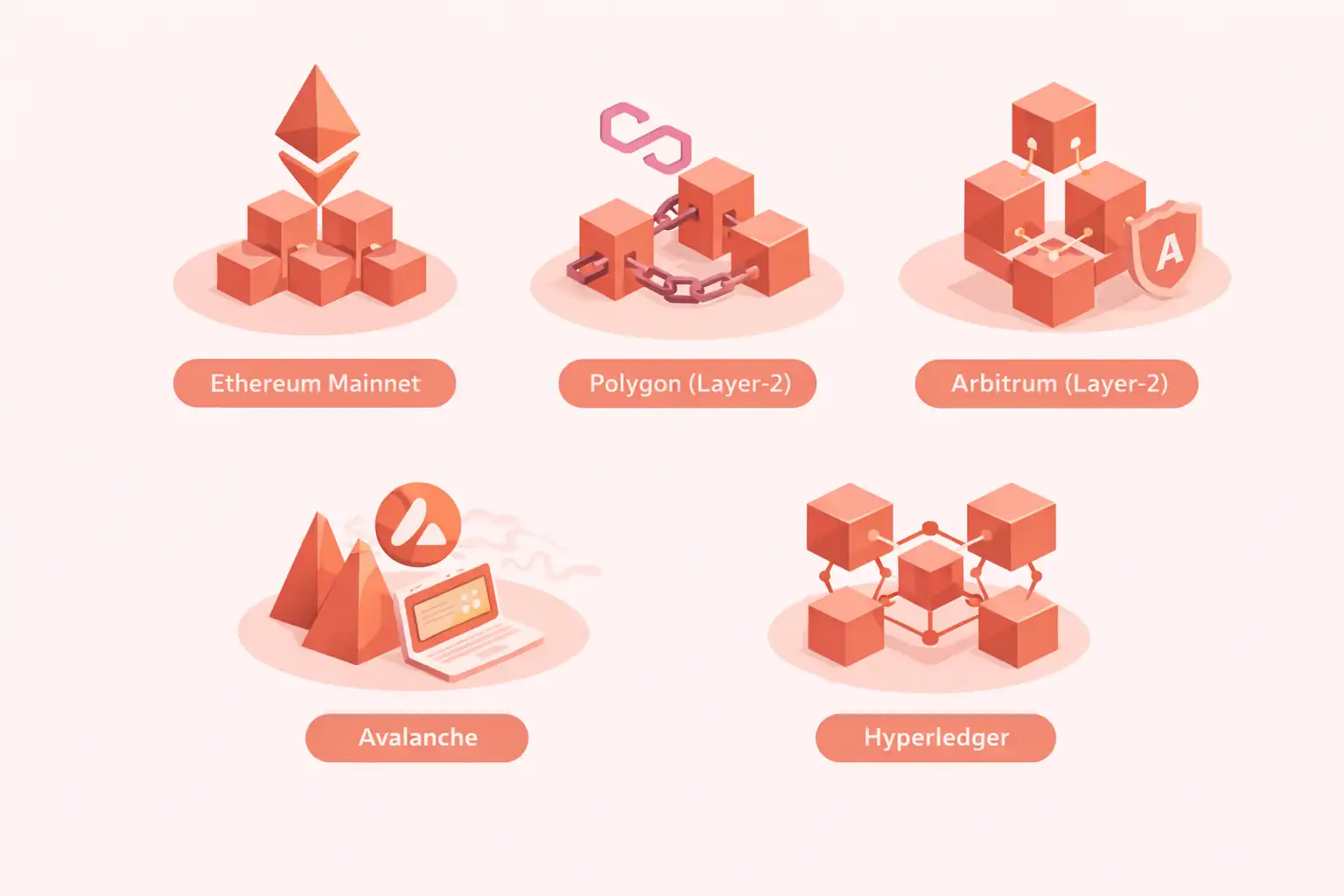
Transaction Cost Comparison Across Networks
Transaction costs vary dramatically across blockchain networks:
- Ethereum Mainnet: Simple transfers $20-$80, complex operations $100-$400 during congestion. Benefits: maximum security, largest ecosystem, regulatory familiarity. Drawbacks: high costs, lower throughput.
- Polygon (Layer-2): Simple transfers $0.10-$1.50, complex operations $2-$15. Benefits: low costs, Ethereum compatibility, good ecosystem. Drawbacks: additional bridge complexity, somewhat reduced decentralization.
- Arbitrum (Layer-2): Simple transfers $0.20-$2.00, complex operations $3-$20. Benefits: low costs, full Ethereum compatibility, strong security. Drawbacks: bridge requirements, smaller ecosystem than Polygon.
- Avalanche: Simple transfers $0.50-$3.00, complex operations $5-$25. Benefits: high throughput, subnet customization, fast finality. Drawbacks: smaller ecosystem, less regulatory precedent.
- Permissioned Networks (Hyperledger, Corda): Negligible per-transaction costs, infrastructure costs dominate. Benefits: predictable costs, privacy, customization. Drawbacks: setup costs $180K-$550K, limited public ecosystem integration.
Alternative Layer-1 blockchains including Avalanche, Solana, Algorand, and Tezos offer different cost-performance characteristics. These networks provide lower transaction costs than Ethereum mainnet ($0.50 to $5.00 per transaction) with higher throughput capacity. However, alternative Layer-1 networks have smaller ecosystems, fewer infrastructure providers, less mature tooling, and uncertain regulatory treatment compared to Ethereum. Projects choosing alternative Layer-1 networks must carefully evaluate ecosystem maturity and long-term viability.
Permissioned blockchain networks including Hyperledger Fabric, R3 Corda, and Quorum provide enterprise-focused alternatives with different cost structures. Permissioned networks eliminate per-transaction gas fees but require substantial infrastructure investment for node operation, network administration, and maintenance. Permissioned network implementations cost $180,000 to $550,000 for initial setup with annual operational costs of $85,000 to $280,000 for infrastructure, monitoring, and administration.
Smart contract development costs vary across blockchain networks due to different programming languages, development tools, and security considerations. Ethereum smart contracts use Solidity, benefiting from extensive documentation, mature tooling, and large developer communities. Alternative networks using different languages (such as Rust for Solana or Michelson for Tezos) face smaller developer pools and less mature tooling, potentially increasing development costs by 20 to 45 percent.
Security audit requirements and costs depend partially on blockchain selection. Ethereum smart contracts benefit from numerous reputable audit firms with extensive Solidity expertise. Auditing Ethereum smart contracts costs $45,000 to $180,000 depending on complexity and audit depth. Alternative blockchain networks have fewer specialized audit firms and less precedent, potentially increasing audit costs by 15 to 35 percent while introducing audit quality uncertainty.[1]
Infrastructure and hosting costs vary significantly between public blockchain implementations and permissioned networks. Public blockchain projects require only standard web hosting for frontend applications and APIs, with blockchain interaction handled through public node providers or light client implementations. Hosting costs for public blockchain implementations range from $500 to $5,000 monthly depending on traffic and infrastructure sophistication.
Permissioned blockchain implementations require operating blockchain nodes, potentially hosting entire networks, implementing consensus mechanisms, and maintaining peer connectivity. Permissioned network infrastructure costs range from $8,000 to $25,000 monthly including servers, bandwidth, monitoring, and administration. Projects choosing permissioned networks must carefully evaluate whether infrastructure control benefits justify substantially higher ongoing costs compared to public networks.
| Network Type | Initial Development | Transaction Costs | Infrastructure Costs | Best Use Cases |
|---|---|---|---|---|
| Ethereum Mainnet | $95K – $280K | $20-$400 per transaction | $500 – $3K monthly | Low transaction volume, maximum security priority, established ecosystem requirements |
| Layer-2 (Polygon/Arbitrum) | $85K – $250K | $0.10 – $20 per transaction | $800 – $4K monthly | High transaction volume, cost optimization, Ethereum ecosystem benefits |
| Alternative Layer-1 | $105K – $320K | $0.50 – $25 per transaction | $1K – $5K monthly | Specific technical requirements, throughput needs, cost balance with ecosystem maturity |
| Permissioned Network | $180K – $550K | Negligible | $8K – $25K monthly | Privacy requirements, regulatory preferences, consortium structures, control priorities |
Interoperability and bridge infrastructure costs affect multi-chain strategies. Projects deploying tokens across multiple blockchains or enabling asset transfers between chains require bridge implementations, cross-chain messaging protocols, and multi-chain monitoring systems. Bridge development costs range from $85,000 to $280,000 depending on complexity and security requirements. Bridge security audits add $65,000 to $180,000. Ongoing bridge monitoring and maintenance costs $25,000 to $85,000 annually.
Blockchain selection influences regulatory perception and compliance complexity. Ethereum benefits from regulatory familiarity and precedent through numerous token offerings, enforcement actions providing guidance, and regulatory statements acknowledging Ethereum’s role. Alternative blockchains with less regulatory history introduce uncertainty potentially requiring additional legal analysis and regulatory engagement costing $35,000 to $120,000.
Oracle integration requirements and costs vary by blockchain network. Projects requiring external data (such as asset prices, identity verification results, or real-world events) need oracle systems connecting blockchains to external data sources. Chainlink dominates oracle infrastructure on Ethereum with established integration patterns and documentation. Alternative blockchains have less mature oracle ecosystems, potentially requiring custom oracle development costing $55,000 to $180,000.
Token standard adoption affects development costs and ecosystem compatibility. ERC-20 and ERC-1400 standards on Ethereum benefit from widespread wallet support, exchange integration, and developer familiarity. Implementing custom token standards or using non-standard approaches increases development costs by 25 to 60 percent while limiting ecosystem compatibility. Projects should strongly prefer established standards unless compelling requirements justify custom implementations.
Network upgrades and migration risks represent long-term cost considerations. Blockchain networks periodically upgrade protocols, potentially requiring smart contract migrations, testing, and redeployment. Ethereum’s transition to proof-of-stake required projects evaluating contracts for compatibility issues. Permissioned networks require managing upgrade coordination across consortium members. Budget 5 to 15 percent of annual operational costs for network upgrade readiness and potential migrations.
Cost Differences Caused by Public, Private, and Permissioned Blockchain Environments
Public, private, and permissioned blockchain architectures create fundamentally different cost structures affecting initial implementation expenses, ongoing operational overhead, security requirements, and scalability economics. Understanding these architectural cost differences enables selecting appropriate blockchain environments aligned with project requirements, regulatory constraints, and budget realities. No architecture universally dominates across all cost dimensions requiring careful tradeoff evaluation.
Public blockchains including Ethereum, Polygon, and other open networks provide permissionless access where anyone can participate in network validation, transaction submission, and smart contract deployment. Public blockchain advantages include no infrastructure operation requirements, established security through broad validator participation, extensive ecosystem tooling, and regulatory familiarity. Public blockchain costs focus on transaction fees, smart contract deployment, and integration rather than infrastructure operation.
Public blockchain transaction costs vary with network congestion and blockchain selection as discussed in previous sections. These transaction costs represent pure operational expenses with no control or reduction mechanisms beyond architectural choices (such as Layer-2 adoption or batch processing). Projects requiring hundreds of thousands or millions of transactions annually must carefully model transaction cost impacts on long-term economics. A tokenization project generating 500,000 transactions annually on Ethereum mainnet at average $40 per transaction faces $20 million in annual transaction costs clearly unsustainable for most projects.[2]
Public vs Permissioned Cost Analysis Framework
Evaluating public versus permissioned blockchain costs requires analyzing:
- Transaction Volume Projections: Low transaction volumes (under 10,000 annually) favor public blockchains where per-transaction costs remain manageable. High volumes (over 100,000 annually) favor permissioned networks where infrastructure costs are fixed regardless of volume.
- Infrastructure Control Requirements: Projects requiring guaranteed transaction throughput, predictable costs, or data privacy necessitate permissioned networks despite higher fixed costs. Projects accepting public network variability benefit from lower entry costs.
- Regulatory Positioning: Certain regulators prefer permissioned networks providing greater oversight and control. Projects in heavily regulated industries may find permissioned networks reduce regulatory friction despite higher costs.
- Ecosystem Integration Priorities: Projects requiring integration with wallets, exchanges, DeFi protocols, or other ecosystem components benefit from public blockchain compatibility. Permissioned networks sacrifice ecosystem breadth for control and privacy.
- Long-Term Scaling Economics: Public blockchains become more expensive with transaction volume growth. Permissioned networks provide better cost predictability and potential cost per transaction reductions with volume due to fixed infrastructure costs.
Private blockchains represent fully permissioned environments where single organizations control all network nodes, validators, and participation. Private blockchains provide maximum control, privacy, and customization but require complete infrastructure operation. Private blockchain implementations cost $220,000 to $680,000 for initial deployment including software licensing, infrastructure setup, security architecture, and integration. Ongoing operational costs range from $120,000 to $380,000 annually for infrastructure, maintenance, security operations, and administration.
Permissioned blockchain consortiums where multiple organizations jointly operate networks represent middle ground between public and private extremes. Consortium networks provide controlled participation while distributing infrastructure costs and operational responsibilities across members. Consortium blockchain implementations cost $180,000 to $550,000 per organization for initial setup with annual operational costs of $85,000 to $280,000 per member depending on consortium size and cost-sharing arrangements.
Permissioned network software licensing costs vary significantly across platforms. Hyperledger Fabric, an open-source framework, eliminates licensing costs but requires substantial implementation expertise. Enterprise blockchain platforms including R3 Corda Enterprise, ConsenSys Quorum, and proprietary solutions charge licensing fees ranging from $50,000 to $250,000 annually depending on node count, feature access, and support levels. Organizations must evaluate whether commercial platform benefits justify licensing costs compared to open-source alternatives.
Infrastructure requirements for permissioned networks include servers for blockchain nodes, database storage, backup systems, monitoring infrastructure, and network connectivity. Production-grade permissioned network infrastructure requires redundant nodes across multiple availability zones, high-availability databases, comprehensive backup systems, and 24/7 monitoring. Infrastructure costs range from $8,000 to $25,000 monthly depending on network size, throughput requirements, and redundancy levels.
Operational staffing requirements differ dramatically between public and permissioned blockchain architectures. Public blockchain projects require development teams, security expertise, and user support but not infrastructure operations staff. Permissioned networks add requirements for blockchain network administrators, infrastructure engineers, security operations personnel, and database administrators. Staffing permissioned blockchain operations requires two to five full-time equivalent positions costing $280,000 to $850,000 annually in developed markets.
Security requirements and costs scale with infrastructure control. Public blockchains transfer security responsibility to network validators, allowing token projects to focus on smart contract security and key management. Permissioned networks require securing entire infrastructure stacks including servers, networks, databases, consensus mechanisms, and administration interfaces. Comprehensive permissioned network security implementations cost $150,000 to $420,000 beyond base infrastructure costs, covering security architecture, penetration testing, monitoring systems, and incident response procedures.
Risk Warning: Permissioned Network Sustainability
Permissioned blockchain networks create ongoing operational obligations requiring sustained organizational commitment and funding. Unlike public blockchains where network operation is community responsibility, permissioned networks require dedicated operations staff, infrastructure investment, and maintenance attention indefinitely. Organizations selecting permissioned architectures must ensure long-term operational commitments are realistic and funded. Failed permissioned networks create token holder stranding risks absent from public blockchain implementations. Budget permissioned network operations for minimum five-year horizons with contingency planning for network decommissioning if necessary.
Disaster recovery and business continuity costs represent often-overlooked permissioned network requirements. Organizations operating critical permissioned networks must implement comprehensive disaster recovery including geographic redundancy, backup systems, failover procedures, and recovery testing. Disaster recovery infrastructure adds 30 to 50 percent to base infrastructure costs. Business continuity planning, documentation, testing, and maintenance costs $35,000 to $95,000 annually.
Consensus mechanism selection affects permissioned network costs through computation requirements, node count needs, and fault tolerance characteristics. Byzantine Fault Tolerant consensus mechanisms including PBFT and Raft provide strong consistency guarantees but require careful node sizing and network configuration. Proof-of-work variants suitable for public blockchains generally waste resources in permissioned contexts. Consensus mechanism design and optimization costs $45,000 to $150,000 during initial implementation with ongoing tuning requirements.
Privacy and confidentiality requirements often drive permissioned blockchain selection despite higher costs. Permissioned networks enable transaction privacy through confidential channels, encrypted data sharing, and selective disclosure mechanisms. Implementing privacy-preserving features in permissioned environments costs $85,000 to $250,000 depending on privacy model sophistication and integration requirements. Public blockchain privacy solutions including zero-knowledge proofs introduce different tradeoffs and costs.
Hybrid architectures combining public and permissioned elements attempt capturing benefits of both approaches while managing downsides. Common patterns include private permissioned networks for transaction processing with periodic public blockchain settlement for transparency and immutability. Hybrid architectures create complexity managing data flows, ensuring consistency, and coordinating across networks. Hybrid implementations cost 40 to 70 percent more than single-architecture approaches but may provide optimal cost-performance tradeoffs for specific use cases.
Regulatory considerations influence public versus permissioned blockchain selection beyond pure cost analysis. Certain regulators express preferences for permissioned environments providing greater oversight, control, and accountability. Financial institutions operating under strict regulatory frameworks often favor permissioned networks despite higher costs to satisfy regulatory expectations and reduce examination friction. Understanding regulatory preferences in target jurisdictions informs architecture selection beyond cost optimization.
Influence of Security Architecture and Risk Mitigation Layers on Tokenization Cost Factors
Security architecture represents critical tokenization cost factors that organizations often underestimate during initial planning. Comprehensive security implementations protecting against theft, fraud, operational failures, and systemic risks require substantial investment in architecture design, technology implementation, operational procedures, monitoring systems, and incident response capabilities. Security cost optimization requires balancing protection levels with risk tolerances and asset values at stake.
Key management systems protecting cryptographic private keys controlling token contracts and treasury funds represent foundational security requirements. Private key compromise enables unauthorized token minting, treasury theft, contract upgrades, or governance manipulation. Appropriate key management balances security against operational requirements for contract deployment, administrative functions, and emergency responses.
Hardware security modules (HSMs) provide secure key generation, storage, and cryptographic operations resistant to physical and logical attacks. HSM implementations cost $35,000 to $120,000 for initial setup including hardware procurement, security architecture design, key ceremony procedures, and operational integration. Ongoing HSM operation costs $15,000 to $45,000 annually for hardware maintenance, security operations, and key management procedures.
Key Management Architecture Options
Different key management approaches create distinct security and cost profiles:
- Single-Key Control (Not Recommended): Single private key controls all contract functions. Minimal implementation cost but creates single point of failure, insider risk, and loss risk. Appropriate only for test environments or very low-value projects.
- Multi-Signature Schemes: Multiple independent signers required for operations. Implementation costs $45,000 to $120,000 including smart contract development, signer coordination procedures, and operational documentation. Provides protection against individual key compromise and insider threats.
- Time-Locked Controls: Administrative operations subject to time delays allowing emergency intervention. Implementation costs $35,000 to $95,000. Provides protection against compromised keys by allowing cancellation during delay periods.
- Hardware Security Modules: Dedicated hardware protecting keys with physical and logical security. Implementation costs $35,000 to $120,000 with annual operational costs of $15,000 to $45,000. Provides highest security for keys controlling substantial value.
- Threshold Signature Schemes: Distributed key generation and signing requiring threshold cooperation. Implementation costs $85,000 to $220,000 due to cryptographic complexity. Provides protection against key loss and theft while enabling distributed control.
Multi-signature wallet implementations requiring multiple independent signers for administrative operations provide protection against individual key compromise, insider threats, and operational errors. Multi-signature schemes cost $45,000 to $120,000 to implement including smart contract development, signer selection and setup, operational procedures, and emergency protocols. Ongoing multi-signature operations require coordination among signers, secure communication channels, and signer availability management.
Access control systems governing administrative functions, operational capabilities, and user permissions represent essential security layers. Role-based access control (RBAC) implementations defining different permission levels for administrators, operators, auditors, and users cost $35,000 to $95,000. Sophisticated access control with time-based permissions, delegation mechanisms, and emergency override procedures costs $65,000 to $180,000.
Smart contract security audits represent non-negotiable security requirements for production tokenization projects. Professional security audits by reputable firms identify vulnerabilities, logic errors, and attack vectors before contract deployment. Smart contract audit costs vary with code complexity, audit depth, and auditor reputation ranging from $45,000 to $180,000 for comprehensive audits. High-value projects or complex contracts requiring multiple audits by different firms face audit costs of $120,000 to $450,000.
Ongoing security monitoring systems provide continuous surveillance of blockchain activity, smart contract interactions, and infrastructure health. Monitoring implementations detect anomalous transactions, suspicious access patterns, contract exploitation attempts, and system failures. Comprehensive monitoring systems cost $55,000 to $180,000 to implement including monitoring infrastructure, alert systems, dashboard development, and operational procedures. Annual monitoring operations cost $35,000 to $120,000 for ongoing system maintenance and alert response.
Bug bounty programs incentivizing external security researchers to identify vulnerabilities provide cost-effective security testing supplementing formal audits. Bug bounty programs require defining scope, establishing reward structures, implementing disclosure processes, and coordinating vulnerability remediation. Annual bug bounty budgets typically range from $25,000 to $150,000 depending on project value and researcher community engagement levels.
| Security Component | Initial Implementation | Annual Operational | Risk Mitigation Impact |
|---|---|---|---|
| Smart Contract Audits | $45K – $180K | $25K $85K (re-audits after updates) |
Critical protection against contract vulnerabilities, exploitation attacks, logic errors |
| Key Management (HSM) | $35K – $120K | $15K – $45K | Protection against key theft, insider threats, operational key loss |
| Multi-Signature Controls | $45K – $120K | $18K – $55K | Protection against individual key compromise, insider threats, operational errors |
| Security Monitoring | $55K – $180K | $35K – $120K | Early detection of attacks, anomalies, system failures enabling rapid response |
| Penetration Testing | $35K – $95K | $25K – $75K | Identification of infrastructure vulnerabilities, application security gaps |
| Bug Bounty Program | $15K – $45K | $25K – $150K | Continuous security testing by external researchers, vulnerability discovery |
| Incident Response | $25K – $85K | $35K – $95K | Preparedness for security incidents, defined response procedures, recovery capabilities |
| Insurance (Cyber/Custody) | $8K – $25K | $45K – $280K (premiums scale with coverage) | Financial protection against theft, hacks, operational failures, custody losses |
Penetration testing evaluating infrastructure security, application vulnerabilities, and operational procedures complements smart contract audits by examining broader attack surfaces. Comprehensive penetration testing costs $35,000 to $95,000 initially with annual testing costing $25,000 to $75,000 to identify new vulnerabilities introduced through updates, integrations, or environmental changes.
Incident response planning and capabilities enable rapid coordinated responses to security events including contract exploits, infrastructure compromises, or operational failures. Incident response implementations include defining response teams, establishing communication protocols, creating runbooks for common scenarios, implementing circuit breaker mechanisms, and conducting response drills. Incident response program development costs $25,000 to $85,000 with annual maintenance and drill costs of $18,000 to $55,000.
Insurance products covering cybersecurity incidents, custody losses, smart contract failures, and operational errors provide financial backstops for security failures. Crypto-specific insurance products including custodian insurance, smart contract coverage, and cyber policies have emerged though coverage availability and pricing vary significantly. Annual insurance premiums typically range from 0.15 to 1.2 percent of insured value depending on security controls, historical track record, and coverage scope. High-value tokenization projects should budget $45,000 to $280,000 annually for comprehensive insurance coverage.
Secure development lifecycle practices embedding security throughout development processes reduce vulnerability introduction and exploitation risks. Secure development implementations include security training for developers, code review processes, automated security testing, threat modeling, and security-focused quality assurance. Implementing comprehensive secure development practices costs $45,000 to $150,000 initially with ongoing costs of $35,000 to $95,000 annually for training, tooling, and process enforcement.
Third-party dependency management represents often-overlooked security considerations. Smart contracts and applications frequently incorporate external libraries, frameworks, and components introducing potential vulnerabilities. Dependency scanning, license compliance verification, and update management systems cost $25,000 to $75,000 to implement with ongoing operational costs of $15,000 to $45,000 annually.
Formal verification of critical smart contract components provides mathematical proofs of correctness for security-critical functions. Formal verification costs $85,000 to $350,000 depending on code complexity and verification scope. While expensive, formal verification provides highest assurance for contracts controlling substantial value or implementing complex logic where traditional audits may miss subtle vulnerabilities.
How Smart Contract Logic Complexity Drives Variations in Tokenization Cost Factors
Smart contract logic complexity represents major tokenization cost factors affecting development time, testing requirements, audit expenses, and ongoing maintenance overhead. Simple token contracts implementing basic transfer and balance tracking functions cost dramatically less than complex contracts incorporating compliance rules, distribution calculations, governance mechanisms, and integration with external systems. Understanding complexity drivers enables realistic budget development and appropriate scope management.
Basic ERC-20 token implementations providing standard transfer, approval, and balance inquiry functions represent the simplest smart contract category. Standard ERC-20 tokens without additional features cost $15,000 to $45,000 to develop, test, and deploy. However, most tokenization projects require functionality beyond basic ERC-20 capabilities including transfer restrictions, compliance checking, distribution management, or governance features substantially increasing development complexity and costs.
Transfer restriction implementations embedding compliance rules in token logic create significant complexity. Simple transfer restrictions limiting transfers to whitelisted addresses cost $25,000 to $65,000 beyond base token costs. Sophisticated restriction systems checking multiple conditions (such as accreditation status, jurisdiction eligibility, holding periods, and transfer limits) cost $65,000 to $180,000. Each additional restriction dimension increases testing complexity and audit requirements proportionally.
Smart Contract Complexity Cost Drivers
Specific features drive smart contract cost variations:
- Transfer Restrictions: Each restriction type (whitelist, holding periods, volume limits, jurisdiction checks) adds $15,000 to $45,000 in development and testing costs. Complex multi-dimensional restrictions requiring $65,000 to $180,000.
- Distribution Calculations: Simple pro-rata distributions add $25,000 to $55,000. Waterfall distributions with tiers and preferences add $65,000 to $180,000. Dynamic distributions based on performance metrics add $95,000 to $250,000.
- Governance Mechanisms: Basic voting systems add $35,000 to $85,000. Delegation and proposal systems add $85,000 to $180,000. Quadratic voting or complex weight calculations add $120,000 to $280,000.
- Oracle Integrations: Single oracle integration adds $35,000 to $85,000. Multiple oracle sources with aggregation logic add $65,000 to $150,000. Custom oracle implementations add $95,000 to $280,000.
- Upgradability Mechanisms: Proxy patterns enabling upgrades add $45,000 to $120,000 due to implementation complexity and additional security considerations requiring careful access control and testing.
Distribution management smart contracts calculating and executing payments to token holders create substantial complexity especially for non-standard distribution rules. Simple pro-rata distributions proportional to token holdings cost $25,000 to $55,000 to implement including distribution triggering mechanisms, calculation logic, and payment execution. Waterfall distributions with priority tiers, hurdle rates, catch-up provisions, or performance-based adjustments cost $65,000 to $180,000 due to calculation complexity and extensive testing requirements verifying correct operation across scenarios.
Governance smart contracts implementing voting, proposal, and execution mechanisms vary widely in complexity and cost. Simple token-weighted voting on predefined proposals costs $35,000 to $85,000. Sophisticated governance systems with proposal submission mechanisms, delegation features, time-locked voting, quorum requirements, and automated execution of approved proposals cost $120,000 to $350,000. Governance implementations require extensive testing ensuring vote integrity, preventing manipulation, and handling edge cases.
Oracle integrations connecting smart contracts to external data sources introduce complexity through data feed management, price aggregation, staleness detection, and failure handling. Single oracle integration for price feeds or verification results costs $35,000 to $85,000. Multi-oracle implementations with aggregation logic, outlier detection, and fallback mechanisms cost $65,000 to $150,000. Custom oracle implementations providing specialized data not available through existing services cost $95,000 to $280,000.
State machine implementations tracking complex lifecycle stages or conditional logic create development and testing complexity. Assets transitioning through multiple states (such as fundraising, active, maturity, redemption) with state-specific behaviors require careful state management, transition validation, and access control. State machine implementations cost $45,000 to $150,000 depending on state count, transition complexity, and conditional logic sophistication.
Multi-token systems managing multiple token types with different characteristics, conversion mechanisms, or interdependencies multiply complexity. Projects issuing debt and equity tokens, multiple share classes, or tokens with conversion features require coordinating multiple contracts, managing interactions, and ensuring consistency. Multi-token implementations cost 1.6x to 2.4x single-token equivalents due to interaction complexity and integration testing requirements.
Cost Insight: Complexity vs Maintainability Tradeoff
Smart contract complexity creates exponential rather than linear cost increases. Each additional feature interacts with existing features creating testing matrices growing factorially with feature count. A contract with five independent features requires testing 25 feature interactions. Ten features require testing 100 interactions. This complexity explosion makes overly ambitious smart contracts economically impractical and operationally risky. Organizations should ruthlessly prioritize essential features, implement functionality incrementally through upgrades, and favor simplicity over feature completeness. Starting with minimal viable contracts and adding features based on actual requirements costs substantially less than attempting comprehensive implementations upfront.
Upgradability implementations enabling smart contract logic updates without migrating token state create significant architectural complexity. Proxy patterns separating data storage from logic execution enable upgrades but require careful design preventing upgrade vulnerabilities, ensuring state consistency, and controlling upgrade authority. Upgradable contract implementations cost $45,000 to $120,000 beyond non-upgradable equivalents due to proxy complexity, additional security considerations, and upgrade testing requirements.
Gas optimization reducing transaction costs through efficient code patterns requires specialized expertise and additional development time. Well-optimized contracts reduce transaction costs by 30 to 60 percent compared to naive implementations. Gas optimization efforts cost $25,000 to $85,000 depending on contract complexity and optimization target. Projects deploying on high-cost networks like Ethereum mainnet should prioritize gas optimization given transaction cost impacts on long-term economics.
Security audit costs scale with smart contract complexity through increased code size, logic paths, interaction patterns, and attack surfaces. Simple single-contract implementations with standard functionality audit for $45,000 to $95,000. Complex multi-contract systems with novel features, extensive interactions, and sophisticated logic audit for $120,000 to $450,000. Projects requiring multiple audits by different firms or formal verification of critical components face total security assessment costs of $250,000 to $850,000.
Testing requirements scale super-linearly with contract complexity. Comprehensive testing suites for complex contracts require unit tests for individual functions, integration tests for contract interactions, scenario tests for business logic, security tests for vulnerability patterns, and stress tests for edge cases. Developing comprehensive test suites for complex tokenization contracts costs $35,000 to $150,000 beyond contract development costs.
Documentation requirements for complex contracts represent non-trivial costs enabling maintenance, audits, and user understanding. Technical documentation including architecture diagrams, function specifications, security considerations, and deployment procedures costs $15,000 to $55,000. User-facing documentation explaining token functionality, governance processes, and interaction patterns costs $25,000 to $75,000. Inadequate documentation creates long-term technical debt increasing future maintenance costs.
Ongoing maintenance costs for complex smart contracts include monitoring for issues, responding to user questions, coordinating upgrades, and adapting to ecosystem changes. Annual maintenance costs typically range from 15 to 30 percent of initial development costs, with complex contracts falling toward the higher end due to greater surface area for issues and more frequent need for updates.
Impact of Integration With Wallets, Exchanges, and External Platforms on Cost
Integration with ecosystem infrastructure including cryptocurrency wallets, trading platforms, payment systems, identity verification services, and enterprise software represents substantial tokenization cost factors often underestimated during planning. Successful tokenization projects require seamless user experiences connecting tokens with established tools and services investors expect. Integration complexity varies with ecosystem maturity, standard adoption, and customization requirements.
Cryptocurrency wallet integration enables users storing, transferring, and managing tokens through familiar interfaces. Standard ERC-20 or ERC-1400 tokens benefit from automatic support in most Ethereum wallets including MetaMask, Coinbase Wallet, Trust Wallet, and hardware wallets like Ledger and Trezor. Standard-compliant tokens require minimal integration effort beyond basic testing and documentation costing $8,000 to $25,000.
Custom token implementations with non-standard features require explicit wallet integration work or custom wallet development. Wallets must understand transfer restrictions, distribution mechanisms, governance features, or other unique functionality. Integrating custom tokens with major wallets costs $25,000 to $85,000 per wallet including specification development, implementation coordination, testing, and user documentation. Projects requiring custom wallet applications face development costs of $120,000 to $380,000 for cross-platform wallet implementations.
Exchange Integration Cost Framework
Trading platform integration costs vary by platform type and integration depth:
- Centralized Exchanges (Major Platforms): Listing fees $50,000 to $500,000 plus legal costs $35,000 to $120,000 for exchange agreements and disclosures. Annual maintenance fees $15,000 to $95,000. Major exchanges require extensive due diligence, compliance documentation, and ongoing reporting.
- Security Token Exchanges: Listing fees $25,000 to $150,000 plus integration costs $35,000 to $95,000 for compliance systems, reporting interfaces, and investor onboarding coordination. Annual fees $12,000 to $55,000 for ongoing listing and compliance support.
- Decentralized Exchanges: No listing fees but liquidity provision requires capital commitment. Integration costs $15,000 to $55,000 for smart contract deployment, interface development, and liquidity management systems. Ongoing liquidity management costs $25,000 to $120,000 annually.
- Alternative Trading Systems: Vary widely but typically $35,000 to $180,000 for initial integration plus $15,000 to $75,000 annual participation fees. Require broker-dealer registration or alternative regulatory compliance.
Security token exchanges including tZERO, INX, Archax, and other regulated platforms provide compliant trading infrastructure for securities tokens. Security token exchange listings require legal documentation, compliance verification, technical integration, and ongoing reporting obligations. Initial listing costs range from $25,000 to $150,000 including listing fees, legal coordination, and technical integration. Annual listing maintenance fees range from $12,000 to $55,000 depending on platform and token characteristics.
Centralized cryptocurrency exchanges for tokens not classified as securities charge substantial listing fees ranging from $50,000 to $500,000 depending on exchange tier and negotiation. Major exchanges conduct extensive due diligence examining team backgrounds, legal structures, technical implementations, and business models. Legal costs supporting exchange listings range from $35,000 to $120,000 for agreement negotiations, disclosure preparation, and compliance coordination.
Decentralized exchange integration provides permissionless trading options without listing fees or centralized intermediaries. DEX integration costs $15,000 to $55,000 including smart contract deployment to AMM protocols, liquidity pool setup, interface development, and monitoring systems. However, DEX trading requires providing initial liquidity through paired token deposits, potentially requiring capital commitment of $100,000 to $500,000 or more depending on target liquidity depth.
Payment system integration enabling token purchases with fiat currency requires connecting with payment processors, implementing purchase flows, managing currency conversion, and handling payment failures. Payment integration costs $55,000 to $180,000 including payment processor agreements, technical integration, compliance for money transmission, and user experience development. Payment processing fees typically range from 2.5 to 5.0 percent of transaction value plus fixed per-transaction fees.
Identity verification service integration for KYC/AML compliance enables automated investor onboarding with regulatory compliance. Third-party identity verification services including Jumio, Onfido, Sumsub, and Persona provide APIs for document verification, facial recognition, and liveness detection. Identity verification integration costs $25,000 to $75,000 including API integration, user flow development, result handling, and exception management. Per-verification costs range from $1.50 to $8.00 depending on verification depth and volume commitments.
Accreditation verification services for U.S. securities tokens enable automated confirmation of accredited investor status through financial data aggregation or third-party certifications. Services including VerifyInvestor, Parallel Markets, and North Capital provide accreditation verification APIs. Integration costs $18,000 to $55,000 with per-verification fees ranging from $20 to $45. Manual accreditation verification through document review costs $35 to $75 per investor but requires less technical integration.
| Integration Type | Initial Implementation | Ongoing Costs | Key Considerations |
|---|---|---|---|
| Cryptocurrency Wallets | $8K – $85K depending on standard compliance and customization needs | $5K – $25K annually for testing new wallet versions and support | Standard-compliant tokens integrate automatically, custom features require explicit integration |
| Security Token Exchanges | $60K – $245K including listing fees and integration | $12K – $55K annually | Require securities compliance, investor verification coordination, ongoing reporting |
| Centralized Exchanges | $85K – $620K including substantial listing fees | $15K – $95K annually | Major exchanges charge significant fees, extensive due diligence, ongoing compliance |
| Decentralized Exchanges | $15K – $55K plus liquidity capital commitment | $25K – $120K for liquidity management | Permissionless listing but requires providing trading liquidity and ongoing management |
| Payment Processors | $55K – $180K | 2.5% – 5.0% of transaction value | Enable fiat purchases, require money transmission compliance, ongoing processing fees |
| Identity Verification | $25K – $75K | $1.50 – $8.00 per verification | Automated KYC/AML compliance, document verification, fraud detection |
| Accreditation Services | $18K – $55K | $20 – $45 per verification | U.S. accredited investor verification, financial data aggregation or manual review |
| Enterprise Software | $85K – $350K depending on system complexity | $35K – $150K annually | Integration with ERP, CRM, accounting systems, requires custom development |
Cap table management system integration for equity tokens enables synchronizing blockchain token records with traditional share registries and reporting systems. Integration with cap table platforms including Carta, Shareworks, or Capshare costs $55,000 to $180,000 including API development, data synchronization logic, reconciliation procedures, and reporting integration. Maintaining cap table synchronization requires ongoing operational attention costing $25,000 to $75,000 annually.
Enterprise resource planning (ERP) system integration connects tokenization platforms with organizational financial systems, enabling automated accounting, revenue recognition, and financial reporting. ERP integration costs $85,000 to $280,000 depending on ERP platform complexity and integration requirements. Maintaining ERP integrations through system updates and organizational changes costs $35,000 to $120,000 annually.
Customer relationship management (CRM) integration enables coordinating investor communications, tracking interactions, and managing investor support within existing organizational systems. CRM integration costs $45,000 to $150,000 including data synchronization, communication workflow configuration, and reporting development. CRM integration maintenance costs $18,000 to $65,000 annually.
Data analytics and business intelligence integration enables analyzing token holder demographics, transaction patterns, distribution outcomes, and operational metrics through enterprise analytics platforms. Analytics integration costs $35,000 to $120,000 including data pipeline development, report creation, and dashboard configuration. Analytics maintenance and enhancement costs $15,000 to $55,000 annually.
API development for third-party integrations enables partners, service providers, and developers building on tokenization platforms. Comprehensive API implementations with documentation, authentication, rate limiting, and monitoring cost $55,000 to $180,000. API maintenance including version management, deprecation handling, and support costs $25,000 to $85,000 annually.
White-label or embedded integration enabling other platforms incorporating tokenization functionality requires abstraction layers, customization frameworks, and partnership support systems. White-label implementations cost $120,000 to $450,000 depending on customization requirements and partnership complexity. Supporting white-label partners requires dedicated resources costing $55,000 to $220,000 annually.
Role of Token Standards and Customization Levels in Tokenization Cost Factors
Token standard selection significantly influences tokenization cost factors through development complexity, ecosystem compatibility, audit requirements, and long-term maintenance obligations. Established token standards including ERC-20, ERC-1400, and ERC-3643 provide tested frameworks reducing development risks and enabling automatic ecosystem integration. Custom token implementations offer flexibility for unique requirements but substantially increase costs through development effort, security risks, and integration challenges.
ERC-20 represents the foundational token standard on Ethereum, defining basic interfaces for transfers, balance queries, and spending approvals. ERC-20 implementation costs $15,000 to $45,000 for standard compliant tokens without additional features. The widespread ERC-20 adoption ensures automatic wallet support, exchange compatibility, and DeFi integration. However, ERC-20 provides no built-in compliance features, transfer restrictions, or securities-specific functionality requiring extensions for regulated tokenization.
ERC-1400 security token standard extends ERC-20 with features supporting securities compliance including document management, transfer restrictions, partition-based controls, and operator permissions. ERC-1400 implementations cost $55,000 to $150,000 depending on feature utilization and customization requirements. The standard provides frameworks for implementing common securities requirements reducing development complexity compared to fully custom approaches.
ERC-3643 (T-REX standard) provides comprehensive compliance infrastructure including identity registry, claim verification, and transfer validation specifically designed for regulated securities. ERC-3643 implementations cost $85,000 to $220,000 due to multi-contract architecture and sophisticated compliance logic. The standard offers production-tested compliance frameworks reducing regulatory risks but requires deeper integration with identity systems and verification services.
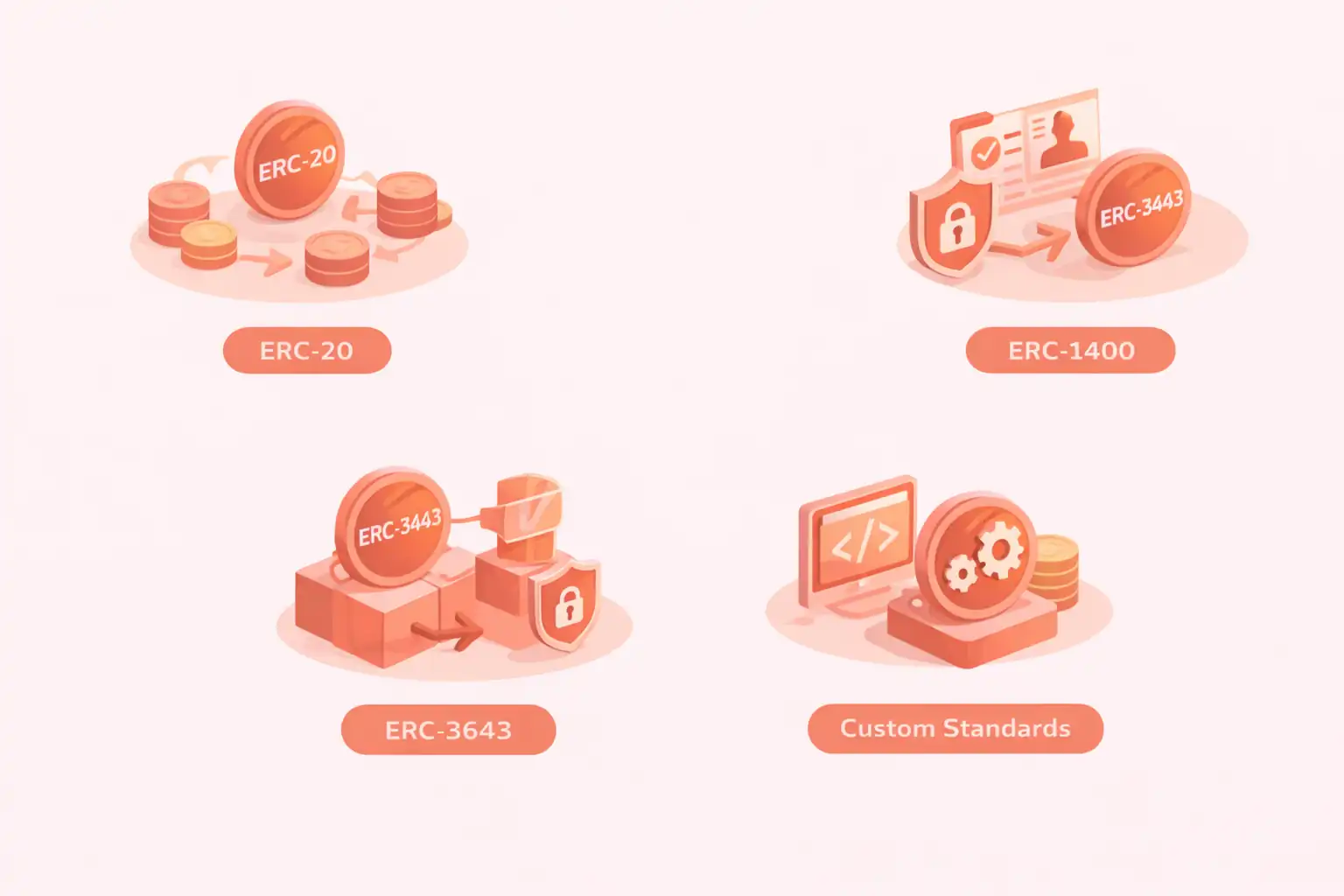
Token Standard Cost-Benefit Analysis
Different token standards create distinct cost and capability profiles:
- ERC-20 (Basic Standard): Lowest cost $15K-$45K, maximum ecosystem compatibility, but requires custom extensions for compliance, transfer restrictions, and securities features. Best for simple utility tokens or projects building custom compliance layers.
- ERC-1400 (Security Token): Moderate cost $55K-$150K, built-in securities features, partition management for different investor classes, operator controls. Reduces custom development needs for regulated securities. Good balance of features and ecosystem support.
- ERC-3643 (T-REX): Higher cost $85K-$220K, comprehensive compliance infrastructure, identity registry integration, claim-based verification. Most complete securities standard but requires extensive integration. Best for heavily regulated securities with complex compliance needs.
- Custom Standards: Highest cost $120K-$450K, maximum flexibility for unique requirements, but limited ecosystem compatibility, higher security risks, extensive testing needs. Only justified when established standards cannot accommodate requirements.
Custom token standard development enables implementing unique features, novel compliance approaches, or specialized functionality not supported by existing standards. Custom implementations cost $120,000 to $450,000 including specification development, implementation, testing, documentation, and security audits. Custom standards sacrifice ecosystem compatibility, requiring explicit integration work with wallets, exchanges, and other infrastructure adding $85,000 to $280,000 in integration costs.
Token standard customization within established frameworks represents middle ground between pure standard adoption and fully custom development. Extending ERC-1400 or ERC-3643 with project-specific features costs $45,000 to $180,000 depending on customization scope. Customizations must maintain standard interface compatibility to preserve ecosystem integration while adding required functionality.
Multi-standard implementations supporting multiple token standards simultaneously enable broader compatibility at increased complexity cost. Tokens implementing both ERC-20 and ERC-1400 interfaces provide basic ERC-20 compatibility for ecosystem tools while offering ERC-1400 compliance features for regulated operations. Multi-standard implementations cost 1.4x to 1.8x single-standard equivalents due to interface duplication and testing complexity.
Standard evolution and version management create ongoing costs as token standards receive updates, improvements, or deprecations. Projects must evaluate new standard versions, assess migration benefits and risks, implement upgrades if appropriate, and maintain compatibility with evolving ecosystem. Standard maintenance and evolution adaptation costs $25,000 to $85,000 annually depending on project complexity and ecosystem dynamics.
Regulatory alignment affects token standard selection and associated costs. Certain jurisdictions or regulators express preferences for specific compliance approaches or standard features. Projects targeting multiple jurisdictions must ensure token standards accommodate diverse regulatory requirements potentially requiring customization or hybrid approaches. Regulatory-driven standard customization adds $55,000 to $180,000 to implementation costs.
Interoperability requirements influence token standard decisions and costs. Projects requiring cross-chain functionality, integration with multiple blockchains, or wrapped token variants need standards supporting these capabilities. Cross-chain token implementations using bridge infrastructure cost $85,000 to $280,000 beyond single-chain implementations. Wrapped token variants for cross-chain compatibility add $45,000 to $150,000 per additional blockchain.
| Token Standard | Implementation Cost | Key Features | Best Use Cases |
|---|---|---|---|
| ERC-20 | $15K – $45K | Basic transfers, approvals, balance queries, maximum ecosystem compatibility | Utility tokens, simple structures, projects building custom compliance separately |
| ERC-1400 | $55K – $150K | Document management, transfer restrictions, partitions, operator controls | Security tokens, regulated offerings, multi-class structures |
| ERC-3643 (T-REX) | $85K – $220K | Identity registry, claim verification, comprehensive compliance infrastructure | Heavily regulated securities, institutional focus, complex compliance needs |
| ERC-721 (NFT) | $35K – $95K | Unique token identification, non-fungible characteristics, metadata support | Unique assets, individual property tokenization, collectibles |
| ERC-1155 (Multi-Token) | $65K – $180K | Multiple token types in single contract, batch operations, efficiency | Multiple asset types, portfolio tokenization, gas optimization priorities |
| Custom Standard | $120K – $450K | Unlimited flexibility, unique requirements, novel compliance approaches | Novel use cases, unique requirements impossible with existing standards |
Backward compatibility considerations affect customization decisions and costs. Projects modifying established standards must determine whether maintaining backward compatibility with the original standard justifies constraints on customization freedom. Backward-compatible customizations require careful interface preservation and testing ensuring compatibility with existing ecosystem tools costing $25,000 to $75,000 beyond standard customization costs.
Documentation requirements scale with standard customization level. Standard-compliant implementations leverage existing documentation requiring only project-specific additions costing $8,000 to $25,000. Custom standards require comprehensive documentation explaining interfaces, behaviors, integration requirements, and security considerations costing $35,000 to $120,000 for thorough technical documentation.
Developer ecosystem and tooling availability varies dramatically across token standards. ERC-20 benefits from extensive libraries, testing frameworks, deployment tools, and development resources reducing implementation costs. Newer or custom standards require building supporting infrastructure, creating testing frameworks, and developing deployment tooling adding $45,000 to $150,000 to project costs.
Effect of Scalability Requirements and Transaction Volume Expectations on Cost
Scalability requirements and projected transaction volumes significantly influence tokenization cost factors through blockchain selection, architecture decisions, infrastructure investments, and ongoing operational expenses. Projects anticipating high transaction volumes require different technical approaches and cost structures than low-volume implementations. Understanding volume-cost relationships enables appropriate architecture selection and realistic budget development.
Transaction volume projections should consider all on-chain activities including token transfers, distribution executions, governance votes, compliance checks, and administrative operations. Realistic volume modeling requires analyzing investor behavior patterns, distribution frequencies, governance participation rates, and operational requirements. Projects frequently underestimate transaction volumes by focusing only on investor-initiated transfers while overlooking automated distributions, compliance verifications, and administrative transactions.
Low-volume tokenization projects generating fewer than 10,000 transactions annually can operate cost-effectively on Ethereum mainnet despite high per-transaction costs. At $40 average transaction cost, 10,000 annual transactions cost $400,000 representing manageable operational expense for substantial tokenization projects. Low-volume projects benefit from Ethereum’s security, ecosystem maturity, and regulatory familiarity without requiring complex scaling solutions.
Medium-volume projects generating 10,000 to 100,000 transactions annually face transaction costs of $400,000 to $4,000,000 on Ethereum mainnet creating strong economic incentives for Layer-2 adoption or alternative blockchain selection. Layer-2 solutions reduce transaction costs by 50x to 500x enabling medium-volume projects to operate with transaction expenses of $8,000 to $80,000 annually. Layer-2 implementations add $35,000 to $95,000 in initial development costs for bridge integration and cross-layer coordination.
Transaction Volume Economic Analysis
Transaction volume thresholds creating architectural inflection points:
- Under 10,000 Transactions Annually: Ethereum mainnet remains economically viable. Transaction costs $200K-$800K annually depending on complexity. Security and ecosystem benefits justify mainnet costs for low volumes.
- 10,000 to 100,000 Transactions Annually: Layer-2 solutions become economically compelling. Mainnet costs $400K-$4M annually vs Layer-2 costs $8K-$80K annually. Layer-2 implementation adds $35K-$95K initial cost with breakeven typically within first year.
- 100,000 to 1,000,000 Transactions Annually: Layer-2 solutions essential for public blockchain viability. Alternative Layer-1 blockchains with lower base costs become competitive. Permissioned networks with fixed infrastructure costs may offer better economics despite higher setup costs.
- Over 1,000,000 Transactions Annually: Permissioned blockchain architectures often provide best economics through fixed infrastructure costs independent of transaction volume. Public blockchain costs become prohibitive even with Layer-2 solutions unless transaction values justify high operational expenses.
High-volume projects exceeding 100,000 transactions annually require careful architecture evaluation comparing Layer-2 public blockchains against permissioned networks. At 500,000 annual transactions, Layer-2 costs range from $40,000 to $200,000 annually while permissioned network infrastructure costs $120,000 to $380,000 annually. Permissioned networks become economically attractive at transaction volumes where their fixed costs compare favorably to volume-dependent Layer-2 expenses.
Batch processing strategies reduce transaction costs by aggregating multiple operations into single blockchain transactions. Distribution calculations, compliance checks, or governance tallies executed off-chain with only final results recorded on-chain dramatically reduce transaction volumes. Implementing batch processing architectures costs $45,000 to $150,000 but enables handling substantially higher operational volumes without proportional transaction cost increases.
State channel implementations enabling off-chain transaction processing with periodic on-chain settlement provide extreme scalability for frequent peer-to-peer transactions. State channels suit use cases requiring rapid transfers between limited participant sets while maintaining occasional blockchain settlement. State channel implementations cost $85,000 to $250,000 depending on complexity and participant management requirements.
Database and storage infrastructure requirements scale with transaction volume and data retention needs. Projects must store transaction history, user data, compliance records, and operational logs for regulatory, operational, and analytical purposes. Low-volume projects require minimal dedicated infrastructure costing $500 to $2,000 monthly. High-volume projects require scalable database systems, data warehousing, and archival storage costing $5,000 to $25,000 monthly.
API and service infrastructure capacity requirements scale with user base and transaction volumes. Low-volume projects operate on standard hosting infrastructure supporting hundreds of concurrent users and thousands of daily requests. High-volume projects require load-balanced architectures, caching layers, content delivery networks, and auto-scaling infrastructure supporting thousands of concurrent users and millions of daily requests. High-volume infrastructure costs $8,000 to $35,000 monthly compared to $800 to $3,000 monthly for low-volume implementations.
Monitoring and observability infrastructure requirements increase with scale complexity. Low-volume projects require basic monitoring tracking uptime, error rates, and key metrics costing $500 to $2,000 monthly. High-volume projects require comprehensive observability including distributed tracing, performance profiling, anomaly detection, and detailed analytics costing $3,000 to $15,000 monthly for monitoring infrastructure and tools.
Decision Framework: Scalability Architecture Selection
Choose Ethereum Mainnet when:
- Transaction volume under 10,000 annually makes mainnet costs acceptable
- Maximum security and decentralization are paramount priorities
- Ecosystem integration with mainnet-only protocols is required
- Regulatory preferences favor established mainnet precedent
Choose Layer-2 Solutions when:
- Transaction volume 10,000 to 1,000,000 annually makes cost reduction critical
- Ethereum ecosystem compatibility remains important
- Users accept occasional bridge interaction complexity
- Project benefits from Layer-2 ecosystem tools and services
Choose Permissioned Networks when:
- Transaction volume exceeds 1,000,000 annually making fixed costs attractive
- Privacy requirements mandate controlled data access
- Regulatory environment prefers permissioned architectures
- Organization has technical capacity for infrastructure operation
- Cost predictability outweighs ecosystem integration benefits
Peak capacity planning requirements affect infrastructure costs beyond average volume considerations. Systems must handle peak transaction loads potentially 5x to 10x average volumes during distribution events, governance votes, or market volatility periods. Infrastructure must provision for peak capacity while minimizing costs during normal operations. Elastic infrastructure supporting dynamic scaling costs 20 to 40 percent more than fixed-capacity systems but provides better cost efficiency across varying load patterns.
Geographic distribution and latency requirements influence infrastructure architecture and costs. Projects serving global user bases require geographically distributed infrastructure ensuring acceptable performance worldwide. Content delivery networks, regional API endpoints, and distributed database replicas improve user experience at increased infrastructure costs of 30 to 60 percent compared to single-region deployments.
Disaster recovery and business continuity planning costs scale with operational volume and criticality. High-volume production systems require comprehensive disaster recovery including geographic redundancy, automated failover, continuous backup, and recovery testing. Disaster recovery infrastructure adds 40 to 70 percent to base infrastructure costs while ensuring business continuity during failures.
How Data Privacy, Access Control, and Identity Verification Increase Cost Factors
Data privacy, access control, and identity verification requirements represent increasingly significant tokenization cost factors driven by regulatory mandates including GDPR, CCPA, PIPEDA, and securities regulations requiring investor verification. Implementing comprehensive privacy-preserving architectures, sophisticated access control systems, and robust identity verification processes requires substantial technical investment, operational overhead, and ongoing compliance monitoring.
GDPR compliance for European data subjects creates extensive requirements around data minimization, purpose limitation, consent management, data portability, and erasure rights. Blockchain immutability creates inherent tensions with GDPR erasure rights requiring careful architecture ensuring personal data remains off-chain while maintaining blockchain integrity. GDPR-compliant tokenization architectures cost $55,000 to $180,000 to implement including privacy impact assessments, data flow mapping, consent systems, and data subject rights management.
California Consumer Privacy Act (CCPA) and successor California Privacy Rights Act (CPRA) impose similar requirements for California residents including disclosure obligations, opt-out rights, and data deletion capabilities. Multi-jurisdictional privacy compliance coordinating GDPR, CCPA, PIPEDA, and other frameworks costs $85,000 to $280,000 for comprehensive implementation across privacy regimes.
Privacy-preserving architecture design separating personally identifiable information from blockchain data represents fundamental approach enabling privacy compliance. Personal data including names, addresses, identification documents, and financial information remains in traditional databases with only pseudonymous identifiers or cryptographic commitments recorded on-chain. Privacy-preserving architectures require careful coordination between on-chain and off-chain systems costing $65,000 to $220,000 to implement properly.
Privacy Compliance Cost Components
Comprehensive privacy compliance requires multiple cost layers:
- Privacy Impact Assessment: Legal and technical analysis identifying privacy risks, data flows, and mitigation strategies costs $25,000 to $75,000 depending on system complexity and jurisdictional scope.
- Data Minimization Implementation: Architecture changes limiting data collection and retention to necessary elements costs $35,000 to $95,000 including data flow redesign and system modifications.
- Consent Management System: User interfaces and backend systems capturing, managing, and respecting consent preferences cost $45,000 to $150,000 for comprehensive implementations across use cases.
- Data Subject Rights Infrastructure: Systems enabling users exercising access, rectification, erasure, portability, and objection rights cost $55,000 to $180,000 including request handling workflows and verification procedures.
- Cross-Border Transfer Mechanisms: Legal agreements (SCCs, BCRs) and technical safeguards for international data transfers cost $35,000 to $120,000 including legal documentation and implementation verification.
- Privacy Operations: Ongoing privacy monitoring, incident response, policy updates, and training cost $35,000 to $120,000 annually depending on organizational scale and regulatory scope.
Access control systems governing user permissions, administrative functions, and data access require sophisticated role-based access control (RBAC) or attribute-based access control (ABAC) implementations. Comprehensive access control systems define granular permissions for different user roles, implement principle of least privilege, provide audit logging, and enable access reviews. Access control implementations cost $55,000 to $180,000 with ongoing administration costs of $25,000 to $85,000 annually.
Identity verification requirements for securities tokenization create substantial operational costs through investor onboarding procedures. Know Your Customer (KYC) processes verify investor identities through document verification, facial recognition, liveness detection, and database checks against sanctions lists and PEP databases. Automated identity verification service integration costs $25,000 to $75,000 with per-verification costs ranging from $1.50 to $8.00 depending on verification depth and provider selection.
Accredited investor verification for U.S. securities adds complexity beyond basic identity verification requiring confirmation of investor financial qualification. Automated accreditation verification services aggregate financial account data or rely on third-party certifications from CPAs, attorneys, or broker-dealers. Accreditation verification integration costs $18,000 to $55,000 with per-verification costs of $20 to $45. Manual accreditation verification through document review costs $35 to $75 per investor.
Anti-Money Laundering (AML) compliance requires screening investors against sanctions lists (OFAC, UN, EU), politically exposed person databases, and adverse media sources. Ongoing transaction monitoring detects suspicious patterns including rapid movement of funds, structuring behaviors, or connections to high-risk jurisdictions. Comprehensive AML systems cost $65,000 to $220,000 to implement with annual operational costs of $45,000 to $180,000 for monitoring, investigations, and suspicious activity reporting.
Qualified Investor verification for non-U.S. jurisdictions applies different financial thresholds and documentation requirements than U.S. accredited investor standards. Multi-jurisdictional investor qualification systems supporting diverse international standards cost $45,000 to $150,000 beyond single-jurisdiction implementations. Each additional jurisdiction with unique qualification requirements adds $15,000 to $45,000 in system customization and operational procedures.
Zero-knowledge proof implementations enabling privacy-preserving verification where users prove attributes (such as accreditation status or jurisdiction) without revealing underlying personal data represent advanced privacy technology. ZK-proof implementations cost $95,000 to $350,000 depending on proof complexity and integration requirements. While expensive, ZK-proofs provide maximum privacy protection potentially reducing regulatory friction in privacy-sensitive jurisdictions.
| Privacy/Identity Component | Implementation Cost | Per-User Cost | Annual Operational |
|---|---|---|---|
| Basic KYC Verification | $25K – $75K | $1.50 – $8.00 | $15K – $55K |
| Accredited Investor Verification | $18K – $55K | $20 – $45 | $12K – $45K |
| AML Screening & Monitoring | $65K – $220K | $2.00 – $12.00 | $45K – $180K |
| GDPR Compliance Infrastructure | $55K – $180K | Negligible incremental | $35K – $120K |
| Access Control Systems (RBAC) | $55K – $180K | N/A | $25K – $85K |
| Multi-Jurisdiction Qualification | $45K – $150K | $8.00 – $35.00 | $35K – $120K |
| Zero-Knowledge Proofs | $95K – $350K | $0.50 – $5.00 (verification cost) | $45K – $150K |
Data encryption requirements protect personal information during storage and transmission. Encryption-at-rest for databases and file systems, encryption-in-transit for network communications, and key management for encryption keys create technical complexity and operational overhead. Comprehensive encryption implementations cost $45,000 to $150,000 including architecture design, encryption system deployment, and key management infrastructure.
Audit logging and compliance monitoring systems track data access, modifications, and transfers enabling regulatory compliance demonstration and security incident investigation. Comprehensive audit systems logging all data interactions, administrative actions, and system changes cost $35,000 to $120,000 to implement with ongoing log storage and analysis costs of $15,000 to $65,000 annually.
Data retention and deletion policies balancing regulatory retention requirements against privacy minimization principles require careful policy development and technical enforcement. Automated data lifecycle management systems purging unnecessary data while preserving required records cost $25,000 to $85,000 to implement with ongoing policy review and enforcement costs of $12,000 to $45,000 annually.
Biometric verification including facial recognition, fingerprint scanning, or voice authentication provides enhanced identity assurance for high-value transactions or sensitive operations. Biometric verification integration costs $35,000 to $120,000 with per-verification costs of $0.50 to $5.00. However, biometric data processing creates additional privacy considerations and regulatory requirements in jurisdictions like the EU treating biometric data as special category requiring enhanced protections.
Impact of Governance Models and Voting Mechanisms on Tokenization Cost Factors
Governance model selection significantly influences tokenization cost factors through technical implementation complexity, operational overhead, and legal structuring requirements. Governance systems enabling token holders participating in decision-making range from simple majority voting to sophisticated multi-tier structures with delegation, proposal mechanisms, and automated execution. Understanding governance cost drivers enables appropriate model selection balancing stakeholder participation desires against budget realities.
Simple token-weighted voting systems where voting power corresponds directly to token holdings represent the most straightforward governance implementation. Basic voting contracts enabling proposals with yes/no votes, simple majority or supermajority thresholds, and manual execution of approved decisions cost $35,000 to $85,000 to implement. These systems suit organizations comfortable with centralized proposal creation and execution while enabling token holder input on major decisions.
Delegation mechanisms enabling token holders delegating voting power to representatives or experts add substantial complexity through delegate registration, delegation tracking, vote calculation across delegated tokens, and delegation management interfaces. Delegation implementations cost $55,000 to $150,000 beyond basic voting systems due to additional state management, user interface complexity, and testing requirements ensuring accurate vote tallying.
Proposal submission systems allowing any token holder creating governance proposals with minimum token thresholds require proposal templates, submission validation, discussion periods, and proposal lifecycle management. Community proposal systems cost $65,000 to $180,000 to implement including proposal smart contracts, discussion infrastructure, moderation tools, and proposal status tracking.
Governance Model Cost Spectrum
Governance sophistication creates escalating cost profiles:
- Centralized Governance (Admin Control): Minimal cost $8,000 to $25,000, administrators make decisions, token holders have limited input, appropriate for operational decisions requiring rapid execution.
- Simple Token Voting: Cost $35,000 to $85,000, token-weighted voting on predefined proposals, manual execution, suitable for major decisions requiring stakeholder approval.
- Delegation-Enabled Voting: Cost $90,000 to $235,000 (base + delegation), representatives vote on behalf of delegators, improves participation efficiency, requires delegate management infrastructure.
- Community Proposal Systems: Cost $100,000 to $265,000 (voting + proposals), open proposal submission with minimum thresholds, enables bottom-up governance, requires moderation and lifecycle management.
- Automated Execution Frameworks: Cost $150,000 to $380,000 (proposals + execution), approved proposals execute automatically, eliminates manual intervention, requires extensive testing and security audits.
- Multi-Tier Governance: Cost $200,000 to $550,000, different token classes with distinct voting rights, complex quorum rules, sophisticated priority systems, maximum flexibility at highest cost.
Quorum requirements ensuring minimum participation before votes become binding add complexity through quorum tracking, vote period management, and quorum failure handling. Quorum-based governance systems cost $25,000 to $75,000 beyond basic voting implementations. Dynamic quorum systems adjusting requirements based on participation history or proposal importance cost $45,000 to $120,000 due to calculation complexity.
Time-locked voting preventing last-minute vote changes or providing review periods before execution creates additional state management requirements and timing coordination complexity. Time-lock implementations cost $35,000 to $95,000 including lock period management, countdown interfaces, and emergency override procedures for critical situations.
Quadratic voting or other novel voting mechanisms attempting to balance voting power more fairly than simple token weighting require sophisticated calculation engines, careful game theory analysis, and extensive testing. Quadratic voting implementations cost $85,000 to $220,000 due to mathematical complexity and potential manipulation vectors requiring careful security analysis.
Multi-tier governance systems with different decision types requiring different approval mechanisms create substantial complexity. Separating operational decisions (simple majority), capital allocation decisions (supermajority), and extraordinary transactions (supermajority with minimum participation) requires complex proposal classification, routing, and execution logic. Multi-tier governance costs $120,000 to $350,000 to implement comprehensively.
Automated execution systems implementing approved governance decisions without manual intervention require careful security architecture preventing unauthorized execution while ensuring approved decisions proceed reliably. Automated execution frameworks with timelock protection, emergency pause mechanisms, and execution verification cost $85,000 to $250,000 beyond proposal and voting systems.
Risk Warning: Governance Complexity Tradeoffs
Sophisticated governance systems create operational overhead, voter fatigue, and security risks that organizations must carefully weigh against participation benefits. High governance complexity with frequent votes, numerous proposal types, and complex rules consistently produces low participation rates (often under 20 percent), sophisticated attack vectors, and operational bottlenecks when urgent decisions require governance approval. Organizations should implement governance incrementally, starting with simple systems for critical decisions and expanding complexity only when participation data justifies additional features. Budget 25 to 40 percent of annual operational costs for active governance administration including proposal management, voter communication, and execution coordination.
Governance token distributions separate from economic tokens enable decoupling voting rights from financial returns creating different stakeholder alignment models. Dual-token governance systems require managing multiple token types, coordinating between tokens, and preventing gaming through token manipulation. Dual-token implementations cost 1.5x to 2.0x single-token governance systems due to added complexity.
Off-chain governance coordination where discussion, deliberation, and consensus-building occurs in forums or social platforms with only final votes recorded on-chain reduces transaction costs but requires robust off-chain infrastructure. Off-chain governance platforms with proposal discussions, stakeholder communication, and vote coordination cost $45,000 to $150,000 to develop beyond core voting infrastructure.
Governance analytics and reporting systems providing transparency into participation rates, voting patterns, proposal outcomes, and stakeholder engagement cost $35,000 to $120,000 to implement. Analytics dashboards, historical reporting, and participation tracking help organizations understanding governance effectiveness and identifying improvements.
Legal coordination between on-chain governance and traditional corporate governance structures requires careful alignment ensuring on-chain votes create legally binding obligations on entities controlling assets. Legal structuring aligning blockchain governance with entity governance costs $55,000 to $180,000 including operating agreement provisions, voting coordination procedures, and execution protocols.
Governance participation incentives encouraging token holder voting through rewards, preferential treatment, or reputation systems cost $35,000 to $120,000 to implement including reward calculation, distribution automation, and gamification features. However, incentive systems create manipulation risks requiring careful design preventing vote buying or strategic voting divorced from genuine preferences.
Cost Implications of Audit, Testing, and Quality Assurance Processes
Audit, testing, and quality assurance processes represent critical tokenization cost factors ensuring security, reliability, and regulatory compliance before production deployment. Comprehensive quality assurance encompasses smart contract security audits, penetration testing, functional testing, integration testing, user acceptance testing, and ongoing monitoring. Organizations under-investing in quality assurance face substantially higher costs through security incidents, operational failures, or regulatory enforcement.
Smart contract security audits represent non-negotiable requirements for production tokenization projects controlling significant value. Professional security audits by reputable firms including Trail of Bits, ConsenSys Diligence, OpenZeppelin, CertiK, or Quantstamp identify vulnerabilities, logic errors, and attack vectors before deployment. Audit costs vary with contract complexity, auditor reputation, and audit depth ranging from $45,000 to $180,000 for comprehensive single-auditor engagements.
Multiple independent audits by different firms provide redundant security verification reducing risks of audit oversights. High-value tokenization projects controlling $50 million or more should strongly consider dual audits costing $90,000 to $360,000 total. The incremental cost of second audits represents prudent risk management compared to potential losses from undetected vulnerabilities.
Formal verification of critical smart contract components provides mathematical proofs of correctness for security-critical functions. Formal verification tools including Certora, Runtime Verification, and academic formal methods groups provide highest assurance for complex logic. Formal verification costs $85,000 to $350,000 depending on code complexity and verification scope but provides assurance beyond traditional audits for mission-critical contracts.
Quality Assurance Investment Framework
Quality assurance investment should scale with asset value and risk exposure:
- Low Value Projects (Under $5M): Single smart contract audit $45K-$95K, basic penetration testing $25K-$65K, standard functional testing $15K-$45K. Total QA investment 10-15% of development costs.
- Medium Value Projects ($5M-$50M): Comprehensive smart contract audit $80K-$180K, thorough penetration testing $45K-$120K, extensive functional and integration testing $35K-$95K, bug bounty program $25K-$75K annually. Total QA investment 15-25% of development costs.
- High Value Projects ($50M-$200M): Dual smart contract audits $120K-$360K, formal verification of critical components $85K-$250K, comprehensive security testing $65K-$180K, extensive QA processes $55K-$150K, substantial bug bounty $75K-$200K annually. Total QA investment 20-35% of development costs.
- Institutional Projects (Over $200M): Multiple audits by top firms $200K-$600K, formal verification $150K-$450K, exhaustive security testing $120K-$350K, comprehensive QA $95K-$280K, significant bug bounty $150K-$400K annually. Total QA investment 25-40% of development costs.
Penetration testing evaluating infrastructure security, application vulnerabilities, and operational procedures complements smart contract audits by examining broader attack surfaces. Comprehensive penetration testing including infrastructure assessment, application security testing, social engineering evaluation, and physical security review costs $45,000 to $180,000 initially with annual retesting costing $35,000 to $120,000 identifying new vulnerabilities introduced through updates or environmental changes.
Functional testing validates that implemented features work correctly according to specifications across normal operating conditions. Comprehensive functional test suites covering all user flows, administrative functions, edge cases, and error conditions cost $25,000 to $85,000 to develop beyond development efforts. Functional testing should achieve minimum 80 percent code coverage with critical paths receiving 100 percent coverage.
Integration testing validates interactions between system components including smart contracts, backend services, databases, external APIs, and third-party integrations. Integration test development costs $35,000 to $120,000 ensuring components work correctly together and handle failure scenarios appropriately. Integration testing complexity scales with architectural complexity and number of integration points.
Load testing and performance validation ensure systems handle expected transaction volumes and user concurrency without degradation. Load testing simulating peak usage scenarios costs $25,000 to $85,000 including test environment setup, load generation tools, performance monitoring, and bottleneck identification. Projects anticipating high volumes must conduct thorough load testing preventing production performance problems.
User acceptance testing (UAT) involving actual users or user representatives validating functionality meets requirements and provides acceptable user experiences costs $18,000 to $65,000 including participant recruitment, testing coordination, feedback collection, and issue resolution. UAT identifies usability problems and requirement gaps before production launch preventing costly post-deployment corrections.
| Testing Category | Cost Range | Frequency | Primary Focus |
|---|---|---|---|
| Smart Contract Audit | $45K – $180K per audit | Pre-deployment, after major updates | Security vulnerabilities, logic errors, best practices compliance |
| Formal Verification | $85K – $350K | Critical contracts only, major updates | Mathematical proof of correctness for critical functions |
| Penetration Testing | $45K – $180K initially, $35K – $120K annually | Annually or after significant changes | Infrastructure vulnerabilities, application security, operational procedures |
| Functional Testing | $25K – $85K | Continuous during development | Feature correctness, specification compliance, error handling |
| Integration Testing | $35K – $120K | Continuous, especially with new integrations | Component interactions, API contracts, failure scenarios |
| Load/Performance Testing | $25K – $85K | Before launch, before scaling changes | System capacity, performance under load, bottleneck identification |
| User Acceptance Testing | $18K – $65K | Pre-launch, major feature releases | User experience, requirement satisfaction, usability |
| Regression Testing | $15K – $55K setup, $8K – $25K per cycle | Every update or release | Ensure updates don’t break existing functionality |
Regression testing validates that software updates, bug fixes, or new features don’t break existing functionality. Automated regression test suites cost $15,000 to $55,000 to develop initially with execution costs of $8,000 to $25,000 per regression cycle. Comprehensive regression testing prevents introducing new defects while fixing existing issues or adding features.
Security testing beyond smart contract audits includes vulnerability scanning, dependency analysis, security code review, and threat modeling. Comprehensive application security testing costs $35,000 to $120,000 including automated scanning tools, manual security review, and remediation verification. Regular security testing identifies emerging threats and new vulnerabilities in evolving codebases.
Compliance testing validates regulatory requirement implementation including transfer restrictions, distribution calculations, reporting functionality, and audit trail completeness. Compliance testing costs $25,000 to $85,000 ensuring implementations correctly enforce regulatory obligations and produce required documentation. Compliance defects discovered post-launch create substantial remediation costs and regulatory risks.
Documentation review and validation ensuring technical documentation, user guides, API documentation, and operational procedures accurately reflect implemented functionality costs $15,000 to $55,000. Accurate documentation enables maintenance, supports audits, and facilitates user onboarding reducing long-term support costs.
Test environment infrastructure providing production-like systems for testing without affecting production operations costs $8,000 to $35,000 to establish with monthly operational costs of $2,000 to $12,000. Adequate test environments enable thorough testing without production risks while allowing iterative testing cycles.
Influence of Ongoing Maintenance, Monitoring, and Upgrade Needs on Cost
Ongoing maintenance, monitoring, and upgrade requirements represent substantial long-term tokenization cost factors that organizations frequently underestimate during initial planning. Unlike traditional software with predictable maintenance patterns, blockchain-based systems require monitoring blockchain network conditions, managing smart contract upgrades, adapting to regulatory changes, and maintaining integrations with evolving ecosystem infrastructure. Annual operational costs typically range from 18 to 35 percent of initial implementation expenses.
System monitoring and observability infrastructure provides continuous visibility into system health, performance metrics, error rates, and security indicators. Comprehensive monitoring implementations cost $55,000 to $180,000 initially including monitoring infrastructure, alert configuration, dashboard development, and operational procedures. Ongoing monitoring operations cost $35,000 to $120,000 annually for infrastructure maintenance, alert response, and monitoring system evolution.
Blockchain network monitoring tracking gas prices, block times, network congestion, and consensus health enables proactive response to network conditions affecting transaction processing. Blockchain monitoring tools and services cost $15,000 to $55,000 annually providing real-time visibility into network conditions and enabling optimization of transaction timing and gas pricing strategies.
Smart contract maintenance including bug fixes, optimization improvements, and feature enhancements requires ongoing development resources. Annual smart contract maintenance costs range from $45,000 to $180,000 depending on contract complexity, usage patterns, and enhancement requirements. Upgradable contract architectures enable deploying fixes without token migrations but require careful governance and testing.
Annual Operational Cost Components
Comprehensive ongoing operations require multiple cost categories:
- Infrastructure Hosting: Servers, databases, monitoring, backups cost $8,000 to $45,000 annually depending on scale and redundancy requirements. Cloud infrastructure dominates costs with potential optimization through reserved instances or committed use discounts.
- Blockchain Transaction Costs: Highly variable $5,000 to $500,000+ annually depending on network selection, transaction volume, and network conditions. Layer-2 solutions provide predictability while mainnet costs fluctuate significantly.
- Security Operations: Monitoring, incident response, vulnerability management cost $35,000 to $150,000 annually. Includes security tooling, threat intelligence, incident response readiness, and periodic security assessments.
- Development and Maintenance: Bug fixes, enhancements, integration updates cost $65,000 to $280,000 annually requiring ongoing development capacity either through internal teams or external contractors.
- Compliance and Legal: Regulatory monitoring, policy updates, reporting, legal counsel cost $45,000 to $220,000 annually varying significantly with regulatory complexity and jurisdictional scope.
- User Support: Help desk, documentation, training cost $35,000 to $150,000 annually scaling with user base size and sophistication level requiring support.
- Third-Party Services: KYC/AML, identity verification, market data, analytics cost $25,000 to $180,000 annually based on usage volumes and service selections.
Infrastructure maintenance including server updates, security patching, database optimization, and capacity management requires dedicated operations resources or managed service contracts. Annual infrastructure maintenance costs range from $35,000 to $150,000 depending on infrastructure complexity and whether operations are performed internally or through managed services. Managed services typically cost 30 to 50 percent more than internal operations but reduce staffing requirements.
Integration maintenance updating connections with wallets, exchanges, payment processors, identity services, and enterprise systems as those platforms evolve costs $35,000 to $120,000 annually. External platform API changes, deprecations, or requirement updates necessitate adapter modifications and testing ensuring continued integration functionality.
Regulatory compliance monitoring tracking regulatory developments, analyzing impact on operations, implementing required changes, and maintaining compliance documentation costs $45,000 to $180,000 annually. Regulatory environments for tokenization continue evolving rapidly requiring sustained attention identifying and responding to regulatory changes across relevant jurisdictions.
User support operations providing help desk services, documentation updates, training materials, and incident response cost $35,000 to $150,000 annually depending on user base size and support sophistication requirements. Institutional projects typically require dedicated account management and technical support creating higher support costs than retail-focused projects relying on self-service documentation and community forums.
Bug bounty programs providing ongoing external security testing cost $25,000 to $150,000 annually depending on bounty budgets and researcher community engagement. Active bug bounty programs discover vulnerabilities before exploitation providing cost-effective continuous security testing supplementing periodic audits.
Protocol and ecosystem evolution tracking blockchain network upgrades, token standard developments, ecosystem tool releases, and best practice evolution costs $25,000 to $85,000 annually through technical monitoring, evaluation, and adaptation efforts. Remaining current with ecosystem developments enables leveraging improvements while avoiding obsolescence.
Long-Term Cost Planning Principles
Multi-Year Budget Modeling:
Organizations should model tokenization cost factors over minimum five-year horizons recognizing:
- Year 1: Highest costs including full implementation expenses plus partial year operations. Budget 100% of implementation costs plus 50% of annual operational costs.
- Years 2-3: Full annual operational costs plus enhancement investments. Budget 25-35% of initial implementation annually.
- Years 4-5: Mature operational costs plus potential major upgrades or migrations. Budget 20-30% of initial implementation annually plus upgrade reserves.
- Beyond Year 5: Sustainable operational costs potentially declining as percentage of initial investment. Budget 15-25% of initial implementation annually barring major architectural changes.
Contingency Reserves:
Maintain reserves for unexpected costs including security incidents, regulatory changes, blockchain migrations, or major ecosystem shifts. Recommended reserves: 20-30% of annual operational budget for established projects, 40-60% for projects under two years old facing higher uncertainty.
Disaster recovery testing validating backup procedures, failover mechanisms, and recovery processes requires periodic testing exercises ensuring recovery capabilities remain functional. Annual disaster recovery testing costs $18,000 to $65,000 including test planning, execution, documentation updates, and remediation of identified gaps.
Performance optimization ongoing efforts improving transaction efficiency, reducing gas costs, optimizing database queries, and enhancing user experience cost $35,000 to $120,000 annually. Performance optimization provides ongoing value through reduced operational costs and improved user satisfaction justifying continued investment.
Data archival and retention management implementing tiered storage strategies, archiving historical data, and maintaining compliance with retention requirements costs $15,000 to $65,000 annually. As tokenization projects mature and accumulate transaction history, data management becomes increasingly important operational concern.
Vendor relationship management coordinating with blockchain network providers, service vendors, legal counsel, auditors, and other external parties requires ongoing attention ensuring relationships remain productive and costs competitive. Vendor management costs $25,000 to $85,000 annually including contract negotiations, performance monitoring, and relationship coordination.
Technology refresh cycles replacing aging infrastructure, upgrading software versions, and adopting improved tooling cost $45,000 to $180,000 every two to three years. Technology refresh prevents technical debt accumulation and security vulnerabilities from outdated systems while enabling adoption of ecosystem improvements.
How Market Readiness, Liquidity Planning, and Distribution Strategy Affect Cost
Market readiness, liquidity infrastructure, and distribution strategy represent often-underestimated tokenization cost factors affecting investor acquisition, trading capabilities, and secondary market functionality. Organizations must invest substantially in market-making arrangements, exchange listings, distribution platforms, and investor relations infrastructure beyond core technical implementation. These market-facing costs vary dramatically based on liquidity priorities and target investor demographics.
Primary distribution infrastructure enabling initial token sales requires investor onboarding systems, payment processing, allocation management, and distribution execution capabilities. Basic distribution infrastructure supporting direct sales to pre-qualified investors costs $55,000 to $180,000 including investor portal development, payment integration, compliance workflows, and token distribution automation. Sophisticated distribution platforms supporting public offerings with broad investor participation cost $150,000 to $450,000 including extensive compliance automation, scalability infrastructure, and user experience optimization.
Need Help Navigating Tokenization Costs?
Our specialists provide detailed cost analysis and budget planning for tokenization projects. Avoid common pitfalls with experienced guidance from project start.
Marketing and investor relations costs for token offerings vary enormously based on offering size, target investor profile, and competitive positioning. Modest offerings targeting sophisticated investors through existing relationships require minimal marketing potentially $25,000 to $85,000 for materials development and communication infrastructure. Large public offerings targeting retail investors require comprehensive marketing campaigns costing $280,000 to $1,200,000+ including brand development, content creation, advertising, public relations, and event participation.
Secondary market infrastructure enabling post-issuance token trading represents major optional cost component that dramatically affects token liquidity and investor attractiveness. Organizations must decide between developing proprietary trading infrastructure, integrating with existing exchanges, or accepting limited liquidity. Each approach creates distinct cost profiles and capabilities.
Liquidity Infrastructure Investment Levels
Liquidity investment scales with liquidity importance and offering size:
- Minimal Liquidity ($50K-$150K): Basic transfer functionality, peer-to-peer bulletin board, no active trading infrastructure. Suitable for illiquid securities where investors expect holding to maturity or issuer-coordinated exits.
- Exchange Listing ($200K-$500K): Security token exchange integration, listing fees, ongoing maintenance. Provides compliant trading venue but liquidity depends on organic trading interest without market-making support.
- Market-Making Support ($400K-$900K): Exchange listing plus professional market-making arrangements providing continuous liquidity. Market makers charge setup fees $50K-$150K plus monthly retainers $8K-$35K creating meaningful ongoing costs.
- Comprehensive Liquidity ($800K-$2.5M): Multiple exchange listings, dedicated market makers, liquidity pool provision, trading analytics. Required for offerings positioning liquidity as major value proposition. Ongoing costs $85K-$350K annually.
Security token exchange listings provide compliant trading venues for securities tokens but require substantial integration work, legal documentation, and listing fees. Initial security token exchange listings including tZERO, INX, or Archax cost $60,000 to $245,000 combining listing fees ($25,000 to $150,000), integration development ($20,000 to $60,000), and legal coordination ($15,000 to $35,000). Annual listing maintenance fees range from $12,000 to $55,000.
Centralized cryptocurrency exchange listings for non-security tokens involve even higher costs with major exchanges charging $50,000 to $500,000 in listing fees alone. Total listing costs including legal work, due diligence support, and technical integration range from $85,000 to $620,000. Exchange listings provide greatest visibility and liquidity potential but create substantial financial commitments and ongoing obligations.
Market-making arrangements with professional trading firms provide continuous bid-ask quotes ensuring baseline liquidity regardless of organic trading activity. Market makers typically charge setup fees of $50,000 to $150,000 plus monthly retainers of $8,000 to $35,000 depending on token characteristics, spread requirements, and liquidity commitments. Market-making costs represent ongoing operational expenses requiring sufficient token value and trading volumes justifying investment.
Decentralized exchange integration provides permissionless trading without listing fees but requires liquidity provision through paired token deposits in automated market maker protocols. Initial DEX integration costs $15,000 to $55,000 for smart contract deployment and interface development. However, meaningful DEX liquidity requires capital commitments of $100,000 to $500,000+ in paired liquidity pools with ongoing impermanent loss risks and liquidity management costs of $25,000 to $120,000 annually.
Proprietary trading platform development enables complete control over trading experience and fee structures but creates substantial development and operational costs. Custom trading platform development costs $280,000 to $950,000 including order book implementation, matching engine, user interfaces, wallet integration, and regulatory compliance infrastructure. Ongoing platform operations cost $120,000 to $450,000 annually for infrastructure, security, customer support, and maintenance.
Alternative Trading System (ATS) registration for U.S. platforms enabling securities trading requires broker-dealer registration or alternative regulatory pathways creating substantial compliance costs. ATS registration and operation costs range from $350,000 to $1,200,000 initially with annual compliance costs of $180,000 to $650,000. ATS operation suits organizations planning multiple token offerings amortizing platform costs across multiple issuances.
| Liquidity Approach | Initial Investment | Ongoing Annual Costs | Liquidity Quality |
|---|---|---|---|
| Peer-to-Peer Bulletin Board | $50K – $150K | $15K – $55K | Minimal – sporadic trades, wide spreads, manual coordination |
| Security Token Exchange | $60K – $245K | $12K – $55K | Low to Moderate – depends on organic interest and volume |
| Exchange + Market Making | $180K – $550K | $108K – $475K | Moderate to Good – consistent quotes, reasonable spreads |
| Decentralized Exchange + Liquidity | $115K – $555K (including capital) | $25K – $120K | Variable – depends on pool depth and trading activity |
| Centralized Exchange Listing | $85K – $620K | $15K – $95K | High Potential – major visibility but depends on market interest |
| Proprietary Trading Platform | $280K – $950K | $120K – $450K | Controlled – full control but requires sustained operational investment |
Investor relations infrastructure including communication platforms, reporting dashboards, document repositories, and support systems costs $45,000 to $180,000 to develop with ongoing operational costs of $35,000 to $150,000 annually. Comprehensive investor relations capabilities build trust, ensure regulatory compliance, and reduce support burden through self-service information access.
Distribution analytics and reporting systems tracking token sales, investor demographics, geographic distribution, and marketing effectiveness cost $35,000 to $120,000 to implement. Analytics capabilities enable optimizing distribution strategies, demonstrating compliance with offering limitations, and understanding investor composition informing ongoing operations.
Token economics and pricing mechanisms for offerings require financial modeling, valuation analysis, and pricing strategy development. Professional token economics consulting costs $55,000 to $220,000 depending on asset complexity and pricing sophistication requirements. Appropriate token pricing balances issuer capital-raising objectives against investor return expectations and market conditions.
Legal documentation for offerings including prospectuses, offering memoranda, purchase agreements, and disclosure documents costs $85,000 to $350,000 depending on offering type, jurisdictional requirements, and complexity. Comprehensive offering documents provide investors required information while protecting issuers through appropriate disclosures and risk factor documentation.
Distribution partner coordination when working with broker-dealers, investment platforms, or distribution networks requires relationship management, coordination infrastructure, and potentially revenue sharing arrangements. Partner-assisted distribution adds $65,000 to $250,000 in initial setup costs plus ongoing revenue sharing typically 3 to 8 percent of capital raised.
Long-Term Cost Considerations Driven by Ecosystem Expansion and Feature Evolution
Long-term tokenization cost factors considerations extending beyond initial implementation and first-year operations significantly affect project sustainability and total cost of ownership. Successful tokenization projects evolve continuously through feature additions, ecosystem integrations, regulatory adaptations, and scaling enhancements. Understanding long-term cost trajectories enables appropriate financial planning ensuring projects maintain adequate resources throughout multi-year lifecycles.
Feature enhancement roadmaps adding capabilities based on user feedback, competitive dynamics, or strategic opportunities create ongoing development costs. Annual feature development budgets typically range from $85,000 to $350,000 depending on enhancement ambition and development velocity. Organizations must balance feature additions against code complexity management and maintenance burden increases.
Ecosystem integration expansion connecting tokens with emerging platforms, protocols, and services maintains competitiveness and expands utility. Annual ecosystem integration costs range from $55,000 to $220,000 as organizations add DeFi protocol integrations, new exchange listings, payment system connections, or enterprise software integrations. Ecosystem integration intensity varies with project ambition and available resources.
Regulatory adaptation responding to evolving compliance requirements, new regulatory guidance, or expanded jurisdictional operations creates substantial ongoing costs. Annual regulatory adaptation costs range from $65,000 to $280,000 in dynamic regulatory environments requiring frequent policy updates, system modifications, and legal consultations. Mature regulatory frameworks reduce adaptation costs while emerging regulations increase requirements.
Multi-Year Cost Evolution Patterns
Tokenization cost factors follow predictable evolution patterns across project lifecycle:
- Year 1 (Implementation + Launch): Highest total costs including full implementation expenses plus 6-12 months operational costs. Expect spending 100% of implementation budget plus 40-60% of steady-state annual operations. Focus: building foundation, establishing compliance, initial investor onboarding.
- Year 2 (Stabilization): Full annual operational costs plus enhancement investments addressing post-launch findings. Budget 25-35% of Year 1 implementation costs for Year 2 operations. Focus: operational optimization, investor experience improvements, compliance refinement.
- Year 3 (Growth): Mature operational costs plus potential expansion investments (new jurisdictions, features, integrations). Budget 22-32% of initial implementation. Focus: ecosystem expansion, feature additions, scale optimization.
- Years 4-5 (Maturation): Efficient operations with selective enhancements plus potential major upgrades or migrations. Budget 18-28% of initial implementation annually. Focus: long-term sustainability, competitive positioning, technology refresh.
- Year 6+ (Sustained Operations): Optimized operational costs with periodic investment cycles for major improvements. Budget 15-25% of initial implementation annually barring major changes. Focus: efficiency, reliability, strategic evolution.
Technology refresh cycles replacing aging infrastructure, upgrading protocols, or adopting architectural improvements occur every 2-4 years. Major technology refresh efforts cost $120,000 to $550,000 depending on scope, potentially approaching re-implementation costs for complete architectural overhauls. Technology refresh prevents technical debt accumulation, maintains security posture, and enables leveraging ecosystem improvements.
Blockchain migration scenarios where projects move between blockchain networks due to cost pressures, capability requirements, or strategic repositioning create substantial one-time costs. Blockchain migrations cost $180,000 to $850,000 including smart contract redevelopment, testing, security audits, data migration, user communication, and transition coordination. Migration complexity varies with token customization degree and ecosystem integration depth.
Governance evolution developing more sophisticated decision-making frameworks as token holder communities mature costs $85,000 to $280,000 for significant governance upgrades. Governance systems frequently evolve from simple administrator-controlled models toward progressive decentralization with enhanced stakeholder participation requiring ongoing governance infrastructure investment.
Security posture enhancement maintaining robust protection against evolving threat landscapes requires continuous investment beyond baseline security operations. Annual security enhancement budgets should range from $45,000 to $180,000 for threat landscape monitoring, security technology adoption, advanced testing techniques, and security training ensuring security measures remain effective against emerging threats.
User experience optimization improving interfaces, streamlining workflows, and enhancing accessibility creates ongoing value through improved user satisfaction and reduced support burden. Annual UX optimization budgets of $35,000 to $150,000 enable continuous improvement based on user feedback, usage analytics, and competitive benchmarking.
Data analytics and business intelligence capabilities providing insights into token holder behavior, transaction patterns, operational efficiency, and market dynamics cost $55,000 to $220,000 to establish comprehensively with ongoing enhancement costs of $35,000 to $120,000 annually. Analytics capabilities inform strategic decisions, identify optimization opportunities, and demonstrate value to stakeholders.
Financial Sustainability Framework
Revenue Models Supporting Long-Term Operations:
Tokenization projects require sustainable revenue models covering ongoing operational costs:
- Transaction Fees: Charging 0.1% to 1.0% on token transfers or distributions provides revenue scaling with activity. Requires sufficient transaction volume generating meaningful revenue without suppressing usage.
- Asset Management Fees: Annual fees of 0.25% to 2.0% on total tokenized asset value provide predictable revenue independent of transaction volume. Common for asset-backed tokens where ongoing asset management justifies fees.
- Platform Fees: Charging investors platform access fees, premium features, or enhanced services provides revenue independent of tokenization success. Subscription models $50-$500 monthly per user depending on value delivered.
- Distribution Carry: Participating in distribution economics through carried interest, success fees, or performance allocation aligns operator interests with token holder returns. Typical structures 5-20% of distributions above hurdles.
Break-Even Analysis: Organizations should model clear pathways to operational sustainability within 24-36 months of launch. Projects failing to achieve sustainable unit economics within this timeframe face increasing sustainability risks requiring ongoing capital infusions or operational restructuring.
Community building and engagement developing active token holder communities through communication platforms, educational content, events, and incentive programs costs $55,000 to $220,000 annually. Strong communities increase project resilience, provide valuable feedback, and create network effects attracting additional participants.
Partnership development establishing relationships with service providers, distribution partners, technology vendors, and ecosystem participants requires ongoing relationship management investment. Annual partnership development and management costs range from $45,000 to $180,000 depending on partnership breadth and strategic importance.
Competitive intelligence and market research monitoring competitive offerings, tracking industry trends, and identifying strategic opportunities costs $25,000 to $95,000 annually. Market intelligence enables proactive strategic adjustments maintaining competitive positioning in rapidly evolving tokenization landscape.
Exit planning and succession considerations ensuring projects can transition ownership, management, or operational responsibility require documentation, knowledge transfer, and governance procedures. Exit planning investments of $35,000 to $150,000 provide future flexibility while protecting token holder interests during transitions.
Insurance coverage evolution adapting coverage as projects mature, asset values grow, and risk profiles change requires periodic insurance review and adjustment. Annual insurance costs typically increase 10-20% annually with asset value growth necessitating coverage expansion. Periodic insurance program reviews costing $15,000 to $45,000 ensure appropriate coverage at competitive rates.
Audit and assurance requirements increasing as projects mature or face regulatory scrutiny create growing compliance costs. Annual financial audits cost $35,000 to $150,000 depending on complexity. SOC 2 or similar operational audits cost $45,000 to $180,000 annually. Public company accounting standards for registered securities create audit costs of $150,000 to $650,000 annually.
| Lifecycle Stage | Primary Cost Drivers | Annual Budget as % of Initial Implementation | Strategic Focus |
|---|---|---|---|
| Year 1 (Launch) | Full implementation, initial operations, investor onboarding, compliance establishment | 140% – 160% (implementation + operations) | Build foundation, establish operations, launch successfully |
| Year 2 (Stabilization) | Full operations, post-launch improvements, compliance refinement, investor experience optimization | 25% – 35% | Optimize operations, improve experience, refine processes |
| Year 3 (Growth) | Mature operations, ecosystem expansion, feature additions, possible jurisdiction expansion | 22% – 32% | Expand capabilities, grow ecosystem, scale efficiently |
| Years 4-5 (Maturity) | Efficient operations, selective enhancements, technology refresh, competitive positioning | 18% – 28% | Sustain efficiently, strategic positioning, technology currency |
| Year 6+ (Sustained) | Optimized operations, periodic enhancement cycles, long-term sustainability | 15% – 25% | Efficient operations, strategic evolution, value delivery |
Decommissioning planning for eventual project end-of-life scenarios requires establishing procedures for token redemption, asset liquidation, stakeholder communication, and regulatory wind-down. Decommissioning planning costs $45,000 to $150,000 ensuring orderly conclusions protecting token holder interests if projects conclude operations.
Knowledge management and institutional memory preservation through documentation, training, and succession planning prevents critical knowledge loss as teams evolve. Annual knowledge management investments of $25,000 to $85,000 maintain operational continuity and organizational resilience through personnel transitions.
Total cost of ownership over five-year horizons typically ranges from 2.0x to 3.5x initial implementation costs depending on enhancement ambition, regulatory evolution, and operational sophistication. Organizations should budget tokenization initiatives using five-year total cost models rather than focusing exclusively on initial implementation preventing sustainability challenges when ongoing costs exceed available resources.
Comprehensive Understanding Enables Realistic Planning
Tokenization cost factors span legal compliance, technical implementation, security infrastructure, operational overhead, and long-term sustainability requirements. Successful tokenization projects begin with comprehensive cost understanding enabling realistic budgets, appropriate contingency planning, and sustainable financial models. Organizations approaching tokenization with adequate resources, clear-eyed understanding of cost drivers, and commitment to long-term operational excellence position themselves for success in this transformative technology space.
People Also Ask
Q1.What are the main factors that affect tokenization cost?
The main factors include asset type complexity, regulatory compliance requirements, blockchain network selection, smart contract development scope, security architecture depth, integration needs with external platforms, ongoing maintenance provisions, and jurisdictional legal structuring. Each factor scales independently based on project specifications, target investor profiles, and operational requirements across different markets.
Q2.How much does it typically cost to tokenize a real estate asset?
Real estate tokenization typically ranges from $150,000 to $800,000 depending on property value, jurisdictional requirements, investor structure complexity, and secondary market infrastructure needs. Costs include legal entity formation, securities compliance, smart contract development, platform integration, KYC/AML systems, audit processes, and initial operational setup across regulated environments in markets like the USA, UK, UAE, and Canada.
Q3.Why does blockchain selection impact tokenization cost?
Blockchain selection impacts cost through transaction fees, infrastructure requirements, developer availability, security audit depth, and interoperability needs. Public blockchains like Ethereum incur variable gas costs and require robust security measures, while private networks demand dedicated infrastructure but offer predictable expenses. Permissioned environments add identity management layers, each creating distinct cost profiles affecting both initial deployment and ongoing operations.
Q4.What legal costs should be expected in tokenization projects?
Legal costs for tokenization typically range from $50,000 to $300,000 and cover securities classification analysis, regulatory filing preparation, investor documentation, compliance framework design, jurisdictional structure optimization, and ongoing legal advisory support. Complex cross-border offerings targeting multiple jurisdictions like USA, UK, UAE, and Canada require coordinated legal strategies that substantially increase advisory expenses and regulatory filing fees.
Q5.How do smart contract development costs vary across tokenization projects?
Smart contract development costs range from $30,000 for basic token standards to $250,000 for complex governance systems with custom logic, multi-signature controls, automated compliance checks, and upgradeable architectures. Cost variation depends on functionality scope, security requirements, audit depth, testing rigor, and integration complexity with existing systems, wallets, exchanges, and compliance platforms across different blockchain environments.
Q6.What ongoing costs exist after initial tokenization deployment?
Ongoing costs include platform hosting ($2,000 to $15,000 monthly), compliance monitoring ($3,000 to $20,000 monthly), investor reporting systems, transaction processing fees, security updates, smart contract upgrades, legal advisory retainers, audit renewals, customer support operations, and market-making activities. Annual recurring costs typically represent 15% to 30% of initial deployment expenses depending on asset complexity and investor base size.
Q7.How does regulatory compliance affect tokenization cost factors?
Regulatory compliance drives 30% to 50% of total tokenization costs through securities registration, exemption filings, KYC/AML system implementation, ongoing reporting obligations, audit requirements, legal opinions, and jurisdictional coordination. Projects targeting institutional investors in regulated markets like USA, UK, UAE, and Canada face higher compliance thresholds requiring sophisticated systems, extensive documentation, and continuous monitoring capabilities.
Q8.What security measures increase tokenization cost significantly?
Security measures adding significant cost include multi-layered smart contract audits ($25,000 to $150,000), penetration testing, bug bounty programs, insurance policies for digital assets, cold storage infrastructure, multi-signature wallet systems, real-time monitoring tools, incident response planning, and disaster recovery provisions. Enterprise-grade security for institutional tokenization projects typically requires 20% to 35% of total technical budget allocation.
Q9.How do integration requirements with existing systems affect tokenization cost?
Integration with legacy systems, banking infrastructure, custody solutions, trading platforms, and reporting tools adds $40,000 to $200,000 in development costs depending on API availability, data format compatibility, real-time synchronization needs, and system complexity. Enterprise tokenization projects requiring seamless integration with existing workflows, accounting systems, and investor portals face substantially higher costs than standalone implementations.
Q10.What cost differences exist between equity and debt tokenization structures?
Equity tokenization typically costs 20% to 40% more than debt structures due to complex governance requirements, voting mechanisms, dividend distribution logic, shareholder rights management, and regulatory scrutiny. Debt tokens have simpler legal frameworks with predictable payment schedules but may require sophisticated default management and restructuring provisions. Each structure demands specialized legal counsel, different compliance approaches, and distinct technical architectures affecting overall cost profiles.
Explore Services
Related Services
Reviewed by

Aman Vaths
Founder of Nadcab Labs
Aman Vaths is the Founder & CTO of Nadcab Labs, a global digital engineering company delivering enterprise-grade solutions across AI, Web3, Blockchain, Big Data, Cloud, Cybersecurity, and Modern Application Development. With deep technical leadership and product innovation experience, Aman has positioned Nadcab Labs as one of the most advanced engineering companies driving the next era of intelligent, secure, and scalable software systems. Under his leadership, Nadcab Labs has built 2,000+ global projects across sectors including fintech, banking, healthcare, real estate, logistics, gaming, manufacturing, and next-generation DePIN networks. Aman’s strength lies in architecting high-performance systems, end-to-end platform engineering, and designing enterprise solutions that operate at global scale.