Ai Overview
Building a defi exchange development cost typically ranges from $50,000 to $500,000+ depending on complexity and features. The average cost to build a defi exchange with basic features lands around $100,000 to $200,000, while enterprise-grade platforms can exceed $1 million. Year 1 Outlook: 10% to 30% of initial defi exchange development cost recovered. Adds $50,000 to $120,000 to defi exchange development cost but essential for competitiveness.
Key Takeaways
- ✓Basic defi exchange development cost starts at $50,000 while advanced platforms range $200,000 to $500,000
- ✓White label defi exchange solutions reduce development timelines by 60% and lower overall costs significantly
- ✓Security audits and compliance add 15% to 25% of total defi exchange pricing but are essential for user trust
- ✓Blockchain choice impacts defi platform development cost, with Ethereum development typically costing more than Binance Smart Chain
- ✓DeFi exchanges can generate revenue through trading fees, liquidity pools, and premium features within 12 to 24 months
- ✓Maintenance and operational costs typically run 10% to 20% of initial development investment annually
- ✓Team structure in offshore locations reduces defi app development cost by 40% to 50% compared to onshore teams
- ✓Advanced features like margin trading and staking increase defi exchange pricing by $50,000 to $150,000 each
- ✓Mobile app development adds 30% to 40% to your total defi exchange development cost but captures growing mobile traders
- ✓ROI for defi exchanges averages 150% to 300% within 2 to 3 years based on trading volume and user acquisition rates
How Much Does It Cost to Build a DeFi Exchange?
Building a defi exchange development cost typically ranges from $50,000 to $500,000+ depending on complexity and features. The average cost to build a defi exchange with basic features lands around $100,000 to $200,000, while enterprise-grade platforms can exceed $1 million. Understanding the cost to build defi exchange variations helps startup founders make informed investment decisions.
This guide breaks down every factor affecting defi app development cost, from blockchain selection to security features. Whether you’re planning a basic decentralized exchange or a full-featured trading platform, knowing the real pricing helps you budget accurately and plan your ROI strategy.
What is a DeFi Exchange?
A DeFi exchange is a decentralized finance platform where users can trade cryptocurrencies directly without intermediaries. Unlike traditional centralized exchanges like Coinbase, defi exchanges operate on blockchain smart contracts, giving users full control over their funds.
Think of it like comparing a stock broker (centralized) to a peer to peer stock trading app (decentralized). Users hold their own private keys and execute trades through smart contracts. Popular examples include Uniswap and SushiSwap which handle billions in daily trading volume.
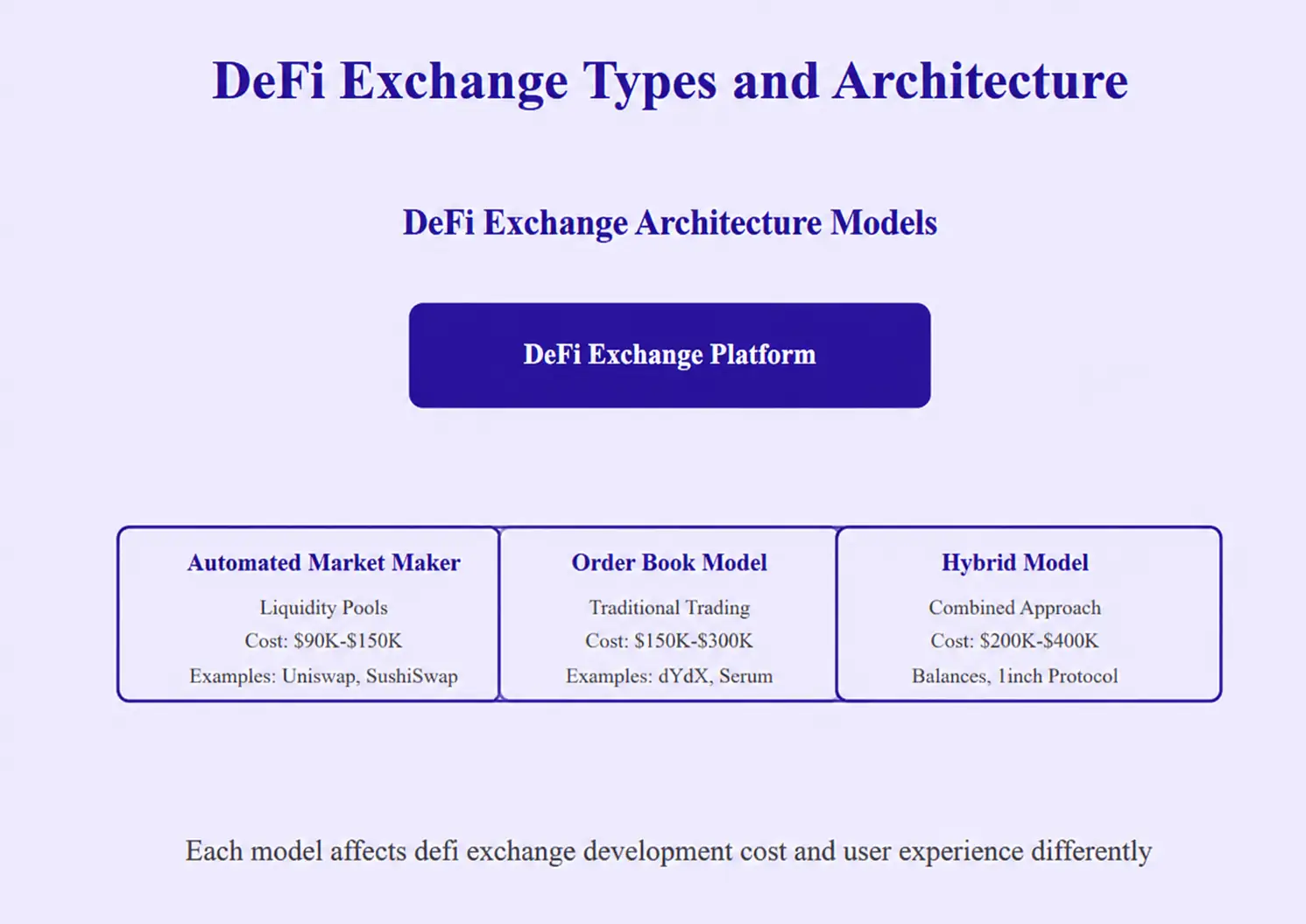
The cost to build a defi exchange depends heavily on whether you want an automated market maker (AMM) model, order book model, or hybrid approach. Each model requires different smart contract architecture and affects your overall defi exchange development cost.
Why Businesses are Investing in DeFi Exchanges in 2026
The DeFi market has exploded to over $100 billion in total value locked. Smart entrepreneurs see massive opportunity in launching their own defi exchanges. Here’s why the defi exchange development cost is justified:
- High Revenue Potential: Trading volume in DeFi continues growing 200% to 300% annually
- Lower Operating Costs: Defi exchanges require minimal staff compared to centralized platforms
- Global Market Access: Your defi exchange serves worldwide users instantly without geographic limitations
- 24/7 Automated Trading: Unlike traditional markets, DeFi exchanges operate continuously
- Token Launch Platform: Offer initial DEX offerings as additional revenue stream
Key Features That Affect DeFi Exchange Development Cost
Not all DeFi exchanges cost the same. Features directly impact your defi app development cost. Let me break down the essential features and their cost implications:
Core Features Overview
| Feature | Description | Estimated Cost |
|---|---|---|
| Smart Contract Development | Core trading logic and token swaps | $30,000 – $60,000 |
| User Authentication | Wallet integration and KYC systems | $15,000 – $35,000 |
| Frontend Interface | Web dashboard and trading interface | $25,000 – $50,000 |
| Backend Infrastructure | Servers, databases, API integration | $20,000 – $45,000 |
| Mobile Application | iOS and Android trading apps | $40,000 – $80,000 |
| Security Audits | Smart contract security review | $15,000 – $50,000 |
| Advanced Trading (Margin/Futures) | Leverage trading capabilities | $50,000 – $150,000 |
| Liquidity Management | Liquidity pools and yield farming | $30,000 – $80,000 |
Step by Step Cost Breakdown of Building a DeFi Exchange
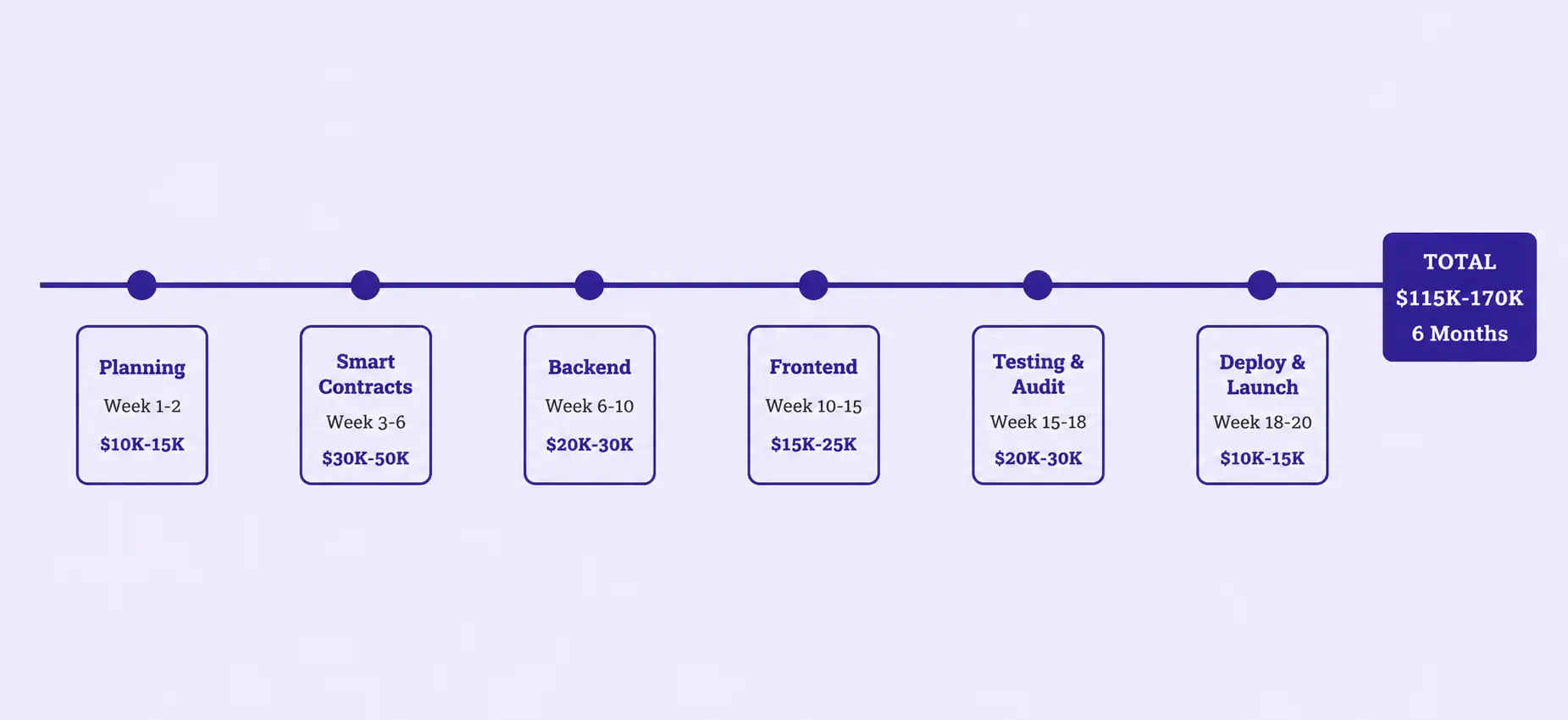
Understanding the defi exchange development cost requires looking at each development phase. Here’s how expenses break down across the project timeline:
Phase 1: Planning and Requirements (Weeks 1-3)
Cost: $5,000 – $15,000
This phase includes market research, feature scoping, technology stack selection, and creating detailed specifications for your defi exchange development cost.
Phase 2: Smart Contract Development (Weeks 4-8)
Cost: $30,000 – $70,000
Developers write, test, and optimize smart contracts. This is critical for your defi app development cost as contract quality directly affects security and performance.
Phase 3: Backend Development (Weeks 9-14)
Cost: $20,000 – $50,000
Build servers, databases, and APIs that connect your frontend to blockchain. This determines your defi exchange pricing efficiency.
Phase 4: Frontend Development (Weeks 15-20)
Cost: $25,000 – $50,000
Create responsive web interface where users trade. This impacts user experience and retention for your defi exchange.
Phase 5: Testing and Security Audit (Weeks 21-24)
Cost: $20,000 – $60,000
Comprehensive testing and security audits are essential. Many projects skip this and face exploits later, making this crucial for defi exchange development cost planning.
Phase 6: Deployment and Launch (Weeks 25-26)
Cost: $10,000 – $25,000
Mainnet deployment, initial liquidity setup, and launch marketing for your defi exchange.
Total Basic DeFi Exchange Development Cost: $120,000 – $270,000
Timeline: 6 months for basic platform, 9-12 months for advanced features
DeFi Exchange Development Timeline and Cost Breakdown
Cost Based on Development Approach
You have two main options for building your defi exchange: custom development from scratch or using white label solutions. Let’s compare the defi exchange development cost for each approach:
Custom Development
Cost Range: $150,000 to $500,000+
Building entirely from scratch gives you complete control and unique features. However, defi exchange development cost is highest with this approach.
Advantages:
- → Full customization and branding
- → Unique competitive features
- → Complete intellectual property ownership
- → Scalability designed to your exact needs
Disadvantages:
- ✕ Highest defi app development cost
- ✕ Longest development timeline (6-12 months)
- ✕ Greater security risks if not properly audited
- ✕ Requires experienced blockchain development team
White Label Solution
Cost Range: $30,000 to $100,000
White label defi exchanges are pre-built platforms you customize with your branding. This dramatically reduces defi exchange pricing and time to market.
Advantages:
- → Lowest defi exchange development cost
- → Fast deployment (2-8 weeks)
- → Pre-audited smart contracts
- → Ongoing vendor support and maintenance
- → Regular updates and new features
Disadvantages:
- ✕ Limited customization options
- ✕ Ongoing licensing or revenue share fees
- ✕ Vendor lock in
- ✕ Less competitive differentiation
| Factor | Custom Development | White Label Solution |
|---|---|---|
| Initial Cost | $150,000 to $500,000+ | $30,000 to $100,000 |
| Timeline | 6 to 12 months | 2 to 8 weeks |
| Customization | 100% customizable | Limited customization |
| Ongoing Costs | $15,000 to $30,000/year | $5,000 to $15,000/year |
| Security Audits | Included in cost | Pre-audited contracts |
| IP Ownership | 100% yours | Limited/Licensed |
| Best For | Unique platforms, scale players | Quick market entry, MVP testing |
Factors Affecting DeFi Exchange Pricing
Several variables impact your final defi exchange development cost. Understanding these helps you budget more accurately and plan your investment strategy:
Team Location and Expertise
Impact on defi app development cost: 40% to 60% variation
Onshore teams (US, UK) command premium rates ($150 to $250/hour) while offshore teams (India, Eastern Europe) offer competitive rates ($30 to $80/hour). This dramatically affects defi exchange pricing.
- USA Teams: $120,000 to $300,000 (highest quality, highest cost)
- European Teams: $100,000 to $250,000 (high quality, moderate cost)
- Offshore Teams: $50,000 to $150,000 (variable quality, lowest cost)
Blockchain Selection
Impact on defi exchange development cost: 20% to 40% variation
Different blockchains require different expertise and tools, affecting defi platform development cost 2026 estimates:
- Ethereum: $100,000 to $250,000 (expensive developers, complex contracts)
- Binance Smart Chain: $80,000 to $180,000 (similar to Ethereum, lower gas costs)
- Solana: $70,000 to $150,000 (fewer developers, simpler programming)
- Polygon: $75,000 to $160,000 (fast, low cost, growing ecosystem)
Feature Complexity
Impact on defi exchange pricing: 30% to 100% increase per feature
Advanced features significantly increase cost. Budget additional funds for:
- Margin Trading: Additional $50,000 to $100,000
- Futures Contracts: Additional $80,000 to $150,000
- Staking Rewards: Additional $30,000 to $60,000
- Governance Tokens: Additional $40,000 to $80,000
- Cross Chain Bridges: Additional $60,000 to $120,000
Security Requirements
Impact on defi exchange development cost: 15% to 30% premium
Professional security audits are essential but expensive. Never skip this for defi app development cost planning:
- Single Audit: $15,000 to $50,000
- Multiple Audits: $50,000 to $150,000
- Insurance Coverage: Additional $5,000 to $25,000/year
Regulatory Compliance
Impact on defi exchange pricing: 10% to 40% depending on jurisdiction
Operating in regulated jurisdictions requires KYC, AML, and legal frameworks. This affects defi platform development cost planning substantially.
- KYC Implementation: $20,000 to $50,000
- Legal Setup: $10,000 to $30,000
- Licensing: $5,000 to $50,000+ (varies by region)
Tech Stack and Blockchain Choice Impact on Cost
Your technology decisions directly influence defi exchange development cost. Let’s examine how different tech stacks affect pricing:
Recommended Tech Stack for DeFi Exchanges
Smart Contracts Layer:
- Solidity (Ethereum, BSC) or Rust (Solana) are most popular
- Developer availability affects defi app development cost
- Solidity developers more expensive but more experienced with DeFi
Backend Infrastructure:
- Node.js or Python for API servers
- PostgreSQL or MongoDB for databases
- Docker and Kubernetes for deployment reduce defi exchange pricing through efficiency
Frontend Framework:
- React or Vue.js for web interface
- React Native or Flutter for mobile apps
- Choosing popular frameworks reduces defi exchange development cost through developer availability
Blockchain Cost Comparison
The blockchain you choose dramatically impacts defi app development cost and your operational expenses:
Ethereum
Development Cost: $120,000 to $250,000
Pros: Largest ecosystem, most liquidity, best tooling
Cons: High gas fees, expensive developers, complex
Binance Smart Chain
Development Cost: $100,000 to $200,000
Pros: Lower fees, fast, compatible with Ethereum
Cons: Centralized, fewer users than Ethereum
Solana
Development Cost: $80,000 to $150,000
Pros: Very fast, low cost, good ecosystem
Cons: Fewer developers, smaller user base
Polygon
Development Cost: $90,000 to $170,000
Pros: Ethereum compatible, fast, growing user base
Cons: Less mature than Ethereum
How DeFi Exchanges Generate Revenue
Understanding revenue streams justifies the defi exchange development cost investment. DeFi exchanges have multiple income sources unlike traditional platforms:
Primary Revenue Streams
1. Trading Fees
Typical Rate: 0.1% to 0.5% per trade
Standard revenue model. If your exchange does $10 million in daily volume at 0.25% fee, that’s $25,000 daily revenue ($9.1M annually).
2. Liquidity Pool Fees
Typical Rate: 0.25% to 1% of pool transactions
Passive income from liquidity providers using your exchange. This is secondary to trading fees but essential for defi exchange ROI.
3. Premium Features
Typical Rate: $10 to $100 monthly per user
Advanced traders pay for margin trading, futures, or premium tools. 1,000 premium users at $50/month = $600,000 annually.
4. Token Listing Fees
Typical Rate: $5,000 to $50,000 per token
New projects pay to list their tokens. 50 projects at $10,000 each = $500,000 annually.
5. Staking and Farming
Typical Rate: 2% to 10% of staked assets annually
Offer yield farming through your governance token. $10 million staked at 5% = $500,000 annually.
6. Referral Programs
Typical Rate: 10% to 30% of referred user fees
Incentivize users to bring friends. Effective for user acquisition while justifying defi exchange development cost.
ROI of DeFi Exchange Development
Let’s examine realistic return on investment for defi exchange development. The defi exchange ROI depends heavily on execution, marketing, and market conditions:
ROI Timeline Breakdown
Year 1: Market Entry and Growth
Expected Monthly Volume: $1M to $10M
Revenue: $2,500 to $25,000 monthly
Year 1 is establishment phase. Expected profitability depends on marketing spend. Most platforms operate at slight loss while building user base.
Year 1 Outlook: 10% to 30% of initial defi exchange development cost recovered
Year 2: Scaling Operations
Expected Monthly Volume: $50M to $500M
Revenue: $125,000 to $1.25M monthly
Established brand and user base drive volume growth. Network effects kick in as more liquidity attracts traders.
Year 2 Outlook: 80% to 150% of initial defi exchange development cost recovered
Year 3 and Beyond: Profitability
Expected Monthly Volume: $500M to $5B+
Revenue: $1.25M to $12.5M monthly
Mature platforms operate highly efficiently. Multiple revenue streams diversify income. Exit opportunities emerge (acquisition, IPO).
Year 3+ Outlook: 300% to 500%+ ROI
Real Numbers Example
Scenario: $200,000 Initial Investment
Assuming moderate success:
- Year 1: $30,000 revenue = ($170,000 loss)
- Year 2: $500,000 revenue = $300,000 profit (cumulative +$130,000)
- Year 3: $2,000,000 revenue = $1,800,000 profit (cumulative +$1.93M)
3 Year ROI: 965% Return on Initial Investment
Factors Affecting Your Actual ROI
- Market Conditions: Bull markets accelerate adoption, bear markets slow growth
- Marketing Effectiveness: Viral growth can 10x your ROI timeline
- Operational Excellence: Platform downtime kills user retention and revenue
- Regulatory Changes: New regulations can boost or hurt adoption
- Competition: More competitors mean lower fees and market share
Real World Example of a DeFi Exchange Business Model
Let’s analyze a successful DeFi exchange to understand how defi exchange development cost translates into real business metrics:
Case Study: SushiSwap Launch Analysis
Initial Investment: ~$500,000 (estimated team, marketing, security)
- Smart Contract Dev: $100,000
- Security Audits: $80,000
- Frontend Development: $120,000
- Team and Operations: $150,000
- Marketing: $50,000
Year 1 Performance
- Peak Volume (First Month): $1+ billion daily
- Average Fee Per Trade: 0.25%
- Year 1 Revenue: $80M+ (estimated)
- Users: 500,000+
Result
Initial defi exchange development cost recovered in weeks. Platform became top 5 DEX by volume. Demonstrates the enormous potential of defi exchange development when executed well.
Benefits of Investing in DeFi Exchange Development
Beyond financial returns, building a defi exchange offers strategic advantages worth the development cost:
High Profit Margins
After initial defi exchange development cost, operational expenses are minimal. Trade fees flow directly to profit.
Global Reach
Serve users worldwide instantly without geographic barriers. Scale customer base quickly.
24/7 Operations
Unlike traditional stock exchanges, DeFi runs continuously. Revenue flows even while you sleep.
Network Effects
More liquidity attracts traders, more traders attract liquidity. Compound growth accelerates revenue.
Multiple Revenue Streams
Trading fees, premiums, listings, staking, farming create diverse income. Reduces risk concentration.
Exit Opportunities
Successful defi exchanges are acquisition targets. Build for 3 years, sell for 10x+ return.
Challenges and Risks in DeFi Exchange Development
Understanding risks helps justify defi exchange development cost and plan mitigation strategies:
Technical Risks
- Smart Contract Exploits: Bugs in defi exchange development cost extra via security breaches. One vulnerability can wipe out years of profit.
- Scalability Issues: High transaction volume can crash poorly designed platforms, destroying user trust.
- Blockchain Risks: Network congestion or blockchain issues impact your defi exchange performance directly.
Business Risks
- Market Competition: New defi exchanges launch constantly. Differentiation is critical to justify your development cost.
- User Adoption: Building a defi exchange doesn’t guarantee users. Marketing and community building are essential.
- Liquidity Bootstrapping: No liquidity means no traders. Expensive incentive programs may be needed initially.
Regulatory Risks
- Regulatory Changes: New laws could ban certain features or require expensive compliance. Plan for regulatory uncertainty.
- Licensing Requirements: Some jurisdictions may require expensive licenses or prohibit defi exchanges entirely.
- Tax Complexity: Decentralized exchanges face unclear tax treatment in many jurisdictions.
Future Trends in DeFi Exchange Development
Understanding emerging trends helps plan your defi exchange development cost strategically for competitive advantage:
Cross Chain Trading
Exchanges enabling seamless trading across multiple blockchains will gain massive adoption advantage. Adds $50,000 to $120,000 to defi exchange development cost but essential for competitiveness.
Advanced Order Types
Limit orders, stop losses, and advanced trading tools differentiate professional defi exchanges. Implementation cost adds $30,000 to $80,000 to your defi app development cost.
Better UX and Mobile First
Mobile users dominate crypto adoption. Investing in mobile first design ($40,000 to $80,000 additional) will be essential for defi exchange development cost ROI.
AI and Machine Learning
Price prediction, fraud detection, and personalized trading recommendations powered by AI will become standard. Budget $60,000 to $150,000 for AI integration in defi exchange pricing.
Privacy Focused DEXs
Exchanges offering anonymity via privacy coins or zero knowledge proofs will capture users concerned about surveillance. Specialized development increases defi platform development cost estimates.
Ready to Build Your DeFi Exchange?
Building a successful defi exchange development requires expertise, planning, and execution. At Nadcab Labs, we’ve helped numerous crypto entrepreneurs launch scalable, secure DeFi exchanges that generate millions in trading volume.
Understanding defi exchange development cost is the first step. Let’s discuss your specific project and create a roadmap tailored to your goals.
Final Thoughts
The cost to build a defi exchange in 2026 ranges from $50,000 for basic white label solutions to $500,000+ for enterprise custom development. Understanding the defi exchange development cost breakdown helps you make informed investment decisions.
Key takeaways on defi exchange pricing:
- Basic platforms cost $100,000 to $200,000 with typical features like AMM trading and basic wallet integration
- White label solutions reduce cost and timeline significantly, ideal for quick market entry
- Advanced features like margin trading add $50,000 to $150,000 each to your defi app development cost
- Security audits are essential despite the cost – protecting your defi exchange from exploits preserves revenue
- ROI can exceed 300% within 2 to 3 years with proper execution and marketing
The DeFi industry continues explosive growth. Businesses investing in defi exchange development now position themselves to capture massive market share. Multiple revenue streams, global reach, and high profit margins make defi exchanges attractive investments despite the development cost.
Whether you choose custom development or white label, understanding these pricing factors ensures you allocate budget wisely and plan realistic ROI timelines. The defi exchange development cost is justified by the enormous market opportunity in decentralized finance.
Frequently Asked Questions
Q1.What is the minimum budget needed to start a defi exchange?
The absolute minimum defi exchange development cost is around $30,000 to $50,000 using white label solutions. However, this covers only the basic platform. For a competitive platform with proper security, budget at least $100,000. This includes smart contracts, security audits, and initial marketing.
Q2.How long does it take to develop a defi exchange?
Development timeline depends heavily on your approach. White label solutions launch in 2 to 8 weeks. Custom development takes 6 to 12 months depending on complexity and features. A basic AMM exchange typically requires 4 to 6 months, while order book exchanges require 8 to 12 months.
Q3.Do I need security audits for my defi exchange?
Absolutely yes. Security audits are essential, not optional. The cost is $15,000 to $50,000 for professional audits, but one exploit can cost millions in lost funds and reputation. Professional audits are crucial before any defi exchange development launch. Never skip this step.
Q4.Which blockchain is cheapest for defi exchange development?
Solana typically offers the cheapest defi exchange development cost at $80,000 to $150,000. Followed by Polygon at $90,000 to $170,000. Ethereum and BSC cost $100,000 to $250,000 due to higher developer rates. However, Ethereum has the most liquidity and user base, which may justify higher costs.
Q5.What are the main operational costs after launch?
After defi exchange development cost is spent, plan for ongoing expenses. Server hosting costs $1,000 to $5,000 monthly. Team salaries for developers and support staff range $30,000 to $100,000+ monthly. Security monitoring and insurance add $5,000 to $15,000 yearly. Total annual operations typically cost 10% to 20% of your initial development investment.
Q6.How can I reduce my defi app development cost?
Several strategies reduce defi exchange development cost. Use white label solutions for faster, cheaper launches. Hire offshore development teams which cost 40% to 50% less than onshore teams. Choose Solana or Polygon instead of Ethereum. Start with basic AMM model instead of complex order books. Bootstrap liquidity through incentive programs rather than manual seeding.
Q7.What features should I prioritize for defi exchange development?
For initial launch, prioritize core features that keep defi exchange development cost manageable. Swap functionality and liquidity pools are essential. Add wallet integration and basic token listing. Avoid expensive features like margin trading initially. Launch MVP first, then add advanced features based on user feedback. This staged approach optimizes your defi exchange pricing and time to market.
Q8.How much revenue can I expect in year one?
Year one revenue depends heavily on adoption rate and trading volume. With aggressive marketing, expect $5,000 to $50,000 monthly in early months. By year end with successful growth, $50,000 to $300,000 monthly is realistic. Most platforms operate at a loss year one while building user base, making this defi exchange development cost justified by longer term vision.
Q9.Should I hire an in house team or outsource defi exchange development?
For initial defi exchange development cost efficiency, outsourcing to a specialized blockchain development company is usually better. Allows you to pay fixed rates with defined deliverables and timelines. In house teams require higher salaries, benefits, and overhead. As your defi exchange grows, transitioning to internal teams gives you more control. Many successful projects start outsourced and gradually bring development in house.
Q10.What makes a defi exchange successful beyond defi exchange development cost?
While defi exchange development cost is important, success requires more. Superior user experience beats cheaper alternatives. Strong community and branding drive adoption. Effective marketing gets your platform in front of traders. Continuous innovation keeps users engaged. Quality customer support builds trust. Security and reliability prevent disasters. Many expensive defi exchanges fail due to poor marketing and execution, while cheaper platforms succeed through excellence in these areas. Don’t just minimize defi exchange pricing focus on maximizing value.
Explore Services
Related Services
Reviewed by

Aman Vaths
Founder of Nadcab Labs
Aman Vaths is the Founder & CTO of Nadcab Labs, a global digital engineering company delivering enterprise-grade solutions across AI, Web3, Blockchain, Big Data, Cloud, Cybersecurity, and Modern Application Development. With deep technical leadership and product innovation experience, Aman has positioned Nadcab Labs as one of the most advanced engineering companies driving the next era of intelligent, secure, and scalable software systems. Under his leadership, Nadcab Labs has built 2,000+ global projects across sectors including fintech, banking, healthcare, real estate, logistics, gaming, manufacturing, and next-generation DePIN networks. Aman’s strength lies in architecting high-performance systems, end-to-end platform engineering, and designing enterprise solutions that operate at global scale.