Ai Overview
Modular blockchain infrastructure separates execution, consensus, and data availability into distinct layers, each with unique cost profiles. This architecture reduces long-term total cost of ownership by 35-60% compared to monolithic chains for applications processing over 10,000 transactions daily, primarily through optimized resource allocation and independent layer scaling. 0018 per transaction cost, while the same volume on a monolithic chain costs $0.
Modular blockchain infrastructure separates execution, consensus, and data availability into distinct layers, each with unique cost profiles. Organizations evaluating modular blockchain deployments face initial investments averaging $150,000 to $500,000 for development, plus ongoing operational expenses of $8,000 to $25,000 monthly depending on transaction volume and layer configuration. This architecture reduces long-term total cost of ownership by 35-60% compared to monolithic chains for applications processing over 10,000 transactions daily, primarily through optimized resource allocation and independent layer scaling.
Key Takeaways
- Core infrastructure costs split across execution ($3-8K/month), consensus ($2-6K/month), and data availability layers ($3-11K/month) with volume-based scaling
- Modular development requires 20-40% higher upfront investment but delivers faster deployment cycles and reduced audit expenses through pre-built layer components
- Operational expenses decrease 25-45% after the first year as layer specialization enables targeted optimization versus full-stack maintenance overhead
- High-throughput applications achieve break-even within 18-24 months when processing 15,000+ daily transactions, with cost-per-transaction dropping below $0.002
- Migration from monolithic architectures costs $80,000-$200,000 but unlocks 40-55% reduction in five-year TCO for enterprise-scale deployments
- Hidden expenses include multi-layer monitoring tools ($1,200-$3,500/month) and specialized DevOps talent commanding 15-30% salary premiums
What Are the Core Cost Components of Modular Blockchain Infrastructure?
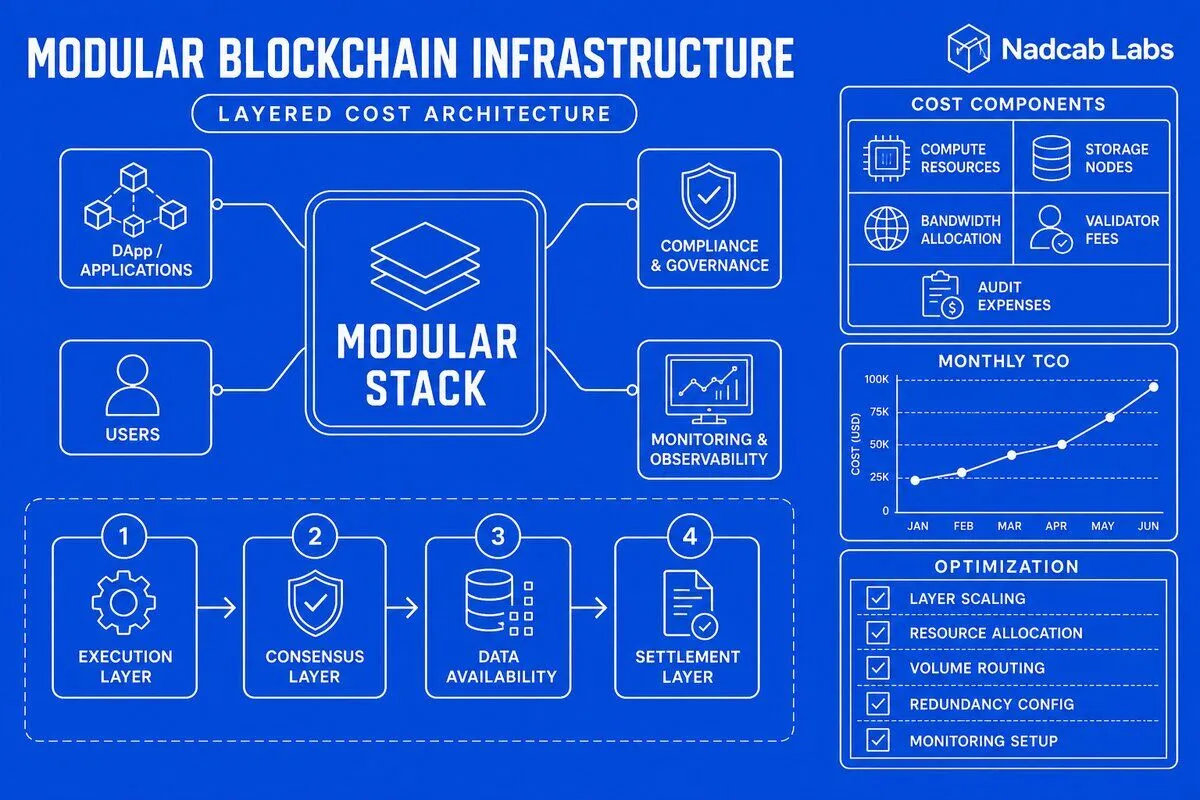
The layer separation in blockchain architecture creates distinct cost centers that organizations must budget independently. Understanding these components helps teams allocate resources effectively and predict scaling expenses as network demand grows.
The execution layer handles smart contract computation and state transitions. For a mid-scale deployment processing 5,000 transactions daily, execution layer costs typically range from $3,000 to $8,000 monthly. This includes virtual machine hosting on cloud infrastructure, compute resources for transaction processing, and memory allocation for state management. Organizations running custom execution environments often spend an additional $1,500-$4,000 on specialized hardware or dedicated server instances to maintain consistent performance during peak loads.
Consensus layer expenses center on validator infrastructure and network participation. Running a validator node requires dedicated hardware costing $2,500-$6,000 upfront, plus $2,000-$6,000 in monthly operational costs covering bandwidth, energy consumption, and backup systems. Many Blockchain Protocol implementations also impose staking requirements ranging from $50,000 to $500,000 in native tokens, creating significant capital lockup costs. Delegated consensus models reduce these expenses but introduce validator fee payments of 5-15% of block rewards.
Data availability layer pricing varies dramatically based on storage strategy and retrieval frequency. Basic data availability services charge $0.08-$0.25 per gigabyte monthly for hot storage, with archival node expenses adding $0.02-$0.05 per gigabyte for long-term retention. A blockchain processing 10,000 transactions daily generates approximately 150-300 GB of data monthly, translating to $12-$75 in storage costs alone. Advanced retrieval mechanisms with sub-second query performance can multiply these figures by 3-5x, particularly for applications requiring frequent historical data access.
Cross-layer communication overhead represents a hidden cost component often overlooked in initial budgets. Inter-layer message passing, data synchronization, and state verification consume additional compute resources and bandwidth. For complex modular architectures with multiple specialized layers, these coordination costs add 15-25% to baseline infrastructure expenses. Organizations must provision redundant communication channels and implement robust retry mechanisms, further increasing operational overhead.
Below is a detailed breakdown comparing monthly infrastructure costs across different deployment scales:
| Infrastructure Component | Small Scale (1K TPS) | Medium Scale (5K TPS) | Large Scale (15K+ TPS) |
|---|---|---|---|
| Execution Layer Compute | $1,800 | $4,200 | $9,500 |
| Consensus Validator Infrastructure | $2,200 | $3,800 | $6,500 |
| Data Availability Storage | $900 | $3,100 | $8,200 |
| Cross-Layer Communication | $600 | $1,400 | $3,200 |
| Bandwidth & Network Egress | $500 | $1,800 | $4,600 |
| Total Monthly Infrastructure | $6,000 | $14,300 | $32,000 |
Hardware depreciation adds another layer of cost consideration. Validator nodes and execution layer servers typically require replacement every 3-4 years as performance demands increase. Organizations should budget $800-$1,500 annually per node for hardware refresh cycles. Cloud-based deployments avoid upfront capital expenditure but incur 20-35% higher total costs over five years compared to self-hosted infrastructure for stable, predictable workloads.
How Do Development Costs Differ Between Modular and Monolithic Architectures?
Initial build expenses for modular blockchain infrastructure typically exceed monolithic alternatives by 20-40% due to integration complexity and specialized expertise requirements. A typical modular deployment demands $150,000-$500,000 in development costs compared to $120,000-$350,000 for equivalent monolithic implementations. This premium reflects the need for developers fluent in multiple layer protocols, cross-layer communication patterns, and distributed system orchestration.
Specialized developer talent commands significant salary premiums. Engineers with experience building modular blockchain systems earn $140,000-$220,000 annually, approximately 25-35% above general blockchain developers. Teams typically require at least one architect familiar with execution layer frameworks, one consensus protocol specialist, and one data availability expert. For organizations without in-house expertise, Hire Blockchain Developers services charge $80-$150 per hour for modular blockchain development versus $60-$110 for traditional implementations.
Tooling and integration complexity drive additional costs. Modular architectures require specialized development kits, testing frameworks, and deployment orchestration tools. Commercial tooling licenses range from $5,000-$20,000 annually per developer seat. Open-source alternatives reduce direct costs but increase development time by 30-50% as teams build custom integration layers and debugging utilities. Cross-layer testing environments alone can consume $15,000-$40,000 in initial setup costs for realistic multi-node simulation infrastructure.
Time-to-market dynamics create interesting tradeoffs. Pre-built modular layers enable faster deployment cycles, with production-ready implementations achievable in 4-6 months compared to 8-12 months for custom monolithic chains. This acceleration stems from reusing battle-tested execution environments, established consensus protocols, and proven data availability solutions. Organizations can launch with 60-70% of core functionality operational, then iteratively enhance specific layers without full-stack redevelopment.
The following process flow illustrates the typical development lifecycle for modular blockchain deployment:
2-3 weeks
$8K-$15K
6-10 weeks
$35K-$80K
4-6 weeks
$25K-$60K
2-3 weeks
$12K-$25K
3-4 weeks
$15K-$35K
1-2 weeks
$8K-$18K
Testing and audit costs exhibit significant variation between architectures. Modular systems benefit from layer-specific security reviews, where each component undergoes independent auditing. A comprehensive execution layer audit costs $25,000-$60,000, consensus layer review runs $20,000-$45,000, and data availability verification requires $15,000-$35,000. Total audit expenses range from $60,000-$140,000 for modular implementations. Monolithic chains require full-stack auditing costing $80,000-$180,000, but the integrated nature creates more complex attack surface analysis.
Layer reusability dramatically reduces costs for organizations building multiple blockchain applications. After initial modular infrastructure deployment, subsequent projects reuse 50-70% of existing layer implementations. The second blockchain deployment costs only $50,000-$120,000 compared to $150,000-$500,000 for the first, achieving 60-75% cost reduction. Monolithic architectures offer minimal reusability, with each new chain requiring 80-90% of original development investment.
Smart contract migration and compatibility testing add unexpected expenses. Adapting existing contracts for modular execution environments costs $8,000-$25,000 per complex application, particularly when transitioning from Ethereum Virtual Machine to alternative execution frameworks. Organizations with extensive smart contract portfolios should budget $30,000-$100,000 for comprehensive migration and regression testing to ensure behavioral parity across environments.
What Are the Ongoing Maintenance and Operational Expenses?
Node operation costs form the foundation of ongoing blockchain expenses. A single validator node consumes 150-300 watts continuously, translating to $45-$90 monthly in electricity costs at typical commercial rates. Organizations running redundant validator sets across multiple geographic regions multiply these figures by node count. A three-node validator cluster costs $135-$270 monthly in energy alone, before accounting for cooling and facility overhead which adds another 30-40%.
Bandwidth consumption scales directly with transaction volume and data availability requirements. Execution layer nodes transmit 500 GB to 2 TB monthly for medium-scale deployments, costing $50-$200 in bandwidth charges. Consensus layer participation adds another 200-800 GB monthly for block propagation and validator communication. Data availability nodes serving historical queries can exceed 5 TB monthly egress, particularly for applications with frequent archival data access patterns. Total bandwidth costs range from $100-$600 monthly for typical modular deployments.
Hardware maintenance and replacement cycles create recurring capital expenditure. Server components experience failure rates of 2-5% annually, requiring spare parts inventory and replacement budgets. Organizations should allocate $2,000-$5,000 annually per production node for preventive maintenance, component upgrades, and emergency replacements. Similar to Mining Rigs operations, thermal management and power supply stability prove critical for validator uptime, with cooling system maintenance adding $800-$1,500 annually per rack.
Upgrade and migration expenses differ substantially between modular and monolithic architectures. Modular systems enable independent layer updates, where execution layer upgrades cost $5,000-$15,000 without touching consensus or data availability components. Consensus protocol updates run $8,000-$20,000, while data availability enhancements require $6,000-$18,000. Organizations can schedule updates strategically, spreading costs over time and minimizing operational disruption.
Monolithic chain upgrades necessitate coordinated hard forks affecting all network participants. A major protocol upgrade costs $25,000-$80,000 including development, testing, coordination, and deployment. These events occur 2-4 times annually for actively developed chains, creating $50,000-$320,000 in annual upgrade expenses. The coordination overhead alone consumes significant engineering resources, with 3-5 developers dedicating 2-4 weeks per upgrade cycle.
Monitoring and observability infrastructure represents a substantial ongoing expense. Multi-layer architectures require specialized monitoring tools tracking cross-layer dependencies, performance bottlenecks, and failure propagation patterns. Commercial blockchain monitoring platforms charge $1,200-$3,500 monthly for comprehensive coverage across execution, consensus, and data availability layers. Custom observability stacks built on open-source foundations cost $800-$2,000 monthly in infrastructure plus $40,000-$80,000 annually for dedicated DevOps engineering resources.
The visualization below shows monthly operational expense distribution across different cost categories:
Incident response and disaster recovery planning create additional operational overhead. Organizations should maintain hot standby infrastructure costing 40-60% of primary deployment expenses to ensure rapid failover during outages. A comprehensive disaster recovery setup for modular blockchain infrastructure runs $4,000-$9,000 monthly including backup validator nodes, redundant data availability storage, and automated failover orchestration. These systems require quarterly testing cycles consuming 2-3 engineering days per test, adding $3,000-$8,000 annually in validation expenses.
Security operations and threat monitoring demand continuous investment. Blockchain networks face constant attack attempts including DDoS, consensus manipulation, and smart contract exploits. Security operations center staffing costs $120,000-$200,000 annually for 24/7 coverage, or $3,000-$6,000 monthly for outsourced managed security services. Automated threat detection systems add $800-$2,500 monthly in licensing and infrastructure costs.
Documentation and knowledge management often get overlooked in operational budgets. Maintaining current technical documentation, runbooks, and incident response procedures requires dedicated technical writing resources. Organizations should budget $25,000-$50,000 annually for documentation maintenance, particularly important for modular architectures where layer-specific operational procedures differ significantly from monolithic chain management.
How Does Scaling Impact Long-Term Cost Structures?
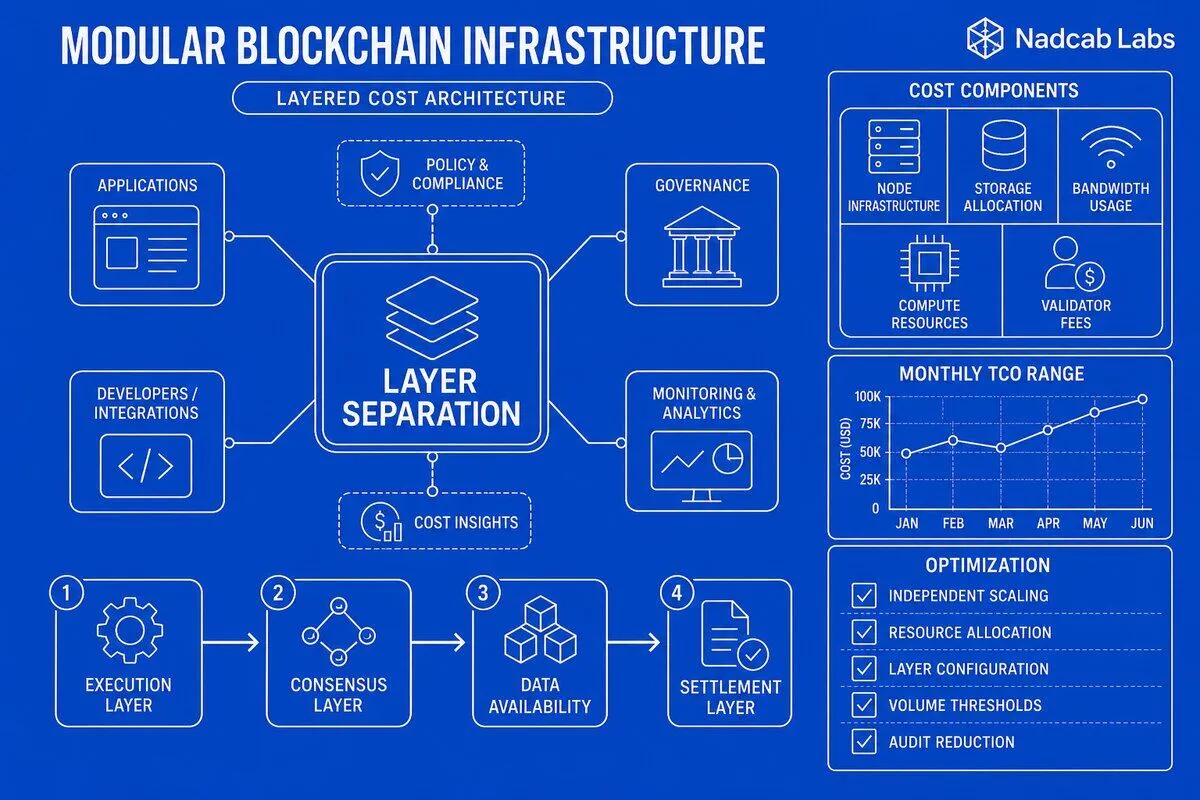
Horizontal scaling economics fundamentally differentiate modular from monolithic architectures. Modular systems scale individual layers independently based on demand, adding execution capacity without expanding consensus or data availability infrastructure. Doubling transaction throughput in a modular architecture costs $6,000-$12,000 monthly by adding execution layer compute, compared to $15,000-$30,000 for monolithic chains requiring full-stack capacity expansion across all components.
Layer specialization enables targeted optimization that reduces per-unit costs at scale. An execution layer processing 50,000 transactions daily achieves $0.0018 per transaction cost, while the same volume on a monolithic chain costs $0.0032 per transaction. This 44% efficiency gain compounds over time, with high-volume applications saving $200,000-$500,000 annually at 15 million monthly transactions. The cost advantage stems from optimized resource allocation where consensus and data availability layers serve multiple execution environments simultaneously.
Transaction throughput cost efficiency improves dramatically at higher volume tiers. The table below demonstrates per-transaction costs across different scaling scenarios:
| Daily Transaction Volume | Modular Cost/TX | Monolithic Cost/TX | Modular Advantage |
|---|---|---|---|
| 1,000 transactions | $0.0085 | $0.0072 | -18% |
| 5,000 transactions | $0.0042 | $0.0048 | +12% |
| 15,000 transactions | $0.0018 | $0.0032 | +44% |
| 50,000 transactions | $0.0009 | $0.0022 | +59% |
| 100,000+ transactions | $0.0005 | $0.0018 | +72% |
Storage growth management creates divergent long-term cost trajectories. Monolithic chains accumulate full historical state, with storage requirements growing linearly at 8-15 GB monthly for typical deployments. After three years, archival storage costs reach $3,600-$6,750 annually at $0.02 per GB monthly. Modular architectures implement aggressive data pruning on execution layers while maintaining availability proofs, reducing storage growth to 3-6 GB monthly and cutting long-term archival costs by 60-70%.
Data availability sampling techniques further optimize storage expenses at scale. Rather than storing complete transaction data, modular systems maintain cryptographic proofs and reconstruct full data on demand. This approach reduces storage costs from $0.08 per GB to $0.02 per GB for hot data, with archival costs dropping to $0.005 per GB. A blockchain generating 300 GB monthly saves $18,000-$24,000 annually through optimized data availability strategies.
Vertical scaling limitations in monolithic architectures create cost cliffs at specific throughput thresholds. Beyond 20,000 transactions daily, monolithic chains require enterprise-grade hardware upgrades costing $15,000-$40,000 per node, plus migration downtime expenses of $8,000-$20,000. Modular systems avoid these cliffs by distributing load across specialized execution environments, with incremental scaling costs remaining linear up to 100,000+ daily transactions.
Network effect economics favor modular architectures for shared infrastructure deployments. Multiple applications sharing consensus and data availability layers distribute fixed costs across larger transaction volumes. A shared modular infrastructure serving five applications processes 75,000 combined daily transactions at $0.0012 per transaction, compared to $0.0028 for five independent monolithic chains. This 57% cost reduction makes modular blockchain infrastructure particularly attractive for platform providers and consortium deployments.
Geographic distribution costs scale more favorably in modular architectures. Adding validator nodes in new regions costs $2,500-$6,000 monthly for consensus participation, while execution and data availability layers leverage existing AWS Cloud infrastructure with minimal incremental expense. Monolithic chains require full-stack deployment in each region, multiplying costs by geographic footprint. A three-region deployment costs $42,000-$96,000 monthly for modular versus $75,000-$180,000 for monolithic implementations.
What ROI Scenarios Favor Modular Blockchain Adoption?
Break-even analysis reveals modular architectures achieve cost parity with monolithic alternatives within 18-24 months for applications processing 15,000+ daily transactions. The higher upfront investment of $150,000-$500,000 gets offset by 35-45% lower monthly operational expenses after the first year. Organizations with five-year deployment horizons realize total cost of ownership reductions of $380,000-$850,000 compared to equivalent monolithic implementations, representing 40-55% savings on total spend.
High-throughput decentralized applications demonstrate the strongest ROI metrics. A DeFi protocol processing 50,000 daily transactions spends $27,000 monthly on modular infrastructure versus $48,000 for monolithic alternatives, saving $252,000 annually. Over five years, cumulative savings reach $1.26 million after accounting for initial development premium. The ROI calculation shifts dramatically at this scale, with modular architecture delivering 3.2x return on incremental investment within 36 months.
Use case cost sensitivity varies significantly across application categories. Financial services applications requiring regulatory compliance and extensive audit trails benefit most from modular data availability layers that reduce archival costs by 60-70%. Supply chain tracking systems with high write volume but infrequent reads optimize costs through specialized execution layers processing 100,000+ daily transactions at $0.0005 per transaction. Identity management systems leveraging Blockchain Identity Management achieve 50-65% cost reduction through shared consensus infrastructure serving multiple credential issuers.
The following comparison illustrates five-year total cost of ownership across different deployment scenarios:
Migration cost-benefit analysis requires careful evaluation of transition expenses against long-term savings. Moving from a legacy monolithic chain to modular architecture costs $80,000-$200,000 including smart contract adaptation, data migration, testing, and parallel operation during cutover. Organizations processing 20,000+ daily transactions recoup migration costs within 14-18 months through reduced operational expenses, while lower-volume applications require 24-36 months to achieve positive ROI.
The migration process involves several cost components that vary by deployment complexity. Smart contract redeployment and testing consume $25,000-$60,000, historical data migration runs $15,000-$40,000, validator infrastructure reconfiguration costs $12,000-$30,000, and parallel operation during transition adds $8,000-$25,000 monthly for 2-4 months. Organizations with complex governance mechanisms or extensive integration points should budget an additional 30-50% contingency for unforeseen compatibility issues.
Multi-chain strategy economics favor modular infrastructure for organizations deploying multiple blockchain networks. The first modular deployment costs $150,000-$500,000, but subsequent chains reuse 50-70% of infrastructure components. Building three separate modular blockchains costs $280,000-$750,000 total, compared to $360,000-$1,050,000 for three independent monolithic chains. This 22-28% cost advantage grows with each additional deployment, making modular architecture increasingly attractive for platform providers and enterprise consortia.
Regulatory compliance costs decrease significantly with modular architectures that isolate data availability and auditability concerns. Organizations subject to data retention requirements save $15,000-$35,000 annually through optimized archival strategies that maintain compliance while minimizing storage overhead. Similar patterns emerge in Blockchain MLM Platform deployments where transparent transaction history requirements benefit from specialized data availability layers.
Developer productivity improvements contribute substantial indirect ROI. Modular architectures enable parallel development across layers, reducing time-to-market by 30-40% for new features. A development team of five engineers delivers features 6-8 weeks faster on modular infrastructure, translating to $45,000-$75,000 in accelerated revenue realization per major release cycle. Over five years, cumulative productivity gains justify 15-25% of initial modular architecture investment through faster iteration and reduced opportunity costs.
Ecosystem integration costs favor modular approaches for applications requiring interoperability with multiple blockchain networks. Modular execution layers support standardized interfaces that simplify cross-chain communication, reducing integration expenses from $30,000-$80,000 per blockchain to $8,000-$20,000. Organizations building applications that interact with five or more chains save $110,000-$300,000 in integration costs while maintaining consistent security and performance characteristics.
Risk mitigation value becomes apparent when evaluating protocol obsolescence and upgrade flexibility. Monolithic chains face existential risk if core components become outdated, requiring complete reimplementation costing $200,000-$600,000. Modular architectures isolate obsolescence risk to individual layers, with execution layer replacement costing $40,000-$120,000 while preserving consensus and data availability investments. This architectural insurance reduces long-term technical debt and maintains competitive positioning as blockchain technology evolves.
Final Thoughts
Modular blockchain infrastructure delivers compelling economic advantages for organizations processing significant transaction volumes, with break-even occurring at 15,000+ daily transactions within 18-24 months. The architecture’s ability to scale individual layers independently, optimize resource allocation, and enable component reuse across multiple deployments creates 40-55% total cost of ownership reduction over five years compared to monolithic alternatives. While initial development investment runs 20-40% higher, the combination of reduced operational expenses, improved scaling economics, and enhanced developer productivity generates substantial long-term ROI.
Organizations evaluating modular blockchain adoption should focus on transaction volume projections, infrastructure reusability across multiple applications, and long-term scalability requirements. High-throughput applications, multi-chain platform providers, and enterprises with evolving compliance needs realize the strongest financial benefits. The cost structure favors modular architecture increasingly at scale, with per-transaction expenses dropping below $0.001 at enterprise volumes while monolithic alternatives struggle to break $0.002. For blockchain projects with five-year horizons and growth ambitions, modular infrastructure represents a strategic investment that compounds economic advantages over time while maintaining architectural flexibility for future technology evolution.
Frequently Asked Questions
Q1.What's the main advantage of a modular blockchain architecture compared to a monolithic in terms of cost?
Modular blockchain architectures enable cost optimization by separating execution, consensus, data availability, and settlement into specialized layers. This separation allows enterprises to scale individual components independently, avoiding over-provisioning resources. Organizations pay only for the specific throughput and storage they need per layer, reducing infrastructure waste and operational expenses compared to monolithic chains that bundle all functions together at fixed costs.
Q2.How much does it cost to build a modular blockchain infrastructure from scratch?
Building modular blockchain infrastructure from scratch typically ranges from $150,000 to $800,000 depending on layer complexity and customization requirements. Core expenses include execution layer development ($60,000–$250,000), consensus mechanism implementation ($40,000–$180,000), data availability integration ($30,000–$150,000), settlement layer configuration ($20,000–$120,000), and security audits ($50,000–$200,000). Ongoing maintenance adds 15–25% annually to initial development costs.
Q3.What are the hidden expenses in modular blockchain deployments that enterprises often overlook?
Hidden modular blockchain expenses include cross-layer communication overhead (10–18% of transaction fees), bridge security audits ($30,000–$80,000 annually), data availability sampling infrastructure ($5,000–$15,000 monthly), validator incentive mechanisms (3–7% of network value), governance token economics management, rollup sequencer operational costs ($8,000–$25,000 monthly), and compliance monitoring tools ($12,000–$40,000 annually). Integration complexity often doubles initial timeline estimates.
Q4.How do data availability layer costs scale with transaction volume in modular architectures?
Data availability layer costs scale sub-linearly with transaction volume through batching and compression techniques. At 100 TPS, DA costs average $0.002–$0.008 per transaction; at 1,000 TPS they drop to $0.0005–$0.002 per transaction due to economies of scale. Celestia and EigenDA implementations demonstrate 60–80% cost reduction per transaction when volume increases 10x, as fixed validator costs amortize across larger transaction batches.
Q5.What is the typical TCO difference between running a modular blockchain versus a monolithic chain over five years?
Five-year TCO for modular blockchains typically runs 35–55% lower than monolithic equivalents for high-throughput applications. Modular infrastructure averages $1.2M–$3.5M (development, operations, scaling) versus $2.8M–$6.2M for monolithic chains requiring entire network upgrades. Cost advantages emerge from independent layer scaling, reduced validator requirements, optimized storage through data availability sampling, and lower governance coordination expenses as modules upgrade independently without full network consensus.
Q6.Which cost factors make modular blockchains more economical for high-throughput decentralized applications?
Modular blockchains achieve cost efficiency through specialized execution environments (reducing computation costs 70–85%), shared security models eliminating independent validator sets, optimized data availability layers (40–60% cheaper than on-chain storage), parallel transaction processing increasing throughput without proportional cost increases, and flexible settlement options. High-throughput dApps benefit most as execution layer scales independently while consensus and DA layers maintain fixed costs, creating economies of scale.
Explore Services
Related Services
Reviewed by

Aman Vaths
Founder of Nadcab Labs
Aman Vaths is the Founder & CTO of Nadcab Labs, a global digital engineering company delivering enterprise-grade solutions across AI, Web3, Blockchain, Big Data, Cloud, Cybersecurity, and Modern Application Development. With deep technical leadership and product innovation experience, Aman has positioned Nadcab Labs as one of the most advanced engineering companies driving the next era of intelligent, secure, and scalable software systems. Under his leadership, Nadcab Labs has built 2,000+ global projects across sectors including fintech, banking, healthcare, real estate, logistics, gaming, manufacturing, and next-generation DePIN networks. Aman’s strength lies in architecting high-performance systems, end-to-end platform engineering, and designing enterprise solutions that operate at global scale.