Ai Overview
Accepting payments from customers in other countries used to mean dealing with high bank fees, slow settlement times, and currency conversion costs. 5% to 1%, compared to 2% to 3% for credit card networks, directly reducing costs per transaction. No Chargebacks: Blockchain transactions are irreversible, eliminating chargeback fraud that costs merchants over $100 billion annually through card networks.
Accepting payments from customers in other countries used to mean dealing with high bank fees, slow settlement times, and currency conversion costs. Crypto payment gateways remove most of these barriers. They let businesses accept digital currencies from buyers anywhere in the world and settle in either crypto or local currency — often at fees well below what traditional card networks charge. This blog covers what these gateways do, which platforms perform best for international use, what they cost, and how to pick the right one for your business.
Key Takeaways – Crypto Tokens
- Lower Fees: Crypto payment processors typically charge 0.5% to 1%, compared to 2% to 3% for credit card networks, directly reducing costs per transaction.
- Global Reach: International crypto payment gateways let businesses accept payments from customers in 100+ countries without cross-border surcharges.
- No Chargebacks: Blockchain transactions are irreversible, eliminating chargeback fraud that costs merchants over $100 billion annually through card networks.
- Settlement Flexibility: Most gateways offer fiat settlement (USD, EUR, GBP) or stablecoin settlement, giving businesses control over how they receive funds.
- Stablecoin Volume: Stablecoin transactions reached $33 trillion in 2025, confirming that stablecoins are now core payment infrastructure, not just speculation.
- Compliance Matters: For EU businesses, MiCA-compliant gateways like CoinGate provide the regulatory framework needed for legal operation in 2026.
- Custodial vs Non-Custodial: Custodial gateways (BitPay, CoinGate) hold funds temporarily during processing. Non-custodial options (NOWPayments) send funds directly to your wallet.
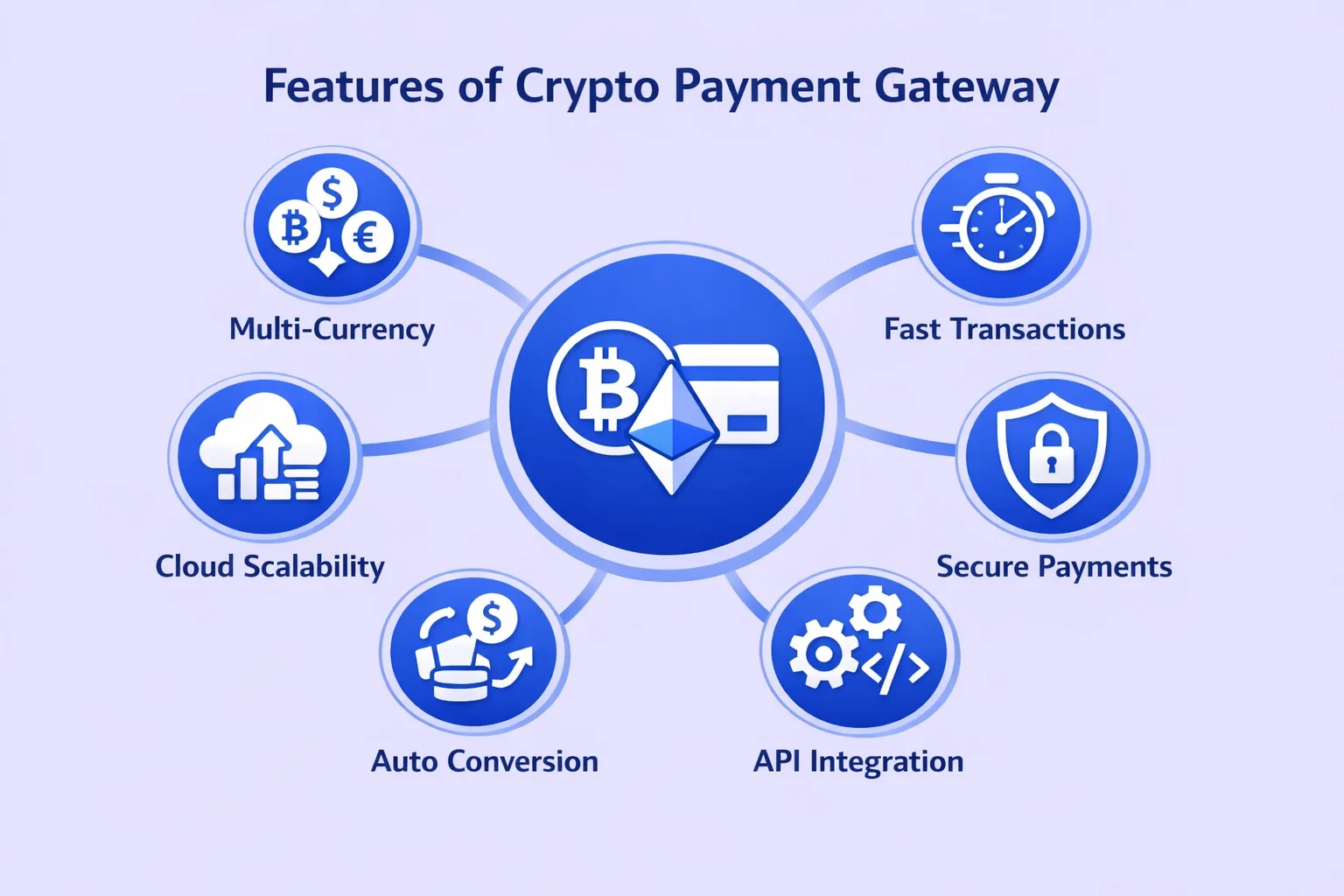
- E-Commerce Ready: Top gateways offer plugins for WooCommerce, Shopify, Magento, and PrestaShop, allowing integration without custom development.
- Volatility Protection: Auto-conversion features lock in fiat value at the moment of payment, protecting businesses from crypto price swings.
What Is a Crypto Payment Gateway?
A crypto payment gateway is a technology layer that sits between your customer and your business. When a customer pays in Bitcoin, Ethereum, USDT, or another digital currency, the gateway processes the transaction on the blockchain, verifies it, and either holds the funds for settlement or sends them directly to your wallet.
The gateway handles the technical complexity of blockchain verification so your business does not have to. Most also offer auto-conversion, which means you receive the equivalent in fiat currency (USD, EUR, GBP) or a stablecoin even if the customer paid in a volatile cryptocurrency. Understanding how crypto payment gateways work at a technical level helps businesses choose the model that fits their settlement preferences and risk tolerance.
For international businesses, the main advantage is that there are no cross-border banking restrictions or currency conversion markups from card networks. A business in Europe can accept payment from a customer in Southeast Asia in seconds, with a fee well below what SWIFT or card processors would charge.[1]
Why International Businesses Use Crypto Payment Gateways
Lower Transaction Costs
Credit card networks charge merchants between 2% and 3% per transaction, plus fixed per-transaction fees. Cross-border payments add currency conversion costs on top of that. Crypto payment gateways typically charge between 0.5% and 1% per transaction with no additional cross-border fee. For a business processing $500,000 per month internationally, this difference can save tens of thousands of dollars annually.
In 2026, the global cryptocurrency payment apps market is estimated to reach $718 million, part of a broader trend toward digital payment infrastructure. This growth is largely driven by businesses seeking to cut the overhead of international payment processing.[2]
Faster Settlement
Traditional international bank transfers (SWIFT) can take 2 to 5 business days to settle. Card processors typically hold funds for 1 to 3 days before releasing them to the merchant. Crypto settlements can complete within minutes, depending on the blockchain used, and stablecoin payments in particular offer near-instant finality with confirmed transaction status on-chain.
No Chargebacks
Blockchain transactions are irreversible once confirmed. Chargebacks, which cost the global payments industry over $100 billion annually through card networks, do not exist in crypto payments. This removes a significant risk for businesses that sell digital goods, services, or internationally to customers they cannot easily verify.[3]
Access to More Customers
More than 430 million people worldwide use cryptocurrencies. Many of these users are in regions where access to traditional banking or international card payments is limited. Businesses that accept crypto payment gateways can reach these customers directly without requiring them to have a credit card or bank account.
Best Crypto Payment Gateways for International Businesses in 2026
The following platforms are the most widely used and consistently reviewed for international business use. Each has different strengths depending on your geography, settlement preference, and asset requirements.
1. CoinGate
CoinGate is widely regarded as the strongest overall crypto payment gateway for online businesses in 2026. It is licensed under the EU’s MiCA (Markets in Crypto-Assets) regulation and the Payment Institutions directive, giving it clear legal standing for European merchants. It supports over 70 cryptocurrencies, charges a flat 1% fee, and settles in EUR, USD, or GBP via SEPA and SWIFT. It offers ready-made plugins for WooCommerce, Shopify, WHMCS, and PrestaShop.[4]
CoinGate is a custodial gateway, which means it holds funds temporarily during settlement processing. It operates in 180+ countries and is particularly well-suited for European e-commerce businesses that need regulatory compliance alongside broad integration support.
2. NOWPayments
NOWPayments supports over 350 cryptocurrencies, making it the broadest option for asset variety among international crypto payment gateways. It charges 0.5% for same-coin payments and 1% for payments requiring auto-conversion. It is non-custodial, which means funds go directly to your wallet rather than passing through a third-party custodian. It integrates with Shopify, WooCommerce, Magento, and PrestaShop, and supports mass payouts, recurring billing, and white-label options. It does not offer direct fiat settlement without a third-party partner.[5]
3. BitPay
BitPay is one of the oldest crypto payment processors, founded in 2011. It is used by large merchants including Microsoft and AMC. It supports 16+ cryptocurrencies, charges 1% to 2% based on volume (with the 1% tier available to merchants processing over $1 million per month), and offers daily fiat settlement. It integrates with QuickBooks and Xero for accounting. It is heavily US-focused in its compliance framework and best suited for high-volume enterprise merchants rather than startups or small cross-border sellers. Businesses looking for a cheapest payment gateway for fintech at startup scale will find BitPay’s fee structure less competitive than alternatives.
4. Coinbase Commerce
Coinbase Commerce charges a flat 1% fee and is the easiest option for businesses already using the Coinbase ecosystem. It integrates with Shopify and supports a range of popular cryptocurrencies. Its managed plan offers fiat conversion. It is best for businesses that want a simple setup and already have crypto exposure through Coinbase accounts. It is not the strongest option for businesses needing deep altcoin support or advanced payout features.[6]
5. Stripe (Stablecoin Payments)
Stripe re-entered the crypto space in 2025 with USDC-based stablecoin payments on Ethereum, Base, and Polygon networks. It charges 1.5% per transaction and settles directly in USD to your Stripe balance. This makes it a practical option for US-based businesses already on Stripe that want to add crypto acceptance without changing their existing payment stack. It is not designed for non-USD settlement or businesses outside the US.
6. Cryptomus
Cryptomus supports over 100 cryptocurrencies with fees starting at 0.4%, making it one of the lower-cost options in the market. It includes auto-conversion tools that convert incoming crypto to stablecoins or preferred currencies at the time of payment. It allows merchants to set prices in fiat with the equivalent crypto amount calculated in real time. It is a solid choice for businesses that want broad asset support and low fees without the enterprise infrastructure of BitPay.
Crypto Payment Gateway Comparison: Key Metrics
| Gateway | Transaction Fee | Currencies Supported | Fiat Settlement | Custody Model | Best For |
|---|---|---|---|---|---|
| CoinGate | 1% | 70+ | Yes (EUR/USD/GBP) | Custodial | EU e-commerce, MiCA compliance |
| NOWPayments | 0.5% – 1% | 350+ | Via third party | Non-custodial | Altcoin variety, SaaS, global |
| BitPay | 1% – 2% | 16+ | Yes (daily) | Custodial | High-volume US enterprise |
| Coinbase Commerce | 1% | Major coins | Managed plan | Custodial | Beginners, Coinbase users |
| Stripe (USDC) | 1.5% | USDC only | Yes (USD) | Custodial | US businesses on Stripe |
| Cryptomus | From 0.4% | 100+ | Via stablecoin | Custodial | Low-fee, broad asset support |
Custodial vs Non-Custodial Crypto Payment Gateways
One of the most important decisions when choosing a crypto payment gateway for business is whether you want a custodial or non-custodial model.
A custodial gateway (BitPay, CoinGate, Cryptomus) holds your funds temporarily during the settlement process. The gateway manages the conversion and transfer, making the process smoother. However, you are exposed to counterparty risk — if the gateway has operational issues, your funds could be temporarily inaccessible. Businesses that prioritize simplicity and fiat settlement usually prefer this model.
A non-custodial gateway (NOWPayments, BTCPay Server) sends funds directly to your wallet at the point of payment. You retain full control at all times. This reduces counterparty risk but requires you to manage your own wallet security and, if needed, handle fiat conversion separately. Businesses wanting to accept and hold crypto rather than convert it immediately are better served by this model.
📌 Compliance Note for 2026
For businesses operating in the EU, the MiCA (Markets in Crypto-Assets) Regulation now applies. This requires crypto payment service providers to hold specific licenses to operate legally. CoinGate holds both MiCA and Payment Institutions licenses, making it the most straightforward compliant option for EU-based merchants in 2026. Businesses outside the EU should verify that their chosen gateway holds the licenses required in their specific jurisdiction before accepting live payments.
How to Accept Crypto Payments Internationally: Step-by-Step
If your business is ready to start accepting global crypto payments, these are the concrete steps to follow:
Step 1: Define Your Settlement Preference
Decide whether you want to receive funds in fiat (USD, EUR, GBP), stablecoins (USDT, USDC), or keep the crypto as-is. This determines which gateways are compatible with your treasury strategy.
Step 2: Check Licensing in Your Region
Verify that the gateway you choose holds the necessary licenses for your country. EU businesses should look for MiCA compliance. US businesses should check for FinCEN registration and relevant state licenses. Businesses building their own payment infrastructure can explore crypto payment gateway development as an alternative to third-party platforms for greater control.
Step 3: Choose Custodial or Non-Custodial
Select based on whether you want the gateway to manage settlement (custodial) or send funds directly to your wallet (non-custodial). Most businesses new to crypto start with custodial gateways for simplicity.
Step 4: Integrate with Your Platform
If you run an e-commerce store, use the gateway’s plugin for your platform (Shopify, WooCommerce, Magento). If you have a custom system, use the gateway’s API. Most top gateways offer API documentation and developer support. For a full technical walkthrough, the process of creating a crypto payment gateway from scratch covers both hosted and self-built integration paths.
Step 5: Enable Volatility Protection
Turn on the gateway’s auto-conversion feature to lock in fiat value at the moment of payment. This protects your revenue from crypto price swings between when the customer pays and when the funds settle in your account.
What to Look for When Choosing an International Crypto Payment Gateway
Fee Structure
Compare the transaction fee, but also check for network (gas) fees, withdrawal fees, currency conversion markups, and any subscription fees for advanced features. The advertised rate is rarely the complete cost.
Supported Currencies
If your customers pay in major coins (Bitcoin, Ethereum, USDT), most gateways will serve you well. If you need broad altcoin support, NOWPayments with 350+ assets is the most flexible. If you only need stablecoins, Stripe’s USDC integration may be sufficient.
Settlement Speed and Method
Check whether the gateway settles daily, weekly, or on a rolling basis. Confirm the settlement currency and the method (SEPA, SWIFT, or stablecoin to wallet). Faster settlement improves cash flow for businesses with ongoing operating expenses.
Security
Look for gateways that use end-to-end encryption, two-factor authentication, and have a documented security history. Platforms that have undergone third-party audits or operate under regulatory frameworks provide additional assurance for a secure crypto payment solution for businesses handling large volumes.
E-Commerce Integration
If you sell online, confirm that the gateway has a native plugin for your platform. CoinGate, NOWPayments, and BitPay all offer plugins for the major e-commerce systems. This avoids the need for custom API development just to get started.
📌 Trend to Watch (2025–2026)
Stablecoin-based cross-border payments are now worth $17.9 trillion globally, with B2B payments accounting for $14.7 trillion of that total. Businesses are no longer treating stablecoin payments as experimental — they are integrating them as primary infrastructure for international settlements. Gateways that support multi-chain stablecoin flows (USDT on Tron, USDC on Base and Ethereum, etc.) will have a clear operational advantage for businesses serving customers across multiple regions.
Build a Custom Crypto Payment Gateway for Your Business
Nadcab Labs develops custom crypto payment gateways tailored to your business requirements — including multi-currency support, fiat settlement, API integration, and compliance infrastructure for international operations.
Frequently Asked Questions
Q1.Which crypto payment gateway has the lowest fees?
Cryptomus starts at 0.4% per transaction, making it the lowest advertised fee among major gateways. NOWPayments charges 0.5% for same-coin payments. However, total cost also includes network fees, withdrawal fees, and conversion markups. Always calculate the full cost stack for your expected transaction volume before choosing based on headline fees alone.
Q2.Can small businesses use crypto payment gateways?
Yes. Platforms like NOWPayments, CoinGate, and Coinbase Commerce have no minimum volume requirements and offer free or low-cost setup. They provide ready-made plugins for Shopify and WooCommerce, making integration straightforward for small e-commerce businesses without technical teams. Subscription or advanced feature fees apply only if you use optional tools beyond basic payment acceptance.
Q3.How do crypto gateways handle currency conversion?
Most custodial gateways offer auto-conversion at the time of payment. The gateway locks in the fiat equivalent the moment the customer pays, then settles that fiat amount to your account according to your settlement schedule. This removes exposure to crypto price volatility between payment and settlement. Non-custodial gateways send crypto directly; fiat conversion is your responsibility.
Q4.What is the difference between custodial and non-custodial gateways?
In most jurisdictions, yes — with conditions. The EU now has MiCA regulation providing clear legal rules. The US requires compliance with FinCEN and state-level money transmitter laws. Other regions vary. Businesses should choose gateways that hold licenses in the jurisdictions where they operate, and verify their own reporting obligations for crypto transactions under local tax and financial regulations.
Explore Services
Related Services
Reviewed by

Aman Vaths
Founder of Nadcab Labs
Aman Vaths is the Founder & CTO of Nadcab Labs, a global digital engineering company delivering enterprise-grade solutions across AI, Web3, Blockchain, Big Data, Cloud, Cybersecurity, and Modern Application Development. With deep technical leadership and product innovation experience, Aman has positioned Nadcab Labs as one of the most advanced engineering companies driving the next era of intelligent, secure, and scalable software systems. Under his leadership, Nadcab Labs has built 2,000+ global projects across sectors including fintech, banking, healthcare, real estate, logistics, gaming, manufacturing, and next-generation DePIN networks. Aman’s strength lies in architecting high-performance systems, end-to-end platform engineering, and designing enterprise solutions that operate at global scale.