Ai Overview
A crypto payment gateway is a system that allows a business to accept payments in cryptocurrency from customers. 39 billion in 2026, growing from $2 billion in 2025 at a compound annual growth rate of 19%. Crypto payment adoption grew 82% between 2024 and 2026. The saving scales directly with revenue, which is why 45% of merchants who accept crypto cite faster transaction speed and cost reduction as their top reasons for adoption.
A crypto payment gateway is a system that allows a business to accept payments in cryptocurrency from customers. It processes the transaction, handles the exchange rate calculation, and either settles the payment in cryptocurrency directly to the merchant’s wallet or converts it to fiat currency instantly. The business receives payment without needing to understand the technical details of blockchain transactions.
The global crypto payment gateway market reached $2.39 billion in 2026, growing from $2 billion in 2025 at a compound annual growth rate of 19%. It is forecast to reach $4.74 billion by 2030. Crypto payment adoption grew 82% between 2024 and 2026. Over 430 million people globally own cryptocurrency as of early 2026, and nearly 1 in 4 of them has used digital currency for a payment in the past year. These are not projections. They are current market conditions that affect customer expectations and business competitiveness right now.[1]
Key Takeaways
- Market Size: The global crypto payment gateway market reached $2.39 billion in 2026 and is projected to hit $4.74 billion by 2030 at a CAGR of 18.7%.
- Lower Processing Fees: Crypto payment gateways charge 0.23% to 1% per transaction, compared to 2% to 3% for credit cards. This difference compounds significantly at scale.
- No Chargebacks: Cryptocurrency transactions are irreversible. Once confirmed on the blockchain, they cannot be reversed by the customer, eliminating chargeback fraud entirely.
- Global Reach Without Currency Conversion: Crypto payments work across borders without requiring currency exchange or international banking network fees, making them ideal for businesses with international customers.
- Stablecoins Solve Volatility: Stablecoins made up 82% of crypto payment gateway transactions in 2026. USDT alone held a 33% share of merchant crypto payment volume, providing stable value for both merchants and customers.
- Instant Settlement: Nearly 80% of crypto payment gateways enabled instant settlement in 2025, compared to 1 to 3 business days for traditional card payment processors.
- Customer Demand Is Real: 45% of merchants report that accepting crypto helps them attract new customers. Over 75% of crypto users aged 18 to 35 have used cryptocurrency to pay for goods or services at least once.
- Fraud Detection Has Improved: AI-powered fraud detection in crypto payment systems achieves 92% to 93% accuracy in 2026, reducing false positives by over 40% compared to traditional rule-based tools.
- 78% of Fortune 500 Companies Are Exploring Crypto Payments: Among Fortune 500 companies, 78% were either exploring or piloting crypto payments as of 2025, particularly for international B2B transfers.
What Is a Crypto Payment Gateway?
A crypto payment gateway is a digital platform that sits between a buyer and a business, processing cryptocurrency transactions in the same way that Stripe or PayPal process card payments. When a customer selects crypto as their payment method, the gateway generates a payment address, monitors the blockchain for confirmation of funds received, and either credits the merchant’s account in cryptocurrency or converts it to fiat currency at a locked rate to protect against price fluctuations during the transaction window.
The gateway handles all the technical complexity: blockchain monitoring, wallet management, exchange rate locking, network fee calculation, and settlement. The merchant sees a payment confirmed or rejected in their dashboard, exactly as they would with a traditional payment processor. For a detailed technical breakdown of the transaction flow, the full explanation of how crypto payment gateways work covers each step from checkout to settlement.[2]
Why Businesses Are Adding Crypto Payments in 2026
The reasons businesses accept cryptocurrency payments have become more practical and measurable over the last two years. Early adopters added crypto for brand positioning. By 2026, the reasons are operational: lower costs, faster settlement, access to new customer segments, and elimination of chargeback fraud. Here is what the data shows.
Lower Transaction Fees
Credit and debit card processing fees in most markets run between 2% and 3% of the transaction value, plus fixed per-transaction charges. For a business processing $1 million per month, that is $20,000 to $30,000 per month in payment processing costs. Crypto payment gateways charge between 0.23% and 1% per transaction. At 1%, the same volume costs $10,000 per month. At 0.5%, it costs $5,000. The saving scales directly with revenue, which is why 45% of merchants who accept crypto cite faster transaction speed and cost reduction as their top reasons for adoption.
Cross-border transactions show an even larger cost difference. International wire transfers through banks typically cost $15 to $50 per transaction plus currency conversion fees. Stablecoin payments settle in minutes for a fraction of a percent. Cross-border crypto transactions surged 60% in 2025 specifically because businesses found the cost difference impossible to ignore at scale.
No Chargeback Risk
Chargebacks cost e-commerce businesses an estimated $125 billion globally in 2023, with the figure rising each year. A chargeback occurs when a customer disputes a card transaction with their bank. The bank reverses the charge, the merchant loses both the goods and the payment, and pays an additional chargeback fee. Cryptocurrency transactions are irreversible by design. Once a blockchain transaction is confirmed, neither the customer nor any third party can reverse it. Accepting crypto payments eliminates chargeback risk on those transactions entirely. For businesses in high-risk industries where chargeback rates are elevated, this alone justifies adding a crypto payment gateway.[3]
Faster Settlement
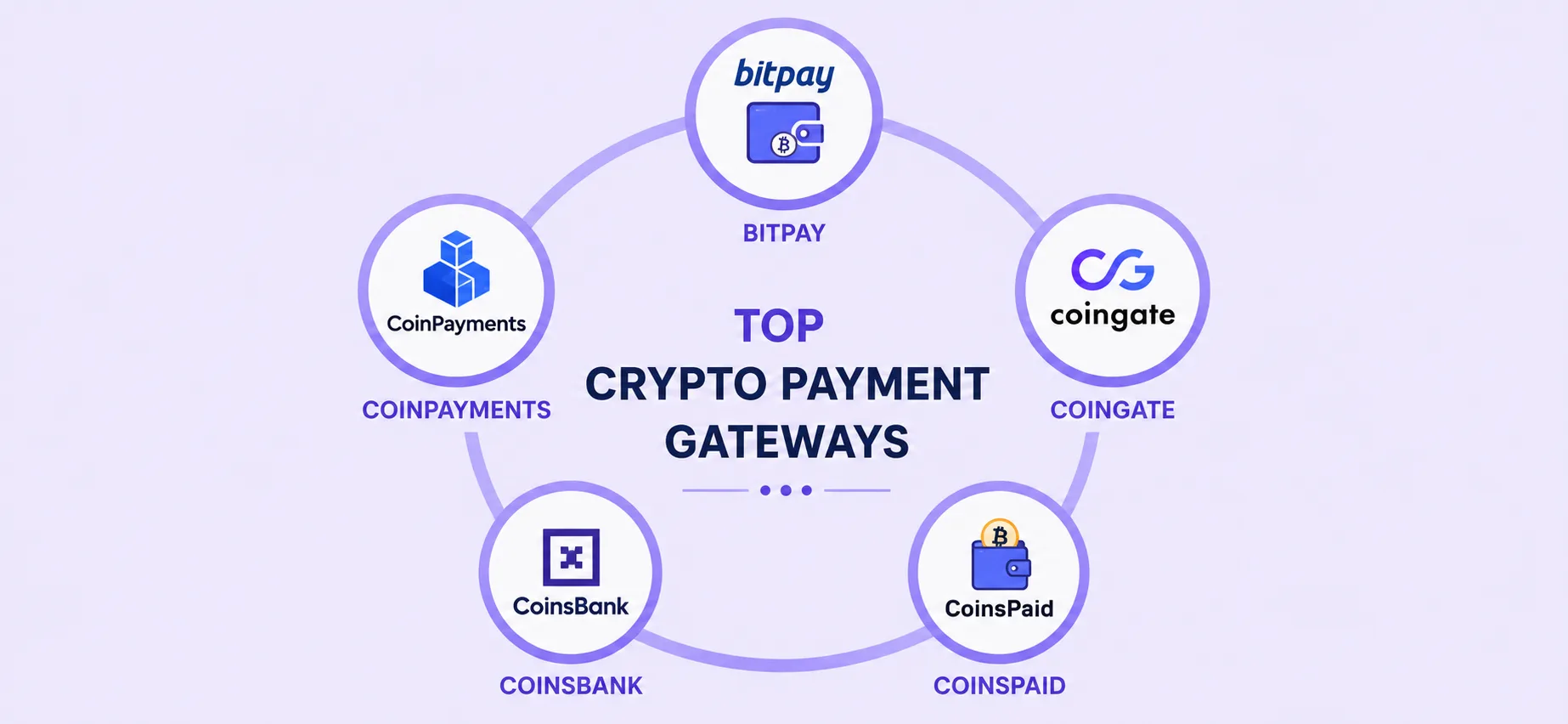
Traditional card payment networks settle merchant funds in one to three business days. On weekends and public holidays, settlements are delayed further. This creates cash flow gaps, particularly for smaller businesses. Nearly 80% of crypto payment gateways offered instant settlement in 2025. NOWPayments settles directly to the merchant’s wallet in real time. BitPay and CoinGate settle fiat conversions within one to two business days, which is comparable to card networks, but without the weekend delays. For merchants who need predictable, fast cash flow, instant crypto settlement removes a consistent friction point.
Access to Global Customers
Over 430 million people owned cryptocurrency globally as of early 2026. Many of them live in countries where access to international payment methods is restricted or where credit card penetration is low. A customer in Argentina (18.9% crypto ownership), Turkey (25.6%), or the Philippines (13.4%) may be more likely to complete a purchase using crypto than attempting an international card payment that gets declined due to currency restrictions or banking limitations. By accepting crypto, businesses access these customers without needing to negotiate payment arrangements with local banks in each country.
Growing Customer Demand Among Younger Demographics
Over 75% of crypto users aged 18 to 35 have used cryptocurrency to pay for goods or services at least once in the past year. In 2026, 40% of Gen Z and 36% of millennials plan to increase their crypto activity. These are the customer segments with the highest lifetime value for many businesses. Among merchants who accept crypto, 45% report it directly helped them attract new customers who would not have purchased otherwise. The average crypto retail payment value is $112, indicating these are real-economy transactions, not only high-value transfers.[4]
How Stablecoins Solve the Volatility Problem
The most common concern businesses raise about accepting cryptocurrency is price volatility. Bitcoin’s price can move 5% to 10% in a single day. If a customer pays $100 in Bitcoin and the price drops before the merchant converts it, the business receives less than expected.
Stablecoins solve this problem directly. A stablecoin is a cryptocurrency pegged to a fiat currency, typically the US dollar, so its value does not fluctuate. USDT (Tether), USDC, and other dollar-pegged stablecoins allow customers to pay in a stable unit of value while the merchant receives the equivalent in fiat without currency risk. Stablecoins accounted for 82% of crypto payment gateway transactions in 2026. USDT alone held a 33% share of merchant crypto payment volume. Stablecoin-based cross-border payments are expected to grow from under 1% to 30 to 40% of cross-border payment volume within three years.
For merchants who want to receive payment in their local fiat currency and avoid any crypto exposure entirely, most gateways offer automatic conversion at checkout. The customer pays in Bitcoin, Ethereum, or USDT, and the merchant receives USD, EUR, or their local currency in their bank account. The gateway handles the conversion at a locked rate during the transaction window, eliminating volatility risk completely.[5]
What a Crypto Payment Gateway Can Process
The range of cryptocurrencies a gateway supports varies by provider. The most commonly supported assets across the leading gateways are:
| Cryptocurrency | Share of Merchant Transactions (2026) | Primary Use Case |
|---|---|---|
| Bitcoin (BTC) | 42% | High-value transactions, brand recognition |
| USDT (Tether) | 33% | Stablecoin payments, cross-border transfers |
| Ethereum (ETH) | 25% | DeFi integrations, smart contract payments |
| XRP (Ripple) | 5% | Cross-border B2B payments |
| Litecoin (LTC) | 3.5% | Fast, low-fee small-value transactions |
Industries Where Crypto Payments Have the Highest Adoption
Crypto payment adoption is not evenly distributed across industries. The sectors showing the highest uptake in 2025 and 2026 are digital goods and entertainment, travel and lodging, gaming, charitable donations, and cross-border B2B remittances. In e-commerce, crypto acceptance grew approximately 38% year over year, pushing the number of merchants accepting digital assets beyond 32,000 globally.
For B2B businesses, the case is particularly strong. International wire transfers between businesses are slow, expensive, and involve multiple intermediary banks each taking a fee. Stablecoin-based B2B transfers settle in minutes at a fraction of the cost. Among Fortune 500 companies, 78% were exploring or piloting crypto payments as of 2025, with international B2B transfers cited as the primary use case. PayPal processed crypto payments across 30 countries in 2025. Visa processed over $3 billion in crypto-linked card transactions. These are not niche use cases.[6]
How to Add a Crypto Payment Gateway to Your Business
There are two ways to add a crypto payment gateway to a business. The first is using an existing third-party gateway provider. The second is building a custom gateway tailored to the business’s specific requirements.
Using a Third-Party Gateway
Providers including BitPay, Coinbase Commerce, NOWPayments, and CoinGate offer pre-built gateway solutions that can be integrated into an existing website or application using plugins or APIs. Most major e-commerce platforms including Shopify, WooCommerce, and Magento have direct integrations available. Setup can be completed in hours for a basic integration. The trade-off is that the business depends on the provider’s infrastructure, fee schedule, and supported currencies, and has limited control over the settlement and reporting processes.
Building a Custom Gateway
Businesses with specific requirements — custom currency support, branded checkout experiences, direct wallet settlement, or integration with proprietary business systems — need a custom-built gateway. The full process of creating a crypto payment gateway covers the technical architecture, blockchain node integration, wallet management, and compliance infrastructure required to build one from scratch.
Custom gateways give full control over the payment flow, settlement logic, and compliance reporting. They eliminate dependency on third-party providers and allow the business to white-label the payment experience entirely. This is the approach taken by larger merchants, fintech companies, and platforms that process high volumes where the cost of third-party fees outweighs the cost of building proprietary infrastructure.
What to Check Before Choosing a Crypto Payment Gateway
Not all crypto payment gateways are the same. Here are the specific factors that determine whether a gateway will work well for a business.
Settlement Options
Determine whether the gateway settles in crypto, fiat, or both, and how long settlement takes. If the business wants to hold crypto as a treasury asset, it needs non-custodial settlement directly to a business wallet. If it wants fiat, it needs a gateway with integrated conversion and a bank account in the settlement currency. Approximately 61% of merchants that accept crypto use instant fiat conversion to eliminate volatility risk.
Supported Cryptocurrencies
The gateway must support the currencies the business’s customers actually use. In most markets, covering Bitcoin, Ethereum, and the major stablecoins (USDT and USDC) covers the majority of customer demand. NOWPayments supports over 300 cryptocurrencies for businesses that need broader coverage. For most businesses, four to six currencies are sufficient at launch.
Compliance and KYC Requirements
In regulated markets, the gateway provider must comply with AML and KYC requirements applicable in the business’s jurisdiction. In the EU, MiCA applies. In the UAE, VARA and FSRA oversight applies. In the US, FinCEN registration is required for money service businesses. The gateway provider’s own compliance status matters because the merchant is part of the same regulatory chain. Using an unregulated provider creates compliance exposure for the business.
Understanding the full scope of what a professional Crypto Payment Gateway Development service covers, including compliance architecture, settlement logic, and multi-currency support, is important for businesses evaluating whether to use a third-party provider or build a custom solution.
Build a Custom Crypto Payment Gateway for Your Business
Nadcab Labs develops custom cryptocurrency payment gateway solutions with multi-currency support, instant settlement, stablecoin integration, AML compliance modules, and white-label checkout experiences built for your business requirements.
Frequently Asked Questions
Q1.What is a crypto payment gateway for business?
A crypto payment gateway is a system that allows businesses to accept cryptocurrency payments from customers. It processes the transaction on the blockchain, handles exchange rate locking during the payment window, and either settles the payment in cryptocurrency to the merchant’s wallet or converts it to fiat currency automatically. It works like a traditional payment processor but uses blockchain infrastructure instead of banking networks.
Q2.How much do crypto payment gateways cost?
Most crypto payment gateways charge between 0.23% and 1% per transaction, significantly lower than credit card fees of 2% to 3%. Some providers such as Crypto.com Pay offer zero-fee options under specific conditions. Coinbase Commerce charges 1% per transaction. Custom-built gateways have higher upfront development costs but eliminate ongoing per-transaction fees for high-volume businesses.
Q3.Are crypto payments irreversible for merchants?
Yes. Confirmed blockchain transactions cannot be reversed. This eliminates chargebacks entirely for crypto payments. Once a crypto payment is confirmed on-chain, neither the customer nor any bank can dispute and reverse it. This is one of the primary reasons businesses in high-risk e-commerce categories add crypto payments, as chargeback fraud costs the global e-commerce industry billions annually.
Q4.What cryptocurrencies should a business accept?
Bitcoin covers approximately 42% of merchant crypto transactions. USDT covers 33% and is the leading stablecoin for payments. Ethereum covers 25%. For most businesses, supporting Bitcoin, Ethereum, USDT, and USDC covers the majority of customer payment preferences. Businesses with specific regional customer bases may add XRP, Litecoin, or other assets based on local adoption data.
Q5.Does accepting crypto help attract new customers?
Yes. Among merchants who accept crypto, 45% report it directly helped them attract new customers. Over 75% of crypto users aged 18 to 35 have paid with cryptocurrency at least once. Gen Z and millennials show the highest crypto payment activity. For businesses targeting these demographics, crypto payment support is increasingly an expected feature rather than a differentiator.
Explore Services
Related Services
Reviewed by

Naman Singh
Co-Founder & CEO, Nadcab Labs
Naman Singh is the Co-Founder and CEO of Nadcab Labs, where he drives the company’s vision, global growth, and strategic expansion in blockchain, fintech, and digital transformation. A serial entrepreneur, Naman brings deep hands-on experience in building, scaling, and commercializing technology-driven businesses. At Nadcab Labs, Naman works closely with enterprises, governments, and startups to design and implement secure, scalable, and business-ready Web3 and blockchain solutions. He specializes in transforming complex ideas into high-impact digital products aligned with real business objectives. Naman has led the development of end-to-end blockchain ecosystems, including token creation, smart contracts, DeFi and NFT platforms, payment infrastructures, and decentralized applications. His expertise extends to tokenomics design, regulatory alignment, compliance strategy, and go-to-market planning—helping projects become investor-ready and built for long-term sustainability. With a strong focus on real-world adoption, Naman believes in building blockchain solutions that deliver measurable value, solve practical problems, and unlock new growth opportunities for organizations worldwide.