Ai Overview
Integrating a crypto payment gateway typically takes between six and twelve weeks from initial planning to full production rollout, though timelines vary significantly based on business complexity, existing infrastructure maturity, and regulatory requirements. Unlike traditional payment processors, crypto gateways introduce additional layers of blockchain interaction, wallet management, and compliance verification that extend standard integration cycles.
Integrating a crypto payment gateway typically takes between six and twelve weeks from initial planning to full production rollout, though timelines vary significantly based on business complexity, existing infrastructure maturity, and regulatory requirements. Unlike traditional payment processors, crypto gateways introduce additional layers of blockchain interaction, wallet management, and compliance verification that extend standard integration cycles. Most businesses underestimate the time required for security audits, multi-currency testing, and post-launch optimization, leading to rushed deployments and preventable technical debt.
Key Takeaways
- Standard crypto payment gateway integration requires 6-12 weeks across five distinct phases: planning (1-4 weeks), development (2-8 weeks), testing (2-6 weeks), go-live preparation (1-2 weeks), and post-launch monitoring (2-4 weeks).
- Business complexity, regulatory environment, and technical readiness are the primary factors determining total integration duration—enterprises in regulated industries often need 16+ weeks for full deployment.
- Pre-built SDKs, clear API documentation, and experienced blockchain developers can reduce integration time by 30-40%, while legacy system compatibility and custom business logic frequently double expected timelines.
- Security audits and compliance testing consume 2-6 weeks and cannot be rushed—penetration testing, KYC/AML verification, and multi-currency validation are non-negotiable for production readiness.
- Soft launches with limited traffic for 1-2 weeks before full rollout dramatically reduce post-production issues, catching edge cases and performance bottlenecks that testing environments miss.
- Common delays include unclear requirements, vendor evaluation paralysis, webhook implementation bugs, settlement reconciliation issues, and underestimated load testing—proactive planning mitigates most timeline risks.
What Determines the Total Integration Time for a Crypto Payment Gateway?
The total crypto payment gateway integration time depends on three primary drivers: business complexity, existing technical infrastructure, and organizational readiness. A small e-commerce store with a modern tech stack and straightforward requirements might complete integration in six weeks, while a multi-national enterprise with legacy systems, custom workflows, and strict compliance mandates often requires twelve to sixteen weeks or longer. The gap between these scenarios stems from fundamental differences in scope, not just development speed.
Business complexity manifests in several dimensions. Companies processing high transaction volumes need robust load balancing, redundant failover systems, and sophisticated fraud detection—each adding weeks to the timeline. Organizations operating in multiple jurisdictions face varied regulatory requirements: European businesses must navigate MiCA regulations, US companies deal with state-by-state money transmitter licenses, and Asian firms encounter diverse crypto-friendly or crypto-hostile regulatory environments. Multi-currency support extends timelines proportionally—supporting Bitcoin and Ethereum is straightforward, but adding fifteen altcoins with different confirmation times, fee structures, and wallet implementations multiplies testing and integration effort. Crypto Payment Gateways for Global operations face these challenges at scale.
Existing infrastructure profoundly impacts integration speed. Modern platforms built on microservices architectures with RESTful APIs integrate crypto gateways relatively quickly—the new payment method slots into existing payment orchestration layers with minimal friction. Legacy monolithic systems present serious challenges: tightly coupled codebases resist modular additions, outdated programming languages lack modern crypto libraries, and database schemas designed for traditional payment flows struggle to accommodate blockchain transaction states. Companies running decade-old ERP systems or custom-built platforms frequently discover that “simple” gateway integration requires substantial refactoring of core payment logic.
Team expertise dramatically influences deployment speed. Developers experienced with blockchain concepts, asynchronous webhook processing, and cryptographic operations complete integrations 40-50% faster than teams learning these concepts during implementation. Organizations with dedicated DevOps engineers, established CI/CD pipelines, and mature testing frameworks avoid the delays that plague teams manually deploying code and running ad-hoc tests. Vendor responsiveness matters too—gateways with comprehensive documentation, responsive technical support, and active developer communities enable faster problem resolution than vendors offering minimal documentation and slow support ticket responses.
Integration Time Factors Comparison
| Factor | Fast Track (6-8 weeks) | Standard (8-12 weeks) | Complex (12-16+ weeks) |
|---|---|---|---|
| Business Size | SMB, single market | Mid-market, 2-3 regions | Enterprise, global operations |
| Tech Stack | Modern APIs, cloud-native | Mix of modern and legacy | Legacy monoliths, custom systems |
| Currency Support | 1-3 major coins | 5-8 cryptocurrencies | 10+ coins, stablecoins, tokens |
| Compliance Needs | Basic KYC, single jurisdiction | Multi-jurisdiction, AML checks | Financial services, heavy regulation |
| Team Experience | Blockchain-savvy developers | General web dev, some crypto knowledge | Learning blockchain during project |
| Custom Features | Standard checkout only | Custom reporting, partial automation | Complex workflows, full customization |
Regulatory requirements introduce unavoidable delays regardless of technical proficiency. Financial institutions must complete formal security audits before processing real transactions—these audits take four to six weeks minimum and cannot be rushed without compromising thoroughness. Companies in healthcare, gaming, or other regulated sectors face additional compliance layers: HIPAA considerations for health-related payments, gambling license requirements for gaming platforms, and export control reviews for businesses serving international markets. Each regulatory touchpoint adds review cycles, documentation requirements, and approval wait times that extend the overall timeline.
Custom feature requests are another major timeline variable. Businesses requesting standard checkout flows with minimal customization complete integrations faster than those requiring bespoke features like dynamic fee adjustment, automated tax calculation across jurisdictions, or integration with proprietary inventory systems. Every custom feature introduces design time, development effort, testing complexity, and potential for bugs that delay launch. Organizations underestimate the compound effect of “small” customizations—five seemingly minor custom features can double the integration timeline when dependencies and testing permutations are properly accounted for.
How Long Does the Planning and Requirements Phase Typically Take?
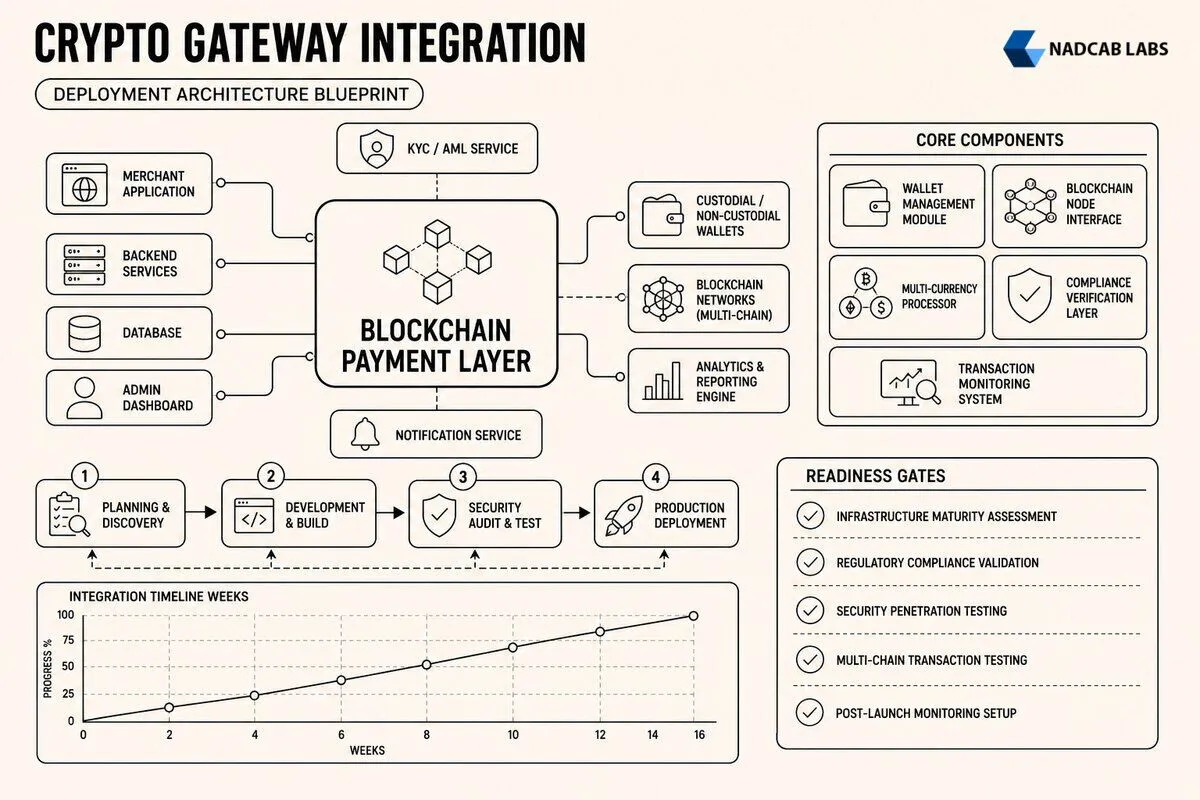
The planning and requirements phase consumes one to four weeks depending on organizational size and decision-making speed. Small to medium businesses with clear objectives and empowered decision-makers complete this phase in seven to fourteen days, while enterprises with multiple stakeholders, committee-based approval processes, and complex requirements often need three to four weeks. This phase establishes the foundation for everything that follows—rushing through planning to “save time” invariably causes delays during development when teams discover missing requirements or conflicting assumptions.
Initial scoping begins with defining business objectives and success criteria. Why is the organization adding crypto payments? Is the goal reducing payment processing fees, accessing new customer segments, enabling cross-border transactions, or staying competitive? Each objective influences gateway selection and feature prioritization. Companies pursuing cost reduction focus on fee structures and settlement times, while those targeting new markets prioritize multi-currency support and localization features. Clear objectives prevent scope creep and keep the project focused on delivering measurable business value.
Stakeholder alignment is critical and frequently underestimated. Finance teams care about reconciliation, accounting integration, and tax reporting. Marketing wants seamless user experience and brand consistency. Legal demands compliance documentation and risk mitigation. IT operations needs monitoring, alerting, and incident response procedures. Security teams require penetration testing and vulnerability assessments. Getting these groups aligned on requirements, priorities, and success metrics takes time—especially in larger organizations where departments operate semi-independently. Skipping proper stakeholder engagement leads to late-stage requirement changes that derail timelines and budgets.
Gateway vendor selection occupies a significant portion of planning time. Businesses evaluate providers based on supported cryptocurrencies, fee structures, settlement options, API quality, documentation completeness, security certifications, regulatory compliance, customer support quality, and integration complexity. Companies serious about this decision test multiple gateways in sandbox environments, review technical documentation, speak with existing customers, and assess vendor stability and roadmap. Organizations evaluating three to five vendors thoroughly need two to three weeks for this process. Rushing vendor selection by choosing the first option or relying solely on marketing materials frequently results in discovering critical limitations mid-integration—forcing expensive vendor switches or compromised functionality. Understanding Businesses Need a Crypto Payment Gateway helps frame evaluation criteria.
Compliance mapping adds one to two weeks for most businesses. Teams must identify applicable regulations in each operating jurisdiction, document required KYC/AML procedures, establish transaction monitoring protocols, and create audit trails for regulatory reporting. Companies in heavily regulated industries like banking or securities trading need legal counsel review, which introduces additional time for attorney availability and document iteration. Organizations operating internationally face multiplied compliance complexity—each jurisdiction has unique requirements that must be researched, documented, and operationalized.
Technical architecture review determines how the gateway integrates with existing systems. Teams map out data flows, identify integration points, assess infrastructure requirements, plan for scalability, and design error handling and recovery procedures. This review reveals technical constraints that influence timeline and scope: legacy systems might require middleware layers, high-volume platforms need load balancing and caching strategies, and mobile apps require SDK integration planning. Discovering these constraints during planning allows realistic timeline estimation; finding them during development causes delays and emergency architecture changes.
Planning Phase Process Flow
Common delays during planning include unclear business requirements, multiple vendor evaluation rounds, and legal review bottlenecks. Organizations that begin planning without defining success metrics waste time debating features and priorities mid-process. Companies that evaluate vendors superficially often restart evaluation after discovering deal-breaker limitations. Legal teams unfamiliar with crypto regulations require extended research time, and attorney availability constraints can add weeks to the timeline. Proactive planning mitigates these delays: define objectives before starting, limit vendor evaluation to three pre-qualified candidates, and engage legal counsel early with clear questions and deadlines.
What Is the Realistic Timeline for API Integration and Development?
Standard REST API integration for basic checkout flows requires two to four weeks for experienced development teams. This timeline covers implementing payment initiation, handling webhook callbacks for transaction status updates, managing error conditions, and building basic reconciliation logic. Simple integrations—adding crypto as a payment option on an e-commerce checkout page—fall at the lower end of this range, while integrations requiring custom UI elements, complex business logic, or integration with multiple backend systems push toward the upper end.
The development phase begins with environment setup and API credential provisioning. Teams configure sandbox environments, obtain test API keys, set up local development instances, and establish version control workflows. Well-documented gateways with clear quickstart guides enable developers to complete setup in one to two days. Poorly documented platforms with unclear authentication flows, missing example code, or incomplete API references can consume a week or more as developers reverse-engineer functionality through trial and error. This initial setup phase reveals documentation quality and vendor support responsiveness—early red flags that predict downstream integration challenges.
Core payment flow implementation occupies the bulk of development time. Developers build the checkout interface, integrate payment initiation API calls, implement transaction status polling or webhook listeners, handle payment confirmations and failures, and create user feedback mechanisms. Each cryptocurrency introduces minor variations in implementation: Bitcoin requires different confirmation thresholds than Ethereum, stablecoins have unique gas fee considerations, and layer-2 solutions like Lightning Network need specialized handling. Teams supporting five to eight cryptocurrencies spend three to five weeks on core flow implementation, testing each currency’s unique characteristics and edge cases.
Webhook handling deserves special attention because it introduces asynchronous complexity that trips up developers accustomed to synchronous payment APIs. Crypto transactions take variable time to confirm—Bitcoin confirmations range from ten minutes to an hour depending on network congestion and fee levels, while Ethereum confirmations vary from seconds to minutes. Gateways send webhook notifications when transaction states change: initiated, pending, confirmed, failed, or refunded. Developers must implement idempotent webhook handlers that safely process duplicate notifications, handle out-of-order delivery, and gracefully manage webhook failures with retry logic. Webhook implementation bugs are the single most common source of post-launch production issues, causing duplicate order processing, failed payment confirmations, and customer support nightmares.
Backend reconciliation and accounting integration extends development timelines significantly. Finance teams need transaction records in their accounting systems, matched to bank settlements, with proper tax categorization. Building robust reconciliation requires mapping gateway transaction IDs to internal order IDs, handling partial refunds and chargebacks, calculating crypto-to-fiat conversion rates at transaction time, and generating reports for accounting software ingestion. Organizations with complex accounting requirements or custom ERP systems spend two to four additional weeks on reconciliation logic. Companies underestimating this work discover the gap during user acceptance testing when finance teams reject the integration due to incomplete reporting.
Development Timeline Factors
Custom UI/UX requirements add two to four weeks to standard integration timelines. Businesses wanting branded payment experiences, mobile-optimized interfaces, or embedded wallet functionality need custom frontend development beyond basic API integration. Mobile apps require native SDK integration for iOS and Android, each with platform-specific considerations and testing requirements. Companies building progressive web apps face cross-browser compatibility testing and responsive design challenges. Every custom UI element introduces design iteration, user testing, and accessibility compliance work that extends the development phase. Organizations leveraging the Payment Gateway services from Nadcab Labs benefit from pre-built, customizable UI components that reduce this overhead.
Factors accelerating integration include pre-built SDKs in the organization’s programming language, comprehensive API documentation with working code examples, active developer communities providing troubleshooting help, and experienced blockchain developers who understand crypto transaction lifecycles. Gateway providers offering sandbox environments with test cryptocurrencies enable rapid iteration without real-money risk. Responsive vendor support that answers technical questions within hours rather than days prevents developers from getting blocked on integration issues.
Factors causing delays include legacy system compatibility challenges, custom business logic requirements, API rate limits that force implementation of complex request queuing, undocumented API behaviors requiring reverse engineering, and vendor support bottlenecks. Organizations discover mid-integration that their legacy payment processing code makes assumptions incompatible with asynchronous crypto transactions—requiring substantial refactoring. Custom business rules like “hold orders until three blockchain confirmations” or “automatically convert crypto to fiat when balance exceeds threshold” require careful implementation and testing. API rate limits force developers to implement sophisticated caching and request batching, adding complexity and testing burden. Similar challenges appear in supply chain API integration costs, where legacy system constraints drive timeline extensions.
How Much Time Should You Allocate for Testing and Security Audits?
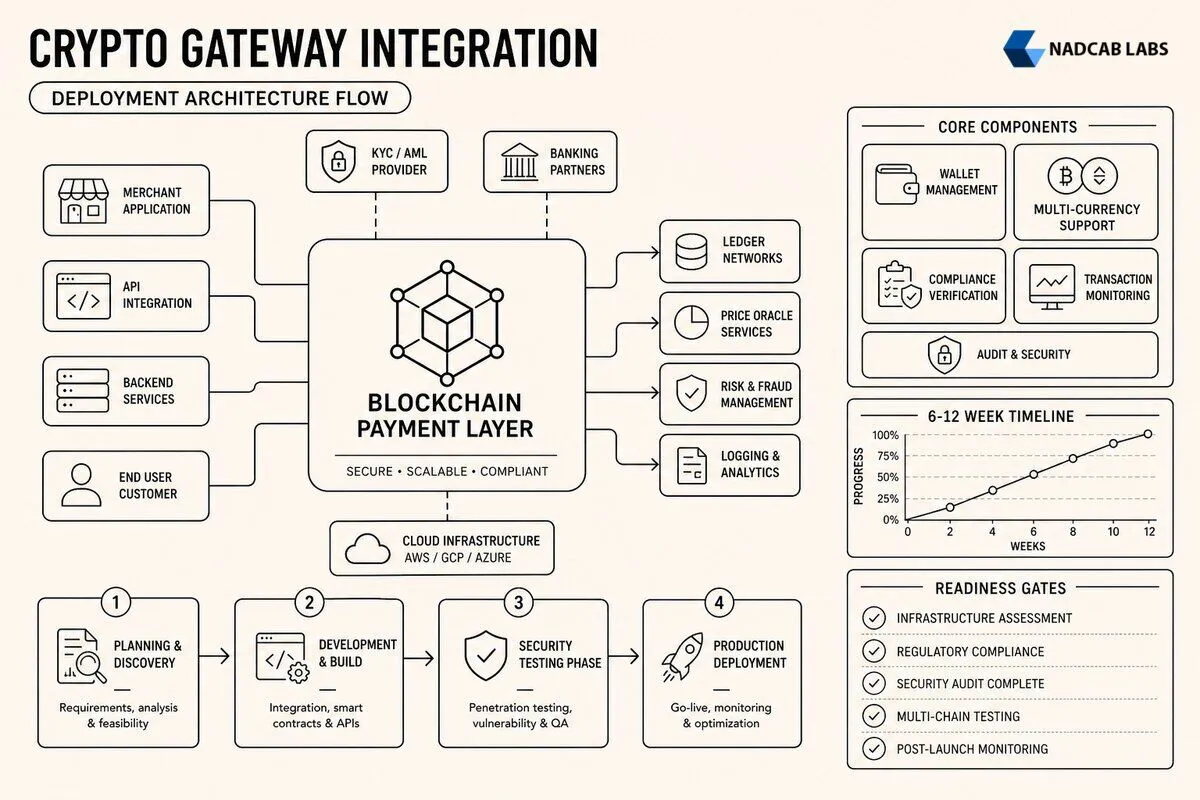
Testing and security validation consume two to six weeks of the integration timeline and cannot be compressed without accepting unacceptable risk. Functional testing alone requires one to two weeks minimum, covering transaction flows, error handling, refund processing, multi-currency validation, and edge case scenarios. Security testing and compliance audits add another two to four weeks for organizations in regulated industries or processing significant transaction volumes. Companies that skimp on testing launch with preventable bugs, security vulnerabilities, and compliance gaps that damage customer trust and trigger expensive emergency fixes.
Functional testing begins with happy-path validation: successful payments for each supported cryptocurrency, proper order confirmation, accurate amount calculation including fees, and correct settlement to merchant accounts. Teams test each payment flow variant: guest checkout, logged-in users, mobile browsers, desktop browsers, and native apps. Each cryptocurrency requires separate test coverage because implementation details vary—Bitcoin’s UTXO model behaves differently than Ethereum’s account model, and stablecoins introduce smart contract interactions. Organizations supporting eight cryptocurrencies across three platforms (web, iOS, Android) face twenty-four distinct test scenarios before considering error conditions or edge cases.
Error handling and edge case testing consume significant time but prevent the majority of production issues. Teams must verify proper handling of insufficient funds, network timeouts, blockchain congestion causing delayed confirmations, partial payments, overpayments, duplicate transactions, expired payment windows, and webhook delivery failures. Each error condition requires test scenario creation, execution, and validation that the system responds appropriately—displaying helpful error messages, logging diagnostic information, and recovering gracefully. Organizations discover during this testing that their initial error handling was incomplete, triggering development iterations that extend the testing phase.
Refund and chargeback testing is essential but frequently rushed. Crypto transactions are irreversible at the blockchain level, so refunds require new outbound transactions from merchant wallets to customer addresses. Teams must test full refunds, partial refunds, refunds across different cryptocurrencies (customer paid in Bitcoin but wants refund in USDC), and refund failures due to invalid addresses or insufficient merchant balances. Each scenario requires careful validation of accounting records, customer notifications, and reconciliation reports. Companies that inadequately test refunds discover gaps when processing their first real customer refund—often in a high-stress situation with an angry customer.
Multi-currency validation extends testing timelines proportionally to supported currencies. Beyond basic transaction testing, teams must verify accurate real-time exchange rate fetching, proper fee calculation for each blockchain, correct confirmation threshold enforcement (Bitcoin needs six confirmations, Ethereum needs twelve), and accurate conversion to merchant’s settlement currency. Exchange rate fluctuations between payment initiation and confirmation introduce accounting complexity that requires thorough testing. Organizations supporting fifteen cryptocurrencies spend two to three weeks on comprehensive multi-currency testing.
Security testing and penetration testing add two to four weeks for regulated industries. Professional security audits examine authentication mechanisms, API key storage, webhook signature validation, SQL injection vulnerabilities, cross-site scripting risks, and sensitive data exposure. Penetration testers attempt to exploit the payment integration, testing for race conditions, replay attacks, and business logic flaws. Financial services firms and high-volume merchants undergo formal third-party security assessments that produce detailed reports requiring remediation before production launch. These audits cannot be rushed—security firms schedule engagements weeks in advance, testing takes one to two weeks, and remediation of findings adds another week or more. The crypto payment gateway security architecture guide details the security layers that audits validate.
Compliance audits verify adherence to KYC/AML regulations, data protection laws, and financial reporting requirements. Auditors review transaction monitoring procedures, customer identity verification workflows, suspicious activity reporting mechanisms, and data retention policies. Organizations in the European Union must demonstrate GDPR compliance, while US businesses face state-specific money transmitter regulations. Each jurisdiction’s requirements must be documented, implemented, and validated—a process taking two to four weeks for multi-jurisdictional operations. Compliance gaps discovered during audits trigger remediation work that delays launch.
Load testing and performance validation are often underestimated and inadequately performed. Teams must verify the integration handles expected transaction volumes without degradation, webhook processing scales to peak loads, database queries remain performant under stress, and API rate limits don’t cause failures during traffic spikes. Realistic load testing requires simulating hundreds or thousands of concurrent transactions—infrastructure most development environments lack. Organizations serious about performance rent cloud resources for load testing, configure realistic test scenarios, and iterate on performance optimizations. This process takes one to two weeks but prevents catastrophic launch-day failures when real traffic overwhelms an untested system.
User acceptance testing (UAT) involves business stakeholders validating that the integration meets requirements and works as expected. Finance teams verify reconciliation reports, customer service tests the refund process, marketing validates the checkout user experience, and executives review dashboards and analytics. UAT frequently reveals misunderstandings between technical implementation and business expectations, triggering additional development work. Allocating one week for UAT with clear acceptance criteria prevents last-minute requirement changes that derail launch schedules.
What Does the Go-Live and Post-Launch Monitoring Period Involve?
The go-live and post-launch monitoring period spans three to six weeks, beginning with a soft launch to limited traffic and culminating in full production rollout with ongoing optimization. Organizations that skip soft launches and immediately expose new payment integrations to full traffic volumes risk catastrophic failures that damage customer trust and revenue. A phased rollout approach catches edge cases and performance issues that testing environments miss, enabling fixes before problems affect the majority of customers.
Soft launch with limited traffic runs for one to two weeks and exposes the integration to real-world conditions at controlled scale. Businesses route five to ten percent of payment traffic through the new crypto gateway while maintaining existing payment methods as fallback options. This approach validates that real customer behavior matches test scenarios, actual blockchain network conditions align with expectations, and production infrastructure handles live load appropriately. Teams monitor transaction success rates, error frequencies, webhook delivery reliability, and settlement timing during soft launch. Discovering that production webhook delivery is less reliable than sandbox testing, or that blockchain congestion causes longer confirmation times than anticipated, allows fixes before full rollout.
Soft launch monitoring focuses on several key metrics. Transaction success rate should exceed 95%—lower rates indicate integration bugs or user experience friction. Average time to confirmation reveals whether blockchain selection and fee strategies work as expected. Webhook delivery success rate must approach 100% because missed webhooks cause order processing failures. Customer support ticket volume indicates user experience quality—high volumes suggest confusing interfaces or unclear error messages. Payment abandonment rate shows whether the crypto checkout flow introduces excessive friction compared to traditional payment methods.
Full production rollout occurs after soft launch validates integration stability and performance. Teams gradually increase traffic allocation: 25% for two days, 50% for two days, 75% for two days, then 100%. This gradual rollout continues monitoring for issues while expanding exposure. Organizations communicate the new payment option to customers through email campaigns, website banners, and social media announcements. Customer education materials—explaining how crypto payments work, what cryptocurrencies are accepted, and how refunds are processed—reduce support burden and improve adoption.
Staff training consumes one week and is essential for customer support readiness. Support teams need training on crypto payment basics, common customer questions, troubleshooting transaction issues, processing refunds, and escalation procedures for complex problems. Creating internal documentation, FAQ databases, and troubleshooting runbooks ensures consistent support quality. Organizations that skip staff training face frustrated support agents unable to help customers, leading to poor customer experiences and increased escalations to engineering teams.
Go-Live Process Timeline
Post-launch monitoring continues for two to four weeks after full rollout, focusing on identifying and fixing issues that emerge at scale. Engineering teams maintain heightened alertness during this period, with faster incident response and more frequent deployment cycles for bug fixes. Common post-launch issues include settlement delays due to blockchain congestion, webhook failures from unexpected network conditions, user experience friction points revealed by customer behavior analytics, and edge cases that testing didn’t anticipate. Each issue requires investigation, fix development, testing, and deployment—often under time pressure to minimize customer impact.
Settlement reconciliation issues frequently emerge post-launch when finance teams begin processing real accounting. Discrepancies between gateway reports and blockchain explorers, timing mismatches between transaction confirmation and settlement, and exchange rate calculation differences require investigation and resolution. Organizations discover that their reconciliation logic makes assumptions that don’t hold in production, triggering development work to align accounting records with actual blockchain state and gateway settlements.
User experience optimization based on real customer behavior takes one to two weeks. Analytics reveal where customers abandon the crypto payment flow, which error messages cause confusion, and what cryptocurrencies customers prefer. Teams iterate on UI/UX improvements: simplifying wallet address entry, adding QR codes for mobile payments, improving error message clarity, and streamlining the checkout process. Each improvement undergoes A/B testing to validate effectiveness before full deployment.
Performance tuning addresses bottlenecks discovered under real load. Database query optimization, caching strategy refinement, API request batching, and infrastructure scaling ensure the integration maintains responsiveness as transaction volumes grow. Teams monitor response times, server resource utilization, database performance, and third-party API latency. Identifying and fixing performance issues prevents degradation that would harm customer experience and conversion rates.
Common post-launch issues include webhook delivery failures due to firewall rules or DNS misconfigurations that weren’t apparent in testing, settlement delays when blockchain networks experience unexpected congestion, customer confusion about confirmation times leading to support tickets, and edge cases like customers sending payments from unsupported wallet types. Each issue requires root cause analysis, fix implementation, and validation that the fix doesn’t introduce new problems. Organizations maintaining detailed incident logs during this period build knowledge bases that improve long-term operational efficiency. Teams implementing solutions similar to those described in Crypto Payment Gateway development guides encounter similar post-launch patterns.
Ongoing optimization continues beyond the initial post-launch period but at reduced intensity. Teams add support for new cryptocurrencies based on customer demand, implement feature requests from business stakeholders, and refine fraud detection rules based on observed patterns. The integration transitions from project mode to steady-state operations, with established monitoring, incident response procedures, and continuous improvement processes. Organizations that plan for this transition during initial integration design achieve smoother handoffs from development teams to operations teams.
The complete integration journey from planning kickoff to stable production operation typically requires eight to fourteen weeks for most businesses. Organizations that respect each phase’s time requirements, avoid rushing critical activities like security testing, and plan for realistic timelines achieve successful launches with minimal post-production firefighting. Companies that compress timelines by skipping testing, rushing compliance validation, or launching without soft launch periods face expensive remediation, customer trust damage, and extended stabilization periods that ultimately take longer than proper initial execution. Understanding realistic crypto payment gateway integration time expectations enables better project planning, stakeholder communication, and resource allocation—ultimately delivering better business outcomes.
For businesses seeking to minimize integration time while maintaining quality, partnering with experienced providers offering pre-built components, comprehensive documentation, and responsive support significantly accelerates deployment. Organizations leveraging proven integration patterns, established security frameworks, and battle-tested code avoid reinventing solutions to solved problems. The investment in proper planning, thorough testing, and phased rollout pays dividends through stable production operations, satisfied customers, and avoided emergency fixes. Resources like Payment Gateway Integration guides provide additional context for specialized use cases, while understanding the fundamentals from posts explaining Payment Gateway economics helps set realistic budget expectations aligned with timeline requirements.
Frequently Asked Questions
Q1.How long does it take to integrate a crypto payment gateway on average?
Average crypto payment gateway integration takes 2-6 weeks for standard implementations. Simple plugin-based integrations on platforms like WooCommerce or Shopify complete in 3-7 days. Custom API integrations requiring backend development, wallet infrastructure, and compliance checks typically need 4-8 weeks. Enterprise deployments with multi-currency support, advanced reconciliation, and regulatory requirements often extend to 8-12 weeks depending on technical complexity and internal approval processes.
Q2.What is the fastest possible timeline for crypto payment gateway integration?
Fastest integration achievable is 1-3 days using pre-built plugins on supported e-commerce platforms with minimal customization. This requires existing merchant accounts, completed KYC verification, and standard checkout flows. No-code solutions like Coinbase Commerce or BTCPay Server hosted instances can go live within 24-48 hours. Custom implementations cannot realistically complete faster than 7-10 days due to mandatory security audits, testing cycles, and wallet configuration requirements.
Q3.Why does crypto payment gateway integration take longer than traditional payment processors?
Crypto integrations require additional blockchain infrastructure setup including node connectivity, wallet generation, private key management, and transaction monitoring systems that traditional processors handle server-side. Smart contract deployment for certain tokens, multi-signature wallet configuration, and blockchain-specific security audits add complexity. Real-time exchange rate handling, cryptocurrency-to-fiat settlement logic, and compliance with evolving regulatory frameworks like Travel Rule requirements extend timelines beyond standard card processor integrations.
Q4.Can I reduce integration time by using pre-built plugins or SDKs?
Yes, pre-built plugins and SDKs reduce integration time by 60-80% compared to custom development. Official plugins for WooCommerce, Shopify, Magento, and PrestaShop eliminate backend wallet infrastructure work and provide tested checkout flows. Provider SDKs like Coinbase Commerce, BitPay, or NOWPayments offer drop-in JavaScript widgets and REST APIs with comprehensive documentation. However, customization beyond standard features, unique reconciliation needs, or enterprise compliance requirements still necessitate additional development time.
Q5.What are the most common delays during crypto payment gateway integration?
Most common delays include merchant account approval and KYC verification (3-10 business days), blockchain node synchronization for self-hosted solutions (1-3 days), security audit findings requiring code remediation (1-2 weeks), and internal stakeholder approvals for treasury and compliance teams. Wallet infrastructure testing across multiple cryptocurrencies, webhook reliability validation, and exchange rate API integration debugging frequently add 5-7 days. Regulatory documentation preparation for jurisdictions requiring crypto payment licensing extends timelines significantly.
Q6.How much time should I budget for compliance and security testing during integration?
Budget minimum 1-2 weeks for compliance and security testing in standard deployments, 3-4 weeks for regulated industries. Security audits should cover private key storage, API authentication, webhook signature verification, and transaction validation logic. Compliance testing includes AML screening integration, transaction monitoring system validation, and Travel Rule data collection workflows. Penetration testing for payment endpoints requires 3-5 days. Enterprise deployments in financial services should allocate 4-6 weeks for comprehensive security reviews and regulatory documentation.
Explore Services
Related Services

Reviewed by

Aman Vaths
Founder of Nadcab Labs
Aman Vaths is the Founder & CTO of Nadcab Labs, a global digital engineering company delivering enterprise-grade solutions across AI, Web3, Blockchain, Big Data, Cloud, Cybersecurity, and Modern Application Development. With deep technical leadership and product innovation experience, Aman has positioned Nadcab Labs as one of the most advanced engineering companies driving the next era of intelligent, secure, and scalable software systems. Under his leadership, Nadcab Labs has built 2,000+ global projects across sectors including fintech, banking, healthcare, real estate, logistics, gaming, manufacturing, and next-generation DePIN networks. Aman’s strength lies in architecting high-performance systems, end-to-end platform engineering, and designing enterprise solutions that operate at global scale.