Ai Overview
CRM data security is the set of technical controls, encryption protocols, and access policies that protect customer information stored in a CRM system from unauthorized access, breaches, and regulatory violations. GDPR imposes fines up to 4% of global annual revenue for data protection violations, while CCPA penalties reach $7,500 per intentional violation and $2,500 per unintentional breach. In 2023, the average cost of a data breach involving CRM systems exceeded $4.
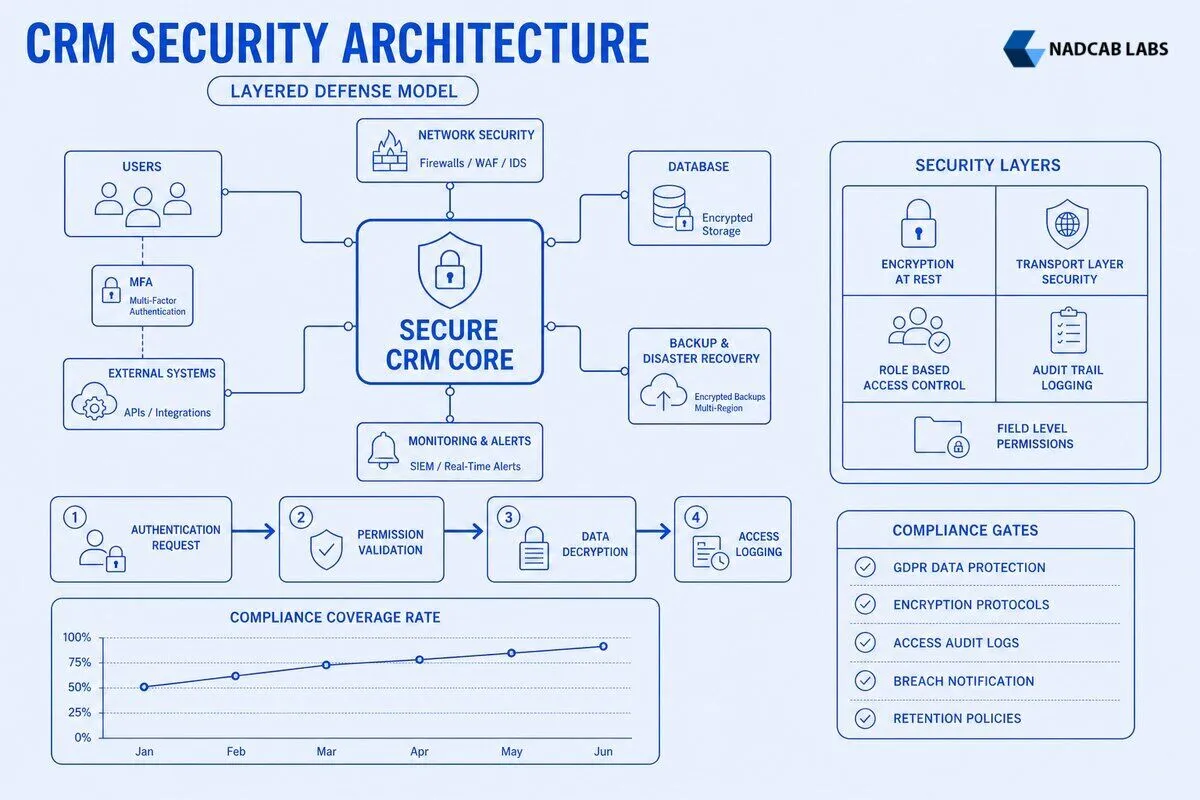
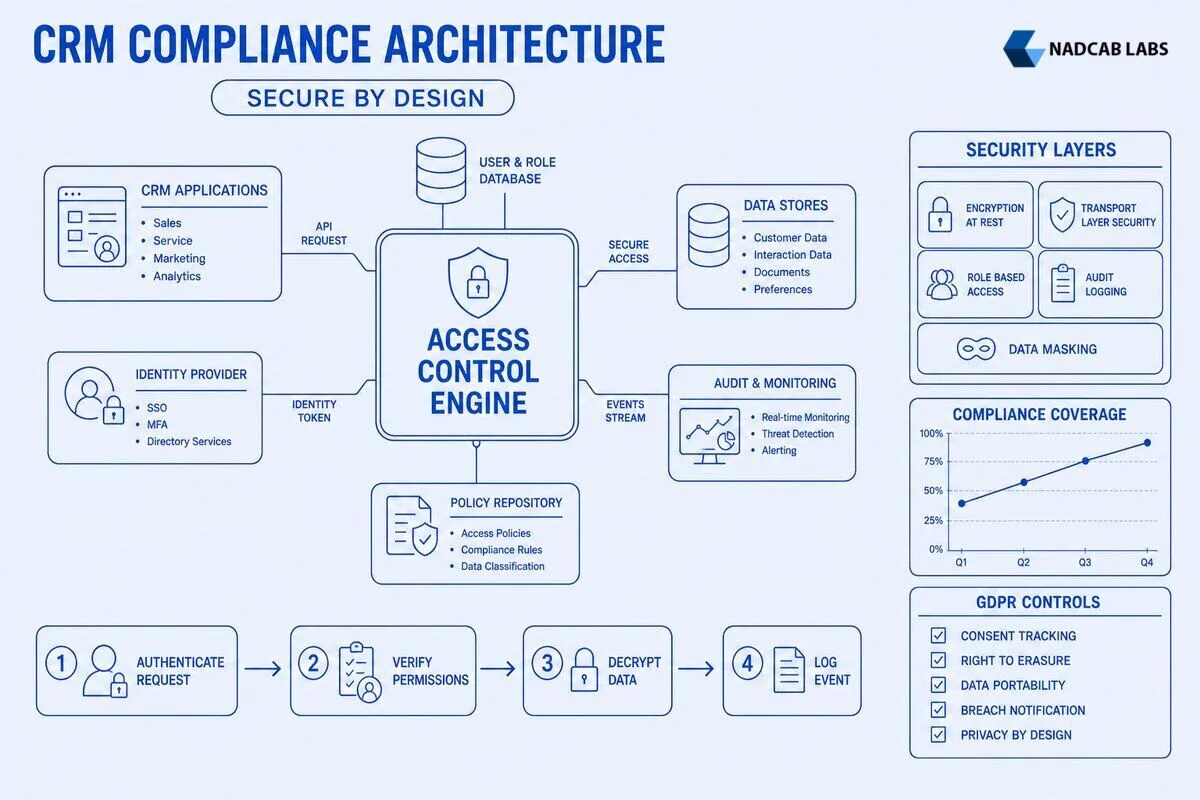
CRM data security is the set of technical controls, encryption protocols, and access policies that protect customer information stored in a CRM system from unauthorized access, breaches, and regulatory violations. A secure CRM architecture validates every authentication request, encrypts data at rest and in transit, logs every state change, and enforces role based permissions to ensure that only authorized users can read, modify, or export sensitive records. When a user attempts to access a customer record, the system must check credentials, verify permissions, decrypt the requested data, log the access event, and return only the fields that user is authorized to see.
Key Takeaways
- Regulatory penalties for CRM data breaches reach 4% of global revenue under GDPR and $7,500 per violation under CCPA, making compliance a financial imperative.
- Secure CRM architecture requires AES 256 encryption at rest, TLS 1.3 in transit, role based access control, multi factor authentication, and tamper proof audit logs.
- Discovery phase deliverables include a STRIDE threat model, compliance gap analysis matrix, and risk register mapping likelihood × impact scores for every data flow.
- Hardening tests must simulate SQL injection, privilege escalation, data exfiltration, and XSS attacks to validate that every failure mode degrades securely.
- Operational SLAs require real time anomaly detection for failed logins and unusual data exports, quarterly compliance audits, and annual third party security assessments.
- Integration with CRM Software Development services ensures compliance ready custom builds that align security controls with business workflows.
Why CRM Data Security and Compliance Matter for Teams Evaluating CRM Software
Organizations that handle customer data face immediate financial and reputational risk when CRM systems lack robust security controls. GDPR imposes fines up to 4% of global annual revenue for data protection violations, while CCPA penalties reach $7,500 per intentional violation and $2,500 per unintentional breach. In 2023, the average cost of a data breach involving CRM systems exceeded $4.45 million, with identification and containment taking an average of 287 days. These figures exclude the long term damage to customer trust, which manifests as churn rates increasing by 15 to 30% following a publicized breach. crm data security.
Customer trust erosion accelerates when organizations cannot demonstrate transparent data handling practices or provide verifiable audit trails. Modern buyers expect to see how their personal information flows through your systems, who accesses it, when modifications occur, and how long records persist. A CRM that cannot produce a complete access log for a specific customer record within minutes fails both regulatory expectations and customer confidence tests. This transparency gap becomes critical during compliance audits, where auditors demand proof that data subject access requests (DSARs) can be fulfilled within the 30 day GDPR window. crm data security.
Operational disruption from security incidents extends beyond immediate breach response. When an attacker gains unauthorized access to a CRM database, incident response teams must isolate affected systems, rotate credentials, analyze logs to determine data exposure scope, notify affected customers, and rebuild trust through remediation reports. During this period, sales teams lose access to pipeline data, support teams cannot retrieve customer history, and marketing automation stalls. The relationship management workflows that drive revenue grind to a halt until security teams can certify system integrity. crm data security.
The decision to implement comprehensive CRM data security and compliance controls is not optional for teams evaluating CRM software. Regulatory frameworks now mandate specific technical controls: GDPR requires encryption, pseudonymization, and regular security testing; HIPAA demands audit controls and transmission security for healthcare CRM deployments; PCI DSS enforces strict access control measures for CRM systems that store payment card data. Organizations that defer security architecture decisions during CRM selection and implementation phases face costly retrofits, regulatory fines, and competitive disadvantage as security conscious customers migrate to vendors with verifiable compliance postures.
| Regulation | Maximum Penalty | Key CRM Requirement | Validation Frequency |
|---|---|---|---|
| GDPR | €20M or 4% global revenue | Encryption, pseudonymization, DSAR fulfillment | Annual audit + breach notification within 72 hours |
| CCPA | $7,500 per intentional violation | Opt out mechanisms, data deletion on request | Quarterly compliance reviews |
| HIPAA | $1.5M per violation category per year | Audit controls, transmission security, access logs | Annual risk assessment + ongoing monitoring |
| PCI DSS | $5,000 to $100,000 per month non compliance | Tokenization, access control, quarterly scans | Quarterly vulnerability scans + annual audit |
Phase 1: Discovery, Mapping Data Flows, Threat Surfaces, and Compliance Requirements
The discovery phase begins with entry criteria validation: stakeholder interviews with sales, marketing, support, legal, and IT teams to identify every system that reads from or writes to the CRM database. Each interview session produces a data flow diagram showing how customer records enter the system (web forms, API integrations, CSV imports, third party connectors), where they persist (primary database, cache layers, backup archives, analytics warehouses), and who accesses them (internal users, external partners, automated processes). A complete data inventory classifies every field as personally identifiable information (PII), payment data, behavioral logs, or non sensitive metadata, then maps each category to applicable regulatory frameworks. crm data security.
Jurisdiction mapping determines which regulations govern your CRM data based on customer location, business entity registration, and data processing activities. Organizations often use entity management software to maintain accurate records of legal entities, subsidiaries, ownership structures, and jurisdiction-specific compliance requirements. A company headquartered in the United States that processes EU citizen data must comply with GDPR; a healthcare provider storing patient interaction history falls under HIPAA; a payment processor integrating with the CRM must meet PCI DSS requirements. This mapping exercise produces a compliance matrix showing which controls apply to which data types in which jurisdictions. For example, GDPR requires that EU citizen data be encrypted both at rest and in transit, while CCPA mandates that California residents can request deletion of their data within 45 days. crm data security.
The STRIDE threat model structures security analysis around six categories: Spoofing (can an attacker impersonate a legitimate user?), Tampering (can data be modified without detection?), Repudiation (can a user deny performing an action?), Information Disclosure (can unauthorized parties read sensitive data?), Denial of Service (can the system be made unavailable?), and Elevation of Privilege (can a low privilege user gain admin access?). Each threat category maps to specific CRM attack vectors: spoofing attacks target weak authentication mechanisms; tampering exploits missing input validation; repudiation succeeds when audit logs lack cryptographic signatures; information disclosure occurs through misconfigured API endpoints; denial of service attacks overwhelm rate limiters; privilege escalation exploits flawed role hierarchies. crm data security.
Deliverables from the discovery phase include a threat model document listing every identified attack vector with assigned likelihood (1 to 5) and impact (1 to 5) scores, a compliance gap analysis matrix showing which required controls are missing or incomplete, and a risk register prioritizing remediation work based on likelihood × impact product. A typical risk register entry reads: “Threat: SQL injection via customer search form. Likelihood: 4 (publicly exposed endpoint, no input sanitization). Impact: 5 (full database exposure). Mitigation: Implement parameterized queries, add Web Application Firewall rules, deploy input validation library. Owner: Backend team. Deadline: Sprint 3.” crm data security.
Failure modes in the discovery phase stem from incomplete data classification and missed integration points. When teams overlook that their CRM exports customer lists to a third party email marketing platform, they fail to account for cross border data transfers and miss the need for Standard Contractual Clauses or Binding Corporate Rules under GDPR. Similarly, classifying mobile device IDs as non sensitive metadata ignores that GDPR treats device identifiers as personal data, triggering consent requirements and right to erasure obligations. These gaps surface during audits as non compliance findings that require expensive retrofits and potential regulatory penalties. The CRM Architecture must account for every data flow, including those managed by third party integrations and background processes. crm data security.
Phase 2: Design, Architecting Security Layers, Encryption Standards, and Access Controls
Security architecture design starts with defining encryption standards for data at rest and in transit. AES 256 encryption protects data stored in the CRM database, ensuring that even if an attacker gains file system access, they cannot read customer records without the encryption keys. Key management follows a hierarchical model: a master key stored in a hardware security module (HSM) or cloud key management service (AWS KMS, Azure Key Vault) encrypts data encryption keys (DEKs) that protect individual database tables or file storage buckets. Key rotation policies mandate that DEKs rotate every 90 days, with the system automatically re encrypting data using the new key while maintaining access to old keys for decryption of historical records. crm data security.
Transport layer security uses TLS 1.3 to encrypt all data moving between clients and servers, between microservices, and between the CRM and external APIs. TLS 1.3 eliminates weak cipher suites present in earlier versions, mandates forward secrecy (so compromising today’s keys cannot decrypt past sessions), and reduces handshake latency from two round trips to one. Certificate management automates renewal through ACME protocol integration with Let’s Encrypt or enterprise certificate authorities, preventing the common failure mode where expired certificates break API integrations and lock users out of the system.
Role based access control (RBAC) implements the principle of least privilege by granting each user only the permissions required for their job function. A sales representative role permits reading and updating opportunity records but blocks access to financial data or system configuration settings. An administrator role allows user management and system configuration but logs every administrative action for audit review. Permission checks occur at multiple layers: the application validates that the authenticated user’s role includes the requested permission before issuing a database query; the database enforces row level security policies that filter results based on user attributes; API gateways reject requests that lack valid authorization tokens.
Multi factor authentication (MFA) requires users to present two independent credentials: something they know (password), something they have (TOTP token from an authenticator app, hardware security key), or something they are (biometric). The authentication flow proceeds as follows: user submits username and password → backend validates credentials against the identity store → system generates a challenge and sends it to the user’s registered MFA device → user responds with the correct TOTP code or approves the push notification → backend validates the MFA response and issues a short lived JWT token → subsequent API requests include this token in the Authorization header → token validation middleware checks signature, expiration, and revocation status before allowing the request to proceed.
| Component | Build Option | Buy Option | Decision Criteria |
|---|---|---|---|
| Identity Management | Custom OAuth2 + JWT implementation | Okta, Auth0, Azure AD | Buy if time to market < 6 months; build if unique federation requirements |
| Audit Logging | Event sourcing with Kafka + Elasticsearch | Splunk, Datadog, AWS CloudTrail | Build if log volume > 1TB/day or custom retention policies; buy otherwise |
| Encryption Key Management | HashiCorp Vault with custom policies | AWS KMS, Azure Key Vault, GCP KMS | Buy for cloud native deployments; build for multi cloud or on premises HSM integration |
| API Rate Limiting | Redis based token bucket algorithm | Kong, AWS API Gateway, Apigee | Build if custom rate limit logic per customer tier; buy for standard API management |
The decision between monolithic and microservices architecture affects audit log isolation and failure domain boundaries. In a monolithic CRM, a single application server handles authentication, business logic, and data access, with audit events written to a shared log table. This simplifies deployment but creates a single point of failure: a vulnerability in the customer search module can expose the entire database. A microservices architecture isolates authentication (identity service), customer data (customer service), and audit logging (audit service) into separate processes with independent databases. Each service exposes a REST or gRPC API, communicates over encrypted channels, and writes audit events to a dedicated log stream. When the customer service receives a data access request, it validates the JWT token by calling the identity service, retrieves the requested record from its database, logs the access event to the audit service, and returns only the fields the requester is authorized to view.
State changes in the authentication and authorization flow must fail securely at every step. If the identity service is unavailable, API requests return 503 Service Unavailable rather than bypassing authentication. If a JWT token signature validation fails, the request is rejected with 401 Unauthorized, and the failure is logged as a potential attack. If a user’s role lacks the required permission, the system returns 403 Forbidden and logs the attempted privilege escalation. If the database query times out, the system rolls back any partial state changes and returns 500 Internal Server Error, ensuring that no incomplete data modifications persist. This fail secure design prevents attackers from exploiting transient failures to bypass security controls. Integration with CRM Features ensures that security controls align with functional requirements like contact management, pipeline tracking, and reporting.
Phase 3: Build and Harden, Implementing Controls, Testing Failure Scenarios, and Validation
Build deliverables translate the security design into running code and configuration. Encrypted database schemas use transparent data encryption (TDE) at the storage layer, with column level encryption for highly sensitive fields like social security numbers or payment card data. The application layer decrypts these fields only when a user with explicit permission requests them, and the decryption operation is logged. Database connection strings reference encrypted credentials stored in a secrets management system, never hardcoded in application configuration files or environment variables.
API rate limiters implement a token bucket algorithm: each client receives a bucket with a fixed capacity (e.g., 100 requests) that refills at a constant rate (e.g., 10 requests per minute). When a request arrives, the system checks if the bucket contains at least one token; if so, it consumes a token and processes the request; if not, it rejects the request with 429 Too Many Requests. The rate limiter tracks buckets in Redis, keyed by client IP address or API key, with expiration times that automatically clean up stale entries. This prevents denial of service attacks where an attacker floods the API with requests, and it mitigates brute force password guessing by limiting login attempts.
Session timeout logic invalidates authentication tokens after a period of inactivity (typically 15 to 30 minutes) and enforces an absolute maximum session duration (typically 8 to 12 hours). When a user’s session expires, the system redirects them to the login page and clears any cached credentials. Sensitive operations like changing a password or exporting customer data require re authentication even within an active session, a pattern known as step up authentication. This limits the window of opportunity for an attacker who gains access to an unlocked workstation or steals a session token.
Automated backup with point in time recovery ensures that data can be restored to any moment within the retention window (typically 30 days). Backup processes encrypt data before writing to storage, use separate encryption keys from production systems, and store backups in a different geographic region to protect against regional outages. Recovery testing runs monthly: a designated team member restores a subset of data to a staging environment, validates that records match production state at the backup timestamp, and documents the time required to complete the restore operation. This testing surfaces issues like missing indexes, incorrect permissions, or corrupted backup files before an actual disaster occurs.
Secure CRM Data Access Flow
Each step validates state and fails securely if validation fails, preventing partial execution that could leak data or grant unauthorized access.
Hardening tests simulate real world attack scenarios to validate that security controls function correctly under adversarial conditions. Penetration testing follows the OWASP Top 10 methodology, probing for injection flaws, broken authentication, sensitive data exposure, XML external entities, broken access control, security misconfiguration, cross site scripting, insecure deserialization, using components with known vulnerabilities, and insufficient logging and monitoring. Each test produces a report listing discovered vulnerabilities, proof of concept exploits, affected components, and recommended fixes.
SQL injection tests attempt to manipulate database queries by injecting malicious input into form fields, URL parameters, and API request bodies. A vulnerable customer search endpoint that constructs queries via string concatenation (SELECT * FROM customers WHERE name = ‘” + userInput + “‘) allows an attacker to inject userInput = “‘ OR ‘1’=’1” to bypass filters and retrieve all records. The hardening test confirms that parameterized queries or ORM frameworks prevent this attack by treating user input as data, never as executable SQL code.
Privilege escalation probes test whether a low privilege user can modify their role assignment, access administrative endpoints, or manipulate API requests to retrieve data outside their authorization scope. A common failure mode occurs when the application checks permissions only in the UI layer but not in the API layer, allowing an attacker to craft direct API requests that bypass UI restrictions. The test validates that every API endpoint performs authorization checks before executing business logic, and that role assignments are stored in a tamper proof audit log.
Data exfiltration simulations measure how quickly the system detects and blocks abnormal data export patterns. An attacker who gains access to a sales representative’s account might attempt to export the entire customer database via the CRM’s bulk export feature. The hardening test confirms that anomaly detection rules trigger alerts when a user exports more than their typical volume (e.g., 10x their 30 day average), that export operations require approval from a manager for volumes exceeding a threshold, and that exported files are encrypted and tracked in the audit log.
Production pitfalls identified during hardening tests include misconfigured cloud storage buckets that allow public read access, missing input sanitization that permits cross site scripting attacks, and audit logs that lack cryptographic signatures allowing attackers to delete evidence of their activity. A misconfigured S3 bucket storing CRM backup files with public read permissions was the root cause of multiple high profile breaches where attackers discovered exposed buckets through automated scanning tools. The fix involves setting bucket policies to deny public access, enabling server side encryption, and configuring access logging to track every read and write operation. Similar principles apply to blockchain cold chain compliance, where immutable audit trails prevent tampering with supply chain records.
Phase 4: Operate, Continuous Monitoring, Incident Response, and Compliance Audits
Operational security for CRM systems requires real time monitoring of authentication events, data access patterns, and system health metrics. Anomaly detection rules trigger alerts when failed login attempts from a single IP address exceed five within a 10 minute window, suggesting a brute force attack. Additional rules flag unusual data export volumes (a user downloading 10,000 customer records when their 30 day average is 50), geographic anomalies (a user logging in from two countries within an hour), and privilege changes (a non administrator account being granted admin permissions). Each alert routes to a security operations center (SOC) queue where analysts triage the event, investigate the context, and escalate to incident response if malicious activity is confirmed.
Quarterly compliance audits verify that implemented controls remain effective and that no configuration drift has introduced vulnerabilities. The audit process reviews access control lists to confirm that terminated employees no longer have active accounts, validates that encryption keys have rotated according to policy, checks that all API endpoints enforce rate limiting, and samples audit logs to verify completeness. Auditors request evidence for each control: screenshots of firewall rules, exports of user role assignments, database query plans showing that row level security policies are active, and incident response playbooks demonstrating that the team can detect and contain a breach within the required timeframe.
Annual third party security assessments provide independent validation of the CRM’s security posture. A qualified security assessor (QSA) conducts penetration testing, reviews architecture diagrams, interviews engineering and security teams, and produces a report detailing findings and recommendations. For organizations subject to PCI DSS, this assessment is mandatory and results in an Attestation of Compliance (AOC) that must be renewed annually. For HIPAA covered entities, a similar assessment validates that the CRM meets the Security Rule’s administrative, physical, and technical safeguards.
Service level agreements (SLAs) for security operations define response times and escalation procedures. A critical security incident (active data breach, ransomware infection, credential compromise) triggers immediate response within 15 minutes, with executive notification within one hour. A high severity incident (vulnerability with known exploits, failed compliance audit finding) requires response within four hours and remediation within 48 hours. Medium and low severity issues follow standard sprint planning cycles but are tracked in a risk register to ensure they do not accumulate into a larger problem. The trading bot security architecture demonstrates similar real time monitoring principles for high frequency financial systems.
Stakeholder sign off ensures that security and compliance responsibilities are clearly assigned and that decision makers understand the risk trade offs. The data protection officer (DPO) reviews and approves all data processing activities, ensuring they comply with GDPR’s lawful basis requirements and that data retention periods align with business needs and regulatory mandates. Legal counsel reviews privacy policies, terms of service, and data processing agreements with third party vendors to ensure they include required clauses like Standard Contractual Clauses for cross border transfers. Executive leadership signs off on the incident response playbook, acknowledging that they understand the potential impact of a security incident and have allocated budget for response activities, customer notification, and regulatory reporting.
CRM Security Metric Tracking
These metrics feed into executive dashboards and compliance reports, demonstrating continuous improvement and proactive risk management.
Incident response playbooks document step by step procedures for common security scenarios. A credential compromise playbook specifies: (1) disable the affected account within 15 minutes, (2) force password reset for all users in the same department, (3) review audit logs for the past 30 days to identify accessed records, (4) notify affected customers if their data was viewed or exported, (5) file a breach notification with regulators if the incident meets reporting thresholds, (6) conduct a post incident review to identify root cause and implement preventive controls. Each step includes assigned roles (who executes the step), communication protocols (who needs to be informed), and decision trees (when to escalate to legal, when to engage external forensics).
Next steps for teams implementing CRM data security and compliance controls involve integrating these technical measures with business processes and continuous improvement cycles. Organizations should establish a security steering committee that meets quarterly to review risk registers, approve security roadmap priorities, and allocate budget for tools and training. Engineering teams should adopt secure development practices like threat modeling during design reviews, static code analysis in CI/CD pipelines, and security testing as part of acceptance criteria. Sales and marketing teams should receive training on data handling policies, recognizing phishing attempts, and escalating suspicious activity.
Integration with CRM Software Development services ensures that security and compliance requirements are embedded from the initial architecture phase rather than retrofitted after deployment. Custom CRM builds allow organizations to implement industry specific controls (HIPAA for healthcare, FINRA for financial services, FedRAMP for government contractors) and integrate with existing identity providers, security information and event management (SIEM) systems, and data loss prevention (DLP) tools. This approach contrasts with off the shelf CRM platforms where organizations must accept the vendor’s security model and hope it aligns with their regulatory obligations.
Linking security metrics to customer retention KPIs demonstrates the business value of compliance investments. Organizations that can prove robust data protection practices through third party certifications (SOC 2 Type II, ISO 27001, PCI DSS) win competitive deals where security is a decision criterion. Customers increasingly request evidence of security controls during vendor evaluations, and those that cannot produce audit reports, penetration test results, and incident response documentation lose opportunities to competitors with verifiable security postures. The Compliance and Security practices at Nadcab Labs reflect this integration of technical controls with business outcomes, positioning security as a revenue enabler rather than a cost center.
Advanced security patterns for CRM systems include zero trust architecture where every request is authenticated and authorized regardless of network location, blockchain based audit trails that provide tamper proof evidence of data access and modifications, and homomorphic encryption that allows computations on encrypted data without decryption. These emerging techniques address limitations in traditional security models: zero trust eliminates the “trusted internal network” assumption that attackers exploit through lateral movement; blockchain audit trails prevent attackers from covering their tracks by deleting log entries; homomorphic encryption enables analytics and machine learning on sensitive customer data without exposing plaintext records. Organizations exploring these advanced patterns should evaluate trade offs in performance, complexity, and operational overhead against the incremental security benefits. The DID resolver implementation and crypto payment gateway compliance articles provide additional context on decentralized identity and financial transaction security.
The phased delivery framework presented here ensures that CRM data security and compliance controls are implemented systematically, validated rigorously, and operated continuously. Each phase builds on the previous one: discovery identifies what needs protection, design specifies how to protect it, build and harden implement and test the controls, and operate maintains effectiveness over time. Stakeholder sign off at each phase gate ensures alignment between technical implementation and business requirements, preventing the common failure mode where security teams build controls that do not address the organization’s actual risk profile or compliance obligations. This structured approach transforms CRM security from a checkbox exercise into a competitive advantage that builds customer trust and enables business growth.
Final Thoughts
CRM data security and compliance is not a one time project but a continuous operational discipline that protects customer trust, prevents regulatory penalties, and enables business growth. The phased implementation framework presented here structures this work as discovery, design, build and harden, and operate phases, each with defined entry criteria, deliverables, failure modes, and stakeholder sign off requirements. Organizations that follow this approach systematically address threat surfaces, implement defense in depth controls, validate effectiveness through rigorous testing, and maintain security posture through continuous monitoring and auditing.
The technical controls detailed in this article represent the minimum viable security architecture for modern CRM systems: AES 256 encryption at rest, TLS 1.3 in transit, role based access control with least privilege, multi factor authentication, tamper proof audit logs, automated backup with point in time recovery, and real time anomaly detection. Each control addresses specific attack vectors identified in the STRIDE threat model and satisfies requirements from GDPR, CCPA, HIPAA, and PCI DSS. Implementation decisions around build versus buy, monolith versus microservices, and cloud versus on premises deployment affect architecture complexity, operational overhead, and integration flexibility, but the core security principles remain constant across all deployment models.
Teams evaluating CRM software should prioritize vendors and implementation partners that demonstrate verifiable security practices through third party certifications, transparent architecture documentation, and responsive incident handling. The integration of security controls with CRM Software Development services ensures that compliance requirements shape system design from the start, avoiding costly retrofits and reducing time to regulatory approval. Organizations that treat security as a competitive differentiator rather than a compliance burden position themselves to win security conscious customers, command premium pricing, and build sustainable competitive advantage in markets where data protection is a primary buying criterion.
Frequently Asked Questions
Q1.What is CRM data security and why does it matter for compliance?
CRM data security encompasses encryption, access controls, audit logging, and data residency mechanisms protecting customer records in a CRM database. It matters because regulations like GDPR, CCPA, and HIPAA mandate specific technical safeguards: data breach penalties reach 4% of global revenue under GDPR, and non compliance triggers lawsuits, regulatory fines, and customer trust erosion. Secure CRM architecture prevents unauthorized reads, lateral movement after credential compromise, and data exfiltration during API calls or export operations.
Q2.How does GDPR impact CRM data protection requirements?
GDPR mandates lawful basis for processing, purpose limitation, data minimization, and the right to erasure for EU residents. CRM systems must implement pseudonymization or anonymization for analytics pipelines, log every data access with timestamp and user identity, provide API endpoints for subject access requests, and delete or anonymize records within 30 days of a deletion request. Cross border transfers require Standard Contractual Clauses or Binding Corporate Rules; storing EU data on US servers without adequacy decision violates Article 44.
Q3.What encryption standards should a secure CRM system use?
Use AES 256 GCM for data at rest with envelope encryption: each record encrypted under a data encryption key, DEKs wrapped by a master key in AWS KMS or HashiCorp Vault. TLS 1.3 with forward secrecy for transit; disable TLS 1.2 cipher suites lacking AEAD. Field level encryption for PII columns prevents database admin access. Rotate master keys annually, DEKs every 90 days. Hash passwords with Argon2id, cost parameter 3, 64 MiB memory. Avoid ECB mode, SHA1, and RSA below 2048 bits.
Q4.How do role-based access controls work in CRM systems?
RBAC assigns permissions to roles, then roles to users. A CRM defines roles like Sales Rep, Manager, Admin; each role maps to a permission set specifying read, write, delete on objects like Contact, Opportunity, Case. At query time, the ORM injects a WHERE clause filtering records by ownership or territory hierarchy. Attribute based access control extends RBAC: a policy might allow read if user.region equals record.region AND record.status not equals archived. Implement least privilege: deny by default, grant only necessary scopes.
Q5.What are common security failure modes in CRM implementations?
Insecure API keys hardcoded in mobile apps or JavaScript allow credential theft. Missing rate limits on login endpoints enable credential stuffing; absent CAPTCHA after three failures compounds risk. SQL injection through unsanitized search filters bypasses ORM protections. Overly permissive CORS headers let malicious sites exfiltrate data via authenticated user sessions. Unencrypted backups stored in S3 buckets with public read ACLs leak entire customer databases. Lack of session timeout or token revocation leaves stale JWTs valid for hours after logout.
Q6.How often should CRM systems undergo compliance audits?
Conduct internal audits quarterly: review access logs, test backup restoration, verify encryption key rotation, scan for CVEs in dependencies. Annual third party penetration tests simulate attacker tactics; schedule after major feature releases. SOC 2 Type II audits run annually with continuous monitoring; auditors sample three to six months of logs. GDPR Article 32 requires ongoing assessment; document each audit in a compliance register. Post breach, immediate forensic audit within 72 hours to satisfy notification deadlines and identify root cause for remediation.
Explore Services
Related Services
Reviewed by

Naman Singh
Co-Founder & CEO, Nadcab Labs
Naman Singh is the Co-Founder and CEO of Nadcab Labs, where he drives the company’s vision, global growth, and strategic expansion in blockchain, fintech, and digital transformation. A serial entrepreneur, Naman brings deep hands-on experience in building, scaling, and commercializing technology-driven businesses. At Nadcab Labs, Naman works closely with enterprises, governments, and startups to design and implement secure, scalable, and business-ready Web3 and blockchain solutions. He specializes in transforming complex ideas into high-impact digital products aligned with real business objectives. Naman has led the development of end-to-end blockchain ecosystems, including token creation, smart contracts, DeFi and NFT platforms, payment infrastructures, and decentralized applications. His expertise extends to tokenomics design, regulatory alignment, compliance strategy, and go-to-market planning—helping projects become investor-ready and built for long-term sustainability. With a strong focus on real-world adoption, Naman believes in building blockchain solutions that deliver measurable value, solve practical problems, and unlock new growth opportunities for organizations worldwide.