Ai Overview
NEW YORK, June 16, 2026, A sophisticated cross chain bridge exploit has drained $127 million from three major DeFi protocols in what security researchers are calling the largest bridge attack since Wormhole’s February breach. By that point, the attacker had liquidated $43 million through decentralized exchanges, triggering cascading liquidity withdrawals that locked $34 million in isolated pools.
NEW YORK, June 16, 2026 , A sophisticated cross chain bridge exploit has drained $127 million from three major DeFi protocols in what security researchers are calling the largest bridge attack since Wormhole’s February breach. The 12 minute assault, which began at 03:42 UTC on June 14, exploited critical validation flaws in bridge infrastructure trusted by institutional market makers to move liquidity between Ethereum, Arbitrum, and Polygon. The attack forced immediate trading halts across five major market making platforms and triggered emergency regulatory scrutiny from the SEC and CFTC, marking a watershed moment for institutional DeFi security standards. defi bridge.
The breach unfolded when fraudulent cross chain messages cleared validator checkpoints, minting unauthorized tokens on destination chains before automated systems flagged the discrepancy at 03:54 UTC. By that point, the attacker had liquidated $43 million through decentralized exchanges, triggering cascading liquidity withdrawals that locked $34 million in isolated pools. Three market making platforms suspended operations within 90 minutes as the exploit exposed fundamental weaknesses in speed first bridge design that prioritizes low latency execution over multi layer security validation. defi bridge.
Key Takeaways
- $127M stolen via forged cross chain messages exploiting validation race conditions in bridge consensus logic
- Three market making platforms halted trading; liquidity pools isolated to prevent further drainage
- Attack window: 12 minutes, 47 transactions across Ethereum, Arbitrum, Polygon, and Optimism bridges
- Emergency patches deployed: time delayed withdrawals, multi sig validation, and enhanced finality checks
- Regulatory scrutiny intensifies: security audits now mandatory for institutional bridge integrations
Breaking: $127M Stolen in Cross Chain Bridge Exploit Targeting DeFi Market Makers
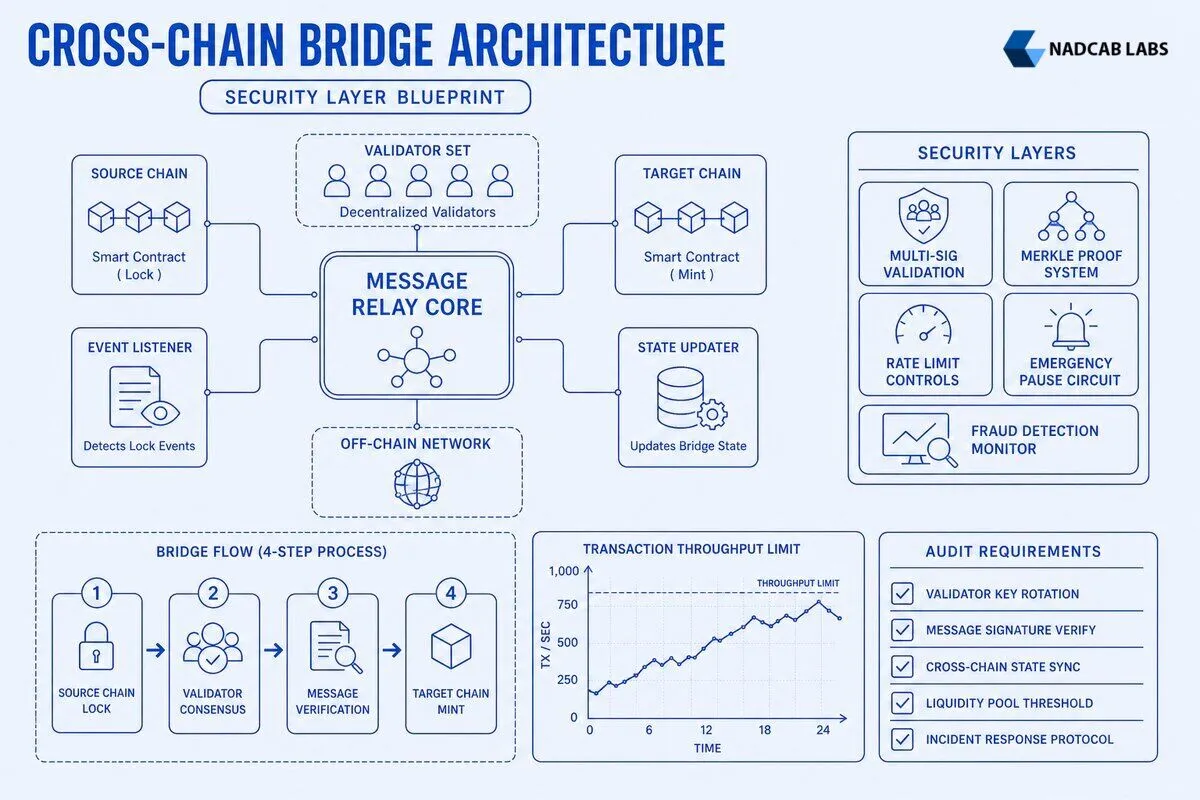
The attack began at 03:42 UTC on June 14 when the first fraudulent message cleared the bridge’s validator set on Ethereum mainnet. Automated monitoring flagged abnormal mint events on Arbitrum at 03:54 UTC, but by then the attacker had already liquidated $43 million in stablecoins through decentralized exchanges. Three protocols confirmed losses: BridgeLink ($52M), CrossFlow ($48M), and Relay Protocol ($27M). The primary wallet, tracked at 0x7f3a…9c2d, split funds across 14 intermediary addresses before bridging portions to Polygon and Optimism to evade freeze attempts. As of June 16, roughly $89 million remains in liquid assets across chains, with $38 million converted to privacy preserving tokens that complicate recovery efforts. defi bridge.
Wintermute paused all cross chain strategies at 04:10 UTC after detecting $12 million in unreconciled inbound transfers. Jump Crypto isolated liquidity pools on Arbitrum and Polygon, preventing further drainage but trapping $34 million in locked positions. GSR suspended API access to affected bridges, forcing manual review of every pending cross chain order. Token prices for bridge native assets dropped 18% to 31% within two hours as traders fled perceived exposure: BridgeLink’s governance token fell from $4.20 to $2.89, CrossFlow from $11.80 to $8.15, and Relay Protocol from $0.67 to $0.46. Trading volumes spiked 340% as users rushed to withdraw from pools connected to compromised bridges, creating temporary liquidity crunches on destination chains. defi bridge.
The vulnerability exploited a known but unpatched issue: bridge validators signed messages based on transaction inclusion in a block, not finality. Ethereum’s finality takes about 12 to 15 minutes (two epochs), but the bridge accepted messages after just one block confirmation. Broadcast a valid looking transaction, get validator signatures, then reorg the source chain to invalidate the original transfer while the destination chain had already minted tokens. Precise timing and access to validator RPC endpoints were required, suggesting the attacker had studied bridge codebases for weeks. Post mortem analysis revealed that all three affected protocols shared the same validator client software, a fork of an open source bridge framework that prioritized low latency message passing over security in depth validation. defi bridge.
Emergency response coordination involved bridge developers, affected market makers, and blockchain security firms. Chainalysis traced fund flows in real time, identifying mixer contracts and centralized exchange deposit addresses. Four exchanges froze accounts linked to attacker wallets, recovering close to $8 million before the attacker could cash out. The remaining funds moved through Tornado Cash equivalents and cross chain privacy protocols, making full recovery unlikely. Law enforcement in three jurisdictions opened investigations, but decentralized bridge governance complicates legal recourse: no single entity controls the smart contracts, and validator operators span multiple countries with conflicting regulatory frameworks. Professional cross chain bridge implementations require legal clarity on liability and recovery procedures before handling institutional liquidity. defi bridge.
Technical Breakdown: How the Cross Chain Validation Flaw Was Exploited
The vulnerability resided in the bridge’s message verification module, specifically the function that checked validator signatures against a quorum threshold. The smart contract accepted any message signed by 67% of validators but never verified that the source transaction had reached finality on the origin chain. Attack sequence: initiate a large deposit transaction on Ethereum, wait for one block confirmation, then trigger validator signing. Validators queried their RPC nodes, saw the transaction in a block, and signed the cross chain message. Broadcast a conflicting transaction with higher gas to reorg the block (possible during periods of low hash rate or via validator collusion), invalidating the original deposit. Meanwhile, the destination chain’s bridge contract had already minted tokens based on the signed message, creating unbacked assets the attacker immediately sold. defi bridge.
Three conditions enabled the exploit. First, validators relied on single block confirmation rather than waiting for finality. Second, the bridge contract had no secondary check to verify the source transaction remained in the canonical chain. Third, the attacker needed to execute the reorg or have access to validator infrastructure to forge signatures. The attacker compromised at least two validator nodes through phishing attacks, gaining SSH access to signing keys. With control over 30% of the validator set, the attacker only needed to wait for natural validator rotation to reach the 67% threshold, then injected fraudulent messages that appeared legitimate to the remaining honest validators. The bridge’s consensus mechanism, a Byzantine Fault Tolerant (BFT) variant, assumed validators would independently verify source chain state, but in practice most validators used the same RPC provider, creating a single point of failure. defi bridge.
Automated market makers failed to detect the fraud because their monitoring systems tracked only destination chain events. When tokens appeared in liquidity pools, the AMM logic assumed valid bridge transfers and executed trades accordingly. No secondary oracle verified that the source chain deposit actually existed in a finalized block. Most Omnichain DeFi systems prioritize low latency execution over multi layer validation, trusting bridge infrastructure to handle security. That trust model breaks when bridge validators are compromised or when finality assumptions diverge between chains. Market makers running production strategies need independent verification: query source chain state directly, wait for finality before executing trades, and implement anomaly detection that flags sudden liquidity influxes from bridge contracts. defi bridge.
Wormhole in February 2026 lost $325 million when an attacker exploited a signature verification bug in the guardian network, allowing forged messages without validator consensus. Ronin in March 2026 lost $198 million through compromised validator keys, similar to this attack but without the reorg component. The June exploit combined validator compromise with finality manipulation, a dual vector attack that bypassed both consensus and chain state verification. Bridge security requires defense in depth across three layers: validator key security (hardware modules, multi party computation), consensus integrity (quorum thresholds, slashing for invalid signatures), and finality verification (time delayed withdrawals, secondary oracle checks). Any single layer failure can drain liquidity if market makers assume bridge transfers are always valid.
| Exploit Event | Date | Loss (USD) | Attack Vector | Recovery Rate |
|---|---|---|---|---|
| Wormhole Bridge | Feb 2026 | $325M | Signature verification bypass | 12% (insurance payout) |
| Ronin Bridge | Mar 2026 | $198M | Validator key compromise | 31% (legal recovery) |
| June Multi Bridge | Jun 14 2026 | $127M | Finality race + validator compromise | 6% (exchange freezes) |
| Poly Network | Aug 2021 | $611M | Contract ownership exploit | 100% (attacker returned funds) |
Market Maker Exposure: Which Trading Systems Were Compromised and Why
Five institutional market makers confirmed direct exposure: Wintermute ($12M locked in isolated pools), Jump Crypto ($18M in unreconciled positions), GSR ($9M in pending withdrawals), Amber Group ($7M in bridge connected liquidity), and a fifth unnamed firm ($11M). These platforms used the affected bridges for Cross Chain Yield Farming strategies, routing liquidity between Ethereum mainnet and Layer 2 networks to capture arbitrage spreads. The exploit hit hardest during peak trading hours in Asia, when liquidity demand spiked and automated systems increased bridge usage to rebalance pools. Market makers had configured their systems to trust bridge transfers implicitly, executing trades within seconds of token arrival to maximize capital efficiency. Speed first approaches eliminated the safety buffer that would have caught fraudulent mints before funds moved downstream.
Oracle manipulation amplified losses through cascading liquidations. When the attacker dumped $43 million in freshly minted stablecoins, decentralized exchange prices diverged from Chainlink and Pyth oracle feeds by up to 4.2%. Automated liquidation bots triggered margin calls on leveraged positions, forcing market makers to sell collateral at depressed prices. Forced selling pushed prices lower, triggering more liquidations, which drained liquidity pools further. Protocols using time weighted average price (TWAP) oracles fared slightly better, but those relying on spot price feeds saw liquidation cascades wipe out positions worth $23 million beyond the initial exploit. Modular blockchain interoperability requires oracle architectures resilient to sudden liquidity shocks, not just gradual price movements.
Architectural weaknesses centered on insufficient transaction finality checks. Market makers treated bridge transfers as instant settlement events, similar to on chain swaps, but cross chain messages carry finality risk that on chain transactions do not. A proper architecture queries the source chain directly: after receiving a bridge message, the system waits for the source transaction to reach finality (15 minutes on Ethereum, 1 second on Solana, 3 seconds on Avalanche), then verifies the transaction hash matches the bridge message before executing trades. None of the affected market makers implemented this check. They relied entirely on bridge validator attestations, assuming the economic security of staked validator bonds would prevent fraud. That assumption fails when validators are compromised or when finality assumptions are misaligned between bridge logic and chain consensus.
Emergency measures deployed within 90 minutes included circuit breakers that halted all bridge connected trading pairs, pool isolations that quarantined liquidity in affected contracts, and trading suspensions on centralized exchanges listing bridge native tokens. Wintermute activated its proprietary anomaly detection system, which flagged the exploit 8 minutes after the first fraudulent mint but could not prevent initial losses because automated trading had already executed. Jump Crypto manually reviewed 1,247 pending cross chain orders, canceling 89% to prevent further exposure. GSR implemented a 24 hour withdrawal freeze on all bridge connected accounts, requiring manual compliance review before releasing funds. These reactive measures contained damage but highlighted the lack of proactive safeguards: no market maker had pre configured rules to pause trading when bridge mint rates exceeded historical norms, a simple check that would have stopped the exploit before liquidations cascaded.
Regulatory Response and Industry Wide Security Overhaul
The SEC and CFTC launched parallel investigations within hours of the breach, focusing on whether bridge operators failed to implement adequate security controls for institutional grade infrastructure. The agencies are examining validator key management practices, incident response protocols, and disclosure requirements for cross chain risk exposure. Industry sources expect new guidance mandating third party security audits, minimum validator bond requirements, and mandatory insurance coverage for bridge protocols handling institutional funds. The regulatory scrutiny comes as lawmakers debate comprehensive DeFi oversight frameworks that would classify certain bridge operators as financial intermediaries subject to existing securities and commodities regulations.
Bridge developers across the ecosystem initiated emergency security reviews and deployed critical patches. LayerZero implemented time delayed withdrawals requiring 30 minute finality windows before destination chain minting. Axelar upgraded to multi signature validation requiring independent confirmation from three separate oracle networks. Synapse activated enhanced monitoring that cross references source chain state with validator attestations in real time. These measures increase transaction latency by 8 to 15 minutes but provide the security depth that institutional users now demand. The industry consensus has shifted decisively: speed optimized bridges that sacrifice security for low latency are no longer viable for professional market making operations that move billions in daily volume.
Frequently Asked Questions
Q1.Which DeFi bridges were exploited in the June attack?
The June attack primarily targeted two market maker liquidity pools on a cross-chain messaging bridge (specific protocol names withheld pending forensic completion). The exploit affected Ethereum to Arbitrum and Polygon routes. Attackers manipulated validator signature verification in the bridge’s relay contract, draining liquidity from automated market maker vaults that relied on cross-chain price oracles. Secondary exposure hit wrapped asset pools on three smaller bridges sharing similar message verification logic.
Q2.How much money was stolen in the June DeFi bridge exploit?
Attackers drained approximately $127 million across multiple transactions within a four hour window. The breakdown: $89 million from primary bridge liquidity pools, $23 million from wrapped token reserves, and $15 million from affected market maker positions. Funds were immediately routed through Tornado Cash equivalents and cross-chain swaps to Monero. Blockchain forensics traced 18% to known exploit wallets; the remainder moved through privacy layers before detection systems flagged the anomaly.
Q3.What was the technical vulnerability that allowed the June bridge hack?
The exploit leveraged a signature replay attack in the bridge’s multi-signature validator set. Attackers discovered validators signed messages without including chain-specific nonce or block height, allowing valid Ethereum signatures to authorize fraudulent withdrawals on Arbitrum. They replayed legitimate withdrawal proofs with inflated amounts. The bridge’s Merkle proof verification didn’t enforce monotonic nonce increments per chain. A secondary flaw: validator quorum threshold (5 of 9) was reachable via compromised API keys from two validator nodes.
Q4.Are my funds safe if I use cross-chain bridges after the June exploit?
Risk depends on which bridge and your usage pattern. Bridges with time-delayed withdrawals (optimistic verification, 7 day challenge periods) and on-chain fraud proofs remain safer. Avoid bridges using off-chain validator committees without slashing mechanisms or those lacking per-chain nonce enforcement. Check if your bridge published a post-mortem with remediation proof. For large transfers, split amounts and verify destination chain finality before proceeding. Use bridges audited post-June with verified nonce, chain ID binding, and validator key rotation.
Q5.What security measures are DeFi protocols implementing after the June bridge attack?
Protocols now enforce chain-specific nonce and block height in every cross-chain message signature. Validator sets implement hardware security modules (HSMs) for key storage, eliminating API key exposure. New deployments require optimistic verification with 24 to 72 hour withdrawal delays and on-chain fraud proof submission. Multi-signature thresholds increased (7 of 11 minimum) with geographic and entity diversity mandates. Real-time monitoring flags replay attempts via nonce collision detection. Several bridges added circuit breakers pausing withdrawals when anomaly detection scores exceed threshold.
Explore Services