Ai Overview
The shift from manual workflows to AI Copilot Automation represents a fundamental change in how work is structured rather than merely how fast it is executed. Business process optimization through AI Copilot Automation operates across three dimensions simultaneously: speed optimization, quality optimization, and cost optimization. Rule-based automation handles high-volume, perfectly structured, rule-deterministic tasks with exceptional efficiency and at lower cost per transaction than AI Copilot Automation.
Key Takeaways
- ›AI Copilot Automation transforms traditional workflows by shifting human effort from execution and information retrieval tasks to judgment, creativity, and strategic decision-making roles that add irreplaceable value.
- ›Unlike rule-based automation that requires pre-defined paths for every scenario, AI Copilot Automation handles novel situations through contextual reasoning, dramatically expanding the scope of automatable workflow scenarios.
- ›Enterprises deploying AI Copilot Automation in India, UAE, and the US report average workflow completion time reductions of 35 to 60 percent across the first year of implementation across all major business functions.
- ›AI Copilot Automation in task orchestration systems enables intelligent routing, priority management, and resource allocation that static workflow engines cannot match in dynamic business environments.
- ›Team collaboration quality improves measurably with AI Copilot Automation because the system handles coordination overhead, meeting preparation, and information synthesis that currently fragment collaborative work into administrative burdens.
- ›Business decision quality improves with AI Copilot Automation because decisions are made with access to complete, current, and synthesized information rather than the partial, delayed data available through manual information gathering.
- ›AI Copilot Automation enables continuous workflow improvement through real-time performance monitoring, anomaly detection, and intelligent suggestions for process optimization that static workflows cannot provide.
- ›Workflow redesign is a prerequisite for effective AI Copilot Automation adoption; organizations that simply layer AI tools onto unchanged manual processes capture only 20 to 30 percent of the available automation value.
- ›AI Copilot Automation scales business process capacity without proportional headcount growth, enabling organizations to handle 3 to 5 times more workflow volume with the same team size through intelligent automation.
- ›The future of AI Copilot Automation points toward fully autonomous workflow execution with human oversight at strategic decision points rather than human involvement in every workflow step.
Manual to AI Copilot Automation Workflow Shift
The shift from manual workflows to AI Copilot Automation represents a fundamental change in how work is structured rather than merely how fast it is executed. Manual workflows are human-centric by design: every step requires a human to receive information, process it, make a decision, and initiate the next action. The workflow moves at human pace, with human capacity as the throughput ceiling and human attention as the quality determinant. This model has served enterprises well for decades but is increasingly misaligned with the information volumes, response speed requirements, and consistency expectations of the modern business environment.
The way enterprises execute work is undergoing its most significant transformation since the introduction of digital tools in the 1990s. AI Copilot Automation is not simply adding a new tool to existing workflows; it is fundamentally redesigning how workflows are structured, how tasks are initiated, how decisions are made within processes, and how organizations think about the relationship between human effort and automated execution. By 2026, the gap between organizations that have embraced AI Copilot Automation and those still operating traditional manual or rule-based workflow systems has become visible in quarterly performance metrics across every industry.
Over eight years of designing and implementing AI-powered automation systems for enterprises across the US, UAE, and India, we have observed the transition from manual workflows to artificial intelligence Copilot automation from the inside of dozens of organizations. What we have consistently found is that the transformation is not primarily about replacing human workers.
The AI Copilot Automation workflow shift redraws the line between what humans do and what the system does at every stage of a process. Humans engage at the points where judgment, authority, relationships, and creativity are genuinely required rather than at every information-handling step. This restructuring, done correctly, does not diminish the human role; it elevates it by concentrating human engagement where it creates the highest value.
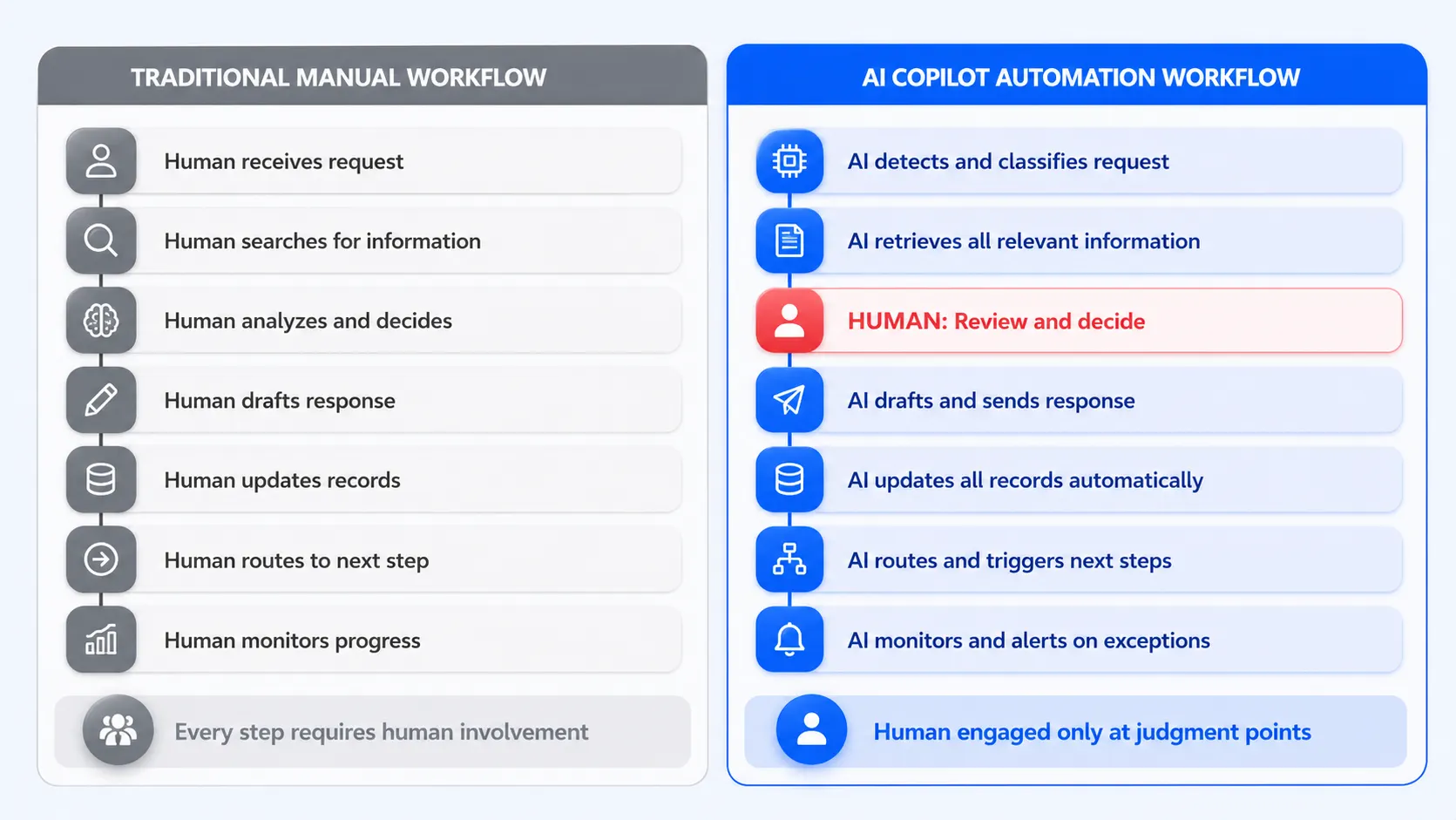
For enterprises in India’s rapidly growing services sector, this workflow shift is particularly impactful because it enables teams to handle significantly larger workloads without proportional hiring. For enterprises in Dubai operating across multiple time zones, AI Copilot Automation enables continuous workflow execution that does not pause when business hours end. For US enterprises competing on speed and quality simultaneously, the shift eliminates the trade-off between fast turnaround and thorough analysis that manual workflows force on every team.
AI Copilot Automation Reduces Human Dependency
One of the most significant and often misunderstood outcomes of ai copilot automation is the reduction of human dependency in workflow execution. The phrase “reduces human dependency” is sometimes interpreted as a threat to employment, but in our experience working with enterprises across all three major markets, the more accurate interpretation is that it reduces human dependency on humans performing tasks that do not require human capability, freeing humans to focus on the work that genuinely requires human judgment, empathy, creativity, and relationships.
Human dependency in traditional workflows creates four categories of operational risk: throughput constraints, consistency variability, availability limitations, and knowledge concentration. When a workflow depends on specific humans to execute specific steps, it is constrained by those humans’ available time, subject to variation in their performance, limited by their working hours and availability, and potentially disrupted by their departure from the organization. AI Copilot Automation addresses all four risks simultaneously.
The reduction in human dependency through AI Copilot Automation does not eliminate human roles; it transforms them. The financial analyst in Mumbai who previously spent 70 percent of their time compiling data and formatting reports transitions to spending 70 percent of their time on analysis, interpretation, and strategic recommendation. The customer service team in a Dubai contact center that previously spent 60 percent of their time on information retrieval and basic query resolution transitions to spending that time on complex escalations and relationship management. The human role becomes more valuable, not less, when AI Copilot removes the execution burden that prevented professionals from operating at their highest level.
AI Copilot Automation Changing Workflow Design
AI Copilot Automation is not only changing how workflows execute; it is changing how workflows are designed from the beginning. Traditional workflow design starts from the assumption that humans will perform most steps and asks: how do we sequence human tasks to achieve the desired outcome? AI Copilot Automation-era workflow design starts from a different question: which aspects of this process genuinely require human judgment, and how do we design an AI Copilot Automation layer to handle everything else?
This design philosophy shift has profound practical consequences. Workflows designed for AI Copilot are structured around data flows and decision points rather than human action sequences. They explicitly identify where human input adds irreplaceable value and design those touchpoints as efficient, well-prepared moments for human engagement rather than as manually orchestrated sequences. They build AI Copilot into the workflow architecture rather than treating it as an optional add-on to existing processes.
The components of an AI Copilot Automation-native workflow design include trigger identification, data assembly automation, intelligent routing logic, human judgment interfaces, action execution automation, and continuous performance monitoring. Each component is designed with the assumption that AI handles execution and humans handle judgment, rather than the reverse assumption that shapes traditional workflow design. Organizations that redesign their workflows with this philosophy consistently capture significantly more value from AI Copilot Automation than those that simply apply AI tools to unchanged manual process designs.
AI Copilot Automation for Business Process Optimization
Business process optimization through AI Copilot Automation operates across three dimensions simultaneously: speed optimization, quality optimization, and cost optimization. Unlike traditional process improvement methodologies that typically require trade-offs between these dimensions, AI Copilot Automation can advance all three at the same time, creating compound improvements that traditional optimization approaches cannot achieve.
Speed optimization through AI Copilot Automation eliminates the waiting time that dominates traditional workflows. In most manual processes, the actual work time is a small fraction of total cycle time; the majority is consumed by queuing, handoffs, status checks, and information retrieval. AI Copilot eliminates these latency sources by processing immediately upon trigger, retrieving information in milliseconds, and executing handoffs through automated routing rather than manual forwarding. A procurement approval process that takes five days in a manual workflow because of queuing and handoff delays can be completed in hours with AI Copilot Automation handling the coordination and information assembly between human approval steps.
Quality optimization through AI Copilot Automation is achieved through consistency and completeness. Manual processes introduce quality variability because different people execute the same steps differently, and time pressure causes steps to be abbreviated or skipped. AI Copilot executes each step consistently every time, following the complete process design without shortcuts. In regulated industries across the UAE, India, and the US, this consistency is particularly valuable because it reduces compliance exceptions and audit findings that result from inconsistent manual process execution.
Cost optimization through AI Copilot Automation is achieved through the reduction of professional time spent on execution-layer tasks. When AI Copilot Automation handles 60 to 70 percent of the execution tasks within a workflow, the professional time freed can either expand the team’s effective capacity or allow headcount needs to grow more slowly as business volume increases. Both outcomes deliver measurable cost advantage relative to organizations managing volume growth through proportional headcount increases alone.
AI Copilot Automation in Task Orchestration Systems
Task orchestration is the coordination function within complex workflows that determines what tasks are initiated, in what sequence, by whom or by which system, and with what priority. In traditional workflow management, orchestration is handled by project management tools, manual scheduling, and human coordination. AI Copilot Automation brings intelligent, adaptive orchestration that responds dynamically to changing conditions rather than following fixed sequences regardless of context.
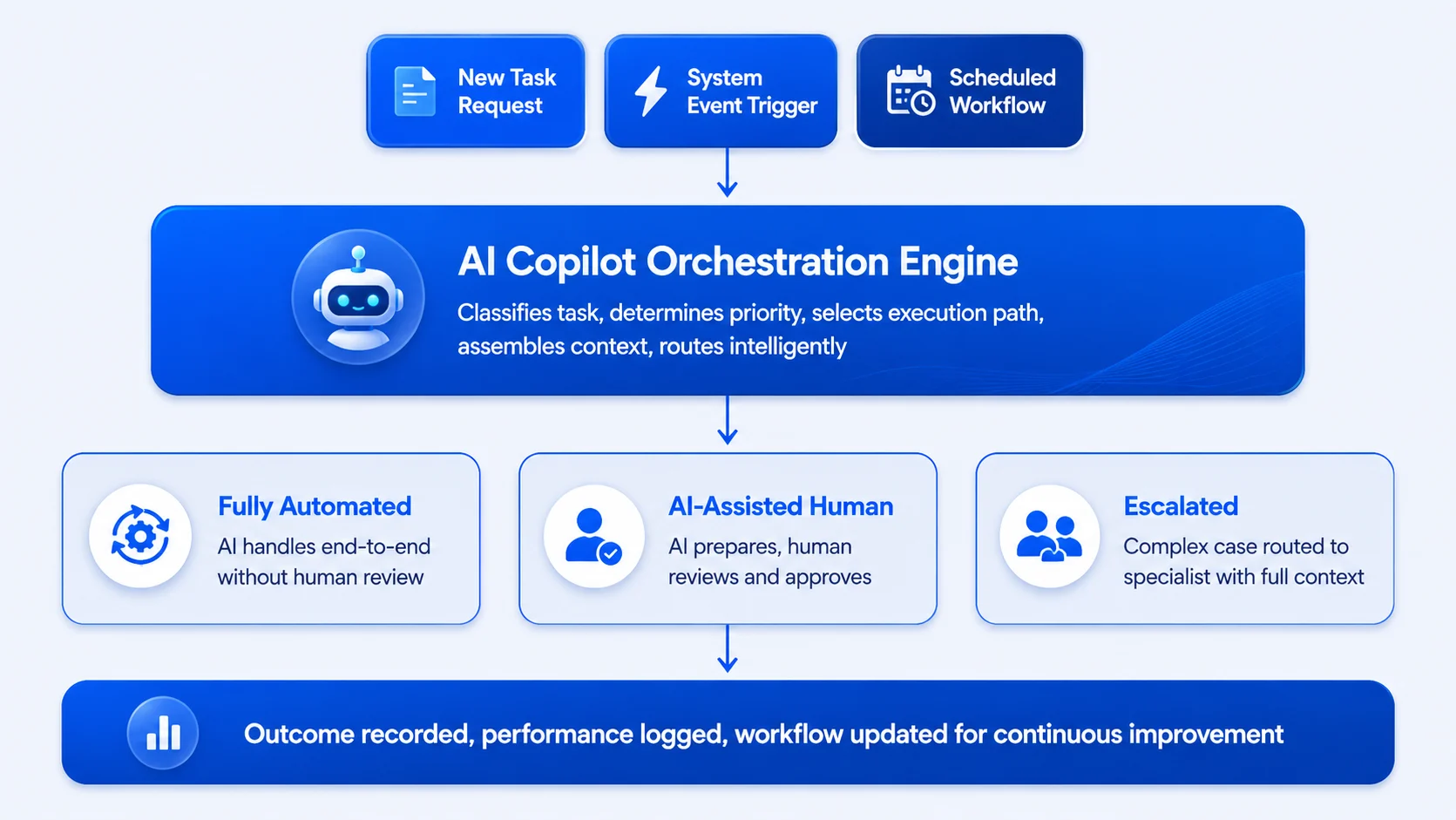
Intelligent task orchestration through AI Copilot Automation is particularly transformative in environments with high task diversity and variable complexity. Customer service operations in India handling thousands of diverse inquiries daily, compliance teams in the UAE managing heterogeneous regulatory tasks, and project management offices in US enterprises coordinating complex multi-team deliverables all operate in environments where fixed, rule-based orchestration is insufficient. AI Copilot Automation-powered orchestration handles the diversity and variability that traditional task management systems cannot.
AI Copilot Automation Improves Team Collaboration
The impact of AI Copilot Automation on team collaboration is one of the most frequently underestimated benefits in pre-implementation business cases. Organizations typically quantify individual productivity gains but underestimate the collaborative efficiency improvements that emerge when AI Copilot Automation removes the coordination overhead that fragments team workflows into administrative burden. In practice, collaboration quality improvements from AI Copilot Automation often exceed individual productivity improvements in total business value delivered.
Meeting preparation is one of the most immediately visible collaboration improvements from AI Copilot Automation. In traditional workflows, meeting preparation requires participants to manually gather relevant data, compile status updates, and align on context before productive discussion can begin. AI Copilot handles this preparation automatically: assembling the relevant information from integrated systems, generating pre-meeting briefings, and ensuring that all participants arrive with the same complete, current context. This automation converts meetings from information-sharing sessions into genuine decision-making and collaboration sessions.
Cross-functional handoffs are another collaboration dimension transformed by AI Copilot Automation. When a workflow crosses department boundaries in a traditional organization, the handoff involves manual communication, document transfer, context explanation, and queue waiting on the receiving end. AI Copilot handles cross-functional handoffs intelligently: packaging the complete context of each handoff, routing to the appropriate recipient with all necessary background information, and following up automatically when handoffs are stalled. For enterprises in India managing large cross-functional teams or those in the UAE coordinating across regional offices, this handoff automation eliminates collaboration friction that currently costs significant time and creates coordination failures.
From Rule-Based to AI Copilot Automation Workflows
The transition from rule-based automation to AI Copilot Automation represents the most significant evolution in enterprise automation technology in the past decade. Understanding this transition clearly is essential for organizations deciding how to invest in automation infrastructure and how to position their existing rule-based systems relative to the AI Copilot Automation capabilities they are evaluating.
Rule-Based Automation vs AI Copilot Automation Capability Comparison
| Capability Dimension | Rule-Based Automation | AI Copilot Automation |
|---|---|---|
| Exception Handling | Escalates all exceptions to human review | Resolves most exceptions through contextual reasoning |
| Unstructured Data | Cannot process without prior structuring | Processes emails, documents, images, and free text natively |
| Process Changes | Requires rule rewriting by technical team | Adapts through natural language instructions and examples |
| Context Awareness | No context; each transaction treated identically | Full contextual awareness across data sources and history |
| Decision Quality | Binary: rule matches or does not match | Nuanced: weighs multiple factors and context |
| Maintenance Cost | High; rules require continuous updating | Lower; system adapts to business changes through learning |
The practical implication of this comparison is that rule-based automation and AI Copilot Automation are complementary rather than competitive. Rule-based automation handles high-volume, perfectly structured, rule-deterministic tasks with exceptional efficiency and at lower cost per transaction than AI Copilot Automation. AI Copilot Automation handles the higher-complexity, exception-heavy, and context-dependent tasks that rule-based systems cannot manage. The most effective enterprise automation architectures deploy both, with rule-based automation handling the predictable core and AI Copilot Automation handling the complexity, exceptions, and unstructured content that rule-based systems route to humans.
AI Copilot Automation Enhances Business Decisions
The relationship between AI Copilot Automation and business decision quality is one of the most strategically significant aspects of the workflow transformation occurring in 2026. Traditional manual workflows often produce decisions of inconsistent quality not because the decision-makers lack capability but because the information available at decision time is incomplete, delayed, or poorly synthesized. AI Copilot Automation addresses this information problem systematically, raising the quality of every decision made within an AI Copilot Automation-enabled workflow.
The first way AI Copilot Automation enhances decision quality is through information completeness. In traditional workflows, the information available for a business decision is typically limited to what the decision-maker can manually gather within the available time. Important context from other systems, past interactions, or related decisions is frequently missed simply because gathering it would take too long. AI Copilot Automation retrieves complete, multi-source information in seconds, ensuring that every decision is made with the full relevant context rather than a partial picture.
The second enhancement is information timeliness. Decisions in traditional workflows are often made based on information that is days or weeks old because the reporting and data aggregation cycles in manual workflows introduce latency between when events occur and when decision-makers are informed. AI Copilot Automation integrates with live data sources and delivers current information at the moment of decision, eliminating the staleness that can make carefully reasoned decisions incorrect because the situation they were responding to has already changed.
The third enhancement is decision consistency. When similar decisions are made by different people at different times under different conditions, the organization gets inconsistent outcomes that are difficult to learn from or improve. AI Copilot Automation applies consistent decision frameworks and surfaced information sets across similar decision scenarios, creating a baseline consistency that allows organizations to identify which decision patterns produce the best outcomes and systematically apply those patterns more broadly. [1]
Continuous Workflow Improvement with AI Copilot
Continuous workflow improvement is one of the most underappreciated long-term benefits of AI Copilot Automation. Traditional workflows improve only when someone explicitly investigates a problem, identifies an improvement opportunity, designs a new process, and implements it through a formal change management process. This cycle typically takes months and requires significant organizational effort even for modest improvements. AI Copilot Automation enables a fundamentally different model of continuous improvement that is faster, lower-cost, and more responsive to real operational performance data.
Real-Time Performance Monitoring
AI Copilot Automation continuously monitors workflow execution metrics including cycle times, exception rates, decision quality scores, and bottleneck frequencies across every active workflow. This real-time visibility identifies performance degradation and improvement opportunities as they emerge rather than in retrospective analysis cycles that lag reality by weeks or months.
Anomaly Detection and Alerting
AI Copilot Automation identifies workflow anomalies that deviate from established performance patterns and alerts process owners with specific, contextualized information about what is unusual and what its likely impact is. This proactive detection enables organizations to address workflow problems before they become significant operational disruptions.
Optimization Recommendation Engine
Based on accumulated performance data, AI Copilot Automation generates specific, evidence-based recommendations for workflow improvements: steps that could be further automated, decision criteria that consistently predict outcomes, routing rules that reduce escalation rates, and resource allocation patterns that minimize bottlenecks during peak periods.
Pattern Learning and Application
AI Copilot Automation learns from every workflow execution, identifying the characteristics of high-quality outcomes and the patterns associated with exceptions or failures. This accumulated learning progressively improves the quality of AI-assisted decisions and routing choices across the entire workflow portfolio.
Process Variant Analysis
When similar tasks are processed through different workflow paths, AI Copilot Automation compares the outcomes of different variants to identify which path produces the best results for which input characteristics. This systematic analysis enables evidence-based process standardization around the highest-performing workflow patterns.
Feedback Loop Integration
AI Copilot Automation integrates structured feedback from human reviewers and end users into its improvement cycle. When humans override AI recommendations or identify AI errors, this feedback is captured and incorporated into the system’s learning, progressively improving AI Copilot Automation quality in the specific contexts where errors occurred.
AI Copilot Automation Redefining Modern Workflows
The cumulative effect of AI Copilot Automation across the dimensions examined in this guide is a fundamental redefinition of what a “workflow” means in a modern enterprise. Traditional workflows are sequences of human-performed steps organized to achieve a business outcome. Modern AI Copilot Automation-enabled workflows are intelligent systems that blend automated execution, contextual reasoning, and targeted human judgment into a continuously improving operational architecture that gets better with every execution.
This redefinition has implications for how organizations think about workforce planning, technology investment, process governance, and competitive strategy. The organizations that understand AI Copilot Automation as a workflow transformation capability rather than a productivity tool are making different and better decisions about all four of these dimensions.
On workforce planning, AI Copilot Automation-aware organizations are hiring for judgment, expertise, and relationship capability rather than execution capacity. They are designing roles around the work that remains distinctly human after AI Copilot Automation handles the execution layer. They are investing in training that helps employees become effective collaborators with AI Copilot Automation systems rather than just proficient users of digital tools.
AI Copilot Automation Workflow Transformation Impact by Business Function 2026
| Business Function | Traditional Workflow Bottleneck | AI Copilot Automation Transformation | Measured Improvement |
|---|---|---|---|
| Sales Operations | Manual CRM updates and pipeline reporting | Automated data capture, intelligent next-step suggestions | 40% more selling time per rep |
| Finance and Accounting | Manual reconciliation and report compilation | Automated reconciliation, real-time financial intelligence | 60% cycle time reduction |
| HR and People Ops | Manual resume screening and onboarding coordination | AI-assisted screening, automated onboarding workflows | 75% faster time-to-hire |
| Customer Service | Manual information retrieval per query | Instant context surfacing, automated response drafting | 35% AHT reduction |
| Legal and Compliance | Manual document review and reporting | AI-assisted review, automated compliance documentation | 50% review time saved |
| Procurement | Manual approval routing and vendor communication | Intelligent approval orchestration and vendor management | 65% faster approval cycles |
The workflow transformation enabled by AI Copilot Automation is not a future possibility for enterprises in the US, UAE, and India; it is an active present-day competitive dynamic. Organizations in every major industry are already operating with AI Copilot Automation-enabled workflows that are demonstrably faster, more accurate, and more scalable than the traditional workflows their competitors still operate. The performance gap between AI Copilot Automation adopters and traditional workflow operators is widening with each passing quarter, and the organizations that delay transformation are not standing still; they are falling behind relative to an increasingly automated competitive environment.
AI Copilot Automation is the New Standard for Enterprise Workflows
The transformation of traditional workflows through AI Copilot Automation is not a technology trend that organizations can afford to observe from a distance until it matures. The maturity is already here. The performance advantages of AI Copilot Automation over manual and rule-based workflows are demonstrated, quantified, and compounding in real enterprise environments across every major industry in the US, UAE, and India. The question for every organization’s leadership is not whether AI Copilot Automation will transform their workflows, but whether their organization will lead that transformation or be led by it.
The organizations making the most successful transitions to AI Copilot Automation workflows share a common approach: they treat workflow redesign as the primary challenge and AI Copilot technology selection as secondary. They invest in understanding where human judgment genuinely creates value and design their AI Copilot Automation architecture around those judgment points. They measure outcomes, not activities, and build continuous improvement into their automation governance from the beginning.
After eight years of guiding enterprises through technology transformations, our conviction is clear: the AI Copilot Automation transformation of traditional workflows is the most significant operational opportunity available to enterprises in 2026. The organizations that act on that opportunity with purpose and rigor will build sustainable performance advantages that compound over time.
Transform Your Enterprise Workflows with AI Copilot Automation
We design and implement AI Copilot Automation systems for enterprises across US, UAE, and India. Workflow redesign, AI integration, and measurable performance improvement.
Frequently Asked Questions
Q1.1. What is AI copilot automation in workflows?
AI copilot automation is the use of AI systems to assist, automate, and optimize business workflows by handling repetitive tasks, improving decision-making, and streamlining operations across departments for better efficiency and productivity.
Q2.2. What are traditional workflows in business?
Traditional workflows are manual or semi-automated processes where tasks are performed step-by-step by employees. These systems often rely on human intervention, making them slower, less efficient, and prone to errors compared to AI-driven workflows.
Q3.3. How does AI improve workflow efficiency?
AI improves workflow efficiency by automating repetitive tasks, analyzing large data sets, reducing delays, and providing real-time insights. This allows employees to focus on higher-value work while improving speed, accuracy, and productivity.
Q4.4. Is AI copilot automation replacing human jobs?
AI copilot automation is not fully replacing jobs but reshaping them. It handles repetitive tasks while humans focus on strategic, creative, and decision-making roles, leading to improved productivity and workforce efficiency.
Q5.5. What are key features of AI copilot systems?
Key features include task automation, real-time data analysis, predictive insights, workflow optimization, natural language interaction, and integration with business tools to enhance operational efficiency and decision-making across organizations.
Q6.6. How does AI copilot reduce operational costs?
AI copilot reduces operational costs by minimizing manual labor, reducing errors, speeding up processes, and improving resource allocation. Businesses save time and money by automating repetitive and time-consuming workflow tasks.
Q7.7. What challenges exist in AI copilot adoption?
Challenges include integration complexity, data privacy concerns, high initial implementation costs, employee resistance, and the need for proper training to ensure smooth adoption and effective use of AI copilot systems.
Q8.8. What is the future of AI workflow automation?
AI workflow automation is expected to become more intelligent, adaptive, and autonomous. It will enable real-time decision-making, deeper integration across systems, and fully optimized business operations with minimal human intervention.
Q9.9. What is the difference between AI copilot and AI agent?
An AI copilot assists humans by suggesting or automating tasks, while an AI agent can act independently to complete tasks. Copilots focus on collaboration, whereas agents focus on full task execution.
Q10.10. How to implement AI copilot in business workflows?
Implementation involves identifying repetitive tasks, selecting the right AI copilot platform, integrating it with existing systems, training employees, and continuously optimizing workflows to achieve maximum efficiency and business value.
Explore Services
Related Services
Reviewed by

Aman Vaths
Founder of Nadcab Labs
Aman Vaths is the Founder & CTO of Nadcab Labs, a global digital engineering company delivering enterprise-grade solutions across AI, Web3, Blockchain, Big Data, Cloud, Cybersecurity, and Modern Application Development. With deep technical leadership and product innovation experience, Aman has positioned Nadcab Labs as one of the most advanced engineering companies driving the next era of intelligent, secure, and scalable software systems. Under his leadership, Nadcab Labs has built 2,000+ global projects across sectors including fintech, banking, healthcare, real estate, logistics, gaming, manufacturing, and next-generation DePIN networks. Aman’s strength lies in architecting high-performance systems, end-to-end platform engineering, and designing enterprise solutions that operate at global scale.