Ai Overview
Prompt engineering in AI Copilot is the art of giving clear, well structured instructions so the AI understands exactly what you need. It helps you get more accurate, useful, and natural responses for writing, coding, research, and everyday productivity tasks.. Measurement is what validates Prompt Engineering investment and guides future optimization priorities.
Key Takeaways
- ›Prompt Engineering is the highest-ROI performance improvement available for AI Copilot systems, capable of delivering 30 to 60 percent output quality gains before any model or infrastructure changes are required.
- ›System-level Prompt Engineering establishes the foundational behavioral framework for the entire AI Copilot, defining its role, capabilities, constraints, and response format standards that apply to every user interaction.
- ›Few-shot Prompt Engineering provides the language model with concrete examples of the desired input-output pattern, dramatically improving performance on specialized domain tasks that deviate from general training data.
- ›Chain-of-thought Prompt Engineering instructs the model to show its reasoning step by step before delivering a conclusion, significantly improving accuracy on complex multi-step problems and reducing confident but incorrect responses.
- ›Role-based Prompt Engineering assigns a specific expert persona to the AI Copilot for each task type, activating domain-appropriate response patterns and vocabulary that improve relevance and precision for specialized workflows.
- ›Context engineering manages what information is included in the prompt context window, in what order, and at what level of detail to maximize the model’s ability to generate relevant, grounded, and accurate responses.
- ›Iterative Prompt Engineering using systematic A/B evaluation and regression testing is the only reliable way to improve prompt quality over time without introducing regressions into previously well-performing use cases.
- ›Negative instruction Prompt Engineering, specifying what the AI Copilot should not do, is often more effective than positive instruction alone for preventing unwanted behaviors in production enterprise AI deployments.
- ›Prompt Engineering for enterprise AI Copilot systems in regulated markets like the UAE and India must incorporate compliance constraints, confidentiality guardrails, and explainability requirements into prompt architecture from the outset.
- ›Measuring Prompt Engineering effectiveness requires a comprehensive evaluation framework covering accuracy, consistency, latency, format compliance, and safety metrics tracked across a representative golden dataset of test queries.
What is Prompt Engineering?
Prompt engineering in AI Copilot is the art of giving clear, well structured instructions so the AI understands exactly what you need. It helps you get more accurate, useful, and natural responses for writing, coding, research, and everyday productivity tasks.. A prompt is not simply a question or instruction submitted by a user; in the context of AI Copilot systems, it is the complete structured input provided to the model, including system instructions, contextual information, retrieved knowledge, conversation history, and the user’s actual query.
If the language model is the engine of an artificial intelligence Copilot system, then Prompt Engineering is the precision tuning that determines how much of that engine’s capability actually reaches the road. Over eight years of designing AI-powered systems for enterprises across the US, UAE, and India, prompt engineering has consistently been one of the highest-ROI investments we recommend to engineering teams who want to improve AI Copilot performance before reaching for more expensive solutions.
The term “engineering” is deliberately applied rather than “writing” or “design” because effective prompt engineering is a systematic, measurable, iterative practice, not an intuitive creative one. It involves hypothesis generation, controlled testing, quantitative measurement of outcomes, and systematic refinement based on empirical evidence. A prompt engineer who works intuitively without measurement is almost certainly leaving substantial performance improvements on the table.
The scope of prompt engineering in AI Copilot systems extends across three primary levels. System-level prompt engineering establishes the global behavioral framework within which the AI Copilot operates across all interactions. Task-level prompt engineering creates specialized instructions for each category of task the AI Copilot handles, such as document summarization, data analysis, or customer communication. Instance-level prompt engineering dynamically assembles the specific context for each individual user interaction, composing retrieved information, user history, and query context into an optimally structured model input.
How Prompt Engineering Improves AI Copilot Performance?
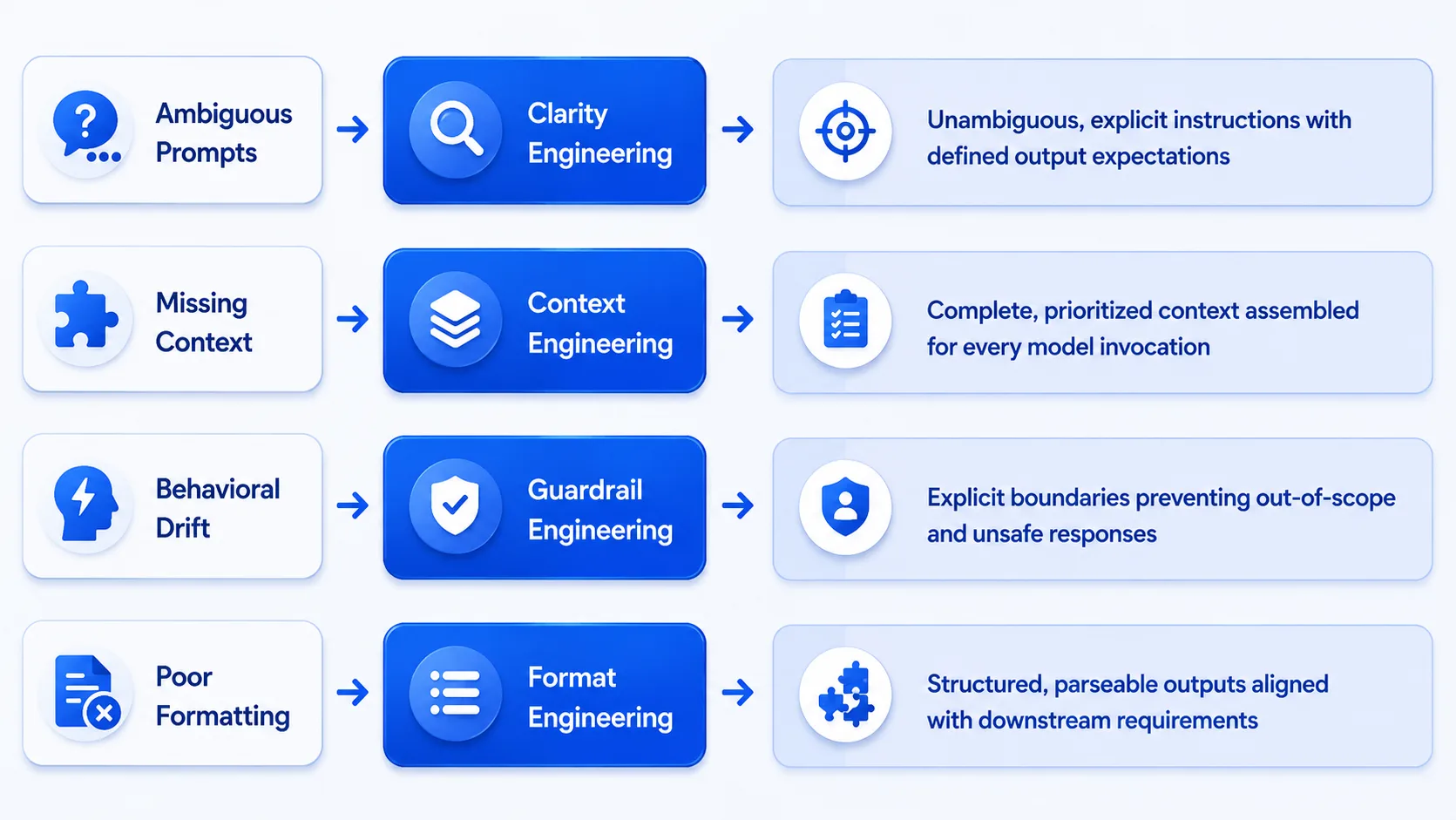
To understand how Prompt Engineering improves AI Copilot performance, it helps to understand what causes performance problems in the first place. Language models are extraordinarily capable systems, but their behavior is highly sensitive to how they are prompted. The same model given different prompt structures can produce radically different quality levels on the same underlying task. Performance problems in AI Copilot systems most commonly stem from one or more of four prompt-related root causes.
The first cause is ambiguity: prompts that do not clearly specify what the model should do, in what format, at what level of detail, or with what constraints leave the model to make assumptions that frequently do not align with the system’s intended behavior. The second cause is missing context: prompts that do not include the relevant background information the model needs to reason accurately about the specific situation it is responding to.
The third cause is behavioral drift: the absence of explicit guardrails that prevent the model from producing outputs that fall outside acceptable parameters for the system’s use case. The fourth cause is poor format specification: prompts that do not clearly communicate how responses should be structured, causing the model to generate content that is accurate but unusable in its raw form.
Prompt Engineering addresses all four root causes systematically. Clarity techniques eliminate ambiguity by making instructions explicit and unambiguous. Context engineering ensures the model has the information it needs to reason accurately. Guardrail design prevents behavioral drift by specifying what the model should and should not do. Format specification ensures outputs arrive in the structure that downstream components and users require. When all four dimensions are well-engineered, the performance improvements compound rather than simply add together.
Prompt Engineering Techniques for Improving AI Outputs
The toolkit of Prompt Engineering techniques for AI Copilot systems is broad and continues to expand as the field matures. Understanding the full range of available techniques, when each is most appropriate, and how they can be combined is essential for engineers and product teams building high-performance AI Copilot systems. The techniques covered in this guide represent the most widely validated and practically impactful approaches for enterprise AI Copilot applications.
Each technique addresses a specific class of AI Copilot performance challenge. Some techniques improve reasoning accuracy on complex tasks. Others improve consistency and format compliance. Others reduce hallucination rates. Others make the AI Copilot more controllable and governable in regulated enterprise contexts. The most effective Prompt Engineering implementations combine multiple techniques into a layered approach that addresses several dimensions of performance simultaneously.
A critical principle that underlies all effective Prompt Engineering is the distinction between what you want the model to do and how you want it to do it. Specifying the “what” without the “how” leaves too much to model assumption. Specifying both, along with concrete examples where relevant, dramatically increases the probability that the model’s output matches the system’s intended behavior. This principle applies regardless of which specific technique is being applied.
System-Level Prompt Engineering for Better Control
System-level Prompt Engineering is the foundation upon which all other prompt techniques operate. The system prompt is the master instruction set that defines the AI Copilot’s identity, operating principles, behavioral constraints, and default response standards. Every user interaction occurs within the framework established by the system prompt, making it the most impactful single prompt artifact in any AI Copilot deployment.
An effective system prompt for an enterprise AI Copilot communicates five core elements. First, it establishes role and identity: who the AI Copilot is, what domain it serves, and what expertise it should project. Second, it defines capabilities and scope: what the AI Copilot can help with and what it explicitly cannot or should not address.
Third, it specifies behavioral standards: the tone, formality level, response length preferences, and reasoning approach expected across all interactions. Fourth, it establishes confidentiality and safety constraints: what information should never be disclosed and what types of requests should be declined or redirected. Fifth, it sets output format defaults: how responses should be structured in the absence of more specific task-level format instructions.
System Prompt Architecture for Enterprise AI Copilot
For AI Copilot systems deployed in regulated industries across the US, UAE, and India, system-level Prompt Engineering must also incorporate jurisdiction-specific compliance requirements. An AI Copilot serving financial professionals in Dubai requires system prompt guardrails aligned with DFSA standards. One serving healthcare professionals in India requires guardrails aligned with applicable data protection and clinical guidance regulations. Embedding these requirements in the system prompt ensures they apply consistently across every interaction without requiring task-level re-specification.
Prompt Engineering for Task Accuracy in AI Copilots
Task accuracy is one of the most direct and measurable outcomes of Prompt Engineering quality. Task accuracy refers to how frequently the AI Copilot produces the correct, expected output for a given input across the full distribution of real-world queries in that task category. Improving task accuracy through Prompt Engineering requires understanding the specific failure modes of each task category and designing prompt elements that address those failure modes directly.
For factual retrieval tasks, where the AI Copilot must find and accurately report specific information from its knowledge base, accuracy is primarily affected by how well the prompt directs the model to stay grounded in retrieved content rather than generating from training memory. Prompt Engineering for factual accuracy includes explicit grounding instructions such as “base your answer only on the provided context,” citation requirements that force the model to reference its sources, and uncertainty articulation instructions that prompt the model to clearly signal when the context does not support a complete answer.
For analytical tasks where the AI Copilot must reason across multiple information sources to reach a conclusion, accuracy is primarily affected by how well the prompt structures the reasoning process. Task-specific Prompt Engineering for complex analysis typically combines role assignment, explicit reasoning steps, and output format specification to guide the model through the analytical process rather than asking it to reach a conclusion directly without intermediate reasoning steps.
For generation tasks where the AI Copilot produces new content such as emails, reports, or summaries, accuracy is measured against quality criteria including completeness, tone appropriateness, length compliance, and factual consistency with the source material. Prompt Engineering for generation tasks includes detailed specification of the required output structure, explicit tone and audience guidance, length constraints, and instructions for what information must be included versus what should be omitted.
Instruction Design Techniques in Prompt Engineering
Instruction design is the craft at the heart of Prompt Engineering. How instructions are written, structured, and sequenced within a prompt significantly affects how reliably the model follows them. Years of empirical testing across AI Copilot systems have produced a set of instruction design principles that consistently improve model compliance and output quality.
Positive Plus Negative Specification
Effective Prompt Engineering specifies both what to do and what not to do. Negative instructions are often more effective than positive instructions alone for preventing specific unwanted behaviors. Combining “always do X” with “never do Y” produces more consistently bounded behavior than either instruction type in isolation.
Instruction Ordering by Priority
Language models give more weight to instructions that appear at the beginning and end of prompts. Place the most critical behavioral instructions at the start of the system prompt. Use the end of the prompt for output format specifications and final-pass instructions that should be fresh in the model’s attention before it generates a response.
Concrete Over Abstract Instructions
Abstract instructions like “be helpful” or “be accurate” are almost entirely ineffective as Prompt Engineering elements because they mean different things to different model reasoning paths. Replace abstract instructions with concrete, measurable specifications: “Limit responses to 200 words,” “Include at least one specific example,” or “End with a single recommended next action.”
Conditional Instruction Branching
Prompt Engineering for AI Copilot systems handling diverse task types benefits from conditional instruction sets: “If the user is asking about X, respond in format A. If the user is asking about Y, respond in format B.” Explicit conditional branching prevents the model from applying the wrong task-specific behavior to a misclassified query type.
Uncertainty Articulation Requirements
One of the most impactful Prompt Engineering instructions for reducing hallucination risk is the explicit requirement that the model acknowledge when it is uncertain or when the provided context does not support a confident answer. Requiring uncertainty articulation prevents the model from generating plausible-sounding but incorrect responses to fill knowledge gaps.
Escalation and Handoff Instructions
Enterprise AI Copilot systems must know when to escalate to human operators rather than generating a potentially incorrect autonomous response. Prompt Engineering that explicitly defines escalation conditions and provides a clear escalation response template significantly improves the AI Copilot’s behavior on edge cases and out-of-scope requests.
Few-Shot and Zero-Shot Prompting Methods
Few-shot and zero-shot prompting are two of the most widely referenced Prompt Engineering techniques, and understanding when to apply each is essential for any engineer working on AI Copilot performance optimization. The choice between them is not a matter of preference; it is a function of task complexity, domain specificity, and the availability of representative examples.
Zero-shot prompting asks the model to perform a task based solely on the instruction, without any examples of the desired input-output pattern. Zero-shot Prompt Engineering is appropriate for well-defined, commonly encountered task types that align closely with the model’s training distribution. For a general-purpose task like “summarize this document in three bullet points,” zero-shot prompting with clear format specification is typically sufficient to produce consistent, high-quality results. Zero-shot prompts are shorter, cheaper to run, and easier to maintain than few-shot alternatives, making them the preferred starting point when they perform adequately.
Few-shot prompting supplements the task instruction with two to five carefully selected examples that demonstrate the exact input format, reasoning approach, and output format expected. Few-shot Prompt Engineering is appropriate when the task involves domain-specific terminology, specialized formatting, nuanced judgment, or any characteristic that deviates meaningfully from the general patterns in the model’s training data. For an AI Copilot at a legal firm in India that must classify contract clauses according to firm-specific risk categories, few-shot examples demonstrating how each category is applied to representative clause types dramatically improve classification accuracy compared to zero-shot instruction alone.
Zero-Shot vs Few-Shot Prompt Engineering Comparison
| Dimension | Zero-Shot Prompting | Few-Shot Prompting |
|---|---|---|
| Context Window Cost | Low; instruction only | Higher; examples consume tokens |
| Domain Specificity | Works well for general task types | Essential for specialized domain tasks |
| Format Compliance | Moderate; relies on format description | High; examples demonstrate exact format |
| Example Quality Dependency | None; no examples required | High; poor examples actively degrade performance |
| Best For | Standard tasks with common output formats | Specialized tasks with distinctive patterns |
| Maintenance Overhead | Low; instruction updates only | Medium; examples require updating when criteria change |
Role-Based Prompting for Task Optimization
Role-based Prompt Engineering is one of the most reliably effective techniques for improving AI Copilot output quality across specialized task categories. It works by assigning a specific expert persona to the AI Copilot for a given task type, activating the domain-appropriate reasoning patterns, vocabulary, and judgment frameworks associated with that role in the model’s training representation.
The mechanism behind role-based prompting is that language models have learned distinct behavioral and reasoning patterns associated with different professional roles. When instructed to respond as a senior financial analyst, the model activates the vocabulary, analytical frameworks, and professional communication standards associated with that role. When instructed to respond as an experienced legal contract reviewer, it activates the careful, hedged, risk-aware language and clause-level precision associated with legal review. The role assignment does not add capabilities the model does not have, but it significantly improves the alignment between the model’s output and the expectations of the domain in which the AI Copilot is deployed.
For AI Copilot systems serving multi-functional enterprise teams in the US, UAE, or India, role-based Prompt Engineering enables a single AI Copilot platform to serve different professional functions with appropriately calibrated response styles. A product team member receives concise, action-oriented recommendations. A legal reviewer receives careful, hedged analysis with explicit uncertainty markers. A data analyst receives structured, quantitative outputs with methodology transparency. The underlying model is the same; the role-based prompt engineering creates the appropriate behavioral differentiation.
Chain-of-Thought Technique in Complex Problem Solving
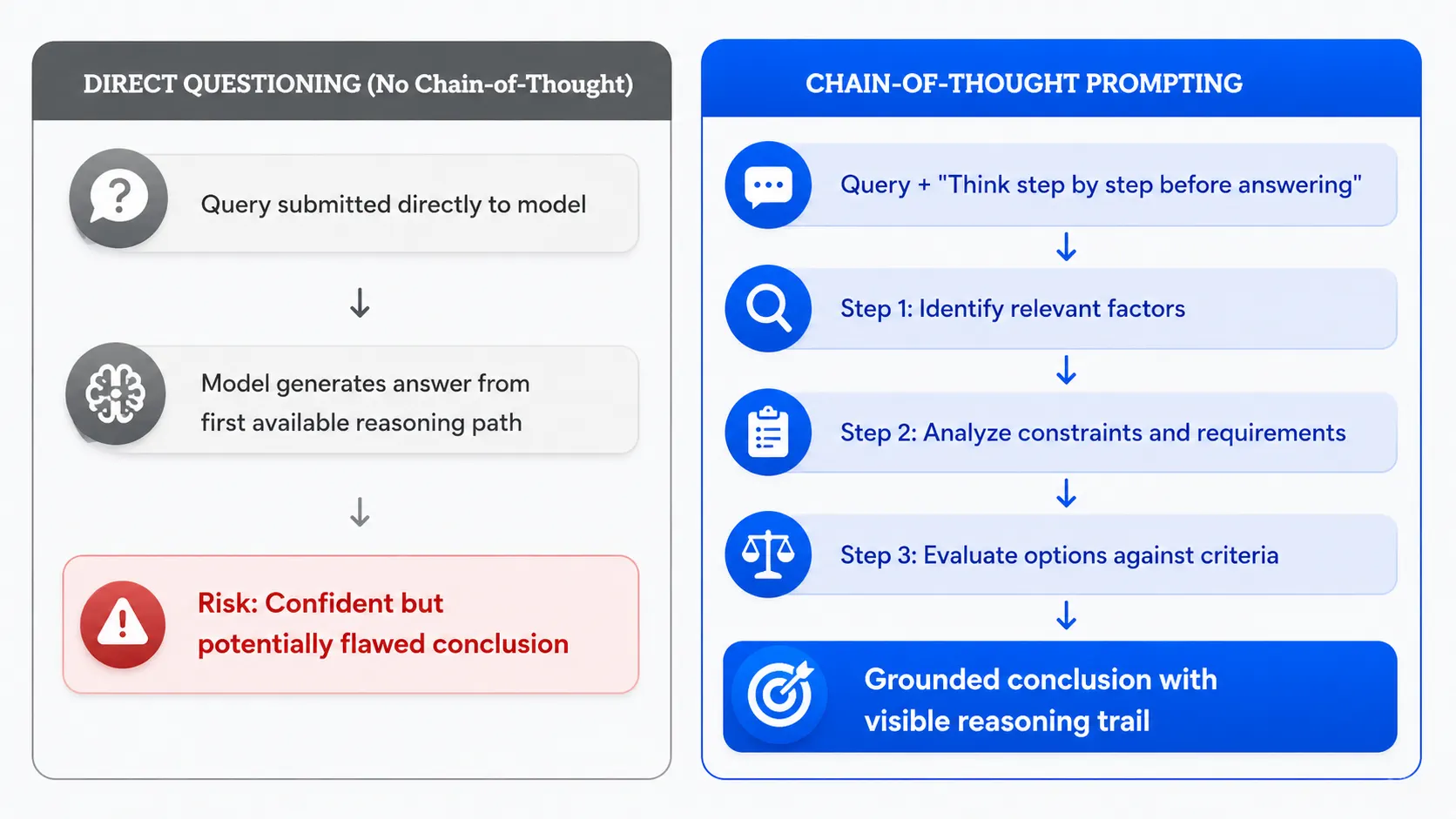
Chain-of-thought Prompt Engineering is one of the most impactful techniques available for improving AI Copilot accuracy on complex reasoning tasks. The core insight behind chain-of-thought prompting is that language models produce more accurate conclusions when they are required to show their reasoning step by step before arriving at a final answer, rather than generating the conclusion directly.
The technique is implemented by adding an instruction to the prompt that explicitly asks the model to think through the problem before answering: “First, analyze the relevant factors. Then, identify any constraints or risks. Then, evaluate the available options. Finally, provide your recommendation with supporting rationale.” By requiring intermediate reasoning steps, chain-of-thought prompting makes the model’s reasoning process visible, catches logical errors before they reach the conclusion, and leverages the model’s context processing to build on each reasoning step rather than reaching for a direct answer that may skip important analytical steps.
For enterprise AI Copilot systems handling complex analytical tasks, the improvement from chain-of-thought Prompt Engineering is particularly pronounced. A compliance AI Copilot in the UAE financial sector asked to assess whether a specific transaction structure complies with applicable regulations produces more accurate assessments when prompted to reason through the applicable regulatory provisions, identify the relevant compliance requirements, and evaluate the transaction structure against each requirement before reaching a conclusion, compared to a direct question that asks only for the compliance assessment.
Context Engineering Techniques for Accurate Responses
Context engineering is the Prompt Engineering discipline concerned with what information is included in the context window of each model invocation, in what order, and at what level of detail. Context quality is one of the most significant determinants of AI Copilot response accuracy because language models can only work with information they have been given. The most sophisticated reasoning capabilities become irrelevant if the model lacks the contextual information required to apply them correctly.
Effective context engineering begins with context prioritization. Not all retrieved information is equally relevant to a given query, and including everything equally dilutes the signal of the most relevant content. Context engineering techniques for prioritization include semantic relevance scoring, where retrieved chunks are ranked by similarity to the query and lower-relevance chunks are excluded or deprioritized; recency weighting, where more recent information is positioned earlier in the context for time-sensitive queries; and source authority weighting, where information from higher-authority sources is given prominence over lower-authority sources within the same topic area.
Context ordering is another important engineering dimension. Language models show primacy and recency effects in context processing, attending more strongly to information at the beginning and end of long context windows. Context engineering practice should place the most critical information at these positions: the user’s query and any time-sensitive constraints at the end, and the most directly relevant knowledge chunks near the beginning of the knowledge section.
Context summarization is required when the total relevant information exceeds the practical context window budget. For AI Copilot systems in the US, UAE, and India handling queries that draw on large knowledge bases, context engineering must include intelligent summarization of lower-priority content to preserve space for high-priority information while maintaining the informational coverage the model needs to reason accurately. The quality of context summarization directly affects the quality of AI Copilot responses on information-dense queries.
Reducing Errors Through Iterative Prompt Refinement
Iterative prompt refinement is the systematic process of improving prompt quality through cycles of testing, measurement, analysis, and revision. It is what separates Prompt Engineering as a rigorous discipline from prompt writing as an intuitive exercise. No prompt, regardless of how carefully it is initially designed, achieves its maximum possible performance on the first attempt. Iterative refinement is not a sign of initial failure; it is the mechanism through which good prompts become great ones.
The iterative refinement cycle begins with establishing a golden evaluation dataset: a representative set of queries with known correct outputs against which prompt performance can be measured. This dataset should cover the full distribution of expected query types, including common cases, edge cases, and adversarial cases that specifically test the prompt’s known weaknesses. Without a consistent evaluation dataset, iterative refinement degrades into subjective impression management rather than systematic improvement.
Each refinement iteration involves generating responses to the evaluation dataset using the current prompt version, scoring the responses against the quality criteria for each query type, analyzing failure patterns to identify the root cause of systematic errors, formulating a hypothesis about which prompt modification would address the identified root cause, and testing the modified prompt against the same evaluation dataset to verify improvement without regression. This structured cycle is what drives measurable, consistent improvement over time.
A critical discipline in iterative refinement is prompt versioning and regression management. As prompts are refined to improve performance on one failure pattern, they can inadvertently degrade performance on previously well-handled query types. Maintaining version control of all prompt artifacts and running the complete evaluation dataset after every modification is essential for avoiding the regression problem that causes many AI Copilot performance improvement efforts to take one step forward and one step back.
Measuring Results of Prompt Engineering in AI Copilots
Measurement is what validates Prompt Engineering investment and guides future optimization priorities. Without systematic measurement, prompt engineering practitioners cannot distinguish genuine improvements from placebo effects, cannot identify which techniques deliver the most value for specific task types, and cannot build a credible business case for continued investment in Prompt Engineering quality.
Prompt Engineering Measurement Framework for AI Copilot Systems
| Metric Category | Specific Metric | Measurement Method | Target Benchmark |
|---|---|---|---|
| Accuracy | Factual correctness rate on golden dataset | LLM-as-judge scoring against known correct answers | Above 85% |
| Format Compliance | Percentage of responses in required format | Automated structural parsing and validation | Above 95% |
| Hallucination Rate | Percentage of responses containing unsupported claims | Grounding verification against source context | Below 5% |
| Scope Adherence | Percentage of out-of-scope requests correctly handled | Classification against scope definition with human review | Above 98% |
| Latency | Response generation time at 95th percentile | Infrastructure monitoring and latency logging | Under 3 seconds |
| User Acceptance | Percentage of AI responses accepted without modification | User interaction tracking and feedback capture | Above 75% |
Prompt Engineering Performance Improvement Benchmarks
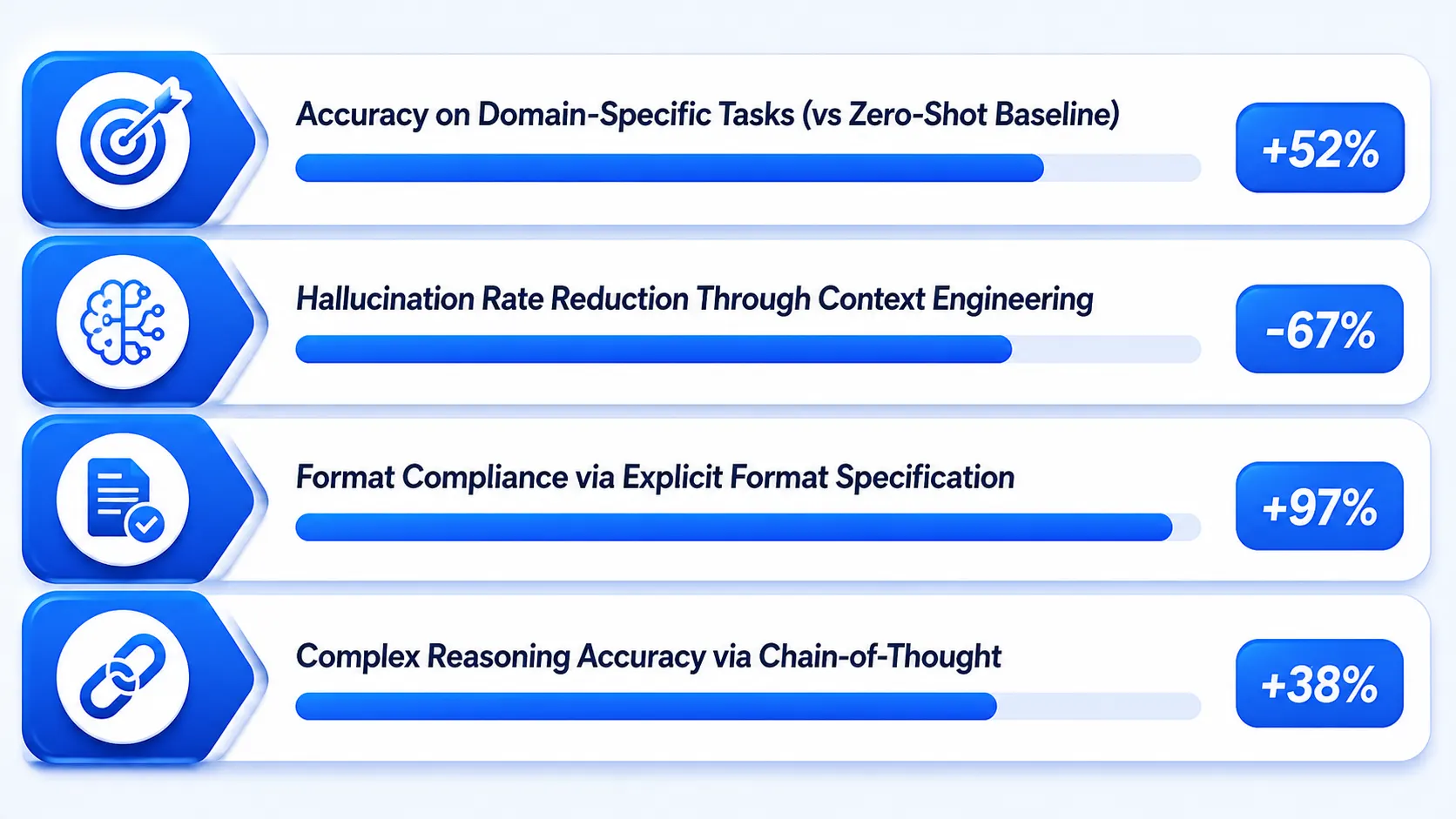
Beyond quantitative metrics, qualitative measurement through structured human evaluation is an essential complement for any comprehensive Prompt Engineering measurement framework. Human evaluators assessing AI Copilot responses on dimensions like professional appropriateness, domain expertise alignment, and communication clarity provide signal that automated metrics cannot capture. For enterprise AI Copilot systems serving specialized professionals in legal, medical, financial, or engineering domains across India, the UAE, and the US, human expert evaluation by domain practitioners is the gold standard for validating that Prompt Engineering improvements translate into real-world usability gains.
Prompt Engineering is the Highest-Leverage AI Copilot Optimization Investment
Prompt Engineering is the discipline that determines how much of an AI Copilot’s underlying capability actually reaches users as useful, accurate, and reliable output. Every enterprise that has deployed an AI Copilot system has, whether intentionally or not, made prompt engineering decisions that significantly affect its performance. The organizations that make those decisions deliberately, systematically, and measurably are the ones building AI Copilot systems that consistently meet and exceed expectations.
The techniques covered in this guide, from system-level prompt design and few-shot examples to chain-of-thought reasoning and iterative refinement, provide a complete toolkit for AI Copilot performance optimization that is accessible to any engineering team regardless of model choice or infrastructure. The return on Prompt Engineering investment, measured in accuracy improvements, hallucination reduction, format compliance, and user acceptance rates, is among the highest available in enterprise AI system optimization.
After eight years of guiding AI Copilot implementations across industries in India, the UAE, and the US, our experience is consistent: the highest-performing AI Copilot systems we have seen are invariably those where Prompt Engineering has been treated as a first-class engineering discipline with dedicated expertise, systematic methodology, and continuous measurement. The lowest-performing are invariably those where it has been treated as an afterthought. The good news is that the gap between these two outcomes is entirely within any organization’s control to close.
Elevate Your AI Copilot with Expert Prompt Engineering
We audit, redesign, and systematically improve Prompt Engineering for enterprise AI Copilot systems across US, UAE, and India. Measurable results in 30 days.
Frequently Asked Questions
Q1.1. What is prompt engineering in AI copilot systems?
Prompt engineering is the process of designing and optimizing inputs given to AI copilots to guide their responses. It helps improve accuracy, relevance, and control over outputs in enterprise AI systems and automation workflows.
Q2.2. Why is prompt engineering important for AI copilots?
Prompt engineering is important because it directly affects AI copilot performance. Well-designed prompts improve response quality, reduce errors, and ensure the system understands user intent clearly in business and technical applications.
Q3.3. What are prompt engineering techniques?
Prompt engineering techniques are structured methods used to design prompts such as zero-shot, few-shot, chain-of-thought, and role-based prompting. These techniques help AI copilots generate more accurate, consistent, and context-aware responses.
Q4.4. What is zero-shot prompting in AI copilots?
Zero-shot prompting is a technique where the AI is given a direct instruction without examples. It relies on the model’s pre-trained knowledge to generate responses, making it useful for simple and direct tasks in AI copilots.
Q5.5. What is few-shot prompting technique?
Few-shot prompting provides a small number of examples within the prompt to guide AI behavior. It helps AI copilots learn patterns and produce more structured and accurate outputs for similar tasks in enterprise systems.
Q6.6. How does role-based prompting work?
Role-based prompting assigns a specific role to the AI such as developer, analyst, or teacher. This helps AI copilots generate responses aligned with the role’s expertise, improving contextual accuracy and relevance.
Q7.7. What is prompt chaining in AI systems?
Prompt chaining is a technique where multiple prompts are connected in sequence. Each output becomes the input for the next step, allowing AI copilots to handle complex multi-stage tasks efficiently and accurately.
Q8.8. What is instruction-based prompting?
Instruction-based prompting involves giving clear and structured commands to the AI. It reduces ambiguity and ensures AI copilots follow specific guidelines, improving the quality and consistency of generated outputs.
Q9.9. Where is prompt engineering used in AI copilots?
Prompt engineering is used in chatbots, enterprise automation, workflow systems, and decision-making tools. It helps AI copilots understand tasks clearly and generate accurate responses across different industries and applications.
Q10.10. What is iterative prompt refinement?
Iterative prompt refinement is the process of continuously improving prompts based on AI responses. It helps fine-tune instructions to achieve better accuracy, consistency, and performance in AI copilot systems.
Explore Services
Related Services
Reviewed by

Aman Vaths
Founder of Nadcab Labs
Aman Vaths is the Founder & CTO of Nadcab Labs, a global digital engineering company delivering enterprise-grade solutions across AI, Web3, Blockchain, Big Data, Cloud, Cybersecurity, and Modern Application Development. With deep technical leadership and product innovation experience, Aman has positioned Nadcab Labs as one of the most advanced engineering companies driving the next era of intelligent, secure, and scalable software systems. Under his leadership, Nadcab Labs has built 2,000+ global projects across sectors including fintech, banking, healthcare, real estate, logistics, gaming, manufacturing, and next-generation DePIN networks. Aman’s strength lies in architecting high-performance systems, end-to-end platform engineering, and designing enterprise solutions that operate at global scale.