Ai Overview
The AI Copilot implementation cost landscape in 2026 is considerably more structured and predictable than it was two years ago. If each physician recovers 90 minutes of documentation time per day and the blended cost of physician time is equivalent to $40 per hour in the Indian market context, the daily productivity value across 200 physicians is $12,000. The annual productivity value approaches $3 million against an implementation cost one-fortieth of that scale.
Key Takeaways
- AI Copilot Implementation Cost ranges from $15,000 for basic single-use-case deployments to over $500,000 for complex enterprise-grade multi-integration systems depending on scope and industry.
- The largest drivers of AI Copilot Implementation Cost are data preparation quality, system integration complexity, number of use cases, and ongoing model maintenance requirements after launch.
- Financial services enterprises report the highest ROI from AI Copilot investment, with compliance automation and risk analysis use cases delivering payback periods of 4 to 8 months post-launch.
- Healthcare organizations achieve the fastest productivity return on AI Copilot Implementation Cost through clinical documentation automation, recovering 5 to 8 physician hours per day per facility.
- AI Copilot Implementation Cost in India is typically 30 to 45 percent lower than equivalent deployments in the US due to lower infrastructure and talent cost structures while delivering comparable productivity gains.
- Manufacturing enterprises that invest in AI Copilot for predictive maintenance recoup their full implementation cost within 6 to 12 months through reduction in unplanned downtime costs alone.
- Ongoing AI Copilot operational costs including model API fees, vector database hosting, monitoring, and knowledge base maintenance typically run 15 to 25 percent of initial implementation cost annually.
- Software engineering teams in the US and UAE that implement AI Copilot assistance reduce per-feature delivery cost by 35 to 50 percent, creating a direct and measurable reduction in engineering spend per output unit.
- Organizations that underinvest in data preparation when calculating AI Copilot Implementation Cost consistently spend 2 to 3 times more on post-launch remediation than the preparation investment would have cost upfront.
- Logistics companies implementing AI Copilot for supply chain optimization report average operational cost reductions of 12 to 18 percent within the first year, substantially exceeding implementation investment.
Understanding AI Copilot Adoption Costs and Productivity Impact in 2026
The AI Copilot implementation cost landscape in 2026 is considerably more structured and predictable than it was two years ago. As the market has matured, cost patterns have become clearer, ROI benchmarks have been established across industries, and the variables that most significantly affect both cost and return are now well understood by organizations that have completed deployments. This clarity makes budgeting and business case construction far more reliable than the early adopter environment that characterized 2023 and 2024.
One of the most consistent questions enterprise leaders ask before committing to artificial intelligence Copilot deployment is deceptively simple: what will it cost, and what will we get back? The answer is not simple, but it is quantifiable, and that quantification is exactly what this guide provides. Understanding AI Copilot implementation cost requires looking at both sides of the investment equation simultaneously, because the cost in isolation tells almost nothing useful without the productivity and ROI context that gives it meaning.
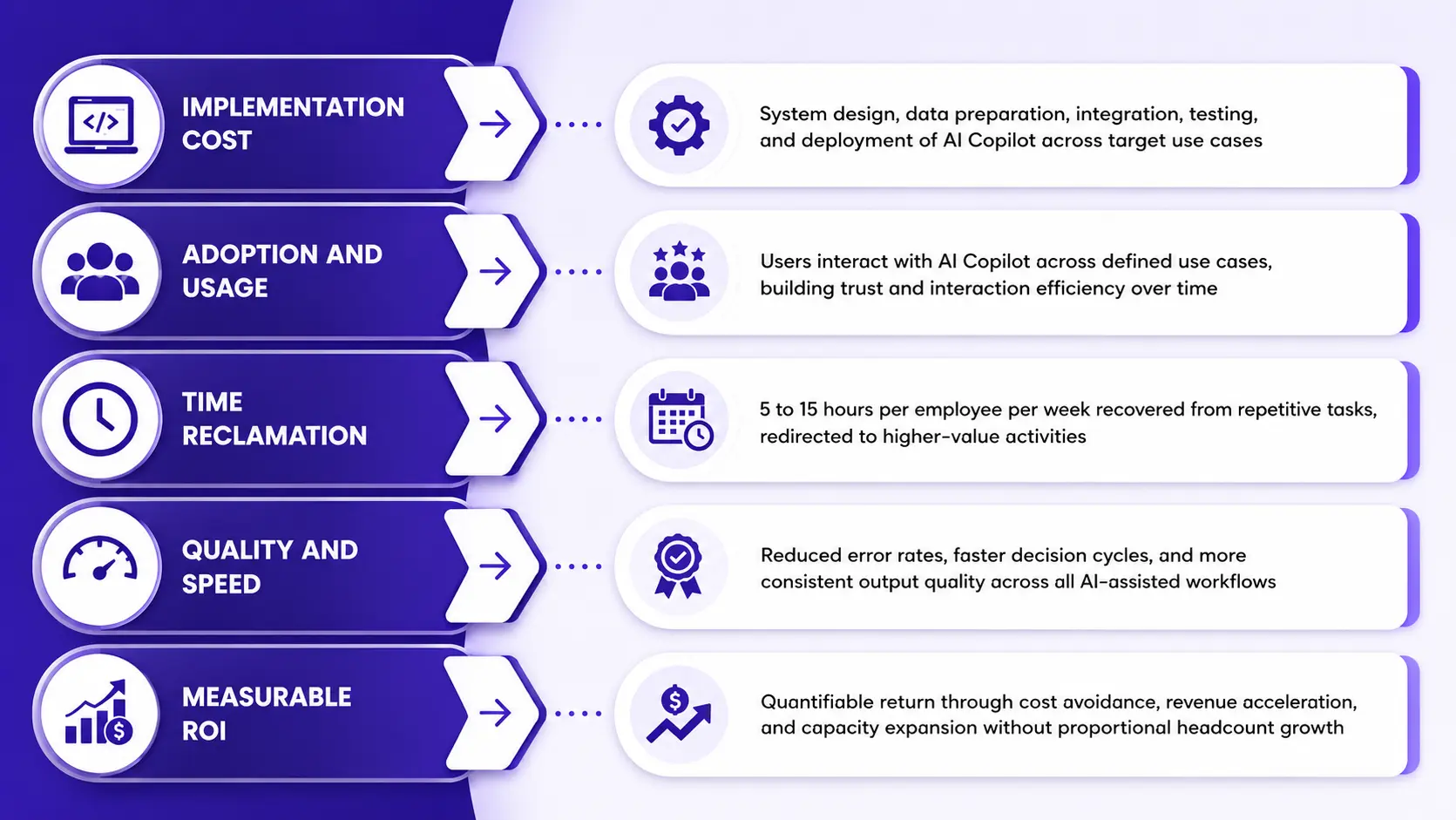
AI Copilot implementation cost is best understood as a combination of four distinct cost categories. Initial design and architecture costs cover the planning, system design, and technical specification work that establishes the blueprint for everything else. Data preparation and integration costs cover the work of collecting, cleaning, chunking, embedding, and indexing the knowledge base, plus connecting the AI Copilot to existing business systems.
Model and infrastructure costs cover the language model API fees, vector database hosting, cloud compute, and monitoring tooling required to operate the system. Ongoing operations costs cover maintenance, knowledge base updates, model evaluations, security audits, and user support. Over eight years of designing, building, and deploying AI Copilot systems for enterprises across the US, UAE, and India, we have accumulated a detailed picture of how implementation cost structures vary by industry, organization size, and deployment complexity.
The productivity impact side of the equation is measured differently depending on the industry and the specific use case, but consistently falls into three categories: time reclamation measured in professional hours recovered per employee per week, error reduction measured in quality incidents or rework costs avoided, and decision acceleration measured in cycle time reduction for key business processes.
AI Copilot Implementation Cost Structure: Four-Category Breakdown
How AI Copilot Drives Cost and Productivity Changes?
Understanding the mechanism through which AI Copilot drives cost and productivity changes is essential for building a credible business case and setting realistic expectations with board-level stakeholders. The value of AI Copilot is not delivered through a single dramatic transformation event; it is delivered through the accumulation of hundreds of small time savings, quality improvements, and decision accelerations across every AI Copilot-assisted interaction every day.
The primary cost driver on the investment side is complexity. AI Copilot implementation cost scales directly with the number of use cases deployed, the number and diversity of data sources that must be processed and indexed, the number of business systems requiring integration, and the compliance requirements that govern data handling and system security. An organization in Dubai’s financial sector deploying an AI Copilot with access to client data, regulatory databases, and multiple CRM and ERP systems will face a significantly higher implementation cost than a retail startup in India deploying a customer service AI Copilot with access to a single product catalog and FAQ database.
The primary productivity driver on the return side is adoption rate. AI Copilot systems deliver productivity returns only when users actually use them, use them effectively, and trust their outputs enough to act on them without excessive verification overhead. Organizations that invest in user onboarding, change management, and progressive use case expansion consistently achieve higher productivity returns from the same AI Copilot implementation cost than those that treat adoption as a natural consequence of deployment.
AI Copilot Cost and Productivity in Financial Services
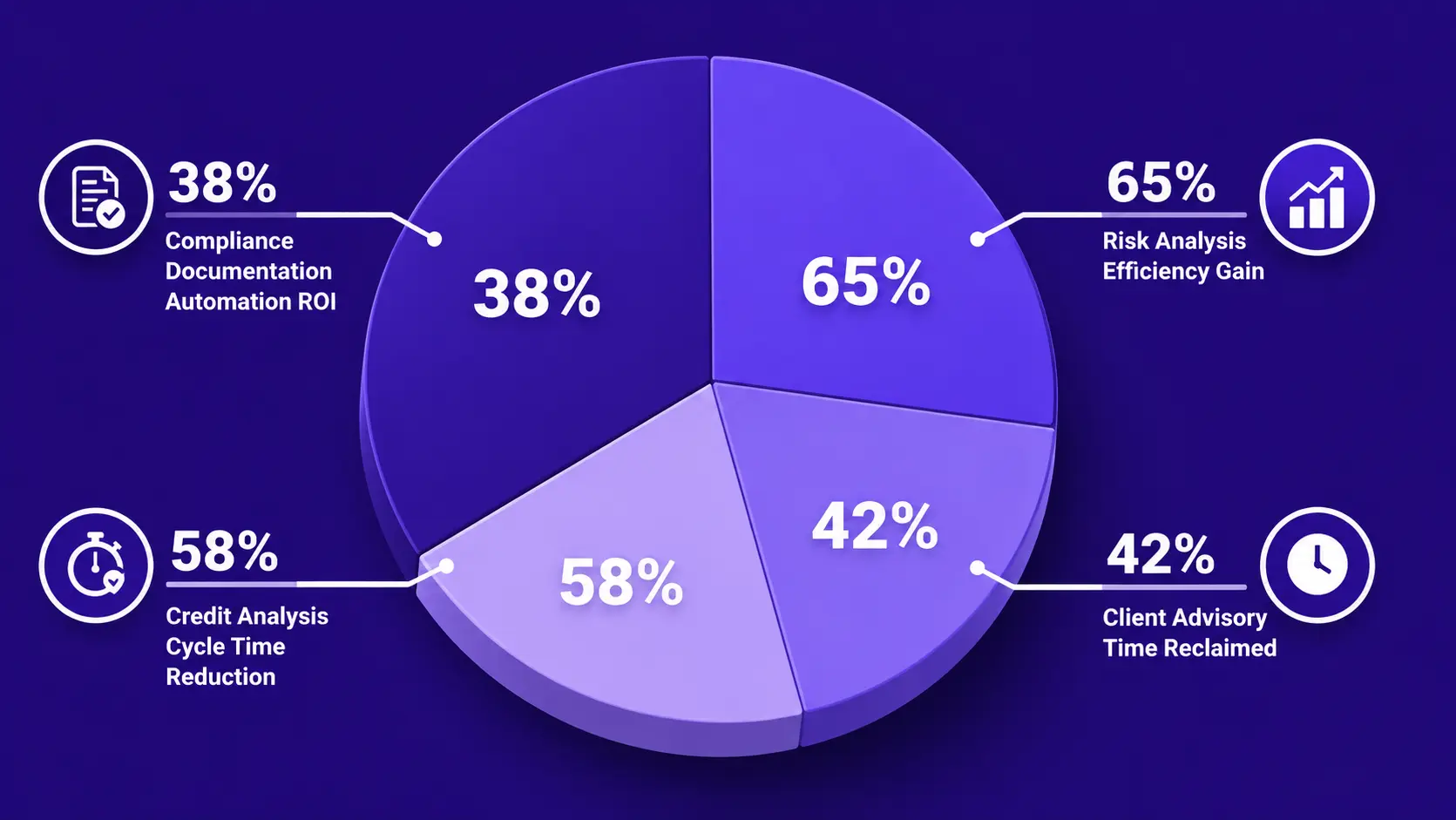
Financial services consistently demonstrates the highest ROI-to-implementation-cost ratio of any industry vertical in our experience. The combination of high-value professional time, massive documentation burden, complex regulatory requirements, and data-intensive decision-making creates an environment where AI Copilot implementation cost is recovered faster than in almost any other sector.
For a mid-sized financial institution in Dubai with 150 to 300 professionals, a comprehensive AI Copilot implementation covering compliance documentation, risk analysis, and client advisory support typically carries an implementation cost in the range of $80,000 to $180,000 depending on the number of system integrations and the volume of regulatory knowledge that must be indexed. This investment regularly delivers payback within 5 to 8 months post-deployment through measurable reductions in compliance team hours, analyst research time, and relationship manager administrative load.
The productivity math in financial services is compelling. A compliance officer in a US financial institution earning $120,000 annually who recovers 8 hours per week from AI Copilot-assisted documentation generates approximately $24,000 in recovered productive capacity per year. Multiply across a compliance team of 20 professionals and the annual productivity value exceeds $480,000, against an implementation cost of $120,000 to $200,000. The ROI within 12 months is clear and defensible.
For financial institutions in India where salary structures are lower but documentation burdens are comparable, the AI Copilot implementation cost is typically 30 to 40 percent lower than US equivalents while the productivity time savings remain proportionally significant. This cost structure makes the investment case even more favorable in the Indian market, where a comparable deployment might cost $50,000 to $100,000 while delivering productivity returns that justify the investment within 6 months.
AI Copilot Cost and Productivity in Healthcare Industry
Healthcare AI Copilot implementation cost is characterized by higher compliance requirements that increase design and security investment, but the productivity returns from clinical documentation automation are among the fastest and most measurable of any industry. Hospitals and healthcare networks in the US, India, and UAE face a common operational reality: physicians are among the most expensive professionals in the organization, and they spend a disproportionate share of their time on documentation rather than patient care.
A mid-sized hospital network in India with 200 physicians might invest $60,000 to $120,000 in AI Copilot implementation covering clinical documentation, decision support, and prior authorization processing. The productivity return is calculated against physician time. If each physician recovers 90 minutes of documentation time per day and the blended cost of physician time is equivalent to $40 per hour in the Indian market context, the daily productivity value across 200 physicians is $12,000. The annual productivity value approaches $3 million against an implementation cost one-fortieth of that scale.
In the US healthcare market, where physician time is valued considerably higher, the AI Copilot implementation cost for a comparable deployment might run $150,000 to $300,000, but the productivity return scales proportionally. At $150 per hour for physician time, the same 90-minute daily recovery across 200 physicians generates $45,000 per day in recovered productive capacity. The payback period for even the higher US implementation cost falls within 2 to 4 months. [1]
The compliance dimension of healthcare AI Copilot implementation cost deserves specific attention. Healthcare data is among the most sensitive personal data categories in every jurisdiction, subject to HIPAA in the US, health data protections under DPDP in India, and sector-specific regulations in the UAE. Implementing the security architecture, access controls, audit logging, and data handling procedures required for healthcare compliance adds 20 to 30 percent to base AI Copilot implementation cost. This increment is non-negotiable in regulated healthcare environments and should be planned for explicitly from the outset of budget planning.
How AI Copilot Impacts Retail and E-Commerce Costs?
Retail and e-commerce AI Copilot implementation cost structures differ from other industries in an important way: the productivity return is measured not primarily in professional time savings but in revenue metrics including conversion rate improvement, average order value increase, customer service cost reduction, and inventory efficiency gains. This revenue-linked return profile makes the ROI calculation more complex but also more compelling, because the upside is not bounded by headcount the way pure time-saving use cases are.
A mid-sized e-commerce operation in India with a product catalog of 50,000 SKUs and a customer service team of 80 agents might invest $40,000 to $80,000 in an AI Copilot covering personalized product recommendations, customer service assistance, and demand planning queries. The return on this AI Copilot implementation cost comes through three channels simultaneously: a 2 to 4 percent improvement in site conversion rate, a 15 to 20 percent reduction in customer service handling time per ticket, and a measurable improvement in inventory positioning that reduces both stockout and overstock situations.
For luxury retail brands operating in Dubai’s competitive market, the AI Copilot implementation cost for a personalized client engagement system is higher, typically $80,000 to $150,000, because the knowledge base requires extensive product expertise content and the integration with customer history systems is more sophisticated. The return, however, comes through increased repeat purchase frequency and higher average transaction values from clients who receive more personalized, informed assistance.
Customer service efficiency is frequently the first measurable win from retail AI Copilot implementation. When agents have instant access to complete order history, product specifications, return policies, and recommended resolution pathways through AI Copilot assistance, average handling time per ticket drops by 30 to 40 percent. For an operation paying $15 per agent hour across 80 agents handling 500 tickets per day, this handling time reduction translates to substantial daily cost savings that accumulate rapidly against the implementation investment.
AI Copilot Cost Impact on Cybersecurity Operations
Cybersecurity AI Copilot implementation cost is justified by a return mechanism that is unique among industry verticals: the cost of a single major security incident that the AI Copilot helps prevent or contain faster can exceed the entire implementation cost many times over. In cybersecurity, AI Copilot implementation cost is most accurately framed not as a productivity investment but as a risk reduction investment with productivity benefits as a secondary value stream.
A security operations center in a large enterprise in the US or UAE typically processes 10,000 to 50,000 security alerts per day. The human capacity to investigate meaningful alerts is finite; without AI assistance, analysts spend the majority of their time on alert triage rather than genuine threat investigation. AI Copilot implementation for a security operations team of 20 analysts typically costs $70,000 to $150,000, covering the integration with SIEM systems, threat intelligence databases, and incident management platforms, plus the domain-specific knowledge base that allows the AI Copilot to understand and classify security events intelligently.
The productivity return in cybersecurity is measured in mean time to detect, mean time to respond, and false positive rate reduction. Organizations in our portfolio that have implemented AI Copilot for security operations consistently report 40 to 60 percent reductions in alert triage time, allowing analysts to investigate 2 to 3 times as many genuine incidents within the same working day. The risk reduction value of this improved analyst capacity is measured in the reduced probability and impact of security incidents that penetrate the organization before detection.
Productivity Gains from AI Copilot in Software Engineering
Software engineering presents perhaps the clearest AI Copilot implementation cost and productivity story of any industry because the outputs are highly measurable: lines of code reviewed, features delivered, bug rates, and test coverage are all quantifiable with engineering precision. The productivity return from AI Copilot assistance in software engineering is among the most well-documented in enterprise technology.
Software Engineering AI Copilot Implementation Cost vs Productivity Return
| Team Size | Typical Implementation Cost | Monthly Productivity Gain Value | Payback Period |
|---|---|---|---|
| 5 to 15 Engineers (Startup) | $15,000 to $35,000 | $8,000 to $20,000 | 2 to 4 months |
| 15 to 50 Engineers (Mid-Market) | $40,000 to $90,000 | $25,000 to $60,000 | 2 to 4 months |
| 50 to 200 Engineers (Enterprise) | $100,000 to $250,000 | $80,000 to $200,000 | 2 to 3 months |
| 200+ Engineers (Large Enterprise) | $250,000 to $500,000+ | $200,000 to $500,000+ | 1 to 3 months |
The productivity gain calculations in the table above are based on a standard assumption that AI Copilot assistance recovers 35 to 45 percent of engineering time from routine tasks including code generation for standard patterns, documentation, test case creation, and code review for common issues. For engineering teams in Bengaluru with an average salary of $25,000 annually, the monthly productivity gain value per engineer recovered is approximately $750. For teams in San Francisco at $200,000 annual salary, the same recovered time is worth $6,000 per engineer per month, making the payback calculation proportionally compelling at all salary levels.
AI Copilot Cost Effects in Manufacturing Industry
Manufacturing AI Copilot implementation cost is justified primarily through operational cost reduction rather than labor productivity gains, although both contribute to the return. In manufacturing, the most financially significant AI Copilot use cases center on predictive maintenance and quality control, both of which deliver value by preventing costly operational events rather than by making humans faster at their existing tasks.
For a manufacturing facility in India’s automotive sector with 50 to 100 production assets, an AI Copilot implementation covering predictive maintenance and quality monitoring typically costs $80,000 to $160,000. This investment covers the integration with sensor data systems, SCADA platforms, and maintenance management software, plus the knowledge base indexing of equipment manuals, historical failure data, and maintenance records. The productivity and cost return comes primarily from reduced unplanned downtime, which in automotive manufacturing can cost $50,000 to $200,000 per hour depending on the production line and vehicle model.
If an AI Copilot predictive maintenance system prevents or reduces the duration of just two major unplanned downtime events per year, the total cost avoidance can easily exceed the entire AI Copilot implementation cost in the first year of operation. For larger manufacturing enterprises in the UAE or US where production line values are higher and downtime costs are proportionally greater, the return multiple is even more dramatic.
Quality control AI Copilot use cases add a second layer of return through defect rate reduction. In industries where defective products trigger warranty claims, regulatory recalls, or customer satisfaction consequences, the cost of quality failures extends well beyond production waste. AI Copilot systems that monitor in-process quality signals and alert operators before defective production volumes accumulate deliver cost avoidance returns that are measurable within the first quarter of deployment.
AI Copilot Impact on Logistics and Supply Chain Costs
Logistics and supply chain AI Copilot implementation cost is recovered through operational efficiency improvements across multiple cost categories simultaneously, making it one of the most financially complex but potentially highest-value investment opportunities for enterprises managing large distribution networks. In logistics, marginal efficiency improvements compound rapidly because the scale of operations amplifies even small percentage improvements into significant absolute dollar values.
A logistics company in the UAE managing regional distribution across five countries with a fleet of 500 vehicles and a warehouse network of 20 facilities might invest $120,000 to $200,000 in AI Copilot covering demand forecasting, route optimization assistance, supplier communication, and inventory management queries. The return comes through fuel cost reduction from optimized routing, inventory carrying cost reduction from improved demand forecasting accuracy, labor cost reduction from streamlined warehouse operations, and supplier relationship efficiency gains from faster, better-informed procurement decisions.
The aggregate operational cost reduction from comprehensive logistics AI Copilot implementation consistently runs 12 to 18 percent of addressable operational cost within the first 12 months based on our experience across deployments in India and the UAE. For a logistics operation with $10 million in annual addressable operational cost, a 15 percent reduction represents $1.5 million in annual savings against an implementation cost that is an order of magnitude smaller.
AI Copilot Cost and Productivity Across Industries Breakdown
Bringing together the analysis across all seven industry verticals provides a comprehensive picture of how AI Copilot implementation cost and productivity return vary by sector, and how organizations in different markets should calibrate their investment expectations.
AI Copilot Implementation Cost and ROI Summary Across Industries 2026
| Industry | Typical Cost Range (US) | India Cost Reduction | Avg Payback Period | 24-Month ROI |
|---|---|---|---|---|
| Financial Services | $80K to $200K | 35 to 40% | 5 to 8 months | 300 to 450% |
| Healthcare | $150K to $300K | 40 to 45% | 2 to 5 months | 500 to 800% |
| Retail and E-Commerce | $40K to $150K | 30 to 40% | 4 to 9 months | 200 to 400% |
| Cybersecurity | $70K to $150K | 30 to 35% | 6 to 12 months | Incident-dependent |
| Software Engineering | $40K to $500K | 40 to 50% | 2 to 4 months | 400 to 600% |
| Manufacturing | $80K to $200K | 35 to 45% | 6 to 12 months | 250 to 500% |
| Logistics and Supply Chain | $80K to $200K | 35 to 40% | 6 to 12 months | 200 to 400% |
Several cross-industry patterns emerge from this analysis that are directly actionable for organizations planning AI Copilot investment. First, the India cost advantage is consistent and significant across all sectors, making it an exceptionally attractive market for AI Copilot adoption from a pure cost-efficiency perspective. Second, software engineering and healthcare consistently deliver the fastest payback periods because the value is delivered directly through expensive professional time and is immediately measurable. Third, cybersecurity ROI is the most context-dependent because the primary return mechanism is incident prevention rather than productivity improvement.
Number of Use Cases
Each additional AI Copilot use case adds 20 to 40 percent incremental cost to base implementation but provides compounding productivity returns. The marginal cost per use case decreases as shared infrastructure is reused across the growing deployment. Strategic sequencing of use case rollout maximizes ROI trajectory.
Data Volume and Quality
Data preparation is the most variable cost component in AI Copilot implementation. Organizations with clean, well-structured knowledge assets spend 30 percent of implementation budget on data. Those with fragmented, poor-quality data can spend 60 percent. Investing in data quality before AI Copilot implementation reduces total cost significantly.
Integration Complexity
Each enterprise system integration adds $5,000 to $20,000 in implementation cost depending on API quality, authentication complexity, and data volume. Well-documented APIs with clear authentication standards are significantly cheaper to integrate than legacy systems requiring custom connector engineering.
Compliance Requirements
Regulated industries face 20 to 35 percent higher AI Copilot implementation cost due to mandatory security architecture, audit logging, data residency controls, and compliance documentation requirements. This increment is non-negotiable and must be planned for from the outset rather than added reactively after a compliance finding.
User Volume and Scale
AI Copilot infrastructure must be sized for concurrent user load. An implementation for 50 users has a meaningfully different infrastructure cost than one serving 5,000 users. Cloud-native architectures with auto-scaling capabilities manage this cost efficiently, but capacity planning must be addressed in the initial design to avoid costly re-architecture later.
Model Selection and API Cost
Ongoing model API cost scales directly with query volume and average context window size per query. Organizations with high query volumes should model their monthly API cost carefully during planning. Hybrid approaches using smaller models for simpler tasks and larger models only for complex reasoning can reduce ongoing operating cost by 30 to 50 percent.
AI Copilot Implementation Cost is an Investment, Not an Expense
The evidence across seven industries and three major markets is unambiguous: AI Copilot implementation cost, when properly planned and executed, delivers returns that substantially exceed the investment within the first year in most scenarios. The organizations that achieve the highest ROI from their AI Copilot implementation cost are those that start with a clear use case strategy, invest adequately in data preparation, size their compliance architecture correctly for their regulatory environment, and treat user adoption as a first-class implementation concern rather than an afterthought.
The organizations that achieve the lowest ROI are those that underinvest in data quality, skip compliance architecture in regulated environments, and deploy AI Copilot without a structured adoption program. The good news is that all three of these failure modes are entirely preventable with proper planning and the right implementation partner.
After eight years of managing AI Copilot implementation budgets and tracking ROI across dozens of enterprise deployments in India, the UAE, and the US, our consistent finding is this: the question is not whether AI Copilot implementation cost is justified. In virtually every industry we analyzed, it clearly is. The question is whether your organization invests in the components of implementation that drive value, or cuts corners on them in ways that undermine the return on every dollar you spend.
Get a Transparent AI Copilot Cost and ROI Plan
We provide detailed AI Copilot implementation cost estimates and projected ROI models for your industry, team size, and market. No surprises, no overclaiming.
Frequently Asked Questions
Q1.1. What is the typical AI Copilot Implementation Cost for a mid-sized enterprise?
AI Copilot Implementation Cost for a mid-sized enterprise typically ranges from $40,000 to $200,000 depending on the number of use cases, integration complexity, data volume, and compliance requirements. Healthcare and financial services deployments tend toward the higher end due to security and regulatory architecture requirements.
Q2.2. What factors drive AI Copilot Implementation Cost the most?
The largest drivers of AI Copilot Implementation Cost are data preparation quality and volume, the number of business systems requiring integration, the number of use cases in scope, and compliance security architecture requirements. Organizations that underestimate data preparation consistently face higher total costs than their initial budget anticipated.
Q3.3. How long does it take to get ROI on AI Copilot Implementation Cost?
Payback periods on AI Copilot Implementation Cost range from 2 to 4 months for software engineering and healthcare deployments where professional time savings are immediately measurable, to 6 to 12 months for manufacturing and logistics deployments where the return comes through operational cost reduction and incident prevention rather than direct labor productivity.
Q4.4. Is AI Copilot Implementation Cost lower in India compared to the US?
Yes. AI Copilot Implementation Cost in India is typically 30 to 45 percent lower than equivalent deployments in the US primarily because engineering talent, infrastructure, and operational costs are lower. However, the productivity returns remain proportionally significant, making the investment case even more favorable in the Indian market.
Q5.5. What ongoing costs should I budget for beyond initial AI Copilot Implementation Cost?
Ongoing AI Copilot operational costs including model API fees, vector database hosting, knowledge base maintenance, security monitoring, and performance optimization typically run 15 to 25 percent of initial AI Copilot Implementation Cost annually. These costs should be included in all multi-year ROI calculations.
Q6.6. Can I reduce AI Copilot Implementation Cost by deploying fewer use cases initially?
Yes. Starting with one or two high-value use cases reduces initial AI Copilot Implementation Cost significantly and allows the organization to validate ROI before committing to broader rollout. The marginal cost of adding subsequent use cases on an existing architecture is considerably lower than the initial implementation, making phased approaches cost-effective for many organizations.
Q7.7. What is the AI Copilot Implementation Cost difference between cloud-based and on-premise deployment?
Cloud-based AI Copilot deployments have lower initial implementation cost but higher ongoing operating cost compared to on-premise deployments. On-premise implementations carry higher upfront infrastructure investment but can achieve lower long-term operating cost at high query volumes. For most enterprises in the US, UAE, and India, cloud-based deployment is more cost-effective for the first 12 to 24 months.
Q8.8. How does AI Copilot Implementation Cost compare to the cost of hiring additional staff?
In most industries, AI Copilot Implementation Cost is recovered within 3 to 9 months through productivity gains that would otherwise require 3 to 8 additional full-time staff to achieve. Unlike headcount, the AI Copilot continues to improve in capability and efficiency over time without salary escalation, making the long-term cost comparison increasingly favorable to AI Copilot investment.
Q9.9. What should I watch out for when budgeting AI Copilot Implementation Cost?
The most common AI Copilot Implementation Cost underestimates occur in four areas: data preparation complexity when source data quality is poor, compliance architecture requirements in regulated industries, integration engineering when legacy systems have poor API documentation, and user adoption investment including training and change management that is essential for productivity return realization.
Q10.10. How do I build a business case using AI Copilot Implementation Cost and projected productivity gains?
A credible AI Copilot business case compares total AI Copilot Implementation Cost including ongoing operations against quantified productivity gains calculated by multiplying recovered professional hours by fully loaded employee cost rates. Adding error reduction value and decision acceleration benefits where measurable strengthens the case. Three-year total cost of ownership compared to three-year total value return is the standard framework for board-level approval decisions.
Explore Services
Related Services
Reviewed by

Aman Vaths
Founder of Nadcab Labs
Aman Vaths is the Founder & CTO of Nadcab Labs, a global digital engineering company delivering enterprise-grade solutions across AI, Web3, Blockchain, Big Data, Cloud, Cybersecurity, and Modern Application Development. With deep technical leadership and product innovation experience, Aman has positioned Nadcab Labs as one of the most advanced engineering companies driving the next era of intelligent, secure, and scalable software systems. Under his leadership, Nadcab Labs has built 2,000+ global projects across sectors including fintech, banking, healthcare, real estate, logistics, gaming, manufacturing, and next-generation DePIN networks. Aman’s strength lies in architecting high-performance systems, end-to-end platform engineering, and designing enterprise solutions that operate at global scale.