Ai Overview
The execution lifecycle is the end-to-end sequence of stages that takes a business requirement from conception through design, implementation, testing, deployment, and ongoing refinement. Building a high-performing artificial intelligence Copilot that genuinely transforms how a business operates is not a matter of selecting a language model and connecting it to your tools. Requirement analysis is the foundational stage of any AI Copilot System Design.
Key Takeaways
- AI Copilot System Design is a structured multi-stage lifecycle that begins with requirement analysis and ends with continuous optimization, not a single configuration event.
- Requirement analysis in AI Copilot System Design must capture use cases, user personas, data sources, integration points, and performance benchmarks before any technical work begins.
- Data preparation quality is the single most important determinant of AI Copilot retrieval accuracy, making chunking strategy, embedding selection, and metadata tagging critical design decisions.
- Model selection in AI Copilot System Design involves evaluating foundation LLMs against domain requirements, latency constraints, cost models, and fine-tuning feasibility for your business context.
- Prompt design is a dedicated engineering discipline within AI Copilot System Design that determines output quality, response format, tone consistency, and safety guardrail effectiveness.
- System integration in AI Copilot design requires API architecture, authentication frameworks, data access scoping, and tool registry configuration before the copilot can perform real business actions.
- The execution workflow defines how modules communicate during runtime, including orchestration logic, context assembly sequence, tool call handling, and output formatting for each use case.
- Testing in AI Copilot System Design must include functional testing, retrieval quality evaluation, adversarial prompt testing, latency benchmarking, and user acceptance testing across all target personas.
- Enterprises in India, the UAE, and the US that follow a structured AI Copilot System Design lifecycle report 60 to 70 percent fewer post-launch issues compared to ad-hoc implementations.
- The end-to-end AI Copilot System Design lifecycle is iterative, with feedback from each deployment phase informing continuous improvements to models, prompts, data pipelines, and integration logic.
What is AI Copilot System Design in Execution Lifecycle?
AI Copilot System Design refers to the complete set of architectural decisions, engineering processes, and implementation activities required to build, integrate, and operate an intelligent AI Copilot system that reliably performs its intended functions in a real business environment. The execution lifecycle is the end-to-end sequence of stages that takes a business requirement from conception through design, implementation, testing, deployment, and ongoing refinement.
Building a high-performing artificial intelligence Copilot that genuinely transforms how a business operates is not a matter of selecting a language model and connecting it to your tools. It requires a disciplined, structured approach to AI Copilot System Design that accounts for every phase of the execution lifecycle, from the initial mapping of business requirements through to deployment, continuous testing, and ongoing optimization.
Over eight years of designing and implementing AI Copilot systems for enterprises across the US, UAE, and India, we have observed a consistent pattern. Organizations that approach AI Copilot System Design with rigor, treating it as a full engineering lifecycle rather than a product configuration task, consistently achieve faster time to value, fewer post-launch failures, and significantly higher user adoption rates than those that underinvest in the design process.
Understanding AI Copilot System Design as a lifecycle rather than a project is a critical mindset shift. Unlike traditional software that is built, tested, and released in a relatively stable form, AI Copilot systems are living architectures that must continuously adapt to evolving business knowledge, changing user needs, new integration requirements, and improving AI model capabilities. The design decisions made in the early stages of the lifecycle set the constraints and opportunities for everything that follows, making upfront design quality the single greatest predictor of long-term AI Copilot success.
The execution lifecycle of an AI Copilot System Design encompasses ten distinct phases, each with its own design principles, technical requirements, and quality standards. Organizations that treat any of these phases as optional or superficial consistently encounter performance problems, integration failures, and user trust issues that are expensive and disruptive to resolve after deployment.
Requirement Analysis in AI Copilot System Design
Requirement analysis is the foundational stage of any AI Copilot System Design. It is where the business context is translated into technical specifications that guide every subsequent design decision. Inadequate requirement analysis is the most common cause of AI Copilot projects that deliver technically functional systems nobody actually wants to use.
Effective requirement analysis for AI Copilot System Design must capture six dimensions of information. First, use case definition: what specific tasks should the AI Copilot perform, in what sequence, and for which users? Second, user persona mapping: who will interact with the AI Copilot, what is their technical literacy, what vocabulary do they use, and what are their expectations for response quality and speed? Third, data inventory: what business knowledge sources exist, in what formats, what is their quality, and how current is the information they contain?
Fourth, integration landscape: which existing business systems must the AI Copilot connect with, what APIs are available, and what constraints exist around data access, authentication, and system modification? Fifth, performance requirements: what response latency is acceptable, what query volume must the system handle, and what accuracy benchmarks will define success? Sixth, compliance constraints: what regulatory, security, and data governance requirements must the system satisfy from the outset?
Requirement Analysis Framework for AI Copilot System Design
Use Case Specification
Define primary and secondary use cases with acceptance criteria, edge cases, and explicit out-of-scope boundaries that will constrain the system design.
User Persona Mapping
Create detailed profiles for each user type covering role, technical background, vocabulary, interaction patterns, and success metrics from the user’s perspective.
Data Source Inventory
Catalogue all knowledge sources including format, volume, update frequency, quality level, and access restrictions that will affect the retrieval architecture design.
Performance Benchmarks
Define measurable performance targets including response latency thresholds, retrieval precision and recall targets, and uptime requirements that will guide technical optimization.
One of the most valuable outputs of the requirement analysis stage is a documented AI Copilot System Design brief that serves as the reference document for all subsequent design decisions. This document captures the business context, technical constraints, performance expectations, and compliance requirements in a form that both engineering teams and business stakeholders can reference and validate throughout the lifecycle.
Data Preparation in AI Copilot System Design
Data preparation is where the quality of an AI Copilot System Design is most fundamentally determined. The AI Copilot’s ability to give accurate, relevant, and trustworthy responses depends entirely on the quality of the knowledge it can access, and that quality is shaped by how the source data is collected, cleaned, structured, chunked, embedded, and indexed before the system goes live.
The data preparation stage begins with a comprehensive audit of all candidate knowledge sources identified in the requirement analysis. This audit evaluates each source for accuracy, currency, completeness, format consistency, and access feasibility. Sources that are outdated, poorly structured, or duplicative add noise to the knowledge base and degrade retrieval quality. The discipline to exclude or remediate low-quality sources before indexing is one of the most impactful quality decisions in the entire AI Copilot System Design process.
Document processing is the next stage, where raw content is extracted from its original format and transformed into clean, processable text. This involves handling diverse formats including PDFs, Word documents, HTML pages, database records, and structured spreadsheets, each of which requires different extraction approaches to preserve semantic integrity. In multimodal pipelines, the system may also process a high-quality image as part of the input data to enrich the knowledge base.
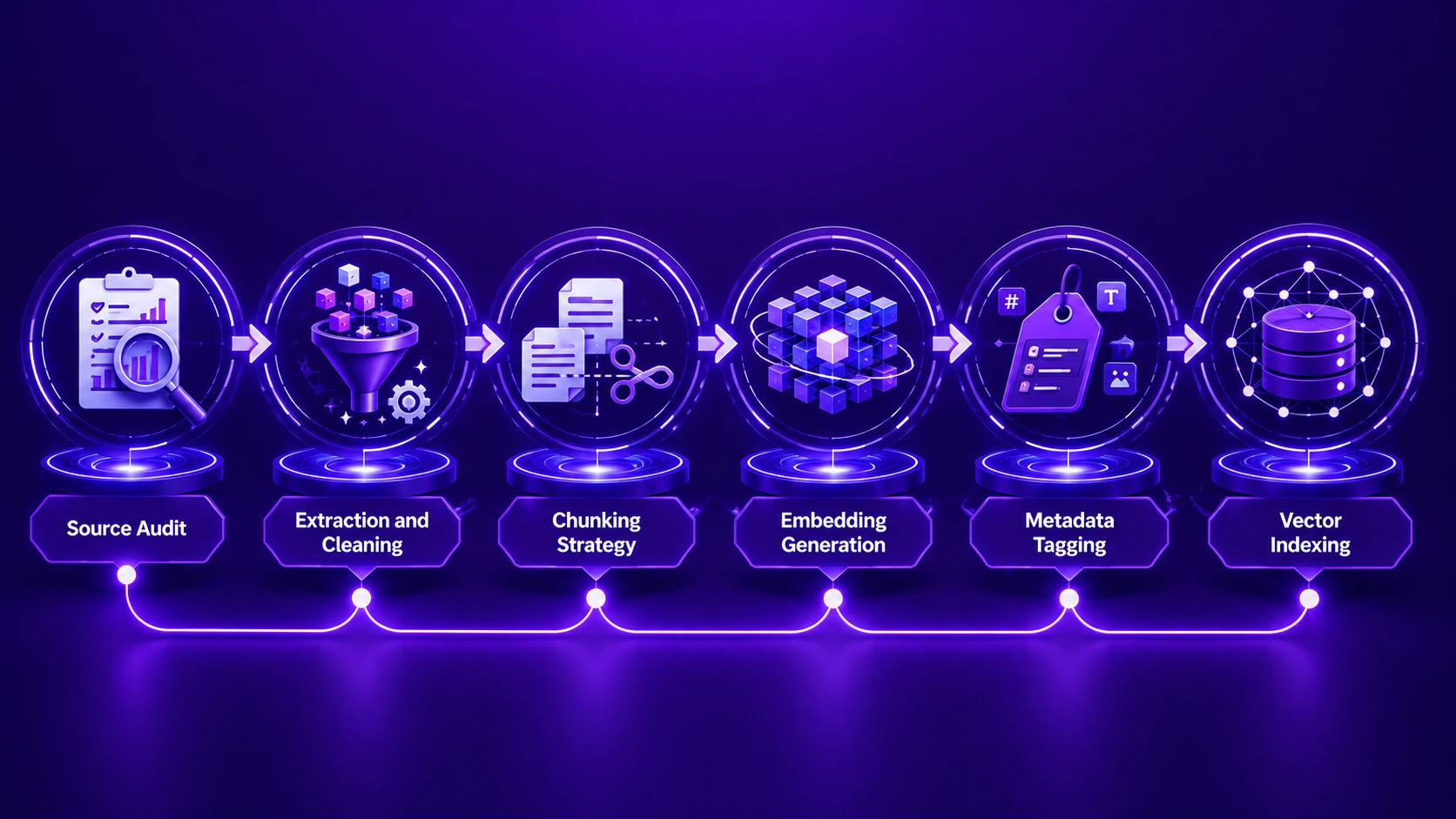
Chunking strategy deserves particular attention in AI Copilot System Design because it is one of the decisions that most directly impacts retrieval quality in practice. The goal is to create chunks that are semantically coherent, meaning each chunk contains a complete, self-contained piece of information rather than arbitrary character or word counts. Recursive character chunking, sentence-boundary chunking, and semantic chunking each produce different results depending on the content type, and the optimal approach must be validated empirically for each knowledge domain.
Model Selection in AI Copilot System Design
Model selection is one of the most consequential decisions in AI Copilot System Design because the choice of foundation model shapes the system’s reasoning quality, contextual understanding, output format flexibility, multilingual capability, and operating cost simultaneously. There is no universally correct model choice; the optimal selection depends on the specific requirements, constraints, and priorities established during requirement analysis.
Model Selection Criteria for AI Copilot System Design
| Selection Criterion | What to Evaluate | Why It Matters in System Design |
|---|---|---|
| Reasoning Quality | Benchmark performance on multi-step reasoning tasks similar to your use cases | Determines how accurately the copilot handles complex, multi-step business queries |
| Context Window Size | Maximum tokens the model can process in a single request | Affects how much retrieved context can be provided per query and conversation length |
| Latency Profile | Time to first token and full response generation speed under load | Directly impacts user experience, particularly for real-time conversational AI Copilot use cases |
| Fine-Tuning Support | Whether the model supports supervised fine-tuning on proprietary business data | Enables domain specialization for industries with unique terminology or regulatory language |
| Multilingual Capability | Quality of performance in languages used by your user base | Critical for India deployments with regional language users and UAE deployments with Arabic support needs |
| Total Cost of Operation | Per-token API cost multiplied by projected query volume over 12 months | Determines commercial viability of the AI Copilot System Design at scale |
A frequently overlooked dimension of model selection in AI Copilot System Design is the choice of embedding model, which operates independently of but in parallel with the foundation LLM. The embedding model converts both knowledge base content and user queries into vector representations for retrieval. Using a high-quality, domain-appropriate embedding model can significantly improve retrieval precision even when the foundation model remains unchanged, making it a high-leverage optimization point in the system design.
Prompt Design for AI Copilot Execution
Prompt design is the engineering discipline that determines how the AI Copilot communicates with the underlying language model to produce outputs that are accurate, appropriately formatted, consistent in tone, and aligned with business standards. In AI Copilot System Design, prompt engineering is not a creative writing exercise; it is a precision engineering task with measurable outcomes.
The system prompt is the most foundational element of prompt design. It defines the AI Copilot’s identity, capabilities, behavioral constraints, response format expectations, and safety guardrails. A well-engineered system prompt establishes the operational parameters within which every user interaction takes place. For enterprise AI Copilot systems deployed across teams in Mumbai, Dubai, and New York, the system prompt must simultaneously accommodate the professional standards of all three markets while maintaining consistency of behavior regardless of how diverse individual user queries become.
Dynamic prompt construction is what transforms a static system prompt into a contextually intelligent response engine. During each query, the orchestration layer assembles a complete prompt that combines the system prompt, retrieved knowledge chunks, conversation history, user context, and the current query into a coherent input structure for the language model. The design of this assembly logic, including how to handle context window limits, how to prioritize competing information sources, and how to format retrieved content for maximum model comprehension, is one of the most technically demanding aspects of AI Copilot System Design.
System Prompt Engineering
Design the foundational instruction set that defines the copilot’s role, boundaries, response style, format requirements, and safety constraints applicable across every interaction the system handles.
Dynamic Context Assembly
Design the logic that assembles retrieved chunks, session history, user context, and the live query into a well-structured prompt that maximizes model comprehension within context window constraints.
Output Format Specification
Define how responses should be structured for different use cases: conversational prose for chat interfaces, structured JSON for API consumers, markdown for document generation, or tabular formats for data-heavy responses.
Guardrail Integration
Embed behavioural guardrails directly into prompt architecture to prevent the copilot from generating out-of-scope, inappropriate, or unsafe responses, with clear fallback instructions when the system cannot handle a request.
Chain-of-Thought Patterns
For complex reasoning tasks, prompt design incorporates chain-of-thought patterns that guide the model through explicit reasoning steps, producing more accurate and auditable outputs for high-stakes business decisions.
Prompt Versioning and Testing
Treat prompt versions as engineering artifacts with proper version control, regression testing, and A/B evaluation frameworks that allow systematic optimization of prompt performance without disrupting production systems.
System Integration in AI Copilot System Design
System integration is where the AI Copilot System Design moves from intelligent text generation to actual business value creation. Without robust integration with the tools, databases, and workflows where real work happens, an AI Copilot is limited to providing conversational guidance from a static knowledge base. Integration is what enables the copilot to take real actions, retrieve live data, and participate as an active agent in business processes rather than a passive advisor.
Integration architecture in AI Copilot System Design must address four functional layers. The data integration layer connects the AI Copilot to the knowledge sources it will retrieve from, including document stores, databases, and data warehouses, through secure, role-scoped connections that enforce access controls at the data level. The tool integration layer connects the AI Copilot to the business applications it will interact with, enabling it to read records, create entries, trigger workflows, and send communications through well-defined API interfaces.
The authentication and authorization layer ensures that all API calls made by the AI Copilot are executed under user-scoped credentials rather than shared service accounts, enforcing the principle of least privilege across every integration point. The monitoring and observability layer tracks all integration activity, logging API calls, data access events, and action executions in tamper-evident audit trails that support both operational monitoring and compliance reporting.
For enterprise deployments in regulated sectors, such as financial services firms in the UAE or healthcare organizations in India, integration architecture must also account for data residency requirements that restrict certain data from leaving specific geographic boundaries. AI Copilot System Design in these contexts requires careful selection of integration patterns that maintain compliance with data localization regulations while preserving the performance and functionality that users expect.
Execution Workflow in AI Copilot System Design
The execution workflow defines the precise sequence of operations that the AI Copilot performs from the moment a user submits a query to the moment a response is delivered. Designing this workflow correctly in the AI Copilot System Design phase is critical because it determines the system’s reliability, performance, and capability to handle the full diversity of real-world business queries.
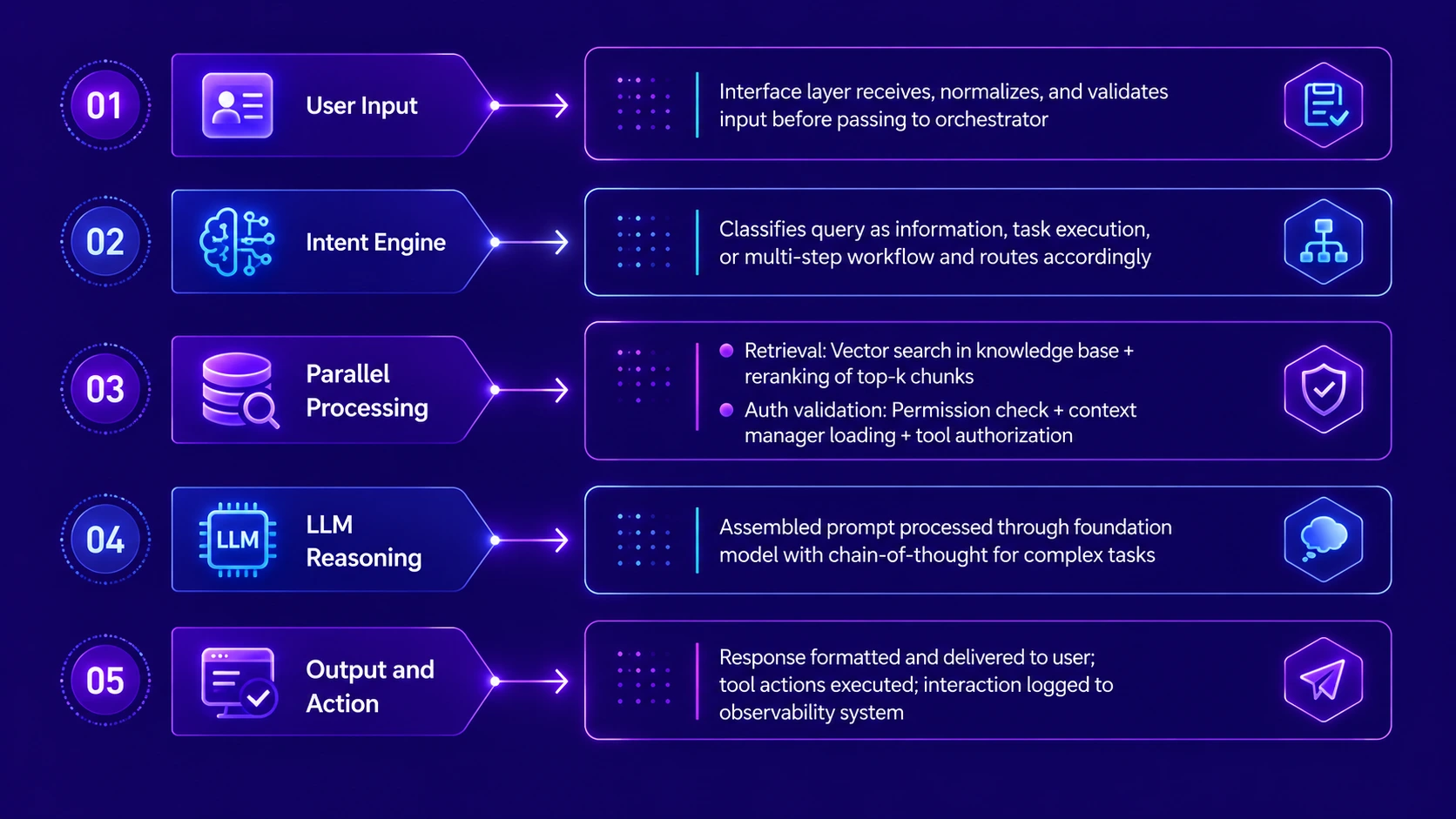
The execution workflow begins at the interface layer, where the user’s input is received, normalized, and passed to the orchestration engine. The orchestrator performs intent classification to determine the type of request: is this an information query, a task execution command, a multi-step workflow request, or an ambiguous input that requires clarification? Each intent type triggers a different execution path through the system’s module architecture.
For information queries, the orchestrator activates the retrieval pipeline, which converts the query to a vector, applies metadata filters based on user context, performs similarity search in the vector database, reranks the retrieved chunks, and assembles them into the prompt context. For task execution commands, the orchestrator additionally invokes the action planner, which validates the requested action against the user’s permissions, selects the appropriate tool from the tool registry, and executes the API call with proper error handling and result confirmation.
Parallel execution is an important design consideration in AI Copilot System Design for complex queries that require both knowledge retrieval and tool execution simultaneously. Well-designed orchestration logic runs retrieval and authentication validation in parallel where possible, reducing total response latency without sacrificing output quality or security. For enterprise teams in the US processing high query volumes during peak hours, this latency optimization can be the difference between a copilot that feels instant and one that feels sluggish.
Testing, Optimization, and Deployment Process
Testing in AI Copilot System Design is fundamentally different from traditional software testing because the system under test is probabilistic rather than deterministic. The same query may produce slightly different responses across runs, and defining “correct” is often a matter of evaluating quality across multiple dimensions rather than verifying an exact output match. This complexity requires a structured testing methodology designed specifically for AI systems.
Retrieval quality testing evaluates whether the vector database returns the correct knowledge chunks for a defined test query set. This testing uses precision and recall metrics across a curated set of golden queries with known correct retrievals, allowing the team to measure the effectiveness of chunking strategy, embedding model choice, and indexing configuration quantitatively. For AI Copilot System Design in domains with specialized terminology, such as legal services in the UAE or pharmaceutical operations in India, retrieval quality testing must include domain-specific test cases that expose gaps in the knowledge base or embedding model performance.
Response quality evaluation assesses whether the language model synthesizes retrieved information into accurate, relevant, appropriately formatted, and safe responses. Automated evaluation using LLM-as-judge frameworks, combined with structured human evaluation from representative users, produces a comprehensive picture of output quality across the full range of expected use cases. [1]
Adversarial testing specifically attempts to identify AI Copilot System Design vulnerabilities including prompt injection susceptibility, data leakage through carefully crafted queries, access control bypass attempts, and guardrail circumvention through social engineering approaches. This testing must be conducted by team members who think like adversaries, not like designers who built the system with benign intent.
AI Copilot System Design Testing Coverage Metrics
The deployment process for an AI Copilot System Design follows a staged rollout model rather than a hard cutover. Initial deployment to a pilot user group allows the team to gather real interaction data, identify edge cases not covered in testing, and refine the system before broader organizational rollout. This staged approach is particularly important for large enterprises in India and the US where the scale of the user base makes post-launch issues proportionally more impactful than in smaller deployments.
AI Copilot System Design in Real Execution Flow
To make AI Copilot System Design concrete, consider how the lifecycle stages play out in a real enterprise scenario. A professional services firm in Dubai with 500 consultants decides to deploy an AI Copilot that assists their team in researching client industries, drafting proposal sections, querying internal project knowledge, and summarizing meeting notes from integrated calendar and communication tools.
The requirement analysis phase produces a detailed system design brief specifying six primary use cases, three user persona types ranging from junior analysts to senior partners, a data inventory covering five years of project documentation and two CRM systems, integration requirements for calendar and email platforms, a 500 millisecond latency target for 95th percentile queries, and DIFC data residency compliance requirements.
The data preparation phase processes 40,000 project documents, applies semantic chunking with 400-token chunks and 50-token overlap, generates embeddings using a multilingual embedding model supporting English and Arabic, and indexes the vectors in a UAE-region-hosted vector database with metadata tagging for practice area, client sector, year, and document type. The model selection phase evaluates three foundation models against the firm’s latency budget and reasoning quality requirements, selecting a model that performs best on professional writing tasks while meeting the 500 millisecond threshold.
The prompt design phase engineers a system prompt that establishes the consultant-assistant role, defines response format standards for each use case type, integrates guardrails preventing disclosure of client-confidential information across projects, and includes chain-of-thought guidance for complex industry research queries. System integration connects the AI Copilot to both CRM systems through user-scoped OAuth tokens, the calendar integration for meeting context, and the internal document management system through a dedicated read-only API connector.
End-to-End AI Copilot System Design Lifecycle Flow
The complete end-to-end AI Copilot System Design lifecycle brings all stages together into a coherent, iterative process. Understanding the full lifecycle as an integrated system rather than a sequence of independent tasks is what separates AI Copilot implementations that compound in value over time from those that plateau at launch quality.
End-to-End AI Copilot System Design Lifecycle Summary
| Lifecycle Stage | Primary Output | Quality Gate | Typical Timeline |
|---|---|---|---|
| Requirement Analysis | System design brief and technical specification document | Business and technical stakeholder sign-off | 1 to 2 weeks |
| Data Preparation | Indexed vector database with metadata-tagged knowledge base | Retrieval precision above defined threshold on test queries | 2 to 4 weeks |
| Model Selection | Chosen LLM and embedding model with documented rationale | Benchmark performance meets latency and quality targets | 1 week |
| Prompt Design | Versioned system prompt library and assembly logic | Output quality scores above threshold across all use case types | 1 to 2 weeks |
| System Integration | Configured API connectors, auth layer, and tool registry | All integrations functional with correct access scoping | 2 to 3 weeks |
| Testing and Optimization | Test reports, optimized components, and launch readiness sign-off | All quality gates passed including adversarial testing | 2 to 3 weeks |
| Staged Deployment and Iteration | Live production system with ongoing monitoring and optimization | Pilot user satisfaction and performance metrics within targets | Ongoing |
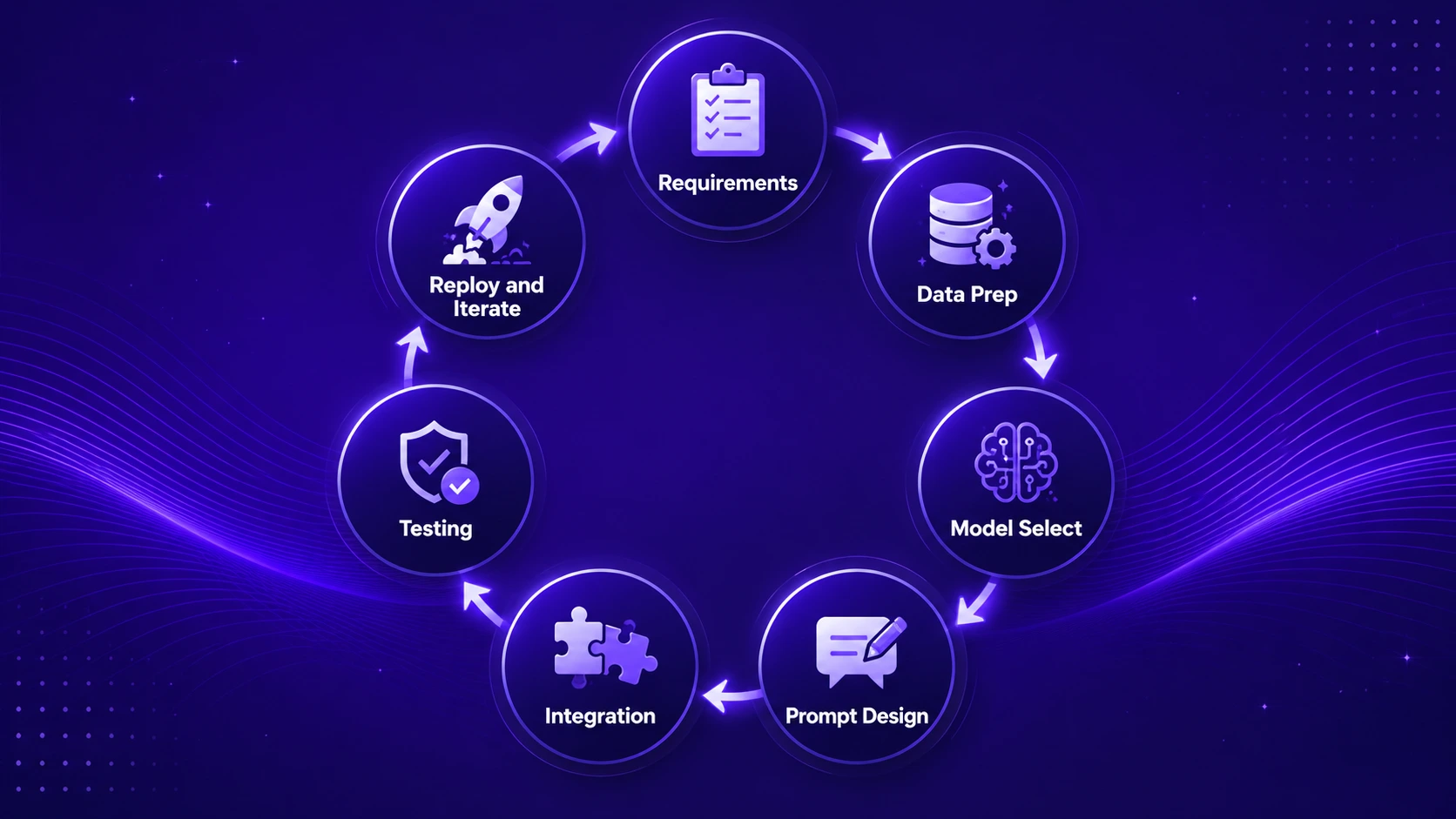
The iterative nature of the AI Copilot System Design lifecycle is what makes it fundamentally different from traditional software delivery. Every interaction logged by the observability system is a data point for improving retrieval quality, prompt effectiveness, or integration reliability. Every user feedback signal is an input to the next prompt optimization cycle. Organizations that build continuous improvement into their AI Copilot System Design governance from the beginning are those that see their system’s value compound month over month rather than plateau at the initial launch quality.
For enterprises across India’s technology sector, the UAE’s professional services industry, and the US enterprise market, the competitive advantage from a well-designed AI Copilot System Design is not just the productivity gains at launch but the compounding improvement trajectory that a structured lifecycle enables. A system designed with rigor gets better over time. A system designed without rigor gets worse as the gap between the knowledge base and current business reality grows wider with each passing month.
AI Copilot System Design is the Foundation of Everything
The execution lifecycle of an AI Copilot System Design is not a project plan; it is an engineering philosophy that recognizes the unique characteristics of AI systems and applies structured discipline at every stage to maximize the probability of building something that genuinely serves its users and grows in value over time.
Every requirement missed in the analysis phase becomes a costly redesign later. Every data quality compromise in the preparation phase degrades retrieval accuracy permanently. Every shortcut in testing becomes a user trust incident in production. And every investment in the design lifecycle, made thoughtfully and with appropriate depth, pays dividends in performance, reliability, and user confidence that accumulate over the entire lifetime of the system.
After eight-plus years of executing AI Copilot System Design for organizations across India, the UAE, and the US, our conclusion is consistent: the organizations that invest in design quality from the first day are the ones that are still expanding their AI Copilot capabilities two years later, while those that rushed to deployment are often rebuilding from scratch.
Design Your AI Copilot System the Right Way
Our team executes the complete AI Copilot System Design lifecycle for enterprises in US, UAE, and India. Architecture-first, compliance-ready, and built to compound in value.
Frequently Asked Questions
Q1.1. What is AI Copilot System Design and why does it matter for businesses?
AI Copilot System Design is the structured process of planning, building, integrating, and optimizing an AI assistant from requirement analysis through deployment. It matters because poor design is the primary reason AI Copilot projects fail to deliver expected business value.
Q2.2. What are the main stages in an AI Copilot System Design lifecycle?
The AI Copilot System Design lifecycle includes requirement analysis, data preparation, model selection, prompt design, system integration, execution workflow design, testing, optimization, staged deployment, and continuous iteration. Each stage produces specific outputs that feed into the next.
Q3.3. How long does it take to complete an AI Copilot System Design and build a working system?
A typical AI Copilot System Design and full implementation takes between eight and sixteen weeks depending on the complexity of use cases, volume of knowledge base content, number of system integrations, and compliance requirements of the target market.
Q4.4. What data is needed to start AI Copilot System Design for my business?
AI Copilot System Design requires an inventory of all knowledge sources the copilot will search, documentation of business processes it will support, details of systems it must integrate with, and clear definition of who the users are and what tasks they need help with.
Q5.5. Can AI Copilot System Design be customized for different industries?
Yes. AI Copilot System Design is inherently customized for each industry context. A financial services firm in Dubai requires different data preparation, model configuration, prompt engineering, and compliance controls than a healthcare organization in India or a technology company in the US.
Q6.6. What is the role of prompt design in AI Copilot System Design?
Prompt design in AI Copilot System Design determines how the system communicates with the language model, defines the copilot’s behavioural boundaries, controls output format and tone, and integrates safety guardrails. It is a precision engineering task that directly determines output quality.
Q7.7. How do you test an AI Copilot System Design before going live?
Testing an AI Copilot System Design involves retrieval quality evaluation using precision and recall metrics, response accuracy assessment on curated test queries, adversarial prompt injection testing, latency benchmarking under realistic load, and user acceptance testing with representative users from each persona type.
Q8.8. What makes AI Copilot System Design different from regular software design?
AI Copilot System Design must account for probabilistic model behaviour, retrieval quality optimization, prompt engineering, knowledge base management, and continuous iteration based on real interaction data. Traditional software design assumes deterministic outputs, which does not apply to AI systems.
Q9.9. How important is data quality in AI Copilot System Design?
Data quality is the single most important factor in AI Copilot System Design after architecture. Poor quality knowledge base content directly produces poor retrieval results regardless of model quality, prompt sophistication, or integration depth. Investing in data preparation pays dividends throughout the system’s lifetime.
Q10.10. What ongoing work is needed after AI Copilot System Design is complete?
After deployment, AI Copilot System Design requires continuous monitoring of output quality and retrieval accuracy, regular knowledge base updates as business information changes, prompt optimization based on user interaction patterns, security audits, and periodic model evaluations as better options become available.
Explore Services
Related Services
Reviewed by

Wazid Khan
Director & Co-Founder
Wazid Khan is the Director & Co-Founder of Nadcab Labs, a forward-thinking digital engineering company specializing in Blockchain, Web3, AI, and enterprise software solutions. With a strong vision for innovation and scalable technology, Wazid has played a key role in building Nadcab Labs into a trusted global technology partner. His expertise lies in strategic planning, business development, and delivering client-centric solutions that drive real-world impact. Under his leadership, the company has successfully delivered numerous projects across industries such as fintech, healthcare, gaming, and logistics. Wazid is passionate about leveraging emerging technologies to create secure, efficient, and future-ready digital ecosystems for businesses worldwide.