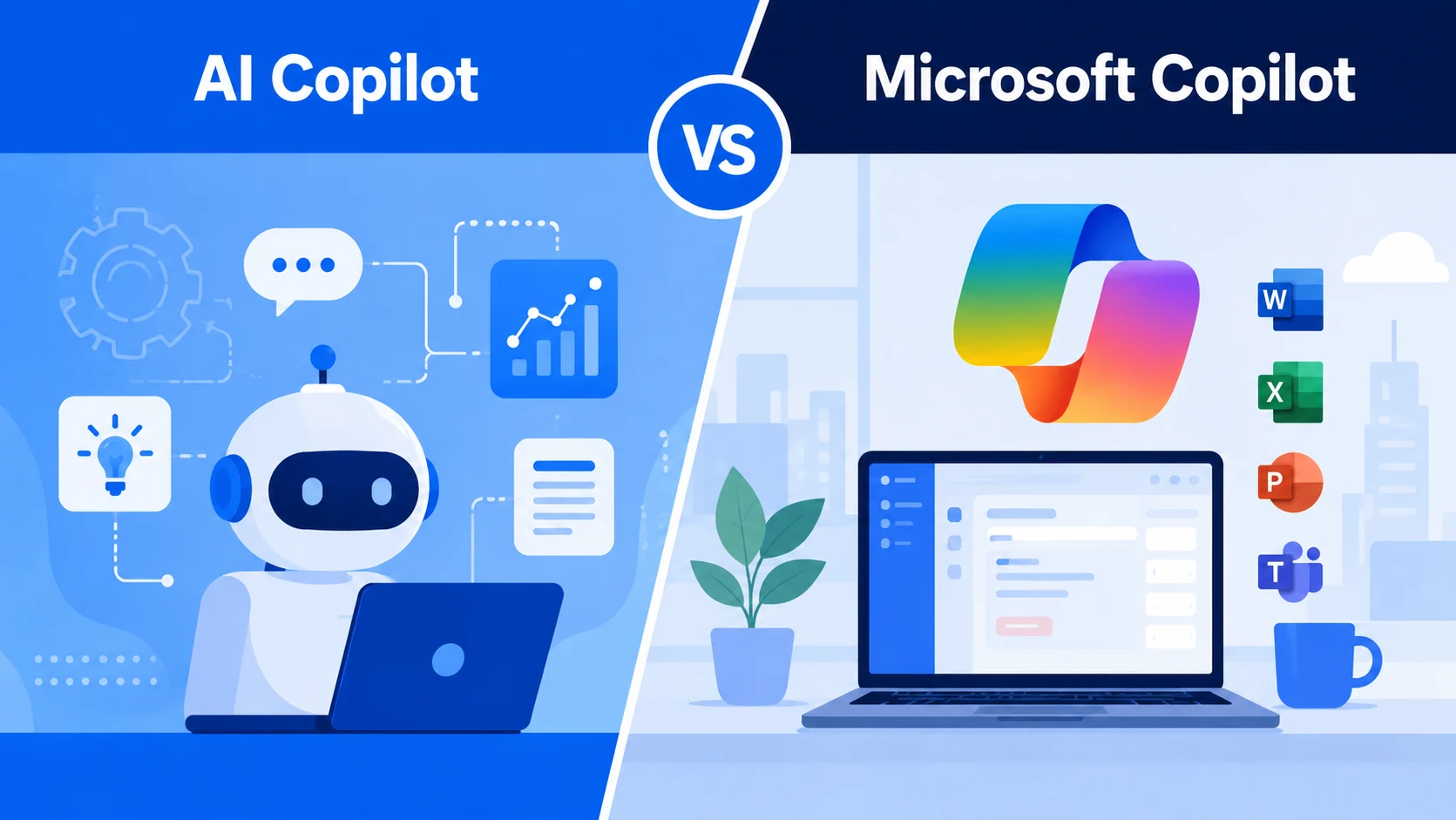
Ai Overview
AI Copilot market growth is transforming global enterprises by boosting productivity, automating workflows, enhancing decision making, and accelerating digital innovation. Market research estimates for the global artificial intelligence Copilot software and services market in 2026 range from $12 billion to $18 billion, with compound annual growth rates that consistently exceed 35 percent across the forecasting horizon through 2030. The US AI Copilot Market represents approximately $5.
Key Takeaways
- ›The global AI Copilot Market reached an estimated $14 billion in 2026, growing at a compound annual rate exceeding 35 percent driven by enterprise adoption across all major industry verticals.
- ›North America leads the AI Copilot Market with approximately 42 percent global market share, followed by Europe at 24 percent and Asia-Pacific including India at 22 percent and growing fastest.
- ›Financial services and healthcare collectively represent nearly 40 percent of total AI Copilot Market enterprise spending, driven by documentation automation, compliance, and decision support use cases.
- ›The Middle East AI Copilot Market, led by UAE investments in Dubai and Abu Dhabi, grew 48 percent year-over-year in 2026 as government and private sector initiatives accelerated AI adoption.
- ›India’s AI Copilot Market is projected to be the fastest-growing major national market through 2028, driven by tech sector adoption, cost-efficiency advantages, and a maturing regulatory framework.
- ›Enterprise AI Copilot Market investment shifted from proof-of-concept budgets in 2024 to full operational deployment budgets in 2026, with average enterprise AI Copilot spend increasing by 3.2x in two years.
- ›Vendor-side AI Copilot Market consolidation is accelerating, with larger platform players acquiring specialized AI Copilot providers to build comprehensive end-to-end enterprise AI suite offerings.
- ›Custom AI Copilot solutions built on open foundation models represent the fastest-growing AI Copilot Market segment in 2026, driven by enterprises seeking proprietary data advantage and compliance control.
- ›Workforce productivity improvement is the most cited business justification for AI Copilot Market investment, cited by 78 percent of enterprise buyers as their primary expected ROI driver in 2026 surveys.
- ›The AI Copilot Market is projected to reach $45 to $55 billion globally by 2030, with the highest growth concentrated in emerging markets adopting AI Copilot ahead of traditional enterprise software cycles.
AI Copilot Market Growth Evolution in Global Enterprises
AI Copilot market growth is transforming global enterprises by boosting productivity, automating workflows, enhancing decision making, and accelerating digital innovation. The evolution of the AI Copilot Market from 2022 to 2026 represents one of the most rapid technology adoption cycles in enterprise software history. What began as a handful of specialized AI writing and coding assistant tools has expanded into a comprehensive market spanning dozens of verticals, hundreds of use cases, thousands of vendors, and tens of billions of dollars in global enterprise spending. Understanding the evolutionary arc of the market is essential context for any investment or deployment decision made in 2026.
Market research estimates for the global artificial intelligence Copilot software and services market in 2026 range from $12 billion to $18 billion, with compound annual growth rates that consistently exceed 35 percent across the forecasting horizon through 2030.Over eight years of building AI-powered systems and tracking market adoption for enterprises across three major geographies, we have had a front-row view of how this market has evolved from prototype to production at scale. This report captures the most important dimensions of that evolution and what it means for enterprise strategy in 2026 and beyond.
In the early market phase of 2022 and 2023, the AI Copilot Market was characterized by experimentation. Enterprises allocated small innovation budgets to test AI Copilot concepts in controlled environments, typically with a single use case, a small user group, and limited integration with core business systems. The technology was promising but unproven at enterprise scale, and market growth was constrained by the legitimate questions enterprises had about reliability, security, and ROI.
The market transition phase of 2024 and 2025 saw a fundamental shift as early adopters published concrete results. Organizations that had deployed AI Copilot tools in financial services, engineering, healthcare, and customer service began sharing performance data that answered the reliability and ROI questions with convincing specificity.
The 2026 AI Copilot Market represents the operational mainstream phase. The question is no longer whether AI Copilot delivers enterprise value; it is how to maximize the value of AI Copilot deployment across the full breadth of an organization’s operations. This maturity shift is visible in procurement patterns, budget allocations, organizational structures, and the sophistication of the RFPs that enterprise technology buyers are issuing to AI Copilot vendors.
AI Copilot Market Evolution Timeline 2022 to 2026

Global Expansion of AI Copilot Market in 2026
The geographic expansion of the AI Copilot Market in 2026 tells a story of rapidly converging adoption across markets that were at very different stages of readiness just two years ago. While North America remains the dominant region by absolute market size, the most interesting growth dynamics are happening in Asia-Pacific, led by India, and in the Middle East, led by the UAE’s ambitious AI adoption agenda.
The US AI Copilot Market represents approximately $5.9 billion of the global total in 2026. It is the most mature market geographically, characterized by the widest breadth of enterprise deployment, the most competitive vendor landscape, and the most sophisticated enterprise buyers who have moved well beyond initial procurement into multi-year strategic AI Copilot platform relationships. The US market is also the primary source of the performance data and ROI benchmarks that are driving adoption decisions in every other market globally.
The UAE AI Copilot Market has emerged as the standout growth story in the Middle East and North Africa region. Backed by the UAE AI Strategy 2031 and significant government and sovereign wealth fund investment in AI infrastructure, Dubai and Abu Dhabi have become among the most AI-forward business environments in the world. Financial services, real estate, logistics, and government services are all running active AI Copilot programs, with the UAE’s English-Arabic bilingual business environment creating specific demand for multilingual AI Copilot capabilities that the global market is actively developing to meet.
India’s AI Copilot Market growth is perhaps the most strategically significant development in the global market in 2026. With a massive technology talent pool, a rapidly growing enterprise software sector, and cost structures that make AI Copilot implementation economics highly favorable, India is simultaneously a major consumer market for AI Copilot solutions and a major production center for custom AI Copilot systems serving global enterprise clients. The India AI Copilot Market is growing at an estimated 52 percent annually, the highest rate of any major national market.
Key Drivers Behind AI Copilot Market Growth
Understanding what is driving AI Copilot Market growth in 2026 is essential for any organization trying to assess whether the market momentum is durable or cyclical. Based on our analysis of enterprise adoption patterns across the US, UAE, and India, six structural drivers are fueling the sustained growth of the AI Copilot Market, each of which is likely to intensify rather than moderate over the next three years.
Labor Productivity Pressure
Rising labor costs and talent scarcity across knowledge work professions are making AI Copilot investment economically compelling at an accelerating rate. In the US, India, and UAE, the fully loaded cost of knowledge worker talent is growing faster than enterprise revenue in most sectors, creating irresistible pressure to find productivity multipliers. AI Copilot delivers the highest productivity return per dollar of investment of any technology category in enterprise software today.
Competitive Differentiation Race
The AI Copilot Market is being driven by a competitive dynamic that is accelerating adoption independent of individual ROI calculations. When a competitor deploys AI Copilot and achieves measurable operational advantages, the organizations competing against them face a compounding capability gap that grows with each quarter of delay. In markets as competitive as financial services in Dubai and technology in Bengaluru, the cost of lagging in AI Copilot adoption is becoming as visible as the cost of early investment.
Foundation Model Maturity
The capability of underlying foundation models has crossed a reliability threshold in 2025 and 2026 that makes enterprise-grade AI Copilot deployment practical at scale in ways that were not possible in 2023. Reduced hallucination rates, improved instruction following, larger context windows, and better multilingual performance have all contributed to a foundation model quality environment that supports enterprise AI Copilot Market growth at a pace the earlier models could not sustain.
Infrastructure Cost Reduction
The cost of the cloud infrastructure and model API services that power AI Copilot systems has declined approximately 70 percent since 2023 while capability has improved substantially. This dramatic cost reduction has made AI Copilot economics viable for mid-market enterprises that could not have justified the investment two years ago, significantly expanding the total addressable AI Copilot Market beyond large enterprise into the mid-market segment that represents the largest number of potential customers globally.
Regulatory Clarity Emerging
The AI Copilot Market has benefited from increasing regulatory clarity across major markets. India’s DPDP Act, the UAE’s AI governance frameworks, and sector-specific guidance in the US have given enterprise buyers clearer compliance pathways for AI Copilot deployment. This regulatory clarity, while creating compliance requirements, has paradoxically accelerated adoption by removing the uncertainty that caused many enterprises to delay AI Copilot investment pending regulatory definition.
Ecosystem Maturation
The AI Copilot Market ecosystem of implementation partners, technology platforms, integration tools, and governance frameworks has matured substantially since 2023. Enterprises can now find qualified implementation partners in virtually every major market, access proven architectural patterns and reference implementations, and leverage a rich ecosystem of integration tools that dramatically reduce the time and cost of deploying AI Copilot systems compared to the custom-build-everything approach that characterized early market deployments.
Investment Trends Accelerating AI Copilot Market Growth
The investment landscape of the AI Copilot Market in 2026 reflects the market’s transition from early-stage technology to established enterprise software category. The nature, scale, and sources of investment have all shifted significantly from the experimental funding patterns of 2023 and 2024.
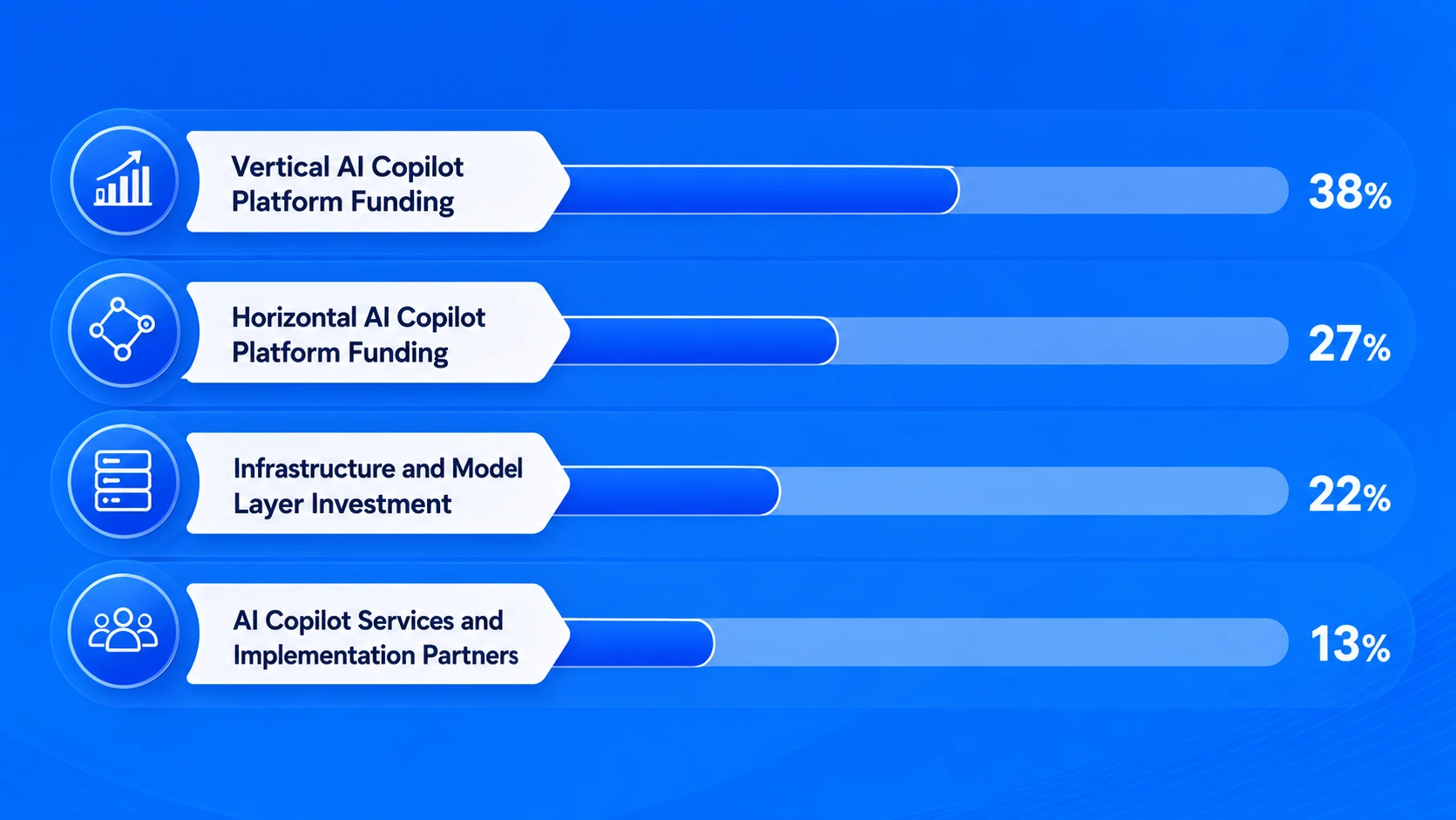
Venture capital investment in AI Copilot Market companies reached approximately $8.2 billion globally in 2025, with a significant portion directed toward vertical-specific AI Copilot platforms serving healthcare, legal, financial services, and manufacturing. This vertical specialization trend reflects a market insight that has proven out across multiple deployment cycles: generic horizontal AI Copilot tools deliver adequate results, while vertically specialized AI Copilot tools trained on domain-specific data and configured for industry-specific workflows deliver substantially superior results and command premium pricing.
Corporate venture and strategic investment in the AI Copilot Market is growing even faster than pure venture investment. Large enterprises are investing directly in AI Copilot technology providers to secure strategic advantages including preferred access to technology, influence over product roadmap, and preferential pricing structures. This trend is particularly pronounced in the UAE, where sovereign wealth funds have made significant strategic investments in AI Copilot platform companies as part of the UAE’s national AI strategy.
Private equity has entered the AI Copilot Market with particular focus on mature AI Copilot businesses that have achieved $10 million or more in annual recurring revenue and demonstrated clear paths to enterprise-grade scalability. PE-backed rollup strategies in the AI Copilot implementation services market are consolidating smaller regional implementation firms into larger national and global service providers capable of serving multinational enterprise clients with consistent quality across geographies.
AI Copilot Market Investment Allocation by Category 2026
Enterprise Demand Fueling AI Copilot Market Expansion
The enterprise demand side of the AI Copilot Market has evolved considerably from the early adoption phase. Where early enterprise buyers were primarily driven by innovation mandates and technology curiosity, the 2026 enterprise buyer base is primarily driven by operational necessity, competitive pressure, and well-documented ROI from peer organizations.
Enterprise AI Copilot Market procurement has shifted from individual department budgets to centralized enterprise AI platform budgets in most large organizations. This shift reflects a recognition that fragmented departmental AI Copilot deployments create data silos, security risks, and management complexity that a unified enterprise AI Copilot platform approach resolves more effectively. The consolidation of AI Copilot spend into central technology and AI governance budgets has increased average deal sizes significantly, with enterprise AI Copilot contracts now commonly exceeding $500,000 annually for organizations with more than 1,000 users.
The enterprise demand profile in 2026 is characterized by several consistent purchasing patterns. Organizations want multi-use-case AI Copilot platforms rather than single-purpose tools, reflecting hard-won lessons from early adopters who deployed multiple disconnected AI tools and created integration complexity. They want platforms with robust API integration capabilities that connect with their existing technology stack rather than requiring replacement. And they want vendors with demonstrable track records in their specific industry, because the performance gap between a generic AI Copilot and a domain-specialized one is now widely understood and consistently cited in enterprise RFPs.
Rising Adoption Trends in the AI Copilot Market
Adoption pattern analysis in the AI Copilot Market reveals several trends that are reshaping how organizations deploy and scale AI Copilot capabilities. Understanding these trends helps enterprises position their own AI Copilot strategies relative to market-leading practices rather than lagging indicators.
The shift from single-department to organization-wide AI Copilot adoption is the most significant adoption trend in the 2026 market. Two years ago, AI Copilot deployments were predominantly confined to single departments, typically engineering, customer service, or marketing. Today, the fastest-growing segment of the AI Copilot Market consists of organization-wide platform deployments that span multiple functions simultaneously. These cross-functional deployments create compounding productivity benefits that single-department deployments cannot achieve and are now the primary driver of year-over-year AI Copilot Market revenue growth.
The adoption of agentic AI Copilot capabilities is accelerating faster than most market observers predicted. The 2026 AI Copilot Market is characterized by growing enterprise appetite for AI systems that go beyond conversational assistance to autonomous task execution within defined parameters. The integration of agent capabilities into AI Copilot platforms is the most competitive battleground in the vendor market in 2026, with every major AI Copilot platform provider investing heavily in agentic features that appeal to enterprises ready to delegate more execution authority to AI systems. [1]
Global AI Copilot Market Growth Shift 2025 vs 2026
The year-over-year shift in the AI Copilot Market from 2025 to 2026 is notable not just in size but in the qualitative character of the growth. The market has changed in ways that matter as much as the headline growth numbers for any organization trying to understand the market’s trajectory.
AI Copilot Market Key Metrics: 2025 vs 2026 Comparison
| Market Metric | 2025 Position | 2026 Position | What Changed |
|---|---|---|---|
| Market Size | $10.2 billion globally | $14.1 billion globally | 38% year-over-year growth |
| Typical Deployment Scope | 1 to 2 use cases per organization | 3 to 7 use cases per organization | Multi-function platform adoption dominates |
| Average Contract Value | $85,000 per year | $210,000 per year | Larger enterprise-wide commitments |
| Primary Buyer | Department heads and innovation teams | CTO, CIO, and Chief AI Officer | Enterprise strategic purchasing |
| Mid-Market Penetration | 18% of $50M to $500M companies | 41% of $50M to $500M companies | Market expanding beyond large enterprise |
| Custom vs Off-Shelf Split | 30% custom, 70% off-shelf | 48% custom, 52% off-shelf | Custom builds gaining share rapidly |
The shift in buyer profile from departmental innovation teams to C-suite enterprise strategists is among the most significant qualitative changes in the AI Copilot Market from 2025 to 2026. When the Chief Technology Officer and the Chief AI Officer are the primary procurement decision-makers rather than individual department heads, the procurement process is more rigorous, the vendor evaluation more thorough, and the contract values significantly higher. This shift elevates the entire market toward enterprise-grade quality standards and accelerates the exit of vendors that cannot meet those standards.
Regional Growth Trends in the AI Copilot Market
Regional analysis of the AI Copilot Market reveals growth patterns that differ significantly in character across geographies, even as every major region shows strong absolute growth. These regional differences reflect distinct economic environments, regulatory frameworks, industry compositions, and AI readiness levels that shape how the market develops in each geography.
North America: Deepening and Expanding
The North American AI Copilot Market is experiencing growth through depth rather than breadth in 2026. Enterprises that deployed AI Copilot in one or two functions are expanding to organization-wide platforms. The market is also deepening into more complex and higher-value use cases in legal, financial analysis, and strategic planning that were considered too sensitive for AI Copilot involvement in earlier years. The US market is also the primary proving ground for agentic AI Copilot capabilities, with the most sophisticated enterprise deployments globally running in the US technology, financial services, and healthcare sectors.
Middle East: Government-Led Acceleration
The UAE AI Copilot Market is growing faster than any other major market in the MENA region, driven by a combination of government mandate, sovereign wealth fund investment, and a business environment that has actively positioned AI adoption as a national competitive priority. Dubai has become a hub for AI Copilot pilot programs and regional deployments, with companies using UAE implementations as the proving ground for broader MENA and international expansion. The multilingual requirements of the UAE market, where Arabic and English coexist in professional environments, are driving specific AI Copilot capability advances that benefit markets globally.
Asia-Pacific: India Leading the Fastest-Growth Region
India dominates the AI Copilot Market growth story in Asia-Pacific in 2026. The country’s unique combination of a massive technology sector workforce, a rapidly growing enterprise software market, favorable AI Copilot implementation economics, and increasing regulatory clarity is creating conditions for sustained high-growth adoption. India is also emerging as a major production center for custom AI Copilot systems, with technology companies in Bengaluru, Hyderabad, and Mumbai serving enterprise clients across the US, UAE, and European markets with custom AI Copilot implementations.
Industry-Wise AI Copilot Market Growth Trends
Industry-level analysis of the AI Copilot Market reveals distinct growth trajectories across sectors, each reflecting the specific workflow economics, data environments, and competitive dynamics of that industry. Understanding industry-level market trends is essential for vendors, investors, and enterprise buyers trying to calibrate their AI Copilot strategies against market-level momentum.
AI Copilot Market Growth by Industry Vertical 2026
| Industry | 2026 Market Share | YoY Growth Rate | Primary Use Case Driver |
|---|---|---|---|
| Financial Services | 22% of total AI Copilot Market | 41% | Compliance documentation and risk analysis automation |
| Healthcare | 17% of total AI Copilot Market | 48% | Clinical documentation automation and decision support |
| Technology and Software | 19% of total AI Copilot Market | 35% | Code generation, review, and technical documentation |
| Retail and E-Commerce | 14% of total AI Copilot Market | 44% | Personalization, customer service, and demand planning |
| Manufacturing | 11% of total AI Copilot Market | 52% | Predictive maintenance and quality control intelligence |
| Logistics and Supply Chain | 9% of total AI Copilot Market | 49% | Demand forecasting, route optimization, supplier management |
| Other Industries | 8% of total AI Copilot Market | 61% | Legal, education, real estate, and government services |
Manufacturing and logistics stand out as the sectors with the highest year-over-year AI Copilot Market growth rates in 2026, despite not being the largest segments by absolute spending. The high growth rates in these sectors reflect the latent AI Copilot adoption potential in industries that were slower to adopt than financial services and technology but that have compelling economics for predictive maintenance and operational optimization use cases. As these industries’ AI Copilot adoption accelerates, they will become increasingly important segments of the total AI Copilot Market.
AI Copilot Market Highlights Across Global Enterprises
Beyond the headline market numbers, several specific market highlights from 2026 enterprise deployments illuminate how the AI Copilot Market is actually developing at the operational level. These highlights reflect patterns observed across hundreds of enterprise deployments across the US, UAE, and India that collectively represent a reliable indicator of where the broader market is heading.
The growing share of custom AI Copilot solutions in the market highlights an important segmentation trend. Organizations that tried off-the-shelf AI Copilot tools and found them generic or underperforming for their specific domain are increasingly investing in custom-built solutions that use proprietary data, domain-specific fine-tuning, and purpose-designed retrieval architectures. This shift toward custom builds is particularly pronounced in industries with specialized knowledge requirements, such as legal, healthcare, and financial services, and in markets with specific language or regulatory requirements, such as India and the UAE.
Key Market Insights in AI Copilot Industry Growth
Synthesizing the market data, adoption trends, investment patterns, and regional dynamics provides several key AI Copilot Market insights that are directly actionable for enterprise leaders, investors, and technology providers navigating this rapidly evolving landscape.
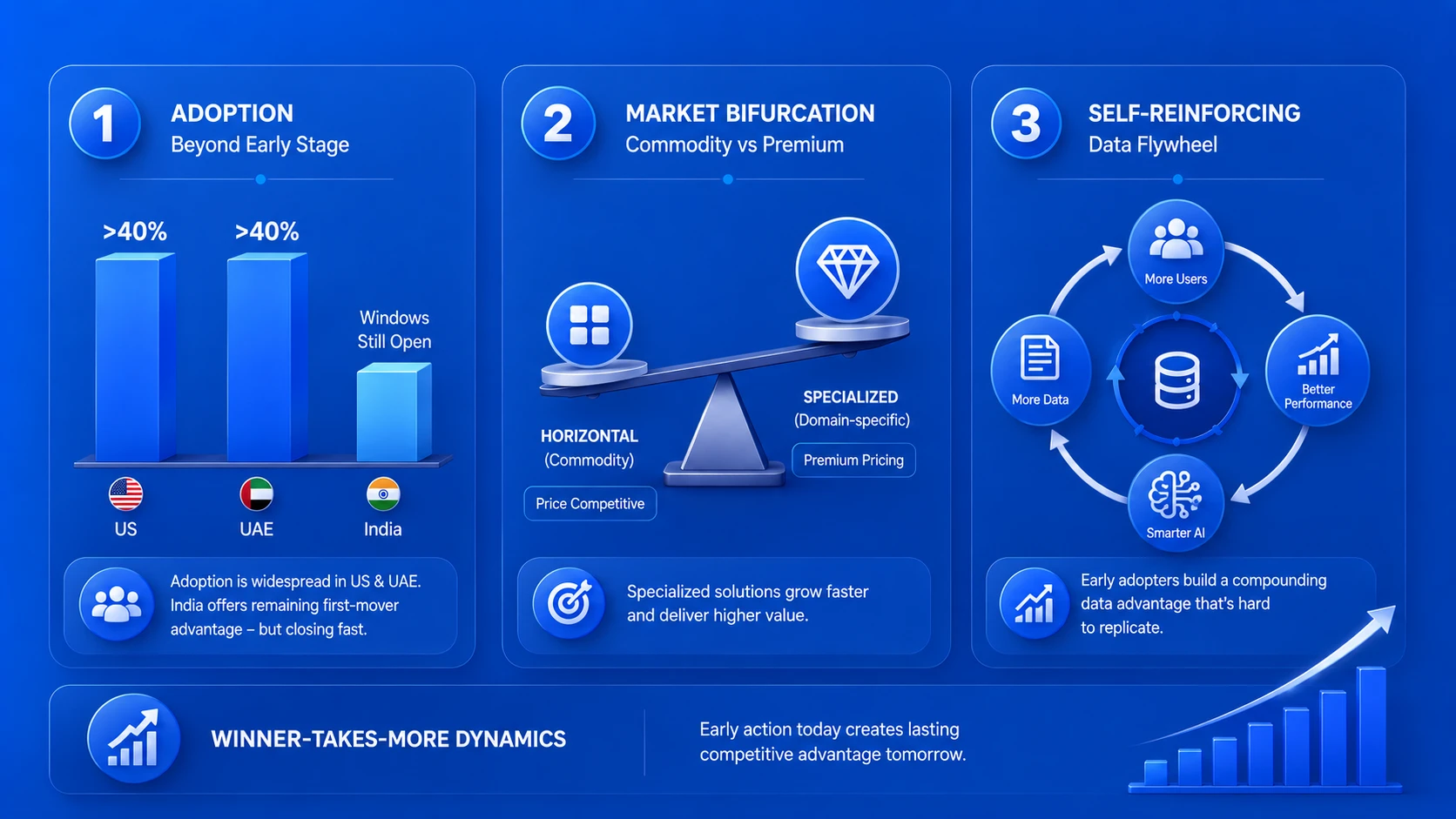
The first key insight is that the AI Copilot Market has moved past the point where broad enterprise adoption can be described as early. More than 40 percent of mid-market and large enterprises in the US and UAE have active AI Copilot deployments in 2026. The window for gaining first-mover advantage has largely closed in these markets; the new competitive question is not whether to deploy but how well to deploy relative to peers who are already live. In India, first-mover advantage windows remain open in several industry verticals, but they are closing rapidly as adoption acceleration continues.
The second key insight is that the AI Copilot Market is bifurcating between commodity horizontal tools and premium specialized solutions. The horizontal market is becoming commoditized and price-competitive, while the specialized, domain-specific AI Copilot market is commanding premium pricing and growing faster in value terms. For vendors, this bifurcation creates a clear strategic choice. For enterprise buyers, it highlights the importance of understanding whether a generic or specialized AI Copilot solution better serves their specific needs, because the performance gap between the two categories is wide and growing wider as specialized vendors accumulate proprietary training advantages.
The third key insight is that AI Copilot Market growth is self-reinforcing through a data flywheel effect. Organizations that deploy AI Copilot accumulate interaction data that improves their system’s performance over time. This performance improvement increases user adoption, which generates more interaction data, which further improves performance. Organizations that deploy AI Copilot early in their market are building proprietary AI performance advantages that competitors cannot easily replicate, because the underlying data advantage compounds over time. This flywheel dynamic is one of the most important reasons the AI Copilot Market exhibits winner-takes-more dynamics within specific industry niches.
AI Copilot Market Growth Driving Enterprise Expansion
The AI Copilot Market’s growth is not just a technology adoption story; it is an enterprise expansion story. Organizations that have successfully deployed AI Copilot are using the productivity, quality, and cost advantages it creates to expand their businesses in ways that would not have been economically viable without AI augmentation. This enterprise expansion dynamic creates a positive feedback loop between AI Copilot Market growth and broader economic growth in the markets where adoption is highest.
In the US market, enterprises that deployed AI Copilot in 2023 and 2024 are reporting measurable improvements in their ability to serve more clients, enter new markets, and compete on quality rather than just price in professional services, financial services, and technology sectors. The AI Copilot productivity advantage is translating directly into business expansion at rates that exceed what the same organizations achieved in the pre-AI period with equivalent headcount growth.
In India, the AI Copilot Market is enabling a specific form of enterprise expansion that has global implications: Indian technology and professional services firms are using AI Copilot to significantly increase the value and complexity of work they can deliver to global enterprise clients without proportionally increasing headcount. This AI-powered capability expansion is repositioning Indian enterprises from primarily cost-advantage players to quality-and-capability players in global services markets, a transformation that creates both new market opportunities and new competitive pressures for service providers in the US, UAE, and European markets.
In the UAE, the AI Copilot Market is supporting the country’s ambition to establish Dubai as a global hub for AI-powered financial services, real estate technology, and professional services. The AI Copilot capabilities being deployed across Dubai’s financial sector and professional services market are increasingly sophisticated, enabling UAE-based enterprises to compete for clients and talent that would have been inaccessible at earlier technology adoption levels. The AI Copilot Market is, in a meaningful sense, helping the UAE economy execute on its Vision 2031 aspirations for technology-driven diversification away from hydrocarbon dependence.
Looking across all three markets and the global AI Copilot Market as a whole, the conclusion is consistent: this is a market in sustained, structurally driven growth with the characteristics of long-duration tailwinds rather than cyclical momentum. The labor dynamics, competitive pressures, technology maturation, and demonstrated ROI that are driving AI Copilot Market growth in 2026 are not abating; they are intensifying. The organizations and investors that position themselves ahead of this market’s continued growth trajectory in 2026 are those most likely to find themselves in leadership positions when the market reaches its projected scale of $45 to $55 billion by 2030.
The AI Copilot Market is Redefining Enterprise Strategy
The AI Copilot Market in 2026 is not a peripheral technology trend that enterprise leaders can afford to monitor from a comfortable distance. It is a central, structural transformation of how enterprises operate, compete, and grow that is happening at a pace that rewards early, decisive action and increasingly penalizes delay. The market data is unambiguous: adoption is broad and accelerating, ROI is documented and compelling, and the competitive advantages accumulating in organizations that have deployed well are becoming increasingly difficult for laggards to close.
For enterprise leaders in the US, UAE, and India evaluating their AI Copilot strategy in 2026, the strategic imperative is clear. The question is no longer whether to invest in the AI Copilot Market; it is whether to invest wisely and early enough to build the deployment quality, data advantages, and organizational capability that translate market momentum into sustained competitive leadership in the years ahead.
Capture Your Share of the AI Copilot Market
We design and build AI Copilot systems that position enterprises in US, UAE, and India ahead of the market. Strategy, architecture, and delivery under one roof.
Frequently Asked Questions
Q1.1. What is the AI Copilot market?
The AI Copilot market refers to tools and platforms that use generative AI to assist enterprises in tasks like automation, decision-making, and productivity enhancement, driving digital transformation and operational efficiency across global industries.
Q2.2. Why is the AI Copilot market growing?
The market is growing due to rising demand for automation, enterprise AI adoption, improved productivity needs, and integration of generative AI into business workflows, enabling companies to reduce costs and enhance decision-making efficiency.
Q3.3. What drives AI Copilot market growth in 2026?
Key drivers include enterprise digital transformation, AI integration in workflows, increased investment in AI tools, demand for automation, and growing adoption of AI-powered enterprise solutions across industries globally.
Q4.4. How are enterprises using AI copilots?
Enterprises use AI copilots for customer support, coding assistance, data analysis, content generation, workflow automation, and decision support, improving efficiency and reducing manual workload across departments.
Q5.5. Which industries use AI copilots the most?
Industries like IT, finance, healthcare, retail, and manufacturing are leading adopters of AI copilots due to high demand for automation, data processing, and improved operational efficiency.
Q6.6. How does AI Copilot impact enterprise growth?
AI copilots enhance productivity, reduce operational costs, improve decision-making speed, and automate repetitive tasks, directly contributing to enterprise expansion and improved business performance.
Q7.7. What is driving enterprise adoption of AI copilots?
Enterprise adoption is driven by efficiency demands, competitive pressure, AI advancements, cost optimization goals, and the need for intelligent automation in business processes.
Q8.8. What is the future of AI Copilot market?
The future involves deeper AI integration, autonomous AI agents, industry-specific copilots, and expanded enterprise adoption, making AI copilots a core part of digital business ecosystems.
Q9.9. What are AI Copilot market investment trends?
Investment in the AI Copilot market is increasing due to strong enterprise demand, venture capital funding, AI innovation, and growing enterprise reliance on automation and generative AI solutions.
Q10.10. What challenges does the AI Copilot market face?
Challenges include data privacy concerns, integration complexity, high implementation costs, regulatory issues, and the need for skilled AI infrastructure management in enterprises.
Explore Services
Related Services
Reviewed by

Aman Vaths
Founder of Nadcab Labs
Aman Vaths is the Founder & CTO of Nadcab Labs, a global digital engineering company delivering enterprise-grade solutions across AI, Web3, Blockchain, Big Data, Cloud, Cybersecurity, and Modern Application Development. With deep technical leadership and product innovation experience, Aman has positioned Nadcab Labs as one of the most advanced engineering companies driving the next era of intelligent, secure, and scalable software systems. Under his leadership, Nadcab Labs has built 2,000+ global projects across sectors including fintech, banking, healthcare, real estate, logistics, gaming, manufacturing, and next-generation DePIN networks. Aman’s strength lies in architecting high-performance systems, end-to-end platform engineering, and designing enterprise solutions that operate at global scale.