Ai Overview
AI Copilot use cases refer to the specific, defined applications through which an AI-powered assistant delivers measurable value within a business function or industry context. For industry leaders evaluating where to focus AI Copilot investment, understanding what AI Copilot fundamentally means for their operational context is the essential first step.
Key Takeaways
- ›AI Copilot Use Cases in 2026 span every major industry and are no longer limited to technology sectors, with finance, healthcare, retail, and manufacturing leading global adoption.
- ›Financial services AI Copilot Use Cases deliver the highest measurable ROI through real-time risk analysis, compliance documentation, and intelligent client advisory assistance at enterprise scale.
- ›Healthcare AI Copilot Use Cases are transforming clinical workflows by reducing documentation burden by up to 60 percent, allowing clinicians to focus more time on patient care activities.
- ›Retail and e-commerce AI Copilot Use Cases enable hyper-personalized customer experiences at scale, driving measurable increases in conversion rates, average order value, and repeat purchase behavior.
- ›Cybersecurity AI Copilot Use Cases reduce mean time to detect threats by enabling security analysts to process alert volumes that would be impossible to handle manually at enterprise scale.
- ›Software engineering AI Copilot Use Cases accelerate code delivery by 35 to 55 percent through automated code generation, intelligent code review, and contextual documentation assistance.
- ›Manufacturing AI Copilot Use Cases in predictive maintenance and quality control reduce unplanned downtime by up to 45 percent, delivering significant cost savings across production facilities.
- ›Logistics and supply chain AI Copilot Use Cases optimize route planning, inventory forecasting, and supplier communications, reducing operational costs while improving delivery reliability.
- ›Organizations in India, the UAE, and the US implementing AI Copilot Use Cases in at least three business functions report compounding productivity benefits that exceed single-function deployments by 3x.
- ›The future of AI Copilot Use Cases points toward agentic, multimodal systems capable of autonomously completing complex multi-step industry workflows with minimal human supervision.
Understanding AI Copilot Use Cases Across Industries
AI Copilot use cases refer to the specific, defined applications through which an AI-powered assistant delivers measurable value within a business function or industry context. Across every major industry vertical, from financial services and healthcare to logistics and manufacturing, the adoption of artificial intelligence Copilot tools has moved from early experimentation to strategic imperative.
Unlike broad AI capabilities that describe what technology can do in theory, AI Copilot use cases are grounded in specific workflows, specific user needs, and specific outcomes that organizations can measure and optimize over time. Over eight years of building AI-powered systems for enterprises across sectors and geographies, we have identified the use cases that consistently deliver the highest impact, the patterns that separate successful implementations from stalled ones, and the industry-specific considerations that determine whether an AI Copilot deployment becomes a competitive asset or a costly exercise in technology adoption for its own sake.
The distinction between an AI Copilot use case and an AI experiment is important. An experiment tries to see if AI can do something. A use case is a defined application where AI Copilot assistance is integrated into a real workflow, used by real employees, and measured against real business outcomes. The maturity of AI Copilot use cases in 2026 means that organizations no longer need to experiment blindly; there are proven patterns across every major industry that provide a solid foundation for purposeful implementation.
What makes AI Copilot use cases distinctive from generic AI tools is contextual grounding. An AI Copilot operating within a financial services use case draws from that firm’s specific product documentation, regulatory framework, client history, and market data. One operating within a healthcare use case accesses clinical protocols, patient history structures, formulary databases, and documentation standards. This grounding in domain-specific knowledge is what separates AI Copilot use cases that transform operations from AI tools that produce generic, unreliable outputs.
What AI Copilot Means for Industry-Wide Applications?
For industry leaders evaluating where to focus AI Copilot investment, understanding what AI Copilot fundamentally means for their operational context is the essential first step. An AI Copilot for industry applications is not a simple chatbot or a search engine wrapper. It is an intelligent assistant that is embedded into the specific workflows where work actually happens, equipped with access to the domain-specific knowledge required to assist meaningfully, and designed to take real actions within the business systems where those workflows live.
In an industry context, AI Copilot use cases consistently deliver value across three operational dimensions. The first is information acceleration: making the right knowledge instantly accessible to the right person at the right moment in their workflow, eliminating the time wasted searching across disconnected systems. The second is task automation: handling the repetitive, time-consuming elements of knowledge work that consume professional capacity without requiring professional judgment. The third is decision support: synthesizing complex information from multiple sources into clear, actionable recommendations that help professionals make better decisions faster.
Industry-specific AI Copilot use cases combine all three dimensions in configurations tailored to the specific work patterns, compliance requirements, and performance metrics of each sector. A compliance officer at a bank in Dubai, a clinical documentation specialist at a hospital in Chennai, and a demand planner at a retail chain in Chicago all have fundamentally different workflows, but each benefits from an AI Copilot that understands their specific context and assists them within it.
Why AI Copilot Use Cases Are Growing Across Industries?
The rapid expansion of AI Copilot use cases across industries in 2026 is driven by a convergence of technological maturity, market pressure, and demonstrated ROI from early adopters. Three years ago, most industry AI Copilot deployments were experimental, confined to single use cases with limited integration and uncertain business outcomes. Today, the landscape has changed fundamentally.
Foundation model capabilities have advanced to the point where AI Copilot systems can reliably handle complex, multi-step reasoning tasks in industry-specific domains without frequent errors or hallucinations, provided they are properly grounded in domain-specific knowledge through well-designed retrieval architectures. This reliability threshold, once crossed, dramatically expands the set of use cases that organizations are willing to trust and deploy at scale.
Simultaneously, competitive pressure is accelerating adoption. In financial services, retail, and technology sectors across all three of our primary markets, US, UAE, and India, organizations that deployed AI Copilot use cases early are demonstrably outperforming those that delayed. Their analysts produce more research in less time. Their support teams resolve issues faster. Their sales teams close more deals. The performance gap between AI Copilot adopters and laggards is visible in quarterly results, and that visibility is the most powerful driver of adoption acceleration.
AI Copilot Use Cases in Financial Services Industry
Financial services is the industry where AI Copilot use cases have achieved the deepest penetration and most measurable ROI in 2026. The combination of massive data volumes, regulatory complexity, high-stakes decision-making, and significant documentation burden makes financial services one of the most target-rich environments for AI Copilot applications. Banks, investment firms, insurance companies, and lending institutions across the US, UAE, and India are all running multiple active AI Copilot use cases simultaneously.
Compliance Documentation
AI Copilot automatically generates compliance reports, regulatory filing summaries, and audit trail documentation from transaction data and system logs. This use case alone reduces compliance team workload by 30 to 40 percent in financial institutions across Dubai and Mumbai. The copilot understands specific regulatory frameworks and formats outputs to meet prescribed standards without manual formatting.
Real-Time Risk Analysis
Risk analysts use AI Copilot to query live portfolio data, market information, and historical risk models simultaneously through natural language. The copilot synthesizes multi-source risk assessments in seconds that would take an analyst hours to compile manually, enabling faster risk committee decision-making and more responsive portfolio management.
Client Advisory Support
Relationship managers at private banks and wealth management firms use AI Copilot to instantly retrieve client portfolio summaries, investment history, risk profiles, and relevant market updates before client meetings. The copilot drafts personalized meeting notes and follow-up communications, allowing advisors to manage larger client books without sacrificing service quality.
Credit analysis is another high-value AI Copilot use case in financial services. Underwriters in India’s growing lending sector use AI Copilot to analyze credit applications, query borrower data, check bureau scores, and assess sector-specific risk factors simultaneously. The copilot surfaces the most relevant risk signals and generates structured credit assessment summaries that significantly reduce decision cycle times while maintaining the quality standards required for regulatory compliance.
AI Copilot Use Cases in Healthcare Industry
Healthcare AI Copilot use cases in 2026 are primarily focused on reducing the administrative burden that has become one of the most significant contributors to clinician burnout globally. Physicians in the US, India, and UAE spend an estimated 35 to 50 percent of their working time on documentation, administrative tasks, and information retrieval rather than direct patient care. AI Copilot use cases target this time loss directly.
AI Copilot listens to or receives transcripts of patient consultations and generates structured clinical notes in the physician’s preferred format, reducing documentation time from 15 to 20 minutes per patient to 2 to 3 minutes for review and signature. Hospitals in India and the UAE deploying this use case report documentation accuracy improvements alongside significant clinician time savings per shift.
Physicians query AI Copilot with patient symptoms, history, and test results to receive evidence-based differential diagnosis suggestions, drug interaction alerts, and treatment protocol recommendations drawn from current clinical guidelines. The copilot does not replace clinical judgment but ensures that no relevant guideline or contraindication is overlooked during high-volume consultation periods.
Healthcare administrative staff use AI Copilot to prepare prior authorization requests by automatically populating forms with relevant clinical data from patient records, identifying the specific clinical criteria required by each insurer, and drafting supporting documentation that meets the insurer’s approval requirements. This use case dramatically reduces denial rates and reprocessing costs.
AI Copilot generates personalized, plain-language patient education materials based on a patient’s specific diagnosis, treatment plan, and medication regimen. Discharge instructions are automatically tailored to the patient’s literacy level, language preference, and specific care requirements, improving medication adherence and reducing preventable readmissions.
AI Copilot Use Cases in Retail and E-Commerce Industry
Retail and e-commerce AI Copilot use cases are transforming every dimension of the customer journey and the operational back-end that supports it. In a sector defined by competition for consumer attention, loyalty, and spending, AI Copilot use cases are delivering competitive differentiation through personalization, efficiency, and service quality at a scale that manual approaches cannot match.
Personalized product recommendation is one of the highest-impact AI Copilot use cases in retail. Rather than relying on simple collaborative filtering, an AI Copilot draws from a customer’s complete interaction history, browse behavior, purchase patterns, stated preferences, and real-time intent signals to generate genuinely personalized recommendations. Retailers in Dubai’s competitive luxury segment and India’s high-volume e-commerce market both report measurable conversion rate improvements from AI Copilot-powered personalization compared to previous recommendation approaches.
Customer service AI Copilot use cases enable support agents to resolve complex queries in a fraction of the time by instantly surfacing order history, product specifications, return policy details, and resolution pathways for each specific customer situation. Rather than navigating multiple systems, the agent converses with the AI Copilot, which assembles the complete picture and suggests the optimal resolution path based on company policy and customer history simultaneously.
Merchandising and demand planning AI Copilot use cases help buying teams query sales data, inventory levels, supplier lead times, and market trend information through natural language. Instead of waiting for weekly reports, category managers can ask the AI Copilot “Which SKUs are at risk of stockout in the northeast region before the holiday period?” and receive an immediate, data-grounded answer with recommended procurement actions.
AI Copilot Use Cases in Cybersecurity Industry
Cybersecurity AI Copilot use cases address the most fundamental challenge in enterprise security: the asymmetry between the scale of the threat environment and the capacity of human security teams to monitor, investigate, and respond to it. Security operations centers in major enterprises across the US, UAE, and India are generating tens of thousands of security alerts daily. Human analysts cannot process them all. AI Copilot use cases in cybersecurity fundamentally change this equation.
Threat detection and triage is the most widely deployed cybersecurity AI Copilot use case. The AI Copilot processes the complete alert stream from SIEM systems, endpoint detection tools, and network monitoring platforms simultaneously. It classifies alerts by severity and likely threat type, correlates related events across different systems to identify coordinated attack patterns, and surfaces the highest-priority incidents for immediate human analyst attention. This triage capability allows security teams to focus their expertise on genuine threats rather than spending the majority of their time dismissing false positives. [1]
Incident response AI Copilot use cases assist security analysts during active investigations by instantly retrieving relevant threat intelligence, querying historical incident data for similar attack patterns, generating containment runbooks tailored to the specific threat type, and drafting incident report documentation in parallel with the investigation rather than after it. This multi-stream assistance allows a single analyst to manage the response to a complex incident that would previously have required a team.
Vulnerability management AI Copilot use cases help security teams query vulnerability databases, cross-reference identified vulnerabilities against their specific technology stack, prioritize remediation based on actual exploitability and business impact, and generate remediation guidance that is contextualized to the organization’s specific systems rather than generic advisory content from public databases.
AI Copilot Use Cases in Software Engineering Industry
Software engineering AI Copilot use cases represent the most mature and widely adopted category in 2026, with engineering teams across the technology sector in Bengaluru, San Francisco, and Dubai all reporting measurable productivity gains from AI Copilot assistance in coding, code review, testing, and documentation workflows.
Software Engineering AI Copilot Use Cases and Productivity Impact
| Use Case | What AI Copilot Does | Measured Impact |
|---|---|---|
| Code Generation | Generates boilerplate, functions, and class structures from natural language descriptions | 35 to 55% faster feature delivery for standard components |
| Code Review Assistance | Reviews pull requests for bugs, security vulnerabilities, and style violations | 40% reduction in critical bug escape rate to production |
| Test Case Generation | Generates unit and integration test cases from existing code and specifications | 60% increase in test coverage with same engineering headcount |
| Technical Documentation | Auto-generates API docs, README files, and inline comments from code | Documentation maintained current with codebase without manual effort |
| Legacy Code Explanation | Explains undocumented legacy code in plain language for new team members | 50% reduction in legacy system onboarding time for engineers |
Infrastructure and DevOps AI Copilot use cases are an emerging high-value category within software engineering. Platform engineers use AI Copilot to query infrastructure state, diagnose deployment failures, generate infrastructure-as-code configurations, and troubleshoot CI/CD pipeline issues through natural language. Rather than navigating multiple monitoring dashboards and configuration files, the engineer asks the AI Copilot and receives an integrated answer that draws from log data, configuration state, and deployment history simultaneously.
AI Copilot Use Cases in Manufacturing Industry
Manufacturing AI Copilot use cases are delivering some of the most financially significant results of any industry vertical in 2026. In an industry where unplanned downtime costs enterprises millions per hour and quality defects create both waste and liability, AI Copilot use cases that improve equipment reliability and production quality pay back their investment within months rather than years.
Predictive maintenance is the flagship AI Copilot use case in manufacturing. The AI Copilot continuously analyzes sensor data streams from production equipment, querying historical failure patterns, maintenance records, and operational parameters to identify early indicators of equipment degradation before failure occurs. Maintenance teams receive proactive alerts with specific diagnostic information and recommended interventions, allowing them to schedule maintenance during planned downtime rather than responding reactively to unexpected breakdowns. Manufacturers in India’s automotive sector and the UAE’s industrial facilities both report unplanned downtime reductions of 40 to 45 percent after implementing this use case.
Quality control AI Copilot use cases assist quality engineers in analyzing production defect data, identifying root causes, and determining optimal parameter adjustments. Rather than waiting for end-of-line quality inspection, AI Copilot monitors in-process quality signals and alerts operators to deviations before they produce significant volumes of defective output. This real-time quality assistance is particularly valuable in high-volume, fast-cycle manufacturing environments where defect propagation is rapid.
Process optimization AI Copilot use cases help production managers query energy consumption, throughput, yield, and equipment utilization data simultaneously to identify optimization opportunities that would not be visible in any single data stream. The AI Copilot synthesizes cross-functional production data into actionable improvement recommendations, supporting continuous improvement programs without requiring dedicated data analyst resources for routine performance analysis.
AI Copilot Use Cases in Logistics and Supply Chain Industry
Logistics and supply chain AI Copilot use cases address the complexity, volatility, and information density that define modern supply chain management. With global supply chains spanning dozens of countries, hundreds of suppliers, and thousands of SKUs, the information processing demands on supply chain professionals far exceed what is manageable without intelligent assistance.
Demand forecasting and inventory optimization is a high-impact AI Copilot use case for supply chain teams. The AI Copilot analyzes historical sales data, promotional calendars, market trend signals, weather patterns, and competitor intelligence simultaneously to generate demand forecasts that are significantly more accurate than single-variable statistical models. Inventory planners query the AI Copilot in natural language to understand reorder requirements, identify slow-moving stock risks, and optimize safety stock levels across distribution networks spanning multiple geographies including India’s complex multi-tier distribution structure.
Supplier relationship management AI Copilot use cases help procurement teams monitor supplier performance, flag delivery risks, draft routine communications, and maintain contract compliance documentation. For logistics companies in the UAE that manage complex multi-region supplier networks, the ability to instantly query supplier performance history, contractual terms, and open issue status through natural language rather than navigating multiple procurement systems represents a significant efficiency gain.
Last-mile delivery optimization is an emerging AI Copilot use case with particularly high impact in the rapidly growing Indian e-commerce market. AI Copilot assists dispatch teams in optimizing delivery routes in real time based on traffic conditions, driver availability, delivery time window commitments, and vehicle capacity. Natural language query capability allows operations managers to quickly assess delivery performance, identify problem areas, and make informed real-time decisions during peak delivery periods.
Key Benefits of AI Copilot Use Cases Across Industries
Across all seven industry verticals examined, AI Copilot use cases deliver a consistent set of core benefits that manifest in industry-specific forms. Understanding these cross-industry benefit patterns helps organizations build the business case for AI Copilot investment and set realistic expectations for what different categories of use cases will deliver.
Future of AI Copilot Use Cases Across Industries in 2026
The trajectory of AI Copilot use cases in 2026 and beyond points toward three transformative shifts that will reshape how organizations across every industry think about human-AI collaboration: agentic capability, multimodal intelligence, and proactive assistance.
Emerging AI Copilot Use Cases by Industry for 2026 and Beyond
| Industry | Current Leading Use Case | Emerging 2026 Use Case | Expected Impact |
|---|---|---|---|
| Financial Services | Compliance documentation and risk analysis | Autonomous regulatory filing with human review gate | 70% reduction in compliance officer time per filing |
| Healthcare | Clinical documentation and decision support | Longitudinal patient journey intelligence and proactive care gap alerts | Measurable improvement in chronic condition management outcomes |
| Retail | Personalized recommendations and demand planning | Fully autonomous inventory replenishment and promotional execution | Near-zero stockout rates with optimized working capital |
| Cybersecurity | Threat triage and incident response assistance | Autonomous threat hunting and self-healing security response | Sub-minute mean time to contain for identified threat patterns |
| Manufacturing | Predictive maintenance and quality control | Fully autonomous process optimization and self-adjusting production parameters | Continuous yield improvement without human analyst intervention |
| Logistics | Demand forecasting and route optimization | End-to-end autonomous supply chain orchestration with multi-tier visibility | Real-time supply chain resilience with proactive disruption response |
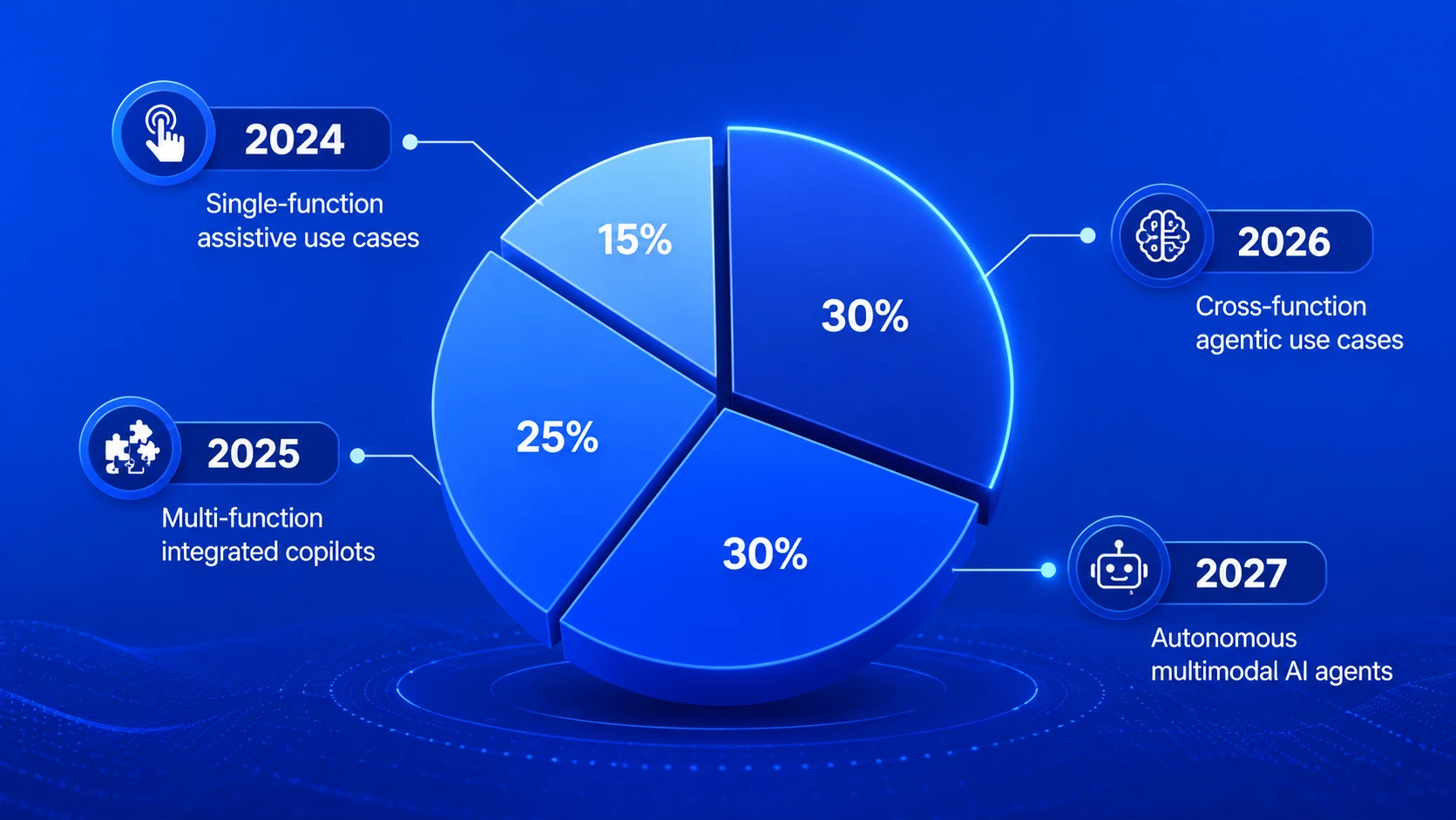
The agentic shift is the most significant trend shaping the future of AI Copilot use cases. Today’s AI Copilot primarily assists humans in completing tasks. Tomorrow’s AI Copilot will complete entire multi-step workflows autonomously, with human involvement limited to exception handling, approval gates, and strategic direction. This shift from assistant to agent does not reduce the role of human judgment; it elevates it by removing humans from the execution layer and concentrating their involvement at the judgment and governance layer where their contribution is most valuable.
Multimodal AI Copilot use cases will add visual, audio, and document processing capabilities to the already powerful text-based assistance that defines current deployments. A manufacturing quality engineer will show the AI Copilot a photo of a production defect and receive an immediate analysis referencing historical defect patterns and recommended interventions. A healthcare professional will review medical imaging with AI Copilot assistance that integrates visual findings with patient history and clinical guidelines in a single coherent workflow.
AI Copilot Use Cases Maturity Trajectory 2024 to 2027
AI Copilot Use Cases Are Defining Industry Leadership in 2026
The evidence from deployments across financial services, healthcare, retail, cybersecurity, software engineering, manufacturing, and logistics is consistent: AI Copilot use cases are no longer optional additions to an organization’s technology portfolio. They are rapidly becoming the operational baseline that defines industry leadership, competitive differentiation, and talent attraction in every sector we serve.
Organizations in India, the UAE, and the US that have systematically identified, prioritized, and implemented AI Copilot use cases in their highest-value workflow areas are demonstrating measurable performance advantages over those still evaluating or piloting. The first-mover benefit is real, but it has a window. As AI Copilot use cases become industry standard, the advantage shifts from adoption itself to the quality of implementation, the depth of domain customization, and the speed of ongoing optimization.
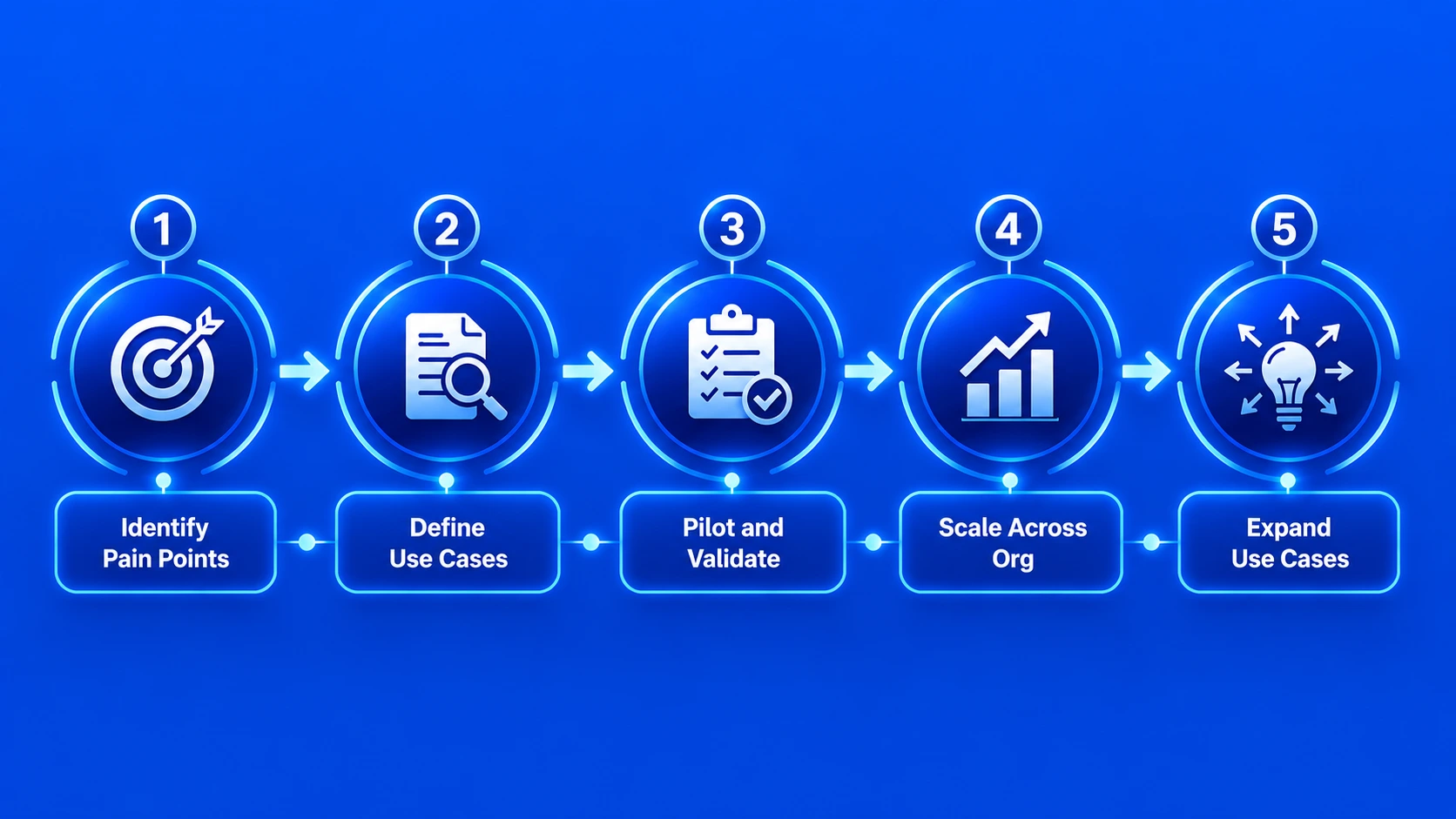
After eight years of building industry-specific AI systems, our guidance for organizations evaluating AI Copilot use cases in 2026 is straightforward: start with the use cases where data quality is highest, workflow pain is greatest, and measurement is clearest. Build with rigor. Measure relentlessly. And expand from a foundation of proven value rather than aspirational deployment breadth. That approach consistently produces AI Copilot implementations that transform operations rather than merely demonstrate capability.
Deploy AI Copilot Use Cases Built for Your Industry
We design and deploy industry-specific AI Copilot solutions for enterprises in US, UAE, and India. Use-case-first approach, proven outcomes, compliance-ready architecture.
Frequently Asked Questions
Q1.1. What are the most common AI Copilot Use Cases for businesses in 2026?
The most common AI Copilot Use Cases in 2026 include compliance documentation in finance, clinical documentation in healthcare, personalized recommendations in retail, threat detection in cybersecurity, code generation in software engineering, and predictive maintenance in manufacturing. Each delivers measurable productivity and quality improvements.
Q2.2. How are AI Copilot Use Cases different across industries?
AI Copilot Use Cases differ by industry because each sector has distinct data environments, regulatory requirements, and workflow patterns. A financial services AI Copilot Use Case focuses on risk data and compliance, while a healthcare use case prioritizes clinical knowledge and patient safety. The underlying technology is similar, but domain customization determines real-world value.
Q3.3. Which industries benefit most from AI Copilot Use Cases?
Financial services, healthcare, and manufacturing report the highest measurable ROI from AI Copilot Use Cases because these sectors combine high data volume, complex decision-making, significant documentation burden, and clear, quantifiable performance metrics. Retail, logistics, cybersecurity, and software engineering follow closely with strong demonstrated impact.
Q4.4. Can small businesses implement AI Copilot Use Cases or is it only for large enterprises?
Small and mid-sized businesses can absolutely implement AI Copilot Use Cases and often achieve faster payback than larger organizations because their workflows are less complex and their implementation timelines are shorter. Cloud-based AI Copilot platforms make most AI Copilot Use Cases accessible without large infrastructure investment.
Q5.5. What are the best AI Copilot Use Cases for healthcare organizations in India?
The highest-impact AI Copilot Use Cases for Indian healthcare organizations include clinical documentation assistance that reduces physician documentation time by up to 60 percent, clinical decision support that surfaces evidence-based treatment protocols, prior authorization processing automation, and patient education material generation tailored to regional language and literacy needs.
Q6.6. How do AI Copilot Use Cases improve productivity in financial services?
AI Copilot Use Cases in financial services improve productivity by automating compliance report generation, enabling natural language queries of risk data, drafting client communications from CRM data, accelerating credit analysis through multi-source data synthesis, and reducing the time relationship managers spend on administrative tasks so they can focus on client interaction.
Q7.7. What AI Copilot Use Cases are most relevant for companies in the UAE?
For UAE-based enterprises, the most relevant AI Copilot Use Cases include regulatory compliance documentation under DFSA and DIFC frameworks, Arabic and English bilingual customer support, financial advisory assistance for wealth management firms, real estate document processing and due diligence automation, and supply chain optimization for businesses managing regional and international trade networks.
Q8.8. How long does it take to see results from AI Copilot Use Cases after implementation?
Most AI Copilot Use Cases deliver measurable productivity results within 30 to 60 days of deployment for the pilot user group. Full-scale ROI visibility typically emerges within three to six months as the system’s knowledge base matures and users develop efficient interaction patterns. Complex agentic AI Copilot Use Cases with multi-system integration may take six to twelve months to reach full performance.
Q9.9. Are AI Copilot Use Cases safe to implement in industries with strict data regulations?
AI Copilot Use Cases can be safely implemented in regulated industries when proper architecture is applied, including role-based access control at the retrieval layer, data residency compliance for cross-border data handling, encrypted data transmission and storage, comprehensive audit logging, and alignment with applicable regulations such as HIPAA in US healthcare or DPDP in Indian enterprises
Q10.10. What is the future of AI Copilot Use Cases across industries?
The future of AI Copilot Use Cases involves the shift from assistive to agentic systems capable of autonomously completing multi-step workflows. Emerging AI Copilot Use Cases include autonomous regulatory filing in finance, proactive clinical care gap detection in healthcare, self-managing inventory systems in retail, and autonomous threat response in cybersecurity. Multimodal capabilities will further expand what AI Copilot Use Cases can address.
Explore Services
Related Services
Reviewed by

Aman Vaths
Founder of Nadcab Labs
Aman Vaths is the Founder & CTO of Nadcab Labs, a global digital engineering company delivering enterprise-grade solutions across AI, Web3, Blockchain, Big Data, Cloud, Cybersecurity, and Modern Application Development. With deep technical leadership and product innovation experience, Aman has positioned Nadcab Labs as one of the most advanced engineering companies driving the next era of intelligent, secure, and scalable software systems. Under his leadership, Nadcab Labs has built 2,000+ global projects across sectors including fintech, banking, healthcare, real estate, logistics, gaming, manufacturing, and next-generation DePIN networks. Aman’s strength lies in architecting high-performance systems, end-to-end platform engineering, and designing enterprise solutions that operate at global scale.