Ai Overview
Web3 API integration connects decentralized applications to blockchain networks, storage layers, and indexing services through standardized interfaces. Unlike traditional APIs that query centralized databases, Web3 APIs interact with distributed nodes, requiring developers to handle wallet authentication, gas estimation, and network-specific error codes while managing rate limits across multiple provider endpoints.
Web3 API integration connects decentralized applications to blockchain networks, storage layers, and indexing services through standardized interfaces. Unlike traditional APIs that query centralized databases, Web3 APIs interact with distributed nodes, requiring developers to handle wallet authentication, gas estimation, and network-specific error codes while managing rate limits across multiple provider endpoints.
Key Takeaways
- Web3 APIs consist of three core layers: RPC nodes for blockchain reads/writes, indexing services for efficient queries, and storage APIs for decentralized content retrieval
- Authentication combines wallet signature verification using EIP-4361 standard with traditional API key management for hybrid architectures
- Rate limiting strategies include request batching through multicall patterns, Redis caching with TTL configuration, and fallback provider rotation
- Error handling must account for transaction reverts, gas estimation failures, nonce conflicts, and transient network issues with exponential backoff
- Production deployments require multi-chain configuration, WebSocket reconnection logic, and monitoring for RPC endpoint health tracking
- Cost optimization depends on caching frequently accessed data, batching contract calls, and selecting appropriate provider tiers based on request volume
What Are the Core Components of Web3 API Architecture?
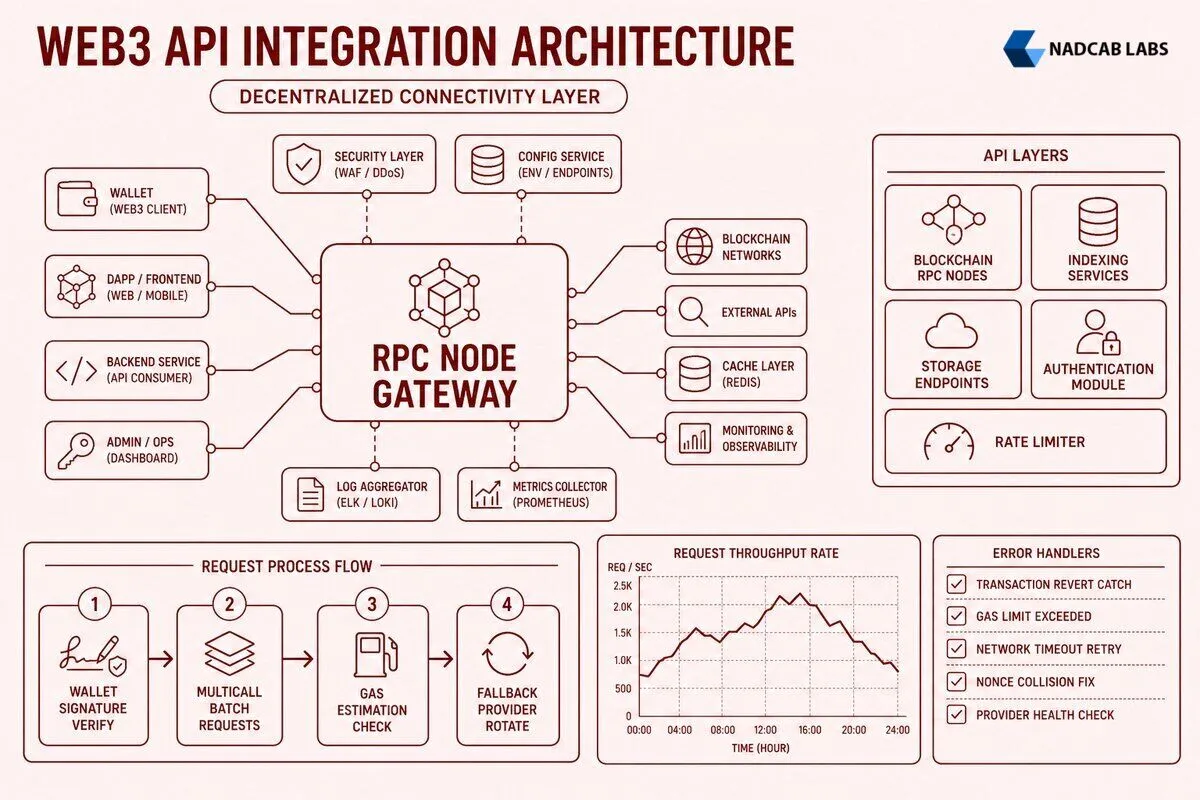
Web3 API architecture differs fundamentally from traditional REST APIs because it must bridge multiple decentralized systems rather than query a single database. The three essential layers work together to provide comprehensive blockchain interaction capabilities.
RPC nodes serve as the primary gateway for reading blockchain state and submitting transactions. When you call eth_getBalance or eth_sendRawTransaction, the request routes through an RPC endpoint that maintains a full or archive node. Providers like Infura and Alchemy offer managed RPC infrastructure, eliminating the operational burden of running your own nodes. A typical read operation might query the current block number, retrieve a wallet’s token balance, or fetch smart contract storage slots. Write operations submit signed transactions to the mempool, where miners or validators include them in upcoming blocks.
The JSON-RPC 2.0 protocol underlies most blockchain APIs, using POST requests with method names and parameters. For example, checking an Ethereum address balance requires calling eth_getBalance with the address and block parameter. This differs from REST APIs that use HTTP verbs and resource paths. The stateless nature of blockchain nodes means each request must specify exact block numbers or use tags like “latest” to ensure consistent reads during rapid block production.
Indexing services solve the query limitation problem inherent in raw RPC calls. The Graph protocol indexes blockchain events into queryable subgraphs, allowing developers to retrieve complex data sets with GraphQL queries instead of making hundreds of individual RPC calls. A marketplace application might query “all NFT transfers for collection X in the past 24 hours” through a subgraph, whereas raw RPC would require fetching every block, parsing logs, and filtering events client-side. Covalent provides another indexing approach with REST endpoints that return normalized data across multiple chains.
Storage layer APIs handle decentralized file hosting through protocols like IPFS and Arweave. NFT metadata typically lives on IPFS, referenced by content identifiers (CIDs) stored on-chain. When displaying an NFT, applications fetch the token URI from the smart contract, extract the IPFS CID, and retrieve JSON metadata through an IPFS gateway. Pinning services like Pinata and NFT.Storage provide reliable gateway access with higher availability than public gateways. Arweave offers permanent storage with one-time payment, useful for archival data that must remain accessible indefinitely.
| API Layer | Primary Function | Example Providers | Typical Request Volume |
|---|---|---|---|
| RPC Nodes | Direct blockchain read/write operations | Infura, Alchemy, QuickNode | 300,000 requests/day (free tier) |
| Indexing Services | Complex queries across historical data | The Graph, Covalent, Moralis | 1,000 queries/day (free tier) |
| Storage APIs | Decentralized content retrieval | Pinata, NFT.Storage, Arweave | Unlimited reads (pinning limits apply) |
| Wallet APIs | Transaction signing and key management | WalletConnect, Coinbase Wallet SDK | Varies by implementation |
Understanding these architectural layers helps developers choose appropriate tools for specific use cases. A simple token balance checker might only need RPC access, while a DeFi analytics dashboard requires indexing services to aggregate trading history efficiently. The Web3 Development process must account for the latency and cost characteristics of each layer when designing application architecture.
How Do You Implement Secure Authentication for Web3 APIs?
Web3 API authentication combines cryptographic wallet signatures with traditional API key management, creating a hybrid security model that proves wallet ownership while protecting provider endpoints. The implementation varies significantly from session-based authentication in Web2 applications.
Wallet signature verification using the EIP-4361 Sign-In with Ethereum standard provides the foundation for user authentication. When a user connects their wallet, the application generates a nonce (a random string used once) and constructs a human-readable message following the SIWE format. This message includes the domain requesting authentication, the wallet address, a statement of intent, the nonce, and an expiration timestamp. The user signs this message with their private key through their wallet interface, producing a cryptographic signature that proves ownership without revealing the private key itself.
Backend verification recovers the signer address from the message and signature using elliptic curve cryptography. The recovered address must match the claimed wallet address, and the nonce must be unused and not expired. Storing used nonces in a database or cache prevents replay attacks where an attacker intercepts and reuses a valid signature. The verification process typically uses libraries like ethers.js or web3.js, which handle the cryptographic complexity. Once verified, the server can trust that requests originate from the wallet owner.
API key management for provider endpoints requires careful environment variable configuration and rotation policies. Services like Infura and Alchemy issue project-specific API keys that authenticate requests to their RPC infrastructure. These keys should never appear in client-side code or public repositories. Instead, backend services store them in environment variables or secret management systems like AWS Secrets Manager or HashiCorp Vault. A typical setup uses different keys for development, staging, and production environments, with production keys restricted to specific IP ranges or domains.
JWT token generation after wallet authentication bridges Web3 identity with traditional session management. After successfully verifying a wallet signature, the backend issues a JSON Web Token containing the wallet address, expiration time, and any application-specific claims. Subsequent API requests include this JWT in the Authorization header, allowing the server to authenticate requests without repeated signature verification. The JWT approach works particularly well for hybrid applications that combine blockchain interactions with traditional database operations. The Crypto Wallet API integration often follows this pattern for secure transaction management.
Token expiration policies balance security with user experience. Short-lived tokens (15-30 minutes) require frequent re-authentication but limit the window for token theft. Refresh tokens stored in secure HTTP-only cookies allow seamless token renewal without wallet interaction. Some applications implement a two-tier system: a short-lived access token for API calls and a longer-lived refresh token that can generate new access tokens. This approach mirrors OAuth 2.0 patterns familiar to Web2 developers.
Rate limiting and API key restrictions prevent abuse of provider endpoints. Most RPC providers enforce request limits based on subscription tier, with free tiers typically allowing 100,000 to 300,000 requests per day. Applications must implement client-side throttling to stay within these limits, queuing requests and spreading them over time. Some providers offer burst capacity for temporary spikes, but sustained high-volume applications require paid plans. The authentication layer should track usage per API key and alert administrators when approaching limits.
What Rate Limiting and Caching Strategies Prevent API Throttling?
Rate limiting and caching form the defensive layer that keeps Web3 applications performant and cost-effective. Without these strategies, applications quickly hit provider limits or incur excessive charges, especially during traffic spikes or when serving real-time data to multiple users.
Request batching through multicall patterns dramatically reduces RPC call volume by combining multiple contract reads into a single request. The Multicall contract, deployed on most EVM chains, accepts an array of contract calls and executes them atomically, returning all results in one response. Instead of making 50 separate calls to check token balances across 50 addresses, a single multicall request retrieves all balances. This approach reduces network round trips and counts as one request against provider limits. Libraries like ethers.js v5+ include built-in multicall support, automatically batching compatible calls.
The batching implementation requires careful consideration of gas limits and response sizes. Each multicall has a gas limit, typically around 10-15 million gas, constraining how many operations fit in a single batch. Complex contract calls with high gas costs may require splitting into multiple batches. Response size also matters; extremely large batches can timeout or exceed HTTP payload limits. A practical approach batches 20-50 simple reads per multicall, monitoring response times and adjusting batch size based on performance metrics.
Redis caching layers store frequently accessed blockchain data with time-to-live (TTL) configuration, serving repeated queries from memory instead of hitting RPC endpoints. Token prices, NFT metadata, and wallet balances change infrequently relative to request volume, making them ideal caching candidates. A typical implementation caches token prices with a 30-second TTL, NFT metadata with a 5-minute TTL, and wallet balances with a 15-second TTL. The cache key structure includes the chain ID, contract address, and relevant parameters to prevent cross-chain or cross-contract collisions.
Cache invalidation strategies determine when to refresh stale data. Event-driven invalidation listens for blockchain events through WebSocket connections, purging cached entries when relevant state changes occur. A transfer event for a token triggers cache invalidation for the sender and receiver balances. This approach provides near-real-time accuracy while maintaining cache efficiency. Time-based invalidation works well for data that changes predictably, like gas prices updated every block. Hybrid strategies combine both methods, using events for critical paths and TTL for less sensitive data.
Fallback provider rotation distributes load across multiple RPC endpoints, preventing single-point failures and maximizing available request capacity. Applications configure an array of provider URLs with priority ordering. When the primary provider returns a rate limit error or fails health checks, the system automatically routes requests to the secondary provider. This rotation happens transparently to application logic. Some implementations use round-robin distribution from the start, spreading requests evenly across all configured providers. The Web3 Infrastructure design must account for provider diversity to ensure resilience.
Provider health monitoring tracks response times, error rates, and rate limit proximity for each configured endpoint. A simple health check pings each provider every minute with a lightweight request like eth_blockNumber, measuring latency and success rate. Providers consistently exceeding 500ms response time or showing error rates above 1% get temporarily removed from the rotation. Automated alerts notify operations teams when all providers in a region show degraded performance, indicating potential network-wide issues. This monitoring data also informs provider selection decisions during contract negotiations.
WebSocket subscriptions for event listening reduce polling overhead by pushing updates to clients as they occur. Instead of repeatedly calling eth_getLogs to check for new events, applications subscribe to specific log filters and receive notifications when matching events appear. A typical subscription might monitor all Transfer events for a specific ERC-20 token, triggering UI updates immediately when transactions complete. WebSocket connections require reconnection logic to handle network interruptions and provider restarts, automatically resubscribing to filters after reconnection.
How Should You Handle Blockchain-Specific Errors and Network Failures?
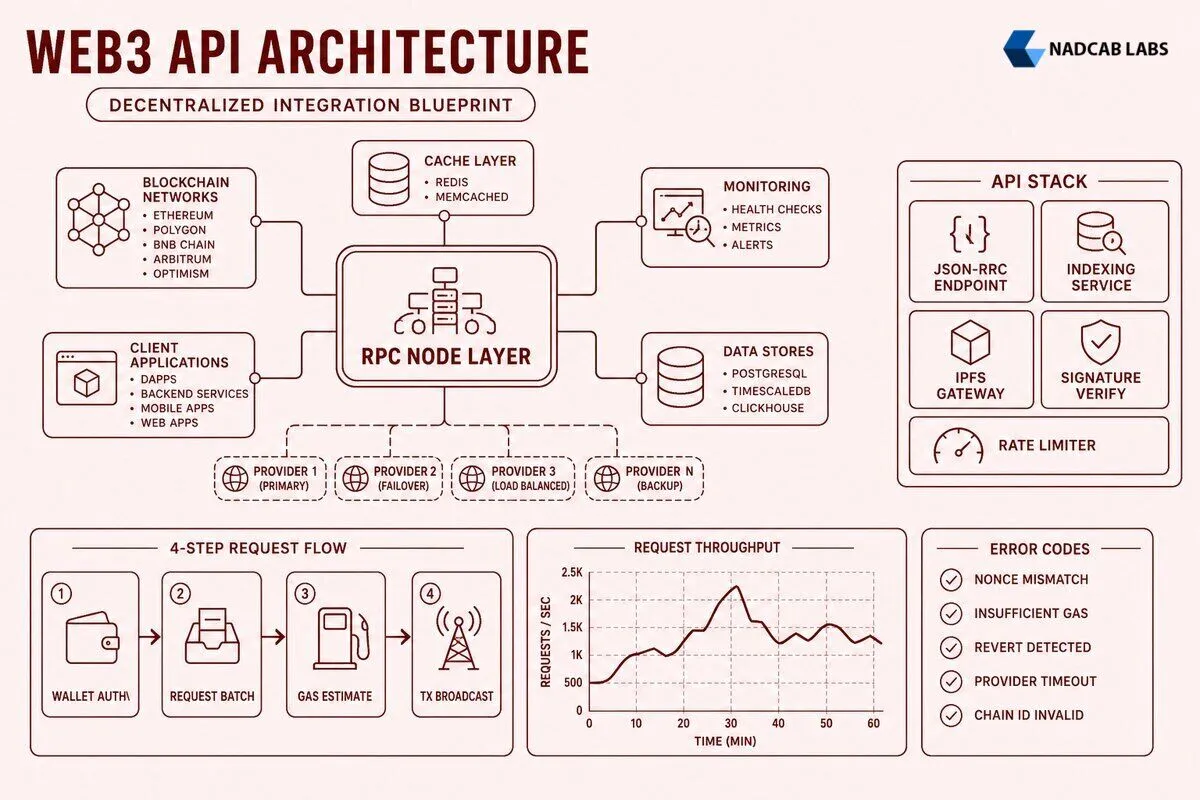
Blockchain error handling differs from traditional API error management because transactions can fail in numerous ways specific to distributed systems, gas mechanics, and smart contract execution. Robust error handling prevents silent failures, provides actionable user feedback, and implements appropriate retry logic for transient issues.
Transaction revert detection identifies when smart contract execution fails, parsing the revert reason from the error response. When a contract call reverts, the EVM returns an error code along with optional revert data. Modern Solidity contracts use custom errors or require statements with descriptive messages. The error parsing process decodes this data using the contract ABI, extracting the specific error type and parameters. For example, an ERC-20 transfer might revert with “InsufficientBalance” and the required amount, allowing the UI to display a precise error message rather than a generic “transaction failed” notice.
The error handling implementation must distinguish between reverts (deterministic contract failures) and other transaction failures. A revert occurs when contract logic explicitly rejects the transaction, like attempting to transfer more tokens than owned. These errors are permanent and retrying the same transaction will always fail. In contrast, failures from insufficient gas, network congestion, or nonce issues may succeed on retry. The error response structure differs between providers, requiring normalization logic that handles Infura, Alchemy, and other provider-specific formats consistently.
Retry logic for transient network issues implements exponential backoff to avoid overwhelming struggling nodes. When a request fails with a timeout, connection error, or 503 status code, the system waits before retrying. The first retry happens after 1 second, the second after 2 seconds, the third after 4 seconds, and so on, up to a maximum wait time and retry count. This pattern gives temporary network issues time to resolve while preventing retry storms that worsen congestion. Jitter (random variation in wait times) prevents thundering herd problems when many clients retry simultaneously.
| Error Type | Cause | Retry Strategy | User Action Required |
|---|---|---|---|
| Transaction Revert | Smart contract logic rejection | Do not retry | Fix input parameters or wallet state |
| Insufficient Gas | Gas limit too low for execution | Retry with 20% higher gas limit | Approve higher gas or wait for lower prices |
| Nonce Too Low | Transaction already mined or replaced | Fetch current nonce and retry | None (automatic recovery) |
| Network Timeout | RPC node unresponsive or overloaded | Exponential backoff up to 3 retries | None (automatic recovery or fallback) |
| Rate Limit Exceeded | Too many requests to provider | Wait for rate limit reset or switch provider | None (automatic provider rotation) |
Gas estimation failures occur when the contract simulation predicts execution will fail or consume excessive gas. The eth_estimateGas call runs the transaction against current blockchain state without committing it, returning the expected gas consumption. If simulation fails, the call reverts with the same error the actual transaction would produce. Applications should catch these estimation errors and present them to users before they waste gas on a failing transaction. Some complex contracts have variable gas costs depending on state, requiring applications to add a 10-20% buffer to estimated gas to account for state changes between estimation and execution.
Nonce management prevents transaction conflicts when submitting multiple transactions concurrently. Each Ethereum account has a nonce counter that increments with each transaction. Transactions must use sequential nonces; a gap causes later transactions to remain pending until the gap fills. When sending multiple transactions rapidly, applications must track pending nonces locally rather than querying the network, which returns only the confirmed nonce. A nonce manager maintains a queue of pending transactions, assigning sequential nonces and monitoring for confirmation or replacement. This becomes critical for high-frequency applications like trading bots or batch processing systems.
The replacement transaction pattern handles stuck transactions by submitting a new transaction with the same nonce but higher gas price. If a transaction sits in the mempool without confirmation due to low gas price, users can “speed up” by broadcasting a replacement with identical parameters except for gas. Miners prioritize the higher-paying version, and only one transaction with each nonce can be mined. Some wallets implement “cancel” functionality using this mechanism, sending a zero-value transaction to the sender’s own address with higher gas, effectively replacing the stuck transaction with a no-op.
What Are the Best Practices for Production Web3 API Deployment?
Production Web3 API deployment requires careful configuration management, monitoring infrastructure, and resilience planning that goes beyond typical Web2 deployment practices. The distributed nature of blockchain networks and the financial stakes involved demand higher operational standards.
Multi-chain configuration management handles the complexity of supporting Ethereum, Polygon, Binance Smart Chain, and other EVM networks simultaneously. Each chain requires its own RPC endpoints, contract addresses, and chain-specific parameters like block time and gas token. A configuration system typically uses a chain ID as the primary key, mapping to a configuration object containing RPC URLs, block explorer URLs, native token symbol, and deployed contract addresses. Environment-specific overrides allow using testnets during development while production uses mainnets. The configuration must be easily extensible to add new chains without code changes.
The chain configuration structure should include fallback RPC URLs, WebSocket endpoints, and chain-specific quirks like Polygon’s faster block time or BSC’s different gas price mechanics. Some applications use a chain registry service that provides this configuration dynamically, allowing updates without redeployment. The registry approach works well for multi-tenant SaaS applications where different customers may require different chain support. Contract address management benefits from a similar registry pattern, mapping contract names to addresses per chain and version.
Monitoring and alerting setup tracks RPC endpoint health, response times, error rates, and rate limit consumption. A comprehensive monitoring stack includes metrics collection (Prometheus or DataDog), log aggregation (ELK stack or CloudWatch), and alerting (PagerDuty or Opsgenie). Key metrics to monitor include RPC request latency percentiles (p50, p95, p99), requests per second, error rate by error type, cache hit rate, and WebSocket connection count. Provider-specific metrics track usage against rate limits, alerting when consumption exceeds 80% of the daily quota.
The alerting configuration should distinguish between informational alerts, warnings, and critical incidents. A single RPC timeout is informational; sustained elevated error rates warrant a warning; complete provider failure triggers a critical page. Alert fatigue is a real concern; overly sensitive alerts train teams to ignore notifications. Threshold tuning based on historical data helps find the right balance. Some teams implement alert suppression during known maintenance windows or low-traffic periods to reduce noise.
WebSocket connection management handles the persistent connections required for real-time event listening. Unlike HTTP requests that complete immediately, WebSocket connections remain open indefinitely, requiring careful resource management. Connection pools limit the total number of concurrent connections, preventing resource exhaustion. Each connection should have a heartbeat mechanism that sends periodic ping frames, detecting dead connections that failed to close properly. Automatic reconnection logic handles provider restarts or network interruptions, exponentially backing off after repeated failures to avoid overwhelming recovering systems.
The reconnection strategy must resubscribe to all active event filters after establishing a new connection. Applications typically maintain a registry of active subscriptions, automatically recreating them after reconnection. Some implementations use a “catch-up” mechanism that queries historical events from the last processed block to the current block, ensuring no events were missed during the disconnection. This approach prevents gaps in event processing that could leave application state inconsistent with blockchain state. The ICO Token exchange integration often requires this level of reliability for order book updates.
Security hardening includes rate limiting at multiple layers, input validation for all user-provided parameters, and protection against common attack vectors. API rate limiting should apply per-user (based on authenticated wallet address) and per-IP to prevent abuse. Input validation must check address checksums, validate numerical ranges for amounts and gas parameters, and sanitize any user-provided data before using it in contract calls. Protection against reentrancy attacks, front-running, and MEV exploitation requires careful transaction construction and sometimes private mempool submission.
Cost optimization strategies balance performance requirements with provider expenses. The supply chain API integration costs analysis shows that caching and batching can reduce monthly provider bills by 60-80%. Archive node access costs significantly more than full node access, so applications should use archive queries only when historical state access is truly necessary. Some providers offer tiered pricing based on request types; read-heavy applications benefit from plans optimized for eth_call and eth_getLogs over transaction submission. Monitoring per-endpoint costs helps identify optimization opportunities and justify infrastructure investments.
Disaster recovery planning addresses scenarios where primary infrastructure fails or blockchain networks experience issues. A complete disaster recovery plan includes automated failover to backup providers, database replication for application state, and documented procedures for handling chain reorganizations or network forks. Regular disaster recovery drills verify that failover mechanisms work as expected and that team members understand their roles during incidents. The plan should cover both technical failures (provider outages) and blockchain-level events (consensus failures, major protocol upgrades).
The deployment pipeline incorporates smart contract verification, integration testing against testnets, and gradual rollout strategies. Contract verification ensures that deployed bytecode matches the source code, building user trust and enabling better debugging. Integration tests run against testnet deployments, exercising all critical paths before mainnet deployment. Canary deployments route a small percentage of production traffic to new versions, monitoring for errors before full rollout. This staged approach catches issues that unit tests miss, like incorrect chain configuration or unexpected provider behavior. The crypto payment gateway integration time can be reduced significantly with proper testing infrastructure.
Final Thoughts
Web3 API integration requires mastering multiple technical layers that work together to bridge decentralized protocols and user-facing applications. The architecture combines RPC nodes for direct blockchain access, indexing services for efficient queries, and storage APIs for decentralized content delivery. Authentication merges wallet signature verification with traditional API key management, creating hybrid security models that prove ownership without compromising private keys.
Rate limiting and caching strategies form the defensive layer that keeps applications performant and cost-effective, using request batching, Redis caching, and provider rotation to maximize available capacity. Error handling must account for blockchain-specific failures like transaction reverts, gas estimation errors, and nonce conflicts, implementing appropriate retry logic and user feedback. Production deployments demand multi-chain configuration management, comprehensive monitoring infrastructure, and WebSocket connection handling for real-time event processing.
The practices outlined here provide a foundation for building reliable Web3 applications that scale under load and handle the unique challenges of distributed systems. As blockchain infrastructure matures and new protocols emerge, these integration patterns will evolve, but the core principles of security, resilience, and performance optimization remain constant. Developers who master these techniques position themselves to build the next generation of decentralized applications that deliver Web2-quality user experiences on Web3 infrastructure. Understanding the API fundamentals helps bridge the gap between traditional and decentralized development patterns.
Frequently Asked Questions
Q1.What is the difference between JSON-RPC and REST APIs in Web3?
JSON-RPC is a stateless, lightweight remote procedure call protocol used by Ethereum nodes to execute blockchain operations like eth_call or eth_sendTransaction. REST APIs, offered by providers like Alchemy or Moralis, wrap JSON-RPC with HTTP endpoints and add indexing, webhooks, and enhanced data queries. JSON-RPC requires method-specific payloads; REST uses standard HTTP verbs. For direct node interaction, use JSON-RPC; for enriched data and simplified queries, REST APIs are more efficient.
Q2.How do I verify wallet signatures on the backend for API authentication?
Use EIP-191 or EIP-712 signature verification. On the backend, reconstruct the original message (e.g., a nonce or timestamp), hash it with keccak256, then call ecrecover or use libraries like ethers.js verifyMessage to extract the signer’s address. Compare the recovered address against the claimed wallet address. Implement nonce tracking and expiration timestamps to prevent replay attacks. This ensures only the wallet owner can authenticate without exposing private keys.
Q3.What are the common rate limits for Infura and Alchemy RPC providers?
Infura’s free tier allows 100,000 requests per day with a burst limit of 10 requests per second. Alchemy’s free tier offers 300 million compute units monthly, with compute-weighted rate limiting (e.g., eth_call costs fewer units than eth_getLogs). Paid plans scale to millions of daily requests. Both enforce per-second throttling; exceeding limits returns HTTP 429 errors. Monitor usage via provider dashboards and implement exponential backoff retry logic to handle rate limit responses.
Q4.How can I reduce API costs when integrating with blockchain networks?
Cache frequently accessed data (token balances, contract ABIs) using Redis or in-memory stores with TTLs. Batch multiple JSON-RPC calls using eth_batch to reduce round trips. Use event logs (eth_getLogs) instead of polling contract state. Implement request deduplication to avoid redundant queries. Leverage archive node calls only when historical data is required; use standard nodes for current state. Consider self-hosting nodes for high-volume applications to eliminate per-request costs entirely.
Q5.What error codes should I handle when calling smart contract functions?
Handle -32000 (execution reverted), -32602 (invalid params), -32603 (internal JSON-RPC error), and -32005 (rate limit exceeded). Parse revert reasons from error.data for custom contract errors or require messages. Implement retry logic for transient errors like network timeouts or node sync issues. Check for insufficient gas (out of gas), nonce mismatches, and underpriced transactions. Use try-catch blocks and log full error payloads for debugging failed transactions or view function calls.
Q6.How do I set up IPFS gateway integration for NFT metadata retrieval?
Replace ipfs:// URIs with HTTP gateway URLs using public gateways (ipfs.io, cloudflare-ipfs.com) or dedicated services like Pinata or Infura IPFS. Parse the CID from tokenURI, construct https://gateway.ipfs.io/ipfs/{CID}, and fetch JSON metadata. Implement fallback gateways for redundancy. Cache metadata locally to reduce gateway load. For production, pin critical content to ensure availability and use authenticated gateways to avoid rate limits or downtime from public endpoints.
Explore Services
Related Services
Reviewed by

Aman Vaths
Founder of Nadcab Labs
Aman Vaths is the Founder & CTO of Nadcab Labs, a global digital engineering company delivering enterprise-grade solutions across AI, Web3, Blockchain, Big Data, Cloud, Cybersecurity, and Modern Application Development. With deep technical leadership and product innovation experience, Aman has positioned Nadcab Labs as one of the most advanced engineering companies driving the next era of intelligent, secure, and scalable software systems. Under his leadership, Nadcab Labs has built 2,000+ global projects across sectors including fintech, banking, healthcare, real estate, logistics, gaming, manufacturing, and next-generation DePIN networks. Aman’s strength lies in architecting high-performance systems, end-to-end platform engineering, and designing enterprise solutions that operate at global scale.