Ai Overview
Web3 infrastructure is the foundational technology layer that enables decentralized applications to function, communicate with blockchain networks, and deliver data to end users. It determines application performance, reliability, and cost structure. Private RPCs are dedicated endpoints from providers, offering 1,000+ requests per second, 99. 9% uptime SLAs, archive data access, and priority support.
Key Takeaways
- ◆ Web3 infrastructure consists of three core components: nodes that store blockchain data, RPCs that enable communication, and APIs that structure data access.
- ◆ Nodes are computers running blockchain software, validating transactions and maintaining the decentralized network’s integrity across thousands of machines globally.
- ◆ RPC (Remote Procedure Call) endpoints serve as the bridge allowing dApps to read blockchain state and submit transactions without running their own nodes.
- ◆ Web3 APIs provide indexed, structured blockchain data that would otherwise require complex queries across multiple blocks and contracts.
- ◆ Major node providers like Infura, Alchemy, and QuickNode power over 90% of Web3 applications, handling billions of requests daily.
- ◆ Private RPC endpoints offer higher rate limits, better uptime, and faster response times compared to free public endpoints.
- ◆ Running a full Ethereum node requires approximately 2TB SSD storage, 16GB RAM, and consistent bandwidth for synchronization.
- ◆ Multi-RPC failover setups are essential for production applications to ensure reliability when primary endpoints experience downtime.
- ◆ The Web3 infrastructure market is projected to grow from $3.47 billion in 2025 to over $41 billion by 2030 at 45% CAGR.
- ◆ Decentralized RPC networks and modular blockchain infrastructure represent the next evolution in reducing single points of failure.
What is Web3 Infrastructure?
Web3 infrastructure is the foundational technology layer that enables decentralized applications to function, communicate with blockchain networks, and deliver data to end users. Just as traditional websites rely on servers, databases, and APIs, web3 platforms depend on a parallel set of components: nodes that store and validate blockchain data, RPC endpoints that facilitate communication between applications and the chain, and APIs that provide structured access to on-chain information. Without this infrastructure, no wallet could display a balance, no DEX could execute a swap, and no NFT marketplace could show ownership records.
For businesses across the USA, UK, UAE, and Canada building on blockchain, understanding Web3 infrastructure is not optional. It determines application performance, reliability, and cost structure. The choice between running your own nodes versus using web3 node providers, selecting public versus private RPC endpoints, and integrating the right web3 API services shapes everything from user experience to operational expenses. In this guide, our team draws on eight years of hands-on experience to break down every component of the Web3 infrastructure stack.
Why Web3 Needs Infrastructure Like Web2?
The comparison to Web2 infrastructure is instructive. When you load a traditional website, your browser sends requests to centralized servers that return HTML, CSS, and data from databases. This happens in milliseconds because companies like AWS, Google Cloud, and Azure have built massive infrastructure to serve billions of requests. Web3 faces the same fundamental challenge: how do you deliver data quickly and reliably to users? The difference is that instead of centralized databases, the data lives on a distributed blockchain maintained by thousands of independent nodes. This decentralization provides censorship resistance and trustlessness but creates complexity that Web3 infrastructure must solve.
Core Building Blocks of Web3 Infrastructure
The Web3 infrastructure stack consists of three interconnected layers. First, nodes form the base layer, running blockchain software, storing the full chain history, and participating in consensus. Second, RPC endpoints provide the communication protocol allowing external applications to query nodes and submit transactions. Third, APIs offer higher-level data services, indexing blockchain information into formats that applications can consume efficiently. Each layer builds on the previous one, and understanding how they interact is essential for anyone building or operating Web3 applications.
What Are Blockchain Nodes in Web3?
Blockchain nodes are the computers that collectively maintain and secure decentralized networks. Every node runs specialized software (like Geth or Erigon for Ethereum) that connects to other nodes, downloads and verifies every block and transaction, and maintains a synchronized copy of the blockchain state. When you hear that Ethereum has over 10,000 nodes globally, these are the machines keeping the network alive. Web3 nodes RPC endpoints connect to these nodes to serve application requests.
Node Meaning in Simple Terms
Think of a node as a computer that holds a complete copy of a blockchain’s ledger and continuously validates new additions. Unlike a traditional database where one company controls all the data, blockchain nodes distribute that responsibility across thousands of independent operators worldwide. This distribution is what makes blockchains censorship-resistant: no single entity can alter the data because every node would reject invalid changes. For enterprises in the UK or Canada evaluating blockchain integration, understanding that nodes are the source of truth for all blockchain data is foundational.
What a Node Actually Stores and Validates?
A full node stores the entire blockchain history: every block header, every transaction, and the current state of all accounts and smart contracts. For Ethereum, this amounts to approximately 1 to 2 terabytes of data that must be continuously synchronized as new blocks are produced every 12 seconds. Nodes validate that each transaction follows protocol rules, has valid signatures, and that the sender has sufficient balance. This validation process ensures that no invalid transactions enter the blockchain, maintaining network integrity.
Why Nodes Matter for Decentralization?
The number and distribution of nodes directly impacts a network’s decentralization and security. More nodes mean more independent verifiers, making it harder for any party to manipulate the blockchain. When applications rely on centralized node providers, they reintroduce trust assumptions that blockchain was designed to eliminate. This tension between convenience (using providers) and decentralization (running your own nodes) is a key consideration for Web3 infrastructure architecture, particularly for enterprises in the USA and UAE building mission-critical applications.
Not all nodes are created equal. Different node types serve different purposes, with varying storage requirements, capabilities, and use cases. Understanding these distinctions helps teams choose the right Web3 infrastructure setup for their specific needs.
Types of Web3 Nodes Explained
Full Nodes
- Store complete blockchain state and recent history
- Validate all blocks and transactions independently
- Require 1-2TB storage for Ethereum
- Can serve RPC requests for current data
Light Nodes
- Store only block headers, not full transaction data
- Rely on full nodes to verify transaction details
- Require minimal storage (few GBs)
- Ideal for mobile wallets and resource-constrained devices
Archive Nodes
- Store complete historical state at every block
- Required for querying past contract states
- Need 12TB+ storage for Ethereum
- Essential for analytics and historical data services
Validator Nodes (PoS Networks)
On Proof-of-Stake networks like Ethereum post-Merge, validator nodes are special nodes that stake cryptocurrency to participate in block production and consensus. Validators propose new blocks and attest to the validity of blocks proposed by others. Running a validator requires 32 ETH stake for Ethereum and carries responsibilities including uptime requirements and slashing risks for misbehavior. While validator nodes are distinct from the RPC infrastructure most dApps use, they form the backbone of network security.
How Nodes Work?
Understanding how nodes process transactions and maintain consensus illuminates why Web3 infrastructure behaves the way it does. Every user action in a dApp ultimately translates to node operations.
Transaction Broadcasting and Propagation
When you submit a transaction through your wallet, it first reaches a node via an RPC endpoint. That node validates the transaction’s format and signature, then broadcasts it to connected peers. Within seconds, the transaction propagates across the network’s mempool (memory pool of pending transactions). Validators or miners select transactions from this pool to include in new blocks. The speed and reliability of this propagation depend heavily on the quality of your RPC in Web3 connection.
Block Validation and Consensus
When a new block is produced, every full node independently validates it. This includes checking that all transactions are valid, that the block follows protocol rules, and that it correctly references the previous block. Only after this validation does a node accept the block and update its local state. This independent verification by thousands of nodes is what makes blockchain data trustworthy without requiring trust in any single party.
State Updates and Chain Synchronization
After validating a block, nodes update their local state database to reflect the changes. Account balances, smart contract storage, and other state variables are modified according to the transactions in the block. Nodes continuously synchronize with the network to stay current, downloading new blocks as they are produced. For Ethereum, this means processing a new block approximately every 12 seconds, with each block potentially containing thousands of state changes.
What Is an RPC in Web3?
RPC is the communication protocol that makes Web3 applications possible. Without RPC, your wallet could not check balances, your DEX could not execute trades, and your NFT marketplace could not display ownership. Understanding how RPC works in Web3 is essential for anyone building or troubleshooting decentralized applications.
RPC Full Form and Meaning
RPC stands for Remote Procedure Call. It is a protocol that allows one computer (the client) to request that another computer (the server) execute a function and return the result. In Web3 context, your dApp is the client, and a blockchain node is the server. The dApp sends an RPC request asking the node to perform an action, such as getting an account balance or estimating gas for a transaction, and the node executes that function and returns the result. This simple request-response pattern underlies all blockchain interaction.
RPC as the “Bridge” Between Apps and Blockchain
Think of RPC as the translator between your application’s world and the blockchain’s world. Your frontend code cannot directly access blockchain data. Instead, it sends a standardized RPC request to a node, which processes the request, queries or updates the blockchain, and returns the result in a format your application can understand. Every time you see a balance update in MetaMask, view an NFT in OpenSea, or swap tokens on Uniswap, RPC calls are happening behind the scenes. RPC is truly the invisible plumbing of Web3.
RPC vs Node (Difference Explained Clearly)
The difference between node RPC and API concepts often confuses newcomers. A node is the actual computer running blockchain software and storing data. RPC is the communication protocol used to talk to that node. You cannot have RPC without a node to talk to, but you can have a node without exposing RPC access. When you use a provider like Alchemy, you are sending RPC requests to their nodes. When you run your own node, you send RPC requests to your own machine. The node does the work; RPC is how you ask it to do that work.
What Is an RPC Endpoint?
An RPC endpoint is the specific URL where your application sends RPC requests. It is the address of a node that is configured to accept and respond to RPC calls. Understanding RPC endpoints and how to choose between public and private options is critical for Web3 infrastructure decisions.
RPC Endpoint Meaning
An RPC endpoint looks like a URL: https://mainnet.infura.io/v3/YOUR_API_KEY or https://eth-mainnet.g.alchemy.com/v2/YOUR_KEY. This URL points to a server (or cluster of servers) running blockchain nodes. Your application sends HTTP POST requests to this URL containing JSON-formatted RPC commands. The endpoint processes these requests and returns the results. Every wallet, every dApp, and every blockchain tool uses RPC endpoints to communicate with the network.
Public RPC vs Private RPC
Public RPCs are free endpoints shared among all users, typically offering 25 to 100 requests per second with no uptime guarantees. They are suitable for testing and personal projects but unreliable for production applications. Private RPCs are dedicated endpoints from providers, offering 1,000+ requests per second, 99.9% uptime SLAs, archive data access, and priority support. For businesses in the USA, UK, UAE, or Canada building production dApps, private RPC is not optional; it is essential infrastructure.
Why Developers Use RPC Providers?
Running your own node requires significant resources: hardware, bandwidth, maintenance, and expertise. For most teams, it is more efficient to use web3 node providers who operate thousands of nodes globally, handle synchronization, and provide reliable uptime. Providers like Infura, Alchemy, and QuickNode have invested millions in infrastructure, allowing teams to focus on building their applications rather than managing nodes. The trade-off is dependency on these providers, which introduces centralization concerns that the Web3 community continues to address.
How RPC Work?
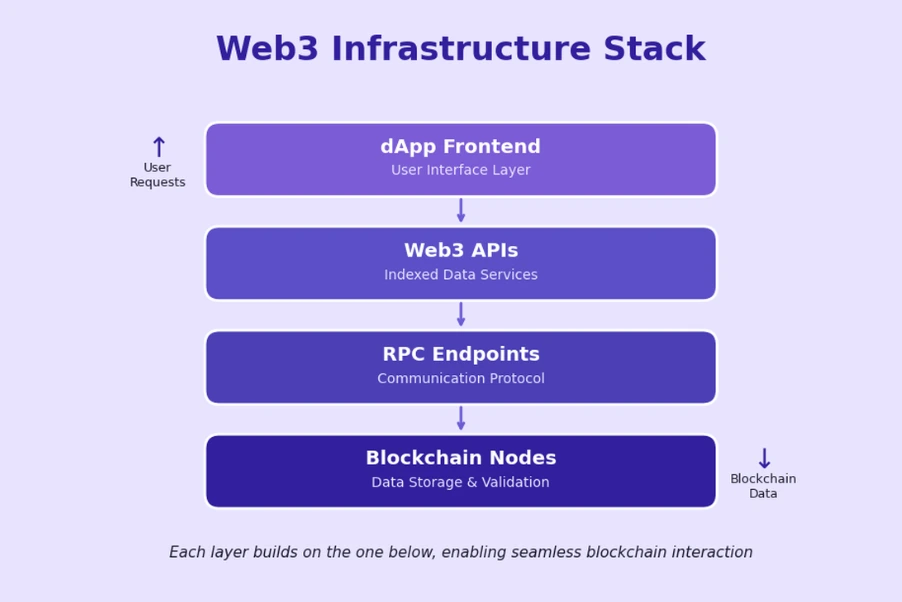
Understanding the mechanics of RPC requests helps developers debug issues and optimize their applications. Let us walk through the technical details of how RPC works in Web3 systems.
JSON-RPC Explained
Ethereum and most EVM-compatible chains use JSON-RPC as their communication standard. JSON-RPC is a stateless, lightweight protocol that encodes RPC calls as JSON objects. A typical request includes a method name (like eth_getBalance), parameters, and an ID for matching responses to requests. The node processes the request and returns a JSON response with the result or an error. This standardization means any compliant node can respond to the same requests, enabling interoperability across the ecosystem.
Common RPC Methods Used in dApps
The most frequently used RPC methods include: eth_getBalance (check account balance), eth_sendRawTransaction (broadcast a signed transaction), eth_call (read data from a smart contract), eth_estimateGas (estimate gas for a transaction), and eth_blockNumber (get the latest block number). Every interaction in a dApp translates to one or more of these underlying RPC calls.
Example Flow: Wallet → RPC → Node → Blockchain
When you click “Send” in MetaMask: (1) MetaMask constructs and signs a transaction locally. (2) MetaMask sends an eth_sendRawTransaction RPC call to its configured endpoint. (3) The RPC endpoint routes this to a node. (4) The node validates the transaction and broadcasts it to the network. (5) Validators include it in a block. (6) MetaMask polls eth_getTransactionReceipt to check confirmation status. This entire flow happens within seconds, powered by reliable Web3 infrastructure.
RPC Request Flow in Web3
1. User Action
User initiates action in dApp (check balance, send transaction, interact with contract).
2. RPC Request
Frontend sends JSON-RPC request to configured endpoint via HTTP POST.
3. Node Processing
Node validates request, queries blockchain state or broadcasts transaction to network.
4. Response Return
Node returns JSON response with result data or error. Frontend updates UI accordingly.
What Are Web3 APIs?
While RPC provides low-level blockchain access, web3 API services offer higher-level, structured data that would be extremely difficult to compile using raw RPC calls alone. APIs are essential for building performant, feature-rich applications.
API Meaning in Web3 Context
In Web3, an API is a service that indexes blockchain data and exposes it through convenient endpoints. Instead of making dozens of RPC calls and parsing raw data, you can make a single API call to get a wallet’s complete token portfolio, an NFT collection’s metadata, or a token’s price history. APIs transform the raw, unstructured blockchain into organized, queryable data that applications can consume efficiently.
RPC APIs vs Indexing APIs
RPC APIs are direct interfaces to node functionality, providing real-time blockchain access for reading state and submitting transactions. Indexing APIs are separate services that continuously scan the blockchain, extract and organize data, and store it in optimized databases for fast querying. The difference between node RPC and API becomes clear in practice: RPC tells you an address’s current ETH balance; an indexing API tells you that address’s complete transaction history, token holdings across all standards, and NFT ownership.
Why APIs Make dApps Faster?
Without APIs, displaying a user’s NFT collection would require: querying every NFT contract the user might have interacted with, checking ownership for each token ID, fetching metadata from IPFS or centralized servers, and aggregating all results. This could take minutes and hundreds of RPC calls. With an NFT API, a single request returns the complete, formatted collection in milliseconds. This efficiency is why APIs are essential Web3 infrastructure for any application serving real users.
Key Types of Web3 APIs
The Web3 API landscape includes specialized services for different data types and use cases. Choosing the right APIs significantly impacts application functionality and performance.
Blockchain Data APIs
Provide indexed access to blocks, transactions, logs, and contract events. Essential for explorers, analytics platforms, and any application needing historical blockchain data.
Token APIs (ERC-20/721/1155)
Return token balances, transfers, metadata, and holder information across all token standards. Critical for wallets, portfolio trackers, and DeFi applications.
Wallet APIs
Aggregate wallet activity including transaction history, portfolio value, profit/loss calculations, and cross-chain holdings in unified endpoints.
NFT APIs
Provide collection data, ownership records, transfer history, floor prices, and metadata for NFTs across marketplaces. Essential for NFT platforms and galleries.
Pricing APIs and Oracle APIs
Deliver real-time and historical price data for tokens and assets. Oracle APIs like Chainlink provide verified off-chain data to smart contracts.
Nodes Vs RPCs Vs APIs
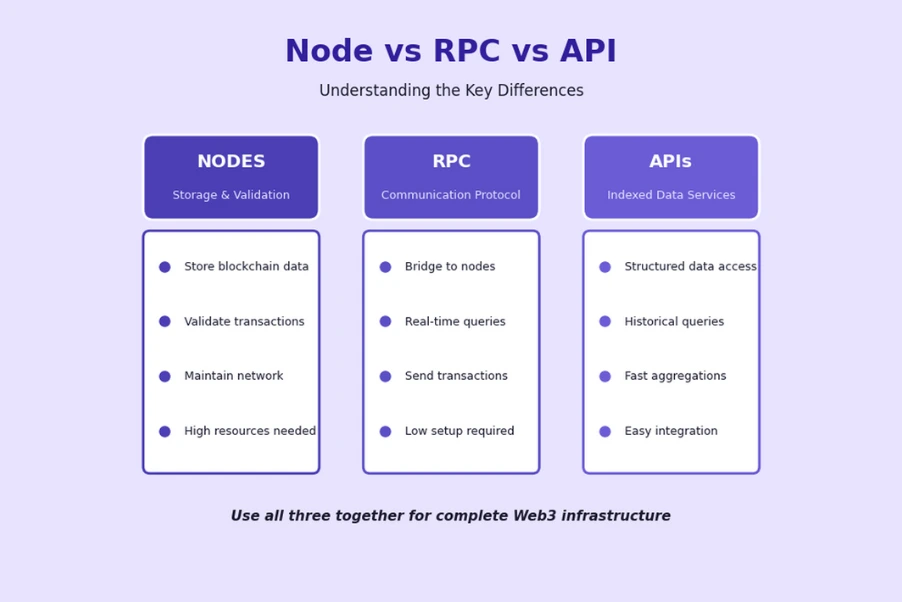
Understanding the distinctions between these three components is crucial for architecting effective Web3 infrastructure. Each serves a different purpose in the stack.
What Each One Does
Nodes store blockchain data and execute validation logic. RPC provides the communication protocol to interact with nodes. APIs index and organize blockchain data for efficient querying. In an analogy: the node is the library holding all the books, RPC is the librarian you ask for specific books, and APIs are the catalog system that tells you which books exist and where to find them.
Which One Developers Use Most
Most dApp builders use all three. RPC endpoints are essential for submitting transactions and reading real-time state. APIs are used for historical data, portfolio displays, and any feature requiring aggregated information. Running your own nodes is less common but important for high-security applications or teams requiring maximum decentralization and independence.
Quick Comparison Table
| Aspect | Nodes | RPC | APIs |
|---|---|---|---|
| Function | Store and validate data | Communication protocol | Indexed data services |
| Data Type | Raw blockchain state | Real-time state queries | Aggregated, structured data |
| Use Case | Network participation | Send transactions, read balances | Token lists, NFT data, history |
| Setup Complexity | High (hardware, maintenance) | Low (use provider URL) | Low (API key integration) |
How Nodes, RPCs, and APIs Work Together in a dApp?
In a production dApp, all three infrastructure components integrate to deliver a complete user experience. Understanding this architecture helps teams make informed infrastructure decisions.
Typical dApp Architecture (Frontend + Wallet + Backend)
A typical dApp has a frontend (React, Vue, or similar) that users interact with, wallet integration (MetaMask, WalletConnect) for signing transactions, and backend services for off-chain processing. The frontend uses libraries like ethers.js or viem to make RPC calls through the wallet or directly to provider endpoints. APIs handle data-heavy operations like displaying token lists or transaction history. The wallet manages keys and signs transactions before broadcasting them via RPC.
Web3.js / Ethers.js Role in RPC Calls
Libraries like ethers.js and Web3.js abstract the complexity of raw RPC calls. Instead of constructing JSON-RPC requests manually, developers write code like provider.getBalance(address). The library handles encoding, sending the request to the configured RPC endpoint, parsing the response, and returning typed data. This abstraction layer is essential for productive Web3 building, allowing teams to focus on application logic rather than protocol details.
Backend Services and API Layer in Web3
Many dApps include backend services that aggregate data from multiple APIs, cache frequently accessed information, and handle business logic that does not belong on-chain. For example, an NFT marketplace might use backend services to index listings, calculate royalties, and serve search results. These backends typically consume web3 API data and may maintain their own databases for performance optimization.
The web3 node providers market has matured significantly, with several enterprise-grade options available. Each provider offers different strengths depending on your requirements.
Top Web3 Node Providers Compared
| Provider | Strengths | Best For | Free Tier |
|---|---|---|---|
| Infura | MetaMask integration, mature platform, IPFS support | EVM-focused teams | 100K req/day |
| Alchemy | Enhanced APIs, debugging tools, excellent documentation | Full-stack builders | 300M compute units |
| QuickNode | 25+ chains, global edge network, marketplace add-ons | Multi-chain projects | Limited free trial |
| Ankr | 65+ chains, decentralized network, competitive pricing | Cost-conscious teams | 200M API credits |
| Chainstack | Enterprise controls, private infrastructure, compliance | Enterprise deployments | 3M requests/month |
Running Your Own Node vs Using a Provider
Running your own nodes provides maximum control, eliminates third-party dependencies, and ensures true decentralization. However, it requires significant investment: an Ethereum full node needs approximately 2TB SSD, 16GB RAM, and reliable bandwidth. Archive nodes require 12TB+ storage. For most teams in the USA, UK, UAE, or Canada, a hybrid approach works best: use providers for general operations and maintain self-hosted nodes for critical or sensitive operations.[1]
Infrastructure Challenges in Web3
Web3 infrastructure faces unique challenges that teams must plan for when building production applications.
RPC Downtime and Rate Limits
Even the best providers experience occasional downtime. Rate limits can throttle applications during traffic spikes. Without proper handling, users see blank balances, failed transactions, and broken interfaces. Multi-RPC failover setups are essential for production reliability.
Network Congestion
During high-activity periods (NFT mints, airdrops, market volatility), networks become congested. Gas prices spike, transactions take longer to confirm, and RPC endpoints may become overloaded. Applications need to handle these conditions gracefully.
Data Indexing Complexity
Building custom indexing solutions requires significant expertise in blockchain data structures, event parsing, and database optimization. Most teams rely on third-party APIs or services like The Graph for this functionality.
Latency and Slow Confirmations
Geographic distance between users and RPC endpoints introduces latency. Block confirmation times vary by network. Applications must manage user expectations and provide appropriate feedback during these waits.
Security Risks in Web3 Infrastructure
Security research highlights that Web3 infrastructure presents unique attack surfaces that teams must understand and mitigate.
Critical Security Risks to Address
RPC Manipulation: Compromised or malicious RPC endpoints can return false data, tricking users into signing harmful transactions.
Node Centralization: Reliance on few providers creates single points of failure and potential censorship vectors.
API Data Integrity: Third-party APIs may serve stale, incorrect, or manipulated data affecting application decisions.
Phishing via RPC: Attackers distribute malicious RPC URLs that intercept or manipulate user transactions.
Best Practices for Reliable Web3 Infrastructure
Use Multi-RPC Failover
Configure 2-3 RPC endpoints with automatic failover. If primary fails, requests route to backups seamlessly, maintaining application availability.
Monitor RPC Health
Implement monitoring for latency, error rates, and response times. Alert on degradation before users are impacted. Track provider status pages.
Prefer Private RPC for Production
Public endpoints are for testing only. Production applications require private endpoints with guaranteed rate limits and SLAs.
Cache and Index Data
Cache frequently accessed data locally. Use indexing services for historical queries. Reduce RPC calls to minimize costs and latency.
Cost Factors in Web3 Nodes, RPC and API
Understanding cost structures helps teams budget appropriately and choose infrastructure that aligns with their ROI expectations.
Use Cases of Web3 Infrastructure
Different applications have different infrastructure requirements. Understanding these patterns helps teams choose appropriate setups.
DeFi Apps: Require low-latency RPC for real-time price feeds and fast transaction submission. Archive nodes needed for historical data analysis. High reliability essential for financial operations.
NFT Marketplaces: Heavy API usage for metadata, ownership, and collection data. RPC needed for minting and trading. Indexing services critical for search and discovery features.
Web3 Games: Need fast, cheap transactions (often on L2s). Asset ownership tracked via APIs. Game state may combine on-chain and off-chain data.
DAOs and Governance: Require reliable RPC for voting transactions. Indexing needed for proposal tracking and participation history. Transparency demands for auditable infrastructure.
Identity and Credential Systems: Need secure, reliable infrastructure for credential verification. Privacy-preserving queries important. Often multi-chain to maximize interoperability.
How To Choose The Right Web3 Infrastructure Setup?
For Beginners
Start with free provider tiers (Alchemy, Infura). Use public APIs for data. Focus on learning before optimizing. Upgrade as you scale.
For Startups
Use paid provider tiers with adequate rate limits. Implement multi-RPC failover. Add monitoring. Consider dedicated nodes for critical paths.
For Enterprises
Hybrid setup with self-hosted nodes plus enterprise providers. Multi-region deployment. Comprehensive monitoring. Dedicated security review.
The Web3 infrastructure landscape is evolving rapidly, with several trends shaping its future.
Decentralized RPC Networks: Projects like Pocket Network and Lava are building decentralized alternatives to centralized providers, addressing the centralization concerns of current infrastructure.
Modular Blockchain Infrastructure: The rise of modular blockchains (separate execution, settlement, data availability layers) creates new infrastructure requirements and opportunities.
ZK-Friendly Data Infrastructure: Zero-knowledge proof systems require specialized infrastructure for proof generation and verification, driving innovation in this space.
Better Indexing and Faster APIs: Real-time indexing, GraphQL interfaces, and sub-second query times are becoming standard expectations for Web3 API services.
Final Thoughts
Summary of Nodes, RPCs, and APIs
Web3 infrastructure forms the invisible foundation that makes decentralized applications possible. Nodes store and validate blockchain data, providing the source of truth for the entire network. RPC endpoints enable applications to communicate with these nodes, translating user actions into blockchain operations. APIs index and organize this data, making it accessible in formats that applications can efficiently consume. Together, these components create the infrastructure layer that powers everything from DeFi protocols to NFT marketplaces to DAO governance systems.
Next Steps for Developers and Businesses
For teams in the USA, UK, UAE, and Canada building on Web3, the path forward involves understanding your specific requirements, choosing appropriate providers, implementing reliability best practices, and planning for scale. Start with managed providers to accelerate building, but consider hybrid setups as you grow. Monitor your infrastructure continuously, implement failover mechanisms, and stay informed about the rapidly evolving landscape. The quality of your Web3 infrastructure directly impacts user experience, operational costs, and application reliability. Invest accordingly.
Ready to Build Scalable, Reliable Web3 Infrastructure?
Our team has 8+ years of experience architecting Web3 infrastructure for enterprises. Let us help you design the right setup for your needs.
Frequently Asked Questions
Q1.What are Web3 node providers?
Web3 node providers are companies that operate and maintain blockchain nodes, offering access to their infrastructure through RPC endpoints and APIs. Instead of developers running their own costly nodes, they can use providers like Infura, Alchemy, QuickNode, and Ankr to connect their applications to blockchains. These services handle the complexity of node maintenance, synchronization, and scaling, allowing teams to focus on building their products while ensuring reliable blockchain connectivity.
Q2.Why do dApps need RPC endpoints?
dApps need RPC endpoints because they serve as the communication bridge between the application frontend and the blockchain backend. Without RPC access, a dApp cannot read blockchain data, check smart contract states, or submit transactions to the network. RPC endpoints translate user actions into blockchain operations, making them essential infrastructure. Most wallets like MetaMask rely on RPC endpoints to display balances, fetch transaction history, and broadcast user transactions to the network.
Q3.What is the difference between public and private RPC?
Public RPCs are free endpoints shared among many users, offering basic access with rate limits and no uptime guarantees. Private RPCs are dedicated endpoints provided by node services, offering higher rate limits, better performance, guaranteed uptime, and often enhanced features like archive data access. For production applications serving real users, private RPCs are recommended because they provide reliability, faster response times, and support for high transaction volumes that public endpoints cannot handle.
Q4.Can I run my own Web3 node instead of using a provider?
Yes, you can run your own Web3 node, which gives you full control over your infrastructure, eliminates dependency on third parties, and ensures maximum decentralization. However, running nodes requires significant resources: an Ethereum full node needs approximately 2TB of SSD storage, 16GB RAM, and constant uptime. Archive nodes require even more storage. For most projects, using a combination of node providers for reliability and a self-hosted node for critical operations represents the optimal balance between control and efficiency.
Q5.What is the difference between a node, RPC, and API in Web3?
A node is a computer running blockchain software that stores the full chain history and validates transactions. An RPC (Remote Procedure Call) is a protocol that lets external applications send requests to a node for data or to broadcast transactions. An API is a higher-level interface that provides structured, often indexed data from the blockchain. Nodes do the heavy lifting, RPCs enable communication, and APIs simplify data access for developers building applications.
Explore Services
Related Services
Reviewed by

Aman Vaths
Founder of Nadcab Labs
Aman Vaths is the Founder & CTO of Nadcab Labs, a global digital engineering company delivering enterprise-grade solutions across AI, Web3, Blockchain, Big Data, Cloud, Cybersecurity, and Modern Application Development. With deep technical leadership and product innovation experience, Aman has positioned Nadcab Labs as one of the most advanced engineering companies driving the next era of intelligent, secure, and scalable software systems. Under his leadership, Nadcab Labs has built 2,000+ global projects across sectors including fintech, banking, healthcare, real estate, logistics, gaming, manufacturing, and next-generation DePIN networks. Aman’s strength lies in architecting high-performance systems, end-to-end platform engineering, and designing enterprise solutions that operate at global scale.