Ai Overview
Traditional monetization methods relied on centralized control points: payment processors, advertising networks, and platform gatekeepers who extracted fees at every transaction. We have seen UK-based eCommerce businesses lose 40% of their revenue overnight due to algorithmic changes on dominant platforms. Play-to-earn games in which players earn crypto tokens through gameplay generated over $4 billion in revenue at their peak, demonstrating the commercial viability of token-based engagement.
Key Takeaways
- Web3 business models use token economies and smart contracts to eliminate costly intermediaries from traditional revenue pipelines globally.
- Decentralized marketplaces allow businesses in the USA, UK, UAE, and Canada to earn peer-to-peer revenue without platform fees or restrictions.
- Token-based subscription models give customers real ownership stakes, increasing retention rates and long-term community loyalty significantly.
- NFT monetization unlocks entirely new digital asset revenue streams for creators, brands, and enterprise-level businesses worldwide.
- Smart contract automation reduces transaction settlement times from days to seconds, improving cash flow across industries dramatically.
- DAOs enable community-driven revenue sharing where contributors are rewarded proportionally based on participation and governance votes.
- Blockchain-based loyalty programs reduce fraud and increase engagement by giving customers verifiable, transferable reward assets.
- Web3 innovation in FinTech is enabling borderless payments, yield-generating DeFi protocols, and programmable revenue distribution mechanisms.
- Industries from eCommerce to gaming are adopting decentralized business models to capture new user segments and increase average revenue per user.
- Regulatory clarity in the UK and UAE is accelerating enterprise adoption of crypto business models for compliant, scalable revenue generation.
The Evolution of Revenue Models in the Web3 Era
How Web3 Is Changing Traditional Monetization Methods?
Traditional monetization methods relied on centralized control points: payment processors, advertising networks, and platform gatekeepers who extracted fees at every transaction. Web3 monetization replaces these intermediaries with self-executing smart contracts that automate revenue distribution instantly and transparently. When a creator in Canada sells digital work through a blockchain-based platform, smart contracts automatically route royalty payments without any third party taking a cut. Token-based access models replace subscription paywalls, giving users actual assets instead of temporary access licenses. Decentralized exchanges replace commission-heavy brokers. Every layer of the traditional monetization stack is being replaced with programmable, trustless alternatives that benefit the actual value creators rather than rent-seeking intermediaries.
Why Businesses Are Moving Toward Decentralized Revenue Systems?
The migration toward decentralized business models is not driven by ideology alone; it is driven by measurable economic advantage. Businesses operating on Web3 infrastructure report significantly lower operational costs because blockchain protocols handle trust and settlement automatically. A UAE-based retail business using a decentralized marketplace pays no platform commission on peer-to-peer sales, retaining revenue that would otherwise go to marketplace operators. Beyond cost savings, decentralized revenue systems build deeper customer trust because every transaction is auditable on-chain. This transparency is increasingly demanded by consumers and regulators alike, making blockchain business models not just profitable but also compliant with the direction of global regulatory trends.
Why Traditional Revenue Models Are Losing Efficiency?
Limitations of Centralized Business Platforms
Centralized platforms create a fundamental structural problem: the platform’s interests and the business’s interests are always in tension. When Amazon raises its seller fees or Apple changes its App Store commission policies, businesses have no recourse. Platform dependency creates a single point of failure for entire revenue streams. We have seen UK-based eCommerce businesses lose 40% of their revenue overnight due to algorithmic changes on dominant platforms. Centralized platforms also create data monopolies where customer relationships are owned by the platform, not the business. This locks businesses out of their own customer data, preventing personalized engagement and undermining long-term retention strategies that are essential for sustainable revenue growth.
Rising Demand for Transparent and Direct Monetization
Consumer expectations around transparency have shifted dramatically. A 2024 survey showed that over 67% of millennials and Gen Z consumers in the USA and Canada prefer to engage with brands that demonstrate clear value exchange. They want to know what they are paying for, what data is being used, and how the platform makes money. Web3 revenue models address this demand structurally: every transaction is recorded on a public ledger, revenue sharing terms are encoded in visible smart contracts, and users can verify exactly how value flows through the system. This radical transparency is not just a nice-to-have ethical stance; it is becoming a competitive differentiator that drives customer acquisition and reduces churn rates significantly.
How Web3 Is Creating Smarter Revenue Models?
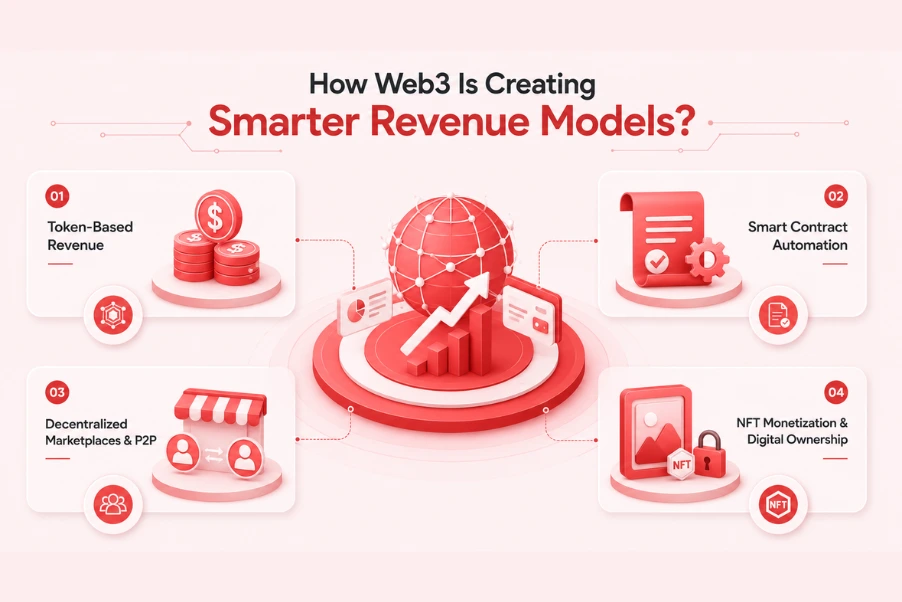
Web3 innovation introduces four powerful mechanisms that collectively redefine what revenue generation looks like for modern businesses.
Token-Based Revenue
The token economy enables businesses to create native digital currencies that power their entire ecosystem. Utility tokens grant access to services; governance tokens distribute decision-making power; and security tokens represent real economic stakes in the business. For businesses in the UAE and USA, token-based revenue creates an entirely new fundraising and monetization channel. Tokens can be sold to early users and investors, creating upfront capital while simultaneously building a community of invested stakeholders. As the token’s utility grows, its value appreciates, aligning user incentives with business growth in a way that traditional stock options or loyalty points simply cannot replicate. This is why the web3 token economy is rapidly becoming one of the most sought-after web3 business opportunities for enterprise strategists.
Smart Contract Automation
Smart contracts are self-executing code deployed on blockchain networks that automatically enforce the terms of an agreement the moment predefined conditions are met. For revenue generation, this is transformative. A music streaming platform using smart contracts can distribute royalties to artists in real time with every single stream, rather than waiting for quarterly accounting cycles. A UK-based SaaS business can encode subscription terms into a smart contract, ensuring automatic renewal payments without card processor delays or failed payment issues. Smart contract automation also eliminates the administrative overhead of manual invoicing, dispute resolution, and reconciliation, freeing up resources that can be reinvested into product and customer acquisition.
Decentralized Marketplaces & P2P
Decentralized marketplaces connect buyers and sellers directly through blockchain-based escrow and smart contract enforcement, removing the need for a central operator to take a commission on every transaction. Platforms like decentralized exchanges (DEXs) and NFT marketplaces have demonstrated that this model can scale to billions in daily trading volume. For businesses, this means building or participating in peer-to-peer revenue ecosystems where they capture value through protocol fees rather than transaction taxes. A Canada-based logistics business can build a decentralized freight marketplace where carriers and shippers transact directly, with the platform earning a minimal protocol fee instead of the 20-30% commissions charged by traditional freight brokers. This is one of the most compelling decentralized business models for capital-efficient revenue scaling.
NFT Monetization & Digital Ownership
Non-fungible tokens have unlocked a category of digital asset monetization that was previously impossible: verifiable, scarce, tradeable digital ownership. Unlike traditional digital products that can be infinitely copied, NFTs carry cryptographic proof of authenticity and ownership. For businesses, NFTs enable multiple revenue streams from a single asset. A brand can sell an NFT, earn royalties every time it is resold on the secondary market (typically 5-10% of each sale), and embed utility within the token to drive ongoing engagement. In the USA, luxury brands, sports franchises, and entertainment companies have generated hundreds of millions in NFT-based revenue. This web3 monetization approach turns one-time purchasers into perpetual revenue relationships through embedded royalty mechanisms that work automatically via smart contracts.
Key Web3 Revenue Models Businesses Can Adopt
Four high-impact blockchain business models are proving their commercial viability across global markets right now.
Token-based subscription models replace traditional paywalls with token-gated access that users actually own. Instead of paying a monthly fee for temporary access, subscribers purchase or earn tokens that unlock platform features. These tokens hold intrinsic value and can be traded, creating a subscription model where users are investors rather than mere customers. Businesses benefit from upfront capital from token sales, reduced churn as token holders have financial incentive to stay engaged, and secondary market activity that generates ongoing royalty revenue. Companies in the UK’s media sector are already piloting this model with measurable success in premium content monetization.
Decentralized Autonomous Organizations represent one of the most structurally innovative web3 business opportunities available to enterprises. A DAO is a community-governed entity where token holders vote on strategic decisions, revenue allocation, and platform direction. For businesses, building a DAO around a product creates a self-sustaining community of contributors who are directly rewarded for adding value. Protocol fees, licensing revenue, and treasury investments flow back to DAO participants. Canada’s tech startup ecosystem has seen several DAO-based projects raise substantial community treasuries, demonstrating that this model can generate and retain capital effectively while maintaining the decentralized governance values that attract Web3-native users.
Digital asset monetization encompasses everything from tokenized real-world assets to in-platform digital collectibles. Businesses can tokenize physical assets like real estate, commodities, or intellectual property, creating fractional ownership markets that attract global investors. This model has exploded in the UAE where regulatory sandboxes have enabled forward-thinking businesses to issue tokenized asset securities to a global investor base. Beyond asset tokenization, businesses can generate revenue by creating digital goods within their ecosystems, virtual items, branded collectibles, and access credentials that hold real market value and generate ongoing secondary market royalties for the issuing business. [1]
Traditional loyalty programs suffer from low engagement because points expire, cannot be transferred, and hold no real market value. Blockchain-based loyalty systems transform reward points into genuine digital assets that users can trade, combine, or redeem across partner ecosystems. This interoperability dramatically increases program engagement and perceived value. A USA-based retail chain using blockchain loyalty tokens sees its rewards currency actively traded on secondary markets, creating organic buzz and attracting new customers who purchase tokens to gain access to the loyalty ecosystem. The business benefits from increased transaction volume, improved data on reward circulation patterns, and reduced fraud since every token issuance and redemption is permanently recorded on-chain.
Industries Benefiting From Web3 Revenue Innovation
Across four major industries, Web3 monetization is generating measurable, real-world revenue uplift. Here is how each sector is leveraging blockchain business models for growth.
| Industry | Web3 Revenue Model | Key Benefit | Example Market |
|---|---|---|---|
| eCommerce & Retail | Blockchain loyalty tokens, NFT product certificates, decentralized marketplaces | Eliminates platform commissions; reduces fraud; builds transferable customer loyalty assets | UAE, USA |
| Gaming & Entertainment | Play-to-earn tokens, in-game NFT assets, virtual land ownership | Players become revenue stakeholders; secondary market activity generates ongoing royalties | USA, UK |
| Finance & FinTech | DeFi yield protocols, tokenized securities, programmable payment rails | Borderless transactions, real-time settlement, programmable revenue distribution | UK, Canada, UAE |
| Creator Economy | NFT content sales, social tokens, tokenized fan memberships | Direct creator-to-fan revenue with embedded perpetual royalties on all secondary sales | USA, UK |
eCommerce and Retail
The retail sector is leveraging web3 business models to address one of its most persistent challenges: building sustainable customer loyalty without ceding control to third-party platforms. UAE retailers participating in blockchain loyalty consortiums have seen program engagement rates increase by over 40% compared to traditional points systems. NFT product certificates serve double duty, proving authenticity for luxury goods while enabling brands to earn royalties on the thriving resale market. Decentralized marketplaces allow independent retailers to sell globally without paying Amazon or Shopify their standard commission rates, dramatically improving unit economics for small and mid-sized operators.
Gaming and Entertainment
Gaming has become the proving ground for web3 revenue models, and the results are compelling. Play-to-earn games in which players earn crypto tokens through gameplay generated over $4 billion in revenue at their peak, demonstrating the commercial viability of token-based engagement. Beyond play-to-earn, the broader concept of player-owned economies, where in-game items are genuine NFT assets tradeable outside the game, is reshaping how studios think about lifetime customer value. A game studio in the UK that embraces this model earns ongoing royalties every time players trade items on secondary markets, creating a revenue stream that outlasts the active game lifecycle and fundamentally changes the economics of game publishing.
Finance and FinTech
DeFi is the most advanced expression of web3 business opportunities in the financial sector. Decentralized lending protocols, yield farming platforms, and automated market makers have collectively managed hundreds of billions in value, operating entirely through smart contracts without traditional financial intermediaries. For FinTech businesses in Canada and the UK, integrating DeFi elements into existing products offers the opportunity to offer customers higher yields on idle capital, lower transaction costs on cross-border payments, and programmable financial instruments that execute automatically based on pre-set conditions. This represents a fundamental competitive advantage over legacy banking infrastructure.
Creator Economy and Digital Content Platforms
The creator economy has been systematically exploited by Web2 platforms that take 30-45% of creator revenue while providing minimal transparency about how algorithmic reach is allocated. Web3 monetization returns economic power to creators through direct fan relationships, token-gated content, and NFT-based intellectual property ownership. A podcaster in the USA who tokenizes their content can sell founding member tokens, receive direct microtransactions per episode listen, and earn royalties when fans trade their access tokens. Social tokens, unique digital currencies tied to individual creator brands, are enabling top creators to build self-sustaining economic ecosystems entirely independent of platform policies.
Business Benefits of Web3 Revenue Models
The practical business case for adopting blockchain business models is built on four concrete competitive advantages.
Lower Transaction Costs
Blockchain networks process peer-to-peer transactions for a fraction of traditional payment processing costs. While credit card processors charge 2.9% plus fixed fees, and marketplace platforms charge 15-25%, Layer 2 blockchain networks can settle transactions for under $0.01 per transaction. For high-volume businesses processing thousands of daily transactions, this reduction in transaction costs directly translates to significant margin improvement. A UAE-based digital marketplace moving to blockchain payment rails can recover several percentage points of revenue that were previously captured by payment intermediaries.
Greater Revenue Transparency
Every transaction recorded on a public blockchain is permanently auditable, eliminating the opacity that plagues traditional revenue reporting. For businesses with multiple revenue streams, investors, and regulatory obligations, this transparency simplifies accounting, accelerates audits, and builds stakeholder trust. Public companies in the UK are exploring blockchain-based revenue tracking as a way to provide shareholders with real-time verified revenue data rather than quarterly estimates. This level of transparency also makes fraud essentially impossible, since no party can manipulate transaction records after they have been committed to the chain.
Improved Customer Engagement
When customers own tokens or NFTs tied to a business, their engagement fundamentally changes. They are no longer passive consumers; they are stakeholders with a financial interest in the business’s success. This ownership psychology drives organic advocacy, word-of-mouth marketing, and community participation that no advertising budget can purchase. Businesses in Canada’s tech sector that have issued governance tokens to early customers report dramatically higher NPS scores and significantly lower churn rates than comparable companies using traditional loyalty mechanisms. The transition from customer to co-owner is the most powerful engagement driver available in the web3 ecosystem.
Global Revenue Without Intermediaries
Blockchain networks are inherently borderless. A business can receive payment from a customer in Japan, settle with a supplier in Germany, and distribute revenue to investors in Canada, all in real time, without currency conversion delays or correspondent banking fees. This eliminates one of the most significant friction points in global commerce. For digital businesses with international customer bases across the USA, UK, UAE, and Canada, Web3 payment infrastructure means global scale without the traditional cost and complexity of multi-currency banking relationships. This is a structural advantage that compounds over time as businesses grow their international revenue footprint.
Challenges Businesses May Face While Adopting Web3
Regulatory and Compliance Concerns
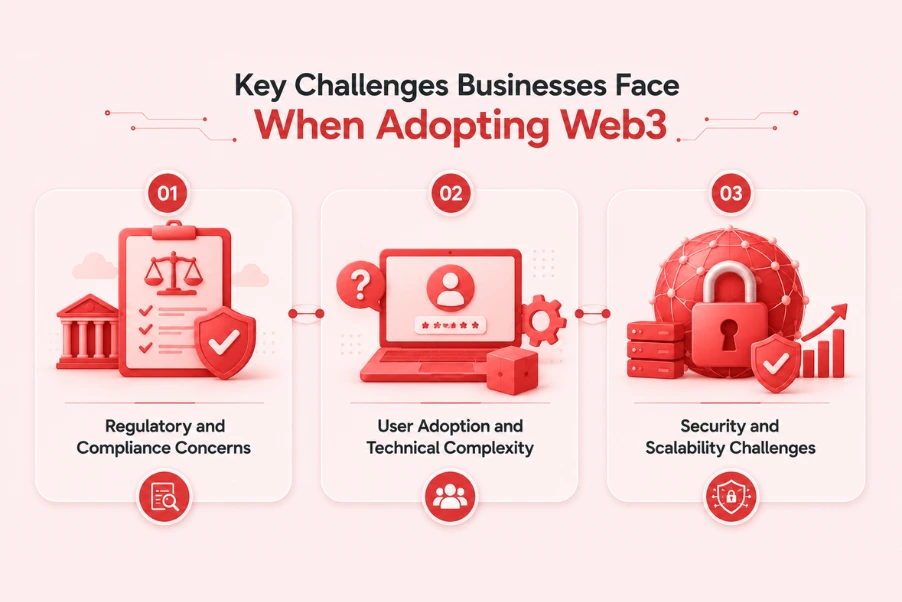
The regulatory landscape for crypto business models remains fragmented and rapidly evolving. In the USA, the SEC’s ongoing efforts to classify many tokens as unregistered securities creates legal exposure for businesses that fail to structure their token offerings carefully. The UK’s FCA has established a registration regime for crypto asset businesses, while the UAE’s ADGM and DIFC free zones offer relatively clear regulatory frameworks that have attracted significant blockchain business activity. Canada has adopted a generally permissive approach with FINTRAC registration requirements for crypto exchanges. Businesses must engage specialist legal counsel in each jurisdiction they operate to ensure their token structures comply with local securities, anti-money laundering, and consumer protection laws. Regulatory risk is real and manageable with the right expertise.
User Adoption and Technical Complexity
The single greatest barrier to mainstream web3 revenue model adoption is not technical, it is experiential. Managing crypto wallets, understanding gas fees, signing transactions, and navigating DeFi protocols requires a level of technical literacy that the majority of consumers in established markets do not yet possess. Businesses that ignore this reality and build web3 products with raw blockchain interfaces will struggle to achieve meaningful adoption outside of the crypto-native user base. The solution is to build abstraction layers that hide blockchain complexity behind familiar interfaces. Web3 wallet-as-a-service providers now enable businesses to create embedded wallets that users manage with email and password credentials, bringing the UX quality of web3 applications to within striking distance of Web2 standards.
Security and Scalability Challenges
Smart contract vulnerabilities represent a unique category of security risk that has no equivalent in traditional software. Unlike a database breach where data can potentially be recovered, exploited smart contracts can result in permanent loss of funds with no recourse. The DeFi sector has lost billions to smart contract exploits, reentrancy attacks, and oracle manipulation. Businesses entering the web3 ecosystem must invest in rigorous smart contract auditing, formal verification where applicable, and bug bounty programs that incentivize white-hat researchers to identify vulnerabilities before malicious actors do. Scalability challenges are being addressed by Layer 2 networks and alternative blockchains that can process thousands of transactions per second at low cost, but selecting the right infrastructure for your specific use case requires careful technical evaluation.
The Future of Revenue Generation in the Web3 Era
The trajectory of web3 innovation points to a revenue landscape that will be unrecognizable within five years, shaped by six transformative trends.
AI-Powered Tokenomics
Machine learning algorithms will dynamically adjust token supply, reward rates, and governance parameters in real time based on ecosystem health metrics, creating self-optimizing web3 revenue models that adapt faster than human governance can.
Real World Asset Tokenization at Scale
Estimates project a $16 trillion real world asset tokenization market by 2030. Businesses in the UK, UAE, and Canada are already piloting tokenized bonds, infrastructure assets, and private equity funds that generate yield for global retail investors through automated smart contract distributions.
Decentralized Identity and Reputation-Based Revenue
Web3 identity protocols will enable businesses to offer differentiated pricing and premium access based on verifiable on-chain reputation scores, unlocking entirely new personalized revenue models that reward loyal, high-value users with tangible economic benefits.
Programmable Revenue Sharing at Protocol Level
Future blockchain architectures will allow businesses to hard-code revenue sharing agreements directly into the protocol layer, ensuring that every stakeholder, investors, employees, community contributors, and partners, receives their agreed portion of revenue automatically without any manual processing.
Cross-Chain Revenue Aggregation
As the multi-chain web3 ecosystem matures, businesses will deploy revenue-generating products across multiple blockchains simultaneously, with cross-chain bridge technology aggregating all revenue streams into a single unified treasury, regardless of which network customers used to transact.
Institutional DeFi Adoption
Major banks and asset managers in the USA, UK, and UAE are actively building institutional DeFi infrastructure that will bring trillions in managed assets onto blockchain networks. Businesses positioned in the web3 ecosystem today will benefit disproportionately from this institutional capital entering decentralized protocols in the coming years.
Web3 Revenue Model Selection Criteria
Use these three steps to identify the most commercially viable blockchain business model for your specific business context.
Audit Your Current Revenue Architecture
Map every touchpoint where intermediaries extract fees from your current revenue model. Identify the three highest-cost friction points: typically payment processing, platform commissions, and settlement delays. These pinch points represent your highest-ROI targets for web3 replacement.
Match Model to Community Readiness
Your web3 revenue model is only as strong as the community it serves. If your customer base is Web3-native and crypto-literate, DAO governance and token economics will resonate immediately. If your audience is mainstream, prioritize blockchain loyalty programs and NFT-backed certificates that deliver tangible value without requiring deep technical engagement.
Pilot, Measure, and Scale
Never migrate your entire revenue model to Web3 in a single step. Begin with a contained pilot: a limited token drop, a blockchain loyalty program for your top 10% of customers, or a smart contract payment rail for a specific product line. Measure token velocity, redemption rates, and net revenue impact rigorously before expanding. Data-driven scaling is the hallmark of successful web3 monetization strategy.
Final Thoughts
Web3 is not a distant future technology; it is an active commercial reality generating measurable revenue for businesses across the USA, UK, UAE, and Canada right now. The shift from centralized, intermediary-heavy revenue models to decentralized, transparent, and community-owned structures represents the most significant business model transformation since the commercialization of the internet itself. Businesses that begin building their web3 revenue capabilities today, whether through token economies, smart contract automation, NFT monetization, or blockchain-based loyalty programs, will establish structural competitive advantages that compound over time.
The businesses that hesitate will face a choice between disruption and irrelevance as web3 business models move from the early adopter phase to mainstream commercial infrastructure. Our recommendation, built on over eight years of guiding businesses through technology-driven revenue transformation, is to start small, move deliberately, and build the internal expertise that will allow you to scale confidently as the web3 ecosystem matures. The window for establishing first-mover advantage in your sector is open now. The most strategically important decision you can make today is to begin.
Ready to Build a Smarter Web3 Revenue Model?
Partner with our team to design, audit, and launch blockchain revenue systems that drive measurable growth for your business.
People Also Ask
Q1.What are web3 business models?
Web3 business models are revenue frameworks built on blockchain technology that replace centralized intermediaries with smart contracts, token economies, and decentralized protocols. Unlike traditional models where platforms extract fees from transactions, web3 business models distribute value directly to users, creators, and stakeholders. They include token-based subscriptions, NFT monetization, DAO revenue sharing, and DeFi yield generation, all of which operate transparently on public blockchains with automated settlement.
Q2.How does the token economy generate revenue for businesses?
The token economy allows businesses to create native digital currencies that serve as both a monetization tool and a community-building mechanism. Companies issue utility tokens for platform access, governance tokens for decision-making rights, or security tokens representing economic ownership stakes. Revenue is generated through initial token sales, ongoing transaction fees within the token ecosystem, and secondary market royalties. Businesses in the USA and UAE are using token economies to raise capital and build loyal user communities simultaneously.
Q3.What is the difference between web3 monetization and traditional monetization?
Traditional monetization relies on centralized intermediaries like payment processors, advertising networks, and marketplace operators who take significant cuts of every transaction. Web3 monetization removes these layers by using smart contracts to automate revenue distribution, enabling peer-to-peer transactions with minimal fees. Web3 also introduces perpetual royalty mechanisms through NFTs and ongoing yield generation through DeFi protocols, creating revenue streams that continue generating income long after the initial transaction.
Q4.Can small businesses benefit from decentralized business models?
Yes. Decentralized business models are particularly advantageous for small businesses because they eliminate the high platform commissions that disproportionately impact smaller operators. A small eCommerce business in Canada that moves to a decentralized marketplace retains 15-25% more revenue per sale. Blockchain loyalty programs allow small brands to compete with enterprise loyalty systems at a fraction of the cost. The global, borderless nature of Web3 also allows small businesses to access international customer bases without costly multi-currency banking infrastructure.
Q5.What industries benefit most from crypto business models?
Gaming, entertainment, FinTech, and the creator economy currently show the highest adoption rates for crypto business models. Gaming benefits from play-to-earn mechanics and NFT-based in-game economies. FinTech gains from DeFi yield protocols and borderless payment rails. The creator economy benefits from direct fan monetization through social tokens and NFT content sales. eCommerce and retail in markets like UAE and USA are also rapidly adopting blockchain loyalty systems and digital asset certificates for luxury goods authentication.
Explore Services
Related Services
Reviewed by

Naman Singh
Co-Founder & CEO, Nadcab Labs
Naman Singh is the Co-Founder and CEO of Nadcab Labs, where he drives the company’s vision, global growth, and strategic expansion in blockchain, fintech, and digital transformation. A serial entrepreneur, Naman brings deep hands-on experience in building, scaling, and commercializing technology-driven businesses. At Nadcab Labs, Naman works closely with enterprises, governments, and startups to design and implement secure, scalable, and business-ready Web3 and blockchain solutions. He specializes in transforming complex ideas into high-impact digital products aligned with real business objectives. Naman has led the development of end-to-end blockchain ecosystems, including token creation, smart contracts, DeFi and NFT platforms, payment infrastructures, and decentralized applications. His expertise extends to tokenomics design, regulatory alignment, compliance strategy, and go-to-market planning—helping projects become investor-ready and built for long-term sustainability. With a strong focus on real-world adoption, Naman believes in building blockchain solutions that deliver measurable value, solve practical problems, and unlock new growth opportunities for organizations worldwide.