Ai Overview
SAP blockchain integration connects enterprise resource planning systems to distributed ledger networks, enabling transparent, immutable records of procurement, logistics, and financial transactions. Assumes 50 KB document, 20 gwei gas price on Ethereum, IPFS pinning service at $0. Blockchain Identity Management solutions map SAP user IDs to blockchain addresses, enabling role based access control where procurement managers can submit purchase orders but only CFOs can approve payments above $100,000.
SAP blockchain integration connects enterprise resource planning systems to distributed ledger networks, enabling transparent, immutable records of procurement, logistics, and financial transactions. By bridging SAP modules like Materials Management and Finance with smart contracts on Ethereum, Hyperledger Fabric, or private consortium chains, organizations gain multi party data reconciliation without intermediaries, automated settlement workflows, and cryptographic proof of supply chain provenance. This architecture requires middleware adapters that serialize SAP transaction payloads, submit them to blockchain nodes via RPC calls, and synchronize on chain state changes back to SAP tables while handling gas volatility, network latency, and reorg scenarios.
Key Takeaways
- SAP blockchain integration extends ERP transparency by anchoring transaction hashes, procurement events, and audit trails to immutable ledgers, eliminating reconciliation disputes across trading partners.
- Architecture flows through NetWeaver or HANA event triggers, OData or RFC adapters, off chain oracles, smart contract ABIs, and confirmation callbacks that update SAP tables with finality proofs.
- Production failures surface as nonce gaps, gas price spikes blocking transactions, schema mismatches between SAP ABAP structures and Solidity structs, and reorg induced rollbacks requiring idempotent retry logic.
- Decision matrices compare custom adapter development for unique workflows against packaged connectors, on chain storage cost versus IPFS anchoring, and public versus private chain trade offs in finality speed and decentralization.
- Phased delivery gates include schema alignment workshops, smart contract audit sign off, testnet integration tests with SAP sandbox environments, load testing at peak ERP volumes, and runbook handoff to operations teams.
- Enterprises evaluating SAP blockchain projects must validate that blockchain adds measurable value over traditional middleware before committing to the complexity of dual ledger state management.
Why SAP Blockchain Integration Matters for Enterprise Teams Evaluating Modern Development
SAP systems manage the operational backbone of global enterprises: purchase orders flow through Materials Management, invoices settle in Finance, shipments track in Logistics Execution. Each module writes to central HANA databases, creating a single source of truth within organizational boundaries. Blockchain extends that truth across organizational boundaries by providing a shared, append only ledger where every participant validates the same transaction history. When a supplier ships goods, the event writes to both SAP tables and a blockchain smart contract; when customs clears the shipment, another on chain state transition occurs. Downstream buyers query the chain to verify provenance without trusting the supplier’s internal ERP logs. sap blockchain integration.
Business drivers cluster around three categories. Supply chain provenance demands cryptographic proof that raw materials originated from certified sources, a requirement in pharmaceuticals, conflict minerals, and organic food. Financial settlement automation replaces manual invoice matching with smart contracts that release payment when delivery confirmations and quality inspections post on chain. Multi party data reconciliation eliminates the monthly spreadsheet exchanges where trading partners compare their separate ERP exports: the blockchain becomes the canonical record, and discrepancies surface immediately as failed transaction validations rather than weeks later during period close. sap blockchain integration.
Decision criteria hinge on whether SAP native modules suffice or whether blockchain bridges unlock competitive advantage. If your supply chain involves fewer than five trusted partners and disputes are rare, SAP Master Data Governance and standard EDI integrations may cover your needs at lower operational cost. Blockchain justifies its complexity when you face adversarial or semi trusted counterparties, regulatory mandates for immutable audit trails, or scenarios where real time settlement reduces working capital by days. Teams should quantify the cost of reconciliation labor, dispute resolution cycles, and capital tied up in payment terms, then compare that to the infrastructure expense of running blockchain nodes, paying gas fees, and maintaining adapter middleware. If the delta exceeds 20 percent of current process cost, a proof of concept becomes defensible. sap blockchain integration.
Enterprises often discover that blockchain adds the most value in cross organizational workflows where SAP alone cannot enforce trust. A procurement smart contract can lock funds in escrow until IoT sensors confirm goods arrived at the correct temperature, a condition SAP cannot validate without trusting the buyer’s sensor data. Blockchain cold chain compliance patterns illustrate how on chain oracles feed temperature readings into contracts that auto release payment or trigger penalty clauses. Similarly, Enterprise Blockchain architectures show how private consortium chains balance the transparency of public ledgers with the access control enterprises require for sensitive procurement data. sap blockchain integration.
| Integration Scenario | SAP Native Capability | Blockchain Value Add | Typical ROI Threshold |
|---|---|---|---|
| Single company audit trail | Change documents, archive logs | Cryptographic immutability for regulatory proof | Audit cost reduction over 15% |
| Multi party supply chain visibility | EDI message exchange, manual reconciliation | Shared ledger eliminates reconciliation cycles | Reconciliation labor savings over 25% |
| Automated payment settlement | Workflow approvals, payment runs | Smart contract escrow with IoT oracle triggers | Working capital improvement over 10 days |
| Provenance certification | Material master attributes, vendor declarations | Immutable chain of custody from origin to delivery | Compliance penalty avoidance over $500k annually |
How SAP Modules Connect to Blockchain Networks: Components, Data Flows & State Changes
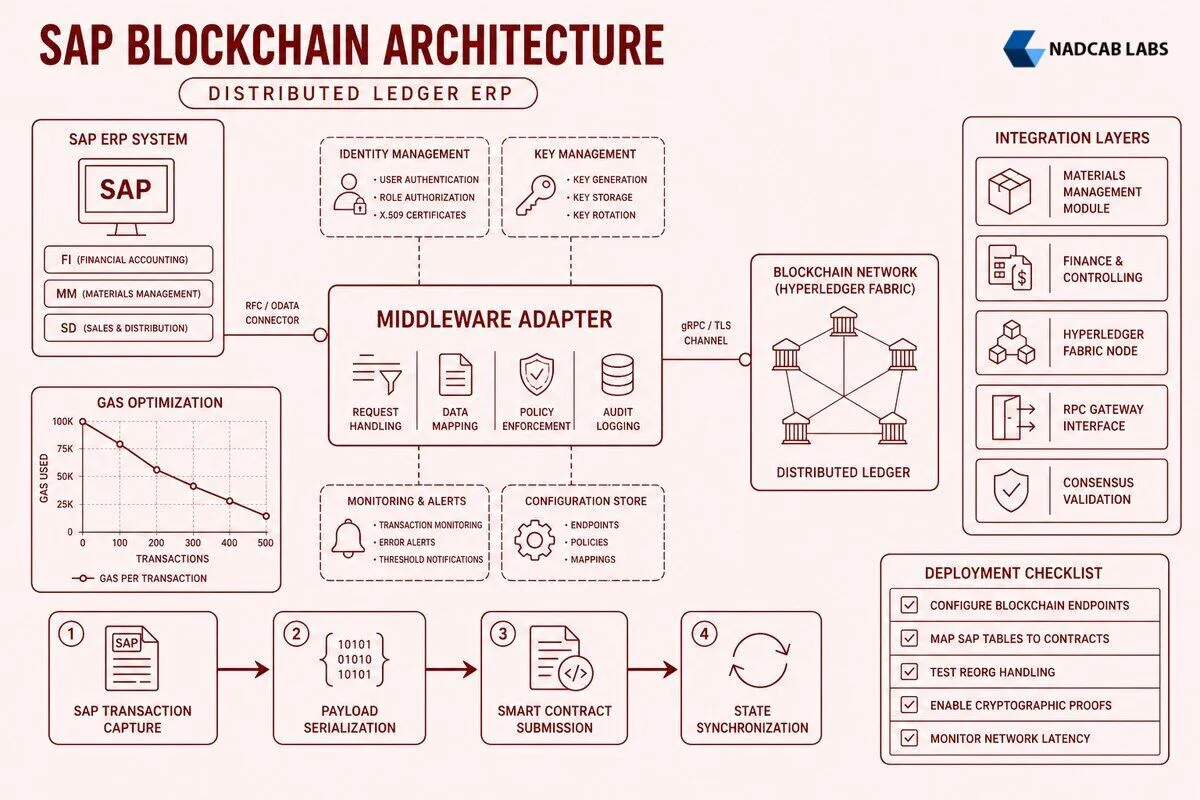
Architecture begins with SAP NetWeaver or HANA as the data source. When a procurement clerk creates a purchase order in MM, the system writes to table EKKO and triggers a change pointer or workflow event. An adapter layer intercepts that event, serializes the relevant fields into JSON or Protocol Buffers, and forwards the payload to a middleware service. Common adapter protocols include OData for RESTful consumption, RFC for synchronous function calls, and IDoc for asynchronous message queues. The middleware validates schema compliance, enriches the payload with external data if needed, and constructs a blockchain transaction. sap blockchain integration.
The blockchain transaction targets a smart contract ABI. For an Ethereum based procurement contract, the adapter calls a Solidity function like createPurchaseOrder(bytes32 poHash, uint256 amount, address supplier). The adapter signs the transaction with a private key managed in a hardware security module or cloud key vault, sets a gas price based on current network conditions, and submits the signed payload to an RPC endpoint running on a full node. The node propagates the transaction to the mempool, miners or validators include it in a block, and consensus finalizes the state change. The contract emits an event log containing the purchase order hash and timestamp. sap blockchain integration.
State synchronization flows bidirectionally. After the blockchain confirms the transaction, the adapter polls event logs or subscribes to a WebSocket feed. When it detects the PurchaseOrderCreated event, it extracts the block number and transaction hash, then writes those values back to a custom Z table in SAP via RFC or OData POST. This creates an audit link: SAP stores the on chain reference, and the blockchain stores a hash of the SAP document. If SAP later modifies the purchase order, the adapter computes a new hash and submits an updatePurchaseOrder transaction. Discrepancies between SAP state and blockchain state trigger alerts in monitoring dashboards. sap blockchain integration.
Finality thresholds determine when SAP considers a blockchain write permanent. On Ethereum mainnet, twelve block confirmations reduce reorg probability below one in ten million. The adapter waits for that depth before updating SAP tables with a “confirmed” status. On Hyperledger Fabric, finality is immediate after endorsement policy satisfaction and orderer commit. On proof of stake chains like Polygon, finality occurs within seconds but requires monitoring validator set changes. If a reorg invalidates a transaction, the adapter must detect the missing event log, revert the SAP Z table entry, and retry the blockchain write with a new nonce.
Merkle proofs enable lightweight verification. Instead of storing entire documents on chain, the adapter computes a Merkle tree from SAP line items, anchors the root hash in a smart contract, and stores the tree off chain in IPFS or a private database. When a trading partner disputes an invoice line item, the adapter retrieves the Merkle branch and submits it to a contract function that verifies the leaf against the stored root. This pattern reduces gas costs by 90 percent compared to storing full documents on chain, a critical optimization when SAP processes thousands of invoices daily.
Data Flow Sequence: SAP Transaction to Blockchain Confirmation
Purchase order save in SAP MM writes to EKKO table, fires change pointer or workflow event
Middleware consumes OData feed or RFC call, validates schema, serializes to JSON payload
Adapter signs transaction with HSM key, calls createPurchaseOrder(poHash, amount, supplier) via RPC
Validators include transaction in block, emit PurchaseOrderCreated event log after 12 confirmations
Adapter polls event log, extracts block number and tx hash, writes to SAP Z table via OData POST
Teams building these integrations often reference private blockchain architecture design patterns to choose between public Ethereum for maximum decentralization and Hyperledger Fabric for permissioned consortia. The choice cascades into adapter design: public chains require gas management and nonce tracking, while Fabric demands certificate authority integration and channel membership configuration. Blockchain Frameworks comparisons help architects evaluate trade offs in throughput, finality latency, and smart contract language support.
What Are the Production Pitfalls and Failure Modes in SAP Blockchain Systems?
Network latency spikes cause timeout cascades when the blockchain RPC endpoint delays transaction receipt acknowledgments beyond the adapter’s configured timeout. SAP workflows expect sub second responses; a five second blockchain confirmation can trigger retry logic that submits duplicate transactions. Without idempotent design, the smart contract processes the same purchase order twice, creating phantom inventory reservations. Detection requires monitoring adapter queue depth and correlating transaction IDs across SAP logs and blockchain explorers. When queue depth exceeds a threshold, alerts fire, and operators inspect whether the bottleneck is network congestion, node sync lag, or mempool saturation.
Gas price volatility blocks transactions when the adapter submits with a fixed gas price that falls below current market rates. Miners or validators ignore the transaction, and it languishes in the mempool until eviction. The adapter increments the nonce for the next transaction, creating a nonce gap that prevents all subsequent transactions from confirming. Detection involves polling the node’s pending transaction pool and comparing submitted nonces to the account’s on chain nonce. Mitigation requires dynamic gas price oracles that query services like EthGasStation or Blocknative, adjusting the gas price every thirty seconds. For urgent transactions, the adapter can submit a replacement transaction with the same nonce and higher gas price, a technique called transaction acceleration.
Schema mismatches surface when SAP ABAP structures evolve independently of smart contract Solidity structs. A developer adds a new field to the purchase order table without updating the contract ABI. The adapter serializes the extra field, but the contract function signature rejects the payload with a revert error. SAP continues to process orders internally, unaware that blockchain anchoring has failed. Detection requires parsing revert reasons from transaction receipts and logging them to a centralized monitoring system. Mitigation involves version controlled schema registries where SAP table definitions and contract ABIs are co managed, and integration tests validate serialization round trips before deployment.
Reorg induced rollbacks occur when the blockchain reorganizes blocks due to temporary forks. The adapter confirms a transaction at block height 1000, writes the confirmation to SAP, then discovers that block 1000 was orphaned and replaced by an alternate chain. The transaction no longer exists on chain, but SAP believes it succeeded. Detection requires subscribing to chain reorganization events and re validating transaction inclusion after every reorg deeper than two blocks. Mitigation involves waiting for finality thresholds appropriate to the chain: twelve confirmations on Ethereum, immediate finality on Tendermint based chains, and monitoring validator slashing events on proof of stake networks.
| Failure Mode | Detection Method | Mitigation Pattern | Recovery Time |
|---|---|---|---|
| Timeout cascade | Queue depth exceeds 100 pending transactions | Circuit breaker halts submissions, drain queue before resume | 5 to 15 minutes |
| Gas price spike | Pending tx pool shows nonce gap over 10 transactions | Replace transaction with same nonce at 150% gas price | 1 to 3 minutes |
| Schema mismatch | Revert reason contains “invalid argument” in logs | Rollback SAP table change, deploy updated contract ABI | 30 to 60 minutes |
| Blockchain reorg | Block hash at height N changes after initial confirmation | Resubmit transaction, update SAP Z table with new tx hash | 2 to 10 minutes |
Audit trail discrepancies emerge when SAP logs show a transaction succeeded but blockchain event logs show a revert. Root cause analysis reveals that the adapter logged success based on transaction submission, not confirmation. The transaction reverted due to a smart contract require statement failure, but the adapter never checked the receipt status. Detection requires parsing transaction receipts for the status field: 1 indicates success, 0 indicates revert. Mitigation involves two phase commit patterns where SAP marks the transaction as “pending blockchain” until receipt confirmation, then updates to “blockchain confirmed” or “blockchain failed” based on the status field.
Oracle failures disrupt workflows that depend on off chain data feeds. A procurement contract requires a quality inspection report from an IoT sensor before releasing payment. The oracle service that posts sensor readings to the chain experiences downtime, stalling all payment settlements. Detection involves heartbeat monitoring of oracle endpoints and alerting when the last data update exceeds a threshold. Mitigation includes fallback oracles from multiple providers, manual override functions in the smart contract for emergency situations, and service level agreements with oracle vendors that specify uptime guarantees and penalty clauses.
Idempotent transaction design prevents duplicate processing. Each SAP document receives a unique identifier, and the smart contract maintains a mapping of processed IDs. When the adapter submits a transaction, the contract checks whether the ID exists in the mapping. If it does, the contract returns early without modifying state, ensuring that retry logic cannot create duplicate records. This pattern requires careful nonce management: if the adapter retries with a new nonce, both transactions may confirm, so the contract must enforce idempotency at the application layer, not rely on nonce uniqueness.
When Should You Choose SAP Blockchain Integration vs Alternative Approaches?
Build versus buy decisions hinge on workflow uniqueness. If your procurement process follows standard SAP best practices and your trading partners use common ERP systems, packaged connectors like SAP Blockchain Business Network or Hyperledger Fabric plugins may suffice. These solutions provide pre built adapters for Materials Management and Finance, reducing development time from months to weeks. Custom adapter development becomes necessary when you integrate non standard SAP modules, use proprietary blockchain protocols, or require complex data transformations that packaged connectors do not support. The trade off: custom adapters demand ongoing maintenance as SAP releases updates and blockchain protocols evolve.
Monolith versus microservices architecture affects scalability and failure isolation. A tightly coupled SAP extension embeds blockchain logic directly in ABAP code, calling smart contracts via HTTP client classes. This approach minimizes latency and simplifies deployment but couples SAP release cycles to blockchain upgrades. A decoupled event driven architecture places an adapter microservice between SAP and the blockchain, consuming SAP events from a message queue like Kafka or RabbitMQ. The microservice scales independently, handles retries without blocking SAP workflows, and allows blockchain network changes without touching SAP code. The trade off: increased operational complexity from managing message brokers, monitoring queue lag, and ensuring exactly once delivery semantics.
| Decision Dimension | Option A | Option B | Selection Criteria |
|---|---|---|---|
| Connector approach | Packaged (SAP Blockchain Business Network) | Custom adapter development | Choose custom if workflows deviate from SAP standard or require proprietary chains |
| Architecture style | Tightly coupled ABAP extension | Decoupled microservice with message queue | Choose microservice if transaction volume exceeds 1000 per hour or failure isolation is critical |
| Data storage | On chain full documents | Off chain IPFS with on chain hash anchoring | Choose IPFS if document size exceeds 10 KB or gas cost per transaction exceeds $5 |
| Blockchain type | Public (Ethereum mainnet) | Private consortium (Hyperledger Fabric) | Choose private if data confidentiality outweighs decentralization or finality under 3 seconds is required |
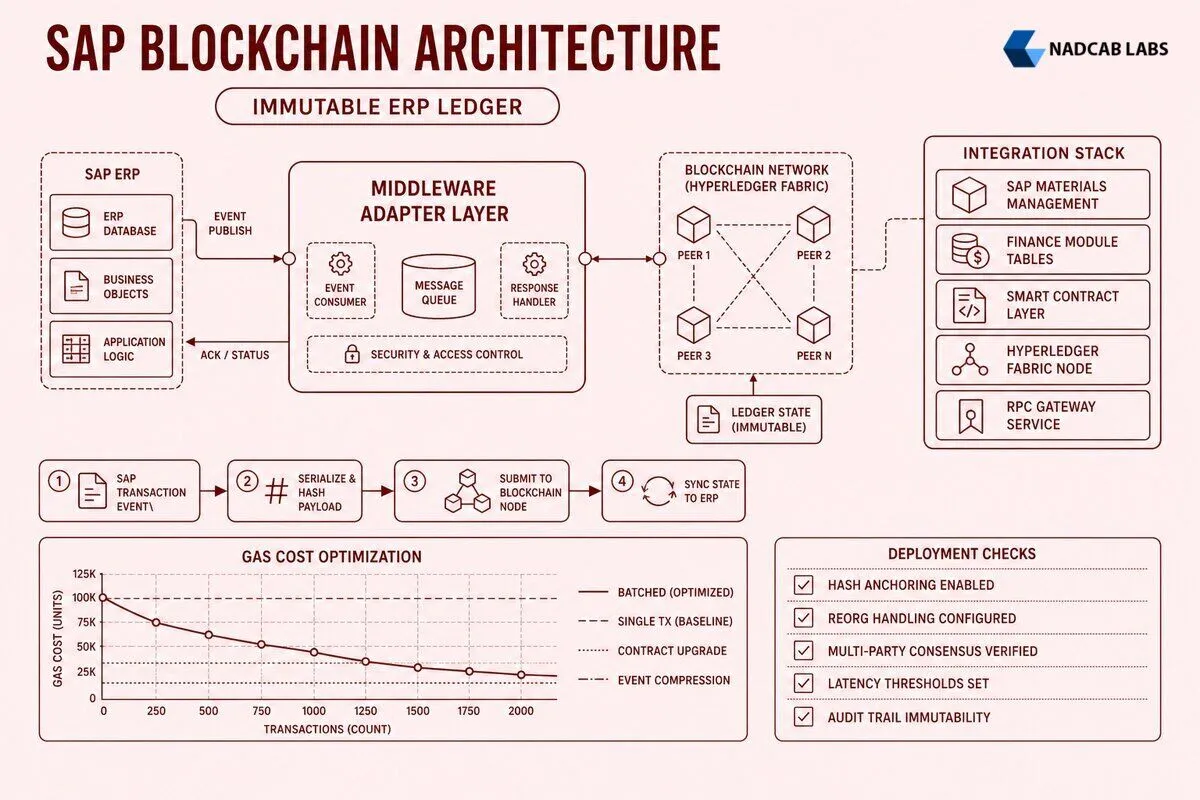
On chain storage cost versus off chain IPFS anchoring trades transparency for expense. Storing a 50 KB purchase order on Ethereum mainnet at 20 gwei gas price costs approximately $15 per transaction. Anchoring a hash of the same document costs under $1. The trade off: IPFS requires maintaining pinning services to ensure data availability, and participants must trust that the off chain data matches the on chain hash. Verification involves retrieving the document from IPFS, computing its hash, and comparing to the smart contract’s stored value. For high volume SAP integrations processing thousands of invoices daily, IPFS anchoring reduces monthly blockchain costs from $450,000 to $30,000.
Public versus private consortium chains balance decentralization guarantees against finality speed. Ethereum mainnet provides maximum censorship resistance: no single entity can block your transactions. Finality takes twelve blocks, roughly 2.5 minutes. Hyperledger Fabric offers sub second finality within a permissioned network where all participants are known and governed by legal agreements. The trade off: Fabric requires operating endorsing peers, orderer nodes, and certificate authorities, increasing infrastructure overhead. Public chains externalize that cost to miners or validators but expose you to gas price volatility and network congestion during peak usage.
Modular blockchain architectures separate consensus, data availability, and execution into distinct layers, allowing SAP integrations to optimize each dimension independently. A modular design might use Ethereum for consensus, Celestia for data availability, and an optimistic rollup for execution, achieving high throughput with Ethereum grade security. This pattern suits enterprises that need public blockchain auditability but cannot tolerate mainnet gas costs or latency.
Cost per Transaction: Storage Strategy Comparison
Assumes 50 KB document, 20 gwei gas price on Ethereum, IPFS pinning service at $0.10/GB/month amortized
Identity management patterns determine how SAP users authenticate to blockchain networks. Blockchain Identity Management solutions map SAP user IDs to blockchain addresses, enabling role based access control where procurement managers can submit purchase orders but only CFOs can approve payments above $100,000. Decentralized identifiers and verifiable credentials allow cross organizational workflows where a supplier’s SAP system proves compliance certifications to a buyer’s smart contract without revealing sensitive internal data.
Concrete Next Steps: Phased Delivery Framework for SAP Blockchain Projects
Discovery phase entry criteria require executive sponsorship, a defined business problem with quantified cost, and a cross functional team including SAP basis administrators, blockchain developers, and procurement stakeholders. Deliverables include a dependency map showing which SAP modules touch the target workflow, a prioritized list of transactions for blockchain anchoring ranked by business value, and success metrics such as throughput (transactions per hour), latency (SAP event to blockchain confirmation), and cost per transaction. Risks center on underestimating integration complexity: teams often assume SAP APIs are well documented, only to discover that custom Z tables require reverse engineering ABAP code.
Design and build gates start with schema alignment workshops where SAP developers and smart contract engineers agree on data models. A purchase order in SAP contains 200 fields; the blockchain contract needs perhaps 10. The workshop produces a canonical mapping document specifying which SAP fields serialize to which contract parameters, how enumerations translate (SAP status codes to Solidity enums), and how date time formats convert (SAP YYYYMMDD to Unix timestamps). Smart contract audit sign off involves external security firms reviewing the contract code for reentrancy vulnerabilities, integer overflows, and access control flaws. Integration test environments pair an SAP sandbox with testnet blockchain nodes, allowing end to end validation without risking production data or spending real Ether.
Harden and operate phases focus on non functional requirements. Load testing simulates peak ERP transaction volumes: if SAP processes 5,000 purchase orders per hour during month end close, the adapter must sustain that rate without queue buildup or dropped transactions. Testing reveals bottlenecks in RPC endpoint capacity, database connection pools, or smart contract gas limits. Runbooks document incident response procedures: when the blockchain halts due to a consensus failure, operators follow a checklist to switch to a fallback centralized ledger, notify trading partners, and queue transactions for later replay. When oracle failures block payment settlements, the runbook specifies manual override procedures and escalation paths to the smart contract owner.
Stakeholder training ensures that procurement clerks understand how blockchain confirmations affect their workflows. A clerk who saves a purchase order expects immediate feedback; if blockchain anchoring adds a 30 second delay, the UI must display a pending status and refresh when confirmation arrives. Operations teams need training on monitoring dashboards that show adapter queue depth, gas price trends, nonce gaps, and reorg alerts. Handoff to the operations team includes transferring private key custody to a hardware security module, documenting disaster recovery procedures for restoring adapter state from backups, and establishing SLAs for blockchain confirmation latency.
| Phase | Entry Criteria | Key Deliverables | Sign Off Authority |
|---|---|---|---|
| Discovery | Executive sponsor assigned, business case quantified | SAP module dependency map, transaction prioritization, success metrics | CIO and CFO |
| Design | Schema alignment workshop completed, audit budget approved | Canonical data mapping, smart contract code, audit report | Chief Architect and Security Officer |
| Build | Test environment provisioned, integration test plan approved | Adapter microservice, SAP Z tables, end to end test results | Development Lead |
| Harden | Load test plan defined, runbook template created | Load test report, incident runbooks, monitoring dashboards | Operations Manager |
| Operate | Training sessions completed, SLAs agreed with stakeholders | Production deployment, key custody transfer, 30 day stability report | COO and Business Unit Head |
Integration with android blockchain wallet integration patterns enables mobile procurement workflows where field technicians approve purchase orders via smartphone apps that sign transactions with hardware backed keystores. The mobile app communicates with the SAP adapter via REST APIs, submitting signed transaction payloads that the adapter forwards to the blockchain. This pattern reduces approval latency from hours to minutes, a critical advantage in time sensitive procurement scenarios like emergency equipment repairs.
Enterprises exploring these architectures benefit from partnering with specialists who have delivered production SAP blockchain integrations. SAP development teams at Nadcab Labs bring domain expertise in both SAP module internals and blockchain protocol nuances, reducing the risk of costly design mistakes that surface only during load testing or production rollout. Their phased delivery framework aligns technical milestones with business value gates, ensuring that each sprint produces demonstrable ROI rather than accumulating technical debt.
Healthcare organizations face unique challenges when integrating SAP with blockchain for patient data provenance and clinical trial transparency. Healthcare blockchain projects must navigate HIPAA compliance, patient consent management, and interoperability with electronic health record systems. The architecture often involves DAG based ledgers for high throughput patient event logging, where each medical encounter generates a transaction that references previous encounters in a directed acyclic graph structure, enabling parallel processing without the sequential bottleneck of traditional blockchains.
Final Thoughts
SAP blockchain integration transforms enterprise resource planning from isolated data silos into shared, verifiable ledgers that span organizational boundaries. By architecting middleware adapters that serialize SAP events, submit smart contract transactions, and synchronize on chain confirmations back to ERP tables, teams unlock transparent supply chains, automated settlements, and immutable audit trails. Production success demands micro level attention to failure modes: nonce gaps, gas volatility, schema drift, and reorg handling. Decision matrices guide build versus buy choices, storage strategy trade offs, and public versus private chain selection. Phased delivery frameworks ensure that discovery, design, build, harden, and operate gates align technical milestones with business outcomes, reducing the risk of costly rework. Enterprises ready to move beyond proof of concept should engage practitioners who understand both SAP internals and blockchain protocol mechanics, ensuring that integration complexity translates into measurable competitive advantage rather than operational burden.
Frequently Asked Questions
Q1.What is SAP and why does it matter for blockchain integration?
SAP is an enterprise resource planning platform managing finance, supply chain, procurement, and HR across thousands of companies. Integrating blockchain with SAP matters because it extends immutable audit trails, multi party consensus, and tokenized asset tracking into existing ERP workflows. Without native blockchain hooks, SAP data remains siloed; integration lets purchase orders, invoices, and inventory events publish to distributed ledgers, enabling real time verification by suppliers, auditors, and regulators while preserving SAP as the system of record for internal operations.
Q2.How does SAP stock performance relate to enterprise blockchain adoption?
SAP stock reflects investor confidence in the company’s cloud transition and innovation roadmap, including blockchain partnerships. Strong stock performance signals financial stability to fund R&D for blockchain connectors, API gateways, and reference architectures. Enterprises evaluating SAP blockchain integration watch stock trends as a proxy for vendor longevity and support commitment. Declining stock may delay blockchain projects if customers fear reduced investment in emerging tech, while rising valuations often correlate with expanded blockchain pilot budgets and executive sponsorship for distributed ledger initiatives.
Q3.What are the key SAP modules that benefit most from blockchain connectivity?
SAP MM (Materials Management) gains transparent supplier provenance and lot traceability on chain. SAP SD (Sales & Distribution) benefits from tokenized invoices and automated three way matching via smart contracts. SAP FI (Financial Accounting) uses blockchain for immutable journal entries and real time reconciliation with banks. SAP QM (Quality Management) publishes inspection results to shared ledgers for regulatory compliance. SAP WM (Warehouse Management) tracks goods movement with RFID events anchored on chain, reducing disputes and enabling instant audits across trading partners.
Q4.How do you handle data consistency between SAP ERP and a blockchain ledger?
Use a two phase commit pattern: SAP transaction commits locally first, then an integration layer (OData API or IDoc listener) publishes a hash or event payload to the blockchain. If the blockchain write fails, a compensating transaction rolls back SAP or queues retry. Store blockchain transaction IDs in custom SAP tables for reconciliation. Implement idempotency keys so duplicate events do not create multiple ledger entries. Monitor block confirmations; only mark SAP records as finalized after N confirmations. Periodic batch jobs compare SAP state snapshots with on chain hashes to detect drift.
Q5.What failure modes occur when SAP transactions interact with smart contracts?
Gas price spikes can cause timeouts if SAP workflows expect sub second responses but blockchain confirmation takes minutes. Revert conditions in smart contracts (invalid signature, insufficient token balance) leave SAP in a pending state unless you handle exceptions and trigger compensating logic. Network partitions may commit SAP data but fail to broadcast the blockchain transaction, creating orphaned records. Smart contract upgrades can break ABI compatibility with SAP integration middleware. Nonce collisions happen when parallel SAP processes submit transactions simultaneously, requiring nonce management and retry queues with exponential backoff.
Q6.When should enterprises choose SAP blockchain integration over traditional middleware?
Choose blockchain integration when multiple untrusted parties need a shared, tamper proof record that no single entity controls—supply chain provenance, cross border trade finance, or consortium settlement. Traditional middleware suffices for internal SAP to SAP replication or trusted partner EDI. Blockchain adds value when disputes are common, audit trails must survive decades, or regulatory frameworks demand immutable logs. Avoid blockchain if latency under 100 ms is critical, transaction volumes exceed 10,000 per second, or all participants already trust a central database with existing SLAs.
Explore Services
Related Services
Reviewed by

Aman Vaths
Founder of Nadcab Labs
Aman Vaths is the Founder & CTO of Nadcab Labs, a global digital engineering company delivering enterprise-grade solutions across AI, Web3, Blockchain, Big Data, Cloud, Cybersecurity, and Modern Application Development. With deep technical leadership and product innovation experience, Aman has positioned Nadcab Labs as one of the most advanced engineering companies driving the next era of intelligent, secure, and scalable software systems. Under his leadership, Nadcab Labs has built 2,000+ global projects across sectors including fintech, banking, healthcare, real estate, logistics, gaming, manufacturing, and next-generation DePIN networks. Aman’s strength lies in architecting high-performance systems, end-to-end platform engineering, and designing enterprise solutions that operate at global scale.