Ai Overview
Blockchain networks compete fiercely for the attention of token creators, but one platform has quietly separated itself from the pack. 39 billion in revenue recently, a 46% increase year-over-year, while the total value locked across its DeFi ecosystem surpassed $17 billion. Applications built on the network generated over $2. Seven distinct applications on Solana each surpassed $100 million in annual revenue, demonstrating the scale of economic activity available to new tokens entering this ecosystem.
Blockchain networks compete fiercely for the attention of token creators, but one platform has quietly separated itself from the pack. Solana processes thousands of transactions per second at costs that barely register, making it the go-to chain for creators who need speed without sacrificing affordability. Applications built on the network generated over $2.39 billion in revenue recently, a 46% increase year-over-year, while the total value locked across its DeFi ecosystem surpassed $17 billion.[1] These numbers are not theoretical. They reflect real demand from real users, and they explain why Solana has become a serious choice for anyone launching a token.
For token creators specifically, Solana delivers a combination of technical advantages that directly affect development costs, user experience, and long-term project viability. Understanding how does Solana offer an advantage for token creators requires looking beyond surface-level speed claims and into the architecture, tooling, and ecosystem dynamics that make a measurable difference during the development process.
Key Takeaways
- Solana’s Proof of History mechanism enables transaction throughput exceeding 65,000 TPS with sub-second confirmation, giving token creators unmatched operational speed.
- Average transaction fees on Solana cost fractions of a cent, reducing the development and operational budget for token launches dramatically.
- The SPL token standard and Token Extensions program provide native features like transfer fees, confidential transfers, and metadata support without custom smart contract development.
- Solana’s DeFi ecosystem includes major DEX aggregators, liquid staking protocols, and NFT marketplaces that give new tokens immediate distribution channels.
- Upcoming upgrades like Alpenglow and Firedancer are expected to cut finality to approximately 150 milliseconds and push throughput beyond one million TPS.
What Makes Solana’s Architecture Different
Every blockchain must solve a fundamental coordination problem: how do thousands of independent validators agree on the order of transactions without a central authority? Most networks handle this through sequential communication rounds that consume time and bandwidth. Solana took a different approach by introducing Proof of History, a cryptographic clock that timestamps transactions before they enter consensus. This seemingly simple innovation eliminates the back-and-forth communication that slows other chains, allowing validators to process transactions in parallel rather than waiting for synchronization.
Proof of History works by generating a continuous, verifiable sequence of hashed timestamps using a Verifiable Delay Function. Each hash depends on the previous one, creating an immutable record of when events occurred relative to each other. This means validators do not need to negotiate transaction ordering, the ordering is already cryptographically proven before consensus begins. Combined with Tower BFT, Solana’s optimized Byzantine Fault Tolerance mechanism, the result is a network capable of processing over 65,000 transactions per second with fast finality. For token creators, this architecture means their web3 tokens can handle high-volume activity like trading, gaming rewards, or micropayments without bottlenecks or failed transactions.
Core Advantages Solana Provides to Token Creators
The technical architecture translates into several concrete benefits that directly affect the development process, launch economics, and operational sustainability of any token project on the Solana network.
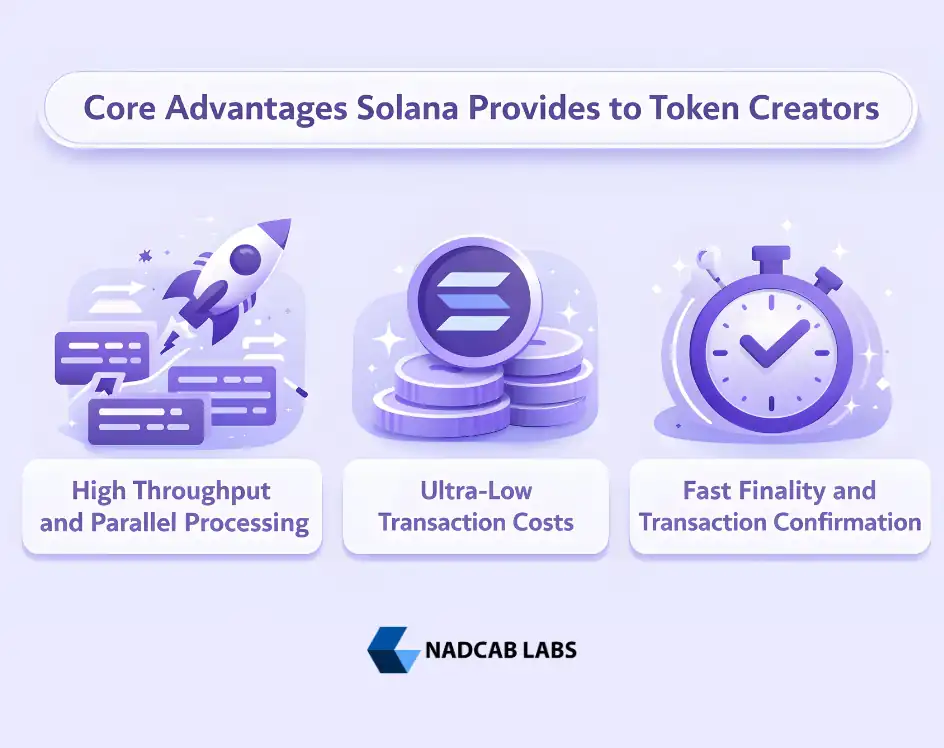
High Throughput and Parallel Processing
Solana can process thousands of transactions per second under real-world conditions, with theoretical capacity reaching much higher under optimized settings. This matters because token creators building applications, whether decentralized exchanges, gaming platforms, or payment systems, need infrastructure that does not collapse under demand spikes. The network uses Sealevel, a parallel smart contract runtime that executes transactions simultaneously across multiple cores rather than sequentially. This means a token used in a gaming application and a token traded on a DEX can both process transactions at the same time without competing for block space. The upcoming Firedancer validator client, built by Jump Crypto, has demonstrated processing speeds exceeding one million TPS in testing, pointing toward even greater capacity ahead.[2]
Ultra-Low Transaction Costs
Transaction fees on Solana average around $0.00025, making it one of the cheapest networks for token operations. For creators, this low cost structure changes the economics of token deployment entirely. Minting tokens, distributing airdrops, processing trades, and executing smart contract functions all carry negligible fees. This is particularly relevant for use cases involving microtransactions, loyalty rewards, in-game currencies, or tipping systems, where high fees on other chains would make the business model unviable. The development of applications that require frequent, small-value transfers becomes practical only when the underlying network charges fractions of a cent per operation.
Fast Finality and Transaction Confirmation
Once a transaction on Solana reaches confirmed status, it is processed and settled. The current finality time sits around 12 seconds, but the Alpenglow consensus upgrade, approved by 98% of validators, is expected to reduce this to approximately 150 milliseconds.[3] For token creators, fast finality eliminates the risk of double-spending and transaction reversals, which is critical for financial applications, exchanges, and any platform where users expect instant settlement. This speed advantage also improves user experience dramatically, making Solana-based tokens feel responsive rather than sluggish.
SPL Token Standard and Token Extensions
Solana uses the SPL (Solana Program Library) token standard as the foundation for all tokens on its network, both fungible and non-fungible. Similar to Ethereum’s ERC-20 but architecturally optimized for Solana’s speed, the SPL standard provides a unified framework for creating, transferring, burning, and managing tokens through a single universal Token Program. This means token creators do not need to write and deploy separate smart contracts for basic token functionality, significantly reducing the development effort and potential security risks.
The development of Token Extensions expanded the standard with programmable features that were previously impossible without custom smart contracts. Transfer fees allow issuers to automatically collect a percentage on every transaction, enabling monetization models built directly into the token itself. Confidential transfers mask balances and transfer amounts using zero-knowledge proofs, serving businesses and institutions that require privacy. Permanent delegation lets regulated issuers maintain control over tokens for compliance purposes, a feature already adopted by Paxos for its USDP stablecoin. These native capabilities give types of crypto token projects on Solana a significant advantage over chains where such functionality requires expensive custom development.
Practical Use Cases for Token Creators on Solana
Solana’s technical strengths are not theoretical, they map directly to real-world token use cases where speed and cost determine whether a project succeeds or fails. The ecosystem has already demonstrated its capacity across multiple sectors.
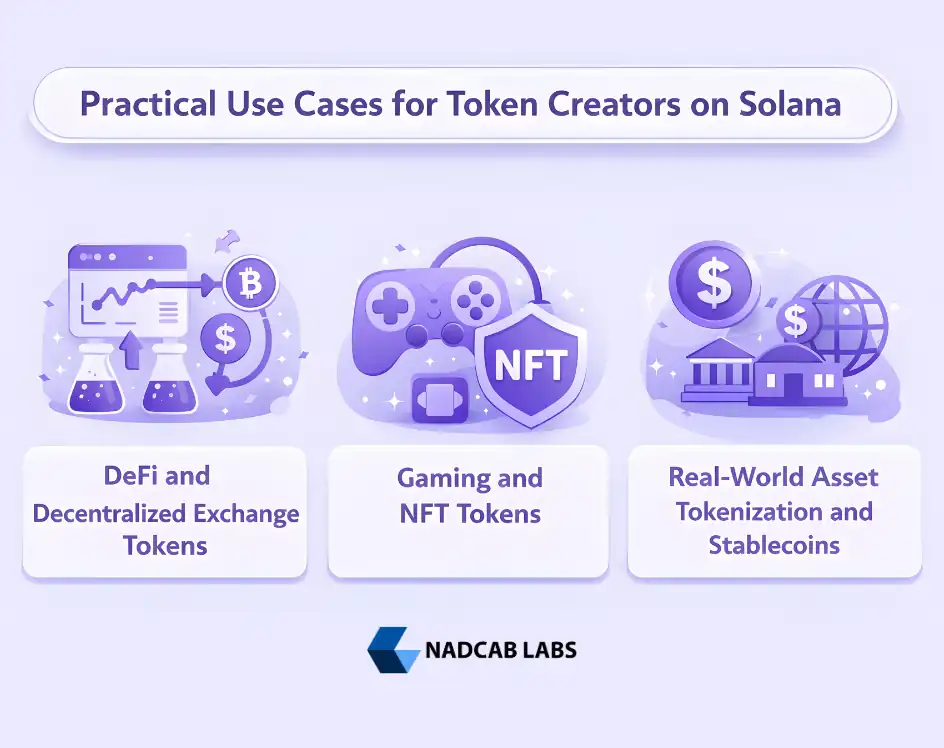
DeFi and Decentralized Exchange Tokens
Solana hosts major decentralized exchanges like Jupiter, Raydium, and Orca, which collectively process billions in trading volume. Token creators launching DeFi tokens benefit from immediate integration with these platforms, giving their tokens liquidity and trading access from day one. The low fees make yield farming, liquidity provision, and high-frequency trading strategies viable for users of all sizes. Seven distinct applications on Solana each surpassed $100 million in annual revenue, demonstrating the scale of economic activity available to new tokens entering this ecosystem. Understanding the relationship between different crypto coin and token categories helps creators position their development strategy within this landscape.
Gaming and NFT Tokens
Gaming platforms require blockchain infrastructure that handles thousands of concurrent operations, item trades, reward distributions, marketplace transactions, without lag or prohibitive costs. Solana’s parallel processing and sub-cent fees make it the natural choice for gaming tokens. NFT marketplaces like Magic Eden built their foundations on Solana for the same reasons: creators can mint thousands of assets without worrying about transaction costs eating into their margins. The development of AI tokens that power intelligent in-game economies is also gaining traction on Solana, where the network’s speed supports real-time AI agent interactions.
Real-World Asset Tokenization and Stablecoins
Institutional adoption of Solana is accelerating rapidly. WisdomTree brought its full suite of regulated tokenized funds to the network, and Ondo Global Markets expanded to offer over 200 tokenized U.S. stocks and ETFs on-chain. Stablecoin activity on Solana has surged, with the network processing an estimated $11.7 trillion in stablecoin transfer volume. For token creators working on real-world asset tokenization, the combination of Token Extensions’ compliance features and Solana’s low-cost settlement infrastructure provides a compelling foundation. The network’s gas token costs remain negligible compared to other chains, making high-volume settlement operations economically efficient.[4]
Looking to Build on Solana?
Nadcab Labs helps token creators design, develop, and deploy secure SPL tokens with custom smart contracts and tokenomics strategies tailored to the Solana ecosystem.
Network Upgrades Strengthening the Advantage
Solana’s current capabilities are already compelling, but the network’s development roadmap signals even greater advantages ahead. Two major upgrades are reshaping what token creators can expect from the platform in the near future.
Alpenglow Consensus Overhaul
The Alpenglow upgrade replaces Solana’s existing Tower BFT and Proof of History systems with a streamlined consensus architecture built around two new components called Votor and Rotor. The practical impact is transformative: transaction finality drops from roughly 12 seconds to approximately 150 milliseconds, and validator voting moves off-chain, freeing up block space for actual user transactions. This also eliminates voting transaction fees, lowering the barrier for smaller validators to participate and strengthening decentralization. For token creators, sub-second finality means their tokens can power applications that require instant settlement, from payment processing to high-frequency trading platforms.
Firedancer and Expanded Throughput
Firedancer, developed by Jump Crypto, is an independent validator client that has already demonstrated processing over one million transactions per second in testing. A hybrid version is already operating on mainnet, processing blocks faster than the original client. The full deployment of Firedancer gives Solana client diversity, meaning the network continues operating smoothly even if one client experiences issues. Combined with planned increases in block capacity and the introduction of the P-token standard through the SIMD-0266 proposal, which could reduce resource usage by up to 98%, these upgrades position Solana as the development infrastructure of choice for token creators who need enterprise-grade performance.
Challenges Token Creators Should Consider
No blockchain is without its trade-offs, and token creators considering Solana should take a balanced view. While the network has experienced outages in the past, its reliability has improved significantly thanks to recent infrastructure upgrades and the introduction of multiple validator clients. Solana’s programming model relies primarily on Rust, which has a steeper learning curve than Solidity on Ethereum; however, modern no-code platforms and advanced token development solutions have largely removed this barrier for standard token launches. At the same time, the ecosystem’s rapid expansion has attracted scams and low-quality projects, requiring legitimate creators to put in extra effort to build trust and credibility. Even so, Solana’s trajectory indicates increasing stability, more robust token development solutions, and growing institutional confidence.
Final Thoughts
How does Solana offer an advantage for token creators? Through a combination of architectural innovation, practical economics, and ecosystem depth that no other blockchain currently matches at scale. Proof of History eliminates consensus bottlenecks. Sub-cent fees make microtransactions viable. The SPL standard and Token Extensions provide native programmability without custom development overhead. A thriving DeFi ecosystem gives new tokens immediate distribution channels. And upcoming upgrades like Alpenglow and Firedancer are set to push performance even further. For token creators who want their projects to operate at the speed and cost efficiency that users now expect, Solana delivers the infrastructure to make it happen.
Frequently Asked Questions
Q1.What makes Solana fast for tokens?
Solana uses Proof of History to timestamp transactions before consensus begins, enabling parallel processing that achieves over 65,000 transactions per second with sub-second confirmation times for all token operations on the network.
Q2.How much does Solana token creation cost?
Creating an SPL token on Solana costs fractions of a cent in transaction fees, making it one of the most affordable blockchains for token deployment compared to networks with higher gas costs.
Q3.What is the SPL token standard?
SPL stands for Solana Program Library, providing a unified framework and standard for creating and managing both fungible and non-fungible tokens through a single universal program on the Solana blockchain network.
Q4.What are Solana Token Extensions features?
Token Extensions add native programmable features including transfer fees, confidential transfers, permanent delegation, and embedded metadata support, eliminating the need for custom smart contract development on the Solana network entirely.
Q5.How does Proof of History work?
Proof of History generates a verifiable cryptographic sequence of timestamps using sequential hashed functions, proving transaction order before consensus begins and eliminating time-consuming communication delays between distributed network validators entirely.
Q6.Can non-developers create Solana tokens?
Yes, multiple no-code platforms allow anyone to create SPL tokens on Solana by simply connecting a wallet and filling out basic token details without writing any code or needing technical expertise at all.
Q7.What is the Alpenglow upgrade about?
Alpenglow is a major overhaul of Solana’s consensus mechanism designed to reduce transaction finality from twelve seconds to approximately 150 milliseconds while moving validator voting off-chain to free valuable block space.
Explore Services
Related Services
Reviewed by

Aman Vaths
Founder of Nadcab Labs
Aman Vaths is the Founder & CTO of Nadcab Labs, a global digital engineering company delivering enterprise-grade solutions across AI, Web3, Blockchain, Big Data, Cloud, Cybersecurity, and Modern Application Development. With deep technical leadership and product innovation experience, Aman has positioned Nadcab Labs as one of the most advanced engineering companies driving the next era of intelligent, secure, and scalable software systems. Under his leadership, Nadcab Labs has built 2,000+ global projects across sectors including fintech, banking, healthcare, real estate, logistics, gaming, manufacturing, and next-generation DePIN networks. Aman’s strength lies in architecting high-performance systems, end-to-end platform engineering, and designing enterprise solutions that operate at global scale.