Ai Overview
The cryptocurrency industry continues to face significant security challenges, with recent data showing over $2. 5 billion lost annually across hundreds of security incidents, averaging millions per attack. These staggering figures underscore why token audit has become essential for any blockchain project seeking to protect users and build trust. For instance, the BNB Chain has experienced hundreds of security incidents within a single year, with losses surpassing $100 million.
The cryptocurrency industry continues to face significant security challenges, with recent data showing over $2.5 billion lost annually across hundreds of security incidents, averaging millions per attack. These staggering figures underscore why token audit has become essential for any blockchain project seeking to protect users and build trust. A comprehensive crypto token audit evaluates smart contract functions, security measures, and compliance with industry standards before deployment. This guide explains what token audits involve, why they matter in the Web3 ecosystem, the complete audit process, and how proper security evaluation prevents the devastating losses that continue plaguing the blockchain space.
Key Takeaways
- Definition: A token audit is a comprehensive evaluation of smart contract code, functions, security, and compliance with blockchain standards.
- Critical Importance: Billions in losses annually from smart contract vulnerabilities make audits essential for protecting user assets.
- Dual Methodology: Effective audits combine automated testing tools with manual expert code review for thorough coverage.
- Vulnerability Detection: Audits identify issues ranging from critical exploits to minor optimizations before deployment.
- Trust Building: Published audit reports demonstrate security commitment and build investor confidence.
- Severity Classification: Findings are categorized by impact level to prioritize remediation efforts effectively.
- Continuous Process: Security requires ongoing attention through regular audits as code evolves and threats change.
What is a Token Audit?
A token audit is a systematic examination of a cryptocurrency token smart contract code to identify vulnerabilities, verify functionality, and ensure compliance with industry standards. The audit evaluates multiple aspects including tokenomics implementation, supply mechanisms, transferability rules, access controls, and interactions with the broader blockchain ecosystem.
Unlike traditional software testing that can be patched after deployment, blockchain smart contracts are often immutable once launched. This permanence makes pre-deployment auditing critical. Vulnerabilities discovered after launch may be impossible to fix without complex migration procedures that can disrupt users and damage project credibility.
Token audits go beyond simple bug detection. They examine whether the code actually implements what the project documentation describes, whether tokenomics are correctly encoded, and whether the contract behavior aligns with user expectations. This comprehensive approach ensures both technical soundness and functional accuracy.
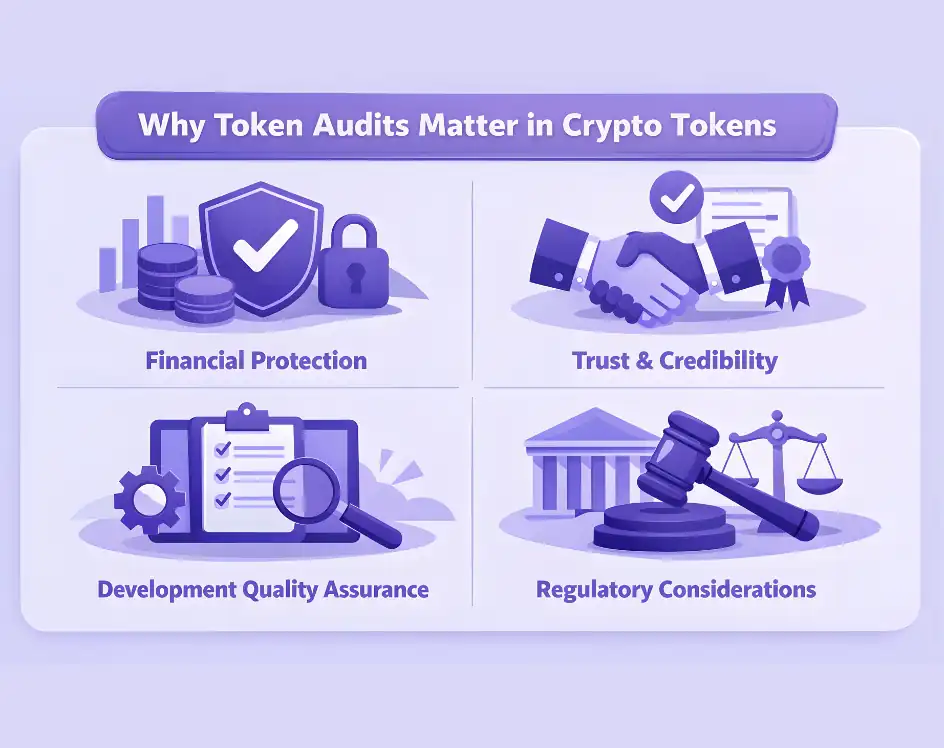
Why Token Audits Matter in Crypto Tokens
Token audits play a critical role in the success, security, and credibility of crypto tokens. Beyond technical code reviews, audits directly impact investor trust, financial safety, and long-term project sustainability within the rapidly evolving Web3 ecosystem.
Financial Protection
Crypto token vulnerabilities have caused significant financial damage across blockchain ecosystems. For instance, the BNB Chain has experienced hundreds of security incidents within a single year, with losses surpassing $100 million. Even a single exploit can drain liquidity pools, alter token supply, or permanently lock user funds. This is why working with a reliable token development company and conducting thorough token audits is essential, as they help uncover critical smart contract vulnerabilities before deployment while ensuring the safety of project assets and protecting token holders from potential attacks.
Trust and Credibility
The crypto space is often associated with scams, rug pulls, and poorly built tokens. A professionally audited crypto token immediately stands out as more trustworthy. Publicly available audit reports from reputable firms demonstrate that the project team is serious about security and transparency. This assurance builds investor confidence and encourages broader adoption of the token.
Development Quality Assurance
Even experienced blockchain developers can overlook edge cases or make assumptions that introduce vulnerabilities. Independent token audits provide an objective review of the smart contract code, identifying logic errors, security gaps, and inefficient implementations. This external validation improves overall code quality and ensures the token behaves exactly as intended under all conditions.
Regulatory Considerations
As global crypto regulations continue to evolve, security due diligence is becoming increasingly important. Token audit reports serve as documented proof that a project has taken responsible steps to protect users and investors. This can be valuable when engaging with exchanges, partners, or regulators and helps position the token for long-term legitimacy.
Common Smart Contract Vulnerabilities
Understanding common attack vectors helps appreciate what token audits examine and protect against. The following table outlines major vulnerability categories that comprehensive blockchain security audits address.
| Vulnerability Type | Description | Potential Impact | Prevention Method |
|---|---|---|---|
| Reentrancy | Malicious contracts repeatedly call back into vulnerable contracts before state updates complete | Complete fund drainage | Checks-effects-interactions pattern, reentrancy guards |
| Integer Overflow/Underflow | Arithmetic operations exceed variable limits causing unexpected values | Token minting, balance manipulation | SafeMath libraries, Solidity 0.8+ built-in checks |
| Access Control Flaws | Insufficient permission checks allow unauthorized function execution | Unauthorized minting, ownership takeover | Proper role-based access, modifier implementation |
| Front-Running | Attackers observe pending transactions and execute before them | Price manipulation, sandwich attacks | Commit-reveal schemes, slippage protection |
| Logic Errors | Code does not implement intended functionality correctly | Varies widely based on error | Thorough testing, formal verification |
| Denial of Service | Attackers block contract functionality for legitimate users | Platform unusability, locked funds | Gas limits, pull-over-push patterns |
| Oracle Manipulation | External data sources provide manipulated information | Price manipulation, unfair liquidations | Decentralized oracles, TWAP pricing |
The Token Audit Process
A comprehensive smart contract audit follows a structured methodology combining multiple analysis techniques. Understanding these steps helps projects prepare for audits and interpret results effectively.
Step 1: Documentation Gathering
The audit begins with collecting all relevant project materials. The development team initiates a code freeze to ensure auditors examine the final version. Documentation provided typically includes the complete codebase, project whitepaper, technical specifications, architectural diagrams, and any previous audit reports. This comprehensive overview helps auditors understand intended functionality and scope.
Clear documentation accelerates the audit process and improves accuracy. Auditors can more effectively identify deviations between intended behavior and actual implementation when they understand project goals thoroughly.
Step 2: Automated Testing
Automated smart contract testing employs specialized tools to scan code for known vulnerability patterns. These tools execute various test scenarios, perform static analysis, and check for common security issues efficiently. Automated testing excels at identifying straightforward vulnerabilities and provides consistent coverage across the entire codebase.
Common automated testing approaches include static analysis for code pattern detection, dynamic analysis for runtime behavior examination, and fuzzing to test unexpected inputs. While powerful, automated tools cannot replace human judgment for complex logic issues or novel attack vectors.
Step 3: Manual Code Review
Manual smart contract code review involves security experts examining every line of code for vulnerabilities that automated tools might miss. Experienced auditors identify logic errors, architectural weaknesses, and subtle security issues requiring human insight. They evaluate whether the implementation matches documentation and assess overall code quality.
Manual review also examines gas optimization opportunities, code maintainability, and adherence to best practices. Multiple independent auditors often review the same code, with their findings compared to ensure comprehensive coverage. This collaborative approach catches issues that any single reviewer might overlook.
Step 4: Error Classification
Identified issues are categorized by severity to prioritize remediation efforts and communicate risk levels clearly. Standard classification systems help development teams understand which issues require immediate attention versus those that can be addressed during normal development cycles.
| Severity Level | Description | Required Action | Examples |
|---|---|---|---|
| Critical | Direct financial loss or complete system compromise possible | Must fix before deployment | Reentrancy vulnerabilities, access control bypass |
| High | Significant impact on security or functionality | Should fix before deployment | Incorrect calculations, missing validations |
| Medium | Moderate impact under specific conditions | Recommended to fix | Suboptimal access patterns, edge case issue |
| Low | Minor issues with limited security impact | Consider fixing | Code style issues, minor optimizations |
| Informational | Best practice recommendations and suggestions | Optional improvements | Documentation gaps, code clarity suggestions |
Step 5: Initial Audit Report
After completing analysis, auditors compile findings into a detailed initial report. This document outlines all discovered vulnerabilities, provides severity classifications, explains potential exploitation scenarios, and offers remediation guidance. The report serves as a roadmap for the development team to address identified issues.
Good audit reports include specific code references, clear explanations accessible to both technical and non-technical stakeholders, and actionable recommendations. This clarity ensures development teams can efficiently implement fixes without ambiguity about what changes are needed.
Step 6: Remediation and Verification
The development team addresses identified issues based on audit recommendations. Once fixes are implemented, auditors verify that remediations correctly resolve the original vulnerabilities without introducing new issues. This verification step is crucial since well-intentioned fixes sometimes create different problems.
Step 7: Final Audit Report Publication
The final audit report documents all findings and their resolution status. This report typically becomes public, demonstrating the project’s security commitment to potential users and investors. Transparency about both discovered issues and their remediation builds trust more effectively than claiming perfect security.[1]
Token Audit Checklist
A comprehensive token audit examines multiple dimensions beyond basic security. The following checklist outlines key areas that thorough audits address.
Smart Contract Security
Core security review examines vulnerability patterns including reentrancy, overflow conditions, access control implementation, and external call handling. Auditors verify that security best practices are followed consistently throughout the codebase and that no obvious attack vectors exist.
Tokenomics Implementation
Tokenomics audit verifies that supply mechanisms, distribution logic, and economic parameters match project documentation. This includes examining minting controls, burning functions, vesting schedules, and fee mechanisms. Discrepancies between documented tokenomics and actual implementation create both security and trust issues.
Standard Compliance
For tokens implementing established standards like ERC-20 or BEP-20, audits verify complete and correct standard implementation. Non-compliant tokens may face integration issues with wallets, exchanges, and DeFi protocols that expect standard behavior. Even minor deviations can cause unexpected problems.
Access Control and Permissions
Review of administrative functions examines who can execute privileged operations and what safeguards prevent abuse. This includes ownership transfer mechanisms, pause functionality, and any special permissions that could impact user funds or token behavior.
External Dependencies
Tokens interacting with external contracts, oracles, or protocols require examination of these dependencies. Auditors assess whether external integrations introduce vulnerabilities and whether appropriate safeguards exist for handling external failures or malicious responses.
Gas Optimization
While not strictly security-related, gas efficiency affects user experience and adoption. Auditors identify opportunities to reduce transaction costs without compromising security. Efficient contracts cost less for users to interact with, supporting broader adoption. Projects concerned with transaction costs may also explore solutions like gas tokens in DEX environments.
Choosing an Audit Provider
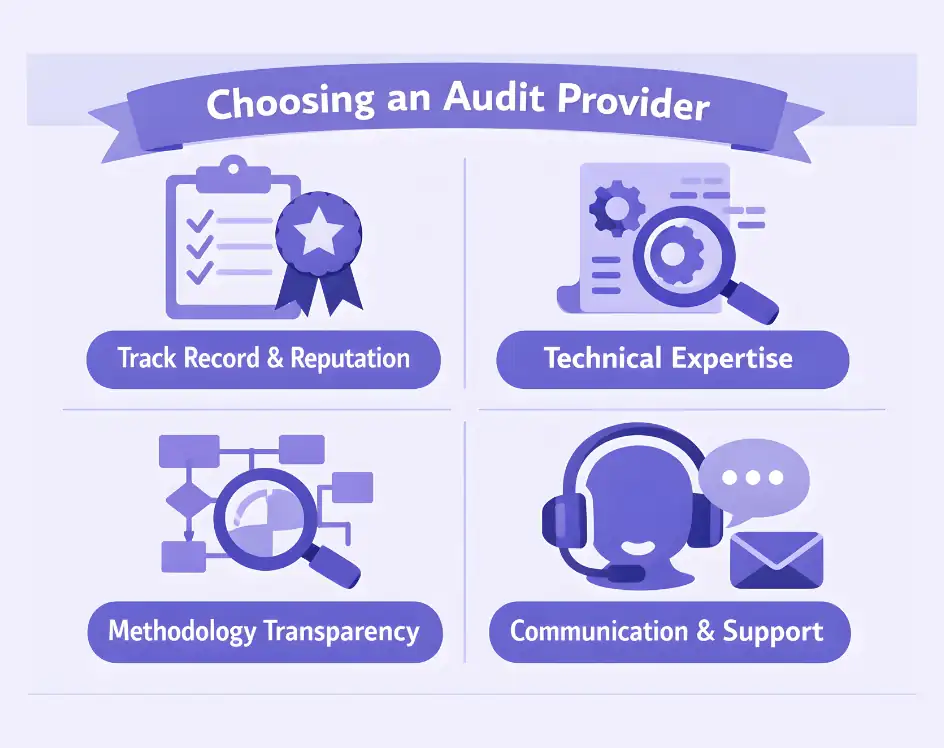
Selecting the right audit firm significantly impacts audit quality and credibility. Several factors merit consideration when evaluating potential auditors.
Track Record and Reputation
Established audit firms have documented histories of identifying vulnerabilities in major protocols. Review their published audits, note any high-profile security incidents involving their clients, and assess their standing in the security community. Reputation matters because audit reports carry weight based on auditor credibility.
Technical Expertise
Different blockchains and token types require specific expertise. Ensure potential auditors have experience with your particular technology stack. ERC20 token audit requirements differ from Solana program audits, and DeFi smart contract audit needs differ from simple utility tokens. Matching auditor expertise to project requirements improves audit effectiveness.
Methodology Transparency
Reputable auditors explain their methodology clearly. Understanding how they combine automated and manual testing, how many reviewers examine code, and what their quality assurance processes involve helps assess audit thoroughness. Vague methodology descriptions may indicate superficial review processes.
Communication and Support
Effective audits require collaboration between auditors and development teams. Auditors should be accessible for questions during review and responsive when clarifying findings. Good communication ensures issues are understood correctly and remediations address root causes rather than symptoms.[2]
Planning a Token Launch?
Professional development teams integrate security best practices from initial design through deployment, reducing audit findings and accelerating time to market.
Beyond the Initial Audit
Security is not a one-time achievement but an ongoing commitment. Several practices extend security assurance beyond initial audits.
Regular Re-audits
Code changes require renewed security examination. Any significant modifications to audited contracts should trigger follow-up audits to ensure changes do not introduce vulnerabilities. The frequency depends on development activity, but major upgrades always warrant fresh review.
Bug Bounty Programs
Bug bounties incentivize ongoing security research by offering rewards for vulnerability discovery. These programs tap into the broader security community, potentially identifying issues that formal audits miss. Well-structured bounty programs complement rather than replace professional audits.
Security Monitoring
Post-deployment monitoring detects unusual activity patterns that might indicate exploitation attempts. Alerting systems enable rapid response to potential attacks, limiting damage even when vulnerabilities exist. Monitoring provides a safety net while maintaining ongoing vigilance.
Incident Response Planning
Despite best efforts, security incidents may occur. Having predetermined response procedures enables rapid, coordinated action when needed. Plans should outline communication protocols, technical response steps, and decision-making authorities for various scenarios.
Preparing for a Token Audit
Projects can improve audit efficiency and outcomes through proper preparation.
Complete Documentation
Comprehensive technical documentation helps auditors understand intended behavior. This includes specifications for all functions, explanations of economic mechanisms, and descriptions of expected user interactions. Clear documentation reduces time spent clarifying intentions and improves issue identification accuracy.
Internal Testing
Running automated security tools internally before formal audit catches obvious issues cheaply. This pre-audit cleanup ensures professional auditors spend time on complex problems rather than basic errors. Working with experienced token development teams that follow security best practices reduces audit findings significantly.
Code Cleanup
Well-organized, clearly commented code is easier to audit effectively. Removing dead code, using consistent naming conventions, and adding explanatory comments helps auditors understand logic quickly. Clean code also reduces the chance of auditors misunderstanding intent and raising false concerns.
Realistic Timeline Allocation
Quality audits take time. Rushing auditors increases the chance of missed vulnerabilities. Budget adequate time for thorough review, issue remediation, and verification. Projects working with professional crypto development company teams typically have more predictable timelines since code quality reduces audit complexity.
Final Thoughts
Token audits have become essential for any serious blockchain project seeking to protect users and build lasting credibility. With billions lost annually to smart contract vulnerabilities, the investment in professional security review represents prudent risk management rather than optional expense.
Understanding the audit process helps projects prepare effectively and interpret results accurately. From initial documentation gathering through automated testing, manual review, and remediation verification, each step contributes to comprehensive security assurance. The combination of human expertise and automated tools provides coverage that neither approach achieves alone.
Beyond the technical benefits, published audits demonstrate commitment to user protection that differentiates legitimate projects in a space still plagued by scams and rug pulls. For teams engaged in crypto token development, integrating security considerations from initial design through final audit produces more secure code and smoother audit processes. As the Web3 ecosystem matures, token audits will remain foundational to building the trust necessary for mainstream adoption and sustainable growth.
Frequently Asked Questions
Q1.What is a token audit?
A token audit is a comprehensive examination of cryptocurrency token smart contract code to identify security vulnerabilities, verify functionality, and ensure compliance with blockchain standards before deployment.
Q2.Why is a token audit important?
Token audits protect user funds by identifying vulnerabilities before exploitation, build trust through demonstrated security commitment, and catch development errors that internal teams might miss.
Q3.How does a token audit work?
Audits combine automated testing tools with manual expert code review. Auditors examine code for vulnerabilities, verify functionality matches documentation, classify issues by severity, and provide remediation guidance.
Q4.How much does a token audit cost?
Costs vary based on code complexity, audit scope, and auditor reputation. Simple token audits may cost $5,000 to $15,000, while complex DeFi protocols can cost $50,000 or more for thorough examination.
Q5.How long does a token audit take?
Timeline depends on code complexity and auditor availability. Simple tokens may require one to two weeks, while complex projects need four to eight weeks or more for comprehensive review and remediation verification.
Q6.Can audited contracts still be hacked
Audits significantly reduce risk but cannot guarantee absolute security. New attack vectors emerge, and auditors may miss subtle issues. Audits are one component of comprehensive security strategy, not complete protection.
Q7.What should be included in an audit report?
Quality reports include executive summary, methodology description, detailed findings with severity classifications, code references, exploitation scenarios, remediation recommendations, and resolution status for each issue.
Q8.When should I get a token audit?
Audit after code is feature-complete but before mainnet deployment. Allow time for addressing findings and verification. Re-audit after any significant code changes to audited contracts.
Explore Services
Related Services
Reviewed by

Aman Vaths
Founder of Nadcab Labs
Aman Vaths is the Founder & CTO of Nadcab Labs, a global digital engineering company delivering enterprise-grade solutions across AI, Web3, Blockchain, Big Data, Cloud, Cybersecurity, and Modern Application Development. With deep technical leadership and product innovation experience, Aman has positioned Nadcab Labs as one of the most advanced engineering companies driving the next era of intelligent, secure, and scalable software systems. Under his leadership, Nadcab Labs has built 2,000+ global projects across sectors including fintech, banking, healthcare, real estate, logistics, gaming, manufacturing, and next-generation DePIN networks. Aman’s strength lies in architecting high-performance systems, end-to-end platform engineering, and designing enterprise solutions that operate at global scale.