Ai Overview
The cryptocurrency industry continues to face significant security challenges, with over $3. This vulnerability has plagued DeFi protocols since the infamous DAO hack in 2016, which resulted in $60 million in losses and ultimately led to the Ethereum hard fork. Despite increased awareness, reentrancy vulnerabilities continue causing significant losses, with over $300 million stolen through this attack vector since 2024.
The cryptocurrency industry continues to face significant security challenges, with over $3.4 billion lost to hacks and exploits in 2025 alone.[1] Understanding security risks in token development has become essential for anyone involved in blockchain projects, from developers to investors. Smart contract vulnerabilities, private key compromises, and sophisticated social engineering attacks threaten digital assets at every stage of their lifecycle. The immutable nature of blockchain technology means that once vulnerabilities are exploited, recovering stolen funds becomes extremely difficult or impossible. This comprehensive guide explores the critical risks associated with crypto tokens and provides practical strategies to mitigate these threats during the development process and beyond.
Key Takeaways
- Smart Contract Risks: Reentrancy attacks and logic errors caused over $325 million in losses in 2025.
- Private Key Vulnerabilities: Compromised keys accounted for 88% of stolen funds in Q1 2025.
- Human Factor: Social engineering and phishing attacks now rival technical exploits in damage caused.
- Audit Importance: Audited contracts experience 98% fewer exploits from logic vulnerabilities.
- Regulatory Compliance: Token classification affects legal obligations and investor protections.
- Cross-Chain Risks: Bridge vulnerabilities amplify potential damage across connected networks.
- Market Volatility: Crypto token price fluctuations create additional investment risk layers.
- Operational Security: Insider threats and supply chain attacks bypass even robust technical defenses.
What Are Crypto Token Risks?
Crypto token risks encompass the various threats and vulnerabilities that can result in financial loss, security breaches, or operational failures in blockchain-based digital assets. These risks span technical, regulatory, market, and operational domains, each presenting unique challenges for token creators and holders. The interconnected nature of blockchain ecosystems means that a vulnerability in one protocol can cascade across multiple platforms, amplifying potential damage exponentially.
The creation of secure tokens requires understanding how vulnerabilities emerge at different stages of a project lifecycle. From initial smart contract coding through deployment and ongoing operations, each phase introduces potential attack vectors that malicious actors continuously probe. Unlike traditional software where patches can be deployed quickly, blockchain’s immutable architecture means that flawed contracts may require complex migration procedures or remain vulnerable indefinitely.
For businesses looking to create crypto token projects, recognizing these risks early in the planning process enables proactive mitigation rather than reactive crisis management. Understanding the full spectrum of threats helps teams allocate resources appropriately and implement comprehensive security measures that address both technical vulnerabilities and human factors.
The crypto token development landscape has evolved significantly, with attackers becoming increasingly sophisticated in their methods. State-sponsored hacking groups, particularly from North Korea, stole over $2 billion in cryptocurrency in 2025 alone, demonstrating that token projects face threats from well-resourced adversaries with advanced capabilities. This reality demands that security considerations permeate every aspect of token creation and management.
Smart Contract Security Risks
Smart contracts form the foundation of most crypto tokens, and their immutable nature makes vulnerabilities particularly dangerous. Once deployed, buggy or malicious contracts cannot be changed without redeployment or complex proxy patterns, meaning flaws can persist indefinitely and remain exploitable. The average DeFi smart contract interacts with 4.6 other contracts, increasing the attack surface through external calls and creating complex dependency chains that are difficult to secure comprehensively.
Reentrancy Attacks
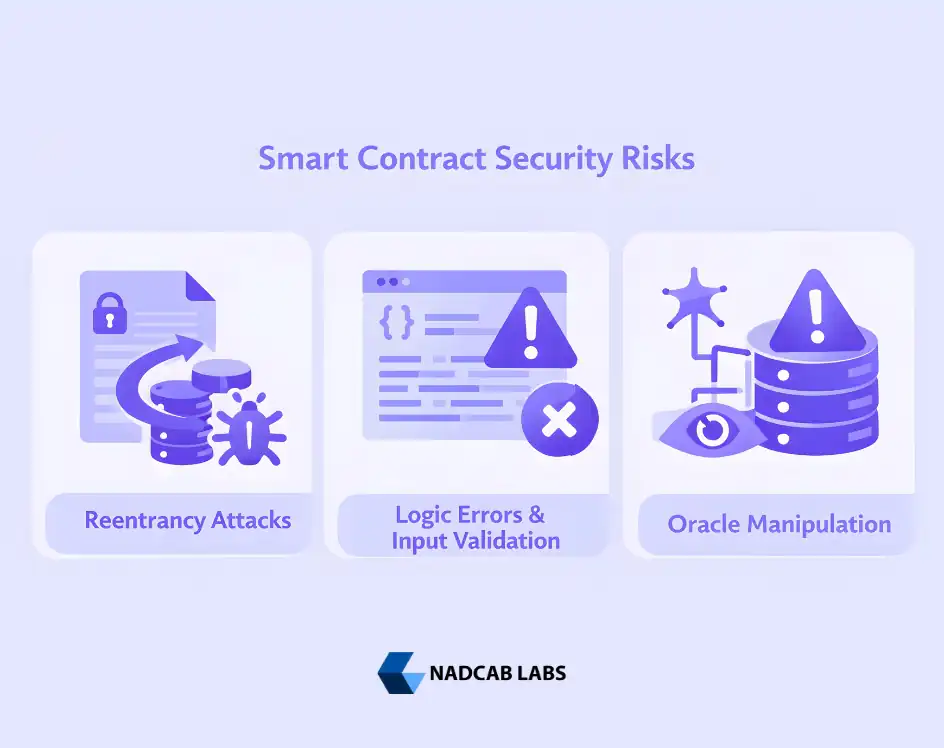
Reentrancy attacks involve recursive contract calls before state variables are updated, enabling attackers to drain funds through repeated withdrawals. This vulnerability has plagued DeFi protocols since the infamous DAO hack in 2016, which resulted in $60 million in losses and ultimately led to the Ethereum hard fork. Despite increased awareness, reentrancy vulnerabilities continue causing significant losses, with over $300 million stolen through this attack vector since 2024.
The token development process must incorporate proper state management patterns and reentrancy guards from the earliest design stages. Implementing checks-effects-interactions patterns, using OpenZeppelin’s ReentrancyGuard, and conducting thorough testing against known attack vectors help mitigate this persistent threat. However, novel variations of reentrancy attacks continue emerging, requiring ongoing vigilance and security research.
Logic Errors and Input Validation
Logic errors comprise the third most common vulnerability identified in security audits, causing $63 million in losses from improper token minting and lending operations. These flaws in contract reasoning allow attackers to manipulate expected behaviors, bypass permission checks, or inflate token supplies in ways that developers never anticipated.[2]
Faulty input verification accounts for 34.6% of direct contract exploitation cases, highlighting the critical need for thorough validation across all user-supplied data. Integer overflow and underflow bugs, while less common since Solidity 0.8.0 introduced automatic checks, still expose tokens built on older versions or those using unchecked blocks. The building of comprehensive input validation requires understanding edge cases and potential manipulation vectors that automated tools often miss.
Oracle Manipulation
Tokens relying on external data feeds face oracle manipulation risks that have caused some of the largest DeFi exploits in history. Attackers exploit price discrepancies between chains or manipulate oracle data to artificially inflate collateral values and drain protocol funds. Flash loan attacks frequently leverage oracle vulnerabilities to execute profitable exploits within single transactions, borrowing massive amounts to temporarily manipulate prices before repaying the loan.
Proper oracle design and price feed diversification help mitigate these risks. Time-weighted average prices (TWAPs), multiple oracle sources, and circuit breakers that pause operations during abnormal price movements provide layers of protection. However, sophisticated attackers continue finding novel ways to exploit price feed dependencies, making ongoing monitoring essential.
Crypto Token Regulatory Risks
Regulatory uncertainty represents one of the most significant challenges in token development. Tokens may unintentionally fall under securities laws depending on their functionality, distribution model, and marketing approach, exposing projects to legal penalties, forced shutdowns, or costly compliance remediation.
The regulatory environment surrounding blockchain and cryptocurrencies continues evolving globally, with different jurisdictions taking vastly different approaches. Changes in regulations can affect the legality of token offerings, tradability across jurisdictions, and tax obligations for both issuers and holders. The creation of compliant token structures requires ongoing legal guidance and awareness of jurisdictional differences that can shift rapidly based on political and economic factors.
Understanding coin and token solution frameworks helps navigate these complexities and structure tokens appropriately for their intended use cases. Whether a token qualifies as a utility token, security token, or payment token affects everything from registration requirements to investor eligibility restrictions.
Anti-money laundering (AML) and know-your-customer (KYC) requirements add compliance complexity that many projects underestimate. Failure to implement proper verification mechanisms can result in legal consequences, fines, or reputational damage that undermines project viability. Recent regulatory actions have demonstrated that enforcement agencies are increasingly willing to pursue token projects that fail to meet compliance obligations.
Crypto Token Market Risks
Market-related risks affect token value and tradability regardless of technical security measures, creating challenges that even the most secure projects must address.
Crypto Token Volatility
Digital assets are subject to extreme price volatility that exceeds most traditional asset classes. Token values can fluctuate dramatically within hours based on market sentiment, news events, regulatory announcements, or broader cryptocurrency market movements. This volatility creates significant investment risk and can impact project treasury management, making long-term planning difficult.
The interconnected nature of cryptocurrency markets means that events affecting major assets like Bitcoin or Ethereum can trigger cascading effects across the entire ecosystem. Projects must maintain diversified treasury strategies to weather market downturns.
Crypto Token Liquidity Risks
Tokens may face limited liquidity, making it difficult for holders to buy or sell at desired prices. Low trading volume or limited exchange listings can trap investors in positions they cannot exit without accepting substantial losses. The planning process should include liquidity provision strategies that ensure adequate market depth for anticipated trading activity.
Market manipulation poses additional risks, particularly for smaller-cap tokens with limited liquidity. Pump-and-dump schemes, wash trading, and coordinated manipulation campaigns can artificially inflate or deflate prices, harming legitimate investors while benefiting malicious actors.
| Risk Category | Common Vulnerabilities | Impact Level | Mitigation Strategies |
|---|---|---|---|
| Smart Contract | Reentrancy, logic errors, oracle manipulation, unchecked calls | Critical | Multiple audits, formal verification, bug bounties, continuous monitoring |
| Private Key | Key theft, compromised wallets, insider threats, phishing | Critical | Multi-sig wallets, cold storage, MPC technology, hardware security modules |
| Regulatory | Securities classification, AML/KYC requirements, cross-border issues | High | Legal counsel, compliance frameworks, transparent documentation |
| Market | Price volatility, liquidity constraints, manipulation schemes | High | Liquidity provision, market making, transparent tokenomics, diversified treasury |
| Operational | Social engineering, supply chain attacks, insider compromise | High | Security training, access controls, incident response plans, vendor vetting |
| Cross-Chain | Bridge vulnerabilities, validator compromise, token inflation | Critical | Decentralized validators, time locks, monitoring systems, insurance |
Crypto Token Security and Hacking Risks
Security threats extend beyond smart contract vulnerabilities to encompass the entire operational environment surrounding token projects. The gap between technical risk and identity risk has effectively closed, with 56 smart contract exploits and 50 account compromises recorded during 2025.
Private Key Compromises
Compromised private keys accounted for 88% of stolen funds in Q1 2025, demonstrating that technical smart contract security alone is insufficient to protect digital assets.[3] Attackers target key storage systems, exploit third-party wallet integrations, and trick legitimate signers into authorizing malicious transactions through sophisticated deception campaigns.
The crypto token development process must incorporate robust key management practices from the outset. Cold storage for significant holdings, multi-signature requirements for large transactions, and Multi-Party Computation (MPC) technology that splits private keys into shards provide layered protection. Hardware security modules and geographic distribution of signing authority add additional safeguards against both external attacks and insider threats.
Social Engineering Attacks
Human-targeted tactics increasingly rival technical exploits in effectiveness and financial impact. Attackers impersonate customer support, project founders, recruiters, or journalists to harvest credentials and gain privileged access to critical systems. AI-enabled deepfakes and synthetic media have made these attacks dramatically more sophisticated, with voice clones and video forgeries rendering traditional verification methods obsolete.
Phishing campaigns have evolved beyond simple malicious links into multi-stage operations that build trust over time before executing attacks. The building of effective defenses requires combining technical controls with comprehensive awareness training that keeps pace with evolving attack methods.
Conducting a thorough token audit addresses technical vulnerabilities, but comprehensive security also requires organizational awareness training, robust access controls, and incident response procedures that can contain breaches before catastrophic losses occur.
Cross-Chain and Bridge Risks
Cross-chain bridges represent high-risk infrastructure, accounting for nearly 40% of Web3 exploits in last year. These protocols enable asset transfers between different blockchain networks but rely on complex validator networks and often use single points of failure like hot wallets or admin keys that attackers specifically target.
When bridge validators are exploited or when large-value transactions encounter insufficient security verification, attackers can artificially inflate token supplies across networks. The Cetus exploit in May 2025 demonstrated how spoofed tokens could manipulate pricing across an entire ecosystem, ultimately affecting around $223 million in liquidity. Such incidents highlight how bridge vulnerabilities create systemic risks that extend far beyond individual protocols.
The creation of secure bridge integrations requires understanding these unique vulnerabilities and implementing appropriate safeguards including decentralized validator sets, time-locked withdrawals, and real-time monitoring systems. Working with experienced crypto token solution providers helps ensure cross-chain security receives adequate attention during project planning.
Utility Token Risks
Utility tokens present specific risk factors related to their functionality and ecosystem dependency that differ from other token types.
Platform Dependency
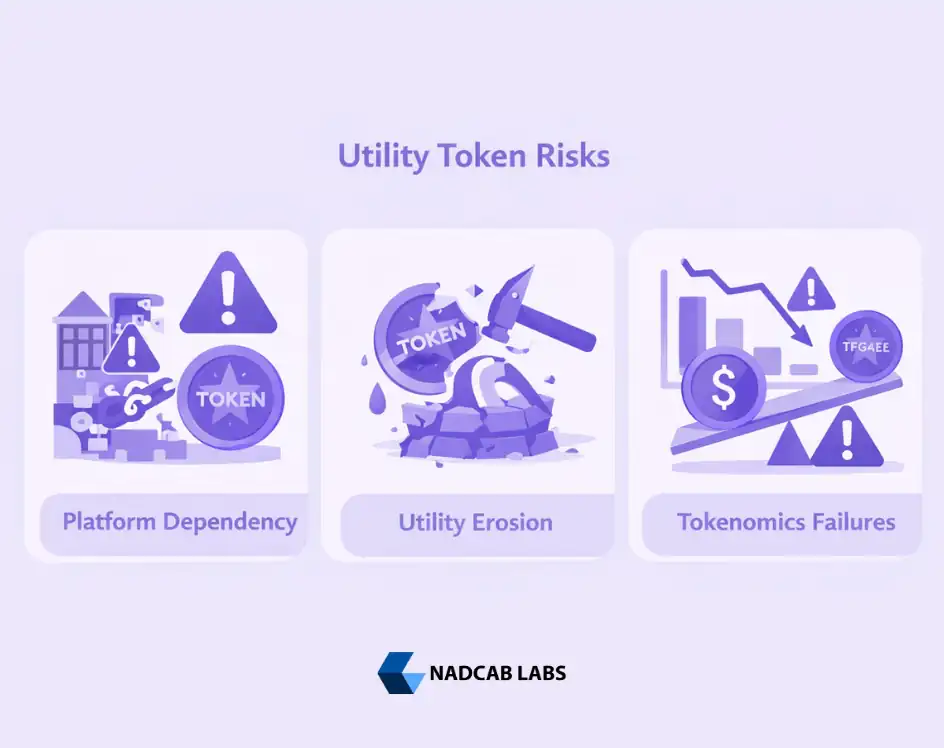
The value and utility of tokens may be closely tied to the success of the issuing platform or project. If the underlying project fails to gain adoption, faces operational challenges, or loses competitive position, token value can decline regardless of technical soundness. This dependency creates concentration risk that investors must carefully evaluate before committing capital.
Utility Erosion
Token utility may diminish over time due to technology changes, shifting market preferences, or regulatory changes that restrict certain use cases. Projects must continuously demonstrate value and adapt to changing conditions to maintain holder confidence and prevent utility token depreciation. The token development strategy should include plans for utility evolution and expansion.
Tokenomics Failures
Poorly designed token economics can undermine project stability regardless of technical security. Inflationary supply models that dilute holder value, unclear utility propositions, or weak incentive structures can lead to price volatility and loss of community trust.
Need Secure Token Solutions?
Professional Token Development services help navigate security challenges and build robust, compliant crypto tokens with comprehensive protection measures that address both technical and operational risks.
Best Practices for Risk Mitigation
Implementing comprehensive security measures throughout the token development lifecycle significantly reduces vulnerability exposure and builds stakeholder confidence.
Security Audits and Testing
Multiple independent audits before deployment catch vulnerabilities that single reviews miss. Manual audits detect over 90% of business logic issues that automated tools overlook, while automated scanning provides broad coverage of known vulnerability patterns. Formal verification provides mathematical proofs of contract correctness for critical functions, offering the highest level of assurance for core token mechanics.[4]
Bug bounty programs incentivize community participation in security testing and provide ongoing vulnerability discovery after deployment. The building of effective bounty programs requires clear scope definitions, fair reward structures, and responsive communication with security researchers who report issues.
Operational Security
The crypto token development process should incorporate security considerations from initial design through ongoing operations. Transaction simulation tools that show signers exactly what will happen before execution help prevent unauthorized transfers. Monitoring systems that detect anomalous activity enable rapid response before losses accumulate. Incident response plans ensure teams can act decisively when breaches occur.
Transparent tokenomics, clear documentation, and consistent community communication build trust and demonstrate commitment to holder protection. Projects that maintain open communication channels and respond constructively to security concerns establish reputations that attract serious investors and partners.
Regulatory Compliance
Engaging legal counsel early in the planning process helps structure tokens appropriately and avoid costly compliance failures. Documentation of token utility, transparent allocation disclosure, and clear terms of use provide foundations for regulatory defense if questions arise. Staying informed about evolving regulations enables proactive adaptation rather than reactive scrambling.
Final Thoughts
Security risks in token development span technical vulnerabilities, regulatory challenges, market dynamics, and operational threats that require comprehensive mitigation strategies. The $3.4 billion lost to crypto exploits in last year demonstrates that these risks remain significant despite industry maturation and increased security awareness. Smart contract flaws, private key compromises, and sophisticated social engineering continue threatening digital assets at every level of the ecosystem.
Successful risk mitigation requires a comprehensive approach combining technical security measures, regulatory compliance, operational best practices, and ongoing vigilance. Multiple audits, robust key management, legal guidance, transparent communication, and incident response planning form the foundation of secure token projects that can withstand evolving threats.
For organizations serious about launching secure tokens, partnering with an experienced Crypto Development Company provides access to specialized expertise in navigating these complex challenges. Professional token development teams understand the full spectrum of risks and implement proven strategies to protect both projects and their holders from the constantly evolving threat landscape that characterizes the blockchain industry.
Frequently Asked Questions
Q1.What are the biggest risks of investing in crypto tokens?
The primary risks include smart contract vulnerabilities, private key compromises, regulatory uncertainty, market volatility, and liquidity constraints. Each risk category requires different mitigation strategies for comprehensive protection, and investors should evaluate how projects address each area before committing funds.
Q2.How do smart contract vulnerabilities cause token losses?
Flaws in contract code allow attackers to drain funds, manipulate token supplies, or bypass permission checks. Reentrancy attacks, logic errors, oracle manipulation, and unchecked external calls are common exploitation methods that have caused billions in losses across the cryptocurrency ecosystem.
Q3.What is the role of audits in token security?
Security audits identify vulnerabilities before deployment, with audited contracts experiencing 98% fewer exploits from logic vulnerabilities. Multiple independent audits from reputable firms provide the most comprehensive coverage, combining automated scanning with manual expert review.
Q4.How can token projects protect against private key theft?
Projects should implement multi-signature wallets requiring multiple approvals for transactions, cold storage for significant holdings, and Multi-Party Computation technology that eliminates single points of failure. Regular security training helps prevent social engineering attacks targeting key holders.
Q5.What regulatory risks affect crypto tokens?
Tokens may be classified as securities requiring registration, face AML/KYC compliance requirements, or encounter varying legal frameworks across jurisdictions. Legal counsel specializing in digital assets helps navigate these complexities and structure tokens appropriately.
Q6.How do cross-chain bridges increase token risks?
Bridges connect multiple blockchain networks, meaning vulnerabilities can cascade across ecosystems. Validator compromises, insufficient security verification, and smart contract flaws in bridge contracts allow attackers to inflate token supplies or drain funds across connected chains simultaneously.
Q7.What makes utility tokens particularly risky?
Utility tokens depend on platform adoption and ongoing utility relevance. If the underlying project fails to gain traction, loses competitive position, or faces regulatory restrictions on its use case, token value can decline regardless of technical security measures.
Explore Services
Related Services
Reviewed by

Aman Vaths
Founder of Nadcab Labs
Aman Vaths is the Founder & CTO of Nadcab Labs, a global digital engineering company delivering enterprise-grade solutions across AI, Web3, Blockchain, Big Data, Cloud, Cybersecurity, and Modern Application Development. With deep technical leadership and product innovation experience, Aman has positioned Nadcab Labs as one of the most advanced engineering companies driving the next era of intelligent, secure, and scalable software systems. Under his leadership, Nadcab Labs has built 2,000+ global projects across sectors including fintech, banking, healthcare, real estate, logistics, gaming, manufacturing, and next-generation DePIN networks. Aman’s strength lies in architecting high-performance systems, end-to-end platform engineering, and designing enterprise solutions that operate at global scale.