Ai Overview
It is a business model that millions of people around the world participate in, either as distributors, recruiters, or customers. The structure itself is legal in most countries as long as the primary revenue comes from actual product sales rather than recruitment fees alone. In an MLM setting, a smart contract might say: “When Distributor A makes a sale of $100, send 10% to their direct upline, 5% to the next level up, and 2% to the level above that.
Key Takeaways
- A blockchain-based MLM network uses distributed ledger technology to manage multi-level marketing operations with transparency and automation.
- Smart contracts remove the need for manual commission calculations by automatically executing payout rules coded into the blockchain.
- Decentralization reduces the risk of fraud, data manipulation, and single points of failure in MLM platforms.
- Crypto payments allow for borderless, near-instant transactions that cut out banking delays and conversion fees.
- Every transaction on a blockchain MLM is permanently recorded, making the system fully auditable and trustworthy for distributors and regulators.
- While challenges like user education and gas fees exist, the advantages of blockchain MLM are driving adoption across industries worldwide.
Introduction to Blockchain-Based MLM Networks
Multi-level marketing has been around for decades. It is a business model that millions of people around the world participate in, either as distributors, recruiters, or customers. But for all its popularity, MLM has always had a trust problem. People worry about hidden fees, unclear commission structures, delayed payments, and companies that disappear overnight.
Blockchain technology is changing that narrative. By moving the core functions of an MLM network onto a decentralized ledger, businesses can build platforms where every transaction, every commission, and every referral is recorded permanently and openly. There is no single authority controlling the data. There is no way to quietly change the rules after people have joined.
This guide walks you through everything you need to know about blockchain-based MLM networks. We will cover how they work, what makes them different from traditional MLM systems, and why they matter for businesses, marketers, and the broader economy. Whether you are an entrepreneur exploring new business models, a developer building MLM software, or a distributor looking for a fair platform, this article will give you a clear and practical understanding of the topic.
If you are new to the concept of multi-level marketing and want a foundational overview before diving deeper, our comprehensive guide on MLM meaning, types, benefits, and global regulation is a great starting point.
What Is a Traditional MLM Network? (Quick Overview)
A traditional MLM network is a business structure where participants earn money by selling products and recruiting new members into the network. Each person in the hierarchy earns a percentage of the sales made by their recruits, often referred to as their “downline.” This creates multiple levels of commission distribution, which is where the name multi-level marketing comes from.
Companies like Amway, Herbalife, and Avon have used this model for years. The structure itself is legal in most countries as long as the primary revenue comes from actual product sales rather than recruitment fees alone. According to Wikipedia’s entry on multi-level marketing, the distinction between a legitimate MLM and a pyramid scheme depends largely on whether real products are being sold to end consumers.
Traditional MLM platforms typically run on centralized software. A company hosts its own servers, manages its own database, and handles commission calculations internally. Distributors trust the company to calculate their earnings correctly and pay them on time. This centralized approach works, but it comes with obvious risks. If the company’s database is compromised, manipulated, or poorly managed, distributors have little recourse.
What Is a Blockchain-Based MLM Network?
A blockchain-based MLM network takes the multi-level marketing model and runs it on top of blockchain technology. Instead of relying on a single company’s server to track sales, referrals, and commissions, all of that data is stored on a distributed ledger that no single entity controls.
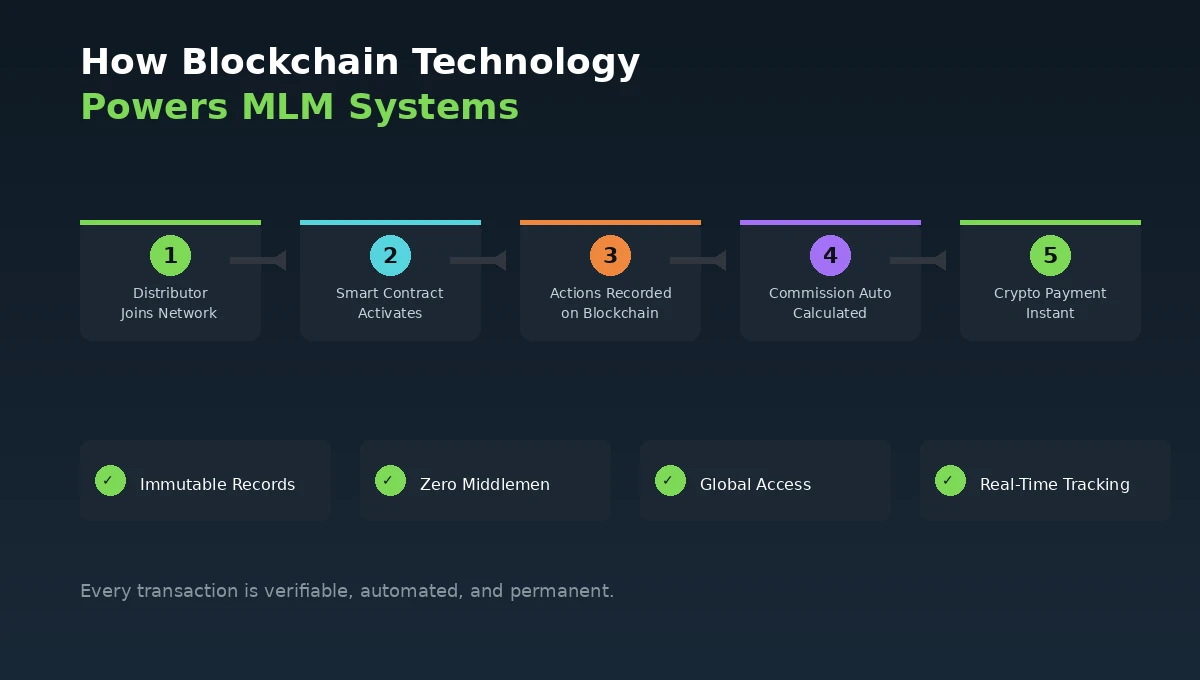
In practical terms, this means that when a distributor makes a sale or recruits a new member, that action is recorded on the blockchain. The commission for that action is calculated and distributed automatically through a smart contract. No human being needs to approve the payment. No accountant needs to reconcile spreadsheets. The code handles it.
The result is a system that is transparent by design. Anyone can verify the rules of the compensation plan by reading the smart contract. Anyone can check whether a payment was made by looking at the blockchain. This openness is what separates blockchain MLM from traditional MLM at a fundamental level.
For a deeper look at how decentralized architectures reshape network marketing, read our detailed article on what decentralized MLM really means.
How Blockchain Technology Powers MLM Systems
Blockchain technology powers MLM systems through three main mechanisms: distributed ledger storage, smart contract execution, and cryptographic security.
The distributed ledger keeps a permanent record of every transaction that happens within the MLM network. When a new member joins, their registration is recorded. When a sale is made, the transaction details are stored. When a commission is paid out, the payment record is added. All of this information is duplicated across multiple nodes on the network, making it nearly impossible to alter or delete.
Smart contracts are self-executing programs that live on the blockchain. In an MLM context, a smart contract contains the entire compensation plan. It knows how many levels of commission exist, what percentage each level earns, and what conditions must be met before a payout is triggered. When those conditions are met, the contract executes automatically. Our guide on smart contract-based MLM logic breaks down how this works in practice.
Cryptographic security ensures that every transaction is verified and authenticated. Each participant in the network has a unique wallet address. Transactions are signed with private keys, which means only the rightful owner can initiate actions from their account. This eliminates identity fraud and unauthorized access.
Core Components of a Blockchain MLM Network
A well-built blockchain MLM platform has several interconnected components working together. Each one serves a specific purpose, and together they create a system that is secure, automated, and transparent.
| Component | Function | Why It Matters |
|---|---|---|
| Distributed Ledger | Stores all transactions across a decentralized network | No single point of failure or manipulation |
| Smart Contracts | Automates commission calculation and payouts | Removes human error and delays |
| Crypto Wallets | Holds funds and enables secure payments | Instant, borderless transactions for distributors |
| Consensus Mechanism | Validates and agrees on new data entries | Ensures data integrity without a central authority |
| Token System | Provides the currency for transactions | Enables programmable money within the ecosystem |
| User Dashboard | Frontend interface for distributors | Makes blockchain complexity accessible to regular users |
Understanding how these components fit together at a system level is crucial for builders and business owners. Our technical breakdown of crypto MLM platform architecture covers the full stack in detail.
Key Differences: Traditional MLM vs Blockchain MLM
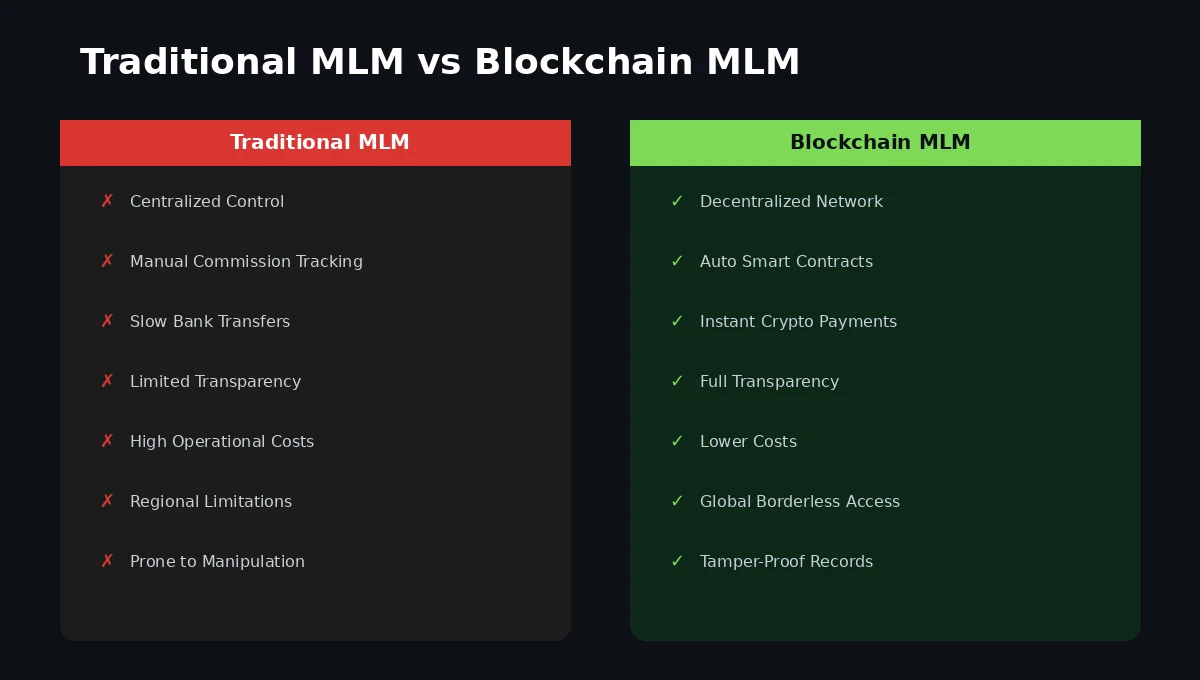
The differences between traditional and blockchain-based MLM go beyond just the technology stack. They touch every aspect of how the business operates, from how participants are paid to how disputes are resolved.
| Parameter | Traditional MLM | Blockchain MLM |
|---|---|---|
| Data Storage | Centralized company servers | Distributed across blockchain nodes |
| Commission Payouts | Manual or batch processed weekly/monthly | Automated and instant via smart contracts |
| Transparency | Limited; controlled by the company | Full; all transactions visible on-chain |
| Payment Method | Bank transfers, checks | Cryptocurrency |
| Geographic Reach | Limited by banking infrastructure | Truly global, no borders |
| Trust Model | Trust the company | Trust the code (trustless) |
| Operational Costs | High (staff, servers, payment processing) | Lower (automated, no middlemen) |
| Auditability | Requires internal or external audits | Built-in; blockchain is the audit trail |
Why Transparency Matters in MLM and How Blockchain Solves It
The biggest complaint people have about MLM companies is the lack of transparency. Distributors often do not know exactly how their commissions are calculated. They might see a number on their dashboard, but they cannot verify the math behind it. If a payment is late or lower than expected, they have no way to independently check what happened.
Blockchain solves this problem at its root. Because every transaction is recorded on a public or permissioned ledger, distributors can trace exactly how their earnings were calculated. They can see the sales that triggered their commissions, the exact percentage applied, and the timestamp of the payout. There is no black box. There is no “trust us” factor.
This level of transparency does more than just satisfy curiosity. It builds real confidence in the platform. When people can verify that the system works as promised, they are more likely to participate actively, recruit new members, and stay with the network long term.
Role of Smart Contracts in MLM Automation
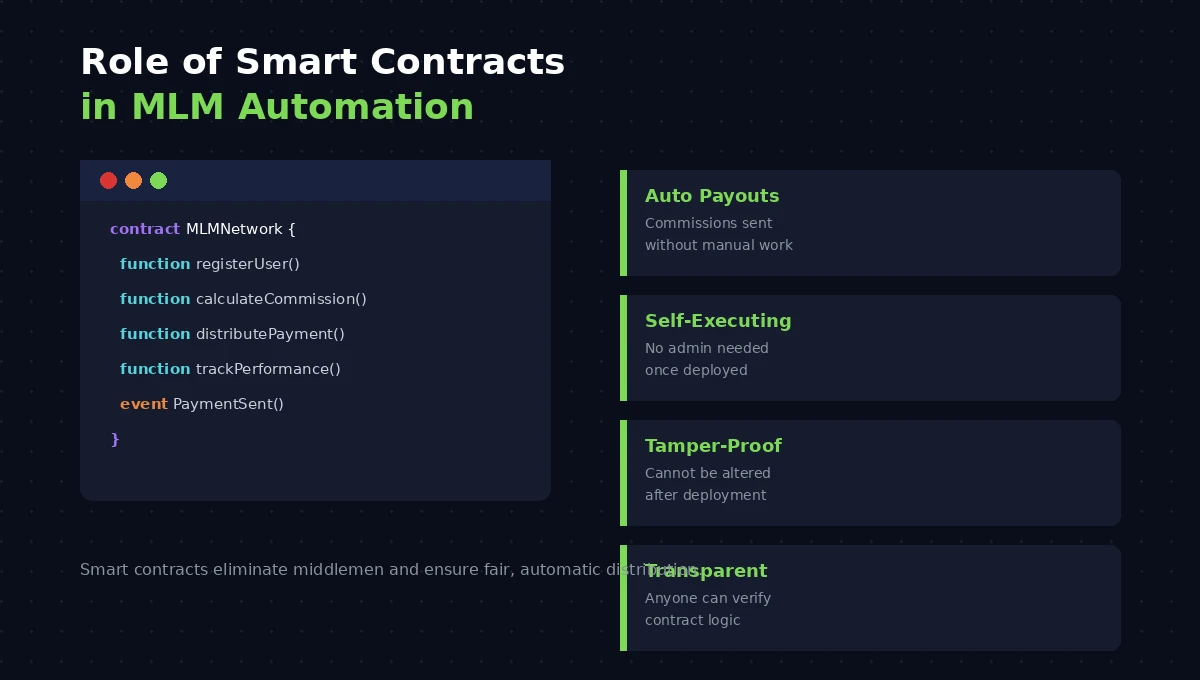
Smart contracts are the engine behind every blockchain-based MLM platform. They are pieces of code deployed on the blockchain that execute predetermined actions when specific conditions are met. Think of them as digital agreements that enforce themselves.
In an MLM setting, a smart contract might say: “When Distributor A makes a sale of $100, send 10% to their direct upline, 5% to the next level up, and 2% to the level above that.” Once this logic is written and deployed, it runs exactly as coded every single time. No exceptions, no favoritism, no delays.
The beauty of this approach is that it removes the human bottleneck from commission processing. Traditional MLM companies need accounting teams to process payouts. They need dispute resolution processes for when numbers do not match. Smart contracts make all of that unnecessary. The architecture behind these contracts is detailed in our guide on smart contract architecture for crypto MLM.
For builders optimizing their platforms, understanding transaction costs is essential. Our article on gas optimization in MLM smart contracts explains practical strategies to keep costs down without sacrificing functionality.
Security Benefits of Blockchain in MLM Platforms
Security is not optional in any financial system, and MLM platforms handle significant amounts of money. Traditional platforms face the usual risks of centralized systems: server hacks, data breaches, insider manipulation, and payment fraud.
Blockchain technology addresses these risks structurally. Data on a blockchain is encrypted and linked to the previous block through cryptographic hashes. To alter a single transaction, an attacker would need to rewrite every subsequent block on the chain and gain control of the majority of nodes in the network. This makes successful attacks practically impossible on well-established blockchains.
Additionally, because each user’s wallet is secured by private keys, there is no central database of passwords to steal. Each distributor controls their own funds directly. This self-custody model shifts the security responsibility to the individual, which, while requiring user education, eliminates the risk of a company-wide breach exposing everyone’s earnings. Speaking of private key management, understanding the benefits of seed phrases is critical for anyone participating in a blockchain MLM.
How Decentralization Reduces Fraud and Manipulation
Fraud in MLM is not always dramatic. Sometimes it is subtle. A company might quietly change the compensation plan. An administrator might adjust numbers in the database to favor certain distributors. Or worse, a company might collect recruitment fees and disappear entirely.
Decentralization makes all of these scenarios extremely difficult. When the compensation logic lives in a smart contract on a public blockchain, changing the rules requires either deploying a new contract (which everyone can see) or having the governance mechanisms built into the system (which requires community approval). You cannot silently edit a deployed smart contract the way you can edit a database entry.
For platforms that do need to evolve their contracts over time, our article on upgradeability and governance in MLM smart contracts covers how to handle updates responsibly and transparently.
The decentralized nature also means there is no single server to shut down. Even if one node goes offline, the network continues to operate. This resilience is valuable for global MLM networks that need to be available around the clock.
Ready to Build Your Blockchain MLM Platform?
Launch a transparent, automated, and scalable MLM network powered by blockchain and smart contracts. Get expert development support tailored to your business model.
Improving Trust Between Companies and Distributors
Trust is the currency of network marketing. If distributors do not trust the company, they will not recruit aggressively. If customers do not trust the distributors, they will not buy. Blockchain creates a foundation of trust that does not depend on personal relationships or brand reputation alone.
When a company deploys its MLM compensation plan as a smart contract, it is making a public commitment. The rules are visible. The execution is automatic. Distributors do not need to take the company’s word for it. They can read the contract, or have a developer review it on their behalf, and know exactly what they are signing up for.
This shift from trust-based to verification-based relationships is one of the most significant changes blockchain brings to the MLM industry. It levels the playing field between large companies and individual distributors, giving everyone access to the same information.
Real-Time Commission Tracking with Blockchain
In a traditional MLM setup, commission reports might be generated daily, weekly, or even monthly. Distributors often wait days or weeks to see their earnings reflected in their accounts. This delay creates uncertainty and frustration.
With blockchain, commission tracking happens in real time. The moment a qualifying sale occurs, the smart contract processes it. The distributor can see the transaction on the blockchain within seconds or minutes, depending on the network. There is no batch processing, no end-of-month reconciliation, and no wondering whether a sale was counted.
This real-time visibility changes how distributors operate. They can adjust their strategies immediately based on actual performance data. They can see which downline members are active and which are not. They can plan their finances with confidence because they always know exactly where they stand. Explore the growing market around these capabilities in our analysis of cryptocurrency MLM software market size, trends, and forecast.
Faster and Borderless Payments Using Crypto
One of the most practical advantages of blockchain MLM is the payment system. Traditional MLM companies that operate internationally face a maze of banking regulations, currency conversions, and transfer fees. Paying a distributor in Nigeria from a company based in the United States can take days and cost significant fees through the traditional banking system.
Cryptocurrency payments bypass all of that. A smart contract can send a commission to any wallet address in the world within minutes. The cost of the transaction depends on the blockchain being used, but it is typically a fraction of what a bank wire would cost. There are no business hours to worry about. There are no holidays. The blockchain operates continuously.
This borderless payment capability is especially important for MLM networks that operate in developing countries, where banking infrastructure is limited but mobile phone adoption is high. Distributors who might have been excluded from traditional MLM because they lacked a bank account can now participate fully with just a smartphone and a crypto wallet. To understand what lies ahead for this payment landscape, check out our article on the future of crypto and what comes next.
Scalability and Performance Advantages of Blockchain MLM
Scalability is a legitimate concern for any MLM platform. As the network grows, the number of transactions increases exponentially. A network with 100,000 distributors generates far more data than one with 1,000.
Modern blockchain solutions are built to handle this scale. Layer 2 solutions, sidechains, and newer blockchain protocols like Solana and Polygon offer high transaction throughput at low costs. These technologies allow blockchain MLM platforms to process thousands of transactions per second without bottlenecks.
The key advantage is that scaling a blockchain MLM does not require the company to invest in bigger servers or more staff. The network itself handles the increased load. This makes growth more predictable and cost-effective compared to traditional centralized platforms that need constant infrastructure upgrades.
Cost Efficiency Compared to Traditional MLM Software
Running a traditional MLM platform is expensive. You need servers, databases, security infrastructure, payment processing integrations, compliance teams, and customer support staff to handle payout disputes. All of these costs add up quickly.
A blockchain-based MLM platform reduces many of these expenses. Smart contracts handle commission calculations and payouts, eliminating the need for large accounting teams. The blockchain itself provides security and data integrity, reducing the need for expensive server infrastructure. Crypto payments cut out payment processors and their fees.
| Cost Category | Traditional MLM | Blockchain MLM |
|---|---|---|
| Commission Processing | Dedicated accounting staff | Automated via smart contracts |
| Payment Fees | 2-5% per transaction (banks, processors) | Gas fees only (often under $1) |
| Infrastructure | Managed servers, databases, backups | Blockchain nodes (shared infrastructure) |
| Security | Firewalls, penetration testing, SSL | Built into the protocol |
| Dispute Resolution | Customer support teams | Verifiable on-chain records reduce disputes |
If you are evaluating whether to build or migrate to a blockchain MLM platform, our cryptocurrency MLM software solutions page outlines the options available for businesses of all sizes.
Compliance, Auditability, and Regulatory Advantages
Regulatory scrutiny of MLM companies is increasing worldwide. Governments want to ensure that these businesses are not operating as disguised pyramid schemes. Traditional MLM companies face expensive audit processes to prove compliance. They must maintain detailed records and make them available to regulators on demand.
Blockchain simplifies this process considerably. Because the entire transaction history is stored on an immutable ledger, auditing a blockchain MLM is straightforward. Regulators can access the data directly without needing to rely on the company’s internal records. This transparency actually works in the company’s favor, as it demonstrates compliance proactively rather than reactively.
Smart contracts also help with regulatory compliance by encoding rules directly into the system. If a jurisdiction limits the number of MLM levels to five, the smart contract can be programmed to enforce that limit automatically. If a certain percentage of revenue must come from product sales (not recruitment), the contract can track and enforce that ratio.
Lifecycle of a Blockchain MLM Transaction
To understand how everything fits together, let us walk through the lifecycle of a single transaction in a blockchain MLM network.
Step 1: Distributor Makes a Sale
A distributor sells a product to a customer. The customer pays using cryptocurrency, which is sent to the platform’s smart contract.
Step 2: Smart Contract Receives Payment
The smart contract receives the funds and checks the conditions of the compensation plan. It identifies the distributor’s upline chain based on the referral tree stored on the blockchain.
Step 3: Commission Calculation
The contract calculates commissions for each level in the distributor’s upline. Level 1 might get 10%, Level 2 gets 5%, Level 3 gets 3%, and so on, as coded in the contract.
Step 4: Automatic Distribution
The smart contract sends the calculated amounts to each upline distributor’s wallet address. This happens in the same transaction or within the same block.
Step 5: On-Chain Record
Every aspect of this transaction is recorded permanently on the blockchain. The sale amount, the commission percentages, the wallet addresses involved, and the exact timestamps are all verifiable by anyone.
Step 6: Dashboard Update
The distributor’s frontend dashboard pulls data from the blockchain and displays updated earnings, downline activity, and network statistics in real time.
Use Cases of Blockchain-Based MLM Networks
Blockchain MLM is not limited to a single business model. Several use cases have emerged as the technology matures.
Direct Product Sales: The most straightforward application. Companies sell physical or digital products through a distributor network, with all commissions handled by smart contracts.
Subscription Services: Recurring revenue models work well with blockchain MLM. Smart contracts can automatically process monthly subscriptions and distribute recurring commissions to the upline.
DeFi and Investment Pools: Some blockchain MLM networks incorporate decentralized finance elements, where participants can stake tokens or contribute to liquidity pools and earn both DeFi yields and MLM commissions.
Crowdfunding Networks: Blockchain MLM structures can be applied to crowdfunding campaigns where participants earn rewards for bringing in new contributors. If you are interested in this intersection, our guide on how to hire crowdfunding developers to start your project is worth a read.
Education and Training Platforms: Online course providers use MLM referral structures to grow their user base, with blockchain ensuring that all referral credits are tracked accurately.
Industries Adopting Blockchain MLM Models
The adoption of blockchain MLM is spreading across industries that benefit from referral-driven growth and decentralized operations.
Health and wellness companies were among the first to explore blockchain MLM, given that the MLM model is already deeply established in this sector. E-commerce businesses use blockchain MLM to create decentralized affiliate networks that reward participants fairly. The real estate industry has experimented with tokenized property investments distributed through MLM structures. Gaming and NFT platforms use multi-level referral systems to drive user acquisition. Even financial services companies are exploring blockchain MLM for insurance and investment product distribution.
The common thread is that any industry where word-of-mouth marketing and referral networks add value can benefit from blockchain MLM. Organizations exploring cloud-based deployment for these platforms may also benefit from our cloud consulting services to ensure their infrastructure is set up correctly.
Challenges and Limitations of Blockchain MLM
No technology is perfect, and blockchain MLM has its own set of challenges that businesses need to address.
User Education: Most MLM participants are not tech-savvy. Expecting them to manage crypto wallets, understand gas fees, and navigate blockchain explorers is a significant barrier. Platforms need to invest heavily in user-friendly interfaces that hide the complexity.
Gas Fees and Transaction Costs: On networks like Ethereum, gas fees can spike during periods of high activity. While Layer 2 solutions and alternative chains mitigate this, it remains a factor in platform design and user experience.
Regulatory Uncertainty: The legal status of cryptocurrency and blockchain-based businesses varies significantly from country to country. What is perfectly legal in one jurisdiction might be restricted or banned in another. Companies must navigate this patchwork of regulations carefully.
Smart Contract Bugs: Once a smart contract is deployed, it is difficult to change. If there is a bug in the commission logic, fixing it requires deploying a new contract and migrating users. Thorough testing and auditing before deployment is essential.
Crypto Volatility: Commissions paid in cryptocurrency can fluctuate in value. A distributor might earn $100 worth of tokens today that are worth $80 tomorrow. Some platforms address this by using stablecoins pegged to fiat currencies.
Future Trends in Blockchain-Powered MLM Systems
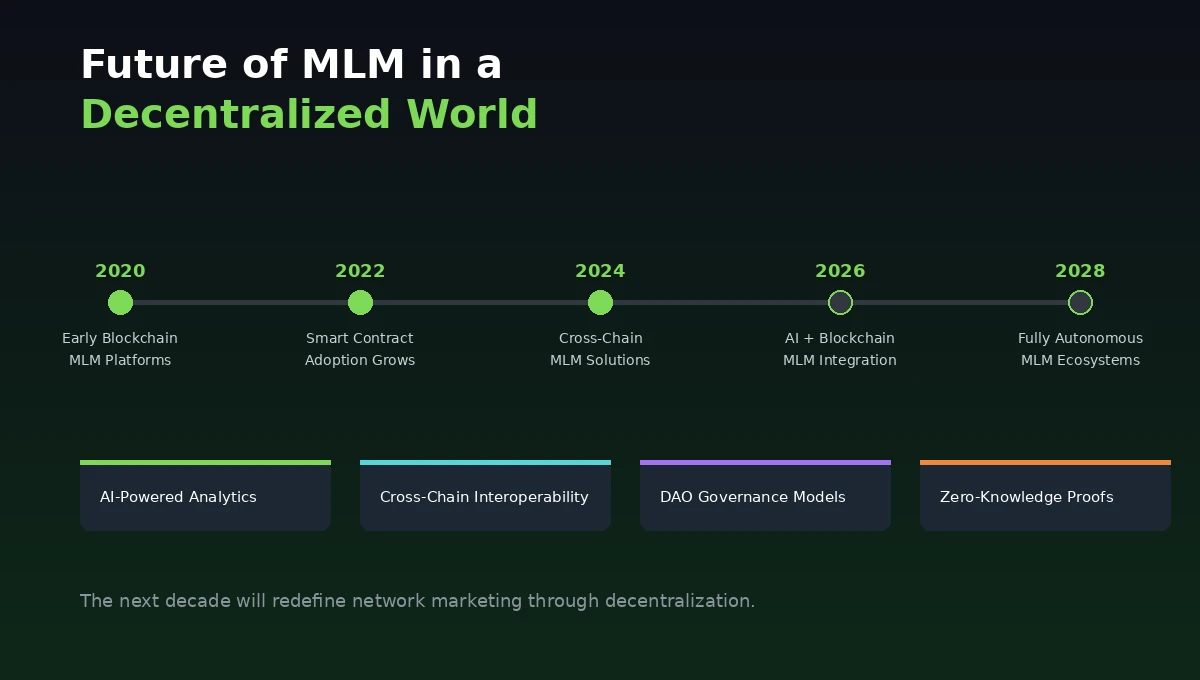
The blockchain MLM space is evolving quickly. Several trends are shaping where the industry is headed.
AI Integration: Artificial intelligence combined with blockchain MLM can provide predictive analytics for distributors, helping them identify the most effective recruitment strategies and optimize their downline performance.
Cross-Chain Interoperability: Future platforms will likely support multiple blockchains simultaneously, allowing distributors to receive payments on the chain of their choice. This flexibility will make adoption easier across different crypto communities.
DAO-Governed MLM Networks: Decentralized Autonomous Organizations (DAOs) could replace traditional MLM companies entirely. Instead of a company running the network, the participants themselves govern it through token-based voting.
Zero-Knowledge Proofs for Privacy: While transparency is a feature of blockchain, some participants want privacy. Zero-knowledge proofs allow transaction verification without revealing sensitive details, balancing transparency with personal privacy.
Mobile-First Platforms: As smartphone penetration continues to grow globally, blockchain MLM platforms are being designed with mobile users as the primary audience. Simplified wallet management and one-tap commission claims are becoming standard features.
Why Blockchain-Based MLM Matters for Businesses and Marketers
For businesses, blockchain MLM offers a way to build a distribution network that is cheaper to operate, more trustworthy for participants, and easier to scale globally. The automation provided by smart contracts reduces administrative overhead. The transparency reduces disputes and legal risk. The borderless payment system opens up markets that were previously difficult to reach.
For marketers and distributors, blockchain MLM means a fairer playing field. They can verify that they are being paid correctly. They receive their commissions faster. They do not have to worry about a company changing the rules without notice. And they can participate from anywhere in the world with just an internet connection.
The combination of these benefits makes blockchain MLM more than just a technological upgrade. It represents a structural improvement in how network marketing works. It addresses the fundamental trust issues that have plagued the MLM industry for decades and replaces them with a system built on mathematical proof and code.
Conclusion: The Future of MLM in a Decentralized World
Blockchain-based MLM networks are not just a trend. They are a practical response to the real problems that have limited the growth and reputation of multi-level marketing for years. By replacing centralized control with distributed ledgers, manual processing with smart contracts, and slow bank transfers with instant crypto payments, blockchain MLM creates a system that is fairer, faster, and more reliable.
The challenges are real. User education, regulatory compliance, and technical complexity are barriers that need to be addressed. But the trajectory is clear. As blockchain technology matures and becomes more accessible, the adoption of blockchain-based MLM will continue to grow.
For businesses considering this path, the time to explore is now. The infrastructure is ready. The tools are available. And the demand from distributors for transparent, automated, and fair compensation systems has never been higher. Our complete blockchain MLM networks guide serves as the central resource for anyone looking to go deeper into this space.
Frequently Asked Questions
Q1.What is a blockchain-based MLM network and how does it work?
A blockchain-based MLM network is a multi-level marketing system that runs on distributed ledger technology instead of centralized servers. It uses smart contracts to automate commission calculations and payouts. When a distributor makes a sale, the smart contract processes the transaction, calculates commissions for each level in the upline, and sends payments to the correct wallet addresses automatically. All records are stored permanently on the blockchain, making the entire system transparent and verifiable by anyone.
Q2.How are smart contracts used in blockchain MLM platforms?
Smart contracts in blockchain MLM platforms contain the complete compensation plan logic coded as self-executing programs. They define commission percentages for each level, conditions for bonus payouts, and rules for member registration. Once deployed on the blockchain, smart contracts execute automatically whenever conditions are met, removing the need for manual processing, accounting teams, or administrative approval. This automation ensures that every distributor receives accurate and timely payments.
Q3.Is blockchain MLM legal and compliant with regulations?
Blockchain MLM itself is legal in most jurisdictions, as long as the underlying business model focuses on real product sales rather than recruitment-only income. The blockchain component actually improves regulatory compliance because every transaction is recorded on an immutable ledger that auditors and regulators can access. However, cryptocurrency regulations vary by country, so businesses must research and follow the specific rules in each market where they operate. Consulting with legal professionals is always recommended.
Q4.What are the main advantages of blockchain MLM over traditional MLM?
The primary advantages include complete transparency of all transactions, automated commission payouts through smart contracts, instant borderless payments using cryptocurrency, reduced operational costs by eliminating middlemen and manual processes, and enhanced security through cryptographic protection. Unlike traditional MLM where you trust the company to pay correctly, blockchain MLM lets you verify every payment on the public ledger. These benefits combine to build greater trust between companies and their distributors.
Q5.What blockchain platforms are best suited for building MLM networks?
Ethereum is the most widely used blockchain for MLM smart contracts due to its mature ecosystem and developer tools. However, high gas fees during peak times have led many projects to choose alternatives like Binance Smart Chain, Polygon, and Solana, which offer faster transactions at lower costs. The best choice depends on your priorities around transaction speed, cost, security, and developer availability. Many modern platforms use Layer 2 solutions to get the security of Ethereum with the speed of newer networks.
Q6.Can existing MLM businesses migrate to blockchain-based platforms?
Yes, existing MLM businesses can migrate to blockchain-based platforms, though it requires careful planning. The migration typically involves converting the compensation plan logic into smart contracts, setting up crypto wallet integration for distributors, transferring existing member data and downline structures to the new system, and training users on how to use crypto wallets and understand on-chain transactions. Many businesses choose a phased approach, running both systems in parallel during the transition period to minimize disruption.
Explore Services
Related Services
Reviewed by

Aman Vaths
Founder of Nadcab Labs
Aman Vaths is the Founder & CTO of Nadcab Labs, a global digital engineering company delivering enterprise-grade solutions across AI, Web3, Blockchain, Big Data, Cloud, Cybersecurity, and Modern Application Development. With deep technical leadership and product innovation experience, Aman has positioned Nadcab Labs as one of the most advanced engineering companies driving the next era of intelligent, secure, and scalable software systems. Under his leadership, Nadcab Labs has built 2,000+ global projects across sectors including fintech, banking, healthcare, real estate, logistics, gaming, manufacturing, and next-generation DePIN networks. Aman’s strength lies in architecting high-performance systems, end-to-end platform engineering, and designing enterprise solutions that operate at global scale.