Ai Overview
It has created millionaires and also drawn heavy criticism for its opaque payout structures and reliance on centralized organizations to manage everything from commissions to member tracking. Each of these mechanisms should be carefully modeled to ensure the token economy remains balanced as the network grows from 100 users to 100,000 users. Budget 5,000 to 50,000 USD depending on complexity. Getting from 100 users to 10,000 and then to 100,000 requires deliberate technical and strategic planning.
Key Takeaways
- Blockchain MLM platforms use smart contracts to automate commissions, referral tracking, and rank progression without any middleman involvement.
- Choosing the right blockchain (Ethereum, BSC, Polygon, or Solana) depends on your budget, transaction speed needs, and target audience.
- Tokenomics design is the backbone of any crypto MLM. Poor token economics will collapse the network regardless of how good your platform looks.
- Smart contract audits and KYC/AML compliance are not optional. They protect both you and your users from fraud and regulatory action.
- Layer-2 solutions and gas fee optimization are critical for scaling a blockchain MLM network globally without bleeding money on transaction costs.
- Sustainable compensation plans, DAO governance, and continuous upgrades are what separate long-lasting platforms from short-lived schemes.
Introduction to Blockchain MLM Networks
Network marketing has been around for decades. It has created millionaires and also drawn heavy criticism for its opaque payout structures and reliance on centralized organizations to manage everything from commissions to member tracking. The problem was never the MLM model itself. The problem was always the lack of transparency and the amount of trust participants had to place in a single company to handle their money fairly.
That is where blockchain technology steps in. By putting MLM compensation logic on a decentralized ledger, you remove the single point of failure. Payouts happen automatically. Referral chains are recorded permanently. Nobody can tamper with the data once it is on-chain. This combination of network marketing and blockchain is not just a theoretical concept anymore. Real platforms are being built, launched, and scaled across the globe right now.
This guide walks you through the entire process. From understanding what a blockchain MLM actually is, to building smart contracts, designing token economics, launching your platform, and scaling it to thousands of users. Whether you are an entrepreneur looking to start a crypto MLM business or a developer planning the technical architecture, this article covers it all in practical detail.
What is Blockchain-Based MLM?
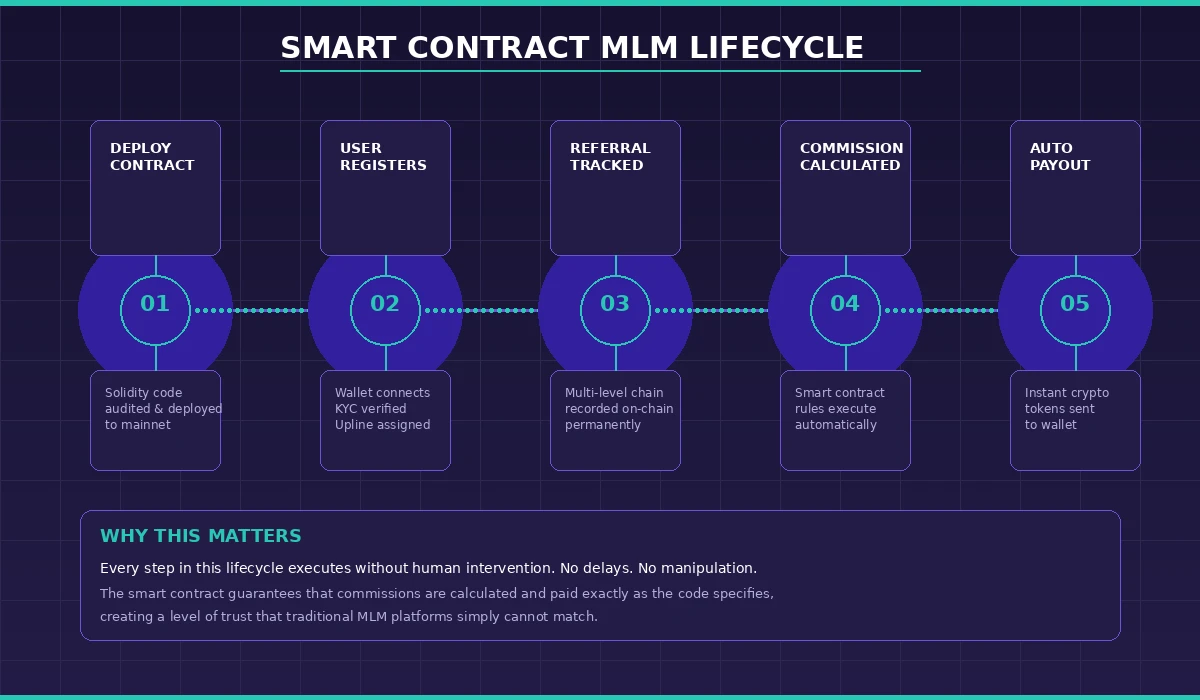
A blockchain-based MLM is a multi-level marketing network that runs on decentralized blockchain infrastructure instead of traditional centralized servers. The core business logic, including commission calculations, referral tracking, rank upgrades, and reward distributions, is encoded in smart contracts. These contracts execute automatically when predefined conditions are met. No human intervention is required for payouts, and no single entity can alter the rules after deployment.
Participants interact with the platform through their cryptocurrency wallets. They join by connecting a wallet, get assigned to a referral tree, and earn crypto tokens as they bring in new members or meet certain activity milestones. Everything is visible on the blockchain. Any member can verify their earnings, check the referral chain, and confirm that the compensation plan is executing exactly as promised.
Why Crypto-Powered MLM is Gaining Popularity
Several factors are driving this shift. First, trust. Traditional MLM companies have been plagued by accusations of unfair practices. When commissions are calculated on a blockchain and paid out through a smart contract, nobody can quietly change the rules. Second, global accessibility. Crypto wallets do not care about national borders. Someone in Nigeria and someone in Germany can participate in the same network with the same rules and the same payout mechanism. Third, cost efficiency. Smart contracts eliminate a massive chunk of the administrative overhead that traditional MLM companies carry. You do not need a large accounting team to process commissions when the code does it automatically.
If you are new to the broader concept of network marketing and want a solid foundation before diving into the blockchain side of things, it is worth reading about MLM meaning, types, benefits, and global regulation to get the full picture.
Traditional MLM vs Blockchain MLM
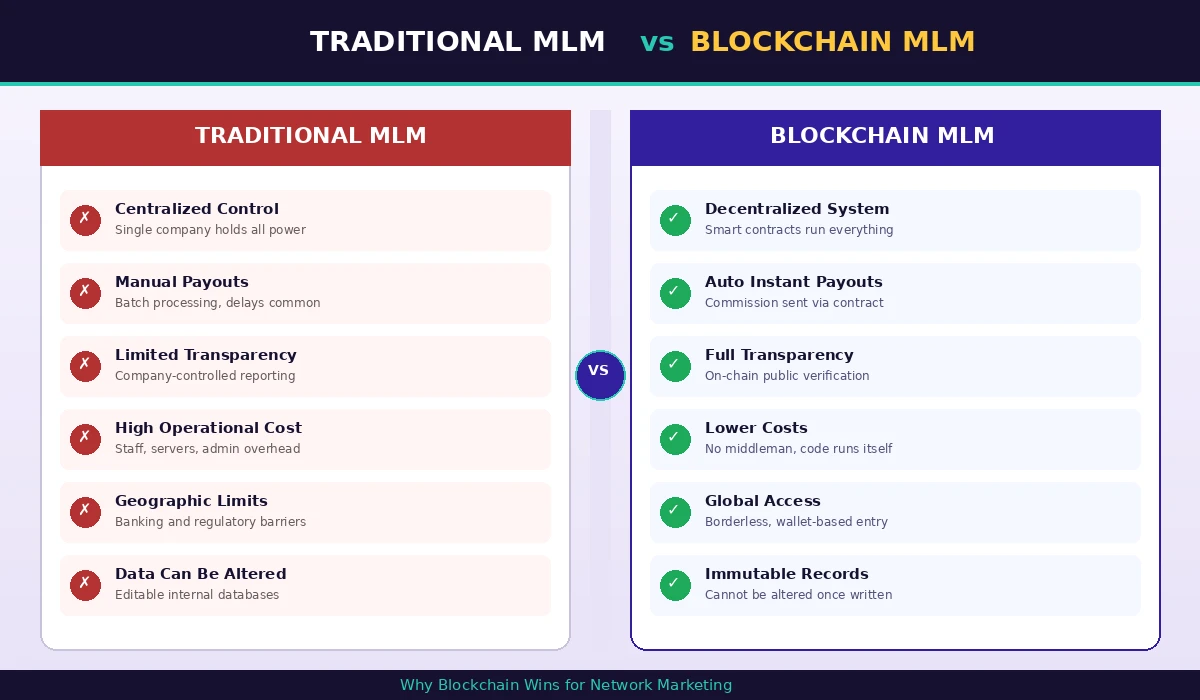
Before building anything, you need to understand how a blockchain-powered MLM differs from a conventional one. The differences are not just cosmetic. They fundamentally change how the business operates, how participants interact with the platform, and how trust is established.
| Parameter | Traditional MLM | Blockchain MLM |
|---|---|---|
| Control Structure | Centralized company | Decentralized smart contracts |
| Commission Payouts | Manual or batch processing | Automated, instant via smart contract |
| Transparency | Limited, company-controlled | Full on-chain visibility |
| Trust Model | Trust the company | Trust the code |
| Geographic Reach | Limited by banking and regulations | Borderless, wallet-based access |
| Data Integrity | Editable database records | Immutable on-chain records |
| Operational Cost | High (staff, servers, admin) | Lower (contract runs itself) |
| Fraud Risk | Higher due to opaque systems | Lower due to public audibility |
Core Components of a Blockchain MLM Platform
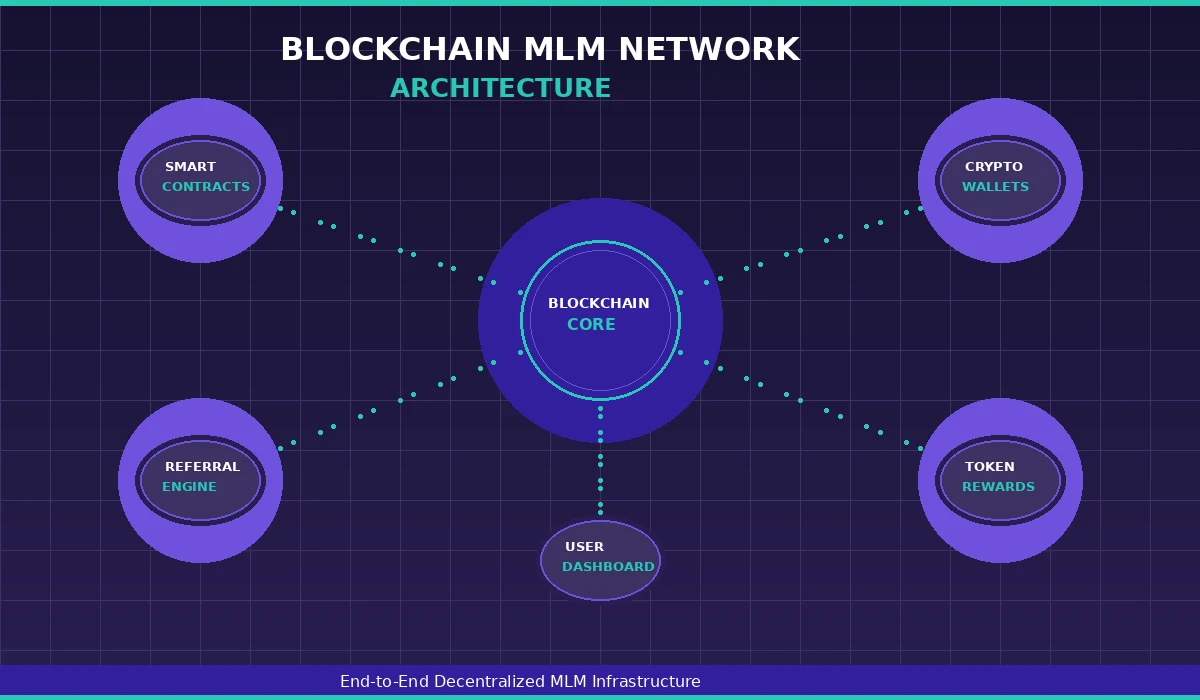
Building a blockchain MLM platform is not just about slapping a referral link onto a crypto app. It requires several interconnected components working together. Each piece plays a specific role, and if one is weak, the entire system suffers.
Smart Contracts
Smart contracts are the foundation. They contain all the business logic: how commissions are calculated, how referral trees are structured, when bonuses trigger, and how rank upgrades work. Once deployed, they run exactly as written. A well-written smart contract for an MLM system handles user registration, maps each user to their upline, calculates multi-level commissions based on the compensation plan, and distributes tokens to the correct wallets automatically.
Crypto Wallet Integration
Users interact with your platform through crypto wallets like MetaMask, Trust Wallet, or WalletConnect-compatible wallets. The wallet serves as their identity, their login credential, and their payment method all in one. No usernames or passwords needed. Commissions go directly into their wallet the moment the smart contract executes. No withdrawal requests, no waiting periods.
Tokenomics & Reward Systems
Your platform needs a token. This token is what members earn, trade, and use within the ecosystem. How you design the token supply, distribution, and utility determines whether the network grows sustainably or collapses under its own weight. You need to decide on total supply, community reward allocation, development reserves, and value maintenance mechanisms.
User Dashboard & Referral Engine
Even though the backend runs on blockchain, users still need a clean, intuitive frontend. The dashboard shows earnings, referral tree, rank status, and transaction history. The referral engine generates unique links, tracks clicks, and attributes new signups to the correct upline. Your average user should not need to understand Solidity or block explorers to participate.
How Blockchain Enhances MLM Transparency & Trust
The biggest selling point of a crypto MLM is trust through transparency. This is not marketing fluff. It is a structural advantage that traditional platforms simply cannot replicate.
Immutable Records
Every transaction, every referral, every commission payout is permanently recorded on the blockchain. Once written, it cannot be altered or deleted. No company can quietly adjust someone’s earnings after the fact. If a member earned 500 tokens, the blockchain confirms it, and that record stays forever.
Automated Commission Distribution
Manual commission processing is where most traditional MLM complaints originate. Late payments, incorrect calculations, undisclosed deductions. Smart contracts solve all of these. When a qualifying event happens, the contract calculates the commission and sends the tokens instantly. No human in the loop.
Fraud Prevention & Fair Payouts
On blockchain, the compensation plan is public code. Anyone can read it. Any change requires a new contract deployment, which is visible to all participants. This structural transparency makes fraud extremely difficult and builds genuine trust within the community.
Step-by-Step Guide to Building a Blockchain MLM Network
Now we get into the actual building process. This section is for founders and technical leads who want a clear roadmap from concept to deployment.
Defining Business Model & Compensation Plan
Before writing a single line of code, you need to nail down your compensation plan. Will you use a binary plan, unilevel, matrix, or a hybrid? Each structure has trade-offs. Binary plans are simple and encourage balanced growth. Unilevel plans allow unlimited width and are easier to understand. Matrix plans cap the width and depth, creating spillover effects. Your compensation plan directly determines how your smart contract is coded, so changing it later means redeploying contracts, which can be disruptive.
Map out every commission type: direct referral bonuses, level-based commissions, matching bonuses, rank achievement rewards, and any pool-based distributions. Document the exact percentages, qualifying conditions, and caps for each. This becomes the specification document for your smart contract developer.
Choosing the Right Blockchain
This decision affects everything from transaction costs to user experience. Here is how the main options compare:
| Blockchain | Speed | Gas Fees | Ecosystem | Best For |
|---|---|---|---|---|
| Ethereum | 12-15 sec | High | Most mature | High-value networks needing credibility |
| BNB Smart Chain | 3-5 sec | Very Low | Mature | Budget-friendly launches, high volume |
| Polygon | 2-3 sec | Very Low | Growing | Ethereum compatibility at lower cost |
| Solana | 0.4 sec | Extremely Low | Growing | Speed-critical, large-scale platforms |
Most new blockchain MLM projects today launch on BNB Smart Chain or Polygon because of the low transaction fees. If your users are making frequent transactions (referrals, purchases, staking), high gas fees on Ethereum mainnet will kill user retention. However, if you are targeting a more premium audience or need maximum security and decentralization, Ethereum with a Layer-2 solution like Arbitrum or Optimism can be a solid middle ground.
Designing Smart Contract MLM Logic
Your smart contract needs to handle several core functions: registering users with an upline reference, building and storing the referral tree, calculating commissions across multiple levels, handling rank qualifications, and distributing rewards. The logic gets complex quickly, especially if you have multiple commission types running simultaneously. Work with a developer who has specific experience in MLM smart contracts. Generic Solidity developers often underestimate the complexity of multi-level referral tracking and end up building contracts that are too gas-heavy or have edge-case bugs.
Platform Architecture & UI/UX Planning
The frontend of your platform typically consists of a web application that connects to the blockchain through a library like Web3.js or Ethers.js. The backend may include an off-chain database for caching data (so users do not have to wait for blockchain queries on every page load) and an API layer for handling non-blockchain operations like notifications and analytics. The UI should be clean and functional. Participants should be able to see their dashboard, referral link, earnings history, team structure, and rank progress within seconds of logging in.
Smart Contract Development for MLM Systems
Smart contract development for MLM is a specialized niche. It requires a deep understanding of both Solidity (or the relevant smart contract language) and the business logic of network marketing compensation plans.
Commission & Bonus Automation
The contract must calculate commissions in real time. When User C joins under User B, who joined under User A, the contract should instantly determine what percentage goes to B (direct referral) and what percentage goes to A (level-2 commission). If there are matching bonuses or pool-based rewards, those calculations happen in the same transaction or in a batch process. The key challenge is gas optimization. Looping through multiple levels to calculate commissions can become expensive on chains with higher gas costs. Experienced developers use techniques like capped depth iterations, off-chain computation with on-chain verification, or batch processing to keep costs manageable.
Rank Progression Logic
Most MLM plans have rank systems. As members build their team and generate volume, they qualify for higher ranks with better commission rates or additional bonus types. The smart contract needs to track each user’s qualifications, such as personal volume, team volume, number of direct referrals, and active legs, and automatically upgrade their rank when thresholds are met. Some contracts use a claim-based system where users trigger their own rank check, which saves gas because the contract does not need to evaluate every user on every transaction.
Multi-Level Referral Tracking
Storing an entire referral tree on-chain is possible but needs careful data structure design. Most contracts use a mapping of each user address to their sponsor address. To traverse up the tree (for calculating multi-level commissions), the contract walks up the chain from the current user to the sponsor, then to the sponsor’s sponsor, and so on, up to the maximum level depth defined in the compensation plan. This upward traversal is where gas costs accumulate, which is why capping the depth at a reasonable level (say, 10 to 15 levels) is common practice.
Tokenomics & Crypto Incentive Design
Your token is not just a reward vehicle. It is the economic engine of your entire platform. Get the tokenomics wrong, and the platform dies regardless of how good the technology is.
Token Utility & Distribution
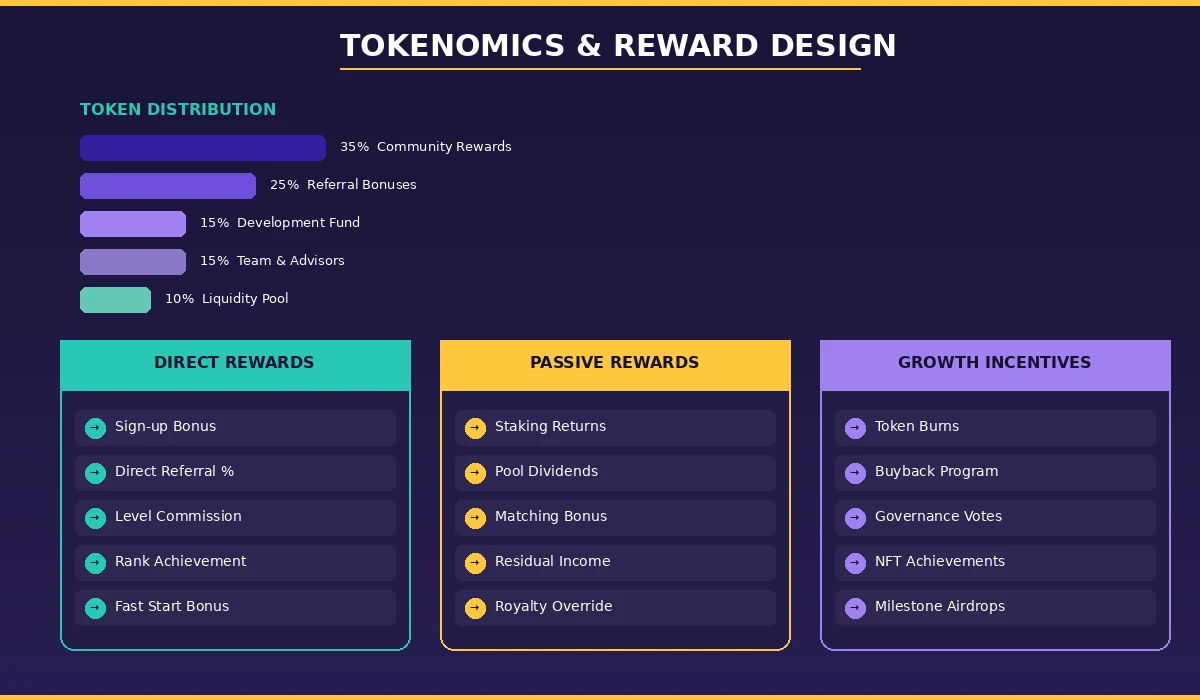
A token needs utility beyond just “something you earn.” It should have real use cases within the ecosystem: paying for platform subscriptions, unlocking premium features, staking for higher commission rates, governance voting, or accessing exclusive products. The more genuine utility the token has, the more sustainable its demand. Distribution typically follows a pattern: 30 to 40 percent for community and referral rewards, 15 to 20 percent for the development team (with a vesting schedule), 10 to 15 percent for liquidity, and the remainder split between marketing, partnerships, and reserve.
Inflation vs Deflation Models
If your platform mints new tokens every time a commission is paid, supply will increase constantly. This is inflationary, and without counterbalancing mechanisms, the token price will trend downward over time. Deflationary mechanisms include token burns (destroying a percentage of tokens on each transaction), buyback programs (using platform revenue to buy and burn tokens), and capped supply with decreasing emission rates. The best approach for an MLM token is usually a balanced model: moderate inflation to reward network growth, paired with burn mechanisms and utility sinks that absorb excess supply.
Security & Compliance Considerations
A blockchain MLM platform handles real money. Cutting corners on security or compliance is a recipe for disaster, both legally and financially.
Smart Contract Audits
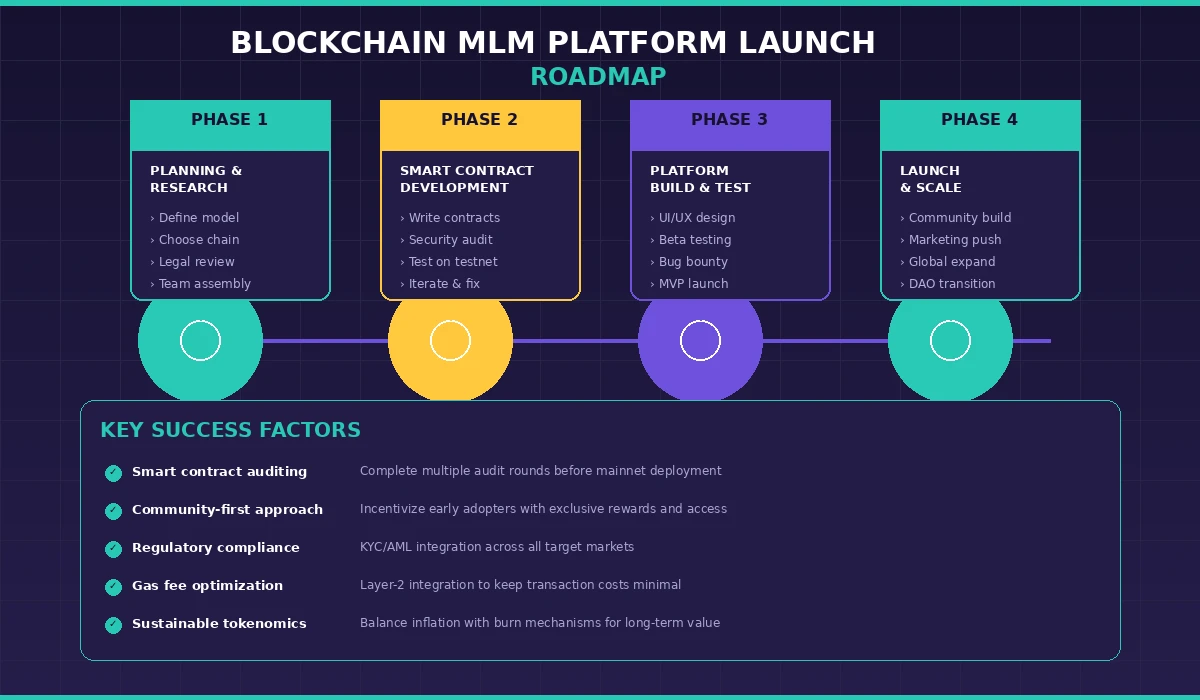
Every smart contract that handles funds must be professionally audited before deployment. An audit by a reputable firm like CertiK, OpenZeppelin, or Hacken examines the code for vulnerabilities such as reentrancy attacks, integer overflows, access control issues, and logic errors. Do not skip this step. Budget 5,000 to 50,000 USD depending on complexity.
Regulatory & Legal Compliance
MLM regulation varies by country. In the US, the Federal Trade Commission (FTC) scrutinizes MLM companies closely. A token that promises returns based on the efforts of others may be classified as a security. Consult with a legal team that understands both MLM regulation and cryptocurrency law.
KYC/AML Integration
Know Your Customer and Anti-Money Laundering compliance is increasingly required for crypto platforms. Integrating a KYC provider into your onboarding flow adds friction but protects the platform from being used for illegal activities. Solutions like Sumsub, Onfido, or Jumio can be integrated via API.
How to Launch a Crypto MLM Platform Successfully
Building the platform is half the battle. Launching it properly determines whether it gains traction or fades into obscurity.
Beta Testing & MVP Launch
Start with a minimum viable product (MVP) that includes the core functionality: user registration, referral tracking, commission calculation, and token distribution. Deploy it on a testnet first (like BSC Testnet or Polygon Mumbai) and run it with a small group of beta testers. Have them stress-test the referral system, try edge cases, and report bugs. Only move to mainnet after the beta phase has resolved all critical issues.
Community Building & Early Adopters
Your earliest members are the foundation of your network. Recruit them carefully. Look for people with existing networks in the crypto or MLM space who understand the model and can effectively communicate it to their contacts. Offer early adopter incentives: higher commission rates for the first 500 members, bonus tokens for beta participants, or exclusive access to premium features. Create Telegram and Discord communities where members can ask questions, share their referral strategies, and provide feedback on the platform.
Marketing & Growth Strategies
Marketing a crypto MLM requires a mix of community-driven growth and targeted outreach. Content marketing (educational articles and videos about your platform and the broader crypto MLM space) builds organic traffic. Influencer partnerships in the crypto and network marketing niches can accelerate growth. Paid advertising on platforms that allow crypto ads, combined with airdrop campaigns and referral contests, can create viral growth loops. The most effective strategy, however, is product quality. If your platform works well and pays on time, your existing members become your best marketers.
Scaling a Blockchain MLM Network
Getting from 100 users to 10,000 and then to 100,000 requires deliberate technical and strategic planning. What works at small scale breaks at larger scale if you are not prepared.
Performance Optimization
As the network grows, on-chain transactions increase dramatically. Use off-chain indexing services (like The Graph or custom indexers) to query blockchain data efficiently. Cache frequently accessed data on your backend. Implement event-driven architecture where your backend listens for blockchain events and updates your database in real time.
Layer-2 & Gas Fee Optimization
If you started on Ethereum mainnet, Layer-2 solutions like Arbitrum, Optimism, or zkSync can reduce gas costs by 90 percent or more. Consider batching commission distributions: instead of processing each commission individually, accumulate them and distribute in batches at set intervals to save costs significantly.
Global Expansion Strategies
Crypto is borderless, but marketing and compliance are not. As you expand to new regions, you need localized marketing, language support, and compliance with local regulations. Prioritize markets where both crypto adoption and network marketing culture are strong, such as Southeast Asia, parts of Latin America, and Africa.
Monetization Models & Revenue Streams
A blockchain MLM platform needs sustainable revenue streams beyond just the initial token sale. Here are the most common monetization approaches:
| Revenue Stream | Description | Typical Range |
|---|---|---|
| Transaction Fees | Small fee on each on-chain transaction | 0.5% – 3% |
| Subscription Plans | Monthly or annual membership tiers | $10 – $100/mo |
| Premium Features | Advanced analytics, extra referral tools | One-time / Recurring |
| Token Appreciation | Platform holds reserve tokens that gain value | Variable |
| White-Label Licensing | License your platform to other organizations | $10K – $100K+ |
The healthiest blockchain MLM businesses combine multiple revenue streams. Transaction fees provide consistent income that scales with usage. Subscription plans create predictable recurring revenue. Premium features give power users a reason to pay more while keeping the base experience accessible. If you are exploring a ready-made approach to get started faster, take a look at specialized cryptocurrency MLM software solutions that can be customized to fit your specific compensation plan and business model.
Challenges in Blockchain MLM Development
Building a blockchain MLM platform is not without significant hurdles. Being aware of these challenges upfront helps you plan better and avoid costly mistakes.
⚠
Technical Complexity
Combining blockchain development with MLM business logic is inherently complex. Smart contract bugs can result in locked funds or incorrect commission calculations. The development team needs expertise in both areas. Expect 3 to 6 months of development from scratch.
⚠
Market Trust & Adoption
MLM already has a trust problem. Adding cryptocurrency creates a double barrier. Your marketing needs to address concerns head-on. Transparency, audit reports, clear documentation, and real product utility build credibility. Avoid hype-driven marketing with unrealistic income promises.
⚠
Regulatory Risks
The regulatory landscape for both MLM and cryptocurrency is evolving rapidly. What is legal today might not be tomorrow. Keep your legal counsel updated, maintain flexibility in your platform to adapt, and consider structuring your business from crypto-friendly jurisdictions.
Real-World Use Cases of Crypto MLM Platforms
Blockchain MLM is not limited to one model. Several variations have emerged that show the versatility of this approach.
DeFi-Based Referral Networks
Some decentralized finance (DeFi) protocols use referral-based structures to grow their user base. Yield farming platforms, lending protocols, and decentralized exchanges have implemented multi-level referral programs where existing users earn a percentage of the trading fees or yields generated by users they refer. This is essentially an MLM structure applied to DeFi, and it works because the underlying utility (trading, lending, staking) is real.
NFT & Gaming MLM Models
Play-to-earn games and NFT marketplaces have experimented with MLM-style referral systems. A player invites friends, and when those friends purchase NFTs or earn in-game tokens, the referrer gets a cut. Some projects extend this to multiple levels, creating a network marketing overlay on top of the gaming economy. The key to making these work is ensuring the game or NFT collection has genuine entertainment or collectible value independent of the referral system.
Web3 Affiliate Marketing
Affiliate marketing is undergoing a transformation with the integration of blockchain technology. New platforms are now able to record referrals directly on-chain, distribute commissions in cryptocurrency, and expand traditional models into multi-tiered structures. This shift is especially visible in the crypto tools and education sector, where services like trading bots, analytics platforms, and online courses are leveraging smart contracts to power multi-level referral systems while optimizing traffic sources for affiliate marketing.
Best Practices for Long-Term Success
Building the platform is step one. Keeping it alive and growing for years requires a different set of strategies.
⚠ Critical Warning: Sustainability First
The number one reason blockchain MLM platforms fail is unsustainable economics. If the platform pays out more in commissions and rewards than it generates in revenue and genuine economic activity, it will collapse. Period. Design your compensation plan with conservative assumptions. Model it for 100 users, 1,000 users, 10,000 users, and 100,000 users. Make sure the math works at every scale.
Community Governance with DAO
As the platform matures, consider transitioning governance to a Decentralized Autonomous Organization (DAO) where token holders can vote on key decisions: changes to the compensation plan, allocation of the community fund, new feature development priorities, and partnership proposals. This gives members a genuine stake in the platform’s direction and builds stronger loyalty than any bonus structure ever could. It also aligns with the decentralization ethos that attracts people to blockchain in the first place.
Continuous Platform Upgrades
Technology moves fast. A platform that launched with cutting-edge features in 2024 will feel dated by 2026 if it is not continuously improved. Plan for regular updates: new features, UX improvements, gas optimizations, security patches, and integrations with new wallets and blockchain networks. Use upgradeable proxy contract patterns (like OpenZeppelin’s UUPS or Transparent Proxy) to allow smart contract logic to be updated without losing state or requiring users to migrate.
Future Trends in Blockchain MLM Networks
The intersection of blockchain and network marketing is still young. Several emerging trends are likely to shape the next generation of platforms.
Final Thoughts
Blockchain MLM networks represent a fundamental upgrade to how network marketing operates. By moving commission logic to smart contracts, recording referral trees on an immutable ledger, and distributing rewards in cryptocurrency, these platforms solve the trust, transparency, and efficiency problems that have plagued the MLM industry for decades.
Building one is not simple. It requires solid understanding of both blockchain technology and MLM business models. You need well-audited smart contracts, thoughtful tokenomics, a scalable platform architecture, and a go-to-market strategy that builds community before chasing viral growth. The regulatory landscape adds another layer of complexity that demands ongoing attention.
But for those who execute well, the opportunity is significant. The global MLM market is worth well over 180 billion dollars. The crypto economy is measured in trillions. The overlap between these two worlds is where the next wave of innovation in network marketing will come from. The platforms being built today, with sustainable economics, genuine utility, and real transparency, are the ones that will define this space for the next decade.
Whether you choose to build from scratch or leverage existing cryptocurrency MLM software, the key is to prioritize sustainability over hype, transparency over promises, and community over quick growth. That is how blockchain MLM networks succeed in the long run.
Frequently Asked Questions
Q1.What is a blockchain MLM platform and how does it work?
A blockchain MLM platform is a network marketing system built on decentralized blockchain technology where the core business operations run through smart contracts. Users join by connecting their crypto wallets, get placed in a referral tree recorded on-chain, and earn token-based commissions automatically when their downline members make purchases or recruit new participants. Smart contracts handle all the commission calculations and payouts without human involvement, which eliminates payment delays and reduces the risk of errors or manipulation in the payout process.
Q2.Which blockchain is best for building an MLM platform?
The best blockchain depends on your specific project needs and audience. BNB Smart Chain and Polygon are popular choices because of their low gas fees and fast transactions, making them ideal for high-frequency MLM operations. Ethereum offers the strongest security and decentralization but has higher transaction costs unless paired with Layer-2 solutions. Solana provides extremely fast speeds at low cost but has a smaller developer ecosystem. Most crypto MLM startups today prefer BSC or Polygon to keep user costs low while maintaining solid performance and reliability.
Q3.How much does it cost to develop a blockchain MLM platform?
Development costs vary significantly based on complexity, but a typical blockchain MLM platform costs between 30,000 and 150,000 USD to build from scratch. This includes smart contract development (5,000 to 25,000 USD), security auditing (5,000 to 50,000 USD), frontend and backend development (15,000 to 60,000 USD), and testing. Ongoing costs include server hosting, blockchain transaction fees, and maintenance. Using pre-built cryptocurrency MLM software can reduce initial costs substantially while still allowing customization of the compensation plan and branding.
Q4.Are blockchain MLM platforms legal and regulated?
The legality of blockchain MLM platforms depends on your jurisdiction and how the platform operates. MLM itself is legal in most countries as long as it involves real products or services and is not structured as a pyramid scheme. Adding cryptocurrency introduces additional regulatory considerations, particularly around securities law. If your token could be classified as a security, you may face registration requirements with agencies like the SEC. KYC and AML compliance are increasingly mandatory. Working with legal counsel experienced in both MLM and crypto regulation is critical before launching in any market.
Q5.What is the role of smart contracts in a crypto MLM system?
Smart contracts serve as the automated engine of a crypto MLM platform. They handle user registration, map the referral tree structure, calculate multi-level commissions based on the coded compensation plan, track rank progression qualifications, and distribute token rewards directly to participant wallets. Once deployed on the blockchain, these contracts execute automatically whenever qualifying events occur, like new signups or purchases. This removes the need for manual processing, ensures consistent application of the rules, and provides public verifiability since anyone can inspect the contract code.
Q6.How do you scale a blockchain MLM network for global users?
Scaling a blockchain MLM globally requires both technical and strategic optimization. On the technical side, use Layer-2 solutions or low-cost chains to manage gas fees, implement off-chain indexing for fast data queries, and batch commission distributions to reduce on-chain transaction volume. Strategically, prioritize markets with strong crypto adoption and network marketing culture, add multi-language support to your platform UI, and ensure regulatory compliance in each target country. Building a strong early community and using referral contests or airdrop campaigns helps create organic growth momentum across borders.
Explore Services
Related Services
Reviewed by

Aman Vaths
Founder of Nadcab Labs
Aman Vaths is the Founder & CTO of Nadcab Labs, a global digital engineering company delivering enterprise-grade solutions across AI, Web3, Blockchain, Big Data, Cloud, Cybersecurity, and Modern Application Development. With deep technical leadership and product innovation experience, Aman has positioned Nadcab Labs as one of the most advanced engineering companies driving the next era of intelligent, secure, and scalable software systems. Under his leadership, Nadcab Labs has built 2,000+ global projects across sectors including fintech, banking, healthcare, real estate, logistics, gaming, manufacturing, and next-generation DePIN networks. Aman’s strength lies in architecting high-performance systems, end-to-end platform engineering, and designing enterprise solutions that operate at global scale.