Ai Overview
Multi-Level Marketing platforms have found a new home on blockchain technology. Smart contracts now handle commission distributions, membership management, and reward calculations automatically. Proposals can include compensation plan changes, new feature additions, or budget allocations. Community members need protection against changes that benefit owners at their expense.
Key Takeaways
- Upgradeable smart contracts allow MLM platforms to fix bugs, add features, and adapt to regulatory changes without losing user data or funds.
- Governance mechanisms such as multi-signature wallets, DAO voting, and time-locks protect community interests and prevent centralized abuse.
- Proxy contract patterns and modular architectures are the most widely used upgradeability models in blockchain-based MLM systems.
- Poor upgrade design can lead to security vulnerabilities, contract takeover risks, and loss of user trust.
- Balancing platform owner control with community participation builds long-term sustainability and regulatory compliance.
- Regular smart contract audits, emergency pause functions, and transparent decision-making are essential security best practices.
Introduction
Multi-Level Marketing platforms have found a new home on blockchain technology. Smart contracts now handle commission distributions, membership management, and reward calculations automatically. But there is a problem that many MLM businesses face when they launch on blockchain. Traditional smart contracts are immutable. Once deployed, they cannot be changed.
This immutability creates serious challenges for MLM platforms. What happens when you discover a bug in your commission calculation? How do you add new bonus structures that members have requested? What if regulations change and you need to modify how your platform operates?
The answer lies in two critical concepts that every MLM platform must understand: upgradeability and governance. Upgradeability refers to the technical ability to modify or replace smart contract code after deployment. Governance defines who makes decisions about those changes and how those decisions are made.
Together, these two elements determine whether an MLM platform can survive and grow over the long term. Without proper upgradeability, platforms become stuck with outdated code. Without proper governance, upgrade power can be abused. Getting both right is essential for building trust with your community and ensuring your business can adapt to future needs.
If you want to understand the basics of MLM business structures before diving into the technical aspects, you can read about MLM meaning, types, benefits and global regulations to build a solid foundation.
Understanding Upgradeability in MLM Smart Contracts
When developers deploy a smart contract to a blockchain like Ethereum or Binance Smart Chain, that code becomes permanent. Every transaction, every function call, every piece of logic remains exactly as it was written. This permanence is actually one of the main selling points of blockchain technology. Users can trust that the rules will not change unexpectedly.
But MLM businesses are not static. They evolve based on market conditions, member feedback, and regulatory requirements. A binary plan might need adjustment to improve fairness. A matrix system might require new spillover rules. Commission rates might need tweaking to remain competitive.
Upgradeability in blockchain refers to technical patterns that allow developers to modify contract behavior without losing existing data or user balances. Think of it like renovating a building while people still live inside. The foundation stays the same, but the rooms can be reconfigured.
Immutable vs Upgradeable Contracts Comparison
| Feature | Immutable Contracts | Upgradeable Contracts |
|---|---|---|
| Code Changes | Not possible after deployment | Can be modified through proxy patterns |
| Bug Fixes | Requires new contract and migration | Can be patched in place |
| Feature Additions | Not possible without migration | New functions can be added |
| User Trust | High certainty, rules cannot change | Depends on governance model |
| Data Preservation | Complex migration needed | Data remains intact during upgrades |
| Complexity | Simpler architecture | More complex design required |
MLM platforms need upgrades for several reasons. Compensation plans often require fine-tuning based on real-world performance. Security patches may become necessary if vulnerabilities are discovered. New features like additional bonus types or rank systems keep the platform competitive. Regulatory compliance may require changes to how data is handled or how commissions are calculated.
Key Upgradeability Models for MLM Contracts
Several technical patterns exist for making smart contracts upgradeable. Each has its own trade-offs between flexibility, security, and complexity. Understanding these patterns helps platform owners make informed decisions about their contract architecture.
Proxy Contract Pattern
The proxy pattern is the most common approach for upgradeable contracts. It separates the contract into two parts: a proxy contract and an implementation contract. The proxy holds all the data and user balances. The implementation contains all the business logic. When users interact with the platform, they always talk to the proxy, which then forwards calls to the current implementation.
When an upgrade is needed, developers deploy a new implementation contract and update the proxy to point to it. All the data stays in the proxy, so user balances and referral relationships remain intact. This is similar to how web applications work, where the database stays constant but the application code can be updated.
According to Wikipedia’s explanation of the proxy pattern, this design pattern provides a surrogate or placeholder for another object to control access to it. In blockchain, this concept enables controlled upgradeability.
Modular Smart Contract Architecture
Modular architecture breaks the MLM platform into multiple smaller contracts that handle specific functions. One contract might manage membership registration. Another handles commission calculations. A third manages the genealogy tree. A fourth processes withdrawals.
This approach allows developers to upgrade individual modules without touching others. If the commission calculation needs adjustment, only that specific contract gets replaced. The membership and withdrawal contracts remain unchanged. This reduces risk because each upgrade affects a smaller portion of the system.
Upgradeable Storage Patterns
Storage patterns focus on how data is organized within contracts. The diamond pattern, also known as EIP-2535, allows unlimited contract functionality by routing calls to different facets based on function signatures. Eternal storage patterns separate data storage completely from logic, making it possible to replace all logic while keeping data intact.
Comparison of Upgradeability Models
| Pattern | Pros | Cons | Best For |
|---|---|---|---|
| Proxy Pattern | Simple to implement, well-documented, preserves contract address | Storage collision risks, function selector clashes possible | Standard MLM platforms with moderate complexity |
| Modular Architecture | Isolated upgrades, easier testing, reduced risk per upgrade | Higher gas costs, complex inter-contract communication | Large platforms with many features |
| Diamond Pattern | Unlimited functionality, granular upgrades, single address | Complex implementation, steeper learning curve | Enterprise-level platforms requiring extensive features |
| Eternal Storage | Complete logic replacement, clean separation | More gas intensive, requires careful data management | Platforms expecting significant future changes |
Risks of Poor Upgrade Design in MLM Systems
Upgradeability is powerful, but it introduces risks that must be managed carefully. Poor upgrade design has led to some of the biggest losses in blockchain history. For MLM platforms, these risks are amplified because of the financial relationships between members.
Security Vulnerabilities
Every upgrade is an opportunity for bugs to enter the system. If the upgrade process itself has flaws, attackers can exploit them. Storage layout changes during upgrades can corrupt existing data. Function selector collisions can cause unexpected behavior. Initialization functions that can be called multiple times create attack vectors.
The development team at Nadcab Labs has observed these vulnerabilities firsthand during security audits. With over 8 years of experience building blockchain MLM solutions, the team has developed strict protocols for testing upgrades in isolated environments before deploying them to production systems.
Loss of User Trust
When users know that contracts can be upgraded, they naturally question whether the rules might change against their interests. An MLM platform could theoretically upgrade to reduce commission rates, change qualification requirements, or even drain user funds. Without proper governance safeguards, upgradeability becomes a liability rather than an asset.
Contract Takeover Risks
If upgrade permissions are not properly secured, malicious actors could potentially take control of the upgrade function. This would give them the ability to replace legitimate contract logic with malicious code. They could redirect all commissions to their own wallets or lock users out of their funds entirely.
Regulatory and Compliance Concerns
Regulators are increasingly scrutinizing blockchain-based financial platforms. If an MLM platform can upgrade contracts arbitrarily, it may face questions about whether it truly operates as a decentralized system or whether it is effectively a centralized business hiding behind blockchain marketing.
Build a Secure and Upgradeable MLM Platform
Partner with experienced blockchain developers who understand both the technical and business aspects of MLM smart contracts. Get a platform built for long-term success.
Governance in MLM Smart Contracts
Governance refers to the rules and processes that determine how decisions are made about a platform. In traditional companies, governance means board meetings, shareholder votes, and executive decisions. In decentralized systems, governance can range from single-owner control to fully democratic community voting.
For MLM platforms, governance answers critical questions. Who can propose changes to the compensation plan? Who approves those changes? How are disputes resolved? Who controls the treasury? These decisions directly affect every member’s earnings and experience.
Role of Governance in MLM Platforms
Good governance builds trust. When members understand how decisions are made and have some voice in the process, they are more likely to remain engaged and committed. Poor governance, where decisions appear arbitrary or favor insiders, leads to member churn and reputation damage.
Governance also provides legal protection. Platforms that can demonstrate transparent decision-making processes are better positioned to defend themselves against regulatory scrutiny. They can show that changes benefit the community rather than extracting value from members.
Centralized vs Decentralized Governance Models
| Aspect | Centralized Governance | Decentralized Governance |
|---|---|---|
| Decision Speed | Fast, single point of decision | Slower, requires consensus building |
| Accountability | Clear responsibility | Distributed responsibility |
| Abuse Risk | Higher risk of self-dealing | Lower risk through checks and balances |
| User Trust | Depends on owner reputation | Built into the system design |
| Implementation | Simple to set up | Complex mechanism design required |
| Regulatory Clarity | Clearer legal entity | Potentially uncertain legal status |
Governance Mechanisms for MLM Contracts
Several proven mechanisms exist for implementing governance in blockchain-based MLM platforms. The right choice depends on platform size, member sophistication, and business goals.
On-Chain Voting Systems
On-chain voting allows members to vote directly on proposed changes using their blockchain wallets. Votes are recorded on the blockchain, making them transparent and tamper-proof. Proposals can include compensation plan changes, new feature additions, or budget allocations.
The challenge with on-chain voting is participation. Most members do not actively engage with governance proposals. Low turnout can make voting results unrepresentative of the broader community. Platforms must design incentives to encourage participation without creating vote-buying opportunities.
Multi-Signature Control
Multi-signature or multi-sig wallets require multiple parties to approve transactions or changes. Instead of a single owner controlling upgrades, a multi-sig might require three out of five designated signers to approve any change. This distributes power and creates accountability.
For MLM platforms, multi-sig signers might include company leadership, community-elected representatives, and independent third parties. This ensures that no single party can make unilateral changes that harm members.
DAO-Based Governance
Decentralized Autonomous Organizations or DAOs represent the most decentralized governance approach. DAO members hold governance tokens that give them voting power. All major decisions go through proposal and voting processes defined in smart contracts.
According to Wikipedia’s article on DAOs, these organizations operate through rules encoded as computer programs, reducing the need for traditional management hierarchies.
Token-Based Decision Models
Token-based governance ties voting power to token holdings. Members who hold more platform tokens have more influence over decisions. This aligns incentives because larger stakeholders have more to lose from bad decisions.
The downside is potential plutocracy, where wealthy participants dominate governance. Platforms can address this through quadratic voting, where voting power scales with the square root of token holdings, or through caps on individual voting power.
Balancing Power: Platform Owners vs Community
The fundamental tension in MLM governance is between operational efficiency and community protection. Platform owners need the ability to respond quickly to problems and opportunities. Community members need protection against changes that benefit owners at their expense.
Avoiding Centralized Abuse
Centralized control creates opportunities for abuse. A platform owner with unilateral upgrade power could change commission rates, modify qualification requirements, or even redirect funds. Even if the owner is honest, the mere possibility of abuse undermines trust.
The solution is to separate different types of power. Emergency functions like pausing the contract during an attack might remain centralized for speed. Compensation plan changes might require multi-sig approval. Major treasury decisions might require community voting. This tiered approach balances efficiency with protection.
Protecting Investor and User Interests
MLM members invest time, money, and social capital into building their networks. They deserve protection against changes that devalue their investments. Governance mechanisms should include provisions for grandfathering existing members under current terms, requiring supermajorities for major changes, and providing advance notice before changes take effect.
Exploring different types of MLM business structures helps understand what protections different plan types might require.
Transparency and Accountability Models
Transparency is essential for trust. All governance decisions should be publicly visible on the blockchain. Vote tallies, proposal texts, and execution timestamps create an audit trail that members and regulators can verify. Platform owners should publish regular reports explaining governance decisions and their rationale.
MLM Contract Governance Lifecycle
Proposal
Submission
Community
Discussion
Voting
Period
Time-Lock
Delay
Execution &
Deployment
Security Best Practices for Upgradeable MLM Contracts
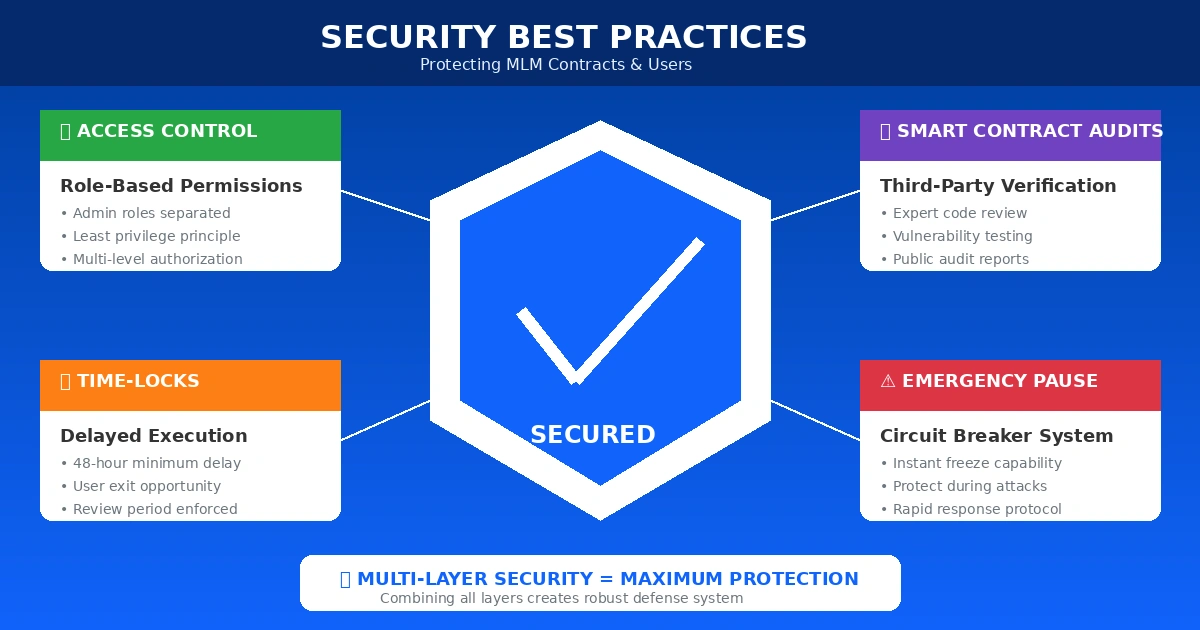
Security in upgradeable contracts requires attention to both the upgrade mechanism itself and the ongoing operation of the platform. Nadcab Labs, with its 8+ years of experience in blockchain MLM development, has established comprehensive security protocols that protect platforms and their members.
Access Control and Permission Layers
Not everyone should have the same permissions. A well-designed MLM contract implements role-based access control. Administrators might have permission to pause the contract. Upgraders might have permission to propose changes. A separate role might execute approved changes. This separation of duties prevents any single compromised account from causing catastrophic damage.
Audit Requirements
Every upgrade should undergo security review before deployment. This includes both automated testing and manual code review by experienced auditors. The audit should cover the new code itself, the upgrade process, and potential interactions with existing functionality. Audit reports should be published publicly to maintain transparency.
Emergency Pause Mechanisms
Circuit breakers allow authorized parties to pause contract operations during emergencies. If an exploit is discovered, pausing prevents further damage while the team develops and tests a fix. The pause function should be tightly controlled but available for rapid response.
Time-Locks and Delayed Upgrades
Time-locks create mandatory delays between when an upgrade is approved and when it takes effect. This gives members time to review proposed changes and exit the platform if they disagree. A typical time-lock might be 48 hours for minor changes and one week for major modifications.
Expert Statement: “The combination of time-locks with transparent governance creates a trust architecture that traditional MLM platforms cannot match. Members can verify that every change goes through proper channels and has sufficient review time. This transparency is what separates legitimate blockchain MLM platforms from schemes that use blockchain as marketing camouflage.” – Nadcab Labs Development Team
Legal, Ethical and Compliance Considerations
MLM platforms operate in a complex regulatory environment that varies by jurisdiction. Blockchain technology adds another layer of regulatory uncertainty. Platform operators must consider both MLM-specific regulations and emerging blockchain regulations.
Regulatory Risks in MLM Smart Contracts
Many jurisdictions have specific requirements for MLM businesses. These may include registration requirements, disclosure obligations, and restrictions on compensation structures. Smart contracts that can be upgraded may face questions about whether they comply with regulations that require certain terms to be fixed.
Platforms should work with legal counsel familiar with both MLM regulations and blockchain technology. Documentation of governance processes can demonstrate good faith compliance efforts even when regulations are unclear.
Ethical Governance Practices
Beyond legal requirements, ethical governance means treating members fairly. This includes honest communication about how governance works, avoiding conflicts of interest in governance decisions, and ensuring that governance mechanisms actually function as described. Platforms that claim to be decentralized but operate with centralized control face both legal and reputational risks.
Preventing Misuse and Scams
Unfortunately, the MLM space has attracted bad actors who use blockchain terminology to run fraudulent schemes. Legitimate platforms must distinguish themselves through genuine transparency and member protection. This includes publishing smart contract code for public review, using reputable auditors, and implementing governance mechanisms that genuinely constrain platform owner power.
Real-World Use Cases of Upgradeable and Governed MLM Systems
The concepts of upgradeability and governance are not theoretical. Successful blockchain MLM platforms have implemented these features to build sustainable businesses.
Example Scenario: Commission Rate Adjustment
Consider an MLM platform that needs to adjust commission rates because the original structure is too aggressive to be sustainable. With proper governance, the platform would submit a proposal explaining the need for changes and the new rate structure. The community would discuss the proposal and potentially suggest modifications. A vote would be held with results recorded on-chain. If approved, a time-lock would delay implementation, giving members who disagree time to withdraw. Finally, the upgrade would execute automatically after the time-lock expires.
Example Scenario: Security Vulnerability Response
When a security researcher discovers a vulnerability, the platform needs to respond quickly. Emergency governance procedures might allow a smaller multi-sig group to approve and deploy security patches with a shorter time-lock. The patch would be deployed and the vulnerability disclosed after members’ funds are safe. A post-mortem report would explain what happened and how the governance process worked.
Benefits for Scalability and Sustainability
Platforms with well-designed upgradeability and governance can scale more effectively. They can add new compensation plan features as the network grows, respond to competitive pressures by adjusting terms, integrate new blockchain technologies as they become available, and adapt to regulatory changes in different jurisdictions. This adaptability is essential for long-term sustainability in a rapidly evolving industry.
For businesses looking to implement these concepts, partnering with experienced developers is crucial. Cryptocurrency MLM software development services from established providers include proper upgradeability and governance features built into the platform architecture from the start.
Future Trends in MLM Governance and Contract Upgradeability
The blockchain industry continues to evolve rapidly. Several emerging trends will shape how MLM platforms approach upgradeability and governance in the coming years.
AI-Driven Governance
Artificial intelligence may play an increasing role in governance. AI systems could analyze proposal impacts, predict member reactions, and flag potential risks. They might assist in detecting fraudulent proposals or identifying governance attacks. While humans should remain in control of final decisions, AI can enhance the quality of governance processes.
Fully Decentralized MLM Ecosystems
Some platforms are moving toward fully decentralized operation where no central party has special privileges. Smart contracts handle all operations automatically, and governance is entirely community-driven. These platforms face challenges in initial bootstrapping and ongoing coordination but offer the highest level of censorship resistance and trust minimization.
Cross-Chain Governance Models
As MLM platforms expand across multiple blockchains, governance must adapt. Cross-chain governance allows token holders on different chains to participate in unified decision-making. This requires sophisticated technical solutions but enables platforms to leverage the strengths of multiple blockchain ecosystems.
Future Trends Impact Assessment
| Trend | Timeline | Impact on MLM Platforms | Preparation Needed |
|---|---|---|---|
| AI Governance Assistance | 1-3 years | Enhanced proposal analysis, risk detection | Data infrastructure for AI integration |
| Full Decentralization | 3-5 years | No central point of failure or control | Progressive decentralization roadmap |
| Cross-Chain Operations | 2-4 years | Unified governance across blockchains | Bridge integration, multi-chain architecture |
| Regulatory Clarity | 2-5 years | Clearer compliance requirements | Flexible governance to adapt to rules |
Final Thoughts
Upgradeability and governance are not optional extras for blockchain MLM platforms. They are fundamental requirements for building sustainable businesses that can adapt, grow, and maintain member trust over the long term.
Upgradeability allows platforms to fix bugs, add features, and respond to changing market conditions. Without it, platforms become frozen in their initial state, unable to compete or improve. Governance ensures that upgrade power is exercised responsibly, with appropriate checks and balances that protect member interests.
The key to success is thoughtful design from the beginning. Platforms should choose upgradeability patterns appropriate to their complexity and expected evolution. They should implement governance mechanisms that balance efficiency with community protection. They should build transparency and accountability into every process.
Security cannot be an afterthought. Regular audits, access controls, emergency mechanisms, and time-locks create layers of protection that minimize risk. Legal and ethical considerations must guide governance decisions to ensure long-term viability in an evolving regulatory landscape.
The future will bring new challenges and opportunities. AI-assisted governance, full decentralization, and cross-chain operations will reshape what is possible. Platforms that build flexible, well-governed foundations today will be best positioned to adopt these advances tomorrow.
For MLM businesses considering blockchain implementation, the message is clear: invest in proper upgradeability and governance from day one. The short-term cost is minimal compared to the long-term benefits of a platform that can evolve, adapt, and maintain the trust of its community. Working with experienced development partners who understand both the technical and business aspects of MLM ensures that these critical features are implemented correctly.
Frequently Asked Questions
Q1.What is smart contract upgradeability in MLM platforms?
Smart contract upgradeability refers to the technical ability to modify or update the code of an MLM smart contract after it has been deployed on a blockchain. Since traditional smart contracts are immutable and cannot be changed once deployed, upgradeability patterns like proxy contracts allow developers to fix bugs, add new features, and adapt to regulatory changes while preserving all existing user data and balances. This is essential for MLM platforms that need to evolve their compensation plans over time.
Q2.Why is governance important for blockchain-based MLM businesses?
Governance determines who can make decisions about changes to an MLM platform and how those decisions are made. Without proper governance, a single owner could make changes that harm members by altering commission rates or qualification requirements. Good governance builds trust by implementing checks and balances through mechanisms like multi-signature wallets, community voting, and time-locks that ensure changes benefit the entire community rather than just platform owners.
Q3.What is the proxy contract pattern and how does it work?
The proxy contract pattern separates an MLM smart contract into two parts. The proxy contract holds all user data including balances and network relationships. The implementation contract contains the business logic for commissions and bonuses. Users always interact with the proxy which forwards calls to the implementation. When upgrades are needed, developers deploy a new implementation and point the proxy to it while all data stays intact.
Q4.How do time-locks protect MLM platform members?
Time-locks create mandatory delays between when a contract upgrade is approved and when it actually takes effect. This gives community members time to review proposed changes and decide whether they want to continue participating. For example, if a platform proposes reducing commission rates, a 48-hour or one-week time-lock allows affected members to withdraw their funds before the change happens if they disagree with the new terms.
Q5.What is the difference between centralized and decentralized governance in MLM?
Centralized governance means a single owner or small team controls all decisions about the MLM platform including upgrades and policy changes. Decentralized governance distributes decision-making power among token holders or community members through voting mechanisms. Centralized systems are faster but risk abuse while decentralized systems are slower but provide better protection through distributed accountability. Most successful platforms use hybrid approaches combining both elements.
Q6.What security measures should upgradeable MLM contracts have?
Upgradeable MLM contracts should implement multiple security layers including role-based access control where different permissions exist for different functions, mandatory security audits before any upgrade is deployed, emergency pause mechanisms that can stop operations during attacks, time-locks that delay upgrades to allow review, and multi-signature requirements where multiple parties must approve changes. These measures prevent both external attacks and internal abuse of upgrade powers.
Explore Services
Related Services
Reviewed by

Aman Vaths
Founder of Nadcab Labs
Aman Vaths is the Founder & CTO of Nadcab Labs, a global digital engineering company delivering enterprise-grade solutions across AI, Web3, Blockchain, Big Data, Cloud, Cybersecurity, and Modern Application Development. With deep technical leadership and product innovation experience, Aman has positioned Nadcab Labs as one of the most advanced engineering companies driving the next era of intelligent, secure, and scalable software systems. Under his leadership, Nadcab Labs has built 2,000+ global projects across sectors including fintech, banking, healthcare, real estate, logistics, gaming, manufacturing, and next-generation DePIN networks. Aman’s strength lies in architecting high-performance systems, end-to-end platform engineering, and designing enterprise solutions that operate at global scale.