Ai Overview
MLM or Multi-Level Marketing is a business model in which people earn money by selling products or services directly to consumers and by building a team of other people who do the same. The FTC emphasizes that MLM companies must primarily earn revenue through genuine product or service sales rather than through recruitment. According to multiple market research reports, the global MLM market size is valued at around $200 billion and is projected to reach approximately $300 billion by 2030.
Key Takeaways
- Multi-Level Marketing (MLM) is a legitimate business model where earnings come from direct product sales and team commissions, with the global market projected to reach $300 billion by 2030.
- MLM operates through three main models: Single-Level, Two-Level, and Multi-Level structures, each offering different income opportunities.
- Legal MLM focuses on genuine product sales rather than recruitment-based earnings, distinguishing it from illegal pyramid schemes.
- Countries including the USA, EU nations, and India have established specific regulations to govern MLM operations and protect consumers.
- Blockchain technology and cryptocurrency are transforming MLM by enabling transparent transactions, automated smart contract payouts, and enhanced trust among participants.
- Success in MLM requires patience, consistent effort, proper company selection, and a focus on helping team members grow.
In recent years, Multi-Level Marketing (MLM) has become one of the most talked-about business models in India and across the world. You might have come across such opportunities around you or on social media, where people talk about earning money either by selling products directly or by building a team of others who do the same. According to multiple market research reports, the global MLM market size is valued at around $200 billion and is projected to reach approximately $300 billion by 2030. According to the World Federation of Direct Selling Associations (WFDSA) 2023 Global Report, the Asia-Pacific region continues to dominate the global market, contributing around 40.3% of worldwide sales, followed by the Americas with about 37.3%, and Europe accounting for 21.6%.
But what exactly makes MLM so popular? For some, it is an opportunity to start their own business with low investment. For others, it is a way to learn entrepreneurship and leadership skills while building a team. However, MLM is also often misunderstood. Some people see it as a legitimate business model, while others confuse it with illegal pyramid schemes. This confusion exists mainly because many people do not clearly understand how MLM actually works.
At Nadcab Labs, with over 8 years of experience in developing blockchain-based MLM solutions, we have helped numerous businesses navigate the complexities of network marketing. In this comprehensive guide, we will simplify everything you need to know about Multi-Level Marketing, including how it works, earning mechanisms, key terminology, benefits, risks, and global legality.
What is MLM (Multi-Level Marketing)?
MLM or Multi-Level Marketing is a business model in which people earn money by selling products or services directly to consumers and by building a team of other people who do the same. MLM is also known as network marketing or direct selling. The basic idea is simple: you become a distributor of a company’s products, sell them to customers, and introduce new people to join the business. You earn a commission from your own sales and a small percentage from the sales made by your team.
Unlike traditional jobs, there is no fixed salary in MLM. Your earnings depend on your performance, how much you sell, and how strong your network becomes. This system creates multiple levels of income, which is why it is called multi-level marketing.
Real-World Example
Suppose you join a cosmetic brand as an independent distributor. You purchase beauty products from the company at a wholesale price and sell them at a retail price to your customers. You earn profit from your direct sales. Then you introduce three friends who also start selling these products. Whenever they make a sale, you receive a small percentage of their total sales as commission. This continues as your team grows, and your income increases as your downline performs better.
This example shows that MLM is built on two major pillars: product sales and team growth. When done ethically and transparently, it can be a legal and rewarding business model. For a deeper understanding, you can explore our detailed guide on MLM meaning, types, benefits, and global regulation.
Types of Multi-Level Marketing Models
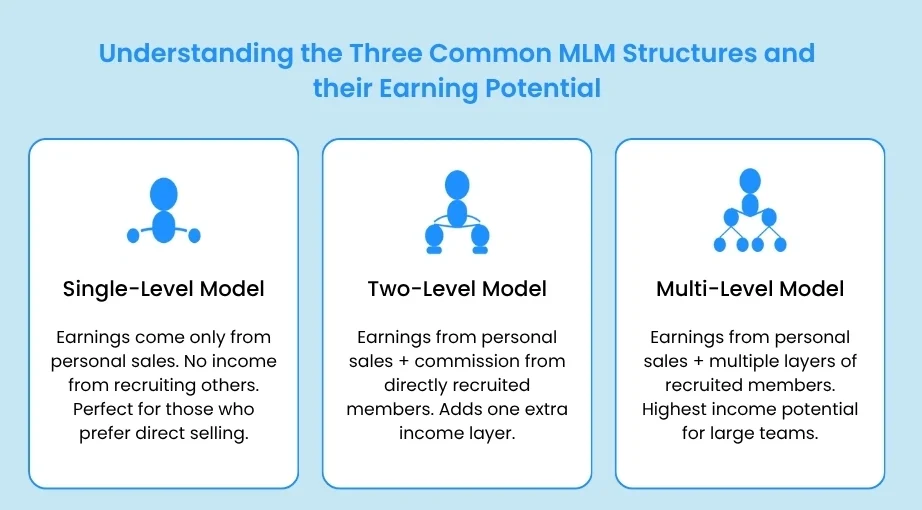
Multi-Level Marketing companies follow different structures based on their compensation plans and business goals. Understanding these models helps you choose the right opportunity that aligns with your skills and expectations.
| MLM Model Type | Income Source | Best Suited For |
|---|---|---|
| Single-Level Model | Earnings come only from personal sales. There is no income from recruiting others. | Individuals who prefer selling without building a team. |
| Two-Level Model | Earnings include personal sales and commission from directly recruited members’ sales. | Those who want limited team management with additional income. |
| Multi-Level Model | Earnings flow from personal sales and from multiple layers of recruited members. | Entrepreneurs focused on building large networks for higher income potential. |
How Do You Earn From MLM?
In a Multi-Level Marketing business, people earn money mainly through two ways: by selling products directly to customers and by building a network of distributors who also sell the company’s products.
1. Direct Sales Commission
When you join an MLM company, you become an independent distributor. You buy products from the company at a lower price and sell them to customers at a higher retail price. The difference between the buying and selling price becomes your profit. This is called direct sales commission and represents the foundation of MLM earnings. Website design beauty brands suppose you join a cosmetic brand as an independent distributor. You purchase beauty products from the company at a wholesale price and sell them at a retail price to your customers. You earn profit from your direct sales. Many growing businesses also invest in professional website design beauty brands strategies to build trust and attract more online customers. Then you introduce three friends who also start selling these products. Whenever they make a sale, you receive a small percentage of their total sales as commission. This continues as your team grows, and your income increases as your downline performs better.
2. Team or Downline Commission
The second way to earn in MLM is through your team, also known as your downline. When the people you have introduced to the business sell products, you receive a small percentage from their total sales as a team commission. The more your team grows and performs, the higher your income becomes. This residual income structure is what makes MLM attractive to many entrepreneurs.
Ready to Launch Your MLM Business?
Partner with Nadcab Labs to build a secure, transparent, and scalable MLM platform powered by blockchain technology. Our 8+ years of expertise ensures your success.
How Does MLM Work?
The working process of Multi-Level Marketing is based on product selling and network building. It is designed in such a way that both the company and the distributors can earn together. Here is the complete MLM lifecycle explained step by step:
MLM Business Lifecycle
Joining the Company
You start by registering yourself as an independent distributor with an MLM company. Some companies may ask for a small joining fee or a starter kit that includes their products and marketing materials.
Product Selling
After joining, your main task is to sell the company’s products or services to customers. You can earn a direct profit from every sale you make. This is your first source of income in MLM.
Building Your Team
The second step is to introduce new people to the business. When these new members join under you, they become a part of your downline. You will guide and help them to sell products and grow their own teams.
Earning from Your Team
As your team starts selling, you receive a small percentage from their sales as a commission. The bigger your network becomes, the more you can earn through multiple levels of income.
Rank and Rewards
Most MLM companies offer ranks or levels based on your sales performance and team growth. As you achieve higher ranks, you can earn extra bonuses, gifts, travel opportunities, and other rewards.
Continuous Growth
The main idea of MLM is teamwork and consistent effort. When you and your team keep selling and adding new members, your income keeps increasing. Active teams lead to stable earnings.
In simple words, MLM works like a community of sellers who help each other grow. When done honestly, it allows people to build a long-term source of income with teamwork, product quality, and leadership.
Difference Between Network Marketing and MLM
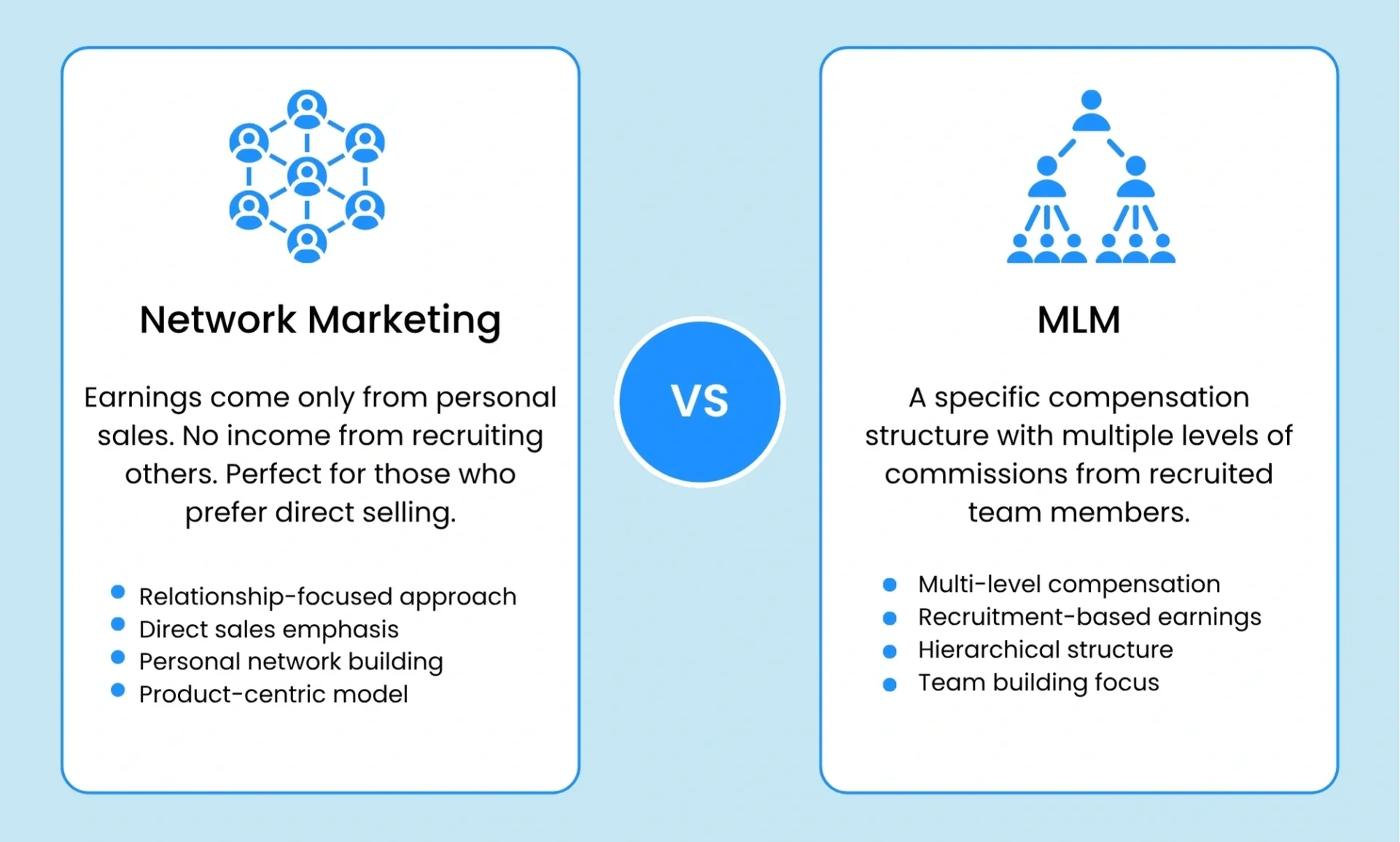
Many people think that Network Marketing and MLM are two different things, but in reality, both are part of the same business concept. The only difference lies in how they are understood and presented.
| Aspect | Network Marketing | MLM (Multi-Level Marketing) |
|---|---|---|
| Definition | A broader term focusing on creating a network of people to sell products | A specific structure used within network marketing |
| Focus | Building relationships, promoting products, and reaching more customers | Earning from personal sales and multiple levels of team sales |
| Income Structure | Primarily from direct sales and customer relationships | From own sales plus commissions from downline sales at various levels |
| Relationship | The process of building a sales network | The system that makes the network marketing process work |
In simple words, Network Marketing is the process, and MLM is the system used to make that process work. Both rely on teamwork, product quality, and leadership skills to achieve success. To learn more about various types of MLM business plans, explore our detailed resources.
Advantages and Disadvantages of MLM
Like every business model, Multi-Level Marketing also has its good and bad sides. Before joining any MLM company, it is important to understand both the advantages and disadvantages. The table below provides a balanced perspective:
| Benefits of MLM | Disadvantages of MLM |
|---|---|
| Low Starting Cost: You can begin your business with a small investment. | Risk of Fake Companies: Some unregistered companies misuse the MLM model. |
| Flexible Working Hours: You can work from anywhere and manage your own time. | Requires Continuous Effort: Regular sales and team building are needed. |
| Unlimited Income Potential: Earnings depend on performance with no cap. | Dependence on Team Performance: Success depends on active team members. |
| Personal Development: You gain valuable communication and leadership skills. | Negative Public Image: Fraud cases have caused trust issues in the industry. |
| Recognition and Rewards: Bonuses, gifts, and trips for top performers. | Market Competition: Hard to stand out without consistent effort. |
In short, MLM can be a powerful opportunity for personal and financial growth when you choose the right company and stay consistent. But it also requires patience, effort, and awareness to avoid risks and scams.
Is MLM Legal Around the World?
MLM (Multi-Level Marketing) is legal in most countries, but each region follows its own set of rules to protect consumers from fraud and ensure transparency. Understanding these regulations is crucial for anyone looking to participate in or launch an MLM business.
United States
In the United States, MLM is legal but closely monitored by the Federal Trade Commission (FTC). The FTC emphasizes that MLM companies must primarily earn revenue through genuine product or service sales rather than through recruitment. Companies like Amway and Herbalife have faced strict scrutiny in the past, leading to stronger transparency requirements. As long as the business model rewards real sales and discloses income possibilities honestly, MLMs can operate legally across the country.
European Union
In the European Union, MLM businesses are allowed, but they must comply with the EU’s Unfair Commercial Practices Directive. This law strictly bans pyramid or money-circulation schemes, which pay members only for recruitment without selling real products. EU nations such as Germany, France, and Spain have strong consumer protection agencies that regularly audit direct selling companies. Transparency, fair marketing practices, and verified product value are the key factors for MLMs to stay compliant within the European market.
Asia
Across Asia, countries like Japan, South Korea, Malaysia, and the Philippines have established specific laws for MLM and direct selling activities. Japan’s Specified Commercial Transactions Act and South Korea’s Door-to-Door Sales Act both ensure fair business conduct and consumer rights. In these nations, companies must clearly disclose earning structures and product authenticity. This region has seen rapid growth in MLM adoption, especially with the integration of technology and online sales, which has made participation easier and more transparent.
India
MLM is legal in India, but only when it follows the rules and guidelines issued by the Government of India under the Consumer Protection (Direct Selling) Rules, 2021. The Ministry of Consumer Affairs notified these rules in December 2021 to bring transparency and fairness to the direct selling industry.
Key Requirements Under Indian MLM Regulations:
The company must be registered under Indian law, such as the Companies Act, 2013 or LLP/Partnership Act.
It must have a registered office in India and provide complete contact details and grievance redressal information on its website.
All direct sellers must have valid identity proof, address verification, and a written contract with the company.
No pyramid schemes or money circulation schemes are allowed. The focus must always be on selling genuine products or services, not on earning money by enrolling new members.
Every company is responsible for consumer grievances related to sales made by its direct sellers.
State Governments are required to monitor and supervise the activities of direct selling companies and sellers in their region.
The rules also make it compulsory for both companies and sellers to comply with the Consumer Protection (e-Commerce) Rules, 2020, if they sell products online.
Important MLM Terms Explained
Understanding the terminology used in MLM is essential for navigating the business effectively. Here are the key terms you will encounter:
| Term | Explanation |
|---|---|
| Upline | The person who introduced you to the MLM company. They guide and support you in building your team and earn a small commission from your sales. |
| Downline | All the people you bring into the business and the members they later add under them. Your income depends partly on how well your downline performs. |
| Sponsor | The person who directly adds a new member to the MLM network. In most cases, your upline is also your sponsor. |
| Leg or Branch | Each new person you add under you creates a new branch or leg in your network. Your total earnings depend on how these branches perform. |
| Level | Every time someone joins under another member, a new level is created. The deeper your network goes, the more levels you have. |
| Commission | The percentage of income you earn from your sales and from your team’s sales. Rates differ based on the MLM compensation plan. |
| Volume | The total sales value generated by you and your downline. It helps determine your rank, bonus, and commission percentage. |
How Blockchain is Changing the MLM Industry
Over the past few years, technology has completely transformed how MLM businesses work. Earlier, most MLM companies managed sales records, commissions, and team data manually. This often led to confusion, delayed payments, and even trust issues among distributors. But now, with the help of blockchain technology, the entire MLM system has become smarter, faster, and more transparent.
A blockchain is basically a digital record book that cannot be changed or deleted once information is added. This feature helps in maintaining complete transparency between the company and its members. Smart contracts, which are self-executing programs on the blockchain, automatically distribute commissions and bonuses once certain conditions are met. This means no manual calculations, no third-party control, and no delays in payments.
Nadcab Labs Expertise Statement
“At Nadcab Labs, we have been at the forefront of blockchain-based MLM development for over 8 years. Our team has successfully deployed hundreds of secure, scalable MLM platforms across networks like Ethereum, Tron, Polygon, and Binance Smart Chain. We understand that trust and transparency are the cornerstones of any successful network marketing business, which is why our solutions are designed to eliminate manual errors and ensure instant, verifiable commission payouts.”
Today, many network marketing companies are adopting blockchain-based MLM software to ensure that every transaction is recorded securely and every member gets paid fairly and on time. This is the reason why blockchain MLM platforms are gaining popularity among modern entrepreneurs and investors.
How Cryptocurrency and MLM Are Coming Together
Cryptocurrency has opened a new world of opportunities for MLM companies. Just like traditional MLMs sell physical products or services, crypto-based MLMs deal with digital assets and utility tokens. The core idea remains the same, where members earn income through direct sales and team commissions, but now everything operates in a digital ecosystem powered by blockchain technology.
In this setup, smart-contract based crypto MLM software plays a major role in automating tasks such as payouts, transaction recording, and performance tracking. Smart contracts ensure that every commission is processed instantly and directly into members’ wallets without manual intervention. This automation not only saves time but also builds greater trust among distributors and investors.
Today, many businesses are switching to advanced cryptocurrency MLM platforms built on blockchain networks like Ethereum, Tron, Polygon, and Binance Smart Chain. These networks ensure high security, transparency, and scalability for global operations. Companies can also choose from different plan types such as binary, matrix, or unilevel, depending on their reward structure and growth strategy.
Transform Your MLM with Blockchain Technology
Leverage Nadcab Labs’ 8+ years of expertise to build a secure, transparent, and automated MLM platform. Our smart contract solutions ensure instant payouts and complete trust.
Final Words
In recent years, Multi-Level Marketing (MLM) has become one of the most talked-about business models in India and across the world. You might have come across such opportunities around you or on social media, where people talk about earning money either by selling products directly or by building a team of others who do the same. According to multiple market research reports, the global MLM market size is valued at around $200 billion and is projected to reach approximately $300 billion by 2030. 1 3 According to the World Federation of Direct Selling Associations (WFDSA) 2023 Global Report, the Asia-Pacific region continues to dominate the global market, contributing around 40.3% of worldwide sales, followed by the Americas with about 37.3%, and Europe accounting for 21.6%.
But what exactly makes MLM so popular? For some, it is an opportunity to start their own business with low investment. For others, it is a way to learn entrepreneurship and leadership skills while building a team. However, MLM is also often misunderstood. Some people see it as a legitimate business model, while others confuse it with illegal pyramid schemes. This confusion exists mainly because many people do not clearly understand how MLM actually works.
In this blog, we will simplify everything you need to know about Multi-Level Marketing. We will explain what MLM is, how it works, how people earn through it, and what terms like upline, downline, and mlm compensation plan actually mean. We will also look at the benefits, risks, and global legality of MLM so that you can make an informed decision if you ever plan to join or start one, no matter where you are.
Frequently Asked Questions (FAQ) - MLM
Q1.What is the main purpose of MLM?
The main purpose of MLM is to sell genuine products or services through a network of distributors and allow people to earn income from their sales as well as their team’s performance.
Q2.Is MLM a good business opportunity?
Yes, MLM can be a good business opportunity when you work with a trusted and legal company. It allows you to start with low investment and earn based on your hard work and dedication.
Q3.How is MLM different from a pyramid scheme?
MLM is legal and product-based, where income comes from real sales. A pyramid scheme is illegal because it focuses only on recruitment and money circulation without selling any real product.
Q4.What is the full form of MLM?
The full form of MLM is Multi-Level Marketing. It is a business model where people earn income by selling products directly to consumers and by building a network of other distributors who do the same.
Q5.How can I find a genuine MLM company in India?
Before joining, check if the company is registered under the Government of India’s Direct Selling Rules 2021, offers real products, and provides transparent income plans. Avoid companies that promise quick money.
Q6.How much can I earn from MLM?
There is no fixed income in MLM. Your earnings depend on your sales performance, team growth, and the company’s plan. With time and consistent effort, many people earn a good monthly income.
Q7.Is MLM Legal in the USA?
Yes, MLM (Multi-Level Marketing) is legal in the United States — but only when it follows proper regulations.
According to the Federal Trade Commission (FTC), a legitimate MLM company must:
-
Focus mainly on real product or service sales
-
Pay commissions based on product sales — not just recruitment
-
Avoid making false income promises
If a company earns primarily from recruitment fees instead of product sales, it may be considered a pyramid scheme, which is illegal in the USA.
Q8.What Does MLM Mean?
MLM stands for Multi-Level Marketing.
It is a business model where individuals:
-
Sell products or services directly to customers
-
Earn commissions from their own sales
-
Recruit others and earn a percentage from their sales as well
In simple terms:
MLM is a network-based marketing system where income comes from both personal sales and team sales.
It is also known as network marketing or direct selling, depending on the structure of the company.
Explore Services
Related Services
Reviewed by

Aman Vaths
Founder of Nadcab Labs
Aman Vaths is the Founder & CTO of Nadcab Labs, a global digital engineering company delivering enterprise-grade solutions across AI, Web3, Blockchain, Big Data, Cloud, Cybersecurity, and Modern Application Development. With deep technical leadership and product innovation experience, Aman has positioned Nadcab Labs as one of the most advanced engineering companies driving the next era of intelligent, secure, and scalable software systems. Under his leadership, Nadcab Labs has built 2,000+ global projects across sectors including fintech, banking, healthcare, real estate, logistics, gaming, manufacturing, and next-generation DePIN networks. Aman’s strength lies in architecting high-performance systems, end-to-end platform engineering, and designing enterprise solutions that operate at global scale.