Ai Overview
You’ve probably heard the term “MLM” or Multi-Level Marketing. Maybe you think of home parties, wellness products, or that friend who suddenly started posting about a “ground-floor opportunity. ” For decades, the traditional MLM model has been a mixed bag. It offers the dream of entrepreneurial freedom but is often weighed down by real problems: confusing payment structures, delays in earning your money, and a nagging lack of trust in how the whole system is run.
Key Takeaways
- It fixes old MLM problems. Decentralized MLM uses blockchain to solve issues like lack of transparency, slow payments, and blind trust in a central authority.
- You get paid instantly by code. Smart contracts automate commission payouts instantly without human intervention or monthly delays.
- Everything is publicly verifiable. All transactions are recorded on an immutable blockchain ledger that anyone can audit.
- Earnings are in digital tokens. Commissions are paid in cryptocurrency tokens, enabling fast, borderless payments and asset ownership.
- The community can have a voice. Token holders can often vote on key decisions through decentralized governance models.
- You are responsible for your wallet. Users must secure their own digital wallets and private keys, ensuring control and accountability.
- Technology enables fairness, but ethics still matter. Blockchain creates transparency, but ethical products and practices are essential for sustainability.
You’ve probably heard the term “MLM” or Multi-Level Marketing. Maybe you think of home parties, wellness products, or that friend who suddenly started posting about a “ground-floor opportunity.” For decades, the traditional MLM model has been a mixed bag. It offers the dream of entrepreneurial freedom but is often weighed down by real problems: confusing payment structures, delays in earning your money, and a nagging lack of trust in how the whole system is run.
Now, a new term is popping up: Decentralized MLM. It sounds technical, maybe even a bit buzzwordy. But at its core, it’s a simple yet powerful idea: using modern technology, specifically blockchain, to solve those old, persistent problems. This isn’t just a minor upgrade; it’s a complete rethinking of how a distribution network can and should operate. Let’s break down exactly what it is, how it works, and why it matters.
What Exactly is Multi-Level Marketing (MLM)? The Starting Point
Before we get to the “decentralized” part, let’s ground ourselves in the basics. According to Wikipedia, Multi-Level Marketing[1] is a business model where a company’s salesforce is compensated not only for sales they personally generate but also for the sales of others they recruit. This creates a downstream network (or “downline”) of distributors.
In a traditional setup, a central company manages everything. They track sales, calculate commissions for potentially thousands of members, hold the money, and send out payments, often on a slow, monthly schedule. The entire system runs on trust in that single company’s ledger and goodwill. This central control is the root of most common complaints.
The Core Flaws of Traditional, Centralized MLM
Why does the old model need fixing? The issues are well-documented:
- Lack of Transparency: You essentially have to take the company’s word for it. How were your team’s sales calculated? Is the bonus formula being applied correctly? You see a number on a dashboard, but you can’t audit the math behind it.
- Payment Delays and Complexity: Commissions are typically batched and processed manually by an accounting department. This can mean waiting 30-60 days to get paid for your work. For someone relying on this income, that delay is a significant burden.
- Risk of Fraud and Manipulation: A malicious actor at the company headquarters could, in theory, tamper with records, siphon funds, or change rules unfairly. The centralized database is a single point of failure.
- High Administrative Costs: The company spends huge amounts on servers, software, and payroll to manage the complex compensation plan. These costs often get passed down, affecting product prices or commission rates.
Decentralized MLM aims to address each of these points head-on by shifting the foundation of the network from a private server to a public blockchain.
Stop trusting promises. Start trusting code.
You’ve seen how decentralization works. Now picture it working for you—payments you can see, trust, and receive in real time.
Decentralized MLM Explained: It’s All About the Ledger
Think of a blockchain as a digital, public notebook that everyone in the network can see and trust, but no single person owns or can erase. Every transaction—a sale, a new recruit, a commission payout is written as a new line in this notebook. Once written, it’s permanent and visible to all.
A Decentralized MLM platform builds its entire operation on top of this kind of transparent ledger. Instead of a company running proprietary software, the rules of the network are baked into the system itself via smart contracts (we’ll get to those in a second). This shift from a central authority to a decentralized, rules-based network changes everything.
The Key Pillars of a Decentralized MLM System
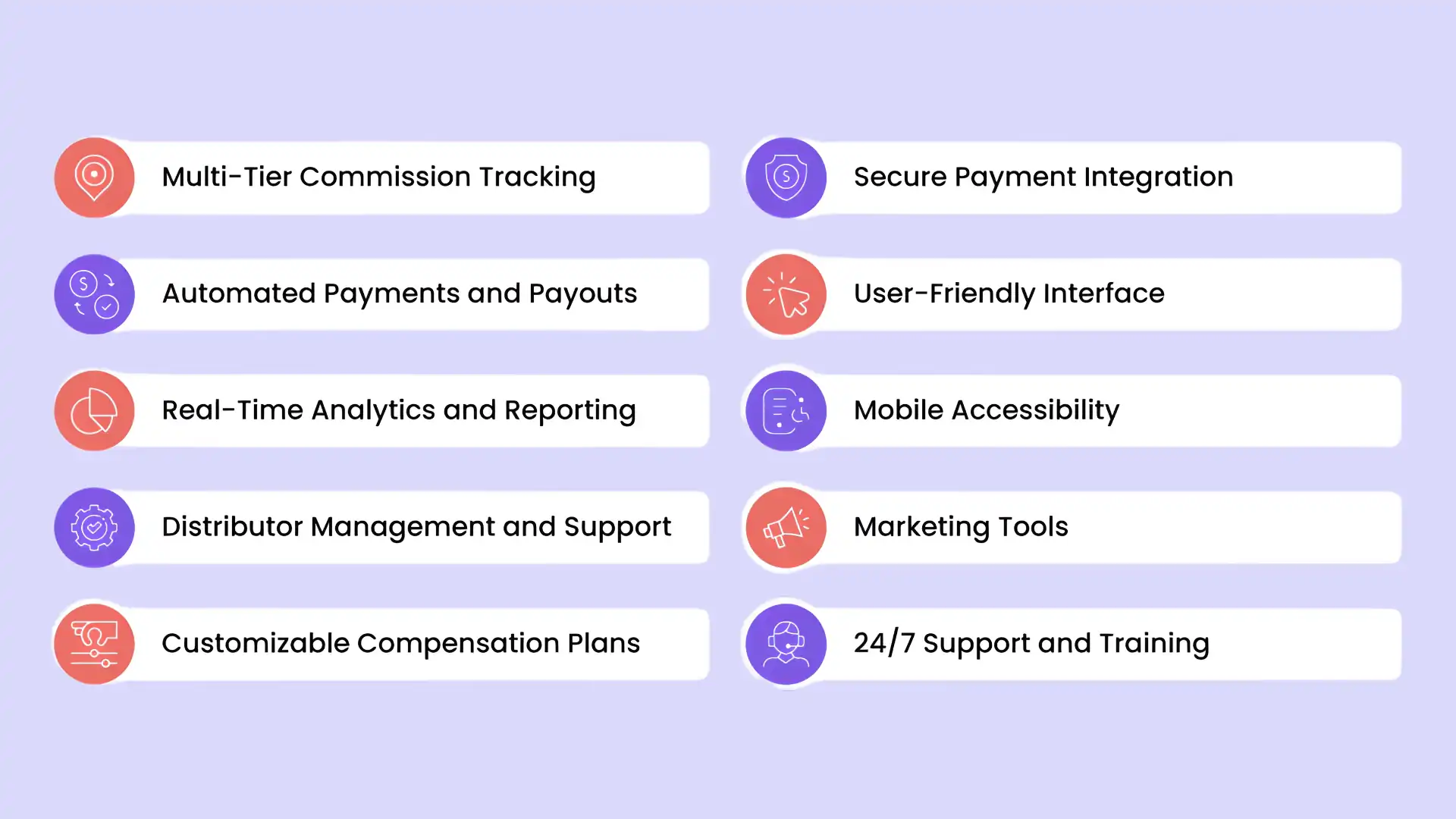
Let’s look at the four main technological pieces that make this possible.
1. Blockchain: The Foundation of Trust
The blockchain is the immutable record-keeper. Every action is time-stamped, encrypted, and linked to the previous one. For an MLM member, this means you can independently verify every piece of data that affects your earnings. Did a sale in your downline actually happen? Check the blockchain. Was your commission calculated correctly? The formula is open; you can check the math yourself. This removes the “black box” feeling of traditional systems.
2. Smart Contracts: The Automated Rulebook
This is the real game-changer. A smart contract is a set of pre-programmed rules[2] that live on the blockchain. Think of it as a digital vending machine: if you do X (make a sale), then Y (your commission) happens automatically and instantly.
In a decentralized MLM, the entire compensation plan—all the complex bonus rules, rank advancements, and pairing bonuses—is coded into smart contracts. The moment a qualifying sale is recorded on the blockchain, the smart contract triggers. It calculates who gets paid what, down to the last cent, and instantly routes the funds to their digital wallets. No waiting for payday. No manual processing. It’s automatic, fair, and tamper-proof.
3. Tokenization: A Unified Currency of Value
Instead of dealing with points, credits, and eventual cash conversions, decentralized platforms often use their own digital tokens. These tokens represent real value within the ecosystem.
- You earn tokens for sales and team performance.
- You can use tokens to purchase products from the company’s catalog.
- You might pay membership fees with tokens.
- You can often trade them on exchanges for other cryptocurrencies or fiat money.
This creates a seamless, global economy within the network. A member in Japan and a member in Brazil are transacting with the same, borderless asset, eliminating currency conversion hassles.
4. Decentralized Governance: The Community Has a Say
Who gets to decide when the rules need to change? In traditional MLM, it’s the corporate office. In a decentralized model, major decisions (like changing a commission rate or adding a new product line) can be put to a vote among token holders. The more you’ve invested in the network’s success, the more say you have. This aligns incentives and fosters a true sense of community ownership.
A Side-by-Side Comparison: Old vs. New
| Feature | Traditional (Centralized) MLM | Decentralized MLM |
|---|---|---|
| Record Keeping | Private, company-controlled database. | Public, immutable blockchain ledger. |
| Transparency | Low. You see only what the company shows you. | High. Every transaction is verifiable by anyone. |
| Commission Payouts | Manual, batched processing. Can take 30–60 days. | Automated via smart contracts. Instant or near-instant. |
| Trust Mechanism | Trust in the central company’s integrity and competence. | Trust in the open-source blockchain and smart contracts. |
| Governance | Top-down. Company executives make all decisions. | Community-driven. Token holders vote on key changes. |
| Cross-Border Payments | Slow, expensive, and bank-dependent. | Fast and efficient using tokens. |
| System Security | Central server is a target for hackers. | Decentralized network is highly resistant to attack or fraud. |
The Real-World Benefits for Everyday Participants
So, what does this mean for you if you join one of these networks?
- You Get Paid Faster, Period. The elimination of the month-long wait for a check is perhaps the most immediate and tangible benefit. Your cash flow improves dramatically.
- You Can Actually Trust the System. You’re no longer relying on a corporation’s promise. You’re relying on code that executes exactly as written, every single time. This builds incredible confidence.
- It’s Fairer. The rules are applied equally to everyone, from the newest member to the top earner. There’s no room for favoritism or “special adjustments.”
- You Have a Voice. The potential for governance tokens means you can participate in shaping the network’s future, making it feel more like a cooperative and less like a corporate hierarchy.
It’s Not All Perfect: The Challenges to Consider
This model is still emerging, and it comes with its own set of hurdles.
- Technical Complexity: For non-tech-savvy users, dealing with crypto wallets, private keys, and tokens can be a steep learning curve and a barrier to entry.
- Regulatory Uncertainty. Governments around the world are still figuring out how to regulate cryptocurrencies and token-based economies. This creates a legal gray area for some platforms.
- Scalability Issues. Some blockchains can get slow and expensive when too many people use them at once. Platform developers need to choose their underlying technology carefully.
- The Human Element Remains. While technology solves fraud and transparency, it doesn’t eliminate the need for ethical leadership, quality products, and responsible marketing. A scammy plan built on blockchain is still a scam.
Is Decentralized MLM the Future?
The technology behind decentralized MLM offers clear, technical solutions to the most legitimate criticisms of the traditional industry. It has the potential to legitimize the MLM space by making it auditable, efficient, and member-centric.
For entrepreneurs, it represents a more professional, trustworthy, and financially fluid environment to build a network. For the industry, it’s a call to evolve toward greater accountability.
However, its success won’t depend on technology alone. The best platforms will be those that pair this powerful, transparent infrastructure with genuine products, ethical marketing practices, and a focus on real-world value. They will use blockchain not as a marketing gimmick, but as a silent, powerful engine for fairness—one smart contract at a time.
If you’re curious about the deeper technical work that goes into building such systems, you can learn more about the process of blockchain development from various educational resources online that explain how developers create these secure and transparent ledgers.
Frequently Asked Questions
Q1.What is decentralized MLM in simple terms?
It’s a new kind of MLM that runs on blockchain, a shared digital record book. This cuts out the central company controlling the ledger. All transactions, sales, and commission payments are recorded on a public, unchangeable blockchain. This makes everything automatic and transparent, so you can trust the system itself, not just a company’s word.
Q2.How do I get paid in a decentralized MLM?
You get paid instantly with digital tokens (cryptocurrency). The rules are coded into “smart contracts,” which are like automatic digital agreements. The moment a sale is made in your network, the smart contract calculates and sends your commission directly to your digital wallet. No more waiting for a monthly company check.
Q3.Is my money safe on a blockchain MLM platform?
Blockchain is highly secure because it’s decentralized and encrypted. Your earnings and transaction history are recorded across a vast network of computers, making them nearly impossible to hack or alter fraudulently. However, you are responsible for securing your own private keys and digital wallet, which is a new layer of personal security to learn.
Q4.Can I join a decentralized MLM if I don't understand cryptocurrency?
You can, but there’s a learning curve. You’ll need to understand basics like setting up a crypto wallet, securing your private keys, and maybe converting tokens to cash. Reputable platforms have guides, but be prepared for this technical step. If crypto feels too complex, it might not be the right fit for you yet.
Q5.What’s the biggest advantage over traditional MLM?
The biggest advantage is transparency and trust. You can independently verify every sale, recruitment, and commission calculation on the public blockchain. This eliminates the common “black box” problem where you have to trust a central company’s often confusing and delayed reporting. Payments are also automatic and fast.
Q6.Are decentralized MLMs legal?
The legality depends on the platform’s structure and your country’s regulations. While the blockchain tech itself is legal, authorities still scrutinize the underlying business model. A decentralized MLM must still sell real products/services and avoid being a pyramid scheme. Always consult local financial regulations before joining or investing.
Q7.What are the main risks or downsides?
Key risks include cryptocurrency price volatility (your earnings’ value can swing), the technical responsibility of managing your own wallet and private keys, and evolving government regulations that could impact operations. Also, the technology doesn’t automatically make the business model ethical—strong products and fair plans are still crucial.
Explore Services
Related Services
Reviewed by

Aman Vaths
Founder of Nadcab Labs
Aman Vaths is the Founder & CTO of Nadcab Labs, a global digital engineering company delivering enterprise-grade solutions across AI, Web3, Blockchain, Big Data, Cloud, Cybersecurity, and Modern Application Development. With deep technical leadership and product innovation experience, Aman has positioned Nadcab Labs as one of the most advanced engineering companies driving the next era of intelligent, secure, and scalable software systems. Under his leadership, Nadcab Labs has built 2,000+ global projects across sectors including fintech, banking, healthcare, real estate, logistics, gaming, manufacturing, and next-generation DePIN networks. Aman’s strength lies in architecting high-performance systems, end-to-end platform engineering, and designing enterprise solutions that operate at global scale.