Ai Overview
The NFT marketplace landscape has grown exponentially since the first digital collectibles were introduced to the blockchain. Building machine learning recommendation engines typically costs between 20,000 and 50,000 dollars, depending on scale and sophistication. Monthly expenses typically range from 2,000 to 10,000 dollars, depending on the user base size. Initial setup costs generally fall between 15,000 and 40,000 dollars.
The NFT marketplace landscape has grown exponentially since the first digital collectibles were introduced to the blockchain. Today, these platforms handle billions of dollars in transactions annually, serving millions of users worldwide. However, as the market expands, the need for intelligent solutions has become increasingly critical. Artificial intelligence is now fundamentally reshaping how NFT platforms operate, from the moment buyers discover assets to the moment creators receive their royalties. As a result, many platforms are now integrating advanced NFT marketplace solutions powered by AI to improve discovery, security, and overall platform efficiency.
The integration of AI technology into NFT marketplaces addresses several longstanding challenges. Users struggle to find relevant digital assets among millions of listings. Platforms face constant threats from fraud and unauthorized sales. Creators worry about intellectual property protection and fair compensation. These problems have limited mainstream adoption of NFTs, preventing the technology from reaching its full potential.
AI offers practical solutions to these real challenges. Machine learning algorithms can analyze user behavior to provide personalized recommendations. Computer vision systems can detect counterfeit assets and unauthorized reproductions. Natural language processing can verify ownership claims and identify suspicious transactions. The combination of these technologies creates marketplaces that are more efficient, more transparent, and more trustworthy than previous generations, while also supporting advanced platforms such as AI-powered LMS for intelligent learning and content management.
Recommended Reading:
NFT Marketplace Development Guide
One of the most visible ways AI improves NFT marketplaces is through intelligent discovery systems. When a new user enters a marketplace with millions of listings, finding relevant assets becomes overwhelming. Traditional search and browse functions fail because they do not consider individual preferences, market trends, or personal collection goals.
Modern NFT platforms now use machine learning to analyze what users view, purchase, and interact with. These algorithms identify patterns that humans might miss. For example, a user who consistently buys digital art from female artists might receive recommendations for similar creators before they appear in popular lists. Someone interested in gaming NFTs will see curated selections of play-to-earn assets in their feed.
These systems work by comparing a user’s activity to thousands of others with similar interests. When matches are found, the platform can suggest assets the user has not yet discovered. Over time, as the algorithm learns more about individual tastes, recommendations become increasingly accurate. Users report spending less time searching and finding higher-quality assets that match their goals.
AI systems examine historical transaction data to predict future value movements. These models consider factors like creator reputation, collection size, holder diversity, social media engagement, and broader market trends. When the system detects an undervalued asset based on these factors, it can highlight the opportunity to interested buyers.
Price prediction models have become sophisticated enough to alert collectors when assets drop below historical averages or when emerging collections show signs of growth potential. While no algorithm can guarantee accuracy, these tools give informed buyers better data for making purchasing decisions. Creators also benefit because platforms can price NFT drops more effectively based on market conditions.
NFT marketplaces receive thousands of new listings daily. Manually categorizing these assets would be impossible. AI systems use image recognition, metadata analysis, and even tools like AI video maker, technology to automatically sort collections by type, style, rarity, and other attributes. This organization makes browsing faster and more intuitive for all users.
Smart collections created by AI can group assets by emerging themes before human curators notice them. For instance, an algorithm might identify that 200 new NFTs feature the same artist’s style and automatically create a collection. These dynamic groupings help collectors find related works and give emerging artists visibility they would not have achieved otherwise.
Recommended Reading:
What Is an NFT Marketplace? How It Works End-to-End
Security has become a critical concern in the NFT space. Since 2021, hundreds of millions of dollars in digital assets have been lost to theft, counterfeiting, and fraud. These incidents have undermined user confidence and slowed mainstream adoption. Traditional security measures, like wallet protection and transaction verification, have proven insufficient against sophisticated attacks. This is where AI technologies provide meaningful improvements.
AI systems constantly monitor marketplace activity to identify patterns that deviate from normal behavior. An algorithm might flag a transaction where someone with a new account suddenly purchases a high-value asset, or where a creator’s account suddenly sells multiple authenticated works to unknown buyers. These anomalies trigger immediate review by human moderators.
Machine learning models trained on historical fraud cases can recognize the signs of common scams. Wash trading, where the same person repeatedly buys and sells an asset to inflate its perceived value, generates distinctive transaction patterns that algorithms can detect within minutes. When the system identifies likely wash trading, it can prevent the asset from appearing in trending lists and notify platform administrators.
Artificial intelligence can analyze visual content to detect unauthorized copies and plagiarized artwork. Image recognition technology can compare new uploads to an enormous database of authenticated works. When a system finds a high-similarity match between a new NFT and existing artwork, it flags the submission for manual verification.
This technology goes beyond simple copy detection. AI can identify when artwork has been slightly modified to avoid automated detection. It can spot when an artist’s distinctive style has been imitated without permission. These detection capabilities help creators protect their intellectual property and give buyers confidence that they are purchasing original, authentic works.
When someone’s account gets compromised, attackers often move quickly to steal high-value NFTs. AI systems establish normal patterns for each user, including login locations, transaction sizes, purchase timing, and device types. When login attempts or transactions deviate dramatically from these patterns, the system triggers security alerts. A user in California suddenly accessing their account from three countries in the same hour would immediately raise red flags.
These behavioral guardrails prevent most account takeovers from resulting in theft. Some platforms even require additional verification when transactions exceed normal parameters, adding another layer of protection.
AI examines the complete blockchain history of an NFT to verify authenticity. These systems check that the creator actually issued the token, that ownership has been properly transferred through all transactions, and that the blockchain record matches the asset information displayed on the platform. Discrepancies trigger a detailed investigation.
Some advanced systems use AI to detect when assets have been split across multiple blockchain networks in suspicious patterns, a technique used in some advanced fraud schemes. By analyzing cross-chain activity, platforms can identify complex fraud operations that humans would struggle to detect.
When marketplace developers decide to integrate AI capabilities, additional expenses enter the budget. Working with an experienced AI development company can help businesses reduce development risks while implementing scalable AI-powered NFT marketplace features. These costs vary significantly based on the complexity of the features being implemented. A basic recommendation system costs far less than a sophisticated fraud detection network that analyzes thousands of transactions in real time.
Building machine learning recommendation engines typically costs between 20,000 and 50,000 dollars, depending on scale and sophistication. This covers the infrastructure to collect user data, train the algorithms, and serve personalized results to millions of users. Platforms handling high transaction volumes need more robust infrastructure, pushing costs toward the higher end.
Ongoing costs for these systems include server maintenance, model updates as new data arrives, and periodic retraining to maintain accuracy. Monthly expenses typically range from 2,000 to 10,000 dollars, depending on the user base size.
Implementing computer vision for fraud detection and counterfeit identification requires specialized expertise and computing resources. Initial setup costs generally fall between 15,000 and 40,000 dollars. This includes building the image recognition models, creating the verification databases, and integrating the systems with the marketplace infrastructure.
The most significant ongoing expenses come from computing power. Processing thousands of images daily through neural networks consumes substantial resources. Monthly costs range from 3,000 to 15,000 dollars, depending on transaction volume and desired verification speeds.
Some marketplaces use AI to analyze text in collection descriptions, comments, and user messages to identify suspicious behavior or inappropriate content. Implementing these systems costs 10,000 to 30,000 dollars initially. Monthly maintenance and cloud computing costs typically run 1,000 to 5,000 dollars.
Recommended Reading:
NFT Marketplace Business Model Explained
Despite the significant benefits that AI brings to NFT platforms, implementing these technologies presents real challenges that developers and platform managers must address, which is why many students and professionals seek artificial intelligence assignment help to better understand these advanced integrations.
Building effective AI systems requires large amounts of user data. Recommendation engines need to know what assets users view and purchase. Fraud detection systems must analyze transaction patterns. Marketplaces must balance the desire for better AI capabilities against users’ legitimate privacy concerns. Many users feel uncomfortable having their activity continuously analyzed and processed, even when the goal is to improve the experience.
Regulations like GDPR in Europe and emerging privacy laws in other regions add complexity. Platforms must implement systems where users can opt out of AI analysis while still accessing the marketplace. Some developers have started exploring techniques like federated learning, which trains models on decentralized data without collecting everything in one central location.
Machine learning models trained on historical data often perpetuate existing biases. For example, a recommendation system trained on past purchases might underrepresent creators from certain backgrounds if they were previously underrepresented in the marketplace. This creates a self-reinforcing cycle where algorithmic bias limits visibility for creators who already face barriers.
Addressing algorithmic bias requires conscious effort. Platforms must audit their AI systems to identify disparities in how they treat different groups of users and creators. Some have implemented fairness constraints in their algorithms to ensure equal visibility regardless of historical patterns. This work remains ongoing and imperfect.
Training and running sophisticated AI models consume enormous amounts of electricity. This creates both financial pressure on platforms and environmental concerns. Some users and creators have raised concerns about the carbon footprint of AI-powered marketplaces, particularly given blockchain’s own environmental impact.
Platforms are exploring more efficient AI architectures and using renewable energy sources for their computing infrastructure. Some have committed to carbon-neutral operations. As AI technology matures, efficiency improvements continue to reduce the environmental cost of these systems.
Generative AI systems can create entirely new digital artwork based on user preferences and market trends. While this raises important questions about originality and creator compensation, these tools are increasingly being integrated into NFT platforms. Creators working on NFT collections also use AI-powered tools to enhance their images before minting, ensuring artwork renders with sharp resolution and accurate color across every device and marketplace display. Some marketplaces now offer AI-assisted design tools that help users create NFTs, democratizing the creation process.
AI can also curate dynamic collections in real time, creating themed galleries as new assets matching specific criteria are listed. These evolving collections adapt to trends faster than human curators could manage.
Future platforms will likely use AI to automate customer support, answer questions about assets, and facilitate communication between creators and collectors. Natural language processing can translate product descriptions, analyze contract terms, and identify when creators should update their work descriptions based on market interest.
As the NFT ecosystem matures, AI systems will increasingly connect across multiple marketplaces, blockchains, and communities. An AI system might track the same artist’s work across different platforms, providing comprehensive analytics that individual marketplaces cannot offer alone. This ecosystem-wide intelligence will help collectors understand the complete market landscape.
Some emerging platforms are experimenting with decentralized machine learning, where users and creators contribute to training AI models and share in the benefits these models generate. Instead of a central company controlling the AI systems, the community participates in decisions about how algorithms work. This approach aligns with blockchain philosophy and addresses concerns about corporate control of marketplace algorithms.
Recommended Reading:
Common NFT Terminologies Every Founder Must Know
Users deserve to understand how AI systems affect their experience. Marketplaces should clearly explain how recommendations are generated, what factors influence fraud detection algorithms, and how user data is used. Some platforms now publish reports detailing their AI systems and how they have evolved over time.
Platforms should conduct regular audits of their AI systems to identify and address bias. This includes examining whether recommendations favor certain creators, whether fraud detection treats users equitably, and whether algorithmic decisions disproportionately impact any demographic groups. Third-party audits add credibility and objectivity to this process.
Users should be able to provide feedback when AI systems fail, make recommendations about algorithmic changes, and appeal decisions made by automated systems. Platforms that take this feedback seriously and use it to improve their systems build stronger relationships with their communities.
Rather than collecting maximum data and then trying to protect privacy, platforms should design systems that achieve their goals with minimal data collection. Techniques like differential privacy can improve recommendations while protecting individual user information. Some marketplaces have implemented on-device processing, where personalization happens locally on the user’s device rather than on company servers.
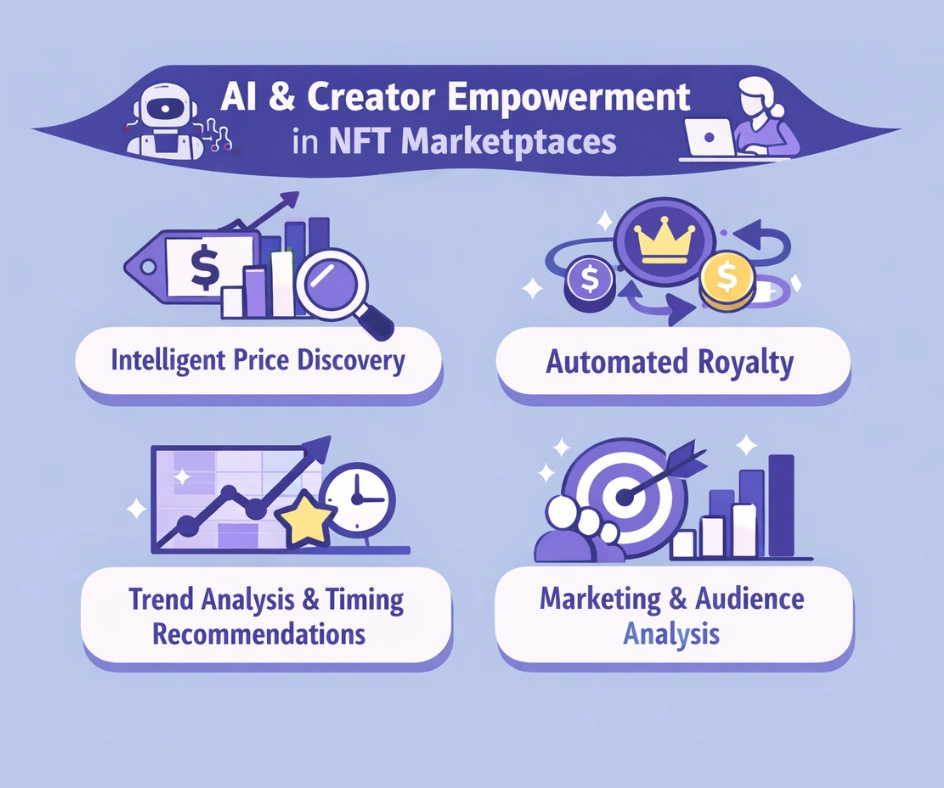
Creators often struggle to price their work appropriately. Underpricing leaves money on the table, while overpricing discourages buyers. AI systems can analyze the market to suggest optimal launch prices based on creator reputation, collection size, historical sales, and current demand. Some platforms now offer these recommendations as standard features.
AI can help creators understand which royalty percentages maximize their long-term earnings by balancing immediate revenue against the volume of secondary market sales. An algorithm might recommend lower royalties for emerging creators to encourage trading, and higher royalties for established artists with proven demand.
Machine learning systems can identify emerging trends in NFT collecting before they become mainstream. Creators using these insights can launch collections aligned with rising interest, dramatically improving their chances of success. An artist analyzing AI trend reports might decide to release dragon-themed NFTs when data shows increasing collector interest in fantasy artwork. To stay ahead of such shifts, businesses and creators can also find polar trends to better understand extreme market movements and early adoption patterns.
AI tools can identify which audiences are most likely to appreciate a creator’s work and suggest targeted marketing strategies. These tools analyze social media engagement, collection diversity, and spending patterns to predict which platforms and communities would most value a new NFT release.
Smart contracts that power NFT transactions can now access real-world data through blockchain oracles, which are services that feed external information onto the blockchain. An oracle might provide AI-generated market analysis that a smart contract uses to determine pricing. This creates more intelligent, responsive contracts that adapt to market conditions.
AI systems monitor NFT activity across multiple blockchains simultaneously. When an asset is listed on both Ethereum and Solana, AI algorithms can optimize which platform is more likely to find a buyer quickly. This cross-chain awareness helps match buyers and sellers more efficiently, regardless of which blockchain they prefer.
Blockchain transactions incur fees, which fluctuate based on network demand. AI systems now predict when fees will be lowest and recommend optimal timing for purchases and sales. This helps users minimize costs and maximize transaction efficiency. Some platforms automatically schedule transactions for low-fee periods when users enable this feature.
NFT marketplaces are increasingly moving transactions to layer-2 blockchains, which process transactions faster and cheaper than main networks. AI helps route transactions intelligently between main chain and layer-2 solutions based on transaction size, cost considerations, and user preferences.
Recommended Reading:
Primary vs Secondary NFT Marketplaces
The improvements that AI brings directly impact user retention. When marketplaces offer better recommendations, more users find assets they love. When fraud detection works effectively, users feel safe making purchases. When platforms provide transparent, fair systems, communities become more engaged. This translates to growth in monthly active users and transaction volumes.
Creators increasingly choose platforms where AI tools help them succeed. Marketplaces offering sophisticated analytics, pricing recommendations, and audience insights attract more talented artists. This creates a positive cycle where the best platforms attract the best creators, which attracts more collectors, which further strengthens the platform.
Institutional investors who previously avoided NFTs due to security and fraud concerns now view AI-enhanced marketplaces more favorably. When platforms demonstrate sophisticated fraud detection and transparent operations, traditional financial institutions feel more comfortable participating. This influx of institutional capital has significantly increased the NFT market value.
Some users believe that AI recommendations and price predictions promise guaranteed returns on NFT investments. This misunderstanding causes problems when users suffer losses despite following AI suggestions. The reality is that AI improves decision-making by providing better information, but markets remain unpredictable. AI cannot eliminate investment risk, only help users manage it more thoughtfully.
The most effective NFT platforms combine AI analysis with human expertise. Moderators review flagged transactions to prevent false positives from disrupting legitimate trading. Community members vote on algorithmic changes in some decentralized platforms. Algorithms provide insights, but humans make final decisions in high-stakes situations.
AI tools help creators succeed, but they do not create quality artwork. An AI that predicts market trends cannot make a creator produce better work. Pricing recommendations help, but only if the underlying art appeals to collectors. The most successful creators combine artistic skill with strategic use of AI tools.
Recommended Reading:
What is Treasure NFT? Is it Real or Fake?
The combination of blockchain technology and artificial intelligence creates environmental concerns that responsible platforms must address. Blockchain transactions require energy-intensive computation, particularly on proof-of-work networks like Bitcoin. Running sophisticated AI systems adds additional power consumption.
Platforms are taking several approaches to address these concerns. Some have moved to proof-of-stake blockchains like Ethereum 2.0, which use less energy dramatically. Others purchase carbon offsets or have committed to using renewable energy sources for their AI infrastructure. Some are developing more efficient AI architectures that deliver the same functionality with lower computational costs.
The industry has also begun recognizing that environmental impact varies significantly based on choices. A marketplace running on Solana with optimized AI systems has a far smaller environmental footprint than one using Bitcoin with compute-intensive machine learning algorithms. As awareness of these trade-offs grows, platforms that prioritize sustainability may gain competitive advantages.
Launch Your AI-Powered NFT Marketplace Platform Today
Our specialized team brings advanced expertise in blockchain technology and artificial intelligence to NFT marketplace development. We handle everything from smart contract creation to AI implementation, machine learning integration, and multi-chain support, ensuring your platform is built for growth, security, and exceptional user experience. Whether you need a curated art marketplace with sophisticated recommendation engines, a gaming NFT platform with fraud detection, or any specialized NFT solution, we deliver platforms that work effectively.
Start Your NFT Marketplace Project
Artificial intelligence is fundamentally transforming how NFT marketplaces operate. From the moment new users arrive at a platform to the moment transactions settle on the blockchain, AI systems work behind the scenes, making experiences better, safer, and more efficient. Recommendation engines help users discover assets and creators more quickly. Fraud detection systems protect billions of dollars in digital assets. Price analysis tools give collectors and creators better information for decision-making.
The integration of AI into NFT marketplaces addresses real problems that have limited mainstream adoption. The market’s growth from 48.7 billion in 2025 toward projections of 247 billion by 2029 reflects increased confidence in these platforms, partially driven by improvements that AI makes possible. As these technologies mature, the gap between well-engineered platforms with sophisticated AI and basic marketplaces will only widen.
However, the path forward requires careful consideration of challenges alongside opportunities. Privacy concerns, algorithmic bias, environmental impact, and the risks of false positives must all be addressed thoughtfully. The most successful platforms will be those that implement AI transparently, audit their systems for fairness regularly, engage their communities in decisions about algorithms, and design systems that minimize data collection while maximizing benefits.
For creators, NFT marketplaces enhanced by AI offer unprecedented opportunities. Artists can access tools that help them understand markets, price their work effectively, reach appropriate audiences, and receive compensation fairly. The barriers to entry for creators have lowered as AI democratizes access to insights that were previously available only to experienced traders.
For collectors and investors, AI-powered marketplaces provide better tools for discovering valuable assets, understanding market movements, and making informed decisions. The security improvements protect both casual collectors and institutional investors whose participation is driving the market forward.
Looking ahead, the next wave of AI innovation in NFT marketplaces will likely involve more sophisticated generative AI, deeper ecosystem integration across platforms, and increased community participation in algorithmic governance. The projects that successfully balance innovation with responsibility will define the future of this rapidly evolving space.
The transformation of NFT marketplaces through artificial intelligence is just beginning. Early platforms that embrace AI thoughtfully while addressing legitimate concerns will establish advantages that compound over time. For anyone building in this space, understanding both the possibilities and the challenges of AI integration is essential. The future belongs to platforms that use AI not just to extract value, but to create genuinely better experiences for everyone participating in the NFT ecosystem.
Frequently Asked Questions
Q1.How do recommendation engines in NFT marketplaces actually work?
Recommendation engines analyze your browsing history, purchases, collections you follow, and assets you interact with. They then identify patterns by comparing your behavior to thousands of other users with similar interests. When patterns match, the system suggests assets that similar users purchased or viewed. Over time, as the algorithm learns more about your specific preferences, recommendations become increasingly accurate. The goal is to help you discover assets aligned with your collecting interests without spending hours browsing thousands of listings.
Q2.Can AI fraud detection systems make mistakes, and what happens if I get flagged incorrectly?
Yes, AI systems can and do make mistakes. A legitimate transaction might occasionally trigger fraud alerts, especially if it deviates significantly from your normal behavior. For example, a much larger purchase than you typically make, or accessing your account from an unusual location, could trigger alerts. When this happens, most platforms require additional verification, like multi-factor authentication or contacting customer support. The important thing is that these safeguards prevent most fraud while affecting legitimate users minimally. If you do get blocked, reliable platforms have customer support teams that can quickly review and resolve the issue.
Q3.What data do AI systems need to work effectively, and how is my privacy protected?
AI systems work best when they have access to user behavior data like browsing history, purchases, and transaction patterns. This data helps systems make better recommendations and detect fraud. Most reputable platforms protect this data through encryption, access controls, and anonymization techniques. Many platforms also allow users to opt out of data collection while still using the marketplace. Privacy regulations like GDPR give users rights to access their data, correct errors, and request deletion. Responsible platforms are transparent about what data they collect and how it is used.
Q4.How can AI help me as an NFT creator price my work fairly?
AI tools analyze market data to recommend optimal pricing for new NFT releases. These recommendations consider factors like your creator reputation, the size of your existing collection, historical sales data, current collector demand for similar work, and broader market trends. The algorithms can identify underpriced similar assets and overpriced comparable works to help calibrate your pricing. While recommendations are not guaranteed to be perfect, they provide data-driven guidance that is far better than guessing. Many successful creators now use these tools as part of their launch strategy.
Q5.Are AI-generated NFTs real art, and will they affect prices for human-created work?
This is an evolving question in the NFT community. Some collectors view AI-generated images as a new art form deserving of recognition, while others believe authentic human creativity is essential to valuable art. The market is accommodating both perspectives. Platforms now host both AI-generated NFTs and human-created work in separate sections, allowing collectors to choose their preference. Evidence so far suggests that high-quality human-created work maintains value and appeal regardless of AI-generated competition. The distinction between human and AI creativity is becoming more important to collectors, not less.
Q6.How does AI impact the environmental footprint of NFT marketplaces?
AI systems require computational resources that consume electricity, adding to the environmental impact of NFT marketplaces. However, the overall impact depends on many factors. Marketplaces using proof-of-stake blockchains consume far less energy than those on proof-of-work networks. Platforms using efficient AI architectures and renewable energy have smaller footprints than those using compute-intensive algorithms on coal-powered servers. The key is that environmental impact varies significantly based on choices. Responsible platforms are addressing this by transitioning to efficient blockchains, implementing optimized AI systems, and committing to renewable energy sources.
Explore Services
Related Services
Reviewed by

Aman Vaths
Founder of Nadcab Labs
Aman Vaths is the Founder & CTO of Nadcab Labs, a global digital engineering company delivering enterprise-grade solutions across AI, Web3, Blockchain, Big Data, Cloud, Cybersecurity, and Modern Application Development. With deep technical leadership and product innovation experience, Aman has positioned Nadcab Labs as one of the most advanced engineering companies driving the next era of intelligent, secure, and scalable software systems. Under his leadership, Nadcab Labs has built 2,000+ global projects across sectors including fintech, banking, healthcare, real estate, logistics, gaming, manufacturing, and next-generation DePIN networks. Aman’s strength lies in architecting high-performance systems, end-to-end platform engineering, and designing enterprise solutions that operate at global scale.