Ai Overview
A Non-Fungible Token (NFT) is a unique digital asset that lives on a blockchain. During peak activity, a single transaction can cost anywhere from a few dollars to hundreds. Beeple’s “Everydays: The First 5000 Days” sold at Christie’s for $69 million and is the most famous example of 1:1 NFT artwork. Over $100 million worth of NFTs were stolen between July 2021 and July 2022, with scammers averaging around $300,000 per incident.
Key Takeaways
- Every NFT is unique and cannot be swapped for another, the way cash or crypto coins can.
- Smart contracts run NFT transactions on their own without any middleman getting involved.
- The floor price of a collection is the first number every buyer and founder checks before making a move.
- Royalties let creators earn a cut every time their NFT is resold, not just on the first sale.
- PFP collections make up 37 percent of total NFT trading volume, making them the biggest category by trade activity.
- ENS domains work like nicknames for wallet addresses, so people do not have to share a long string of characters.
- A rug pull happens when project founders disappear with the money, and it has burned thousands of buyers in the past.
- IPFS stores NFT files across many computers, so the asset does not vanish if one server goes offline.
- NFT ticketing already accounts for 5.3 percent of ticket sales at major US venues in 2025.
- Gas wars happen when too many people try to mint at once, and fees shoot up fast, often pricing out smaller buyers.
If you are working in the Web3 space or planning to launch an NFT project, you will quickly come across a flood of unfamiliar terms. NFT glossary terms, blockchain jargon, marketplace-specific phrases, and community slang all come at you at once. This becomes even more important when you start exploring NFT marketplace development solutions, where understanding the right terminology directly affects product decisions and platform features. Most glossaries online dump a list of terms and leave it at that. This guide is different. It is written for founders, product teams, and entrepreneurs who want to truly understand what these terms mean, how they connect to each other, and why they matter when building a business.
Whether you are building an NFT marketplace, launching a collection, or planning a gaming platform, knowing your NFT terminologies is not optional. It shapes your product decisions, your investor conversations, your legal understanding, and your go-to-market strategy. This is your full NFT glossary for founders, written in plain language that anyone can follow.
NFT Marketplace Development Guide
What Is an NFT?
A Non-Fungible Token (NFT) is a unique digital asset that lives on a blockchain. The word “non-fungible” is the key part here. Something fungible can be swapped for an identical version of itself. A ten-dollar bill is fungible because every ten-dollar bill is worth the same and can be traded for another. A Non-Fungible Token (NFT) cannot be swapped that way because each one is one-of-a-kind.
NFTs can represent digital art, music, videos, game items, domain names, tickets, credentials, real estate, or any other type of asset. What they all share is that ownership is recorded on a blockchain, making that record public, permanent, and nearly impossible to fake.
Fungible vs Non-Fungible is one of the most foundational ideas in NFT business terms. Get this distinction wrong in a pitch or a product spec, and it creates confusion fast. Fungible tokens are interchangeable. Non-Fungible Tokens are unique. That uniqueness is the entire basis for their value.
Core Blockchain NFT Terms
NFTs do not exist in a vacuum. They live on blockchains, and understanding blockchain NFT terms is non-negotiable for any founder in this space. Here are the most important ones explained clearly.
1. Blockchain
A blockchain is a digital ledger made up of blocks of data that are chained together and stored across many computers at once. No single person or company controls it. When an NFT is minted or transferred, that action is recorded in a new block and added to the chain. Once written, it cannot be changed or deleted. This is what makes NFT ownership verifiable without needing a bank or government to confirm it.
2. Ethereum
Ethereum is the most widely used blockchain for NFTs. It introduced the first NFT token standard and still powers approximately 62 percent of NFT transactions globally. Ethereum uses a programming language called Solidity for smart contracts, and it has the largest developer community in the Web3 space. High demand on Ethereum often leads to higher gas fees, which is why many founders also look at alternative blockchains.
3. Smart Contract
A smart contract is a self-executing program stored on a blockchain. It runs automatically when certain conditions are met, without needing a middleman. In the NFT world, smart contracts handle everything: they mint tokens, transfer ownership when payment is made, distribute royalties to original creators, and record every action permanently on the blockchain. Smart contracts are the engine behind every NFT transaction.
4. Token Standards: ERC-721 and ERC-1155
These are the two main NFT token standards on Ethereum. ERC-721 is the original standard and creates truly unique one-of-a-kind tokens. ERC-1155 is a newer multi-token standard that can handle both fungible and non-fungible tokens in one contract, making it more efficient for games and platforms that deal with large volumes of different asset types. Founders building NFT marketplaces or gaming platforms need to choose which standard fits their use case.
5. Gas Fees
Gas fees are the charges paid to blockchain validators for processing transactions. On Ethereum, gas fees fluctuate based on network demand. During peak activity, a single transaction can cost anywhere from a few dollars to hundreds. This is a real business concern for founders because high gas fees can hurt user adoption. Many projects choose Layer 2 solutions or alternative blockchains like Solana or Polygon specifically to reduce gas costs.
6. Decentralization
Decentralization means no single entity controls the system. A decentralized network spreads data and processing across thousands of computers called nodes. For NFTs, decentralization means ownership records are not held by any one company. If OpenSea shut down tomorrow, the NFTs on the Ethereum blockchain would still exist and still belong to their owners. This is a core value proposition of blockchain-based ownership.
7. Wallet
A wallet is software or hardware that stores a user’s private keys and lets them manage their blockchain assets. It is not actually storing the NFTs themselves, which live on the blockchain. The wallet holds the keys that prove ownership and allow transactions. MetaMask, Phantom, and Coinbase Wallet are common examples. For founders building NFT platforms, wallet integration is one of the first technical decisions to make.
8. Public Key and Private Key
A public key is your wallet address that others can see and send assets to. A private key is a secret code that proves you own that wallet and authorizes transactions. Whoever holds the private key controls the wallet. This is why “not your keys, not your coins” is a well-known phrase in crypto. Founders must educate their users on keeping private keys safe, as losing them means losing access to all assets permanently.
9. Layer 1 and Layer 2
Layer 1 refers to the base blockchain, like Ethereum or Solana. Layer 2 refers to secondary networks built on top of Layer 1 to improve speed and reduce costs. Polygon is a popular Ethereum Layer 2. For founders dealing with high transaction volumes, Layer 2 solutions often make economic sense because they process transactions more cheaply while still settling back on the secure Layer 1 chain.
10. Consensus Mechanism
A consensus mechanism is the method a blockchain uses to agree on which transactions are valid. Proof of Work (used by older Bitcoin) requires computational energy. Proof of Stake (now used by Ethereum since 2022) requires validators to lock up cryptocurrency as collateral. Proof of Stake is more energy-efficient and is now the standard for most NFT-focused blockchains.
NFT Marketplace Business Model Explained
NFT Marketplace Terminology
If you are planning to launch a marketplace or list your project on one, these NFT marketplace terminology terms will come up constantly. Understanding them will help you make better product decisions and communicate clearly with your development team.
1. Minting
Minting is the process of creating a new NFT on the blockchain. When someone mints an NFT, a smart contract registers the token with a unique ID on the ledger. The creator’s wallet address is recorded as the original owner. Minting can be paid (where the creator pays gas fees upfront) or lazy minted (where the cost is passed to the buyer at point of first sale). Founders need to decide which minting model their marketplace will support.
2. Listing and Floor Price
When an NFT is put up for sale on a marketplace, it is called a listing. The floor price of a collection is the lowest price at which any NFT from that collection is currently listed. Floor price is one of the most watched metrics in the NFT space. A rising floor price signals growing demand. A dropping floor price is often the first sign of declining interest. For founders running a marketplace, displaying floor prices clearly is an important UX decision.
3. Royalties
Royalties are the percentage of each secondary sale that goes back to the original creator. If an artist mints an NFT and sets a 10 percent royalty, every time that NFT is sold to a new buyer, 10 percent of that sale goes back to the artist automatically through the smart contract. This is one of the most appealing features for NFT creators because it gives them ongoing income from their work long after the initial sale.
4. Primary and Secondary Market
The primary market is where NFTs are sold for the first time, directly from the creator or project. The secondary market is where those NFTs are resold between collectors. Marketplaces like OpenSea operate mostly in the secondary market. Many NFT projects have their own primary sale mechanisms through their website before the NFTs ever hit a marketplace. OpenSea alone accounts for 90 percent of Ethereum NFT trading volume and hosts over 80 million NFTs as of 2024. Founders building platforms must decide whether they are targeting primary, secondary, or both market types.
5. Dutch Auction and English Auction
These are two common auction formats used in NFT sales. In a Dutch auction, the price starts high and drops over time until a buyer accepts the current price. This creates urgency without requiring competitive bidding. In an English auction, the price starts low and rises through competing bids. NFT platforms like Foundation use timed English auctions. Founders should understand both models to decide what fits their creator community.
6. Curated vs. Open Marketplaces
A curated marketplace only accepts NFTs that pass a selection or verification process. Foundation and SuperRare are curated. An open marketplace lets anyone list anything without approval. OpenSea is open. Curated platforms tend to attract higher-quality work and higher average prices. Open platforms have higher volume and more variety. The choice between curated and open is a core strategic decision for any marketplace founder.
7. Airdrop
An airdrop is when tokens or NFTs are sent directly to wallet addresses for free. Projects use airdrops to reward early supporters, build community, or promote a new launch. For founders, airdrops are a growth and retention tool. They create goodwill and often generate buzz on social media. However, poorly planned airdrops can attract wallet-holders who immediately sell, which crashes prices.
8. Whitelist (WL)
A whitelist is a pre-approved list of wallet addresses that are allowed to mint an NFT before the public. Being on the whitelist usually means lower or no gas fees during mint and a guaranteed spot. Whitelists are used to reward community members and build hype before a public launch. For founders, managing a whitelist well is a key part of community strategy.
9. Reveal
Many NFT collections launch as a blind mint, where buyers receive a placeholder image and do not see the actual NFT until a reveal date. This is common in generative collections where traits are randomly assigned. The reveal creates a shared event that drives social media activity and community excitement. Founders need to plan the timing and mechanics of reveals carefully, as they strongly affect community reaction.
10. Rarity and Traits
In generative NFT collections, each token is made up of different visual traits like background color, clothing, accessories, and expressions. Some traits appear in many tokens, while others appear in very few. Rarity refers to how uncommon a specific trait or combination is. Tools like Rarity Sniper and Rarity Tools rank NFTs within collections by their rarity score. Rarity drives price differences within a collection and is a core concept in NFT collectibles.
NFT Marketplace Development Costs
| Development Component | Cost Range | Key Considerations |
|---|---|---|
| Basic Platform Features | $30,000 – $50,000 | User authentication, NFT minting, buying/selling functionality, basic wallet integration |
| Advanced Platform Features | $100,000 – $150,000+ | Custom smart contracts, multi-chain support, advanced analytics, decentralized storage, royalty management |
| UI/UX Design | $5,000 – $20,000 | Simple interface vs. custom-branded design with intricate elements |
| Blockchain Integration | $10,000 – $20,000 | Ethereum is the most common; alternatives like Solana or BSC may vary |
| Smart Contract Development | Included in platform costs | Token standards (ERC-721, ERC-1155), security audits, testing |
| Security Implementation | $5,000 – $15,000 | Encryption, multi-factor authentication, and regular security audits |
| Ongoing Maintenance | $1,000 – $5,000/month | Server hosting, updates, customer support, security monitoring |
NFT Business Terms That Directly Affect Your Revenue Model
Many NFT founders understand the technology but miss the business mechanics. These NFT business terms describe how money flows through NFT projects and platforms.
1. Creator Royalties
As mentioned earlier, royalties give creators a cut of every future sale. The standard range is 5 to 10 percent. Some platforms enforce royalties at the smart contract level. Others allow buyers and sellers to bypass them. This ongoing debate is a major business issue for NFT founders. If your platform does not enforce royalties, you risk losing creator loyalty. If you enforce them strictly, some traders may prefer competitor platforms with optional royalties.
2. Platform Fees
Marketplaces charge a percentage of each sale to sustain the platform. OpenSea charges 2.5 percent on each transaction. These platform fees are the primary revenue source for most NFT marketplaces. Founders setting their own fee structure need to balance competitive pricing with sustainable operations. Charging too much drives creators to competitors. Charging too little may make the business unsustainable.
3. Tokenomics
Tokenomics refers to the economic system built around a token. This includes total supply, how tokens are distributed, how they are earned or spent, and what gives them value. For NFT platforms that issue their own tokens like Rarible’s RARI, tokenomics determines how governance works, how revenue is shared, and how the community is incentivized to participate. Poorly designed tokenomics can sink a project even if the product itself is strong.
4. DAO (Decentralized Autonomous Organization)
A DAO is an organization governed by smart contracts and community token votes rather than a traditional management team. Some NFT platforms are transitioning to DAO structures to give their communities direct control. Rarible introduced RARI tokens specifically so token holders can vote on platform changes. For founders, deciding whether to build toward DAO governance is a significant strategic question that affects everything from fundraising to product direction.
5. Floor Sweeping
To sweep the floor means to buy many or all of the NFTs listed at a collection’s floor price at once. This is usually done by whales or investment groups. Floor sweeping drives the floor price up quickly and signals strong conviction in a project. For founders, understanding floor sweeping behavior helps in designing price curves, supply structures, and community communication strategies.
6. Wash Trading
Wash trading is when someone buys and sells an NFT to themselves using different wallets to artificially inflate volume or price. It is a form of market manipulation. Founders building marketplaces need to design systems that detect and limit wash trading, especially if they plan to list trading volume publicly or use it to attract creators and collectors.
Primary vs Secondary NFT Marketplaces
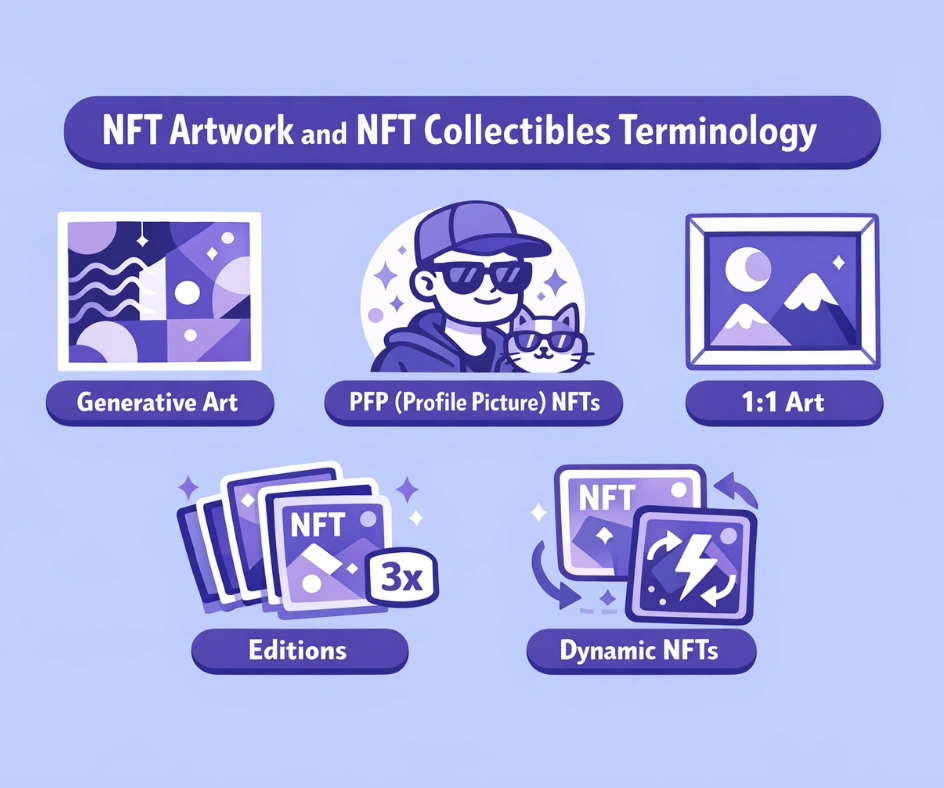
NFT Artwork and NFT Collectibles Terminology Explained
NFT artwork and NFT collectibles are the most visible categories in the space. These terms describe how these assets are created, structured, and valued.
1. Generative Art
Generative art is created by an algorithm that randomly combines traits from a predefined set of assets. Collections like CryptoPunks and Bored Ape Yacht Club are generative. A script picks from hundreds of possible traits like hats, eyes, mouths, and backgrounds to create each unique token. The rarest trait combinations command the highest prices.
2. PFP (Profile Picture) NFTs
PFP stands for Profile Picture. These are NFT collections where each token is designed to be used as a social media profile picture. PFP collections make up 37 percent of total NFT trading volume, according to market data.[1] CryptoPunks, Bored Apes, and Azuki are well-known examples. Owning a PFP from a prestigious collection has become a form of social signaling in the Web3 world.
3. 1:1 Art
1:1 art (said as “one of one”) refers to a single, unique piece with no copies. These are usually created by individual artists and sold in auctions on platforms like SuperRare or Foundation. Beeple’s “Everydays: The First 5000 Days” sold at Christie’s for $69 million and is the most famous example of 1:1 NFT artwork. These pieces hold different value dynamics compared to generative collections.
4. Editions
Editions are NFTs where multiple copies of the same work are minted. An artist might create an edition of 100, meaning 100 people can own the same artwork as a limited edition print. This is similar to the traditional art world concept of limited-edition prints. Editions are priced lower than 1:1 works but still carry provable scarcity.
5. Dynamic NFTs
Dynamic NFTs are tokens whose metadata can change based on external conditions. For example, a sports NFT might update a player’s stats after each game. Or a game character’s appearance might evolve as the player levels up. Dynamic NFTs use oracle services to feed real-world data into smart contracts. They are a growing area, especially in gaming and sports.
Web3 Domains and Digital Identity in the NFT World
Web3 domains are a category of NFTs that most NFT glossaries do not cover deeply enough. They are important for founders thinking about digital identity infrastructure.
1. What Are Web3 Domains?
Web3 domains are blockchain-based domain names that replace complicated wallet addresses with human-readable names. Instead of sending money to “0x742d35Cc6634C0532925a3b844Bc454e4438f44e,” you can send it to “yourname.eth” or “yourname.crypto.” These domains are owned as NFTs, meaning you hold them in your wallet and no central registry can take them away. Ethereum Name Service (ENS) is the most popular Web3 domain provider.
2. ENS (Ethereum Name Service)
ENS maps human-readable names to machine-readable blockchain identifiers. It works similarly to how the traditional DNS system maps domain names like “google.com” to IP addresses, except ENS runs on the Ethereum blockchain without any central authority controlling it. ENS domains have sold for tens of thousands of dollars for highly sought-after names.
3. Soul-Bound Tokens (SBTs)
Soul-bound tokens are NFTs that are permanently tied to one wallet and cannot be transferred or sold. They are designed to represent credentials, achievements, memberships, and reputation. Think of them as blockchain versions of a diploma or professional certificate. For founders building platforms around identity, credentials, or community membership, soul-bound tokens are an important concept to understand.
On-Chain vs Off-Chain NFTs Explained
NFT Community and Culture Terms
Community is one of the most important assets any NFT project can build. These NFT terminologies come from the community itself, and knowing them helps founders connect with their audience authentically.
1. WAGMI and NGMI
WAGMI stands for “We’re All Gonna Make It.” It is used to express community optimism and support. NGMI stands for “Not Gonna Make It” and is used to criticize poor decisions or pessimistic thinking. These terms might seem like just slang, but they reflect the deeply community-driven culture of NFTs. Using them naturally in communications signals to your community that you understand their world.
2. HODL
HODL started as a typo for “hold” in a 2013 Bitcoin forum post and became a rallying cry for holding assets through market dips rather than selling in panic. It now stands informally for “Hold On for Dear Life.” NFT communities use it to encourage long-term belief in a project even when prices fall.
3. FUD
FUD stands for Fear, Uncertainty, and Doubt. It refers to negative or misleading information spread about a project to discourage investment or participation. Founders need to distinguish between legitimate criticism and FUD, and respond to each differently. Ignoring real concerns damages trust. Over-reacting to FUD can signal weakness to the community.
4. FOMO
FOMO means Fear of Missing Out. In NFTs, it describes the feeling of rushing to buy into a rising project before prices go higher. FOMO-driven buying can inflate prices quickly and crash them just as fast. Founders can design mint mechanics, whitelists, and reveal events to activate positive FOMO, but must manage it carefully to avoid price collapses that damage community trust.
5. Degen
Short for “degenerate,” a degen is someone who makes high-risk investments in NFT or crypto projects, often without thorough research. The term is used both as a criticism and as a badge of honor, depending on context. Many early NFT investors self-identify as degens. Understanding degens’ behavior matters for founders because degens drive early trading volume and can make or break a launch.
6. Rug Pull
A rug pull happens when the founders of a project take investor or community funds and disappear. It is one of the most common scams in the NFT space. Over $100 million worth of NFTs were stolen between July 2021 and July 2022, with scammers averaging around $300,000 per incident. Signs of a potential rug pull include anonymous team members, no verifiable roadmap, and pressure to invest quickly. Founders building legitimate projects need to take transparency seriously because the community is highly sensitive to rug-pull red flags after years of being burned.
7. Blue Chip NFTs
Blue-chip NFTs are collections that are considered established, lower-risk investments in the NFT world. These are collections that have proven staying power, strong communities, and consistent trading volumes. CryptoPunks, Bored Ape Yacht Club, and Art Blocks are examples. The term is borrowed from traditional finance, where blue-chip stocks are the most established companies.
NFT Types and Their Primary Use Cases
| NFT Type | Primary Use Case | Example Platforms | Revenue Potential |
|---|---|---|---|
| NFT Artwork (1:1) | High-value single art piece sales | SuperRare, Foundation | Very high per item, lower volume |
| PFP Collections | Community building, social identity | OpenSea, Blur | High volume, royalty income |
| Gaming NFTs | In-game assets, characters, and land | Axie Infinity, The Sandbox | Play-to-earn, marketplace fees |
| Virtual Real Estate | Digital land ownership and development | Decentraland, The Sandbox | Rental income, event hosting |
| Event Tickets | Fraud-proof ticketing, resale control | GET Protocol, YellowHeart | Primary sales, resale royalties |
| Music NFTs | Direct fan ownership of songs/albums | Sound.xyz, Royal | Streaming royalty sharing |
| Web3 Domains | Blockchain identity and wallet naming | ENS, Unstoppable Domains | Registration fees, renewal fees |
Storage, Metadata, and Technical NFT Terms
Many founders focus on the visual and community side of NFTs and overlook the technical foundation. These technical NFT terms explained here are the ones that determine whether your NFT project is built to last.
1. Metadata
NFT metadata is the information attached to a token. This includes the name, description, image URL, and trait data. The metadata is what tells a marketplace how to display an NFT. Most NFT metadata is stored as a JSON file. The quality and permanence of metadata storage directly affect the long-term value of an NFT.
2. IPFS (InterPlanetary File System)
IPFS is a peer-to-peer file storage system that stores files across many computers rather than on a single server. When an NFT points to an image stored on IPFS, that image is stored in a way that does not depend on any single company staying online. If the file is stored on a regular web server and that server goes down, the NFT becomes a broken link. IPFS is the standard recommended storage method for NFT assets.
3. On-Chain vs. Off-Chain Storage
On-chain storage means the actual image or file data is stored directly on the blockchain. This is the most permanent and tamper-proof option, but it is expensive because blockchain storage is costly. Off-chain storage means the image lives on a server like IPFS or Arweave, and the blockchain only holds a link to it. Most NFTs use off-chain storage for images. The choice affects both cost and permanence.
4. Arweave
Arweave is a decentralized storage network designed for permanent data storage. Unlike IPFS, where data can disappear if no one is “pinning” it, Arweave is designed to store data permanently through a one-time payment. It is increasingly popular for NFT projects that want to guarantee their assets will be accessible forever.
5. Oracle
A blockchain oracle is a service that brings real-world data onto the blockchain. Smart contracts by themselves cannot access data from outside the blockchain. Oracles solve this. For dynamic NFTs that need to update based on real-world events like sports scores or weather, oracles are the bridge that makes it possible. Chainlink is the most widely used oracle network.
6. Bridging
Bridging is the process of moving an NFT or cryptocurrency from one blockchain to another. For example, moving an Ethereum NFT to the Polygon network to reduce gas costs. Cross-chain bridging is technically complex and introduces risks, as bridges have been the target of major hacks in the crypto space. For multi-chain marketplace founders, understanding bridging mechanics is essential.
How NFTs Are Created, Minted & Sold
The NFT Glossary Section
This quick-reference NFT glossary for founders covers the terms you will hear most often when building, pitching, or operating in the NFT space. These are ordered by how frequently they come up in everyday NFT business conversations.
Frequently Used NFT Terminologies
ATH (All-Time High): The highest price an NFT or collection has ever reached. Often used as a benchmark when tracking price performance.
ATL (All-Time Low): The lowest price recorded. A project near its ATL is often said to be “in the trenches.”
Bear Market: A prolonged period when prices are falling across the NFT and crypto market. Many projects lose significant value during bear markets.
Bull Market: A period of rising prices and strong demand. The NFT boom of 2021 was a classic bull market cycle.
Burn: Sending an NFT to a wallet address from which it can never be retrieved, permanently removing it from circulation. Used to reduce supply and increase scarcity.
Diamond Hands: Holding an asset through heavy market pressure without selling. The opposite of paper hands.
Paper Hands: Selling an asset quickly at the first sign of a price drop. Used critically in NFT communities.
Pump and Dump: A scheme where a group artificially inflates a project’s price through coordinated buying and hype, then sells all at once, leaving other holders with losses.
Shill: Promoting an NFT project aggressively, sometimes in a deceptive way. Can be organic community support or paid promotion.
Minting Pass: An NFT that grants the holder the right to mint from a future collection. Used as an early community reward.
Gas War: When many users try to mint simultaneously, they compete by paying higher and higher gas fees to have their transaction processed first. Gas wars can price out smaller holders during popular launches.
Allowlist: The updated term for whitelist, used to avoid associations with negative historical uses of the word “white.” Both refer to pre-approved wallet addresses for early minting.
Snapshot: A point-in-time record of wallet holdings used to determine who qualifies for airdrops, allowlists, or governance votes.
P2E (Play-to-Earn): A game model where players earn cryptocurrency or NFTs as rewards for playing. Axie Infinity popularized this model.
OpenSea: The largest NFT marketplace by volume, hosting over 80 million NFTs and accounting for 90 percent of Ethereum NFT trading volume as of 2024.
Ready to Build Your NFT Platform?
We bring 8+ years of blockchain expertise to NFT marketplace development. Our specialized team handles everything from smart contract creation to multi-chain integration, ensuring your platform is built for growth, security, and user experience. Whether you need a curated art marketplace or a gaming NFT platform, we deliver solutions that work.
Final Thoughts
The NFT space has its own language, and if you are building in it, speaking that language matters more than most founders realize. From understanding the difference between fungible and non-fungible to knowing how smart contracts handle royalties, each term in this guide is a building block of how the industry actually works.
NFT terminologies are not just vocabulary. They represent the mechanics of a new kind of digital economy. The NFT glossary for founders in this article covers blockchain NFT terms, NFT marketplace terminology, NFT business terms, and the community slang that shapes how projects succeed or fail. This knowledge applies whether you are building a marketplace, launching a collection, designing a gaming economy, or exploring Web3 domains for digital identity.
The global NFT market is still expanding. With gaming NFTs projected to reach $942.58 billion by 2029 and event ticketing NFTs already making up 5.3 percent of ticket sales at major US venues in 2025, the real-world utility of NFTs is growing far beyond speculation. Founders who understand the terminology, the mechanics, and the community culture will be the ones who build platforms that last.
Whether you are just starting to explore NFT terms explained or you are deep in the process of building a product, keep this guide close. The vocabulary will keep evolving. But the foundations covered here, smart contracts, token standards, storage, royalties, marketplace mechanics, and community dynamics, will remain the core of how NFTs work for years to come.
Frequently Asked Questions
Q1.What is an NFT?
An NFT is a unique digital item that you can own on a blockchain. No two are the same, and no one can copy them. Think of it like owning an original painting, except it lives online and the blockchain proves it is yours.
Q2.What is the difference between ERC-721 and ERC-1155 token standards?
ERC-721 creates one unique token per contract deployment, making each token fully non-fungible and distinct. ERC-1155 is a multi-token standard that allows a single smart contract to manage both fungible and non-fungible tokens simultaneously. ERC-1155 is more efficient for gaming platforms where thousands of different item types need to be managed at once, while ERC-721 is preferred for art collections where the uniqueness of each token is the primary value.
Q3.Why do gas fees vary so much on Ethereum?
Gas fees on Ethereum are determined by supply and demand for block space. When many users are trying to transact at the same time, they compete by offering higher gas prices to have their transactions processed first. During high-demand events like popular NFT mints, gas fees can spike dramatically. This is why many founders choose Layer 2 networks like Polygon or alternative chains like Solana for platforms that need frequent or low-cost transactions.
Q4.What is the difference between a curated and an open NFT marketplace?
A curated marketplace like SuperRare or Foundation reviews and selects which creators and collections can list on their platform. This tends to result in higher-quality work, higher average sale prices, and a more exclusive reputation. An open marketplace like OpenSea allows any creator to list without approval, resulting in much higher volume and variety but with more noise. Founders choosing between the two models are essentially choosing between quality-focused and volume-focused growth strategies.
Q5.How do NFT royalties actually work technically?
NFT royalties are programmed into smart contracts at the time of minting. When a secondary sale occurs on a marketplace that honors the royalty settings, the smart contract automatically splits the payment, sending the royalty percentage to the creator’s wallet and the remainder to the seller. The enforcement of royalties depends on whether the marketplace platform respects the royalty data in the contract. Some newer platforms allow buyers and sellers to bypass royalties, which has created ongoing debate in the creator community.
Q6.What is lazy minting, and why does it matter for founders?
Lazy minting allows creators to list NFTs without paying gas fees at the time of creation. The NFT is not actually minted on the blockchain until someone buys it. At that point, the minting and transfer happen in a single transaction, and the gas cost is included in the buyer’s payment. This lowers the barrier for creators to list work on a marketplace and is an important feature for platforms that want to attract large numbers of artists who cannot afford upfront minting costs.
Q7.What makes IPFS different from regular web hosting for NFT storage?
Regular web hosting stores files on servers owned by a company. If that company shuts down or removes the file, the NFT becomes a broken link pointing to nothing. IPFS stores files across a distributed network of computers. The file is addressed by its content, not by where it is stored, so it can be accessed from any node that has a copy. This makes IPFS significantly more durable for NFT asset storage, though files still need to be actively “pinned” by someone to remain available long-term, which is where Arweave offers a more permanent solution.
Explore Services
Related Services
Reviewed by

Aman Vaths
Founder of Nadcab Labs
Aman Vaths is the Founder & CTO of Nadcab Labs, a global digital engineering company delivering enterprise-grade solutions across AI, Web3, Blockchain, Big Data, Cloud, Cybersecurity, and Modern Application Development. With deep technical leadership and product innovation experience, Aman has positioned Nadcab Labs as one of the most advanced engineering companies driving the next era of intelligent, secure, and scalable software systems. Under his leadership, Nadcab Labs has built 2,000+ global projects across sectors including fintech, banking, healthcare, real estate, logistics, gaming, manufacturing, and next-generation DePIN networks. Aman’s strength lies in architecting high-performance systems, end-to-end platform engineering, and designing enterprise solutions that operate at global scale.