Ai Overview
Treasure NFT presented itself as the world’s first AI-powered NFT trading platform — a decentralized marketplace where you could deposit USDT, and an advanced algorithm would trade NFTs on your behalf, generating consistent daily profits. That compounds to roughly 600% return in 150 days — a claim the platform itself made on its marketing materials. For context, even the best-performing hedge funds in the world average 20% to 30% per year.
Key Takeaways
- Treasure NFT is a blockchain-based digital asset platform that enables investors and collectors to discover, buy, and trade rare and valuable NFTs in a secure and transparent environment.[1]
- Treasure NFT is fake. It was not a legitimate NFT marketplace but a Ponzi-style structure that promised unrealistic daily returns of 4.3% to 6.8%, which equals nearly 600% in 150 days — an impossible claim in any real financial market.
- Treasure NFT is most likely fake, as there is no proof of real NFT trading happening on any blockchain, no security checks have been done on its system, and a large number of users have lost their money because the platform stopped allowing withdrawals.
- Guaranteed daily returns of 4.3% to 6.8%, fabricated leadership profiles, manipulated app store reviews, and completely unresponsive customer support are the major warning signs.[3]
- Treasure NFT matches every classic Ponzi indicator, including unsustainable returns, recruitment dependency, withdrawal freezes, and rebranding to NFT Gold and Nova NFT after collapse.[4]
- The Treasure NFT withdrawal problem was not a technical glitch. Thousands of users reported frozen accounts, “Unqualified Conditions” errors, and blocked withdrawals once new deposits slowed down.
- There was no verifiable on-chain NFT trading activity linked to Treasure NFT on public blockchain explorers, despite claims of AI-powered automated trading.
- Investors should verify team identities, check blockchain explorers for real transaction activity, and avoid any platform that promises fixed, guaranteed returns in a volatile market.
- Established marketplaces like OpenSea, Magic Eden, and Rarible offer genuine on-chain NFT trading with transparent fee structures and no requirement for user recruitment.
It started the way most financial scams begin, with a message from someone you trust.
“Bhai, this app is paying 5 percent daily. I already withdrew twice. You should try it.”
Throughout 2024 and early 2025, people across India, Pakistan, and Bangladesh received similar messages from friends, relatives, and colleagues. The app was called Treasure NFT. It featured a professional-looking dashboard, live profit updates, and positive ratings on Google Play. It claimed to use artificial intelligence to trade NFTs automatically and generate daily returns. Users were told they did not need trading knowledge, market experience, or even time. The system would handle everything.
For many, especially first-time investors struggling with rising living costs, it felt like an opportunity that was finally within reach. Then everything changed.
By March 2025, Treasure NFT suddenly stopped processing withdrawals. Soon after, the platform disappeared entirely. Reports suggested that billions of rupees had been collected from users. In Pakistan alone, more than 100,000 investors were reportedly affected, with accounts frozen and customer support becoming unreachable. News outlets also reported tragic personal consequences, including a case in Rahim Yar Khan, where a young investor who had put in his savings and encouraged family members to join was unable to cope after the collapse.
This is the complete story of Treasure NFT, what it claimed to be, how it operated, who it targeted, and why so many ordinary and educated people believed it was real.
What Is Treasure NFT?
Treasure NFT presented itself as the world’s first AI-powered NFT trading platform — a decentralized marketplace where you could deposit USDT, and an advanced algorithm would trade NFTs on your behalf, generating consistent daily profits.
On the surface, it had everything a legitimate platform would need: a mobile app available in 75+ countries, a professional website at treasurenft.xyz, claims of a Money Services Business (MSB) license from FinCEN in the US, and a Google Play rating of 4.8 out of 5.
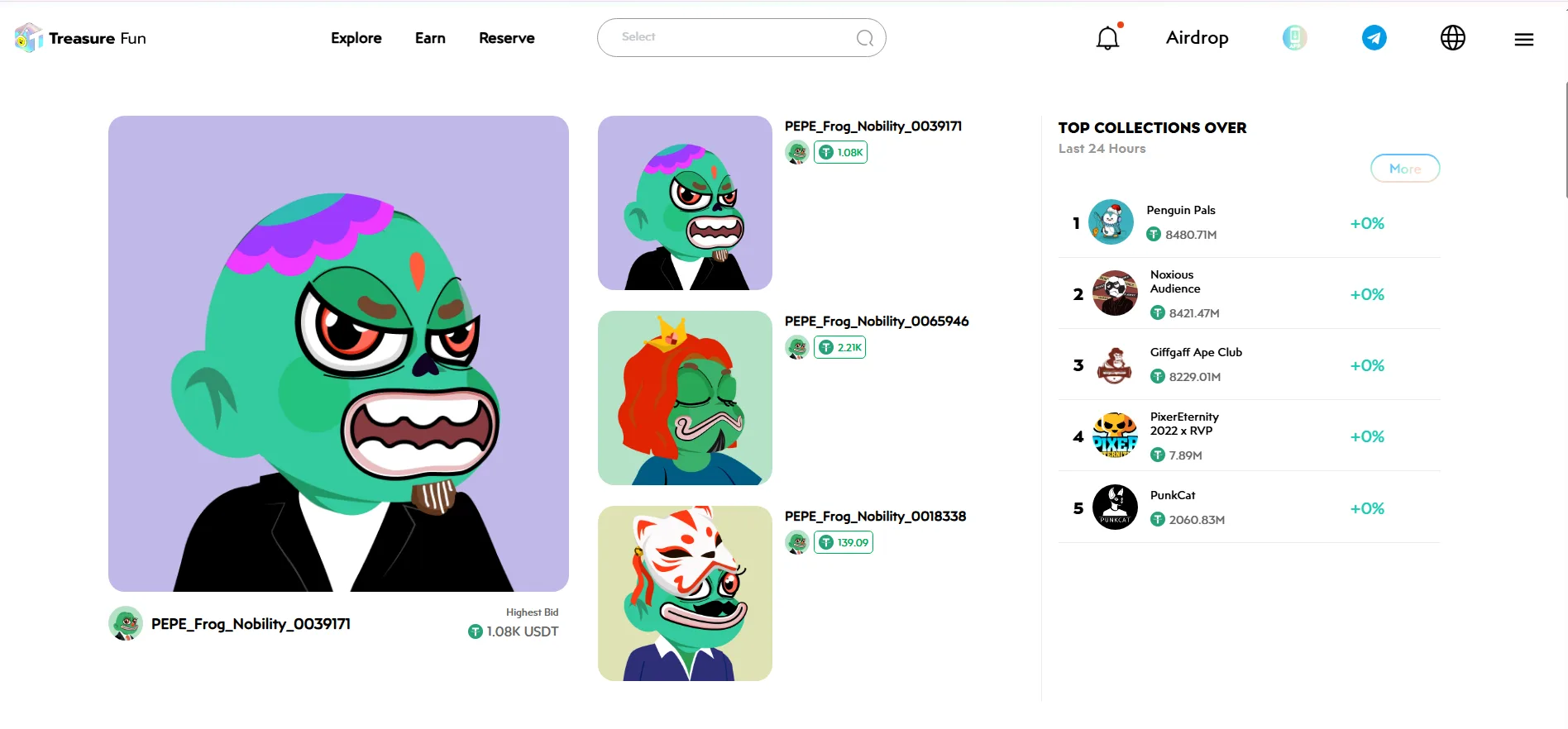
The platform claimed to operate on the Polygon blockchain (with plans for Ethereum, BNB Smart Chain, and TRON) and offered features like:
- Daily Returns: 4.3% to 6.8% per day
- Referral Bonuses: 11% from direct recruits, with smaller cuts from deeper network levels
- Fractional NFTs: The ability to buy portions of high-value digital assets
- AI Pricing Algorithm: An automated system that claims to reduce NFT price volatility
Unlike legitimate NFT marketplaces such as OpenSea or Rarible, where buyers and sellers trade real digital assets that can be verified on a blockchain explorer, Treasure NFT showed no publicly traceable on chain activity. There was no detailed whitepaper explaining the business model, no audited smart contracts to prove how funds were handled, and no transparent tokenomics outlining how returns were generated.
What users saw on the dashboard looked like trading activity, but there was no independent proof behind it. The idea of automated NFT trading powered by artificial intelligence and promoted as advanced agentic AI solutions was simply the narrative used to build trust. was simply the narrative used to build trust. In reality, the only tangible asset in the system was the money deposited by new users. Businesses looking to build genuine AI-powered solutions should work with trusted experts and hire AI developer teams with proven experience rather than relying on unverified AI claims.
Also Read: NFT Marketplace Development Guide
Why Are So Many People Searching “Is Treasure NFT Real or Fake”?
If you reached this page through a search engine, you are not alone, and your concern is completely valid. Thousands of people are asking the same question right now. Here is why.
If a friend invited you to join Treasure NFT:
They may not be intentionally misleading you. Many early users genuinely believed the platform was working because they were able to withdraw small amounts at the beginning. Those early payouts created trust. When someone says they withdrew twice, they are likely telling the truth. However, those payments were not real profits generated from NFT trading. They were funded by deposits from newer members. This is how such schemes build credibility in the early stages.
If you have already invested money:
Pause before making any further decisions. Do not deposit additional funds. Do not invite friends or family in an attempt to recover your money. Platforms like this often encourage users to add more funds to unlock withdrawals or higher returns. That is typically the stage where losses increase rapidly.
If your withdrawal has been blocked:
You are not alone. Many users reported seeing messages such as “Unqualified Conditions” when attempting to withdraw funds. This is unlikely to be a simple technical issue. When large numbers of users face the same restriction at the same time, it usually indicates a systemic control mechanism designed to slow or stop payouts.
If you are searching from India or Pakistan:
Regulatory attention increased after complaints began to surface. Reports indicated that authorities started examining the scale of losses as more victims came forward. When investigations begin, it often signals that the issue has moved beyond isolated complaints and into a broader financial concern.
Search queries such as “Is Treasure NFT a scam?”, “Is Treasure NFT legal in India?” “Treasure NFT withdrawal problem”, “Treasure NFT Unqualified Conditions”, and “Can you withdraw from Treasure NFT?” are not random keywords. They reflect real confusion, real fear, and real financial stress. This article is written to address those concerns clearly and logically so you can understand what happened and protect yourself moving forward.
Is Treasure NFT Real or Fake? The Verdict
Treasure NFT is fake. It is not a legitimate NFT marketplace. This is not speculation. It is the documented conclusion of multiple independent review platforms, crypto watchdogs, investigative journalists, and regulatory agencies across two countries.
Here is the evidence:
1. Unrealistic Return Promises
Treasure NFT promised daily returns of 4.3% to 6.8%. That compounds to roughly 600% return in 150 days — a claim the platform itself made on its marketing materials. For context, even the best-performing hedge funds in the world average 20% to 30% per year. The NFT market, where prices can drop 90% in a bear cycle (as happened broadly post-2022), cannot guarantee any fixed daily return.
Financial experts are unanimous: no legitimate investment product can guarantee fixed daily profits. The only way to pay fixed returns in a volatile market is to use money from new investors to pay old investors. That is the legal definition of a Ponzi scheme.
2. Only 6.4% of Withdrawals Were Ever Processed
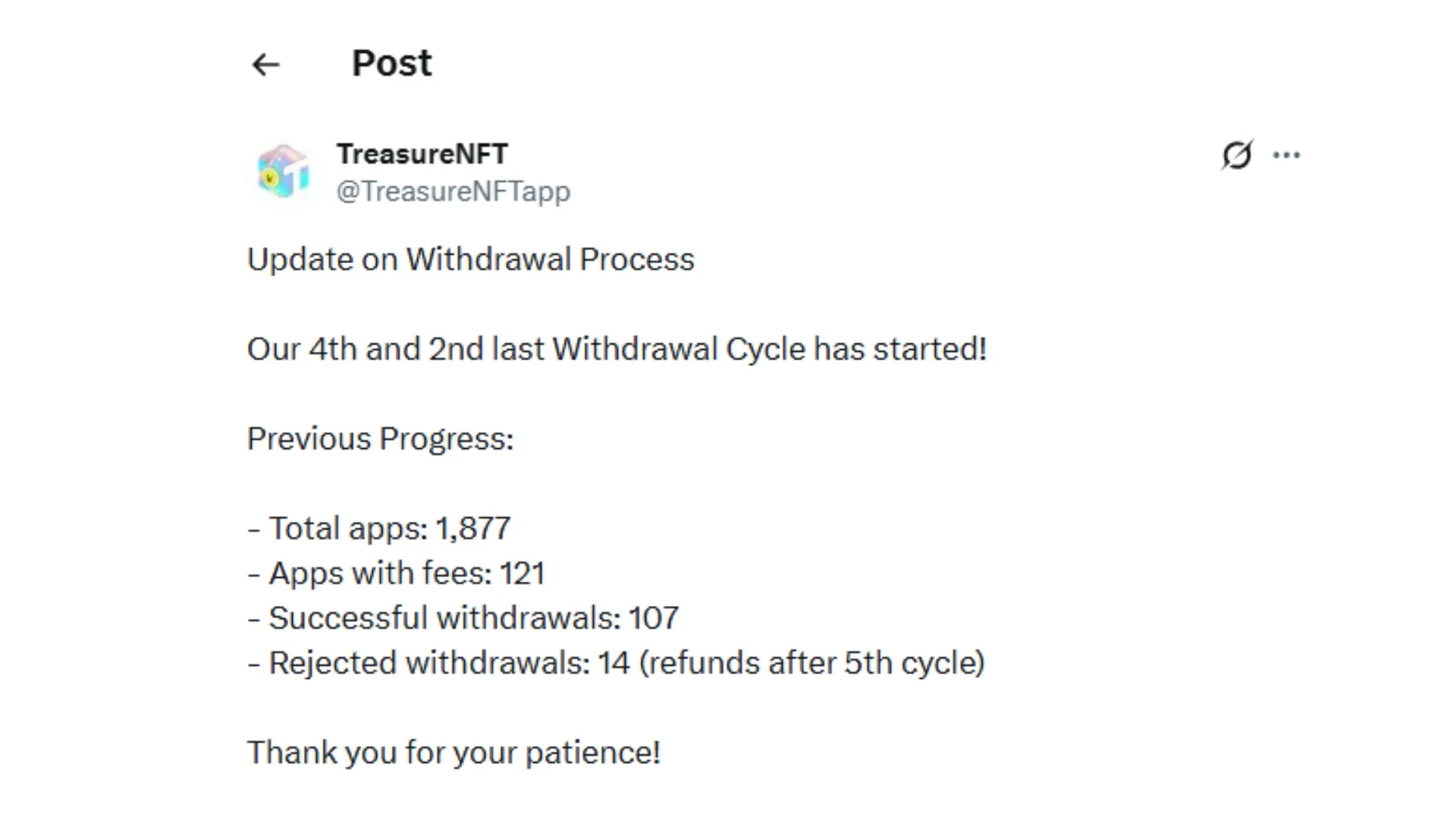
This is the most damning single fact. In March 2025, as complaints mounted, TreasureNFT’s own official X account published withdrawal data. Of 1,887 withdrawal forms submitted, only 121 were successfully processed. The rest were either rejected on technicalities, left perpetually pending, or met with the “Unqualified Conditions” error.
3. No Real NFT Trading on Any Blockchain
Every legitimate NFT transaction is permanently visible on a public blockchain explorer (Etherscan for Ethereum, Polygonscan for Polygon, Solscan for Solana). No independent investigator has found verifiable NFT trading activity associated with TreasureNFT on any public blockchain. The “AI trading” narrative exists only inside the app’s internal dashboard — numbers that any programmer with no underlying asset movement can generate.
4. The Platform Has Now Collapsed and Rebranded
Treasure NFT’s official Telegram channel — which had over 419,000 subscribers — went silent after March 30, 2025. The website was flagged as unsafe by major browsers. Most browsers now display security warnings when users try to visit the domain.
Real Stories: What Actually Happened to Investors
The statistics tell one story. The individual human experiences tell another.
The Pakistan Collapse — Rs. 45 Billion Gone
In early 2025, a wave of recruitment campaigns swept through Pakistan’s rural communities — particularly in Balochistan, Sindh, and the tribal areas. Social media influencers, WhatsApp group admins, and community leaders promoted Treasure NFT as a revolutionary financial tool for people who couldn’t access traditional banking. Laborers in Larkana reportedly quit their physically demanding jobs, choosing to wait for Treasure NFT’s daily profits instead.
When the platform froze withdrawals in March 2025, an estimated 100,000+ Pakistani investors found their money gone. The total losses were reported at approximately Rs. 45 billion (~$160 million USD), making it one of the largest digital fraud incidents in Pakistan’s history.
In the weeks leading up to the shutdown, many users began sharing their experiences on major social discussion platforms and microblogging sites. A clear pattern started to emerge.
The Reddit User Who Saw It Coming
On Reddit’s r/NFT community, one user warned before the collapse: “Don’t. This is a pyramid scheme masquerading as a crypto app. The app will disappear after a certain time.” Responses to that warning included people insisting they had already withdrawn successfully — the classic early-stage confidence that keeps these schemes alive
Several users reported that their withdrawal requests were stuck in pending status for weeks without any clear explanation. Others said they were repeatedly asked to complete additional verification steps or pay processing fees, only to receive automated rejection messages afterward. Some users claimed their accounts were suddenly restricted or completely inaccessible, with login errors appearing whenever they tried to check their balances.
As frustration grew, posts began appearing from people saying they had lost significant amounts of money. A few admitted they had convinced friends or family members to join, believing it was legitimate at the time. When withdrawals stopped, many described feeling shocked, embarrassed, and financially trapped.
You can still find these discussions by searching terms such as:
-
“Treasure NFT withdrawal pending”
-
“Treasure NFT account locked”
-
“Treasure NFT scam”
-
“Treasure NFT lost money”
-
“Treasure NFT Unqualified Conditions”
-
“Treasure NFT withdrawal problem”
Reading real user discussions gives a clearer picture than any promotional material ever could. The common themes are withdrawal freezes, blocked accounts, lack of customer support, and sudden silence from the platform.
The Human Cost
Perhaps the most tragic account: a young man from Rahim Yar Khan, Pakistan, who had invested his savings in Treasure NFT and encouraged family members to join, took his own life after the platform collapsed and he lost access to all funds. This case was reported on X by Pakistani journalist Nasir Badani.
How Treasure NFT Actually Worked Step by Step
Understanding how the platform operated explains why so many intelligent and cautious people believed it was real. This was not a poorly designed scam. It was carefully structured using psychological triggers and social trust.
Step 1: Treasure NFTs spread mainly through personal referrals on WhatsApp, Telegram, and other social platforms. Most users did not discover it through advertisements or search engines. A friend, colleague, or family member introduced it. That existing trust lowered skepticism and became the first point of influence.
Step 2: New users were encouraged to start with a small amount, often around 100 USDT. Within a short time, the dashboard showed steady profits. Small withdrawals such as 20 or 50 dollars, were processed smoothly. This early success created confidence and reduced fear. These payouts did not come from real trading activity. They were funded by deposits made by users who joined later.
Step 3: After a successful withdrawal, users were prompted to invest more. Amounts like 500 or 1,000 USDT felt reasonable because the system appeared to be working. The referral structure rewarded users for inviting others, offering direct commissions and additional earnings from multiple levels below them. This made participants feel like they were growing a legitimate business rather than simply investing.
Step 4: As the platform attracted more users, withdrawal timelines quietly changed. What once took a few days began taking a week or more. Requests moved into a vague “under review” status. Customer support responses became generic, often mentioning system upgrades or compliance checks without providing real explanations.
Step 5: When users attempted to withdraw larger amounts, a new process appeared. They were asked to complete manual withdrawal forms, pay processing fees, and submit transaction details. Most requests were rejected with the same message stating “Unqualified Conditions.” This was not a technical error. It was a deliberate barrier designed to prevent large-scale withdrawals.
Step 6: By late March 2025, communication stopped entirely. Official channels went inactive, the website began triggering browser warnings, and customer support became unreachable. At that point, the operators had already collected enough funds. This final stage is commonly known in crypto fraud as an exit scam, where the platform disappears after extracting maximum value from users.
The Fake Identity Behind Treasure NFT
This section answers a question most people never think to ask: Who actually built this?
The CEO Who Doesn’t Exist (As Described)
Treasure NFT publicly named its CEO as Steven Alexander and its CTO as Bob Steven. Both names appear across the platform’s website, social media channels, and marketing materials.
Independent investigators found that neither individual has a verifiable professional history in blockchain technology, fintech, or any related industry. Their LinkedIn profiles were created specifically to lend credibility to the platform, containing no real work history, no professional connections, and no verifiable academic background. Analysts at CryptoRank and Mudrex have classified these as fabricated identities.
The Headquarters That Isn’t There
Treasure NFT claimed to be registered in Tempe, Arizona, with a valid MSB (Money Services Business) license from FinCEN. Independent investigators looked up the registered address. The physical location corresponds to a Russian music academy — not a technology company, not an NFT marketplace.
The MSB license claim was similarly misleading. An MSB registration with FinCEN covers anti-money laundering compliance requirements. It does not validate the legitimacy of an investment platform, does not protect investors, and does not authorize the offering of guaranteed financial returns.
Why This Matters
When a company operates without a verified founding team and provides a fake physical address, there is no accountability. No one to sue. No one to file a complaint against. No address to send legal notices to. The deliberate anonymity is not a coincidence — it is the architecture of a scam designed to disappear.
Red Flags of Treasure NFT (Quick Reference)
| # | Red Flag | What It Looked Like |
|---|---|---|
| 1 | Guaranteed daily returns | 4.3% to 6.8% daily, up to 600% in 150 days |
| 2 | Referral-dependent earnings | 11% commission on direct recruits, multi-tier structure |
| 3 | Fake headquarters | Tempe, Arizona, address linked to unrelated business location |
| 4 | Unverifiable leadership | CEO and CTO profiles lacked real professional history |
| 5 | No on-chain transaction proof | No verifiable NFT trades found on public blockchain explorers |
| 6 | No published whitepaper or audit | No transparent smart contract or tokenomics documentation |
| 7 | Manipulated app store ratings | High rating pattern with suspicious review activity |
| 8 | Withdrawal trap | “Unqualified Conditions” error blocking fund access |
| 9 | Unresponsive support | No meaningful response once the withdrawal volume increased |
| 10 | Exit and rebrand pattern | Treasure NFT to Treasure Fun to NFT Gold to Nova NFT |
Is Treasure NFT a Ponzi Scheme?
A Ponzi scheme is a type of financial fraud where the people running it collect money from new investors and use that same money to pay “returns” to older investors. There is no real business, trading, or profit happening behind the scenes. The only source of money is new people joining and depositing funds. The moment new users stop joining, there is no money left to pay anyone, and the whole system collapses.
Treasure NFT follows this exact pattern. The table below shows how each characteristic of a classic Ponzi scheme matches directly with how Treasure NFT operated.
Ponzi Scheme vs Treasure NFT
| Characteristic | Ponzi Scheme | Treasure NFT |
|---|---|---|
| Guaranteed High Returns | Promises fixed, unrealistic profits with no risk to attract investors | Promised daily returns of 4.3% to 6.8% and monthly profits up to 30%, which is impossible in any real market |
| No Real Business Activity | No actual product, service, or trading generates the promised returns | No real NFT trading found on any public blockchain, no audited smart contracts, or whitepaper exists |
| New Money Pays Old Investors | Returns for earlier investors come directly from deposits of newer investors | Early users received small payouts funded by deposits from newer users, not from any actual trading profits |
| Recruitment-Based Earnings | Heavy pressure on members to recruit others as the main income source | The multi-tier referral program was pushed as a main earning method, rewarding users for bringing in new people |
| Withdrawal Problems | Users face delays, denials, or complete freezing of withdrawals over time | Thousands of users reported frozen accounts, denied withdrawals, and only about 6.4% of requests were processed |
| Hidden Identity of Operators | Founders use fake names or remain anonymous to avoid legal action | CEO Steven Alexander and CTO Bob Steven have no verifiable background, and analysts believe these profiles may be fake |
| Shutdown and Rebranding | The platform closes down and relaunches under a new name to trap fresh victims | Shut down and redirected users to NFT Gold and later Nova NFT, asking for fresh deposits each time |
| Collapse When Recruitment Slows | The system fails once the new investor flow dries up, and payouts cannot be sustained | Withdrawals were frozen once the flow of new users slowed, leaving the majority of investors with total losses |
The Rebranding Timeline: How the Scam Continued Under New Names
One of the most important and under-reported aspects of the Treasure NFT story is what happened after the platform collapsed. The operators didn’t disappear entirely — they rebranded.
The Collapse-and-Rebrand Cycle:
A verified user complaint on Google’s support forum identified the connection directly: “This app is running a large-scale financial scam. The same developers previously launched an app called Treasure NFT, which scammed thousands of users. Now they’re operating under Nova NFT with the same system.”
Build Secure and Transparent NFT Solutions with Expert Blockchain Development
Looking for legitimate NFT marketplace development, token creation, or smart contract auditing? Partner with experienced blockchain developers who deliver audited, transparent, and regulatory-compliant solutions.
Is Treasure NFT Legal in India?
Treasure NFT operated in an unregulated grey zone in India, and investing in it offered zero legal protection.
In India, cryptocurrencies and NFTs are not explicitly banned, but platforms offering investment products or guaranteed returns must be registered with and regulated by the Securities and Exchange Board of India (SEBI) or the Reserve Bank of India (RBI). Treasure NFT holds no such registration.
As of early 2025, financial regulatory authorities in West Bengal reportedly began preliminary fraud investigations into Treasure NFT. However, because the platform operated anonymously, used overseas servers, and processed transactions through third-party crypto wallets, regulatory action has been slow.
If you are an investor in India who has lost money, file a cybercrime complaint at the National Cyber Crime Reporting Portal (cybercrime.gov.in) with evidence of your transactions and any communication with the platform. You can also approach your local police cybercrime cell.
Is Treasure NFT Legal in Pakistan?
It operated illegally — but in a regulatory vacuum that made enforcement nearly impossible.
Pakistan’s State Bank (SBP) issued warnings against cryptocurrency trading as far back as 2018. Treasure NFT operated without any registration with the SBP, the Securities and Exchange Commission of Pakistan (SECP), or any other recognized financial authority.
If you are an investor in Pakistan who has lost money, file a complaint with the FIA Cybercrime Wing at complaint.fia.gov.pk, or contact the National Cyber Crime Investigation Agency (NCCIA) at nccia.gov.pk. Document every transaction, a screenshot of your dashboard, and any communication with the platform before filing.
How to Spot NFT Scams and Protect Yourself?
The Treasure NFT story follows a template used by dozens of fraudulent platforms before it — and dozens more that are active right now. These eight checks will protect you from all of them:
1. Verify the Team’s Real Identity: Search every named executive on LinkedIn and Google. A legitimate blockchain company founder will have a professional history, conference appearances, media interviews, and verifiable connections in the industry. If you find nothing — or a newly created profile — treat it as a serious red flag.
2. Check Blockchain Explorers for Real Transactions: Every legitimate NFT transaction is permanently visible on public explorers: Etherscan.io for Ethereum, Polygonscan.com for Polygon, Solscan.io for Solana. Search the platform’s stated wallet addresses. If you find no trading activity, the “NFT trading” is fabricated.
3. Never Trust Guaranteed Fixed Returns: This is the single most reliable scam indicator. No legitimate investment in any asset class — stocks, real estate, gold, or NFTs — can guarantee fixed daily returns. If a platform promises you 5% daily, you should immediately understand that this can only be paid by someone else’s deposit. That is a Ponzi scheme by definition.
4. Test Withdrawals Before Scaling Up: Before investing any significant amount, deposit the absolute minimum allowed ($10–$20 USDT if possible). Immediately request a withdrawal of the full amount plus any shown earnings. If the withdrawal is delayed, blocked, or returns error messages, do not invest further. This single test would have saved thousands of Treasure NFT victims.
5. Be Suspicious of Referral-Heavy Structures: If the primary way to earn on a platform is by inviting new people rather than through actual market trading, you are looking at a pyramid scheme. OpenSea makes money through trading fees. Rarible makes money through creator royalties. No legitimate NFT marketplace pays you primarily for recruitment.
6. Demand Published Smart Contract Audits: Every legitimate DeFi or NFT platform publishes its smart contract code on a public blockchain and commissions independent security audits from firms like CertiK, Hacken, or Trail of Bits. If a platform claims to use blockchain but cannot show you its audited contract address, your money is not secured by any blockchain — it is secured by nothing.
7. Cross-Reference Reviews Across Multiple Platforms: Check Trustpilot, Reddit (r/NFT, r/CryptoCurrency), and Telegram groups simultaneously. Scam platforms buy positive reviews, so look for patterns: a flood of 5-star reviews from accounts created in the same week is a manipulation signal. The negative reviews tell the real story.
8. Verify Physical and Regulatory Registration: Search the company’s claimed registration address on Google Maps Street View. Check official regulatory databases (SEBI for India, SECP for Pakistan, SEC for the US) to verify licensing. Treasure NFT’s Arizona address looked legitimate in text, but a 30-second Google Maps search revealed it was a music school.
Safer Alternatives to Treasure NFT
If you’re interested in the legitimate NFT space, these platforms represent genuine blockchain-based ecosystems with transparent operations, verified teams, and no promise of guaranteed returns:
| Platform | Why It’s Trustworthy | Best For |
|---|---|---|
| OpenSea | Largest NFT marketplace globally. All transactions are verifiable on Etherscan and Polygonscan. No guaranteed returns. | General NFT buying, selling, and collecting |
| Magic Eden | Leading marketplace for Solana and Bitcoin Ordinals. Transparent fee structure. No recruitment model. | Solana NFT ecosystem |
| Rarible | Community governed with on-chain voting. Creator royalties supported. Multi-chain platform. | Creators and collectors prioritizing fairness |
| Blur | Designed for professional traders. Real-time analytics, aggregated listings, and portfolio tools. | Active traders seeking speed and data |
| Binance NFT | Backed by a regulated exchange. Verified collections and transparent fee disclosure. | Investors already using the Binance ecosystem |
Final Thoughts
Treasure NFT did not fail because of bad luck. It collapsed because its promises were mathematically impossible.
There was no revolutionary AI trading system. There was no sustainable NFT profit engine. It was a classic cycle where early users were paid with the deposits of newer users. Once new money slowed down, the payouts stopped. Then the platform disappeared.
Tens of thousands of ordinary people across South Asia lost their savings. Many were not risk-taking investors. They were everyday individuals who trusted someone they knew.
If you are reading this before investing, stop here. Do not send money. Do not test it with a small amount. Do not assume you will exit early.
And if this article helped you, share it. One informed decision can prevent another financial loss.
Disclaimer
This article is based on publicly available reports, user discussions, independent research, and analysis of platform behavior at the time of writing. The information provided is for educational and awareness purposes only and should not be considered financial, legal, or investment advice. While every effort has been made to ensure accuracy, readers are encouraged to conduct their own independent research before making any financial decisions. Cryptocurrency and NFT markets are highly volatile and carry significant risk. If you have experienced financial loss, consider contacting your local regulatory authority or cybercrime reporting agency for official assistance.
Frequently Asked Questions
Q1.What Is Treasure NFT?
Treasure NFT is an online platform that says it uses artificial intelligence to trade NFTs automatically and make daily profits for its users. It was started by a company called TreasureMeta Technology, Inc. based in California. The platform offers features like shared NFT ownership and a referral program where users can earn by inviting others.
Q2.Is Treasure NFT still active in 2025/2026?
The original Treasure NFT platform effectively collapsed in March 2025. Its Telegram channel went silent, the website began triggering browser security warnings, and withdrawals stopped. The platform has since redirected users to Nova NFT, which operates on the same model.
Q3.Can I still withdraw my money from Treasure NFT?
Based on current community reports, successful withdrawals are extremely rare. The “Unqualified Conditions” error continues to block most requests. Do not deposit additional funds in any attempt to unlock your balance — this is a known tactic used by successor platforms to extract more money.
Q4.Who Is the Owner of Treasure NFT?
The platform claims Steven Alexander as CEO and Bob Steven as CTO, with Muhammad Ishaq Safdar listed as a co-founder in some sources. However, independent verification of these identities has proven inconclusive, with analysts noting minimal verifiable professional presence.
Q5.What Are Treasure NFT Withdrawal Problems?
Users globally have reported frozen accounts, denied withdrawal requests, unexplained delays extending hundreds of hours, and complete loss of access to deposited funds, particularly following the mass withdrawal suspension that began in early spring of the previous period.
Q6.What is Nova NFT? Is it connected to Treasure NFT?
Nova NFT is a rebranded successor to Treasure NFT, operated by the same or associated parties. Users who transferred to Nova NFT following a “migration announcement” have reported the same withdrawal blocks and identical earning structures. Do not invest in Nova NFT.
Q7.What Happened to Treasure NFT Platform?
The platform stopped allowing withdrawals, shut down its main website, and moved users to new platforms called NFT Gold and later Nova NFT. This is a common tactic where scam projects close down, change their name, and try to collect more money from new and existing users.
Q8.How to Avoid NFT Scams Like Treasure NFT?
Always check if the team behind a platform is real and verifiable. Look for audited smart contracts on public blockchain explorers. Stay away from any platform that promises guaranteed daily returns. Use trusted marketplaces like OpenSea or Magic Eden, and never invest money that you cannot afford to lose.
Explore Services
Related Services
Reviewed by

Aman Vaths
Founder of Nadcab Labs
Aman Vaths is the Founder & CTO of Nadcab Labs, a global digital engineering company delivering enterprise-grade solutions across AI, Web3, Blockchain, Big Data, Cloud, Cybersecurity, and Modern Application Development. With deep technical leadership and product innovation experience, Aman has positioned Nadcab Labs as one of the most advanced engineering companies driving the next era of intelligent, secure, and scalable software systems. Under his leadership, Nadcab Labs has built 2,000+ global projects across sectors including fintech, banking, healthcare, real estate, logistics, gaming, manufacturing, and next-generation DePIN networks. Aman’s strength lies in architecting high-performance systems, end-to-end platform engineering, and designing enterprise solutions that operate at global scale.