Ai Overview
An NFT marketplace is an online platform where people can create (mint), buy, sell, and trade non-fungible tokens. As of October 2024, OpenSea, the largest NFT marketplace in the world, held 90 percent of all Ethereum-based NFT trading volume, with a total trading volume of approximately $14. The platform had exceeded 1 million active buyers and sellers by March 2024, with around 250,000 people trading on it every month.
Key Takeaways
- The global NFT market reached $48.7 billion in 2025, showing a strong recovery from previous volatility, with projections suggesting growth toward $247 billion by 2029, driven by broader adoption and real-world utility use cases.
- OpenSea maintains market dominance with 90 percent of Ethereum NFT trading volume as of October 2024, hosting over 80 million NFTs and generating approximately $14.68 billion in 2024 trading volume.
- NFT marketplace development costs range from $30,000 to $150,000, depending on features, with basic platforms costing $30,000 to $50,000 and advanced platforms with custom smart contracts and multi-chain support reaching $150,000 or more.[2]
- Gaming NFTs represent a massive market valued at approximately $471.90 billion in 2024, with forecasts projecting growth to $942.58 billion by 2029, with trading volume concentrated heavily in PFP assets at 37 percent and gaming at 25 percent.[3]
- Smart contracts automate NFT transactions by handling cryptocurrency transfers, NFT delivery to buyers, royalty distributions to creators, and permanent blockchain recording without intermediaries.[4]
- Virtual real estate NFTs are predicted to grow at a compound annual growth rate of 27.4 percent, with platforms like Decentraland and The Sandbox enabling users to buy, develop, and monetize digital property.[5]
- Security challenges remain significant, with over $100 million worth of NFTs stolen from July 2021 to July 2022, with scammers averaging around $300,000 per incident, making robust security measures essential.
The NFT space has gone from a niche corner of the internet to a multi-billion-dollar industry in just a few years. But while most people talk about which NFTs are trending or who bought what for millions of dollars, very few stop to ask: how do the platforms behind all this trading actually make money?
Understanding the NFT marketplace business model is not just useful for builders and investors. It helps anyone who wants to buy, sell, or launch in this space to know exactly what they are walking into. From transaction fees to royalty splits, from freemium tiers to branded storefronts, and the broader range of NFT marketplace services that support creators and brands, the ways these platforms generate revenue are more layered than most people think.
This blog breaks down every part of the NFT marketplace revenue model in plain language. Whether you are a creator, a developer, or just someone curious about the business side of Web3, this guide covers everything you need to know.
What Is an NFT Marketplace and Why Does Its Business Model Matter?
An NFT marketplace is an online platform where people can create (mint), buy, sell, and trade non-fungible tokens. Think of it like an online auction house or a digital art gallery, except everything runs on a blockchain and ownership is tracked automatically through smart contracts.
Amazon Listing Services help sellers build a strong marketplace presence, just as a business model helps an NFT marketplace operate efficiently while connecting buyers and sellers. Without a well-thought-out NFT marketplace profit model, these platforms cannot cover their costs, pay their teams, or keep improving the product.
The business model also tells you what kind of marketplace you are dealing with. Amazon Product Listing Services help improve product visibility and sales, while different marketplaces serve different audiences and business goals.
Getting this model right is what separates platforms that last from ones that burn out fast.
Recommended Reading:
The NFT Market in Numbers: How Big Is This Industry?
Before diving into the business model itself, it helps to understand the size of the opportunity. The numbers here are not meant to hype you up, but to show you the scale of the transactions these platforms are built around.
As of October 2024, OpenSea, the largest NFT marketplace in the world, held 90 percent of all Ethereum-based NFT trading volume, with a total trading volume of approximately $14.68 billion. The platform had exceeded 1 million active buyers and sellers by March 2024, with around 250,000 people trading on it every month.
From 2022 to 2024, OpenSea facilitated a cumulative $23.14 billion in NFT trading volume, the highest of any platform. Blur, a marketplace focused on professional traders, followed with $8.54 billion in cumulative volume over the same period.
The NFT market generated approximately $683.9 million in revenue in 2024. Over 12,000 NFT sales occur every single day, with around 10,000 active wallets engaging with NFTs daily. In 2024, the NFT market had about 11.58 million users globally, a number expected to reach 11.64 million by 2025.
These numbers give context for why the NFT marketplace monetization question matters so much. Even a 2.5 percent cut of billions of dollars in trading volume adds up to a significant business.
The NFT Marketplace Business Model Canvas: 9 Building Blocks Explained
The NFT business model canvas is a structured way to understand how an NFT marketplace operates as a business. It breaks everything down into nine areas, grouped under four main categories: Offerings, Customers, Infrastructure, and Finances. Let us walk through each one clearly.
1. Value Proposition: What Does the Platform Offer?
The value proposition is the core of any business model. It answers a simple question: why would someone choose this platform over any other?
For NFT marketplaces, the value proposition is different for buyers and sellers. Buyers get access to a wide range of NFTs, easy discovery tools, and a trustworthy environment to make purchases. Sellers get an audience, tools to mint and list their work, and a chance to earn both from initial sales and future royalties.
OpenSea’s value proposition for buyers is a massive catalog with millions of NFTs across different categories and blockchains. For sellers, it offers free listings with no upfront cost and a platform where their work is visible to a large audience. The platform took on gas fees in certain situations, which meant sellers kept more of what they earned.
Other platforms differentiate themselves differently. SuperRare positions itself as a curated marketplace for high-quality digital art, which means sellers gain prestige and buyers get verified authenticity. Rarible gives users governance rights through its RARI token, which is a different kind of value for those who care about community ownership.
2. Customer Segments: Who Uses These Platforms?
NFT marketplaces serve several distinct groups of users, and the business model must work for all of them.
The main groups are creators (who mint and list NFTs), collectors and buyers (who purchase NFTs for ownership or investment), traders (who buy and resell for profit), and gaming users (who buy in-game items and characters). By October 2024, there were 28.22 million NFT holders, of which 5.48 million were active traders, 4.03 million were buyers, and 3.35 million were sellers.
The largest demographic interested in NFTs consists of people aged 18 to 24, making up 14 percent of interested users, followed by 25 to 34 year olds at 8 percent. Men are three times as likely as women to collect NFTs. Understanding these segments helps platforms decide which features to build and how to price their services.
3. Customer Channels: How Do Platforms Reach Users?
Most NFT marketplaces reach their users through their own websites and mobile apps. OpenSea has both Android and iOS apps, alongside its web platform. Rarible uses social media channels heavily to attract new creators and collectors.
Beyond their own properties, platforms rely on crypto forums, influencer partnerships, NFT Twitter (now X), Discord communities, and word of mouth within collector groups. Paid marketing is less common in this space because the community-driven nature of NFTs means organic growth tends to be more powerful when the product is strong.
4. Customer Relationships: How Do Platforms Keep Users Coming Back?
Customer relationships in the NFT space are built through community engagement, responsive support, and platform governance. OpenSea maintains active customer service and regularly communicates updates on social media. Rarible lets its community vote on platform changes through RARI token governance, which builds loyalty by giving users real ownership over decisions.
Gaming-focused platforms like Axie Infinity build relationships through gameplay mechanics and ongoing rewards. The relationship between the platform and its users is often more community-like than transactional, which is quite different from traditional e-commerce.
Infrastructure: The Engine Running Behind the Scenes
The infrastructure of an NFT marketplace covers everything needed to keep the platform running. This includes key partners, key activities, and key resources. Without these, no amount of marketing or smart revenue strategy can keep the platform alive.
5. Key Resources: What Assets Does the Platform Need?
The most important resources for an NFT marketplace include its blockchain infrastructure, its smart contracts, its team of developers, and its user data. Smart contracts are central to everything because they automate the transfer of ownership, handle payments, distribute royalties, and record every transaction permanently on the blockchain.
Ethereum powers approximately 62 percent of NFT transactions. However, alternatives like Solana, Binance Smart Chain, and Cardano have gained ground because they offer lower fees and faster processing. A marketplace that only works on Ethereum will lose users to platforms that support multiple chains. This is why multi-chain support has become a key resource for modern NFT marketplaces.
Storage is another resource issue. NFT metadata and media files are often stored on decentralized systems like IPFS (InterPlanetary File System) rather than traditional cloud servers, which aligns with the decentralized nature of blockchain but adds technical complexity.
6. Key Activities: What Does the Platform Actually Do Day to Day?
The day-to-day operations of an NFT marketplace include maintaining smart contracts, processing transactions, handling wallet integrations, moderating listings to prevent fraud, running customer support, developing new features, and keeping the platform secure.
Security is a major ongoing activity. Between July 2021 and July 2022, over $100 million worth of NFTs were stolen due to scams, with scammers averaging around $300,000 per incident. July 2022 saw the highest number of NFT thefts, with more than 4,600 NFTs stolen in a single month. This means security monitoring and fraud prevention are not optional; they are constant necessities.
7. Key Partners: Who Do These Platforms Rely On?
NFT marketplaces depend on several external partners to function. Blockchain networks like Ethereum, Solana, and Polygon are foundational partners. Crypto wallet providers like MetaMask, Coinbase Wallet, and Phantom (on Solana) allow users to connect to the platform and complete transactions. Decentralized storage networks like IPFS or Arweave store the actual media files linked to NFTs.
On the business side, partnerships with artists, brands, and gaming companies bring exclusive content to the platform and attract new users. NBA Top Shot, for example, is a partnership between Dapper Labs and the NBA that turned basketball highlights into tradable NFTs, generating $780 million in total trading volume.
Recommended Reading:
How NFT Marketplaces Make Money: Revenue Streams Explained
This is the part that most articles gloss over. The NFT marketplace revenue model is actually built from several different income sources, not just one. Understanding each of them separately shows you just how well-designed (or poorly-designed) a platform’s monetization strategy is.
1. Transaction Fees (The Biggest Revenue Driver)
The most straightforward way platforms make money is by taking a percentage of every sale. This is the core of the NFT marketplace monetization strategy for most major platforms. When an NFT is bought or sold, the marketplace keeps a slice of the transaction value.
OpenSea charges a 2.5 percent transaction fee on all sales. LooksRare and Magic Eden both charge around 2 percent. X2Y2 charges just 0.5 percent, which it used to undercut competition and attract high-volume traders. SuperRare and Foundation, being curated art platforms, charge a 15 percent commission on sales because they offer higher exposure and verification services.
The commission model is usually between 2 to 5 percent on every transaction for most platforms. When you multiply that by billions of dollars in trading volume, the math becomes very compelling. OpenSea alone handled over $14.68 billion in trading volume in 2024, which at a 2.5 percent fee rate translates to hundreds of millions of dollars in revenue.
2. Listing Fees
Some platforms charge creators a fee just to list their NFT for sale on the platform, regardless of whether it sells. This provides predictable upfront revenue. OpenSea does not charge listing fees, which is part of why it attracted so many creators. Rarible has charged specific costs associated with creating and listing NFTs in certain situations.
Listing fees are less popular today because zero-fee listing is now expected in competitive segments of the market. However, premium listing placements, where a creator pays to have their NFT featured or shown at the top of search results, still function as a version of this model.
3. Minting Fees
Minting an NFT means recording it on the blockchain for the first time. Some platforms charge a minting fee that covers the cost of this on-chain recording. On Ethereum, typical minting costs during low congestion periods range from $50 to $150. During high traffic periods, these fees can surge to $500 or more.
Many platforms now offer “lazy minting,” where the NFT is not actually recorded on the blockchain until someone buys it. This shifts the gas cost to the buyer and lowers the barrier for creators. Platforms using lazy minting can still collect a fee on the final sale rather than upfront.
Layer-2 solutions and alternative blockchains have brought minting and trading costs down significantly. On Polygon, average gas fees are around $0.003. On Cardano, they average around $0.17. This cost reduction has opened up the market to smaller creators who could not justify paying $100 or more in gas fees on Ethereum.
4. Royalties on Secondary Sales
One of the most exciting parts of the NFT ecosystem is the royalty model. When an NFT is resold on the secondary market, the original creator can automatically receive a percentage of that sale price. This is handled by smart contracts and requires no manual action from anyone.
Royalty fees are commonly set between 5 and 10 percent of the sale price, though platforms like Rarible support up to 50 percent on secondary sales. Over 63 percent of NFT creators report earning more from secondary sale royalties than from their initial mint sales, according to data from Coinlaw.io. Around 428 top NFT collections account for roughly 80 percent of all royalty revenue paid out to creators.
Some marketplaces keep a portion of the royalty transaction as a processing fee, making secondary sales a revenue source not just for creators but for the platform itself.
However, this area has seen controversy. Optional royalty structures on platforms like Blur and OpenSea drove a 12 percent increase in buyer activity but cut creator royalty revenues by around 18 percent. The debate between protecting creators and attracting volume-driven traders is ongoing.
5. Advertisement and Promotion Fees
As with any marketplace, paid visibility is a revenue stream. NFT creators and collections can pay to have their listings featured prominently on the homepage, in search results, or in newsletters. This is sometimes called a “boost” or “promoted listing” feature.
By paying a nominal promotion fee, creators can reach more potential buyers and increase the chances of selling at a good price. For the platform, this is a predictable and scalable revenue source that does not depend on whether the promoted NFT actually sells.
6. Auction Fees
Many NFT marketplaces host timed auctions where buyers place competing bids. These auctions often carry a separate fee structure, with the platform taking a cut of the final auction price in addition to or instead of its standard transaction fee.
Auction mechanics also create urgency and excitement, which drives more activity on the platform. This is why platforms like Foundation and SuperRare rely heavily on auction-style sales. The $69.3 million Beeple sale and other record-setting NFT auctions were not just cultural moments; they were enormous revenue events for the platforms hosting them.
7. Subscription and Premium Membership Plans
Some NFT platforms offer subscription tiers that give users access to additional features. Premium members might get analytics dashboards, advanced search filters, bulk minting tools, lower fees, or early access to exclusive drops.
This freemium model works well because it lets casual users participate without any upfront cost, while heavy users who depend on the platform for their business are willing to pay for better tools. It also creates recurring revenue, which is more stable than transaction-based income alone.
8. White-Label and API Services
Some established NFT marketplace builders offer their technology to other companies as a white-label product. A brand or gaming company can license the platform’s infrastructure to launch its own NFT marketplace without building everything from scratch. The original platform earns licensing fees, revenue shares, or both.
Similarly, API access for developers who want to build apps on top of the marketplace’s data is a growing revenue area. This is particularly relevant for analytics tools, portfolio trackers, and trading bots.
NFT Marketplace Revenue Streams Compared
| Revenue Stream | Who Pays | Typical Rate | Example Platform |
|---|---|---|---|
| Transaction Fee | Buyer or Seller | 0.5% to 15% per sale | OpenSea (2.5%), SuperRare (15%) |
| Minting Fee | Creator | $0 to $150+ (gas-dependent) | Rarible, Foundation |
| Royalty on Secondary Sales | Resale Buyer | 5% to 50% (creator-set) | Rare (up to 50%) |
| Listing / Promotion Fee | Creator / Seller | Fixed or Variable | Various curated platforms |
| Auction Fee | Winning Bidder | % of final bid price | Foundation, SuperRare |
| Subscription / Premium Tier | Power Users | Monthly recurring fee | Various platforms |
| White-Label / API License | Partner Brands | Custom licensing fee | Enterprise-focused platforms |
The OpenSea Business Model: A Closer Look at the Market Leader
When people talk about the OpenSea business model, they are essentially studying the blueprint that most general-purpose NFT marketplaces have tried to copy or improve upon.
OpenSea was founded in 2017 and grew rapidly during the 2020 to 2022 NFT boom. Its model is built around being the most inclusive and wide-ranging marketplace, supporting the broadest range of NFTs, blockchains, and users. Here is how it has structured its business:
How OpenSea Makes Money
OpenSea’s primary revenue source is its 2.5 percent transaction fee on every completed sale. With $14.68 billion in trading volume in 2024, this fee structure generates substantial revenue without requiring any upfront charges from creators or buyers.
OpenSea does not charge listing fees, which removes a major barrier for creators. This decision helped it grow its catalog to over 80 million NFTs and attract over 1 million active users by March 2024. The trade-off is that revenue only flows when trades happen, making the business somewhat dependent on market activity levels.
OpenSea also earns from its creator earnings feature. When sales include royalties enforced by the collection’s smart contract, OpenSea processes those payments and has historically taken a processing share. The platform’s approach to optional versus enforced royalties has been a point of debate, particularly after rival Blur attracted professional traders by allowing royalty-optional trades.
OpenSea’s Challenges and Competitive Positioning
Despite its dominance, OpenSea has faced real pressure. Blur recorded roughly $135 million in 30-day trading volume in August 2025, targeting professional traders with advanced analytics tools and a zero-fee policy for a period. Blur commanded 68.8 percent market share on Ethereum from $2.43 billion YTD trading volume in one stretch, versus OpenSea’s $0.64 billion during the same period.
OpenSea responded with OpenSea 2 Beta, launching 14 new chains and native cross-chain purchasing. As of May 2025, OpenSea captured about 29.7 percent of the NFT market share with $69 million in monthly volume and 283,000 users. Magic Eden amassed $6.39 billion in cumulative trading volume and held a 37 percent market share at its 2024 peak on Solana-based NFTs.
This competition shows that even the dominant player in the NFT marketplace profit model space must keep evolving its model to stay relevant.
Recommended Reading:
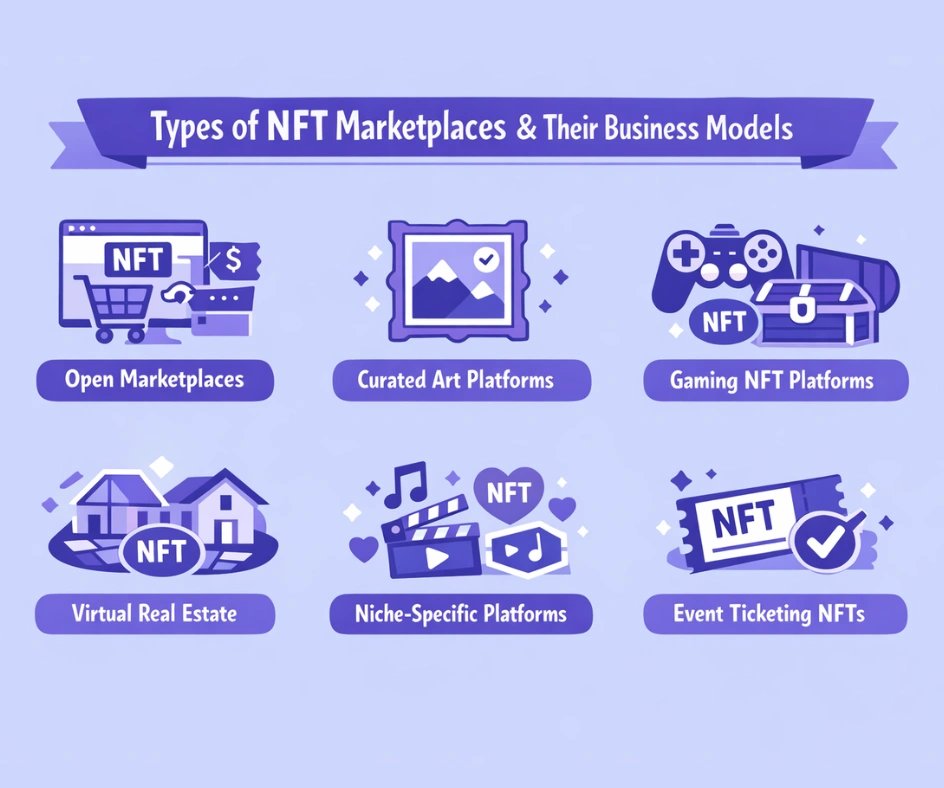
Types of NFT Marketplaces and Their Different Business Models
Not all NFT marketplaces operate the same way. The type of marketplace a platform is determines which revenue streams it prioritizes and how its cost structure looks.
1. Open Marketplaces
Open marketplaces like OpenSea allow anyone to mint and sell NFTs without going through an approval process. They make money primarily through transaction fees and benefit from high volume due to low barriers to entry. The risk is a lower average quality of listings and more potential for fraud.
2. Curated Art Platforms
Platforms like SuperRare and Foundation only accept vetted artists. They charge higher commissions (15 percent or more) but attract serious collectors willing to pay premium prices. The business model works on lower volume and higher per-transaction value.
3. Gaming NFT Platforms
Gaming NFTs represent a market valued at approximately $471.90 billion in 2024, with forecasts projecting growth to $942.58 billion by 2029. Platforms like Axie Infinity (valued at $3.94 billion) operate a play-to-earn model where in-game items are NFTs. Revenue comes from item sales, marketplace fees on trades, and sometimes from new game releases or expansions.
4. Niche or Category-Specific Platforms
Some platforms focus on specific asset types. NBA Top Shot focuses on basketball video highlights as NFTs and has generated $780 million in total trading volume. Decentraland and The Sandbox focus on virtual real estate NFTs. Virtual real estate NFTs are predicted to grow at a compound annual growth rate of 27.4 percent, with users able to buy, develop, and even rent out digital property within these platforms.
5. Event Ticketing NFT Platforms
A newer and rapidly growing category, event ticketing NFTs now represent 5.3 percent of ticket sales across major US venues in 2025. These platforms charge ticketing fees and secondary market fees when NFT tickets are resold. The key advantage here is fraud prevention, as blockchain-verified tickets cannot be duplicated.
Cost Structure: What Does It Cost to Build and Run an NFT Marketplace?
To understand the NFT marketplace profit model, you also need to understand the cost side of the equation. Building and operating a marketplace involves both one-time development costs and ongoing operational expenses.
NFT Marketplace Development Costs
| Development Component | Cost Range | Key Considerations |
|---|---|---|
| Basic Platform Features | $30,000 to $50,000 | User authentication, NFT minting, buying and selling functionality, basic wallet integration |
| Advanced Platform Features | $100,000 to $150,000+ | Custom smart contracts, multi-chain support, advanced analytics, decentralized storage, royalty management |
| UI/UX Design | $5,000 to $20,000 | Simple interface vs. custom-branded design with intricate elements |
| Blockchain Integration | $10,000 to $20,000 | Ethereum is the most common; alternatives like Solana or BSC may vary in cost |
| Smart Contract Development | Included in platform costs | Token standards (ERC-721, ERC-1155), security audits, testing |
| Security Implementation | $5,000 to $15,000 | Encryption, multi-factor authentication, and regular security audits |
| Ongoing Maintenance | $1,000 to $5,000 per month | Server hosting, updates, customer support, security monitoring |
The key takeaway from this cost structure is that building an NFT marketplace is not cheap, but the ongoing operational costs are manageable relative to the revenue potential. A basic platform starts at $30,000 to $50,000, while an advanced platform with custom smart contracts, multi-chain support, and decentralized storage can reach $150,000 or more. Monthly maintenance adds $1,000 to $5,000 on top of that.
Smart Contracts: The Silent Engine of NFT Marketplace Revenue
You cannot talk about how NFT marketplaces make money without explaining smart contracts. These are self-executing programs stored on a blockchain that run automatically when certain conditions are met.
When someone buys an NFT on a marketplace, the smart contract handles everything. It transfers the cryptocurrency payment from the buyer, delivers the NFT to the buyer’s wallet, sends the creator’s royalty to the original artist, takes the platform’s transaction fee, and records everything permanently on the blockchain. All of this happens without any human involvement, often in seconds.
This automation is what makes the NFT marketplace revenue model so powerful. The platform does not need a team to process each transaction manually. Once the smart contract is deployed and working, it generates revenue at scale with minimal marginal cost per transaction.
The most common NFT token standards are ERC-721, which creates unique one-of-a-kind tokens, and ERC-1155, which allows both unique and limited-edition tokens within the same contract. These standards are what most Ethereum-based NFT marketplaces are built around.
The Role of Blockchain in the NFT Marketplace Business Model
The choice of blockchain is a fundamental business model decision, not just a technical one. It affects fees, transaction speeds, user demographics, and the types of NFTs that can be supported.
Ethereum remains the most established network for NFTs, powering approximately 62 percent of NFT transactions. Its large developer community and proven infrastructure make it the default choice for high-value art and collectibles. However, gas fees between $50 and $150 for minting during low-congestion periods (and up to $500 during high-demand periods) have pushed many creators toward alternatives.
Solana offers much lower fees, making it attractive for high-volume gaming NFTs and collections where buyers and sellers need to transact frequently. Magic Eden, built primarily on Solana, amassed $6.39 billion in cumulative trading volume and held a 37 percent market share at its 2024 peak. Polygon, a Layer-2 solution for Ethereum, brings average gas fees down to around $0.003 per transaction, making it viable for mainstream consumer applications.
For marketplace owners, the business model implication is clear: the blockchain you choose determines who your users can be and how much friction exists in every transaction. A marketplace with high fees will naturally attract fewer casual users and more serious collectors willing to pay for quality and prestige.
Security Challenges and Their Impact on the Business Model
Security is not just a technical issue for NFT marketplaces; it directly affects the business model. Platforms with poor security lose user trust, face regulatory scrutiny, and watch their volume drop as scared users move elsewhere.
Between 2017 and 2024, more than $8 million in illegal funds was laundered through NFT platforms. Between July 2021 and July 2022, over $100 million worth of NFTs were stolen due to scams, with scammers averaging around $300,000 per incident. July 2022 saw over 4,600 NFTs stolen in a single month.
Tornado Cash, a cryptocurrency mixer, emerged as a tool for laundering proceeds from NFT scams, processing $137.6 million in crypto linked to NFT marketplaces before sanctions were imposed on it in August 2022.
For marketplace operators, security spending is not optional. Budget allocations of $5,000 to $15,000 for initial security implementation are standard, but ongoing security monitoring adds to the monthly cost base. Platforms that invest in real security and fraud detection earn user trust, which translates directly into higher trading volumes and better revenue.
Recommended Reading:
Creator Economics: Why Royalties Are Central to the NFT Marketplace Model
One of the most meaningful differences between the NFT marketplace revenue model and traditional digital marketplaces is the royalty structure. In most traditional platforms, once a piece of digital content is sold, the creator gets nothing from future resales. NFTs change this entirely.
Smart contract royalties mean that every time an NFT changes hands on the secondary market, the original creator automatically receives a percentage of that transaction. Cumulative Ethereum royalties paid to creators have exceeded $1.8 billion. The average royalty fee is around 6.1 percent. Dynamic royalty models, which adjust the percentage based on sale price or other conditions, can increase creator earnings by up to 40 percent.
Over 63 percent of NFT creators report earning more from secondary sales than from their initial mint. This is a powerful incentive that keeps creators engaged with a platform long after their first sale. For marketplace operators, this matters because creators who earn ongoing royalties are more likely to stay loyal to the platform and bring their audiences with them.
However, the royalty debate has become a real business model tension. Platforms that make royalties optional in order to attract high-frequency traders see more trading volume but upset their creator communities. Platforms that enforce royalties keep creators happy but may lose volume to lower-fee competitors. This is one of the most active areas of business model differentiation in the NFT space today.
How Decentralized Governance Changes the NFT Business Model
One area that sets NFT marketplaces apart from traditional online marketplaces is the growing use of decentralized governance. Rarible introduced community governance through RARI tokens, allowing users to vote on platform decisions, including feature updates and fee changes. This represents a meaningful shift in how a marketplace is managed and who benefits from its success.
When users hold governance tokens, they are not just customers; they are part-owners of the platform. This changes their relationship with it. They are more likely to promote the platform, less likely to leave, and more invested in its long-term success. From a pure business model standpoint, it creates an unusual dynamic where the people who generate the platform’s revenue also have a say in how that revenue is used.
This model is still evolving. LooksRare returns trading fees to users who stake its token, which effectively shares platform revenue with active participants. This community-driven approach creates strong loyalty but requires careful balance to ensure the platform remains financially sustainable.
NFT Marketplace Business Model in Action: Real-World Implementations
The following projects reflect how NFT marketplace and blockchain business models are already being applied across gaming, digital ownership, and decentralized infrastructure. Each case demonstrates the same core principles discussed throughout this blog, from smart contract automation and token governance to multi-chain trading and community-driven growth.
🎮
DentNet: Decentralized Telecom Meets NFT Infrastructure
Built a blockchain-based platform that decentralizes mobile data, voice minutes, and telecom services into a global marketplace. Users can buy, sell, and trade telecom assets across borders with eSIM technology, token staking, and a decentralized swap system. The NFT-like ownership model applied to telecom services mirrors core principles of the NFT marketplace business model applied to a non-art vertical.
⛓️
Athene Network: Decentralized Asset Marketplace for AI
Created a decentralized mining platform for AI development and deployment where researchers, developers, and users securely share AI models, data, and services. The platform uses Proof of Stake consensus and token holder governance, which directly echoes how NFT marketplaces like Rarible distribute platform decision-making power to active community members.
Build Your NFT Marketplace Platform Today:
We bring deep blockchain expertise to NFT marketplace development. Our specialized team handles everything from smart contract creation to multi-chain integration, making sure your platform is built for growth, security, and an outstanding user experience. Whether you need a curated art marketplace or a gaming NFT platform, we deliver solutions that work.
Final Thoughts
The NFT marketplace business model is not a single formula. It is a combination of revenue streams, infrastructure choices, community decisions, and cost management that together determine whether a platform survives and grows or quietly fades away. The most successful platforms are those that have found the right balance between generating enough revenue to sustain operations, keeping fees low enough to attract volume, protecting creators through fair royalty policies, and building trust through strong security.
OpenSea grew to dominate the market by making it easy and cheap for anyone to participate, then earning a modest 2.5 percent on every transaction at a massive scale. Curated platforms like SuperRare and Foundation chose the opposite path, charging more but offering more selective quality. Gaming platforms like Axie Infinity built entire economies where NFTs are functional assets, not just collectibles. And newer platforms like Rarible and LooksRare have shown that sharing revenue and governance with users creates a different kind of loyalty that traditional business models cannot buy.
The NFT industry is still young. With $683.9 million in revenue generated in 2024 and over 12,000 NFT sales happening every day, the infrastructure for this market is still being built. The platforms that get their business models right today, ones that take care of creators, protect buyers, and stay ahead of security threats, will be the ones that shape what this space looks like a decade from now.
If you are considering building an NFT marketplace, the business model decisions you make at the start will shape everything that comes after. Take the time to understand your target users, choose the right blockchain, design a fee structure that rewards all participants fairly, and invest in security from day one. The market is large enough for many players. What it rewards most is good thinking at the foundation level.
Frequently Asked Questions
Q1.What is the primary way NFT marketplaces make money?
The main revenue source for most NFT marketplaces is the transaction fee, which is a percentage deducted from every completed sale. OpenSea charges 2.5 percent, while platforms like LooksRare and Magic Eden charge around 2 percent. Curated platforms like SuperRare charge up to 15 percent because they offer a more selective and prestigious experience for buyers and sellers.
Q2.Do NFT marketplaces take a cut of royalties?
Yes, in many cases. When a smart contract enforces creator royalties on secondary sales, the marketplace processes the payment and may take a processing share. Some platforms also charge fees on top of royalty payments. The debate around optional versus enforced royalties is one of the biggest business model tensions in the NFT space right now.
Q3.How much does it cost to build an NFT marketplace?
A basic NFT marketplace with essential features like user authentication, minting, and wallet integration costs between $30,000 and $50,000 to build. An advanced platform with custom smart contracts, multi-chain support, and decentralized storage can cost $150,000 or more. Ongoing maintenance adds $1,000 to $5,000 per month for hosting, updates, and security.
Q4.Which blockchain is best for an NFT marketplace?
Ethereum is the most widely used, powering around 62 percent of NFT transactions, but its gas fees are high. Solana offers lower costs and is popular for gaming NFTs. Polygon, as a Layer-2 solution for Ethereum, brings gas fees down to fractions of a cent and is suited for consumer-grade applications. The right blockchain depends on your target users, fee tolerance, and the type of NFTs you plan to support.
Q5.What makes the OpenSea business model different from competitors?
OpenSea’s model is built on inclusivity and volume. It charges no listing fees, supports millions of NFTs across multiple blockchains, and earns a 2.5 percent transaction fee at scale. Competitors like Blur focused on professional traders with zero fees and advanced tools, while SuperRare and Foundation focused on quality curation with higher commissions. OpenSea’s advantage is its breadth and the loyalty of its large user base.
Q6.Are NFT marketplaces still a good business opportunity?
The NFT market generated $683.9 million in revenue in 2024, with over 12,000 NFT sales happening every day and 11.58 million users globally. Gaming NFTs alone represent a market projected to reach $942.58 billion by 2029. While the speculative frenzy of 2021 to 2022 has cooled, NFTs are finding real utility in gaming, event ticketing, music rights, virtual real estate, and brand loyalty programs. Platforms built around genuine utility rather than hype have a strong foundation to grow from.
Q7.Is the NFT business profitable?
Yes, it can be. The NFT market generated $683.9 million in revenue in 2024. Platforms like OpenSea earned significantly from a 2.5 percent fee on $14.68 billion in trading volume. Profitability depends on your fee structure, user volume, and how many revenue streams your platform uses.
Q8.How much does 1 NFT cost?
It varies widely. Basic digital collectibles can sell for under a dollar, while rare art NFTs have sold for millions. The record is Beeple’s piece at $69.3 million. On top of the NFT price, buyers also pay gas fees, ranging from a fraction of a cent on Solana or Polygon to $50 to $150 on Ethereum.
Q9.Is NFT legal in India?
Yes, NFTs are legal in India. They are not banned, but they are taxed. Under the Finance Act 2022, profits from NFT sales are taxed at a flat 30 percent, and a 1 percent TDS applies to transactions above a set threshold. There is no dedicated NFT law yet, so existing crypto tax rules apply.
Q10.What is the business model of NFT?
An NFT marketplace earns money by facilitating the minting, buying, and selling of digital assets on a blockchain. Revenue comes from transaction fees, minting fees, secondary sale royalties, listing promotions, and premium memberships. Smart contracts automate the entire process, making the model highly efficient once the platform is built and running.
Explore Services
Related Services
Reviewed by

Aman Vaths
Founder of Nadcab Labs
Aman Vaths is the Founder & CTO of Nadcab Labs, a global digital engineering company delivering enterprise-grade solutions across AI, Web3, Blockchain, Big Data, Cloud, Cybersecurity, and Modern Application Development. With deep technical leadership and product innovation experience, Aman has positioned Nadcab Labs as one of the most advanced engineering companies driving the next era of intelligent, secure, and scalable software systems. Under his leadership, Nadcab Labs has built 2,000+ global projects across sectors including fintech, banking, healthcare, real estate, logistics, gaming, manufacturing, and next-generation DePIN networks. Aman’s strength lies in architecting high-performance systems, end-to-end platform engineering, and designing enterprise solutions that operate at global scale.