Ai Overview
Pudgy Penguins is a collection of 8,888 uniquely generated cartoon penguin NFTs that launched on July 22, 2021, on the Ethereum blockchain. Total retail revenue crossed $13 million across more than 10,000 global retail locations. Annual revenue for the brand was projected to reach $50 million. Its $50 million revenue projection comes from toy sales, not token prices.
Key Takeaways
- Pudgy Penguins was launched in July 2021 as a collection of 8,888 unique NFTs on Ethereum, selling out in just 19 minutes at a mint price of 0.3 ETH, proving that strong visual identity and community can drive instant demand.[1]
- After being acquired for $2.5 million (750 ETH) in April 2022 by Luca Netz, the project went from near-bankruptcy to becoming one of the top NFT brands in the world, showing that strong leadership can fully revive a struggling NFT collection.[2]
- Pudgy Toys crossed one million units sold by May 2024, with over $13 million in retail revenue generated across 10,000 global retail locations, including Walmart, Target, Amazon, and Walgreens, proving that physical products can bring real revenue to an NFT brand.[3]
- The PENGU token launched on December 17, 2024, on the Solana blockchain with a total supply of 88.88 billion tokens, with 25.9% allocated to the Pudgy Penguins community through an airdrop worth approximately $1.5 billion at launch prices.[4]
- Each Pudgy Penguins NFT holder received 1.7 million PENGU tokens in the airdrop, with the token initially priced at $0.05 and reaching an all-time high of $0.07, meaning a single NFT generated up to $116,365 worth of PENGU at peak valuations.[5]
Most NFT projects launch with hype and fade within months. Pudgy Penguins did not follow that path. It launched in 2021, nearly collapsed in 2022, got rescued by a new owner, and then quietly grew into one of the most talked-about NFT brands on the planet. Today, its toys sit on Walmart shelves. Its PENGU crypto token holds a multi-billion dollar market cap. Its NFT collection has a floor price that outperforms many blue-chip collections that once looked far more promising.
For anyone building or running an NFT marketplace, the Pudgy Penguins story is not just interesting reading. It is a roadmap. It shows what actually works in this space when the hype cycle ends and the real work begins. Whether you are an entrepreneur, investor, or an NFT marketplace development company helping clients launch and scale digital asset platforms, there are valuable lessons to learn from this journey. This blog walks you through what happened, what decisions made the difference, and what NFT marketplace businesses can take away and apply right now.
Recommended Reading:
What Is Pudgy Penguins, and How Did It Get Here
Pudgy Penguins is a collection of 8,888 uniquely generated cartoon penguin NFTs that launched on July 22, 2021, on the Ethereum blockchain. The collection sold out in just 19 minutes at a mint price of 0.3 ETH per token. Within one week of the sale, the floor price had already climbed to 2.4 ETH. In August 2022, the rarest penguin in the collection, number 6873, sold for 400 ETH.
The project was originally created by four college friends, known as Mrtubby, Mickyj, Jonah, and Cole. But things went wrong quickly. Allegations of mismanagement of community funds came up, trust dropped, and the floor price fell. By early 2022, the community was pushing for a leadership change.
That is when Luca Netz entered the picture. He bought the entire Pudgy Penguins project in April 2022 for 750 ETH, which was approximately $2.5 million at the time. Netz brought in Lorenzo Melendez as the technical lead and assembled a new team. From that point, the direction of the project changed completely.
1. The Turn from Crisis to Brand Building
Rather than trying to chase hype or launch a new token immediately, Netz focused on something more basic: building a real brand. The team invested in social media content, especially on Instagram, where short animated penguin videos started reaching audiences who had never heard of NFTs. The brand accumulated 1.9 million Instagram followers and 728,100 followers on X, reaching far beyond the typical crypto audience. This was a calculated move to make the penguins feel like a beloved character IP rather than just a blockchain asset.
The Physical Toy Strategy That Changed Everything
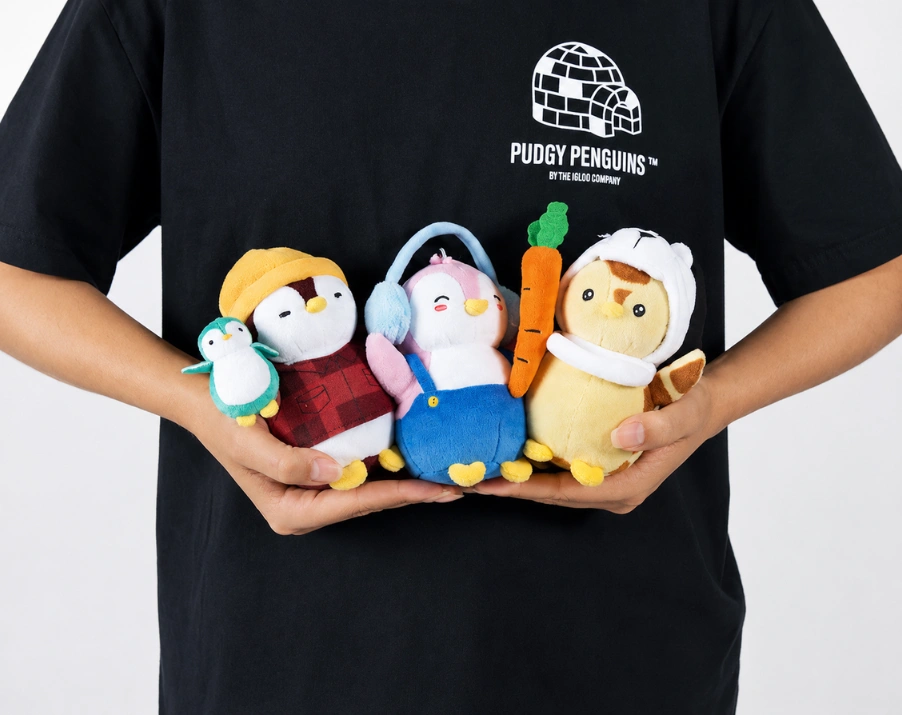
In May 2023, Pudgy Penguins launched Pudgy Toys, a line of physical plush toys and collectibles. This was not a side project. It became the financial foundation of the entire brand. The toys entered Walmart stores first, covering 2,000 locations. By February 2024, the line had expanded to 3,100 Walmart stores and had also reached Target, Amazon, and Walgreens.
By May 2024, Pudgy Penguins had sold its one-millionth toy. Total retail revenue crossed $13 million across more than 10,000 global retail locations. Annual revenue for the brand was projected to reach $50 million. Igloo Inc., the company behind Pudgy Penguins, raised $11 million in a funding round in 2024, led by Founders Fund.
1. The Phygital Bridge: Toys Connected to the Digital World
What made these toys more than just merchandise was the QR code printed on each one. Scanning the code took buyers to Pudgy World, a digital experience built on zkSync, where they could unlock exclusive digital traits and avatars. This meant that a parent buying a toy at Walmart was unknowingly entering the Web3 ecosystem. No wallet setup was required at the point of purchase. The brand met people where they already were and brought them into the NFT world gradually. This is a model that no other NFT project had executed at scale before Pudgy Penguins.
2. IP Licensing Through OverpassIP
Pudgy Penguins also launched the OverpassIP platform, which lets individual NFT holders license their specific penguin character to brands and manufacturers. For example, if a holder owns penguin number 4521, they can license that penguin’s artwork for a clothing line or a toy, and receive a royalty of up to 20% of the toy’s sale price, depending on the product type. This gave holders a real financial benefit tied directly to real-world commercial activity, not just speculation on token prices.
Pudgy Penguins NFT Collection At a Glance
| Detail | Information | Source |
|---|---|---|
| Launch Date | July 22, 2021 | CoinGecko |
| Total NFTs in Collection | 8,888 unique NFTs | CoinGecko |
| Original Mint Price | 0.3 ETH (~$1.18 at launch) | NFT-Stats |
| Peak Floor Price | Over $42,740 per NFT | NFT-Stats |
| Highest Monthly Volume | $76.9 million (January 2025) | NFT-Stats |
| Unique Holders | 5,174 unique owners | CoinGecko |
| Acquisition Price (2022) | 750 ETH / ~$2.5 million | Decrypt |
Recommended Reading:
The PENGU Token: Pudgy Penguins Crypto and What It Means
On December 17, 2024, Pudgy Penguins launched its native token, PENGU, on the Solana blockchain. The total supply is 88,888,888,888 tokens, a number chosen to echo the 8,888 penguins in the NFT collection. The launch came with a massive airdrop valued at approximately $1.5 billion based on prices at the time of release.
The token allocation was designed to put the community first. Here is how the supply was split: 25.9% went to the Pudgy community, 24.12% to other partner Web3 communities (including Doodles, Cool Cats, and Moonbirds holders), 12.35% to liquidity, 17.8% to the team (with a 1-year cliff and 3-year vest), 11.48% to Igloo Inc. (same vesting), 4% to public goods, 4% to marketing, and 0.35% to former FTT token holders from the collapsed FTX exchange.
1. What PENGU Token Holders Got From the Airdrop
Each Pudgy Penguins NFT holder received 1.7 million PENGU tokens in the airdrop. At the token’s all-time high of $0.07, that translated to a value of $116,365 per NFT just from the token reward alone. Across all the airdrops that Pudgy Penguin holders received over 2024 (including partner chains like zkSync, Omni Network, and Dymension), holders of a single NFT accumulated approximately $137,000 in total airdrop value at peak prices. This is a model that shows how an NFT marketplace can use token rewards to keep holders engaged and financially invested for the long term.
2. PENGU Token Utility and Future Plans
Beyond the airdrop, PENGU is being built out with expanding use cases. Token holders participate in governance through the “Inner Igloo” structure, voting on decisions about the Pudgy Penguins ecosystem. Plans include staking rewards, integration into Pudgy World gameplay, and use within NFT minting experiences. The token also launched on Abstract, Igloo Inc.’s own Ethereum Layer 2 network, making it available across multiple chains. A PENGU ETF filing has been acknowledged by the US SEC, which positions it for potential institutional interest. The PENGU market cap stood at over $2 billion at its peak shortly after launch.
What NFT Marketplace Businesses Can Learn From Pudgy Penguins
Pudgy Penguins did not succeed by having the most technically advanced platform. It succeeded by understanding people, building trust, and creating multiple reasons for users to stay connected to the brand. Here are the specific lessons that NFT marketplace developers and business owners can take away.
1. Community Is the Product, Not Just the Audience
Pudgy Penguins CEO Luca Netz has said publicly that community is the moat. What he means is that the technology of any NFT project can be copied, but an actively engaged, emotionally connected community cannot be replicated easily. NFT marketplaces often treat their user base as customers to be served. Pudgy Penguins treated its holders as co-owners of a brand. This is why token governance, IP licensing rights, and airdrop rewards were built directly into the ecosystem. When holders earn money by owning a Pudgy Penguin, they become advocates, not just buyers.
2. Real Revenue Must Come From Outside Speculation
Many NFT marketplaces depend almost entirely on trading fees and mint revenue. When trading volume drops, the platform has no income. Pudgy Penguins showed that NFT projects can generate income from physical retail, brand licensing, and consumer products that have nothing to do with crypto market cycles. Its $50 million revenue projection comes from toy sales, not token prices. For NFT marketplace operators, this means thinking about what physical or real-world products or services your platform’s content can support. Event ticketing, music rights, brand merchandise, and gaming items are all areas where NFT marketplaces can build revenue that does not depend on bull market conditions.
3. Reach People Who Are Not Already in Crypto
Pudgy Penguins did not grow its community by advertising on crypto Twitter or posting on blockchain forums. It grew on Instagram, reaching parents, kids, and pop culture fans who had no idea what Ethereum was. Its Las Vegas Sphere campaign during Christmas deliberately avoided any mention of crypto or NFTs. The goal was to make the brand feel like a mainstream toy and entertainment IP first. NFT marketplaces that want to grow past the same pool of existing crypto users need to take the same approach: build products and content that work for people who have never touched a wallet.
4. Give Holders More Value Over Time
One of the biggest mistakes in NFT projects is offering value only at the point of mint. After the initial hype fades, holders have no reason to keep their asset unless the floor price is rising. Pudgy Penguins kept inventing new reasons for holders to stay. The OverpassIP licensing model gave holders an income stream. The PENGU airdrop gave them a token reward. The Pudgy World digital experience gave them gameplay and digital access. Partner airdrops from zkSync and other chains gave them additional tokens. For NFT marketplace businesses, this translates directly into thinking about retention, not just acquisition. What do holders get at month 3, month 6, and month 12 that they did not get on day one?
5. Survive the Bear Market by Building During It
Total NFT trading volume for all of 2024 was $8.83 billion, a number far below the peak years. Most NFT projects either went silent or collapsed during the crypto bear market of 2022 and 2023. Pudgy Penguins used that period to build its toy line, establish retail partnerships, and grow its social media presence. When the market picked back up, it was already positioned. NFT marketplaces that spend downturns only cutting costs will be behind when the next growth cycle comes. The ones that use quiet periods to improve their product, widen their audience, and build real revenue streams will be the ones that matter in the next phase.
PENGU Token Allocation Breakdown
| Token Recipient Group | Allocation Percentage | Notes |
|---|---|---|
| Pudgy Community | 25.9% | Largest single allocation for Pudgy Penguins and Lil Pudgys NFT holders |
| Other Web3 Communities | 24.12% | Includes Doodles, Cool Cats, Moonbirds holders, and other NFT ecosystem participants |
| Team | 17.8% | 1-year cliff, 3-year vesting schedule |
| Exchange Liquidity | 12.35% | For initial trading on Solana DEX and CEX platforms |
| Igloo Inc. (Company) | 11.48% | 1-year cliff, 3-year vesting schedule |
| Marketing / Proliferation | 4% | Community growth and brand expansion activities |
| Public Goods | 4% | Charitable and public benefit purposes |
| FTT Holders | 0.35% | Allocated to former FTX FTT token holders affected by the exchange collapse |
How NFT Marketplace Development Needs to Change in Light of This
Looking at the Pudgy Penguins playbook, it becomes clear that building an NFT marketplace today is very different from what it was in 2021. Back then, you needed a minting page, a smart contract, and some wallet connections. Now, the platforms that win are the ones that think about the full ecosystem: governance, licensing, physical extensions, multi-chain access, and token-based rewards.
1. Smart Contracts Must Support Royalties and Licensing
Pudgy Penguins’ OverpassIP system depends on smart contracts that can handle IP licensing terms, royalty splits, and payment flows to individual holders. An NFT marketplace that cannot support these kinds of contracts will not be able to offer the same level of holder utility. When building a marketplace today, the smart contract layer needs to support ERC-721 and ERC-1155 token standards, automated royalty distribution, and the ability to track licensing usage on-chain.
2. Multi-Chain Support Is No Longer Optional
Pudgy Penguins originally launched on Ethereum. Its PENGU token launched on Solana. Its Layer 2 experience runs on Abstract (an Ethereum L2). Its Pudgy World metaverse ran on zkSync. No single chain covers all use cases. An NFT marketplace that locks users into one blockchain will lose them to platforms that let them move freely. Solana now powers around 18% of NFT traffic in 2025 because of its lower fees and faster transaction speeds. A well-built marketplace needs bridges, wallet compatibility across chains, and smart contract deployment on at least Ethereum and Solana to cover the largest share of the current user base.
3. Governance Tokens Turn Users Into Stakeholders
The PENGU token does not just give holders access to airdrops. It gives them a vote on what happens to the project through the Inner Igloo governance system. NFT marketplaces that issue governance tokens change the relationship with their users from transactional to ownership-based. Users who can vote on platform fees, new features, and strategic decisions are far less likely to leave for a competitor. They have a stake in the platform succeeding. This model, built properly, also reduces the regulatory risk of a token being treated purely as a speculative investment, because governance utility gives it a functional purpose.
Recommended Reading:
NFT Marketplace Development in the Real World
The following projects show how real blockchain marketplace concepts are being applied across gaming, digital asset trading, and Web3 infrastructure. Each of these reflects the same community-first, multi-chain, and utility-driven principles that made Pudgy Penguins the NFT story of its era.
🎮
RoninChain: Layer-1 Blockchain for Web3 Gaming NFTs
Nadcab Labs developed RoninChain, a purpose-built Layer-1 blockchain designed for Web3 gaming and NFT transactions. The platform enables in-game NFT ownership, play-to-earn mechanics, and fast low-cost trading of digital game assets across a decentralized network. This mirrors the kind of blockchain infrastructure Pudgy World and gaming-based NFT marketplaces need to support active user bases at scale.
🏛️
BendDAO: NFT Marketplace With Lending and Trading Features
Nadcab Labs built BendDAO, a blockchain-based NFT marketplace that goes beyond simple buying and selling to include NFT lending, collateralized borrowing, and community governance. The platform demonstrates how NFT marketplace solutions can generate utility-based revenue beyond trading fees alone, a key lesson from the Pudgy Penguins business model. Holders on BendDAO can put their NFTs to work financially instead of just holding them.
Build an NFT Marketplace That Lasts Beyond the Hype:
The Pudgy Penguins story shows that NFT platforms built on real utility, strong community tools, and smart contract depth survive market cycles. Our blockchain development team handles everything from multi-chain smart contract creation to governance token integration and IP licensing infrastructure, so your NFT marketplace is built for what users actually need in 2025 and beyond.
Start Your NFT Marketplace Project
Final Thoughts
Pudgy Penguins is the clearest proof in the NFT space that the strongest projects are built on more than digital images and trading volume. From a near-bankruptcy situation in 2022 to a brand generating tens of millions in physical toy revenue, a $1.5 billion token airdrop, and a roadmap toward a 2027 IPO, it has done what almost no other NFT project has done: it crossed over from the blockchain into real life in a way that regular people actually noticed.
For NFT marketplace businesses, the message is direct. Build for holders, not just buyers. Create ways for your community to earn that are not tied exclusively to token speculation. Reach people who are not already in crypto. Support governance so your users have a reason to stay. Think about what physical or real-world products your platform’s content could power. And build your technical infrastructure for multiple chains, because your users are not going to stay on just one.
The NFT market in 2025 is smaller by volume than its 2021 peak, but the projects that understood what they were really building are still here, still growing, and still finding new users. Pudgy Penguins is the best example of how to do that. The playbook is there. NFT marketplace businesses that pay attention to it will have a much better chance of building something that is still worth talking about five years from now.
Frequently Asked Questions
Q1.What is Pudgy Penguins NFT and why is it important?
Pudgy Penguins is a collection of 8,888 unique cartoon penguin NFTs launched on July 22, 2021, on the Ethereum blockchain. It is important because it became one of the few NFT projects to build a real business beyond digital trading, including physical toy sales in Walmart and Target, a native crypto token called PENGU, and an IP licensing platform for holders.
Q2.What is the PENGU token and how does it work?
PENGU is the official Pudgy Penguins crypto token launched on December 17, 2024, on the Solana blockchain. It has a total supply of 88.88 billion tokens. It was distributed to holders through an airdrop and is used for community governance, staking, and participation in the broader Pudgy Penguins ecosystem, including Pudgy World and future gaming features.
Q3.What is the Pudgy Penguins coin price and market cap?
At its launch in December 2024, PENGU was priced at approximately $0.05 and reached an all-time high of $0.07, giving it a fully diluted valuation of around $4.4 billion at its peak. The market cap of the PENGU coin has shifted with broader crypto market conditions, but has remained in the multi-billion dollar range. Always check a live exchange or CoinGecko for current pricing.
Q4.How much have Pudgy Penguins toys earned?
Pudgy Toys crossed one million units sold by May 2024, generating over $13 million in retail revenue across 10,000 retail locations worldwide, including Walmart, Target, Amazon, and Walgreens. The brand’s total annual revenue, including merchandise and IP licensing, was projected to reach $50 million, making it one of the highest-earning NFT-native businesses in the world.
Q5.What can NFT marketplace developers learn from the Pudgy Penguins NFT collection?
NFT marketplace developers can learn that community ownership, real-world utility, multi-chain infrastructure, governance tokens, and IP licensing are what keep an NFT project alive past the initial hype. Pudgy Penguins showed that when holders have ongoing financial and governance reasons to stay, trading volume and floor prices hold up much better through market downturns than collections that offer only speculative upside.
Q6.Is Pudgy Penguins planning an IPO?
Yes. Igloo Inc., the company behind Pudgy Penguins, has publicly stated its goal of pursuing an IPO by 2027. The company raised $11 million in a 2024 funding round led by Founders Fund. If it goes through, it would make Pudgy Penguins one of the first NFT-native companies to list on public stock markets, a significant milestone for the broader NFT and Web3 industry.
Explore Services
Related Services
Reviewed by

Aman Vaths
Founder of Nadcab Labs
Aman Vaths is the Founder & CTO of Nadcab Labs, a global digital engineering company delivering enterprise-grade solutions across AI, Web3, Blockchain, Big Data, Cloud, Cybersecurity, and Modern Application Development. With deep technical leadership and product innovation experience, Aman has positioned Nadcab Labs as one of the most advanced engineering companies driving the next era of intelligent, secure, and scalable software systems. Under his leadership, Nadcab Labs has built 2,000+ global projects across sectors including fintech, banking, healthcare, real estate, logistics, gaming, manufacturing, and next-generation DePIN networks. Aman’s strength lies in architecting high-performance systems, end-to-end platform engineering, and designing enterprise solutions that operate at global scale.