Ai Overview
Wash trading, in the traditional financial world, is illegal. The result was that roughly 95% of LooksRare’s $18 billion in total volume turned out to be wash trading. Similarly, when Blur launched its $BLUR token airdrop in February 2023, NFT wash trading across all platforms spiked by 126% in a single month. Chainalysis is one of the most widely used blockchain forensics tools, employed by 85% of U.
Key Takeaways
- Researchers from Wharton and UCLA found that approximately 38% of trades and up to 60% of traded value across three major NFT exchanges likely involve some form of market manipulation, based on direct on-chain analysis.[1]
- Approximately 45% of all NFT trading volume on Ethereum has been linked to wash trades, accounting for over $30 billion in artificially generated volume according to Dune Analytics research.[2]
- Chainalysis identified 262 users who sold NFTs to self-financed addresses more than 25 times, with 110 of them earning a combined $8.9 million in profits from wash trading activities in 2021 alone.[3]
- A machine-learning framework trained on 16 on-chain behavioural indicators reduced wash trading estimation errors to below 1.3%, proving that AI-based tools can identify manipulation patterns with high accuracy.[4]
- For the Meebits NFT collection, a staggering 93% of its total trading volume was attributed to wash trading, making it an extreme outlier in terms of market manipulation scale.[5]
- The U.S. Treasury’s 2024 Illicit Finance Risk Assessment on NFTs was the first federal study focused exclusively on money laundering risks tied to NFTs, highlighting weak AML controls and gaps in sanctions screening across several platforms.[6]
NFT wash trading is one of the biggest problems in the digital asset world right now. In simple terms, it happens when a person or group trades an NFT back and forth between wallets they control, making it look like the asset is popular and valuable when it is not. This fake activity tricks other buyers into thinking an NFT is worth far more than it actually is.
This is not a small issue. Research from Wharton and UCLA found that around 38% of trades and up to 60% of traded value across major NFT exchanges likely involve manipulation. Approximately $30 billion in NFT volume on Ethereum has been linked to wash trading, according to Dune Analytics data. These numbers make it clear that NFT marketplace security is something every platform, trader, and NFT marketplace development company needs to take seriously to maintain trust, transparency, and long-term market growth.
This blog covers what wash trading is, how it works, why it happens, and most importantly, what practical steps can be taken to prevent it. Whether you run an NFT platform or are a buyer trying to protect yourself, this guide has everything you need to know.
NFT Marketplace Development Guide
What Is NFT Wash Trading and Why Does It Happen?
Wash trading, in the traditional financial world, is illegal. Under the U.S. Commodity Exchange Act of 1936, it is explicitly banned because it gives false signals about market activity. But in the NFT space, regulation has not fully caught up, which has allowed this practice to spread widely.
Here is how it typically works: a wash trader creates several crypto wallets, funds them from a shared source, and then buys their own NFT at a higher and higher price each time. This inflates the NFT’s sale history and makes it look like demand is growing. Other buyers see the activity and assume the asset is valuable, which can lead them to pay far more than they should.
1. Common Patterns Behind Wash Trading
Researchers and on-chain analytics firms have identified several tell-tale patterns that wash traders follow:
- Self-Trades: The same user trades an NFT between two wallets they personally control.
- Back-and-Forth Trades: Wallet A sells to Wallet B, then Wallet B sells it right back to Wallet A shortly after.
- Circular Trades: An NFT passes through three or more wallets in a loop, eventually returning to the original owner.
- Common Funding Source: Both the “buyer” and “seller” wallets were funded by the exact same originating wallet.
2. Why Traders Do This
People wash trade for a few different reasons. The most obvious is to inflate an NFT’s apparent value before selling it to an unsuspecting buyer at a large profit. But there are other reasons too. Some platforms offered token rewards based on trading volume, which meant wash traders could generate large volumes and collect those token rewards. When LooksRare launched in January 2022 with LOOKS token rewards tied to trading activity, it directly incentivized this behaviour. The result was that roughly 95% of LooksRare’s $18 billion in total volume turned out to be wash trading. Similarly, when Blur launched its $BLUR token airdrop in February 2023, NFT wash trading across all platforms spiked by 126% in a single month.
Some wash traders also use NFTs to launder money, moving illicit funds through the appearance of legitimate transactions on a public blockchain.
NFT Wash Trading: Platform Comparison
| NFT Marketplace | Wash Trading Volume % | Key Reason |
|---|---|---|
| LooksRare | Up to 94.7% | LOOKS token rewards for trading volume |
| X2Y2 | Up to 85% | Similar reward structure for platform tokens |
| Element | ~63% | Incentivized trading without sufficient controls |
| Blur | ~14% | $BLUR airdrop tied to transaction activity |
| OpenSea | ~2.35% | No direct volume-based token reward system |
| Meebits Collection | 93% (outlier case) | Coordinated manipulation within the collection |
Sources: Cointelegraph, Financial Innovation Journal (Springer), CoinDesk / Dune Analytics
How NFT Fraud Prevention Starts With Better Detection
Before you can stop wash trading, you need to be able to find it. Detection has improved significantly in recent years, mostly because all blockchain transactions are publicly recorded. This transparency, while it helps wash traders create visible fake volume, also means that investigators can trace every transaction after the fact.
1. Blockchain Analytics Tools
Chainalysis is one of the most widely used blockchain forensics tools, employed by 85% of U.S. law enforcement agencies. Its analysis has already identified $2.57 billion in suspected wash trading. For NFTs specifically, it tracks sales to self-financed addresses to flag habitual wash traders. The Chainalysis Reactor tool lets investigators actually see the circular fund flows visually, which makes it easier to build a case. Dune Analytics also provides open-source dashboards that cover 29 or more major NFT marketplaces, tracking wash trading activity both in real time and historically.
2. Machine Learning Models
Researchers at Wharton, University of Pennsylvania, and UCLA built a machine-learning system trained on 16 on-chain behavioural fingerprints. These include things like how quickly an NFT is flipped after purchase, how much the sale price deviates from previous trades, and how active the wallets involved are over time. This approach reduced estimation errors to below 1.3%, proving that AI tools can flag wash trading with a high degree of accuracy. The same framework was even able to successfully identify wash trading in older Bitcoin data, showing its usefulness beyond just NFTs.
3. Heuristic Algorithms
AnChain.AI developed an algorithm that flags a transaction as a wash trade when a wallet buys back an NFT within 30 days of having sold it. The algorithm also traces intermediate transactions that happen within a wash trade cycle. Testing across popular NFT collections such as Bored Ape Yacht Club, Azuki, and Doodles showed that, on average, 0.14% of transactions, 0.11% of wallets, and 0.16% of tokens in each collection were linked to wash trading behaviour.
Common Security Vulnerabilities in NFT Marketplaces
Key Steps to Prevent NFT Wash Trading on Your Platform
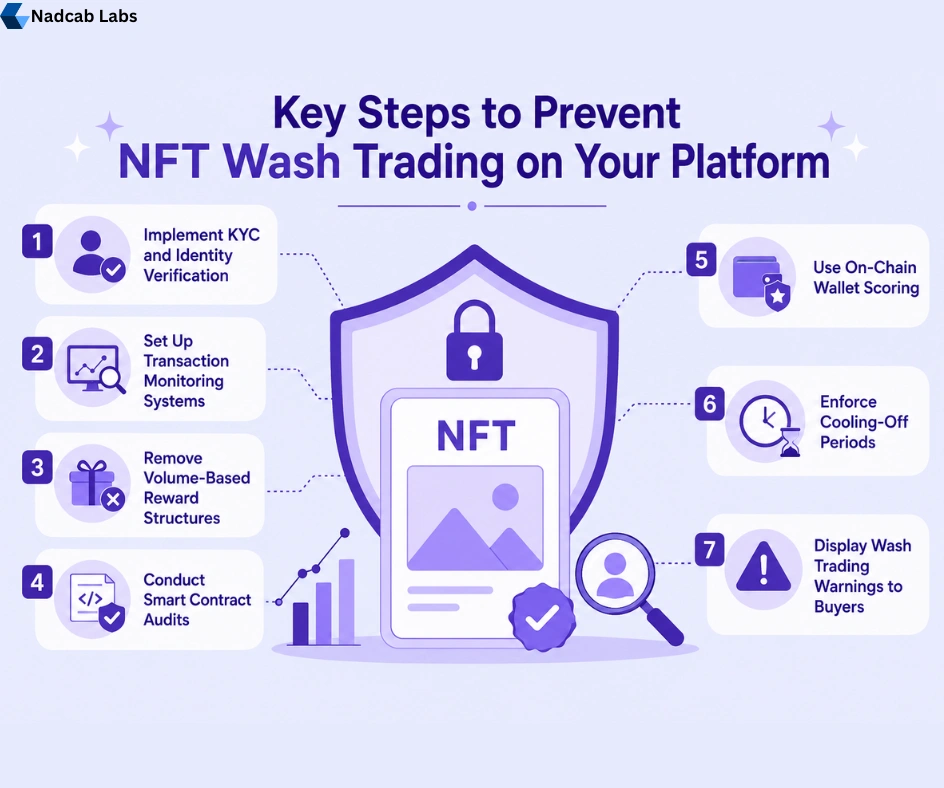
Now that we understand how detection works, here are the most practical and proven steps that NFT marketplace operators can take to stop wash trading before it happens.
1. Implement KYC and Identity Verification
Know Your Customer (KYC) processes are among the most direct tools available for NFT fraud prevention. When users have to verify their identity with a government-issued ID or passport before trading, it becomes much harder to operate dozens of anonymous wallets for wash trading. NFT platforms in Europe and the UK are already expected to align with Anti-Money Laundering (AML) frameworks, which include KYC requirements. The Financial Action Task Force (FATF) clarified in October 2021 that NFT marketplaces may fall under virtual asset service provider (VASP) rules, making KYC compliance potentially mandatory.
Platforms should also request proof of address for higher-risk users and conduct Enhanced Due Diligence (EDD) for accounts showing unusual transaction patterns. PEP (Politically Exposed Person) screening is another layer that helps keep high-risk individuals off platforms.
2. Set Up Transaction Monitoring Systems
Continuous monitoring of on-chain activity is essential. Platforms should flag and investigate transactions that show rapid price jumps, repeated wallet interactions, or patterns where the buyer and seller share a funding source. A Suspicious Activity Report (SAR) system allows platforms to formally report anything that looks like manipulation to the relevant regulatory authority. In the U.S., the 2024 Treasury Illicit Finance Risk Assessment on NFTs specifically pointed to weak transaction monitoring as a gap that needs to be addressed across the industry.
3. Remove Volume-Based Reward Structures
This is one of the most important changes any NFT platform can make. The data is very clear: when a marketplace pays users tokens based on how much volume they generate, wash trading explodes. LooksRare went from being a legitimate competitor to OpenSea to having nearly all its volume classified as fake, purely because of its reward structure. Any platform that incentivizes volume over genuine trades is essentially paying wash traders to inflate its numbers. Reward structures should instead be based on engagement quality, collector history, or creator activity rather than raw trading volume.
4. Conduct Smart Contract Audits
NFT marketplace security also depends heavily on how well-written and audited the underlying smart contracts are. Vulnerabilities in smart contracts can be exploited not just for wash trading but for outright theft. A third-party audit from a reputable blockchain security firm should be done before any marketplace goes live, and periodically after major updates. Smart contracts should be built to enforce fair trading conditions, restrict the same wallet from repeatedly appearing on both sides of a transaction, and log all data permanently for future review.
5. Use On-Chain Wallet Scoring
Assigning a risk score to wallets based on their transaction history is a growing practice in NFT marketplace security. Wallets that have previously been involved in circular trades, that were funded from a single suspicious source, or that have been flagged by Chainalysis or similar tools should be restricted from trading or pushed through extra verification steps. This kind of dynamic risk scoring makes it harder for bad actors to simply create new wallets and start over.
6. Enforce Cooling-Off Periods
A very simple but effective technical control is to prevent the same NFT from being resold too quickly after purchase. If a platform blocks resale for 24 to 48 hours or flags NFTs that are flipped multiple times within a short window, it makes wash trading cycles far harder to execute. The AnChain.AI algorithm mentioned earlier uses a 30-day window to flag repurchases. Platforms can adopt similar logic natively within their smart contract rules.
7. Display Wash Trading Warnings to Buyers
Transparency helps buyers protect themselves. If a platform surfaces data about unusual price activity, shows buyers how many times an NFT has changed hands in a short period, or displays an alert when a wallet’s funding source matches the counterparty’s, buyers can make more informed decisions. Some platforms already display provenance and transaction history, but adding automated risk flags on NFT listing pages would be a meaningful improvement for buyer protection.
NFT Wash Trading Prevention
| Prevention Method | How It Works | Best For |
|---|---|---|
| KYC / Identity Verification | Verifies the real identity of users before they can trade | Regulated marketplaces and high-volume platforms |
| Smart Contract Audits | Identifies vulnerabilities before they can be exploited | All marketplace types during and after development |
| Blockchain Analytics | Flags suspicious wallet patterns and circular fund flows | Real-time monitoring and after-the-fact investigation |
| Cooling-Off Periods | Prevents rapid resale cycles that indicate wash trading | Art, collectibles, and limited-edition NFT platforms |
| Removing Volume Rewards | Removes financial incentive for wash traders to operate | All platforms currently offering token reward schemes |
| Wallet Risk Scoring | Assigns trust levels to wallets based on historical behaviour | High-traffic marketplaces with diverse user bases |
| Transaction Monitoring | Continuously watches for unusual patterns and price jumps | Compliance teams and AML-focused platforms |
The Role of Regulation in NFT Marketplace Security
Regulation is catching up, even if slowly. The U.S. Treasury’s 2024 Illicit Finance Risk Assessment on NFTs was the first federal report dedicated entirely to money laundering risks in the NFT space. It pointed to gaps in AML controls, poor sanctions screening, and insufficient cybersecurity measures across several platforms.
In Europe, NFT platforms are increasingly being treated the same as other virtual asset service providers under local AML laws. This means implementing risk-based KYC, transaction monitoring, and sanctions screening. FATF, whose recommendations have been adopted into law by over 90% of jurisdictions worldwide, has made clear that NFT marketplaces could be subject to the same regulatory expectations as crypto exchanges if they facilitate large-value transfers.
The U.S. Commodity Exchange Act has explicitly prohibited wash trading in traditional financial markets since 1936, but enforcement in crypto has been limited. That is gradually changing as regulators build more expertise in blockchain forensics. Platforms that proactively align with these frameworks will be in a much stronger position when stricter rules arrive.
Smart Contract Risks & Exploits in NFTs
1. What Platforms Can Do Right Now
- Build an AML compliance programme with a designated compliance officer, documented internal policies, and regular third-party audits.
- Introduce Suspicious Activity Reporting (SAR) processes and train staff to identify and escalate red flags.
- Work with law enforcement and blockchain forensics firms when suspicious patterns are detected, rather than ignoring the problem.
- Maintain full records of all transactions in a way that can be provided to regulators upon request.
Real-World NFT Security and Blockchain Implementations
The following projects show how blockchain development principles discussed in this article, including smart contract security, on-chain transparency, and community-driven governance, are being applied in real platforms built by Nadcab Labs.
🔗
BendDAO: NFT Marketplace with Secure Trading
Built a decentralized NFT marketplace offering secure digital asset trading, lending features, and transparent user accessibility. The platform architecture directly addresses common marketplace vulnerabilities by integrating audited smart contracts and on-chain transaction verification, reducing the scope for manipulative trading behaviour.
🎮
R-Games.Tech: NFT Ownership in Gaming
Developed a blockchain-powered gaming platform that gives players genuine NFT-based asset ownership and transparent on-chain records. By embedding play-to-earn rewards tied to real gameplay activity rather than raw trading volume, the platform demonstrates how incentive design can keep the environment clean from wash trading.
How Buyers Can Protect Themselves From NFT Wash Trading
While it is largely the responsibility of platforms to address wash trading at a structural level, buyers also have tools available to protect themselves. Being an informed buyer is the first line of defence.
1. Check Transaction History Before Buying
Before purchasing any NFT, look at its full sales history on the blockchain. If an NFT has been bought and sold many times in a short period, often between a small number of wallets, that is a strong warning sign. Tools like Etherscan allow anyone to look up a specific NFT’s transfer history for free. If the price has jumped sharply without any obvious external reason, treat it with caution.
2. Use Platforms With Transparency and Monitoring
Choose NFT marketplaces that have clear security policies, publish information about their fraud prevention practices, and have undergone third-party smart contract audits. Platforms that operate anonymously or have no published AML practices carry a higher risk of harbouring wash trading.
3. Be Careful With Platforms Offering Aggressive Rewards
As the data from LooksRare and X2Y2 showed clearly, platforms that offer large token rewards for trading are more likely to have inflated volumes. Before trusting the trading history on such a platform, consider that much of that volume may not reflect real buyer demand. Cross-reference with data from Dune Analytics or DappRadar to get a more honest picture.
Build an NFT Marketplace Built for Trust:
We bring deep blockchain expertise to NFT marketplace development. Our team handles everything from smart contract creation and security audits to multi-chain integration and AML-compliant architecture, ensuring your platform is built with protection against wash trading from day one. Whether you need a curated art marketplace or a gaming NFT platform, we deliver solutions that work for both users and regulators.
Final Thoughts
NFT wash trading is a real problem that has cost the industry billions in credibility and has misled countless buyers into paying inflated prices. The scale of the issue is significant. With up to 45% of Ethereum NFT volume linked to wash trading and individual platforms recording fake volumes as high as 95%, it is clear that the problem cannot be ignored or left to fix itself.
The good news is that the tools and methods to prevent NFT wash trading are already available. Blockchain analytics, machine learning models, KYC verification, smart contract audits, wallet risk scoring, and the removal of volume-based reward incentives all form a strong combined defence. Regulation is also moving in the right direction, with the U.S. Treasury, FATF, and European regulators all signalling that NFT platforms will face the same expectations as other financial service providers.
For platform builders, the clearest lesson is this: design for genuine user behaviour from the start. Do not create reward systems that pay traders for volume. Built-in monitoring. Get your contracts audited. Verify your users. The NFT market has enormous potential across art, gaming, real estate, ticketing, and beyond. That potential will only be realized if the market is clean and trustworthy. NFT marketplace security is not an afterthought. It is the foundation on which everything else is built.
Frequently Asked Questions
Q1.What exactly is NFT wash trading?
NFT wash trading is when a person buys and sells the same NFT between wallets they control, creating the false impression that the asset is actively traded and rising in value. It is a form of market manipulation designed to deceive other buyers.
Q2.Is NFT wash trading illegal?
Wash trading is illegal under the U.S. Commodity Exchange Act for traditional financial markets, but enforcement in the NFT and crypto space has been limited due to the lack of clear regulatory frameworks. That said, several jurisdictions are now extending AML and financial market abuse laws to cover NFT platforms.
Q3.How can I tell if an NFT has been wash traded?
You can check an NFT’s full transaction history on blockchain explorers like Etherscan. Warning signs include the same NFT changing hands many times quickly, frequent trades between a small set of wallets, and sharp price increases with no clear external cause. Tools like Dune Analytics and DappRadar also track suspicious trading activity at the marketplace level.
Q4.Why did platforms like LooksRare have such high wash trading rates?
LooksRare and similar platforms offered LOOKS token rewards based on trading volume. This created a direct financial incentive for users to trade with themselves, since the token rewards outweighed the gas fees paid. When platforms tie rewards to volume rather than genuine engagement, wash trading becomes a profitable activity for bad actors.
Q5.What role does KYC play in preventing NFT fraud?
KYC (Know Your Customer) verification requires users to prove their identity before trading. This makes it much harder to operate multiple anonymous wallets for wash trading purposes. It also helps platforms comply with AML regulations and builds greater trust with genuine users and institutional participants.
Q6.Can wash trading be completely eliminated from NFT markets?
Complete elimination is difficult due to the pseudonymous nature of blockchain. However, a combination of proper reward design, on-chain monitoring, KYC controls, smart contract restrictions, and regulatory pressure can reduce wash trading dramatically. As detection tools improve and regulations tighten, the financial incentive and practical ability to wash trade will both shrink significantly.
Explore Services
Related Services
Reviewed by

Aman Vaths
Founder of Nadcab Labs
Aman Vaths is the Founder & CTO of Nadcab Labs, a global digital engineering company delivering enterprise-grade solutions across AI, Web3, Blockchain, Big Data, Cloud, Cybersecurity, and Modern Application Development. With deep technical leadership and product innovation experience, Aman has positioned Nadcab Labs as one of the most advanced engineering companies driving the next era of intelligent, secure, and scalable software systems. Under his leadership, Nadcab Labs has built 2,000+ global projects across sectors including fintech, banking, healthcare, real estate, logistics, gaming, manufacturing, and next-generation DePIN networks. Aman’s strength lies in architecting high-performance systems, end-to-end platform engineering, and designing enterprise solutions that operate at global scale.