Ai Overview
The digital economy has fundamentally transformed how we perceive ownership of creative works, virtual assets, and unique digital items. Security audits typically cost between 5,000 and 15,000 dollars, but prevent potentially catastrophic vulnerabilities. White label solutions provide faster time to market at lower cost but limit differentiation. Marketplaces like Magic Eden have built successful businesses on Solana by targeting users who prioritize speed and cost efficiency.
Key Takeaways
- The global NFT market reached 48.7 billion in 2025, showing a strong recovery from previous volatility, with projections suggesting growth toward 247 billion by 2029, driven by broader adoption and real-world utility use cases.
[1] - OpenSea maintains market dominance with 90 percent of Ethereum NFT trading volume as of October 2024, hosting over 80 million NFTs and generating approximately 14.68 billion in 2024 trading volume.
- NFT marketplace development costs range from 30,000 to 150,000 dollars, depending on features, with basic platforms costing 30,000 to 50,000 and advanced platforms with custom smart contracts and multi-chain support reaching 150,000 or more.[3]
- Gaming NFTs represent a massive market valued at approximately 471.90 billion in 2024, with forecasts projecting growth to 942.58 billion by 2029, with trading volume concentrated heavily in PFP assets at 37 percent and gaming at 25 percent.[4]
- Smart contracts automate NFT transactions by handling cryptocurrency transfers, NFT delivery to buyers, royalty distributions to creators, and permanent blockchain recording without intermediaries.[5]
- Virtual real estate NFTs are predicted to grow at a compound annual growth rate of 27.4 percent, with platforms like Decentraland and The Sandbox enabling users to buy, develop, and monetize digital property.[6]
- Security challenges remain significant, with over 100 million worth of NFTs stolen from July 2021 to July 2022, with scammers averaging around 300,000 per incident, making robust security measures essential.[7]
- Ethereum powers approximately 62 percent of NFT transactions, though alternatives like Solana, Binance Smart Chain, and Cardano have gained traction through lower fees and faster processing times.
- vent ticketing NFTs now represent 5.3 percent of ticket sales across major US venues in 2025, demonstrating practical utility beyond speculative collectibles and providing fraud prevention.[8]
- Rarible introduced community governance through RARI tokens, allowing users to vote on platform decisions, including feature updates and fee changes, representing a shift toward decentralized marketplace management.[9]
Entering the NFT Marketplace Space
The digital economy has fundamentally transformed how we perceive ownership of creative works, virtual assets, and unique digital items. At the center of this transformation sits the NFT marketplace, a platform that connects creators with collectors and enables the trading of one-of-a-kind digital assets. Whether you are an entrepreneur looking to capitalize on this growing market or a development team tasked with building the next generation of trading platforms, understanding how to build an NFT marketplace has become an essential skill in today’s blockchain-driven landscape.
This NFT marketplace development guide walks you through every aspect of creating a successful platform. From understanding the fundamental architecture to implementing advanced features, from choosing the right blockchain to managing development costs, this comprehensive resource covers everything you need to know about NFT marketplace development. The insights shared here draw from real world data, proven development methodologies, and the experiences of successful platforms that have shaped this industry.
As the global NFT market continues its remarkable growth trajectory, the opportunity for custom NFT marketplace development has never been more compelling. The market size reached approximately 48.74 billion dollars in 2025 and is predicted to expand to around 703.47 billion dollars by 2034. This explosive growth creates unprecedented opportunities for entrepreneurs and businesses willing to invest in building robust NFT marketplace solutions.
Understanding the NFT Marketplace Landscape
Before diving into the technical aspects of NFT marketplace development, it helps to understand what exactly these platforms accomplish and why they have become so valuable. An NFT marketplace serves as a digital venue where creators can mint, list, and sell their non fungible tokens while collectors browse, bid, and purchase these unique digital assets.
What Makes NFTs Valuable
Non-fungible tokens derive their value from blockchain technology, which provides irrefutable proof of ownership and authenticity. Unlike cryptocurrencies such as Bitcoin or Ethereum, where each unit is interchangeable with another, every NFT is distinct. This uniqueness is encoded directly into the token’s smart contract, making it impossible to replicate or counterfeit.
The applications for NFTs extend far beyond digital art. Gaming assets, virtual real estate, music rights, event tickets, membership passes, and even legal documents can all be represented as NFTs. The gaming NFT sector alone was valued at approximately 4.8 billion dollars in 2024, with projections suggesting growth to 44.1 billion dollars by 2034. This diversification of use cases has fueled demand for specialized NFT marketplace solutions that cater to specific industries and audiences.
Current Market Leaders and Their Approaches
Studying existing platforms provides valuable lessons for anyone considering custom NFT marketplace development. OpenSea, founded in 2017, emerged as the dominant force in the industry by offering a broad, open marketplace model. By October 2024, the platform accounted for 90 percent of Ethereum NFT trading volume and hosted over 80 million NFTs across multiple blockchains. OpenSea’s success came from its accessibility, supporting various blockchain networks and making it easy for anyone to create and list NFTs without coding knowledge.
Rarible took a different approach by introducing community governance through its RARI token. This mechanism allows platform users to vote on proposals regarding trading fees, new features, and the overall direction of the platform. The decision to decentralize governance has attracted users who want a stake in the platform they use, demonstrating that marketplace design extends beyond technical features into community building and tokenomics.
Specialized platforms have also carved out successful niches. SuperRare focuses exclusively on curated digital art, accepting only select artists after a rigorous application process. NBA Top Shot, built on the Flow blockchain by Dapper Labs, revolutionized sports collectibles by offering officially licensed NBA highlight moments as NFTs. These examples illustrate how custom NFT marketplace development can succeed by targeting specific audiences rather than competing directly with general-purpose platforms.
The Benefits of NFT Ticketing for Event Organizers
NFT Marketplace Architecture: Building the Foundation
The NFT marketplace architecture determines how your platform will function, scale, and evolve over time. A well designed architecture separates concerns, allows for independent scaling of components, and provides the flexibility needed to adapt to changing market conditions and user expectations.
Core Components of NFT Marketplace Architecture
Every NFT marketplace consists of several interconnected layers that work together to create a functioning platform. Understanding these components helps you make informed decisions during the development process.
1. Blockchain Layer: The foundation of any NFT marketplace rests on blockchain technology. This layer handles all on-chain operations, including NFT minting, ownership transfers, and transaction recording. Ethereum remains the most popular choice, powering approximately 62 percent of all NFT transactions in 2025. However, alternative blockchains like Solana, Polygon, and Binance Smart Chain have gained traction by offering lower transaction fees and faster processing times.
2. Smart Contract Layer: Smart contracts are self-executing programs stored on the blockchain that automatically enforce the rules of transactions. For NFT marketplaces, smart contracts handle crucial functions such as token creation using standards like ERC 721 or ERC 1155, facilitating buying and selling operations, managing auction mechanics, and distributing royalties to creators on secondary sales. The quality and security of your smart contracts directly impact user trust and platform reliability.
3. Backend Services: While blockchain handles ownership and transactions, traditional backend services manage everything else. This includes user authentication and profile management, off-chain data storage for NFT metadata and media files, search and discovery functionality, notification systems, and analytics. Most NFT marketplaces use a combination of centralized databases for performance and decentralized storage solutions like IPFS for NFT assets.
4. Frontend Application: The user interface determines how people interact with your platform. A well-designed frontend makes complex blockchain operations feel simple and intuitive. Key interfaces include marketplace browsing and search, individual NFT detail pages, user profiles and collections, wallet connection and transaction signing, and administrative dashboards for platform management.
Decentralized Storage Solutions
NFT metadata and associated media files present unique storage challenges. While the blockchain records ownership and provides immutability, storing large files directly on the chain would be prohibitively expensive. Most NFT marketplace software solutions employ decentralized storage protocols to address this issue.
IPFS, the InterPlanetary File System, has become the standard for storing NFT assets. When a file is uploaded to IPFS, it receives a unique content identifier based on its cryptographic hash. This approach ensures that the content cannot be altered without changing its identifier, providing immutability without the costs of on-chain storage. Your smart contract stores the IPFS content identifier, creating a permanent link between the token and its associated media.
NFT Marketplace Platform Features: What Users Expect
The success of any NFT marketplace depends on delivering features that meet user needs while differentiating your platform from competitors. Understanding what features to prioritize helps allocate development resources effectively and ensures your platform resonates with its target audience.
Essential Features for Every NFT Marketplace
1. User Registration and Authentication: Modern NFT marketplaces support multiple authentication methods. Traditional email and password registration appeals to users new to cryptocurrency, while wallet based authentication using providers like MetaMask, WalletConnect, or Coinbase Wallet satisfies experienced users who prefer decentralized identity management. Supporting both approaches maximizes your potential user base.
2. Digital Wallet Integration: Cryptocurrency wallets serve as the bridge between users and blockchain functionality. Your platform must integrate with popular wallet providers to enable users to connect their existing wallets, sign transactions for purchases and sales, manage their NFT collections, and view their cryptocurrency balances. The quality of wallet integration directly impacts user experience since any friction in this process can drive users to competing platforms.
3. NFT Minting Capabilities: Minting transforms digital files into blockchain-based tokens. A robust minting system allows creators to upload various media types, including images, videos, audio, and 3D models. Creators should be able to add metadata and attributes, set royalty percentages for secondary sales, choose between single editions and multiple copies, and preview their NFT before finalizing creation.
4. Listing and Sales Management: Once minted, NFTs need to be listed for sale. Effective marketplace features include fixed price listings, timed auctions with reserve prices, declining price auctions where prices decrease over time, and open offers allowing buyers to make bids on any NFT. Each sales mechanism serves different use cases and attracts different types of buyers and sellers.
5. Search and Discovery: With thousands of NFTs available, helping users find what they want becomes critical. Advanced filtering by category, price range, and attributes, along with sorting options for newest, most popular, and ending auctions, improves discoverability. Curated collections and featured artists help surface quality content while recommendation engines based on user behavior drive engagement and sales.
6. Transaction History and Provenance: Blockchain technology enables complete transparency into an NFT’s history. Displaying the full ownership chain, previous sale prices, and time stamps builds trust and helps buyers assess value. This provenance data often becomes a selling point for collectors who value documented history.
Advanced NFT Marketplace Platform Features
1. Royalty Management: One of the most revolutionary aspects of NFTs is the ability to automatically pay creators whenever their work sells on secondary markets. Over 80 percent of creators now use royalty-enforcing smart contracts. Implementing robust royalty management, including the ability to split royalties among multiple recipients, attracts serious creators to your platform.
2. Lazy Minting: Traditional minting requires creators to pay gas fees upfront, which can be substantial on networks like Ethereum. Lazy minting defers blockchain interaction until the first purchase, shifting gas costs to buyers. This approach dramatically lowers barriers for creators and increases the supply of NFTs on your platform.
3. Multi-Chain Support: Different blockchains offer different advantages. Ethereum provides the largest ecosystem and the highest liquidity. Solana offers near-instant transactions and minimal fees. Polygon provides Ethereum compatibility with lower costs. Supporting multiple chains gives users flexibility and can help your platform capture activity across different blockchain communities.
4. Social Features: NFT collecting is inherently social. Implementing features like user profiles with follower systems, activity feeds showing purchases and listings, commenting and liking capabilities, and sharing integration with external social media platforms helps build community and drives engagement. Some platforms have found that social features significantly improve user retention and time spent on the platform.
How to Build an NFT Marketplace: Step-by-Step Development Process
Understanding how to build an NFT marketplace involves appreciating both the technical work and the strategic decisions that shape your platform’s trajectory. This section outlines the typical development process from initial concept to launch.
Phase 1: Discovery and Planning
Successful projects begin with thorough planning. During discovery, you define your target market and unique value proposition, research competitors and identify differentiation opportunities, determine which blockchain or blockchains to support, outline feature requirements and prioritize them, establish technical requirements and constraints, and create initial wireframes and user flows.
This phase typically takes four to eight weeks, depending on project complexity. Rushing through discovery often leads to costly changes later in development when modifications become more expensive and time consuming.
Phase 2: Smart Contract Development
Smart contracts form the backbone of your NFT marketplace. Development in this phase includes writing contracts for NFT creation using ERC 721 or ERC 1155, implementing marketplace functionality for listings, sales, and auctions, building royalty distribution mechanisms, creating administrative functions for platform management, and writing comprehensive tests for all contract functionality.
Given the immutable nature of deployed smart contracts and the financial implications of bugs, this phase demands exceptional attention to detail. Most development teams employ formal verification methods and engage third-party security auditors before deployment. Security audits typically cost between 5,000 and 15,000 dollars, but prevent potentially catastrophic vulnerabilities.
Phase 3: Backend Development
The backend supports all functionality that does not need to live on chain. Key tasks include setting up databases for user data and off chain NFT information, implementing APIs for frontend communication, building indexing services that track blockchain events, integrating with IPFS or similar decentralized storage, developing notification and email systems, and creating administrative tools for platform management.
Performance optimization is particularly important for blockchain integration. Blockchain queries can be slow, so implementing caching layers and maintaining synchronized off chain indexes ensures responsive user experiences.
Phase 4: Frontend Development
The frontend transforms complex blockchain operations into intuitive interfaces. Development includes building responsive web applications that work across devices, implementing wallet connection flows for multiple providers, creating transaction signing interfaces that clearly communicate what users are approving, designing NFT browsing and detail views, and building creator tools for minting and managing collections.
User experience research during this phase helps identify and eliminate friction points. Even small improvements in usability can significantly impact conversion rates and user satisfaction.
Phase 5: Testing and Security Audit
Comprehensive testing verifies that all components work correctly individually and together. Testing activities include unit testing for smart contracts and backend services, integration testing across all system components, user acceptance testing with representative users, load testing to verify performance under expected traffic, and security audits for smart contracts and infrastructure.
Given that over 100 million dollars worth of NFTs were stolen between July 2021 and July 2022 through various attacks, security cannot be an afterthought. Professional security audits and penetration testing are essential before launch.
Phase 6: Deployment and Launch
Deployment involves moving your platform from development to production environments. Activities include deploying smart contracts to mainnet blockchains, configuring production infrastructure with appropriate scaling, setting up monitoring and alerting systems, performing final verification of all functionality, and executing launch marketing campaigns.
Many teams opt for a soft launch to a limited audience before full public release. This approach allows identification and resolution of issues before they affect a larger user base.
NFT Marketplace Development Costs and Timeline
Understanding NFT marketplace development costs helps with budgeting and setting realistic expectations. Costs vary significantly based on feature complexity, blockchain choices, and development approach.
| Development Component | Cost Range | Key Considerations |
|---|---|---|
| Basic Platform Features | $30,000 – $50,000 | User authentication, NFT minting, buying/selling functionality, basic wallet integration |
| Advanced Platform Features | $100,000 – $150,000+ | Custom smart contracts, multi-chain support, advanced analytics, decentralized storage, royalty management |
| UI/UX Design | $5,000 – $20,000 | Simple interface vs. custom-branded design with intricate elements |
| Blockchain Integration | $10,000 – $20,000 | Ethereum most common, alternatives like Solana or BSC may vary |
| Smart Contract Development | Included in platform costs | Token standards (ERC-721, ERC-1155), security audits, testing |
| Security Implementation | $5,000 – $15,000 | Encryption, multi-factor authentication, and regular security audits |
| Ongoing Maintenance | $1,000 – $5,000/month | Server hosting, updates, customer support, security monitoring |
The development timeline typically ranges from three to nine months, depending on the scope. A minimum viable product with basic functionality might launch in three to four months, while a feature-rich platform competing with established players could require six to nine months or longer.
Factors Affecting Development Costs
1. Development Approach: Building from scratch costs more but offers complete customization. White label solutions provide faster time to market at lower cost but limit differentiation. The choice depends on your unique requirements and competitive positioning.
2. Blockchain Selection: Different blockchains have different development ecosystems and expertise availability. Ethereum development is most common, meaning more available developers and resources. Newer chains may require specialized expertise that commands premium rates.
3. Team Location: Development rates vary significantly by geography. Teams in North America and Western Europe typically charge 100 to 200 dollars per hour, while equally qualified teams in Eastern Europe or Asia might charge 30 to 80 dollars per hour. Remote collaboration tools have made geographic diversity increasingly viable for development projects.
4. Feature Complexity: Each additional feature adds development time and cost. Prioritizing features based on user value helps optimize budget allocation. Start with essential functionality and plan subsequent releases for additional features.
Choosing the Right Blockchain for Your NFT Marketplace
Blockchain selection influences development complexity, user experience, and market positioning. Each major blockchain offers distinct advantages and limitations that should inform your choice.
Ethereum: The Established Leader
Ethereum remains the dominant force in NFT marketplaces, powering approximately 62 percent of all NFT transactions. Its advantages include the largest developer ecosystem and most extensive documentation, the highest liquidity and largest collector base, proven security through years of operation, and compatibility with established standards like ERC 721 and ERC 1155.
However, Ethereum’s popularity creates challenges. Transaction fees, known as gas, can become expensive during periods of high network activity. Confirmation times of several seconds to minutes can feel slow compared to traditional web applications. These limitations have driven the development of Layer 2 solutions like Polygon, Arbitrum, and Optimism that maintain Ethereum compatibility while reducing costs and improving speed.
Solana: Speed and Low Costs
Solana powers around 18 percent of NFT traffic in 2025, attracting users with its near-instant transaction confirmation and minimal fees. The blockchain can process thousands of transactions per second, making it suitable for high-volume applications. Marketplaces like Magic Eden have built successful businesses on Solana by targeting users who prioritize speed and cost efficiency.
Solana’s tradeoffs include a smaller collector base compared to Ethereum, different programming paradigms requiring Rust expertise rather than Solidity, and occasional network stability concerns. These factors should be weighed against the performance benefits when evaluating Solana for your NFT marketplace solution.
Other Notable Blockchains
Polygon offers Ethereum compatibility with significantly lower fees, making it popular for gaming NFTs and high volume use cases. Brands like Starbucks and Nike have chosen Polygon for their NFT initiatives, demonstrating its appeal for mainstream adoption.
Flow, developed by Dapper Labs, powers NBA Top Shot and other sports collectible platforms. Its resource-oriented programming model is designed specifically for digital assets and collectibles. Immutable X provides a Layer 2 solution focused entirely on NFTs, offering gas-free trading while maintaining Ethereum security.
Multi-Chain Strategy
Many NFT marketplace software solutions now support multiple blockchains, allowing users to choose based on their preferences. This approach maximizes the potential user base but adds development complexity. Each blockchain requires separate smart contract implementations, wallet integrations, and indexing infrastructure. Cross-chain NFT transfers remain technically challenging, so most multi-chain marketplaces maintain separate inventories per chain.
Smart Contract Development for NFT Marketplaces
Smart contracts are the programmable rules that govern how your marketplace operates on the blockchain. Understanding their role and development requirements is essential for anyone involved in custom NFT marketplace development.
NFT Token Standards
Token standards define how NFTs are structured and interact with wallets and marketplaces. Choosing the right standard affects functionality and compatibility.
1. ERC 721: The original NFT standard on Ethereum, ERC 721 defines each token as completely unique. Every token has its own identifier and can have distinct metadata. This standard works well for unique digital art and one of a kind collectibles, where each item truly is different.
2. ERC 1155: This multi-token standard allows a single contract to manage both fungible and non-fungible tokens. It enables batch transfers that reduce gas costs when moving multiple items and supports semi fungible tokens where multiple identical copies exist. Gaming applications particularly benefit from ERC 1155’s flexibility for managing items that exist in quantities.
Core Smart Contract Functions
NFT marketplace smart contracts implement several essential functions that work together to enable trading.
1. Minting: The minting function creates new NFTs by assigning ownership to the creator and setting metadata, including the content identifier pointing to the stored asset. Lazy minting implementations defer actual blockchain minting until the first purchase.
2. Listing: When sellers list NFTs, the smart contract records the sale terms, including price, duration, and payment token. The contract typically requires the seller to approve the marketplace to transfer the NFT on their behalf when a sale occurs.
3. Purchase and Transfer: Purchase functions verify that buyers meet listing requirements, such as having sufficient funds and the listing not being expired, then execute the transfer. The contract moves cryptocurrency from buyer to seller, deducts marketplace fees, distributes any creator royalties, and transfers NFT ownership to the buyer.
4. Auction Management: Auction contracts add complexity by tracking bids, managing escrow for leading bids, extending auctions when last-minute bids occur, and handling auction settlement when time expires.
Security Considerations for Smart Contracts
Smart contract security is paramount given that contracts are immutable once deployed and often control significant value. Common vulnerabilities to address during development include reentrancy attacks, where malicious contracts repeatedly call back into your contract, integer overflow and underflow that can corrupt calculations, unauthorized access to administrative functions, and front running where miners or other observers exploit knowledge of pending transactions.
Best practices for smart contract security include following established patterns and using audited library code such as OpenZeppelin contracts, implementing comprehensive test suites with high coverage, using formal verification tools to mathematically prove correctness, and engaging professional security auditors before mainnet deployment.
What Is an NFT Marketplace? How It Works End-to-End
Use Cases Driving NFT Marketplace Growth
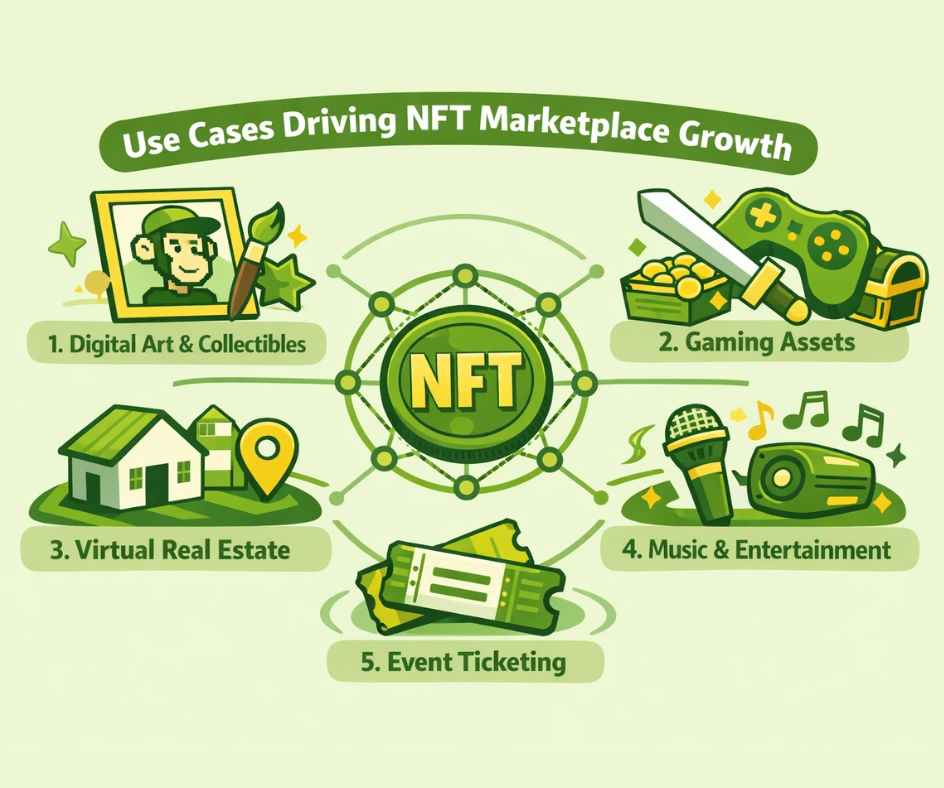
Understanding the diverse applications of NFTs helps identify market opportunities and informs feature prioritization for your platform. The NFT market has expanded well beyond digital art into numerous industries with distinct requirements.
Digital Art and Collectibles
Digital art remains the most visible NFT category. Artists can sell work directly to collectors without galleries or auction houses taking substantial cuts. The most expensive NFT ever sold, “The Merge” by Pak, reached 91.8 million dollars in December 2021. Beyond headline-grabbing sales, thousands of artists earn sustainable income through NFT sales and secondary royalties.
Profile picture projects like CryptoPunks and Bored Ape Yacht Club created a new category of social signaling collectibles. Owners display these NFTs as their social media avatars, creating visible communities around shared ownership. PFP assets account for approximately 37 percent of NFT trading volume.
Gaming Assets
Gaming represents one of the fastest growing NFT sectors, valued at approximately 4.8 billion dollars in 2024, with projections of 44.1 billion dollars by 2034. NFTs enable true ownership of in-game items, allowing players to trade assets outside game ecosystems and maintain ownership even if games shut down.
Play to earn models pioneered by games like Axie Infinity created new economic opportunities, particularly in developing nations. Players earn cryptocurrency by playing, with some earning more than local minimum wages. While the sustainability of specific tokenomics remains debated, the underlying concept of player-owned game economies continues to attract significant investment and development.
Virtual Real Estate
Virtual land in metaverse platforms like Decentraland and The Sandbox has attracted significant investment. The virtual land NFT market is projected to grow from 1.1 billion dollars in 2025 to 20.9 billion dollars by 2035. Owners can develop their virtual properties, hosting events, displaying art, or building interactive experiences.
Brands have purchased virtual real estate to establish a presence in emerging digital spaces. Fashion houses have hosted virtual fashion shows, while entertainment companies have created virtual concert venues. Virtual real estate NFTs are predicted to grow at a compound annual growth rate of 27.4 percent as metaverse adoption increases.
Music and Entertainment
Musicians are using NFTs to create new revenue streams and direct relationships with fans. NFTs can represent album ownership, concert tickets, backstage access, or royalty sharing rights. Kings of Leon generated significant revenue by releasing an album as an NFT collection, including exclusive perks for token holders.
The music NFT sector generated over 520 million dollars in revenue in 2025, demonstrating substantial market demand. Platforms specializing in music NFTs offer features tailored to artists and fans, including streaming integration and royalty distribution.
Event Ticketing
NFT tickets solve longstanding problems in event ticketing, including counterfeiting, scalping, and a lack of secondary market transparency. Event ticketing NFTs now represent 5.3 percent of ticket sales across major US venues in 2025. Benefits include programmable rules such as capping resale prices, automatic royalties to artists on resales, collectible tickets that retain value after events, and verifiable authenticity, eliminating counterfeits.
NFT Marketplace Types and Specializations
Not all NFT marketplaces serve the same purpose or audience. Understanding different marketplace types helps position your platform strategically.
| Marketplace Type | Description | Examples | Key Characteristics |
|---|---|---|---|
| Open Marketplace | Anyone can mint and sell NFTs without approval | OpenSea, Rarible | Maximum accessibility, diverse content, requires content moderation |
| Curated Marketplace | Creators must apply and be approved before listing | SuperRare, Foundation | Higher quality perception, limited supply, stronger creator relationships |
| Niche Marketplace | Focuses on specific categories like art, music, or gaming | NBA Top Shot, Async Art | Specialized features, targeted audience, and less competition |
| Brand Marketplace | A platform created by a specific brand for its NFTs | Nike RTFKT, Starbucks Odyssey | Complete brand control, integration with existing products |
| Aggregator | Combines listings from multiple marketplaces | Gem, Blur | Comprehensive inventory, price comparison, and complex integration |
Choosing Your Marketplace Model
The right model depends on your goals and resources. Open marketplaces attract maximum traffic but require significant content moderation to prevent copyright infringement and inappropriate content. Curated marketplaces build premium brand perception but grow more slowly due to the approval process. Niche marketplaces can dominate specific categories but have smaller total addressable markets.
Consider your target users when choosing a model. Serious art collectors may prefer curated platforms with verified provenance. Gamers want platforms integrated with their favorite games. Music fans appreciate platforms that understand the music industry and offer relevant features.
Security Best Practices for NFT Marketplaces
Security breaches can devastate NFT platforms, eroding user trust and potentially resulting in significant financial losses. Building security into your platform from the beginning is far more effective than retrofitting it later.
Smart Contract Security
Smart contracts present unique security challenges because they cannot be modified after deployment. Mistakes can result in permanent loss of funds or assets. Essential security practices include formal verification using mathematical proofs to verify contract behavior, independent security audits by reputable firms before deployment, bug bounty programs to incentivize responsible disclosure, comprehensive testing, including edge cases and attack simulations, and using established library code rather than writing everything from scratch.
Platform Security
Beyond smart contracts, your platform infrastructure requires protection. Implement secure authentication using multi factor authentication for all accounts, especially administrative access. Encrypt all data in transit and at rest. Maintain regular security audits of your infrastructure and code. Deploy monitoring and alerting systems to detect unusual activity. Create incident response plans so you can react quickly to breaches.
User Education
Many NFT thefts result from user error rather than platform vulnerabilities. Phishing attacks trick users into connecting wallets to malicious sites. Social engineering convinces users to sign transactions they do not understand. Educating users about security best practices helps protect them and reduces support burden on your platform.
Consider implementing a transaction simulation that shows users what will happen when they sign. Display clear warnings for unusual transactions. Provide educational resources about common scams and how to avoid them.
Monetization Strategies for NFT Marketplaces
Understanding revenue models helps ensure your platform’s financial sustainability. Most successful NFT marketplaces employ multiple revenue streams.
Transaction Fees
The most common revenue model charges a percentage of each sale. OpenSea charges 2.5 percent, while other platforms range from zero percent to 5 percent or higher. Lower fees attract more activity but require higher volume to generate equivalent revenue. Some platforms have experimented with zero-fee models funded by token economics or alternative revenue streams.
Listing Fees
Charging to list NFTs creates revenue independent of sales completion. This model works better for curated platforms where listings imply endorsement. Free listings encourage more inventory but can attract low-quality content.
Minting Fees
Some platforms charge creators to mint NFTs beyond gas costs. This creates friction that can reduce spam but may also discourage legitimate creators. Lazy minting, where gas costs transfer to buyers, offers an alternative that removes upfront costs while still generating platform revenue.
Premium Services
Additional revenue can come from premium features such as featured listings and promotional placements, verified creator badges, advanced analytics and sales tools, and custom storefronts or white-label services. These services create value for power users willing to pay for enhanced functionality.
Token Economics
Some platforms issue governance tokens that accrue value as the platform grows. Rarible’s RARI token pioneered this approach in the NFT space, rewarding active users with tokens that grant voting rights on platform decisions. This model aligns user and platform incentives but introduces regulatory complexity around token classification.
Launch Your NFT Marketplace Platform Today
We bring 8+ years of blockchain expertise to NFT marketplace development. Our specialized team handles everything from smart contract creation to multi-chain integration, ensuring your platform is built for growth, security, and user experience. Whether you need a curated art marketplace or a gaming NFT platform, we deliver solutions that work.
Final Thoughts
Building an NFT marketplace represents a significant undertaking that combines blockchain development expertise, thoughtful user experience design, and strategic business planning. The global NFT market’s growth from 48.7 billion dollars in 2025 toward projections of 247 billion dollars by 2029 demonstrates the substantial opportunity available for platforms that successfully serve creator and collector needs.
Success in NFT marketplace development requires attention to multiple dimensions. The technical foundation must be solid, with carefully audited smart contracts and robust infrastructure capable of handling growth. The user experience must make complex blockchain operations accessible to mainstream users while satisfying the demands of crypto native audiences. The business model must generate sustainable revenue while remaining competitive with established players.
This NFT marketplace development guide has covered the essential elements from architecture and features to costs and security. Whether you pursue custom NFT marketplace development from scratch or leverage existing NFT marketplace software solutions, understanding these fundamentals positions you to make informed decisions and build a platform that can thrive in this dynamic market.
The NFT space continues to evolve rapidly. New use cases emerge regularly, from event ticketing now representing 5.3 percent of major venue sales to virtual real estate growing at over 27 percent annually. Staying attuned to these trends while building flexible architecture allows your platform to adapt and capture emerging opportunities.
Remember that technology alone does not guarantee success. The most successful NFT marketplace solutions combine excellent technical execution with strong community building, effective creator relations, and strategic market positioning. By addressing both technical and business dimensions comprehensively, you create the foundation for a platform that can establish itself in this exciting and growing market.
Frequently Asked Questions
Q1.How long does it take to build an NFT marketplace from scratch?
Development timeline varies based on feature complexity and team size. A minimum viable product with basic minting, listing, and purchasing functionality typically requires three to four months. A full featured platform with advanced capabilities like multi chain support, auction systems, and social features usually takes six to nine months. Ongoing maintenance and feature additions continue after initial launch.
Q2.What blockchain should I choose for my NFT marketplace?
Blockchain selection depends on your priorities and target audience. Ethereum offers the largest ecosystem and highest liquidity, powering approximately 62 percent of NFT transactions. Solana provides faster transactions and lower fees, attracting cost-conscious users. Polygon offers Ethereum compatibility with reduced costs. Many platforms now support multiple chains to maximize their potential user base. Consider your target market’s preferences and technical requirements when making this decision.
Q3.How do NFT marketplace platforms make money?
Most NFT marketplaces generate revenue through transaction fees, typically ranging from 2 to 5 percent of each sale. Additional revenue streams include listing fees, minting fees, premium features like verified badges and promotional placements, and subscription services for advanced tools. Some platforms also generate value through governance tokens that appreciate as platform activity grows.
Q4.What security measures are essential for an NFT marketplace?
Essential security measures include professional smart contract audits before deployment, multi-factor authentication for user accounts, encryption of data in transit and at rest, regular penetration testing of infrastructure, monitoring systems to detect unusual activity, and incident response planning. Given that over 100 million dollars worth of NFTs were stolen in a single year, security must be a top priority throughout development and operation.
Q5.Can I build an NFT marketplace without blockchain development experience?
While white label solutions and no code platforms enable launching basic NFT marketplaces without deep technical expertise, building a competitive platform typically requires blockchain development knowledge. Understanding smart contract development, blockchain integration, and decentralized systems helps you make better decisions and troubleshoot issues. If you lack this expertise internally, partnering with experienced blockchain developers is essential for building a professional-grade platform.
Q6.What features differentiate successful NFT marketplaces from unsuccessful ones?
Successful NFT marketplaces excel in user experience, making complex blockchain operations feel simple and intuitive. They build strong creator relationships through fair royalty policies and promotional support. They foster engaged communities through social features and governance mechanisms. They maintain robust security that builds user trust. Finally, they focus on specific niches rather than trying to compete directly with established general purpose platforms, finding unique positioning that attracts dedicated user bases.
Explore Services
Related Services
Reviewed by

Aman Vaths
Founder of Nadcab Labs
Aman Vaths is the Founder & CTO of Nadcab Labs, a global digital engineering company delivering enterprise-grade solutions across AI, Web3, Blockchain, Big Data, Cloud, Cybersecurity, and Modern Application Development. With deep technical leadership and product innovation experience, Aman has positioned Nadcab Labs as one of the most advanced engineering companies driving the next era of intelligent, secure, and scalable software systems. Under his leadership, Nadcab Labs has built 2,000+ global projects across sectors including fintech, banking, healthcare, real estate, logistics, gaming, manufacturing, and next-generation DePIN networks. Aman’s strength lies in architecting high-performance systems, end-to-end platform engineering, and designing enterprise solutions that operate at global scale.