Ai Overview
The numbers around the NFT marketplace industry size are striking. According to Precedence Research, the global non-fungible token market was valued at $48. The United States alone has an NFT revenue forecast of $80. This use case alone is pushing the commercial segment to over 65% of the total NFT market by revenue.
Key Takeaways
- The global NFT market was valued at $48.74 billion in 2025 and is projected to reach approximately $703.47 billion by 2034, growing at a CAGR of 34.53%.[1]
- North America held the largest regional share at 32% in 2024, while the Asia Pacific is growing the fastest, with India recording the highest NFT ownership rate globally at 13.5%.
- Magic Eden led all NFT marketplaces in 2024 with a 36.7% market share and $122.47 million in monthly trading volume, marking its 6th consecutive month at the top position.
- OpenSea remains the all-time volume leader with over $39.5 billion in total trading volume, now supporting NFTs across 19 blockchains, including Ethereum, Polygon, and Base.[2]
- The gaming NFT segment was valued at $4.8 billion in 2024 and is expected to grow at a CAGR of 24.8% through 2034, driven by play-to-earn models and metaverse expansion.[3]
- Ethereum leads NFT activity with approximately 62% of all transactions, while Solana accounts for 18%, Polygon 11%, and BNB Chain 6% of NFT activity.[4]
Non-fungible tokens, or NFTs, have changed how people think about owning things in the digital world. A piece of digital art, a clip from a basketball game, a plot of virtual land, or a character in an online game can now be owned, bought, and sold just like physical goods. This shift has created an entirely new kind of market that is growing fast and pulling in attention from creators, investors, brands, and everyday users around the world, while also increasing demand for services offered by an NFT marketplace development company to build secure and user-friendly platforms.
This blog covers where the global NFT marketplace market stands today, what numbers are coming in from credible sources, which platforms are leading the space, and what factors are pushing this industry toward a much larger future.
NFT Marketplace Development Guide
Global NFT Marketplace Market Size: Where Things Stand
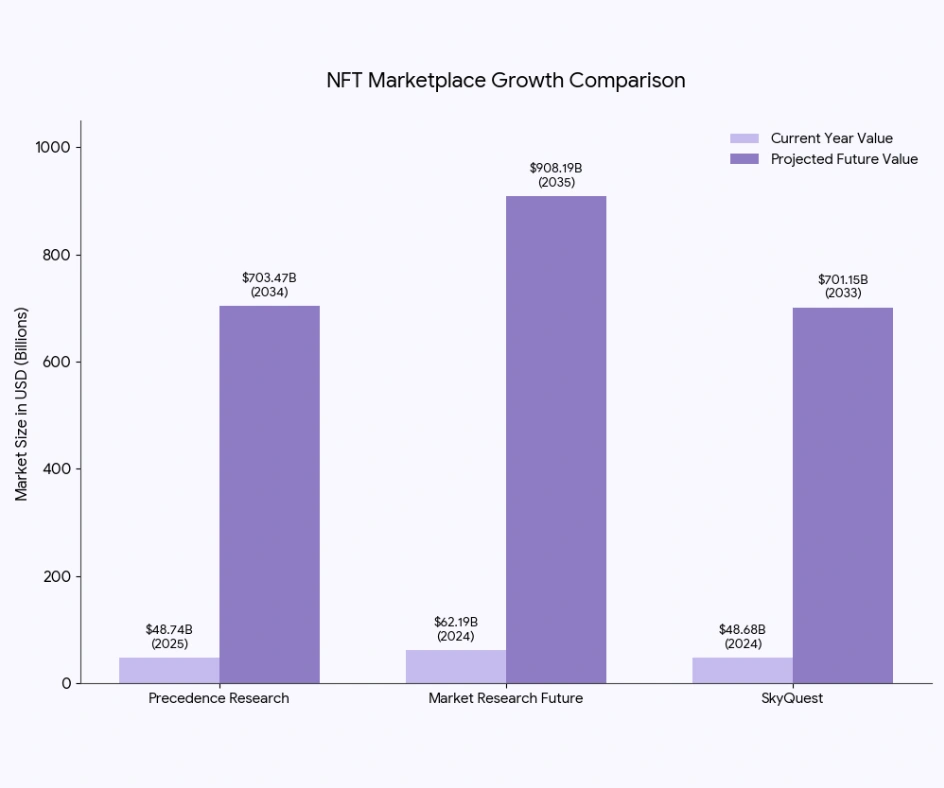
The numbers around the NFT marketplace industry size are striking. According to Precedence Research, the global non-fungible token market was valued at $48.74 billion in 2025 and is projected to climb to approximately $703.47 billion by 2034, at a compound annual growth rate of 34.53%.[7]
Market Research Future puts the 2024 valuation at $62.19 billion and projects the market to reach $908.19 billion by 2035, growing at a CAGR of 27.6%. The slight differences in these figures come from how each research firm defines the scope of the market. What all sources agree on is the direction: clearly upward.[8]
Another report from SkyQuest values the market at $48.68 billion in 2024 and forecasts it to reach $701.15 billion by 2033, growing at a CAGR of 34.5% through 2033. These figures reinforce the picture: the NFT market is not a passing trend. It is becoming a proper industry.[9]
1. Regional Breakdown
Not all parts of the world are adopting NFTs at the same pace. Here is what the data shows:
North America: This region holds the largest market share at 32% as of 2024. The United States alone has an NFT revenue forecast of $80.5 million with a user penetration rate of 0.61%. The presence of major platforms like OpenSea and Dapper Labs gives North America a strong foundation.
Asia Pacific: This region is the fastest-growing area for NFTs. India leads globally with an NFT ownership rate of 13.5%. Singapore comes in second at 9.2% and hosts over 140 NFT-focused blockchain startups. Vietnam shows a 6.4% ownership rate and Indonesia 4.9%, with both seeing growing use in remittances and microfinance. North America is expected to command over 45% of the NFT-as-a-service market by 2035.
Africa: Africa is an unexpected but growing market. Ghana has a 7.5% NFT ownership rate and Kenya at 2.8%, showing that digital ownership is finding a foothold even in markets with limited traditional financial infrastructure.
Latin America: Brazil shows a 4.6% NFT owner share and Mexico 2.3%, with early adoption concentrated in gaming and collectibles. These numbers indicate room for considerable future growth in this region.
Top NFT Marketplace Trends in 2026 & Beyond
NFT Marketplace Market Growth Rate and Forecast
The NFT market growth story is not just about valuation. It is also about how the nature of growth is changing. In 2021 and 2022, the market was driven by speculation. People were buying NFTs hoping to sell them for more money later. That era created massive price swings and eventually a crash. What is happening now is different and arguably more stable.
NFT sales in the first half of 2025 totaled $2.82 billion, only a 4.6% decline from late 2024, while sales counts climbed nearly 80%. This pattern tells us something important: more people are buying NFTs, but they are paying less per item on average. The market is widening its base rather than concentrating on a few high-priced headline sales.
The global NFT market is projected to grow to $60.82 billion by 2026, up from the $49 billion 2025 estimate, reflecting stronger adoption signals than earlier forecasts suggested. The long-range growth models show even larger numbers through 2034 and 2040.
2. What Is Driving NFT Market Growth
Gaming and play-to-earn models: The gaming NFT segment was valued at $4.8 billion in 2024 and is estimated to grow at 24.8% CAGR through 2034. Games like Axie Infinity brought the idea of earning real value through gameplay into mainstream conversation. Today, platforms like Immutable and Ronin Network are building entire gaming ecosystems where in-game items are NFTs that players actually own.
Brand adoption and loyalty programs: Major brands are using NFTs beyond artwork. Nike, Coca-Cola, and Starbucks have all launched NFT-based programs that give customers exclusive benefits, event access, or digital collectibles tied to real-world rewards. Starbucks ran an NFT loyalty program called Odyssey Web3 that connected digital tokens to coffee shop experiences. This use case alone is pushing the commercial segment to over 65% of the total NFT market by revenue.
Real-world asset tokenization: Real-world asset NFTs now represent 11% of the total NFT market share. This covers tokenized property, art, and physical goods. The idea is simple: take a real item, attach a digital certificate to it on the blockchain, and make it easier to trade, verify, or fractionally own. This is proving useful for luxury goods, property, and even supply chain verification.
Ticketing and event access: NFT-based tickets now appear at major events, offering fraud prevention and programmable benefits. Tokenized ticketing has been used across 20 or more global events in 2025. India’s IRCTC even partnered with Chaincode Consulting to launch NFT-based tickets for the MahaKumbh festival at Prayagraj.
Artificial intelligence integration: Around 30% of new NFT projects in 2025 use AI in some form. Intelligent NFTs, sometimes called iNFTs, combine blockchain ownership with AI-driven behavior. An iNFT can change, respond, or evolve based on user interaction. This takes NFTs from static digital objects to something closer to living digital entities.
NFT Market Size by Segment (2024)
| NFT Segment | 2024 Valuation | Notes |
|---|---|---|
| Gaming NFTs | $20.0 Billion (MRFR) / $4.8B (GMI) | Highest valued segment per Market Research Future; GMI tracks pure gaming NFT platforms separately |
| Collectibles | $15.62 Billion | Largest application share in 2024; includes trading cards, digital memorabilia, and profile picture collections |
| Digital Art NFTs | $12.43 Billion | Second most dominant; driven by digital galleries, auction houses, and institutional collector interest |
| Virtual Real Estate | $6.0 Billion | Metaverse platforms like Decentraland and The Sandbox drive demand for digital land ownership |
| Music NFTs | Growing sub-segment | Artists tokenize songs, albums, and royalty rights; rising across platforms like Sound.xyz and Audius |
| Real-World Asset NFTs | 11% of market share | Tokenized physical goods, property, vehicles, and luxury items tied to blockchain certificates |
Creator Economy & NFT Marketplaces
Top NFT Marketplaces: Who Is Leading and Why
Understanding the global NFT market means looking closely at the platforms where buying and selling actually happen. These marketplaces are not all built the same way, and they serve very different kinds of users.
1. OpenSea
Founded in 2017, OpenSea is the all-time leader in total trading volume with over $39.5 billion processed across its lifetime. It now supports NFTs across 19 blockchains, including Ethereum, Polygon, and Base. OpenSea charges a 2.5% transaction fee and has recently launched its OS2 platform, which adds a Voyages rewards system, faster transactions, and a modular design. OpenSea announced the $SEA governance token in February 2025, with 50% of the total supply going to community members, one of the largest Web3 distributions in recent years.
2. Blur
Blur is built specifically for professional traders. It offers 0% maker fees, real-time analytics, batch buying, and portfolio tracking tools. In 2024, Blur commanded 68.8% of the Ethereum-specific NFT market share with $2.43 billion in year-to-date volume. It also offers a lending protocol called Blend that allows traders to buy expensive NFTs without having the full amount in their wallets. Blur recorded roughly $135 million in 30-day trading volume in August 2025. Its model works well for high-frequency trading but is less beginner-friendly.
3. Magic Eden
Magic Eden held a 36.7% overall NFT marketplace share in August 2024, its 6th consecutive month at the top across all chains. It charges just a 2% transaction fee with no listing costs. Originally built for Solana, Magic Eden now supports Ethereum, Polygon, Bitcoin Ordinals, Base, Arbitrum, BNB Chain, and Avalanche. The platform’s CEO, Jack Lu, stated in early 2025 that Magic Eden would expand to 10 chains before the year’s end. It is a strong choice for multi-chain collectors and creators.
4. SuperRare
SuperRare focuses on digital fine art and enforces creator royalties at the protocol level, something that many other platforms have made optional. It charges approximately 15% on primary sales (split between the platform and curators) and 10% on secondary sales. Artists on SuperRare go through a curation process, giving the platform a gallery-like quality that appeals to serious art collectors.
5. Rarible
Rarible introduced community governance through its RARI token, allowing users to vote on platform decisions like fee structures and feature updates. It charges around 2.5% in transaction fees and supports Ethereum, Flow, and Tezos blockchains. Rarible is known for empowering creators and giving community members a direct say in how the platform runs.
Top NFT Marketplace Comparison (2024-2025)
| Marketplace | Transaction Fee | Best For | Blockchains Supported |
|---|---|---|---|
| OpenSea | 2.5% | Beginners, collectors, all-around buyers, and sellers | 19 chains, including Ethereum, Polygon, Base, and Arbitrum |
| Blur | 0% maker / small taker fee | Professional traders, high-frequency flipping | Ethereum, Blast |
| Magic Eden | 2% (no listing fee) | Multi-chain collectors, gaming NFTs, Bitcoin Ordinals | Solana, Ethereum, Bitcoin, Polygon, Base, BNB, Arbitrum, Avalanche |
| SuperRare | ~15% primary / 10% secondary | Digital art collectors, curated fine art buyers | Ethereum |
| Rarible | ~2.5% | Creators who want community governance rights | Ethereum, Flow, Tezos |
| Binance NFT | 1% (platform fee) | Existing Binance exchange users, crypto-native buyers | Ethereum, BNB Chain |
How NFT Marketplaces Actually Work
For someone new to this space, it helps to understand the mechanics behind these platforms before getting into the market data. An NFT marketplace is a website or application where people can create (called minting), list, buy, and sell NFTs. Everything happens on a blockchain, which is a public digital record that tracks who owns what.
1. The Role of Smart Contracts
Smart contracts are programs stored on a blockchain that run automatically when certain conditions are met. When someone buys an NFT, the smart contract handles the payment transfer, delivers the NFT to the buyer, sends any royalty percentage to the original creator, and records the entire transaction permanently on the blockchain. No human needs to approve or oversee any of this. It happens by code.
The most common token standards used are ERC-721 (for unique, one-of-a-kind NFTs) and ERC-1155 (for NFTs that can have multiple copies, useful in gaming). These run primarily on Ethereum, though similar standards exist on Solana and other chains.
2. Blockchain Networks Powering NFTs
Not all NFTs live on Ethereum. The current breakdown by activity shows that Ethereum powers approximately 62% of all NFT transactions, Solana accounts for 18%, Polygon 11%, and BNB Chain around 6%. Each blockchain has its trade-offs.
Ethereum is the most established, with the deepest liquidity and the most recognized collections. However, it can have high transaction fees, especially during busy periods. Solana offers faster processing and much lower costs, which is why gaming NFTs and high-frequency applications tend to favor it. Polygon, as a Layer-2 solution on top of Ethereum, also brings lower fees while keeping EVM compatibility.
Gaming, Metaverse & NFT Marketplace Growth
NFT Industry Analysis: Key Trends Shaping the Market
1. Cross-Chain Trading is Becoming Standard
Early NFT marketplaces were mostly single-chain. OpenSea was built for Ethereum, Magic Eden for Solana. That is no longer the case. Today, every major platform is expanding to support multiple blockchains because users do not want to maintain separate wallets and accounts for each network. Cross-chain bridges now allow NFTs to move between Ethereum, Solana, and Base. This shift reduces friction and makes the market more connected.
2. Creator Royalties Are a Point of Debate
When NFTs were first introduced, one of the key promises to creators was that they would earn a percentage every time their work was resold. This royalty was automatic and built into the smart contract. However, platforms like Blur and LooksRare moved to optional royalties to attract more traders with lower costs. This upset many creators who had built business models around ongoing royalty income. OpenSea and Magic Eden now offer “opt-in” royalty support. The debate between trader cost reduction and creator protection is one of the central tensions in today’s NFT marketplace industry.
3. AI-Generated NFTs and Intelligent Digital Assets
Roughly 30% of new NFT projects in 2025 incorporate AI in some form, ranging from generative art created by algorithms to autonomous in-game agents. Intelligent NFTs can evolve based on user interaction, ownership history, or external data. New token standards like ERC-7857 are enabling programmable, adaptive NFTs. This brings NFTs from being simple pictures or files to actual, dynamic digital objects with behavior built in.
4. NFTs in Sports and Entertainment
Sports NFTs were among the first to prove that digital collectibles had a mass audience. NBA Top Shot by Dapper Labs allowed fans to buy officially licensed video highlights as NFTs. As of April 2025, Dapper Labs remains a major player in gaming and sports NFT growth. Collections like CryptoPunks and Bored Ape Yacht Club, while older, continue to trade at high prices and act as status symbols in the digital world. Collectors and brands treat them like luxury goods.
5. Regulation Is Coming
One area that every analyst mentions as a risk is regulation. Many countries have not yet established clear rules around NFT ownership, taxation, and trading. This uncertainty slows institutional investment and creates confusion for creators and buyers about what they can legally do with digital assets. Platforms that build compliance frameworks early are expected to have a major advantage when regulations do arrive.
How AI Is Transforming NFT Marketplaces
NFT Marketplace Development in the Real World
The following projects show how blockchain-based marketplace infrastructure is being applied across different industries, from digital collectibles to decentralized application development. Each reflects the same underlying principles of smart contracts, tokenization, and distributed ownership discussed throughout this blog.
📡
DentNet: Blockchain-Based Telecom Marketplace
Built a blockchain-powered platform that turns telecom services into tradeable digital assets. Users buy, sell, and transfer mobile data, voice minutes, and eSIM access across borders using token staking and a decentralized swap system. This mirrors the same ownership and trading logic that drives NFT marketplaces, applied to telecom infrastructure.
🎮
RoninChain: Layer-1 Blockchain for Web3 Gaming
Nadcab Labs built RoninChain, a gaming-focused Layer-1 blockchain designed to handle millions of NFT transactions at low cost. The platform moved from Proof of Authority to Delegated Proof of Stake, giving token holders the power to elect validators and shape governance. It supports NFT minting, play-to-earn economies, and cross-game asset ownership, with developer tools including SDKs, APIs, and Ronin Wallet connectivity that make Web3 onboarding as easy as a traditional game login. After opening permissionless smart contract deployment in early 2025, active developers on the chain grew from 21 to over 1,000, directly matching the play-to-earn architecture powering global gaming NFT market growth.
NFT Marketplace Development Costs
| Development Component | Cost Range | Key Considerations |
|---|---|---|
| Basic Platform Features | $30,000 – $50,000 | User authentication, NFT minting, buying/selling functionality, basic wallet integration |
| Advanced Platform Features | $100,000 – $150,000+ | Custom smart contracts, multi-chain support, advanced analytics, decentralized storage, royalty management |
| UI/UX Design | $5,000 – $20,000 | Simple interface vs. custom-branded design with detailed visual elements |
| Blockchain Integration | $10,000 – $20,000 | Ethereum most common; alternatives like Solana or BNB Chain vary in cost and complexity |
| Smart Contract Development | Included in platform costs | Token standards (ERC-721, ERC-1155), security audits, and testing are all part of this phase |
| Security Implementation | $5,000 – $15,000 | Encryption, multi-factor authentication, and regular security audits |
| Ongoing Maintenance | $1,000 – $5,000/month | Server hosting, updates, customer support, and security monitoring |
Top NFT Marketplace Trends in 2026 & Beyond
Challenges Facing the NFT Marketplace Industry
No market grows without problems. The NFT space has real challenges that affect investors, creators, and platform developers alike.
1. Security Risks
NFTs exist entirely in a digital space, which makes them a target for theft and fraud. Phishing attacks, fake marketplace websites, and smart contract vulnerabilities have all been used to steal digital assets. Between July 2021 and July 2022, over $100 million worth of NFTs were reported stolen. Platforms spend significantly on encryption, multi-factor authentication, and regular contract audits to address these threats. Still, users need to be careful about connecting their wallets to unknown platforms.
2. Environmental Concerns
Early criticism of NFTs focused on the energy cost of blockchain networks, particularly Ethereum, before it moved to a Proof-of-Stake model in 2022. That transition, called The Merge, reduced Ethereum’s energy use by approximately 99.5%. Many other networks, like Solana and Tezos, also use energy-efficient consensus methods. While this concern is less urgent than it was in 2021, it still comes up in discussions around NFT adoption by mainstream brands.
3. Market Volatility
NFT prices can move dramatically. A collection that sold for thousands per item can drop to near zero if community interest fades. Unlike stocks or real estate, there is no underlying cash flow to value NFTs against. This makes the market difficult to predict and risky for buyers who treat it as a pure investment. The shift toward utility-based NFTs (event tickets, gaming items, brand memberships) is helping create more stable demand.
4. Intellectual Property and Copyright Issues
Many early NFT sales involved artwork where the NFT creator did not actually own the underlying copyright. Buying an NFT does not automatically give you the copyright to the image or media it represents. This has led to legal confusion and some high-profile disputes. Clearer legal frameworks around what NFT ownership actually grants are still being developed in most countries.
Launch Your NFT Marketplace Platform Today:
We bring deep blockchain expertise to NFT marketplace development. Our specialized team handles everything from smart contract creation to multi-chain integration, making sure your platform is built for growth, security, and a great user experience. Whether you need a curated art marketplace or a gaming NFT platform, we deliver solutions that work.
Final Thoughts
The global NFT marketplace market is going through a genuine transformation. The days of speculative buying based purely on hype are giving way to something more grounded. Real utility, from gaming and ticketing to brand loyalty programs and asset tokenization, is creating lasting demand for this technology.
The numbers back this up. With the market valued at $48.74 billion in 2025 and forecast to reach anywhere from $700 billion to over $900 billion by the early 2030s, the trajectory is clear. Ethereum, Solana, and Polygon continue to power most of the activity, while platforms like Magic Eden, Blur, and OpenSea compete across different user segments with different models.
For anyone thinking about building in this space, whether as a creator, a business, or a developer, the window for early positioning is still open. The infrastructure is maturing, regulation is slowly taking shape, and user numbers are growing steadily. NFTs are no longer just digital pictures. They are becoming a core piece of how ownership, identity, and value work in the digital world.
Frequently Asked Questions
Q1.What is the current size of the global NFT marketplace market?
The global NFT market was valued at approximately $48.74 billion in 2025, according to Precedence Research. Other firms like Market Research Future put the 2024 value at $62.19 billion, depending on the scope of segments included. All major reports agree that the market is growing at a fast pace through the 2030s.
Q2.Which NFT marketplace has the highest total trading volume?
OpenSea holds the highest all-time trading volume at over $39.5 billion as of early 2025. However, Magic Eden leads in monthly trading volume across all chains, having held the top position for several consecutive months in 2024. Blur dominates specifically on Ethereum with a 68.8% Ethereum-chain market share.
Q3.What is the NFT marketplace market growth rate?
Growth rate estimates range from 27.26% CAGR (Roots Analysis, through 2040) to 34.53% CAGR (Precedence Research, through 2034), depending on the forecast timeframe and research methodology. All projections point to very strong growth over the next decade.
Q4.What types of NFTs are most popular?
Collectibles held the largest application share in 2024, followed by gaming NFTs and digital art. Gaming NFTs are the fastest-growing type, with a dedicated segment value of $4.8 billion in 2024, growing at 24.8% annually. Digital assets overall account for 73% of the total NFT market type share.
Q5.Which blockchain is most used for NFTs?
Ethereum is the dominant blockchain for NFTs, handling approximately 62% of all NFT transactions. Solana follows at 18%, Polygon at 11%, and BNB Chain at around 6%. Solana and Polygon are preferred for applications that require lower fees and faster processing, such as gaming and ticketing.
Q6.How much does it cost to build an NFT marketplace?
A basic NFT marketplace with standard buying, selling, and minting features typically costs between $30,000 and $50,000 to build. A more advanced platform with multi-chain support, custom smart contracts, advanced analytics, and royalty management systems can range from $100,000 to $150,000 or more, plus $1,000 to $5,000 per month in ongoing maintenance costs.
Explore Services
Related Services
Reviewed by

Aman Vaths
Founder of Nadcab Labs
Aman Vaths is the Founder & CTO of Nadcab Labs, a global digital engineering company delivering enterprise-grade solutions across AI, Web3, Blockchain, Big Data, Cloud, Cybersecurity, and Modern Application Development. With deep technical leadership and product innovation experience, Aman has positioned Nadcab Labs as one of the most advanced engineering companies driving the next era of intelligent, secure, and scalable software systems. Under his leadership, Nadcab Labs has built 2,000+ global projects across sectors including fintech, banking, healthcare, real estate, logistics, gaming, manufacturing, and next-generation DePIN networks. Aman’s strength lies in architecting high-performance systems, end-to-end platform engineering, and designing enterprise solutions that operate at global scale.