Ai Overview
Validator costs for DeFi infrastructure represent the total expenses required to operate a blockchain validator node. Cloud-based solutions add $300-$1,500 monthly to operational costs. Staking pool services have lower operational costs but charge 10-25% of rewards as fees. The real lesson: attempting to save $2,000-$5,000 annually on infrastructure often results in $50,000-$500,000+ losses from slashing events and downtime.
Key Takeaways
- Validator costs for DeFi infrastructure typically range from $5,000 to $100,000+ annually depending on blockchain and setup type.
- Self-hosted validators require significant technical expertise but offer lower ongoing costs compared to managed hosting solutions.
- Hardware requirements vary drastically across blockchains, with Ethereum validators needing 32 ETH stake plus server costs, while Solana requires only minimal hardware.
- Cloud-based validator hosting eliminates infrastructure setup costs but introduces recurring monthly expenses and dependency on third-party providers.
- Electricity consumption represents a hidden cost that can account for 20-40% of total validator operating expenses annually.
- Validator rewards often exceed operational costs within 12-24 months for well-configured infrastructure on major blockchains.
- Choosing cheap infrastructure creates security risks that can result in slashing penalties, lost staking rewards, and reputation damage.
- Enterprise validator setups require redundancy and failover mechanisms that add 30-50% to baseline infrastructure costs.
- Validator uptime requirements are typically 95-99%, making network connectivity and backup systems critical investment areas.
- Understanding total cost of ownership across hardware, staking, hosting, maintenance, and security enables better ROI calculations and infrastructure planning.
Running a blockchain validator requires significant investment, but most businesses don’t understand the true cost of validator infrastructure until they’re already committed. From hardware requirements to electricity bills, staking costs to security measures, the expenses add up quickly. This guide breaks down validator costs for DeFi infrastructure so you can make informed decisions about deploying blockchain validators for your enterprise or startup.
What Are Validator Costs for DeFi Infrastructure?
Validator costs for DeFi infrastructure represent the total expenses required to operate a blockchain validator node. Think of it like running a small data center for your business. Just as maintaining physical servers requires investment in equipment, electricity, cooling, security, and staff, operating a DeFi validator requires ongoing financial commitment across multiple cost categories.
A blockchain validator is essentially a computer running specialized software that validates transactions, creates new blocks, and secures the network. In return, validators earn rewards. But before you see those rewards, you need to cover several cost categories that work together.
Real-World Analogy:
Running a validator is similar to owning a coffee shop. You need to invest in equipment (the espresso machine), pay for a location (server hosting), buy supplies (electricity and maintenance), comply with regulations (security and monitoring), and only then do you earn profits from customers. The initial and ongoing costs determine how quickly you break even.
For blockchain validators, these costs break down into distinct categories: staking requirements, hardware investments, hosting and infrastructure, electricity and bandwidth, maintenance and monitoring, security measures, and compliance costs. Understanding each component helps you calculate the true cost of validator infrastructure.
Why Validator Infrastructure Is Critical for DeFi Projects
DeFi platforms depend on validators to maintain decentralization, process transactions, and secure the network. Without validators, there’s no blockchain. This makes validator infrastructure a foundational investment for any blockchain project or enterprise seeking network participation.
Key reasons validators matter:
- Network Security: Validators secure the network through consensus mechanisms, making attacks economically unfeasible.
- Transaction Processing: Validators validate and process transactions, ensuring network functionality.
- Decentralization: More validators mean better decentralization, improving network resilience.
- Earning Rewards: Validators earn staking rewards and transaction fees, creating an economic incentive for network participation.
- Governance Participation: Validators often hold governance rights in their respective networks.
For enterprises and startups, running a validator demonstrates commitment to network governance, can generate passive income through staking rewards, and ensures reliable infrastructure for their DeFi operations.
Types of Validator Setups: Understanding Your Options
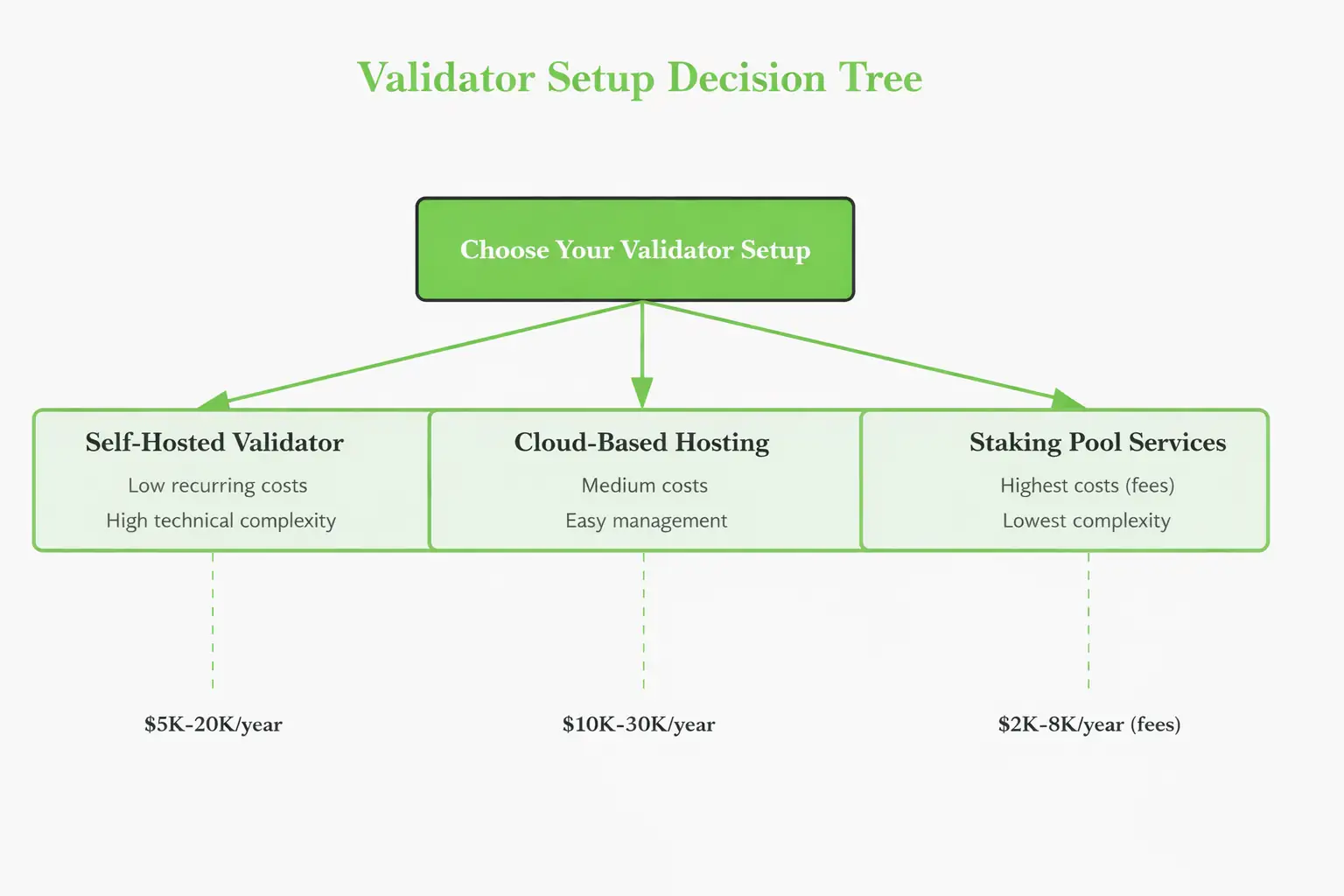
When planning validator infrastructure, you have three primary setup options, each with different cost structures and technical requirements. Your choice depends on your technical expertise, capital availability, and risk tolerance.
Option 1: Self-Hosted Validators
Self-hosted validators require you to purchase hardware, set up the physical infrastructure, manage software updates, and monitor performance directly. This option offers the lowest recurring costs but demands significant technical expertise and operational responsibility.
Self-Hosted Costs:
- Initial hardware investment: $2,000 to $10,000
- Electricity: $200 to $500 per month
- Network and cooling: $100 to $300 per month
- Staking requirement: Varies by blockchain (Ethereum needs 32 ETH worth ~$100,000+)
- Annual total: $5,000 to $20,000 (excluding staking requirement)
Option 2: Cloud-Based Validator Hosting
Cloud providers like AWS, Google Cloud, and specialized blockchain hosting services manage the infrastructure while you focus on validator configuration and monitoring. You avoid hardware investment but pay monthly hosting fees.
Cloud Hosting Costs:
- Monthly hosting fees: $500 to $2,000
- Bandwidth and storage: $100 to $400 per month
- Backup and redundancy: $200 to $500 per month
- Staking requirement: Same as self-hosted
- Annual total: $10,000 to $35,000 (excluding staking requirement)
Option 3: Staking Pool Services
Services like Lido, Rocket Pool, and other staking providers operate validators on your behalf. You deposit crypto into their smart contracts and earn a portion of rewards minus their service fees. This requires no technical setup but involves surrendering control and paying fees.
Staking Pool Costs:
- Service fees: 10% to 25% of staking rewards
- Network fees: Variable (usually included in rewards)
- No infrastructure investment needed
- No technical expertise required
- Annual effective cost: $2,000 to $8,000 (as percentage of rewards)
Step-by-Step Cost Breakdown for Validator Infrastructure
To understand validator costs for DeFi infrastructure, let’s break down each expense category. This comprehensive breakdown helps you calculate your true cost of ownership.
1. Hardware Costs
Validator hardware must be reliable and sufficiently powerful to process blockchain data continuously. Unlike consumer computers, validator hardware needs high uptime, fast storage, and adequate memory.
Typical Hardware Configuration:
- Server or workstation: $3,000 to $8,000
- SSD storage (1-2TB): $500 to $1,500
- RAM (32-64GB): $300 to $800
- Networking equipment: $200 to $500
- Backup power supply (UPS): $1,000 to $3,000
- Total hardware: $5,000 to $14,000 one-time investment
2. Staking Requirements
Most Proof-of-Stake blockchains require validators to hold a minimum amount of the network’s native token as a security deposit. This isn’t an operational expense but a capital requirement that must remain locked.
Staking Requirements by Blockchain:
- Ethereum: 32 ETH (~$100,000 to $150,000 based on market price)
- Polygon: 100 MATIC (~$20 to $50)
- Solana: ~0.02 SOL (~$3 to $5) plus rent costs
- Cardano: No minimum stake (pool based)
- Cosmos: Variable, typically 1 ATOM minimum (~$10 to $20)
3. Electricity and Operational Costs
Validators run 24/7, consuming significant electricity. A typical validator uses 200-400 watts continuously. At an average electricity rate of $0.12 per kilowatt-hour, this creates substantial monthly expenses.
Monthly Electricity Calculation:
- Power consumption: 300 watts (average)
- Hours per month: 730 hours
- Monthly usage: 219 kWh
- At $0.12/kWh: $26 per month
- Annual electricity cost: $312 to $600 (varies by region)
4. Hosting and Colocation
If you’re not running the validator from your office, you need to pay for data center colocation or cloud hosting. Professional data centers provide redundancy, power backup, and network connectivity.
Hosting Options and Costs:
- Data center colocation: $300 to $800 per month
- AWS/Google Cloud medium instance: $500 to $1,500 per month
- Dedicated blockchain hosting (Hetzner, Contabo): $30 to $200 per month
- Office-based (electricity only): $30 to $100 per month
- Annual hosting: $400 to $18,000 depending on choice
5. Maintenance and Monitoring
Validators require continuous monitoring, software updates, and maintenance. You need tools for performance tracking, alerting systems, and incident response capabilities.
Maintenance Costs:
- Monitoring software: $50 to $200 per month
- Alerting and incident management: $30 to $100 per month
- Database backup systems: $20 to $100 per month
- Staff time (for self-managed): 5-10 hours per week
- Annual maintenance: $1,000 to $4,000 (plus labor)
6. Security and Insurance
Validator infrastructure requires security measures including firewalls, DDoS protection, key management systems, and potentially cyber insurance. Losing access to your validator keys can mean permanent loss of staked funds.
Security Investment:
- Hardware security modules (HSM): $1,000 to $5,000
- DDoS protection services: $100 to $500 per month
- Cyber insurance: $200 to $1,000 per month
- Security audits: $2,000 to $10,000 annually
- Annual security: $2,000 to $12,000+
Real-World Cost Estimates: Validator Costs Across Major Blockchains
Validator costs vary significantly across different blockchains. Let’s compare actual expenses for self-hosted validators on major networks:
| Blockchain | Staking Requirement | Annual Operating Cost | Avg. Annual Rewards | Payback Period |
|---|---|---|---|---|
| Ethereum | 32 ETH (~$100K+) | $8,000-$15,000 | $3,200-$4,500 | 2-4 years |
| Polygon | 100 MATIC (~$30) | $5,000-$10,000 | $1,500-$3,000 | 2-6 years |
| Solana | 0.02 SOL (~$4) | $3,500-$8,000 | $1,200-$2,500 | 1-6 years |
| Cosmos | 1 ATOM (~$15) | $4,000-$9,000 | $800-$2,000 | 2-10 years |
| Cardano | 1 ADA minimum (~$0.50) | $3,000-$7,000 | $500-$1,500 | 2-14 years |
These estimates represent self-hosted setups with standard equipment. Cloud-based solutions add $300-$1,500 monthly to operational costs. Staking pool services have lower operational costs but charge 10-25% of rewards as fees.
Hidden Validator Costs Most Businesses Overlook
Beyond obvious expenses, several hidden costs surprise validator operators. Understanding these helps you create more accurate budgets.
Hidden Costs to Budget For:
- Bandwidth Overage Charges: Data center bandwidth limits can incur overage fees of $5-$20 per additional GB, adding $100-$500+ annually
- Slashing Penalties: Validator misconduct results in permanent loss of staked funds, ranging from small amounts to entire stake
- Network Outage Costs: Downtime reduces rewards and can trigger penalties. Redundant connections cost $200-$500 extra monthly
- Software License Fees: Some validator management tools charge $50-$300 per month for advanced features
- Tax and Compliance: Staking rewards are taxable income. Professional tax accounting adds $1,000-$5,000 annually
- Emergency Recovery: Hardware failures require rapid replacement. Keeping spare hardware costs $2,000-$5,000
- Training and Education: Team training on blockchain operations: $500-$2,000 per person annually
- Compliance and Regulatory: Legal review of validator setup for your jurisdiction: $2,000-$10,000
Validator Rewards vs. Operational Cost: When Does It Break Even?
The question every potential validator asks is simple: will my rewards exceed my costs? The answer depends on several factors including the blockchain, staked amount, current market conditions, and your setup efficiency.
Example: Ethereum Validator Economics
Let’s work through a real example with Ethereum, the most popular validator network:
Initial Investment:
- Hardware: $10,000 (one-time)
- 32 ETH stake: ~$100,000 (locked capital)
Annual Operating Costs:
- Electricity: $500
- Cloud hosting: $6,000
- Monitoring tools: $1,500
- Maintenance and security: $2,000
- Total annual cost: $10,000
Annual Rewards (assuming 3.5% APY):
- 32 ETH × 3.5% = 1.12 ETH per year
- At $3,000 per ETH = $3,360 in annual rewards
Result: Operating at a $6,640 annual loss. This validator would need reduced costs or a larger stake to be profitable. However, MEV (Maximal Extractable Value) rewards can add 20-50% to base staking rewards, potentially making this profitable.
For smaller validators or new entrants, joining staking pools initially makes more financial sense until you have the capital and expertise to run a profitable self-hosted validator.
The True Cost of Cheap Infrastructure: Risks and Hidden Expenses
Many startups attempt to cut validator costs by choosing cheap hosting, minimal redundancy, or inadequate security. This approach often backfires spectacularly.
Risks of Underfunded Validator Infrastructure:
- Slashing Penalties: One downtime event can result in permanent loss of 0.25% to 100% of your stake. On a 32 ETH validator, this means $750 to $100,000+ instant loss.
- Missed Rewards: Every minute of downtime costs you approximately $0.20-$1.00 in lost rewards. A 24-hour outage costs $288-$1,440.
- Network Attacks: Cheap DDoS protection makes you a target. A single attack could take your validator offline for hours or days.
- Data Loss: No backup systems mean one hardware failure wipes your validator’s critical data. Recovery costs $5,000-$20,000.
- Security Breaches: Inadequate security can lead to key compromise, resulting in complete loss of all staked funds.
- Reputation Damage: Unreliable validators get slashed by networks, damaging your credibility as an infrastructure operator.
The real lesson: attempting to save $2,000-$5,000 annually on infrastructure often results in $50,000-$500,000+ losses from slashing events and downtime. Enterprise-grade validator infrastructure isn’t a luxury; it’s a necessity.
Enterprise Validator Infrastructure: Scale and Reliability Requirements
Large enterprises running validator infrastructure have different requirements than startups. They need redundancy, failover mechanisms, compliance systems, and multiple geographic locations.
Enterprise Cost Multipliers:
- Geographic Redundancy: Running validators in 3+ geographic regions adds 200-300% to infrastructure costs
- Failover Systems: Automatic failover and load balancing adds 20-30% to baseline costs
- Compliance and Audit: Enterprise compliance (SOC 2, ISO 27001) adds $10,000-$50,000 annually
- Legal and Regulatory: Formal contracts, legal review, and regulatory compliance: $20,000-$100,000+ per year
- Dedicated Operations Team: Full-time DevOps engineers and blockchain specialists: $150,000-$500,000+ annually
- Advanced Monitoring: Enterprise monitoring and alerting tools: $5,000-$20,000 monthly
For enterprises, total validator infrastructure costs often reach $100,000-$500,000+ annually when including all redundancy, security, compliance, and staffing requirements.
Large enterprises like Coinbase, Kraken, and major cryptocurrency exchanges operate validators at massive scale. Their infrastructure investments run into millions of dollars, but they validate billions in transactions daily.
Build Scalable and Cost-Efficient Validator Infrastructure
Deploying a validator isn’t just about technical setup. It requires strategic planning to balance costs, security, and profitability. Whether you’re a startup exploring your first validator or an enterprise managing thousands, the right infrastructure decisions determine your long-term success.
Nadcab Labs specializes in helping businesses design, deploy, and manage enterprise-grade validator infrastructure across all major blockchains. Our experts combine deep blockchain knowledge with infrastructure best practices to help you optimize costs while maximizing uptime and rewards.
From initial planning through ongoing optimization, we ensure your validator infrastructure remains secure, profitable, and aligned with your business goals.
Future Trends in Validator Economics and DeFi Infrastructure Costs
The validator landscape continues evolving. Understanding upcoming trends helps you plan long-term infrastructure investments.
Emerging Trends Affecting Validator Costs:
- Liquid Staking Growth: More users staking through pools like Lido reduces demand for independent validators, potentially increasing validator costs for those remaining.
- Hardware Requirements Increase: As blockchain networks process more data, validator hardware requirements grow. Older servers become obsolete faster.
- Cloud Provider Competition: Increased competition among blockchain-focused hosting providers will likely reduce hosting costs 20-30% over next 2 years.
- Proof-of-Stake Adoption: More blockchains transitioning to PoS creates validator market competition, potentially improving validator rewards.
- Regulatory Clarity: Better regulatory frameworks will increase compliance costs but reduce legal risk and insurance premiums.
- Automation and AI: Smart monitoring and AI-driven optimization will reduce manual operational costs by 30-50%.
Making Informed Decisions About Validator Costs for DeFi Infrastructure
Understanding validator costs for DeFi infrastructure is essential for anyone considering blockchain validator deployment. These costs span hardware investments, electricity, hosting, staking requirements, maintenance, and security. Each component plays a crucial role in ensuring your validator operates reliably and profitably.
The validator landscape offers options for every budget level:
- Budget-conscious: Start with staking pools while learning the ecosystem
- Growing teams: Combine cloud hosting with managed services to balance costs and control
- Enterprises: Invest in self-hosted, geographically redundant infrastructure with dedicated operations teams
The most successful validator operators don’t focus on cutting costs; they focus on optimizing value. They invest adequately in security and reliability because the consequences of failure far exceed the costs of prevention.
As DeFi infrastructure continues maturing, validator economics will evolve. Costs may decrease due to increased competition and automation, but the importance of reliable, secure validator infrastructure will only grow. Whether you’re building a validator for yield, governance participation, or network support, understanding validator costs for DeFi infrastructure ensures you make decisions aligned with your long-term blockchain strategy.
Frequently Asked Questions
Q1.What is the minimum amount I need to start a validator for DeFi infrastructure?
The minimum amount depends on the blockchain. Ethereum requires 32 ETH (approximately $100,000+ depending on market price). However, you also need operational funds for hardware and hosting. For cloud-based setup, you need an additional $500-$2,000 monthly. Some blockchains like Solana have much lower staking requirements ($4-$10), making them more accessible for beginners exploring validator operations before larger capital commitments.
Q2.Can I run a profitable validator from home?
Yes, but profitability depends on your electricity costs and the blockchain. If your electricity costs are under $0.10 per kWh, home-based validators can be profitable after 2-4 years on major blockchains. However, home internet may lack the uptime reliability needed, risking slashing penalties. Most successful home-based validators invest in backup internet connections ($50-$100 monthly) and uninterruptible power supplies ($1,000-$3,000), reducing cost savings significantly.
Q3.How much can I earn as a validator annually?
Annual validator rewards vary by blockchain and network conditions. Ethereum validators earn 3-5% APY on staked ETH plus additional MEV rewards. A 32 ETH validator earns approximately $3,200-$5,600 annually in base rewards, plus $1,000-$5,000+ in MEV rewards. Smaller stake amounts earn proportionally less. Solana validators earn approximately 8-10% APY. These rewards fluctuate based on network participation rates and market conditions, so actual earnings may differ from estimates.
Q4.What happens if my validator goes offline or fails to validate?
If your validator goes offline, you stop earning rewards immediately. Minor downtime (hours to days) typically results in no slashing penalties, just lost rewards. However, if you remain offline for extended periods (weeks) or miss attestations (validations) repeatedly, networks apply slashing penalties that permanently reduce your stake by 0.25% to 100% depending on the slash type and network rules. This is why redundancy and failover systems are essential investments for validators.
Q5.Is validator hosting on cloud platforms safe from hacking?
Cloud platforms implement strong security, but validators specifically require additional protection. The critical factor is key management: your validator private keys must never be exposed to the internet. Use hardware security modules (HSMs), offline key signing, or multi-signature schemes. Many cloud providers offer managed validator services where they handle key management, reducing your security burden. However, always verify their security certifications (SOC 2 Type II, ISO 27001) before trusting them with validator infrastructure.
Q6.How often do I need to upgrade my validator hardware?
As blockchains grow, hardware requirements increase. Most validators need hardware upgrades every 3-5 years. Early hardware may become insufficient as blockchain data sizes expand (Ethereum blockchain currently exceeds 1TB). Budget $3,000-$5,000 for hardware upgrades every 3-4 years. Some blockchains like Ethereum plan to increase storage and processing requirements, potentially shortening hardware lifecycles. Staying informed about network roadmaps helps you plan upgrade timelines and budgets accurately.
Q7.What are MEV rewards and how do they affect validator profitability?
Maximal Extractable Value (MEV) refers to profits validators and searchers extract by reordering or including transactions in blocks. MEV rewards can add 20-50% or more to base staking rewards on Ethereum. However, MEV extraction requires specialized software and coordination with external services. Some validators earn $200-$1,000+ monthly in MEV rewards, significantly improving validator profitability. MEV represents a growing portion of validator income, but it depends on network activity and transaction volumes, making it variable and difficult to predict.
Q8.Can I validate on multiple blockchains simultaneously to diversify earnings?
Yes, validators can operate on multiple blockchains simultaneously, diversifying your income streams and risk. Each blockchain requires separate hardware resources or cloud instances and separate staked capital. Multi-blockchain validator operations typically cost 50-150% more than single-blockchain setups depending on overlapping infrastructure needs. The benefits include diversified rewards, reduced dependence on single network economics, and better uptime protection (network outages only affect one blockchain). Many professional validator operators run validators across 5-10 major blockchains to optimize returns and risk management.
Q9.Do validator taxes affect my profitability calculations?
Yes, significantly. Staking rewards are typically taxable income in most jurisdictions. You’re taxed on rewards when earned, not when withdrawn. For example, if you earn $4,000 in annual staking rewards, you may owe $800-$1,600 in taxes depending on your tax bracket. This effectively reduces your profits by 20-40%. Additionally, slashing penalties may have tax implications. Budget 25-30% of gross rewards for taxes when calculating profitability. Professional tax accounting for validators costs $1,000-$5,000 annually but helps optimize your tax position and ensure compliance.
Q10.How do I decide between self-hosting, cloud hosting, or staking pools?
Choose based on your capital, technical expertise, and risk tolerance. Self-hosting works for experienced operators with $30,000+ capital for setup and adequate technical skills. Cloud hosting suits those with moderate technical skills and $20,000+ annual budget who want flexibility. Staking pools work for beginners with limited capital who prioritize simplicity over control and rewards. Enterprises typically use self-hosted infrastructure with cloud backup for maximum control and security. Many operators start with staking pools, transition to cloud hosting as they learn, then eventually build self-hosted infrastructure as they grow. This staged approach reduces risk while building expertise and capital reserves.
Explore Services
Related Services
Reviewed by

Aman Vaths
Founder of Nadcab Labs
Aman Vaths is the Founder & CTO of Nadcab Labs, a global digital engineering company delivering enterprise-grade solutions across AI, Web3, Blockchain, Big Data, Cloud, Cybersecurity, and Modern Application Development. With deep technical leadership and product innovation experience, Aman has positioned Nadcab Labs as one of the most advanced engineering companies driving the next era of intelligent, secure, and scalable software systems. Under his leadership, Nadcab Labs has built 2,000+ global projects across sectors including fintech, banking, healthcare, real estate, logistics, gaming, manufacturing, and next-generation DePIN networks. Aman’s strength lies in architecting high-performance systems, end-to-end platform engineering, and designing enterprise solutions that operate at global scale.