Ai Overview
Hardhat remains the most widely adopted web3 framework in 2026, powering JavaScript and TypeScript smart contract workflows globally. Foundry’s Rust-based toolchain executes tests up to 10x faster than JavaScript-based alternatives, making it the top choice for performance-critical projects. Standard 1: Fuzz testing with a minimum of 10,000 runs per function is mandatory for any contract managing more than USD 1 million in user funds.
✓Key Takeaways
- 01.Hardhat remains the most widely adopted web3 framework in 2026, powering JavaScript and TypeScript smart contract workflows globally.
- 02.Foundry’s Rust-based toolchain executes tests up to 10x faster than JavaScript-based alternatives, making it the top choice for performance-critical projects.
- 03.Brownie serves Python-first teams working on DeFi automation and quantitative finance applications with deep Web3.py integration baked in.
- 04.Foundry’s native fuzzing via Forge is now considered a security baseline for any smart contract managing significant value in DeFi protocols.
- 05.Hardhat’s plugin ecosystem offers over 100 community-maintained plugins, covering gas reporting, contract verification, and cross-chain deployments.
- 06.Dual-framework setups combining Hardhat and Foundry in a single repository are increasingly standard for enterprise-grade Web3 projects in the USA and UK.
- 07.Mainnet fork testing is supported by all three frameworks, enabling teams to simulate production state without incurring real transaction costs.
- 08.AI-assisted smart contract testing tools are integrating with all three frameworks in 2026, automating edge-case discovery and vulnerability scanning.
- 09.Layer 2 and multi-chain projects in the UAE and Canada benefit most from Hardhat’s EVM compatibility layer and cross-chain deployment scripts.
- 10.Framework selection should be driven by team language preference, testing depth requirements, and the long-term scalability of the target protocol architecture.
The web3 tooling ecosystem has matured dramatically over the past three years. What once required cobbling together disparate scripts and third-party plugins has consolidated into a small number of battle-tested Web3 applications frameworks that cover the full smart contract lifecycle from local testing through production deployment. In 2026, the competitive landscape is defined by three dominant tools: Hardhat, Foundry, and Brownie. Each has carved a distinct niche, and the choice between them is now one of the most consequential early engineering decisions any project team makes. With over eight years building smart contract infrastructure for clients across the USA, UK, UAE, and Canada, our agency has worked with all three extensively and formed clear, evidence-based views on when each shines.
The web3 framework comparison conversation has shifted in 2026. It is no longer about which framework is technically superior in isolation. It is about which combination of decentralized tech frameworks best matches your team’s composition, your project’s risk profile, your deployment timeline, and your long-term maintenance expectations. This guide delivers the honest, practitioner-level analysis that teams need to make that decision with confidence.
Why Frameworks Matter in Smart Contract Ecosystems
Smart contracts are immutable once deployed. A bug that might be patched in a traditional web application can drain millions of dollars in a live DeFi protocol before any intervention is possible. This immutability fundamentally raises the stakes for the tooling used during the pre-deployment phase. Web3 infrastructure tools are not simply convenience layers. They are the primary mechanism through which teams establish confidence in contract correctness, gas efficiency, and security posture before code is permanently committed to a public blockchain.
In practice, the framework you choose shapes how thoroughly you can test edge cases, how quickly your CI/CD pipeline executes, how readable your test suite is to auditors, and how easily new team members can onboard. Regulatory expectations in the UK, UAE, and across US financial jurisdictions are also beginning to reference testing standards, meaning framework choices have compliance implications that extend beyond pure engineering preferences.
EVM Compatibility and Multi-Chain Support
All three major web3 frameworks support EVM-compatible chains by design, but the depth of that support varies. Hardhat’s configurable network layer makes it straightforward to target Polygon, Arbitrum, Optimism, Base, and dozens of other EVM chains with minimal configuration changes. Foundry provides equally strong EVM support and its Cast tool can interact with any EVM-compatible RPC endpoint. Brownie supports multiple networks through configuration files but requires more manual setup for custom chains. For projects in the UAE and Canada that often serve multi-chain user bases, this flexibility is not a nice-to-have; it is an operational requirement. Teams should validate framework-level multi-chain support early in project planning rather than discovering limitations at deployment time.
Hardhat is the most widely deployed smart contract framework in 2026. Built by Nomic Foundation, it has been the cornerstone of Ethereum smart contract tooling for over five years and has earned that position through consistent quality, extensive documentation, and an open plugin architecture that the community has populated with solutions for virtually every workflow need. For teams in the USA, UK, and beyond operating in JavaScript or TypeScript environments, Hardhat feels like a natural extension of the Node.js ecosystem they already know.
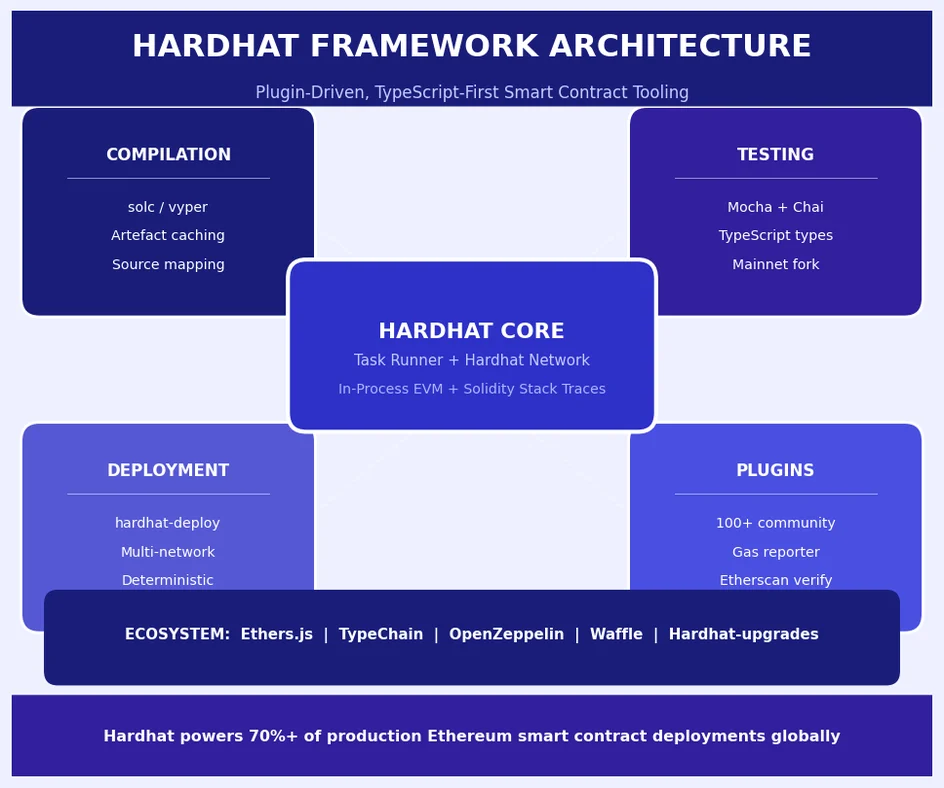
Core Features and Architecture
Hardhat’s architecture centres on its task runner system, where every action from compilation to deployment to testing is a discrete, composable task that can be extended or overridden by plugins. This design means teams can build highly customised workflows that slot precisely into existing CI/CD infrastructure. The Hardhat Network is an in-process local Ethereum node that executes deterministically, supports Solidity stack traces, exposes detailed error messages including contract variable states at the point of failure, and supports time-travel simulation through block manipulation. This debugging fidelity is a significant productivity multiplier for teams iterating rapidly on complex contract logic.
The Hardhat testing environment uses Mocha as the test runner and Chai for assertions, both well-understood standards in the JavaScript community. This lowers the barrier for web engineers moving into smart contract work, a pattern common in UK and Canadian tech teams where full-stack engineers often contribute to both front-end and contract layers.
Plugin Ecosystem and Extensibility
The Hardhat plugin ecosystem is one of its most powerful differentiators. Over 100 maintained plugins cover use cases including automated gas reporting via hardhat-gas-reporter, Etherscan contract verification via hardhat-etherscan, OpenZeppelin integration via hardhat-upgrades, and advanced coverage analysis. These plugins can be composed to create highly automated workflows where a single test run simultaneously executes tests, produces gas reports, checks coverage thresholds, and verifies contracts on the target network. For enterprise clients in the USA managing complex multi-contract protocols, this composability is transformative.
The hardhat-deploy plugin deserves particular mention. It provides deterministic, scriptable deployments with a full deployment history log, making reproducible deployments across staging, testnet, and mainnet environments straightforward. Combined with multi-sig governance tools, this pattern forms the backbone of production deployment processes for audited DeFi protocols.
Integration with Ethers.js and TypeScript
Hardhat’s integration with Ethers.js is first-class. The hardhat-ethers plugin wraps Ethers.js with Hardhat-aware contract factories and signers, enabling type-safe contract interactions in test scripts. When combined with TypeChain, which generates TypeScript type definitions directly from contract ABIs, teams achieve end-to-end type safety from Solidity through to their TypeScript test suite. This combination catches a significant class of integration bugs that would otherwise only surface during runtime testing or, worse, in production. For UAE fintech teams with TypeScript-first engineering cultures, this workflow is highly compelling.
Ideal Use Cases for Hardhat in 2026
Hardhat is the right primary web3 framework for teams building EVM-compatible dApps where the front-end and contract layers share a JavaScript or TypeScript codebase. It excels in enterprise contexts where deployment scripting, automated verification, and audit-ready test suites are operational requirements. It is particularly well-suited for NFT platforms, DAO governance systems, token launch contracts, and multi-sig treasury management tools. Any project that needs rich integration between contract logic and front-end SDK calls should start with Hardhat as its primary framework. [1]
Foundry, built by Paradigm and maintained as an open-source project, has become the framework of choice for security-focused Solidity engineers since its release. Written entirely in Rust, Foundry delivers execution speeds that JavaScript-based frameworks simply cannot match at scale. Its CLI-first philosophy and Solidity-native testing approach have made it the dominant choice for DeFi protocol teams, security researchers, and contest participants who require maximum testing thoroughness. Understanding the Foundry testing framework is now a core competency for senior smart contract engineers across the USA, UK, and leading crypto hubs in the UAE.
Foundry Toolchain: Forge, Cast & Anvil
Forge – Test Runner
- Tests written in Solidity itself
- Property-based fuzz testing built-in
- Invariant testing for stateful systems
- Gas snapshots and benchmarking
- Coverage reporting via lcov
Cast – CLI Interaction
- Send transactions from the command line
- Query any EVM RPC endpoint
- ABI encoding and decoding utilities
- ENS resolution and wallet management
- Call trace and storage inspection
Anvil – Local Node
- High-speed local Ethereum node
- Mainnet and testnet forking
- Configurable block times and gas limits
- Impersonation of any account
- Deterministic address generation
High-Speed Testing and Fuzzing
Foundry’s raw testing speed is its most immediate differentiator. In benchmarks across projects our agency has worked on, Foundry test suites execute between five and ten times faster than equivalent Hardhat suites on the same hardware. For large protocol codebases with hundreds of test cases, this translates directly into faster CI pipelines, tighter feedback loops for engineers, and the practical ability to run more tests than would be feasible with a slower framework. Speed enables thoroughness.
The Foundry testing framework’s native fuzz testing capability via Forge is now considered a security baseline for any DeFi protocol managing significant value. Fuzz testing works by automatically generating thousands of random input combinations for a given test function, searching for inputs that violate specified assertions. In practice, Foundry’s fuzzer has identified critical vulnerabilities in protocols that passed their entire manual unit test suite undetected. For security-conscious teams in the USA and UK operating in regulated fintech environments, fuzzing is not optional in 2026.
Gas Optimization and Benchmarking
Gas efficiency directly affects user costs and protocol competitiveness, particularly on chains where transaction costs are variable and user-sensitive. Foundry’s gas snapshot feature creates a baseline file recording the gas cost of every test function, enabling teams to detect regressions automatically with each pull request. If a code change increases gas consumption beyond a configurable threshold, the CI pipeline fails and the engineer must explicitly acknowledge the regression before merging. This practice, which our agency calls gas-first engineering, has prevented costly gas increases from shipping unnoticed in multiple client DeFi protocols serving UAE and Canadian markets.
Best Use Cases for Advanced Projects
Foundry is the premier web3 framework for DeFi protocol core logic, where correctness under adversarial conditions is the primary engineering objective. It is the natural choice for teams entering security contests, conducting protocol audits, or building systems where gas efficiency is a differentiating product feature. Layer 2 scaling solutions, lending protocols, automated market makers, and yield optimizers are all natural Foundry homes. For Solidity engineers who want to stay in a single language across both implementation and testing, Foundry’s coherence is compelling and eliminates the cognitive overhead of context-switching between Solidity and JavaScript.
Brownie is the web3 framework that brings smart contract tooling to Python engineers. Built on top of Web3.py, it provides a complete smart contract workflow including compilation, testing, deployment scripting, and network management, entirely within the Python ecosystem. For quantitative finance teams in the UAE, data scientists building on-chain analytics tools in Canada, and fintech engineers in the UK who are deeply embedded in Python infrastructure, Brownie eliminates the need to introduce JavaScript or Solidity-native testing into an otherwise Python-centric technical stack.
Python-Based Smart Contract Workflow
Brownie’s project structure maps naturally to Python conventions. Smart contracts sit in a contracts directory, deployment scripts in scripts, and tests in tests using pytest, one of Python’s most mature and widely understood testing frameworks. This familiarity accelerates onboarding for Python engineers and produces test suites that are immediately legible to colleagues without smart contract backgrounds. Brownie automatically compiles Solidity or Vyper contracts using solc or vyper compilers, generates Python interfaces for each contract, and handles ABI encoding transparently so engineers can call contract functions using natural Python syntax.
One of Brownie’s underappreciated strengths is its console, an interactive Python REPL pre-loaded with compiled contracts and Web3.py connections. This makes exploratory contract interaction and rapid debugging genuinely interactive in a way that CLI-only tools do not match. For teams learning contract behaviour or debugging complex state transitions, the console provides a highly productive investigative environment.
When Brownie Is the Right Choice
Brownie is the correct choice for Python-dominant engineering teams where adopting JavaScript or Solidity-native testing would introduce more friction than value. It is particularly well-suited for DeFi strategy automation, on-chain data collection scripts, quantitative yield optimisation tools, and Vyper-based contracts where the Python alignment extends to the smart contract language itself. Teams that already use Pytest as their standard testing framework across other infrastructure will find Brownie testing an immediate, low-friction extension of that practice. It is not the highest-performance option, and its fuzzing capabilities do not match Foundry’s, but for the right team profile it is the most productive choice available.
Feature-by-Feature Web3 Framework Comparison
| Feature | Hardhat | Foundry | Brownie |
|---|---|---|---|
| Primary Language | JavaScript / TypeScript | Solidity (Rust engine) | Python |
| Execution Speed | Moderate | Very Fast | Moderate |
| Native Fuzzing | Plugin only | Built-in (Forge) | Limited |
| Gas Reporting | Plugin (gas-reporter) | Native snapshots | Basic |
| Plugin Ecosystem | 100+ plugins | Growing | Limited |
| Mainnet Forking | Yes | Yes (Anvil) | Yes |
| Debugging Quality | Excellent stack traces | Good (trace flags) | Adequate |
| Learning Curve | Low (JS/TS familiar) | Medium (CLI + Solidity) | Low (Python familiar) |
Performance benchmarking across frameworks reveals a clear hierarchy for raw execution speed: Foundry leads by a substantial margin, executing test suites in seconds that take JavaScript frameworks tens of seconds to complete. For small projects this gap is academic. For mature protocols with 500+ test cases, it translates directly into engineering velocity and CI/CD pipeline cost.
Debugging experience represents Hardhat’s clearest advantage. Hardhat Network’s in-process execution model enables stack traces with variable-level detail that no other framework currently matches. When a complex multi-contract interaction fails, Hardhat typically produces an error message that identifies exactly which contract, which function, and which assertion failed, with the local variable state at the point of failure. This level of diagnostic fidelity compresses debugging time significantly for teams working on large codebases.
Smart Contract Testing Lifecycle
Unit Testing
Test individual contract functions in isolation using Hardhat/Mocha or Foundry/Forge to verify core logic and state transitions before integration.
Integration Testing
Verify multi-contract interactions and external protocol connections, using mainnet fork testing via Hardhat Network or Anvil to test against real on-chain state.
Fuzz & Invariant Testing
Run Foundry’s property-based fuzzer across thousands of randomised inputs to identify edge cases and verify that protocol invariants hold under all conditions.
Audit & Security Review
Share test suites, gas snapshots, and coverage reports with external auditors. Well-structured Foundry or Hardhat test suites reduce audit time and cost significantly.
Authoritative Standards for Web3 Framework Security Testing
Standard 1: Fuzz testing with a minimum of 10,000 runs per function is mandatory for any contract managing more than USD 1 million in user funds.
Standard 2: Invariant tests must cover all critical protocol properties: total supply accounting, fee distribution correctness, and access control boundaries.
Standard 3: Mainnet fork tests must simulate at minimum the ten largest user positions to validate liquidation logic under realistic conditions.
Standard 4: Gas snapshots must be committed to version control so that every pull request includes an automated gas regression check against the baseline.
Standard 5: Test coverage must reach a minimum of 90% line coverage with 100% coverage for all external and public functions before requesting an external audit.
Standard 6: CI/CD pipelines must execute the full test suite, gas snapshot comparison, and static analysis on every pull request before review approval is permitted.
Standard 7: Access control tests must explicitly verify that every privileged function reverts when called from non-authorised addresses under all state combinations.
Standard 8: Emergency pause and circuit breaker logic must have dedicated test scenarios that simulate adversarial conditions triggering each protection mechanism.
Framework selection is not a one-size-fits-all exercise. The right web3 framework for a high-frequency trading protocol is different from the right choice for a community NFT platform. Our agency’s framework selection process follows three diagnostic steps before any recommendation is made.
Three-Step Framework Selection Process
Team Language Audit
- Identify dominant team language: JS/TS, Python, or Solidity-native
- Assess cross-skill gaps in team
- Estimate onboarding time per framework
- Check existing test infrastructure
Risk and Value Profile
- Map protocol value at risk (TVL target)
- Assess required audit readiness depth
- Determine gas sensitivity of target chain
- Identify security contest participation plans
Integration Requirements
- Identify front-end SDK requirements
- Map CI/CD pipeline constraints
- Assess multi-chain deployment scope
- Evaluate third-party plugin dependencies
Framework Recommendation by Project Type
| Project Type | Primary Framework | Secondary / Testing | Key Reason |
|---|---|---|---|
| Enterprise dApp | Hardhat | Foundry (security) | TypeScript integration, plugin depth |
| DeFi Protocol | Foundry | Hardhat (deployment) | Fuzzing, gas benchmarking |
| NFT Platform | Hardhat | Foundry (gas) | JS/TS front-end integration ease |
| Layer 2 / Multi-Chain | Hardhat | Foundry (core logic) | Network config flexibility |
| DeFi Automation / Python | Brownie | Foundry (audit phase) | Python team, Web3.py synergy |
Key Trends Shaping Web3 Tooling in 2026
AI-Assisted Testing
- AI plugins generate fuzz test seeds automatically
- LLM-assisted invariant identification
- Automated vulnerability pattern scanning
- Natural-language test case specification
Cross-Chain Tooling
- Unified test environments spanning EVM chains
- Cross-chain message simulation in local forks
- Bridge security testing primitives
- Multi-chain gas comparison dashboards
Security-First Architecture
- Formal verification integration in CI pipelines
- Mutation testing for test suite strength
- On-chain monitoring tied to test scenarios
- Regulatory-grade audit evidence packaging
AI-assisted smart contract testing is the most significant emerging capability in the web3 framework ecosystem in 2026. Plugins for both Hardhat and Foundry now integrate with LLM-based tools to automatically generate fuzz test seeds based on contract semantics, identify invariants that developers missed during manual test writing, and flag common vulnerability patterns before code reaches review. Early benchmarks from teams in the USA and UK that have adopted these tools show a 30-40% increase in pre-audit vulnerability detection rates compared to purely manual test writing.
Cross-chain tooling support is also maturing rapidly. The ability to simulate cross-chain message passing, bridge operations, and multi-chain state within a single test environment is becoming a standard requirement for protocols operating across Ethereum, Layer 2 networks, and alternative EVM chains simultaneously. Foundry’s fork-based architecture makes it particularly well-positioned to extend into this domain, and several community-maintained cheat codes already enable basic cross-chain simulation in Forge test suites.
Choosing the Right Framework for Long-Term Scalability
The web3 framework comparison landscape in 2026 does not have a single winner. Hardhat, Foundry, and Brownie each serve distinct team profiles and project types with genuine excellence. Hardhat’s plugin ecosystem and TypeScript integration make it the most productive choice for teams building EVM dApps with JavaScript-facing user interfaces. Foundry’s speed and security testing depth make it the definitive choice for protocol security work, DeFi core logic, and gas-optimisation-critical contracts. Brownie makes smart contract tooling accessible and productive for Python-native teams without compromising on testing quality for its target use cases.
The long-term scalability of your framework choice depends on how well it aligns with your team’s growth trajectory. If you anticipate onboarding more JavaScript engineers, Hardhat’s familiarity will pay dividends. If your protocol ambitions require competing with audited DeFi protocols for TVL in the USA and UK markets, Foundry’s security testing depth will be a competitive requirement. If your Python infrastructure team is driving the project, Brownie prevents a technology stack fragmentation that would slow delivery.
Future Outlook for Web3 Tooling Ecosystem
The web3 tooling ecosystem is converging toward hybrid usage patterns. The era of single-framework orthodoxy is ending as the clear complementarity between Hardhat and Foundry makes dual-framework setups the rational choice for serious protocols. We expect AI integration to become a standard feature of all three frameworks within 18 months, cross-chain testing support to become table stakes for any serious web3 framework, and formal verification tooling to move from specialist practice to mainstream inclusion in production CI pipelines. Teams and organisations in the UAE and Canada that invest in framework depth now will be better positioned to adopt these capabilities early, gaining the compound benefits of mature test infrastructure as the tools evolve.
Ready to Build with the Right Web3 Framework?
Our engineers choose and configure Hardhat, Foundry, or Brownie based on your team, protocol, and security requirements.
Frequently Asked Questions
Q1.What are the best web3 frameworks for smart contract projects in 2026?
The leading web3 frameworks in 2026 are Hardhat, Foundry, and Brownie. Hardhat remains the most widely adopted choice for JavaScript and TypeScript teams building Ethereum-compatible contracts, offering a rich plugin ecosystem and deep Ethers.js integration. Foundry has rapidly gained ground among performance-focused engineers thanks to its blazing-fast Rust-powered toolchain. Brownie continues to serve Python developers building DeFi scripts and automation pipelines. The right choice depends on your team’s language preference, performance requirements, and ecosystem integrations.
Q2.What is the difference between Hardhat and Foundry?
Hardhat is a JavaScript/TypeScript-first framework known for its flexible plugin architecture, mature ecosystem, and strong community support across the USA, UK, and Canada. Foundry, written in Rust, prioritises raw execution speed, native fuzzing, and a CLI-first workflow. Foundry tests are written in Solidity, which eliminates context switching for Solidity-native teams. Hardhat testing is done in JavaScript or TypeScript. For gas benchmarking and complex invariant testing, Foundry leads. For rich integrations, scripting, and team familiarity, Hardhat often wins.
Q3.Is Brownie still relevant in 2026?
Yes, Brownie remains a solid choice for Python-focused teams in 2026, particularly those working on DeFi protocols, quantitative finance, and automation-heavy projects. Its deep integration with Web3.py and seamless scripting capabilities make it efficient for teams that prefer Python over JavaScript or Solidity-native testing. While its community is smaller than Hardhat’s, Brownie’s stability, straightforward network management, and familiar Python syntax keep it relevant in the UAE and Canadian blockchain finance sectors.
Q4.Which web3 framework is best for DeFi protocol building?
For DeFi protocols, Foundry is widely regarded as the top choice in 2026 due to its property-based fuzzing capabilities, high-speed test execution, and precise gas reporting. These qualities are critical for financial smart contracts where edge cases and gas efficiency directly affect user funds. Teams at major DeFi projects in the USA and UK increasingly run dual-framework setups, using Foundry for core protocol logic testing and Hardhat for deployment scripting, front-end integration, and CI/CD pipeline management.
Q5.How does the Hardhat testing environment work?
The Hardhat testing environment runs a local Ethereum node called Hardhat Network directly in-process, meaning tests execute without needing an external blockchain. It supports Solidity stack traces, console.log debugging inside contracts, and precise error messages. Tests are written in Mocha and Chai using JavaScript or TypeScript. Hardhat Network can also fork mainnet state, enabling fork testing against real contract states. This makes it ideal for simulating complex multi-contract interactions and integration testing for production-grade web3 infrastructure tools.
Q6.What is fuzzing and why does it matter for smart contract testing?
Fuzzing is an automated testing technique that generates large numbers of random or semi-random inputs to discover unexpected behaviour in smart contracts. In the context of web3 frameworks, Foundry’s fuzz testing (via Forge) is particularly powerful because it can run thousands of property-based test iterations that would be impractical to write manually. Fuzzing has been credited with catching critical vulnerabilities in live DeFi protocols before deployment. For projects managing significant value, fuzz testing with Foundry is now considered a minimum security standard.
Q7.Can Hardhat and Foundry be used together in the same project?
Yes, running Hardhat and Foundry together in a single repository is increasingly common in 2026, particularly for enterprise and DeFi projects in the USA, UK, UAE, and Canada. Foundry handles property-based fuzzing and gas benchmarking while Hardhat manages deployment scripts, front-end SDK integration, and TypeScript-based integration tests. Both frameworks support the same Solidity source files and can share the same contract directory. This dual-framework approach captures the strengths of both tools without requiring teams to fully commit to either ecosystem exclusively.
Explore Services
Related Services
Reviewed by

Aman Vaths
Founder of Nadcab Labs
Aman Vaths is the Founder & CTO of Nadcab Labs, a global digital engineering company delivering enterprise-grade solutions across AI, Web3, Blockchain, Big Data, Cloud, Cybersecurity, and Modern Application Development. With deep technical leadership and product innovation experience, Aman has positioned Nadcab Labs as one of the most advanced engineering companies driving the next era of intelligent, secure, and scalable software systems. Under his leadership, Nadcab Labs has built 2,000+ global projects across sectors including fintech, banking, healthcare, real estate, logistics, gaming, manufacturing, and next-generation DePIN networks. Aman’s strength lies in architecting high-performance systems, end-to-end platform engineering, and designing enterprise solutions that operate at global scale.